

Blog
The Hidden Environmental Cost of Documents Processing
Discover how AI streamlines document processes, cutting carbon emissions and boosting corporate sustainability goals. Learn more!

Blog
Discover how AI streamlines document processes, cutting carbon emissions and boosting corporate sustainability goals. Learn more!
Picture this: every email attachment you've sent today, every contract that's been printed and reprinted, every form that's been scanned multiple times – they're all quietly contributing to global carbon emissions. In fact, a single office worker generates approximately 10,000 sheets of paper annually, translating to roughly 200 pounds of CO₂ emissions. But here's the kicker – that's just the tip of the iceberg.
The real environmental culprit isn't just paper consumption. It's the sprawling, inefficient document workflows that plague modern businesses. Those endless email chains with multiple PDF versions, the redundant file storage eating up server space, and the manual processes that require documents to be recreated from scratch when simple errors occur. Each of these seemingly innocent actions demands energy from data centers, contributes to digital waste, and creates what sustainability experts call "invisible pollution."
Think about the last time you had to chase down a signature on a contract. How many emails went back and forth? How many times was that document opened, saved, and resaved across different systems? Now multiply that by every document workflow in your organization, then across every business globally. The numbers become staggering.
This is where artificial intelligence enters the picture, not as another energy-hungry technology, but as a solution that can fundamentally reshape how we handle documents. AI-driven workflow automation doesn't just make processes faster or more accurate – it makes them dramatically more sustainable. By eliminating redundancies, reducing manual rework, and streamlining data flows, intelligent automation transforms document handling from an environmental liability into an asset that actually supports corporate sustainability goals.
Companies worldwide are waking up to this reality. With new regulations like the EU's Corporate Sustainability Reporting Directive (CSRD) and growing investor pressure around Environmental, Social, and Governance (ESG) metrics, businesses need more than just good intentions. They need measurable, operational changes that reduce their carbon footprint while maintaining competitive advantage. Document workflow automation represents one of the most overlooked opportunities in this space.
For decades, the sustainability conversation around documents has been frustratingly binary: paper bad, digital good. This oversimplification has led many organizations to believe that simply "going paperless" solves their document-related environmental impact. The reality is far more nuanced and, frankly, more interesting.
Let's start with paper, since it's the obvious target. The paper industry is indeed resource-intensive. Manufacturing a single ream of office paper requires approximately 6 gallons of water and generates about 5 pounds of CO₂. When you factor in deforestation impacts, chemical processing for bleaching and coating, transportation costs, and the energy required for commercial printing, paper's environmental footprint becomes substantial. Add to this the physical storage requirements – climate-controlled filing rooms, warehouses, and the associated real estate footprint – and you can see why paper became the villain in corporate sustainability stories.
But digital documents aren't the environmental saints we once thought they were. Every PDF stored in the cloud lives on physical servers that require constant power and cooling. Data centers currently consume about 1% of global electricity, and that figure is climbing rapidly. When employees create multiple versions of the same document, store them in various locations, and send them through email chains, they're essentially multiplying the energy cost of each file. A typical corporate email with a large attachment can generate as much as 50 grams of CO₂ – and that's before accounting for the recipient downloading, storing, and potentially forwarding it again.
The real problem isn't the medium; it's the inefficiency. A paper-based invoice that gets processed smoothly in one pass might actually have a smaller carbon footprint than a digital invoice that gets bounced between five different systems, requires manual data entry in three places, and generates error corrections that spawn additional processing cycles. When documents require human intervention – whether that's re-scanning illegible pages, manually entering data that could be extracted automatically, or routing files through approval chains that could be streamlined – every additional step multiplies the environmental cost.
This is particularly pronounced in industries that haven't fully embraced digital transformation. Legal firms still print contracts for signature, then scan them back into digital systems. Healthcare providers print patient forms, have them filled out by hand, then manually enter the data into electronic health records. Government agencies receive digital submissions, print them for review processes, then digitize them again for archival. Each of these workflow inefficiencies represents not just wasted time and money, but unnecessary environmental impact.
The solution isn't choosing between paper and digital – it's choosing efficiency over waste. Smart workflow automation can make both paper and digital processes dramatically more sustainable by eliminating redundant steps, reducing error rates that require rework, and ensuring that every document, regardless of its original form, follows the most efficient path through your organization.
To understand how document workflows contribute to carbon emissions, we need to look beyond the obvious culprits and examine the complete lifecycle of information processing. The carbon footprint of documents extends far beyond printing and storage – it encompasses every energy-consuming step in the workflow, from initial creation to final archival.
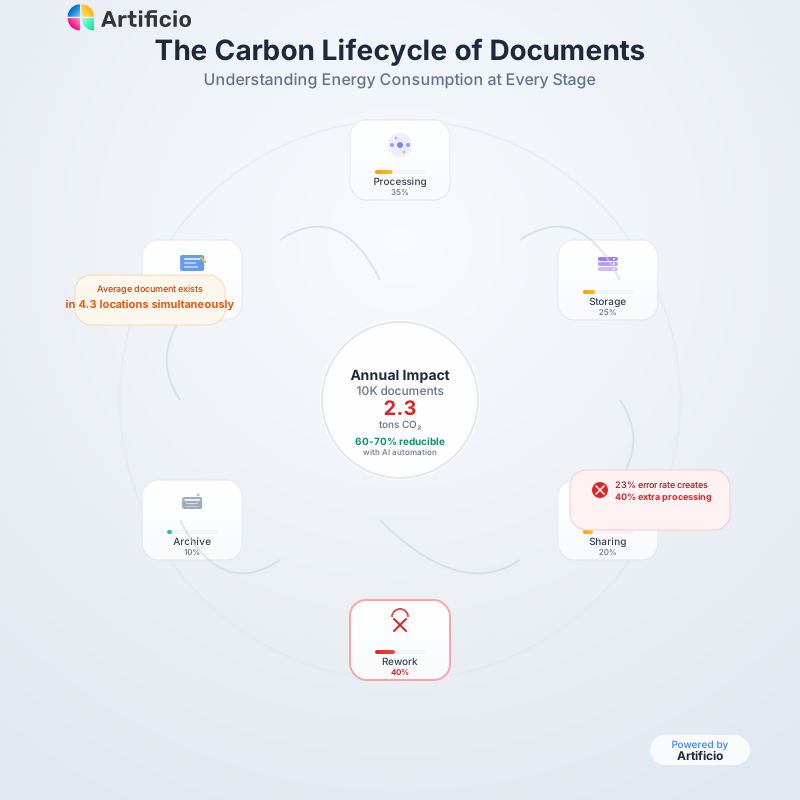
Let's break down the major contributors to document-related emissions by industry and workflow type. In paper-heavy industries like legal services, government, and healthcare, the carbon impact is immediately visible. A large law firm can consume over 100,000 sheets of paper monthly, but the hidden cost lies in the associated workflows. Each contract that requires multiple review cycles, each brief that gets revised and reprinted, each set of discovery documents that needs to be organized and cross-referenced – these processes consume exponentially more resources than the paper itself. The real environmental cost comes from the inefficiencies: the paralegal who spends hours manually reviewing documents that could be processed by AI, the multiple printings required when errors are discovered late in the process, and the physical storage systems that require climate control and regular maintenance.
Digital redundancy represents another massive source of hidden emissions. The average knowledge worker creates 2.5 versions of every document they work on, and most organizations store these multiple versions indefinitely. When you multiply this across thousands of employees and factor in backup systems, disaster recovery copies, and archival requirements, a single document can exist in dozens of locations simultaneously. Each copy requires server space, which requires electricity for storage and cooling. A typical enterprise generates over 2.5 exabytes of data annually, and studies suggest that 30-40% of this data consists of redundant or obsolete files. That's roughly equivalent to the annual electricity consumption of 200,000 homes, just for storing unnecessary document versions.
Manual processes create some of the most significant carbon multiplication effects. Consider a typical accounts payable workflow: an invoice arrives via email, gets printed for approval routing, travels physically through multiple departments, gets scanned back into the system, requires manual data entry into the ERP system, and often needs correction cycles when human errors are discovered. Each manual touchpoint requires human time (which has its own carbon footprint through office energy consumption), physical movement of documents, additional technology usage, and often duplicate processing steps. When errors occur – and they do, frequently – the entire process may need to restart, doubling or tripling the carbon cost of processing a single document.
The emergence of Scope 3 emissions reporting has made these hidden carbon costs increasingly important for businesses. Scope 3 encompasses all indirect emissions throughout a company's value chain, and inefficient document workflows contribute significantly to this category. When a supplier has to reprocess documents multiple times due to workflow inefficiencies, when customers face delays that require additional communications and rework, when third-party service providers must handle redundant data processing – all of these activities contribute to the purchasing company's Scope 3 emissions. Companies that streamline their document workflows don't just reduce their own direct emissions; they help their entire business ecosystem operate more efficiently.
The quantification of these impacts is becoming more sophisticated. Recent studies suggest that optimizing document workflows can reduce related carbon emissions by 40-60% without any reduction in output quality or speed. In some cases, improved efficiency actually accelerates processes while simultaneously reducing environmental impact. This creates a powerful business case: companies can improve their bottom line, enhance customer satisfaction, and achieve sustainability goals simultaneously.
Artificial intelligence transforms document processing from a series of manual, error-prone steps into streamlined, intelligent workflows that minimize resource consumption at every stage. The environmental benefits come not from using less technology, but from using technology more intelligently to eliminate waste and inefficiency.
Optical Character Recognition (OCR) powered by AI eliminates one of the biggest sources of document-related emissions: repetitive processing cycles. Traditional OCR systems require human verification and correction, leading to multiple processing passes and frequent errors that necessitate complete rework. Modern AI-powered OCR systems achieve accuracy rates above 95% even on complex documents, eliminating the need for manual verification in most cases. This means a scanned document gets processed once, correctly, instead of requiring multiple correction cycles. The environmental impact is dramatic – a single-pass processing system can reduce the energy consumption for document digitization by up to 70% compared to traditional methods.
Smart classification systems take this efficiency further by automatically routing documents to appropriate workflows without human intervention. Instead of emails bouncing between departments while people figure out who should handle what, AI systems can instantly identify document types, extract relevant information, and initiate appropriate processes. This eliminates what sustainability experts call "workflow friction" – the unnecessary energy consumption that occurs when processes stall, require human intervention, or need to be restarted due to routing errors.
Validation and error reduction represent perhaps the most significant environmental benefits of AI workflow automation. Traditional document processing is plagued by error rates that can reach 20-30% in manual systems. Each error requires correction cycles that multiply the resource consumption of processing. AI validation systems catch errors at the point of entry, preventing downstream problems that would otherwise require entire workflows to be repeated. The carbon savings are exponential because preventing one early-stage error eliminates all the downstream processing that would be required to fix it.
Workflow orchestration systems optimize the flow of information through organizations in ways that minimize energy consumption. These systems can analyze processing loads, route documents during off-peak energy hours, distribute processing across systems to balance loads, and even predict when certain types of documents will require additional processing time. Smart orchestration can reduce server loads by 25-30% simply by distributing work more evenly and avoiding peak-demand periods that require additional server capacity.
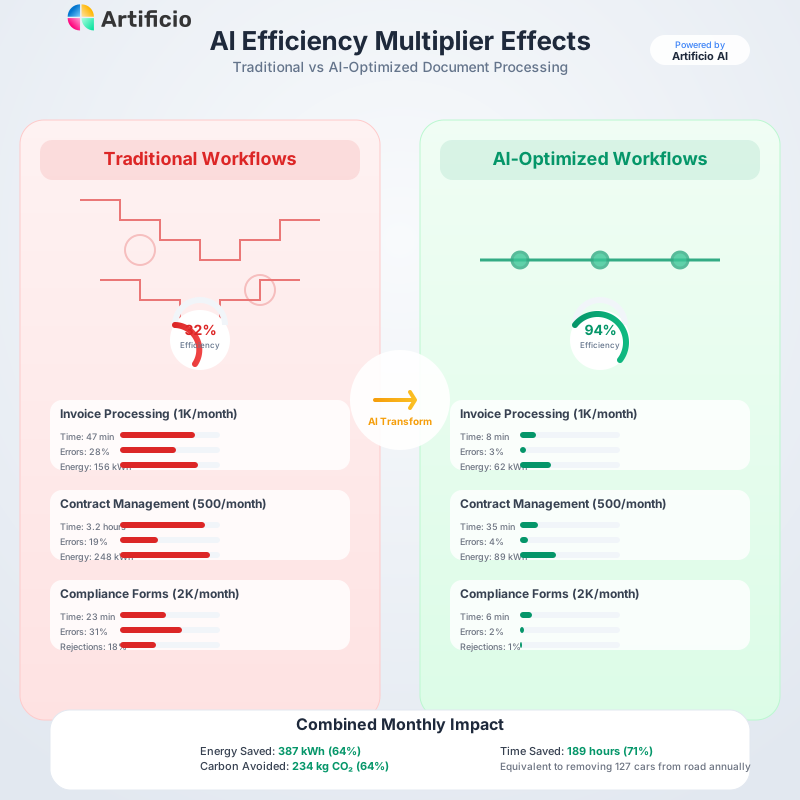
No-code form builders and smart digital forms represent another significant leap in document-related sustainability. These systems allow organizations to create sophisticated data collection processes without requiring traditional software development, which dramatically reduces the time and energy required to deploy new workflows. More importantly, smart forms can adapt their behavior based on user responses, eliminating unnecessary questions and reducing completion times. When a form takes half as long to complete, it consumes half as much energy – both from user devices and from the servers processing the responses.
The quantification of these benefits reveals impressive numbers. A mid-sized organization processing 10,000 documents monthly can reduce their document-related carbon emissions by an amount equivalent to removing 500 cars from the road annually by implementing comprehensive AI workflow automation. These savings come from multiple sources: reduced server loads from eliminating redundant processing, decreased energy consumption from shorter processing times, lower storage requirements from reducing duplicate files, and diminished physical resource usage from optimizing paper-to-digital transitions.
Real-world implementations demonstrate even more dramatic results in certain contexts. Healthcare organizations using AI-powered patient intake systems have reduced paper consumption by 80% while simultaneously cutting processing times in half. Financial institutions implementing intelligent loan processing systems have eliminated an average of 12 touchpoints per application, reducing both processing time and energy consumption by approximately 60%. Manufacturing companies using AI for supplier document processing have cut their vendor onboarding time from weeks to days while reducing document-related errors by over 90%.
These improvements create compound benefits over time. As AI systems learn from processing patterns, they become more efficient at predicting optimal workflows, identifying potential problems before they occur, and routing documents through the most energy-efficient processing paths. This means that sustainability benefits actually increase over time as systems become more intelligent and optimized.
The logistics industry processes millions of documents daily, from bills of lading to customs declarations, creating one of the most carbon-intensive document workflows in global commerce. Traditional logistics documentation requires extensive manual processing, multiple verification steps, and frequent rework when errors are discovered at ports or border crossings.
A major international shipping company recently implemented AI-powered document automation across their global operations, focusing on bill of lading processing and customs documentation. Before automation, each shipment required an average of 47 document touchpoints, with 23% of shipments experiencing delays due to documentation errors. Processing a single shipment's paperwork consumed approximately 3.2 hours of human time and generated an average of 127 pages of printed documentation.
After implementing intelligent document processing, the same workflows now require only 12 touchpoints, with error rates dropping to less than 3%. The AI system automatically extracts data from shipping manifests, validates information against regulatory databases, generates compliant customs forms, and routes documents through approval chains without human intervention except in exceptional cases. The environmental impact has been remarkable: paper consumption dropped by 78%, processing time decreased by 65%, and energy consumption for document-related activities fell by approximately 2,100 MWh annually across their operations – equivalent to the electricity consumption of 190 average homes for an entire year.
The ripple effects extend beyond the shipping company itself. Port authorities report faster cargo processing times, reducing the amount of time trucks and ships spend idling while waiting for documentation approval. Customs agencies can process declarations more efficiently, reducing their own energy consumption for verification activities. The entire logistics ecosystem operates more smoothly, creating sustainability benefits throughout the supply chain.
Financial institutions process enormous volumes of documents for loan applications, account openings, and compliance reporting. Traditional loan origination involves extensive paper documentation, multiple verification steps, and frequent back-and-forth communications between applicants, loan officers, and underwriters.
A regional bank with $12 billion in assets transformed their commercial lending process using AI workflow automation. Previously, commercial loan applications required applicants to submit an average of 47 different documents, many in physical form. The bank's loan officers spent approximately 40% of their time on manual document review and data entry. Error rates in initial applications reached 31%, requiring multiple correction cycles that extended processing times to an average of 23 business days.
The AI-powered system now processes loan applications through intelligent forms that adapt based on loan type and applicant responses. Document verification happens automatically through optical character recognition and data validation against external databases. The system flags potential issues immediately, allowing for correction before documents enter the formal review process. Processing times have dropped to an average of 8 business days, with error rates falling below 5%.
The sustainability benefits are substantial: the bank eliminated approximately 750,000 sheets of paper annually, reduced energy consumption for document processing by 58%, and decreased their physical storage requirements by removing the need for extensive paper file archival. More significantly, faster processing times mean customers spend less time gathering and resubmitting documentation, reducing the overall carbon footprint of the lending process across their entire customer base.
Healthcare organizations face unique challenges in document processing due to regulatory requirements, privacy concerns, and the need for detailed patient information. Traditional patient intake involves extensive paper forms, manual data entry into electronic health records, and multiple verification steps for insurance and medical history.
A large healthcare system serving over 400,000 patients annually implemented AI-powered patient intake across their network of 23 facilities. The traditional process required patients to complete an average of 12 pages of forms per visit, with registration staff spending 8-12 minutes per patient manually entering information into electronic systems. Error rates in manual data entry reached 15%, often requiring callback communications with patients to clarify information.
The new system uses intelligent forms that populate automatically based on patient history, insurance databases, and previous visit information. AI-powered validation catches errors and inconsistencies immediately, allowing patients to correct information before submitting forms. The system integrates directly with electronic health records, eliminating manual data entry entirely for most standard information.
Results have been dramatic: paper consumption dropped by 87% across the healthcare system, patient registration times decreased by 65%, and data accuracy improved to 98.5%. The environmental benefits extend beyond direct resource savings. Faster, more accurate patient intake reduces wait times, allowing facilities to operate more efficiently and serve more patients without expanding physical infrastructure. The system has eliminated approximately 2.3 million pages of annual paper consumption while improving patient satisfaction scores by 23%.
Government agencies process vast quantities of compliance documentation, from permit applications to regulatory filings, often requiring extensive manual review and approval processes. These workflows are typically paper-heavy, time-intensive, and prone to errors that require complete reprocessing.
A state environmental protection agency implemented AI workflow automation for permit application processing, handling over 15,000 applications annually across 12 different permit categories. Traditional processing required applicants to submit extensive paper documentation, with agency staff spending an average of 6.3 hours reviewing each application. Error rates in initial submissions reached 28%, requiring multiple rounds of corrections and resubmissions.
The AI system now processes applications through intelligent forms that guide applicants through requirements based on their specific situation. Document validation happens automatically, with the system checking completeness, regulatory compliance, and consistency across all submitted materials. Only applications that meet specific complexity thresholds require human review, allowing staff to focus on truly complex cases rather than routine processing tasks.
The transformation achieved remarkable results: processing times dropped from an average of 47 days to 12 days, paper consumption decreased by 92%, and staff productivity increased by 340% for routine applications. The agency estimates annual carbon savings equivalent to removing 890 cars from the road, achieved through reduced paper consumption, decreased energy usage for processing activities, and elimination of multiple correction cycles that previously required extensive staff time and additional communications with applicants.
The convergence of environmental regulations, investor pressure, and competitive dynamics is transforming sustainability from a compliance requirement into a strategic differentiator. Organizations that can demonstrate measurable carbon reduction while improving operational efficiency gain advantages in multiple areas: regulatory compliance, investor relations, customer acquisition, and talent retention.
New regulatory frameworks are making document-related emissions increasingly visible and material to business operations. The European Union's Corporate Sustainability Reporting Directive (CSRD) requires large companies to report detailed environmental impacts, including indirect emissions from operational processes. In the United States, the SEC's proposed climate disclosure rules would require public companies to report Scope 3 emissions, which include the carbon footprint of document workflows and business processes. Companies that have already optimized their document processing workflows will find compliance with these regulations significantly easier and less costly than organizations scrambling to measure and reduce emissions after regulations take effect.
Investor interest in Environmental, Social, and Governance (ESG) metrics has reached unprecedented levels, with over $30 trillion in assets under management now applying ESG criteria to investment decisions. Document workflow optimization provides concrete, measurable improvements that can be quantified and reported to investors. Unlike some sustainability initiatives that require significant capital investment with uncertain returns, workflow automation typically pays for itself through operational savings while simultaneously reducing environmental impact. This combination of financial return and environmental benefit makes document automation particularly attractive to ESG-focused investors.
Customer expectations around corporate sustainability continue to rise, particularly in business-to-business relationships where purchasing decisions increasingly factor in supplier environmental performance. Companies that can demonstrate efficient, low-carbon document processing gain competitive advantages in procurement processes where sustainability criteria are weighted alongside cost and quality considerations. In industries like banking, insurance, and professional services, where document processing is central to customer experience, the ability to provide faster, more accurate, and more sustainable service creates clear differentiation.
Talent acquisition and retention benefits are becoming increasingly important as younger professionals prioritize working for environmentally responsible organizations. Companies that can demonstrate concrete sustainability initiatives, including measurable reductions in document-related emissions, find themselves more attractive to high-performing candidates who have choices about where to work. This is particularly important in technology and professional services sectors where competition for talent is intense.
The strategic positioning benefits extend beyond individual companies to entire industries. Sectors that collectively adopt AI-powered document automation can improve their overall sustainability profile, potentially avoiding more stringent regulatory requirements or carbon pricing mechanisms. Industry leaders who drive these transformations position themselves as sustainability innovators, gaining influence in regulatory discussions and standard-setting processes.
Measurement and reporting capabilities represent another strategic advantage. AI-powered workflow systems generate detailed data about processing efficiency, error rates, and resource consumption that can be used for sustainability reporting and continuous improvement initiatives. This data visibility allows organizations to set science-based targets for emission reductions and track progress with precision that's difficult to achieve with manual processes.
The competitive moats created by comprehensive workflow automation are particularly durable because they improve over time. As AI systems learn from processing patterns and optimize workflows based on historical data, the efficiency advantages compound. Organizations that implement these systems early gain learning curve advantages that become increasingly difficult for competitors to match.
The evolution of document processing toward net-zero carbon footprints represents one of the most promising applications of artificial intelligence for climate action. As AI capabilities advance and carbon accounting becomes more sophisticated, we're approaching a future where document workflows don't just minimize their environmental impact – they actively contribute to carbon reduction goals.
Carbon-intelligent workflows represent the next frontier in sustainable document processing. These systems will continuously monitor and optimize their energy consumption, automatically routing processing tasks to servers powered by renewable energy, scheduling compute-intensive operations during periods of low carbon grid intensity, and balancing workloads to minimize peak demand that requires fossil fuel backup generation. Early implementations of carbon-aware computing have demonstrated energy efficiency improvements of 15-30% simply by timing processing tasks to coincide with renewable energy availability.
Machine learning algorithms are becoming sophisticated enough to predict document processing patterns and pre-optimize workflows based on anticipated demand. This predictive capability allows systems to consolidate processing activities during optimal energy periods, reduce server capacity requirements through better load balancing, and minimize the carbon footprint of storage by intelligently archiving and retrieving documents based on usage patterns. The compound effects of these optimizations could reduce document-related emissions by 70-80% compared to current best practices.
Integration with broader sustainability systems represents another significant opportunity. Document processing systems can interface with carbon accounting platforms to provide real-time emissions data, integrate with renewable energy management systems to optimize processing schedules, and connect with supply chain sustainability platforms to minimize the carbon footprint of document-intensive business processes. This integration turns document workflows into active participants in corporate carbon management strategies rather than passive consumers of energy.
Blockchain and distributed ledger technologies may revolutionize document authenticity and version control, eliminating the need for multiple copies and redundant verification processes. Smart contracts could automatically execute document-related processes without human intervention, reducing processing time and energy consumption while improving accuracy and auditability. These technologies could eliminate entire categories of document-related inefficiencies that currently contribute to unnecessary carbon emissions.
The emergence of "self-optimizing" documents represents a fascinating possibility on the technological horizon. These documents would carry metadata about their carbon footprint, automatically compress themselves when storage energy costs exceed certain thresholds, route themselves through processing systems based on real-time energy efficiency metrics, and even "expire" themselves when their business value no longer justifies their storage energy consumption. While this concept may sound futuristic, the underlying technologies already exist and are beginning to be integrated into advanced document management systems.
Industry-wide collaboration on sustainability standards could accelerate the adoption of carbon-efficient document processing. Standards organizations, technology vendors, and major enterprises are beginning to work together on frameworks for measuring and reducing the carbon footprint of information processing. These collaborative efforts could lead to industry-wide adoption of best practices, shared infrastructure for efficient processing, and common metrics for measuring and reporting document-related emissions.
The economic incentives for carbon-efficient workflows will likely strengthen as carbon pricing mechanisms expand and become more sophisticated. Organizations that have invested in efficient document processing systems may find themselves eligible for carbon credits or preferential treatment in carbon markets. The ability to quantify and verify carbon reductions from workflow optimization could create new revenue streams for companies that have made these investments.
Every invoice processed, every contract executed, and every form completed represents a choice between waste and efficiency, between carbon-intensive legacy processes and intelligent automation that supports both business objectives and environmental goals. The transformation of document workflows from environmental liabilities into sustainability assets represents one of the most significant opportunities for immediate, measurable carbon reduction available to modern organizations.
The numbers tell a compelling story. Document-related activities contribute an estimated 2-4% of total corporate carbon emissions across knowledge-intensive industries, but these emissions can be reduced by 40-70% through intelligent workflow automation without sacrificing speed, accuracy, or compliance. For a typical mid-sized organization, this translates to carbon reductions equivalent to removing hundreds of vehicles from the road annually, achieved through investments that typically pay for themselves within 18-24 months through operational savings.
The strategic implications extend far beyond immediate carbon reduction. Companies that optimize their document workflows gain competitive advantages in regulatory compliance, investor relations, customer acquisition, and talent retention. They position themselves at the forefront of the sustainability transformation that's reshaping business expectations across all industries. Most importantly, they prove that environmental responsibility and business efficiency aren't competing priorities – they're complementary strategies that reinforce each other.
The technology infrastructure for this transformation is available today. AI-powered optical character recognition, intelligent workflow orchestration, smart forms, and automated validation systems have matured to the point where implementation risks are minimal and success rates are high. The question isn't whether these technologies work – it's whether organizations will adopt them quickly enough to capture first-mover advantages in the sustainability space.
Looking ahead, the organizations that embrace AI-driven document automation today are building the foundation for the carbon-intelligent workflows of tomorrow. They're developing capabilities that will become essential as carbon regulations tighten, investor scrutiny intensifies, and customer expectations continue to rise. They're also contributing to a broader transformation that could eliminate billions of tons of unnecessary carbon emissions from global business processes.
The silent sustainability revolution in document processing has already begun. Forward-thinking organizations are discovering that the path to net-zero emissions doesn't require sacrificing efficiency or profitability – it requires replacing wasteful manual processes with intelligent automation that serves both environmental and business objectives simultaneously.
For organizations ready to join this revolution, the opportunity is clear: transform your document workflows into lean, efficient, and sustainable processes that reduce costs, improve customer satisfaction, and contribute meaningfully to climate goals. The technology is ready, the business case is proven, and the environmental impact is measurable.
The question is simple: will your organization continue generating invisible carbon emissions through inefficient document processes, or will you join the companies that are turning their workflows into competitive advantages that support both profitability and sustainability?
The choice is yours, and the time to act is now. Explore how Artificio's AI-powered workflow automation can help your organization reduce costs, improve efficiency, and achieve measurable sustainability goals through intelligent document processing. Because in today's world, every document is an opportunity to choose between waste and wisdom, between carbon liability and competitive advantage.
Contact Artificio today to discover how intelligent document automation can transform your workflows into powerful tools for achieving both business success and environmental responsibility. The future of sustainable business operations starts with reimagining how we handle the documents that drive our daily operations – and that future is available today.

Head IT Operations - Co Founder of Artificio
See it in your SAP environment
Bring us a document, a process, or a bottleneck. We'll show how Artificio captures, validates, and posts into SAP — then scale from there.
Security & compliance
ISO 27001:2013 certified, SOC 2 Type 2 compliant, GDPR and HIPAA ready. Every agent action is logged, auditable, and runs in isolated environments.