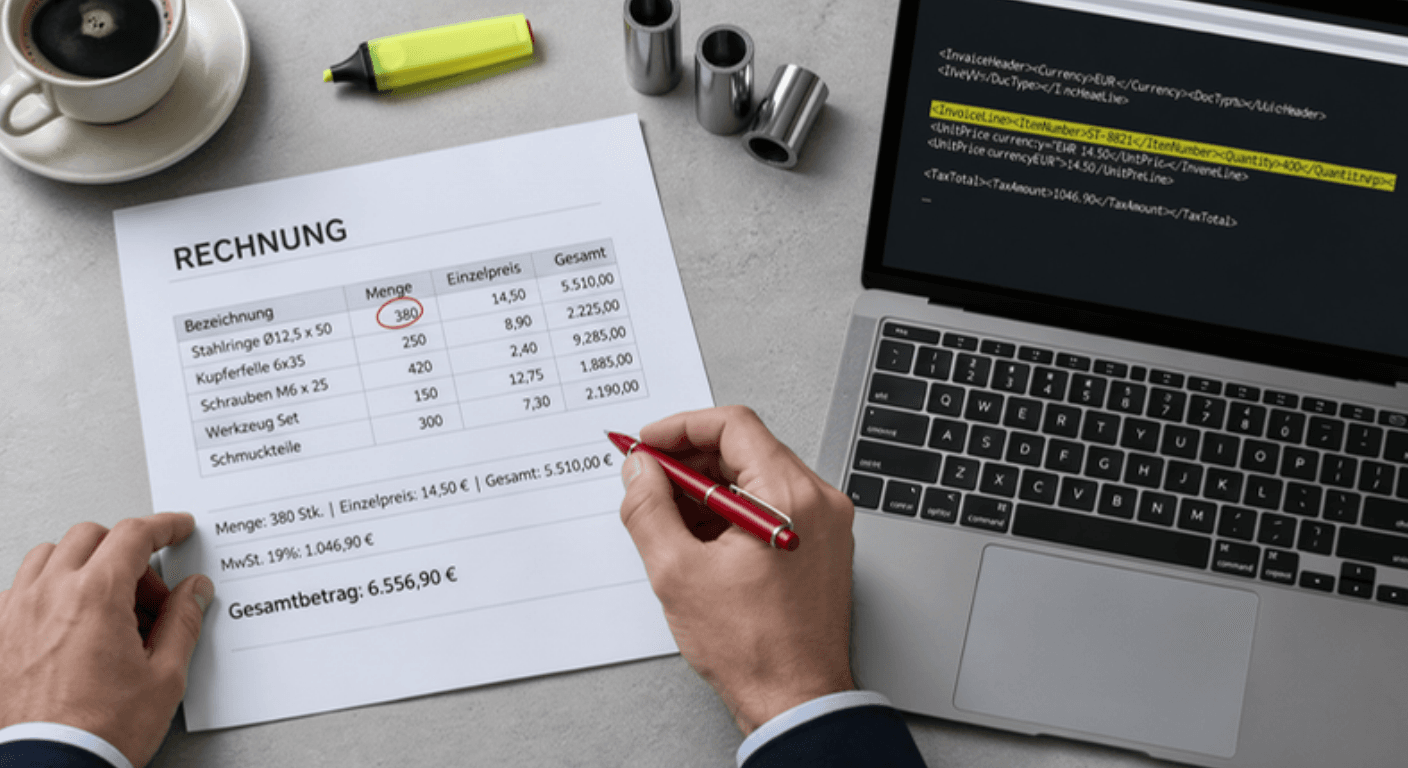
On a Thursday in the middle of January 2027, an accounts payable clerk at a distributor of hydraulic fittings near Stuttgart opens a supplier invoice. It comes from a steel tube maker in the Ruhr, a supplier the distributor has bought from for years. The email looks the same as always. There is a PDF attached, and the PDF looks the same as always too.
The PDF says 380 lengths of precision steel tube at €48.00 each. That is €18,240.00 net, plus 19 percent VAT of €3,465.60, for a total of €21,705.60. The clerk checks it against the goods receipt in SAP. The warehouse booked 380 lengths, because 20 arrived bent and were refused at the dock. Quantity, price and total all agree. She posts the invoice, and it is paid on the due date.
What she did not open is the other file. Since January 1, the steel tube maker has been required to send its domestic invoices as e-invoices, and it chose a hybrid format called ZUGFeRD. That means the PDF she read has a second file embedded inside it, an XML file with the same invoice as structured data. The XML says 400 lengths. It says €19,200.00 net, €3,648.00 VAT and €22,848.00 in total.
The supplier's billing system builds the XML and the PDF in two separate steps. When the supplier's clerk heard about the 20 bent tubes, she corrected the quantity on the PDF. The XML had already been created from the original billing run, and nobody changed it.
So which one is the invoice? Under the German rules for hybrid e-invoices, the answer is the XML. The document the distributor read, checked and posted is not the document German tax law treats as the invoice. In March a payment reminder arrives for €1,142.40. Nobody in the AP team can see where it came from, because the invoice they posted was paid in full.
The companies and figures in this story are a composite, built to make a real problem concrete. The problem itself is real, and from January 2027 it reaches a lot more German businesses. Here is what changes, why hybrid invoices create a new kind of mismatch, and how to decide what to trust when the two halves of one invoice disagree.
What changes for German businesses on January 1, 2027
Germany's move to electronic invoicing for business-to-business sales is happening in steps, and January 2027 is the step that most companies will actually feel.
The first step has already happened. Since January 1, 2025, every business in Germany has had to be able to receive e-invoices from other German businesses. Receiving is not optional, and there was no grace period for it. In practice that has often meant little more than an email inbox that accepts the files.
Sending has been more relaxed. Through 2025 and 2026, businesses have been allowed to keep issuing paper invoices, and PDFs or other electronic formats where the customer agrees. Many suppliers have kept sending exactly what they always sent.
That ends for larger suppliers on January 1, 2027. From that date, a business whose total turnover in the previous calendar year was more than €800,000 has to issue e-invoices for its domestic business-to-business sales. For the January 2027 start, the year that counts is 2026. A business at or below €800,000 can keep using other invoice formats until the end of 2027. From January 1, 2028, the obligation to issue e-invoices applies to everyone in scope.
The scope matters as much as the dates. The rule covers sales between businesses that are both established in Germany. Sales to consumers are outside it. Invoices for small amounts, up to €250 including VAT, stay outside it permanently, as do a few other cases such as passenger tickets and certain VAT-exempt supplies. Cross-border invoices between EU countries follow a different timetable under the EU's VAT in the Digital Age package, which our post on France switching off the PDF invoice covers in more detail.
An e-invoice, in the German sense, is not just any invoice sent by email. It has to be in a structured format that follows the European standard EN 16931, so that a computer can read every field without guessing. A PDF on its own does not qualify, no matter how tidy it looks. The two formats most German businesses use are XRechnung, which is pure XML, and ZUGFeRD from version 2.0.1, which is a PDF with the XML embedded inside it. Not every ZUGFeRD profile counts. The lightest profiles carry too little data to meet the standard, so a supplier has to use one that does.
For most finance teams, January 2027 changes two things at once. If your own company's 2026 turnover was above €800,000, your outgoing domestic invoices must be e-invoices from January 1. And whatever your own size, many of your larger German suppliers will switch at the same moment, so the volume of e-invoices arriving in accounts payable will jump. A lot of them will be hybrid.
Why hybrid invoices are popular, and why they cause trouble
Hybrid formats exist for a sensible reason. A ZUGFeRD invoice gives every reader what they need. A system can read the XML. A person can open the PDF and read it exactly as before. The supplier sends one file, and the customer does not have to own any special software to look at it.
For a supplier facing the January deadline, that is very attractive. Its customers range from large groups with automated accounts payable to small workshops that still print every invoice. A hybrid invoice works for all of them, so many suppliers have chosen it.
The trouble is that a hybrid invoice is really two documents travelling together. The XML is generated from data. The PDF is generated from a template, a print run or, in some billing systems, a separate process entirely. As long as both come from the same data at the same moment, they agree. As soon as anyone touches one of them and not the other, they do not.
On the supplier side this happens more often than anyone would like. A clerk corrects a quantity on the printed version after a phone call. A template shows an old bank account because nobody updated the footer. A discount is printed on the PDF but never made it into the data. A delivery date on the PDF comes from the delivery note, while the XML carries the order date. None of these are deliberate, and most suppliers have no idea their two versions differ.
On the customer side, the habit of years is to open the PDF. People are used to reading invoices, and the PDF is what the email preview shows. That is exactly how the distributor in our story ended up posting the wrong document.
The rule: in a hybrid invoice, the XML is the invoice
Before the e-invoice became mandatory, German practice for hybrid formats was the other way round. If the readable picture and the electronic data disagreed, the readable picture won. That made sense when the PDF was the invoice and the XML was a convenience.
The Federal Ministry of Finance announced in 2023 that this would be reversed once e-invoicing became mandatory, and its guidance now says so directly. For hybrid e-invoices, the data in the structured part, the XML, is the leading part. If the PDF and the XML differ, the XML is what counts. The ministry has not banned hybrid formats or the PDF inside them. The PDF can still help a person read the invoice, and it can carry extra information. But it does not override the data.
In plain terms, the invoice your company receives is the XML. The PDF is a picture of what the supplier meant to send, and it may or may not be accurate.
That has some uncomfortable consequences for a team that reads PDFs.
The amounts you post and the VAT you reclaim should match the XML, because that is the document your input VAT rests on. If the XML is wrong, the PDF does not rescue it. The fix is a corrected invoice from the supplier, and that correction should come as an e-invoice too, so the paper trail stays in one format.
The document you archive and show an auditor is the XML. A posting that matches the PDF but not the XML is a posting that does not match the invoice of record. That is exactly the kind of gap a tax audit is designed to find.
And the supplier's own books follow the XML, because that is what their system produced. When your payment matches the PDF, their ledger sees a short payment. That is where the March reminder for €1,142.40 came from.
The precise legal consequences in any one case depend on the facts and are a question for a tax adviser. The working rule for an accounts payable team is simple enough to put on a sticky note. Read the XML. Check the PDF against it. Never the other way round.
Five ways the PDF and the XML drift apart
Knowing the rule is the easy part. The hard part is noticing when the two halves disagree, because nothing about a hybrid invoice warns you. These are the differences that turn up most often, and what each one should trigger.
Quantities and amounts. This is the story at the top of this post. Someone changes a line on one version and not the other. The XML says 400, the PDF says 380. Treat the XML as the invoice, compare it with the purchase order and the goods receipt as you would any invoice, and you will find a quantity variance of 20 lengths. Hold the invoice and ask the supplier for a corrected e-invoice. Our post on three-way PO matching at scale covers how partial deliveries and price variances should be handled once you are matching the right document.
Bank details. The PDF footer shows one account and the XML carries another. Sometimes this is an old template. Sometimes it is something worse. A changed bank account is one of the oldest fraud patterns there is, and a hybrid invoice gives a fraudster two places to put a number. Any difference in bank details between the two halves should block payment until someone confirms the account through a contact you already trust. Our post on stopping supplier bank detail fraud walks through how to check.
Tax details. The PDF shows 19 percent and the XML shows 7 percent, or one version carries the buyer's VAT ID and the other does not. Tax data is where the XML matters most, because it is what your VAT reclaim depends on. A difference here goes to whoever owns tax in your team, not just to accounts payable.
Dates and references. The invoice date, the delivery date or the order reference differ between the two. These look harmless, but they decide which period the invoice belongs to and which order it matches. A delivery date in December on one version and January on the other can move VAT between periods.
Information that only exists in the PDF. Payment terms with an early-payment discount, a note about a partial delivery or a contact name sometimes appear only in the readable part. The ministry allows the PDF to carry extra information like this, so it is not automatically an error. But your team should know that the discount on the PDF is not in the data, because a system reading only the XML will not see it.
The common thread is that each difference has to be found before it can be handled. A team that only ever opens the PDF will never find any of them.
What a sound process for hybrid invoices looks like
Follow the steel tube invoice through a process built for hybrid e-invoices and the March reminder never happens.
Step 1. Read the XML first
The invoice arrives and the XML is extracted from the PDF before anything else happens. Every field the posting needs, from supplier and invoice number to lines, quantities, prices, tax and bank details, is taken from the structured data. No one types anything, and nothing is read off the picture.
Step 2. Check that it really is an e-invoice
The XML is validated against the format and its rules. Is it a recognized format and version? Are the mandatory fields present? Do the line totals, tax and invoice total add up? An invoice that fails here is a supplier problem to raise straight away, not a posting problem to solve later. Our post on the three e-invoice states explains why it pays to be precise about what has actually arrived.
Step 3. Compare the PDF with the XML
The readable part is then read as well, and compared with the XML field by field. For the steel tube invoice, quantity, net amount, VAT and total all differ. Each difference is listed with both values side by side, so the reviewer sees exactly what disagrees instead of having to spot it.
Step 4. Match the XML, not the PDF
The XML goes through the normal checks against the purchase order and the goods receipt. It says 400 lengths and the goods receipt says 380, so the invoice is held for a quantity variance. The PDF agreeing with the goods receipt is noted as useful context. It suggests the supplier already knows about the short delivery, but it does not change the decision.
Step 5. Send the right question to the right person
The supplier is asked for a corrected e-invoice for 380 lengths, with both versions of the original attached so they can see what went wrong in their billing. Differences in bank details go to whoever owns payment security. Differences in tax go to whoever owns tax. When the corrected e-invoice arrives, it is posted at €21,705.60, and the posting, the VAT and the archived XML all agree.
The distributor still pays the same €21,705.60. The difference is that now the invoice of record says so too, and the supplier's ledger agrees.
How Artificio handles German e-invoices in SAP
Artificio's Tax and E-Invoicing Agent is built for entities that send and receive structured invoices under European mandates, including XRechnung and ZUGFeRD. It reads incoming e-invoices as they arrive, checks the structure and mandatory fields, and checks the tax treatment against your rules before anything posts. When it finds a problem, it flags it with the likely correct code and the reason, and a tax specialist approves the correction. Outgoing e-invoices can be validated the same way before they are sent, which matters if your own company crosses the €800,000 line.
Once an e-invoice passes those checks, the invoice processing agent takes over. It matches against the purchase order and the goods receipt and posts into SAP ECC or SAP S/4HANA. Invoices that do not match are held, and the payment block resolution agent helps the team work through the hold until it clears.
The PDF-versus-XML comparison fits naturally into that flow. Artificio reads documents of every kind, so it can read the readable part of a hybrid invoice as well as the data. With rules and validation, you can add a check that compares the two field by field and flags any difference in quantities, amounts, tax or bank details. Like every Artificio agent, nothing posts on a disagreement by itself. The differences go to a person through human-in-the-loop review, with both versions side by side. Our post on why document AI should never post blind explains the thinking behind that.
Not every supplier will send e-invoices on January 1, and not every e-invoice will be hybrid. Smaller German suppliers can keep sending PDFs through 2027, and foreign suppliers are outside the German rule altogether. The same SAP invoice automation handles all of them in one queue. Each one is read from its data where data exists and from the document where it does not, so accounts payable does not end up running three processes side by side.
What to do before January
There are only a few weeks left, and the useful work divides into your outgoing invoices and your incoming ones.
Check your own turnover. If your company's total turnover in 2026 was above €800,000, your domestic business-to-business invoices must be e-invoices from January 1, 2027. Confirm the figure with your tax adviser, and check the position for each German company in your group separately.
Test your outgoing invoices. Make sure your SAP billing can produce a valid XRechnung or ZUGFeRD file for every domestic customer, and send test invoices to a few of your largest customers before the real ones go out. If you choose a hybrid format, make sure the PDF and the XML are generated from the same data at the same moment, so you do not create for your customers the problem this post describes.
Decide which part your team reads. Write down that for hybrid invoices, the XML is the invoice. Make sure the people and systems in accounts payable take their data from the XML, and that the PDF is only ever used as a check.
Decide what happens when the two disagree. Agree who reviews differences, who handles bank detail differences and tax differences, and what you ask the supplier for. A short, written rule now saves a lot of argument in February.
Clean up supplier master data. Make sure your supplier records carry correct VAT IDs and bank details, and that suppliers know where to send e-invoices. Vendor onboarding automation can help collect and check that data for new suppliers, so the gaps do not come back.
Talk to your top suppliers. Ask your 20 largest German suppliers which format they will send from January and when their first e-invoice will arrive. If any of them plan to send hybrids, ask how they make sure the two halves always match.
Germany's January deadline is mostly described as a change for suppliers, a question of formats and sending. For accounts payable, the bigger change is quieter. The invoice you have always read is no longer the invoice. Teams that read the XML first, check the PDF against it and route every difference to a person will barely notice the switch. Teams that keep opening the PDF will find out from their suppliers' reminders. If you would like to see how this works on your own German entities, book a short demo and bring a few of the hybrid invoices you already receive.