

Blog
Automated AI Exception Handling for Complex Documents
Discover how AI-driven exception handling automates the last 10% of complex document workflows, saving 60-80% of operational costs and improving customer experiences.

Blog
Discover how AI-driven exception handling automates the last 10% of complex document workflows, saving 60-80% of operational costs and improving customer experiences.
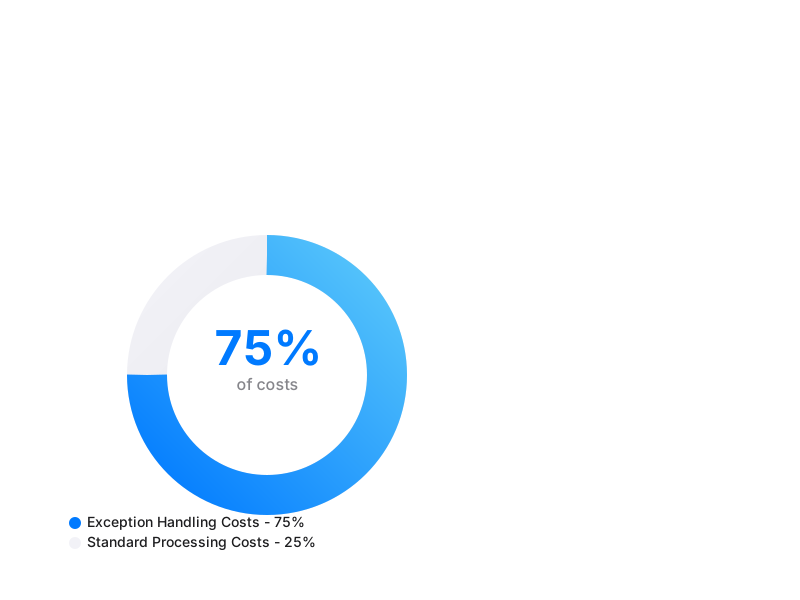
We automated 90% of our document processing, but we're still drowning in manual work." This statement rings painfully familiar across boardrooms where digital transformation initiatives have promised streamlined operations but delivered incomplete solutions. According to recent industry research, 60-80% of operational costs in document workflows stem from exception handling, the messy, unpredictable scenarios that traditional automation systems simply can't manage.
Most organizations celebrate when they successfully automate the straightforward documents. The clean invoices, the perfectly formatted contracts, the standard application forms that flow seamlessly through their digital pipelines. But celebration turns to frustration when they realize that the remaining 10-20% of problematic documents still consume the majority of their resources. These exceptions create bottlenecks that undermine the entire automation investment, forcing companies to maintain large teams of human operators who spend their days untangling data inconsistencies, chasing missing information, and manually correcting errors that derail automated processes.
The reality is stark: true automation success isn't measured by how well your system handles perfect documents. It's determined by how intelligently it resolves the imperfect ones. The companies that master exception handling don't just achieve operational efficiency; they unlock competitive advantages through faster processing times, superior customer experiences, and dramatically reduced operational overhead. This is where artificial intelligence transforms from a nice-to-have technology into a business-critical capability that separates industry leaders from followers.
Document exceptions come in many forms, each presenting unique challenges that traditional automation systems struggle to address. Understanding these categories is crucial for designing intelligent solutions that can handle the full spectrum of real-world scenarios organizations encounter daily.
Missing or unreadable fields represent the most common type of exception. These occur when optical character recognition (OCR) fails to extract critical information due to poor image quality, unusual fonts, handwritten text, or documents that arrive in formats the system wasn't designed to handle. A loan application might arrive with a smudged signature block, making it impossible to verify the applicant's identity automatically. Insurance claims could include damage photos where the policy number is partially obscured by shadows or reflections. Even minor scanning artifacts can render crucial data fields unreadable, forcing the entire document into manual review queues.
Conflicting data across documents creates another layer of complexity that challenges automated systems. Consider a mortgage application where the applicant's name appears slightly differently across various supporting documents. The driver's license shows "Robert J. Smith," while the employment verification form lists "Bob Smith," and the bank statements display "R. Smith." To human reviewers, these variations clearly refer to the same person, but traditional automation systems flag these as data inconsistencies requiring manual resolution. Similar conflicts arise when addresses don't match exactly due to formatting differences, abbreviations, or recent moves that haven't been updated across all documentation.
Compliance and regulatory flags add another dimension of complexity to exception handling. Anti-money laundering (AML) systems might flag transactions that require additional verification before processing can continue. Know Your Customer (KYC) requirements could identify discrepancies between provided identification and database records that demand investigation. Healthcare documents might trigger HIPAA compliance reviews when patient information doesn't align with authorization forms. These regulatory exceptions aren't just operational inconveniences; they're legal requirements that can expose organizations to significant penalties if not handled properly.
Unstructured attachments present perhaps the most challenging category of exceptions. Customers frequently submit supporting documentation that doesn't fit neatly into predefined categories. Property insurance claims might include dozens of photos showing damage from different angles, handwritten contractor estimates, or voice memos describing the incident. Legal document reviews could involve analyzing redlined contracts with margin notes, sticky note annotations, or embedded comments that contain critical information not captured in the main text. These unstructured elements often contain the most important details for decision-making, yet they're completely inaccessible to traditional automation systems.
Each exception type requires different resolution strategies, and the complexity multiplies when multiple exception types occur within the same document or workflow. A single insurance claim might simultaneously have unreadable damage amounts, conflicting policyholder names across documents, regulatory flags for large claim amounts, and unstructured photos that contain crucial evidence. Traditional systems typically escalate the entire document to human review when any exception occurs, creating unnecessary delays and costs even for issues that could be resolved automatically with the right intelligence.
The conventional approach to exception handling has remained largely unchanged for decades, relying on human intelligence to resolve issues that automated systems can't manage. When a document encounters any problem during processing, the entire workflow stops, and the document gets routed to human operators who must manually investigate, correct, and reprocess the information. This approach creates several cascading problems that compound operational inefficiencies.
Traditional exception handling operates on an all-or-nothing principle. A single missing field or data inconsistency triggers complete human review, even when 95% of the document is perfectly processable. Human operators must context-switch between entirely different types of problems, from simple data entry corrections to complex regulatory compliance reviews. They spend significant time familiarizing themselves with each document's unique circumstances, researching background information, and coordinating with multiple stakeholders to gather missing details. The cognitive overhead of constantly switching between different exception types creates fatigue and increases the likelihood of errors, ironically introducing new problems while solving existing ones.
The sequential nature of traditional exception handling creates additional delays that extend far beyond the time required to resolve individual issues. Documents wait in queues based on operator availability rather than exception complexity or business priority. Simple corrections that could be completed in minutes often take days simply because they're buried behind more complex cases in the same queue. Peak processing periods, such as month-end financial closes or seasonal insurance claim spikes, can overwhelm human capacity and create backlogs that affect customer satisfaction and business outcomes.
Communication gaps represent another significant weakness in traditional approaches. Human operators often need additional information from customers, vendors, or internal stakeholders to resolve exceptions, but these interactions happen through manual processes that lack tracking and accountability. Phone calls go unreturned, emails get lost in inboxes, and follow-up requests fall through the cracks. The lack of systematic communication management means that simple information requests can stretch into weeks-long delays, frustrating all parties involved and creating negative customer experiences.
AI-powered exception handling transforms this paradigm by introducing intelligent decision-making capabilities that can resolve many issues without human intervention. Instead of routing every exception to human review, AI agents first classify the problem type, assess the available information, and determine the most appropriate resolution strategy. This approach enables parallel processing of different exception types, allowing simple corrections to proceed immediately while complex issues receive focused attention from specialized agents or human experts.
The intelligence layer in AI-driven systems enables sophisticated problem-solving that goes far beyond simple rule-based automation. Machine learning models can recognize patterns in exception types and learn from previous resolutions to improve future performance. Natural language processing capabilities allow AI agents to understand unstructured information and extract relevant details from documents that would be completely opaque to traditional systems. Computer vision technologies can analyze images and photos to identify relevant information that supports decision-making processes.
Perhaps most importantly, AI-powered systems introduce proactive exception prevention by identifying potential issues before they become blocking problems. Predictive models can analyze incoming documents and flag likely exceptions early in the process, enabling preventive interventions that improve success rates. Real-time data validation can catch inconsistencies immediately rather than waiting for downstream processing failures. This shift from reactive to proactive exception management dramatically improves overall workflow efficiency and reduces the total volume of exceptions that require resolution.
Artificio has developed a sophisticated multi-agent architecture that addresses exception handling with unprecedented intelligence and automation capabilities. Rather than treating exceptions as monolithic problems requiring human intervention, Artificio's platform deploys specialized AI agents that work collaboratively to diagnose, resolve, and prevent document processing issues. This approach represents a fundamental shift in how organizations can think about exception handling, transforming it from a cost center into a competitive advantage.
The Classification Agent serves as the first line of defense in Artificio's exception handling system, automatically identifying and categorizing problems as soon as they're detected. This agent goes far beyond simple rule-based categorization, employing advanced machine learning models that understand the nuanced differences between exception types and can adapt to new scenarios without manual reprogramming. When a document arrives with missing information, the Classification Agent doesn't just flag it as incomplete; it determines which specific fields are missing, assesses the criticality of each missing element, and evaluates the likelihood of successful resolution through different approaches.
The intelligence of the Classification Agent extends to understanding business context and processing priorities. A missing signature on a time-sensitive loan application receives different treatment than an unclear photo in a routine insurance claim. The agent considers factors such as document type, business rules, compliance requirements, and historical resolution patterns to assign appropriate priority levels and resolution pathways. This contextual understanding ensures that critical business processes receive immediate attention while routine issues flow through efficient automated resolution channels.
The LLM Rules Agent represents Artificio's most innovative approach to exception resolution, leveraging large language models to understand document content and business rules in ways that traditional automation never could achieve. This agent can read and interpret complex documents, identify inconsistencies or missing information, and suggest intelligent corrections based on context and business logic. When faced with conflicting data across multiple documents, the LLM Rules Agent analyzes the discrepancies, considers the reliability of different sources, and proposes resolution strategies that align with organizational policies and regulatory requirements.
The communication capabilities of the LLM Rules Agent set it apart from conventional automation solutions. Rather than simply flagging problems for human review, this agent can automatically reach out to relevant stakeholders through their preferred communication channels, whether email, SMS, or WhatsApp. The agent crafts personalized messages that explain the specific issue in plain language, request the exact information needed for resolution, and provide clear instructions for submitting corrections. These communications aren't generic templates; they're intelligently composed based on the specific context of each exception and tailored to the recipient's role and relationship to the document.
The Data Validation Agent provides critical integration capabilities that enable real-time verification of information against authoritative sources. This agent automatically cross-references document data with existing records in ERP systems, CRM databases, loan origination systems, and other business applications to identify discrepancies and validate accuracy. When a customer submits updated address information, the Data Validation Agent can immediately verify the new address against postal databases, update related records across multiple systems, and ensure consistency throughout the organization's data ecosystem.
The validation capabilities extend to complex business logic that requires understanding relationships between different data elements. The agent can verify that loan amounts align with approved credit limits, confirm that insurance coverage matches policy terms, and ensure that contract terms comply with regulatory requirements. This real-time validation prevents many exceptions from occurring in the first place by catching potential issues during initial processing rather than discovering them later in the workflow.
The Communication Agent orchestrates stakeholder interactions throughout the exception resolution process, ensuring that all relevant parties stay informed and engaged without overwhelming them with unnecessary updates. This agent maintains awareness of who needs to know what information and when, automatically sending status updates, resolution confirmations, and next-step instructions to appropriate stakeholders. The communication strategy adapts based on exception severity, stakeholder preferences, and business requirements, ensuring that critical issues receive immediate attention while routine updates follow normal communication cadences.
The sophisticated workflow orchestration capabilities of the Communication Agent eliminate the communication gaps that plague traditional exception handling processes. The agent tracks all interactions, maintains complete audit trails, and ensures that no communication requests fall through the cracks. When human intervention is required, the agent provides complete context and background information, enabling faster and more accurate resolution. The agent also manages escalation procedures, automatically involving supervisors or specialists when resolution timeframes exceed defined thresholds or when exception complexity requires additional expertise.

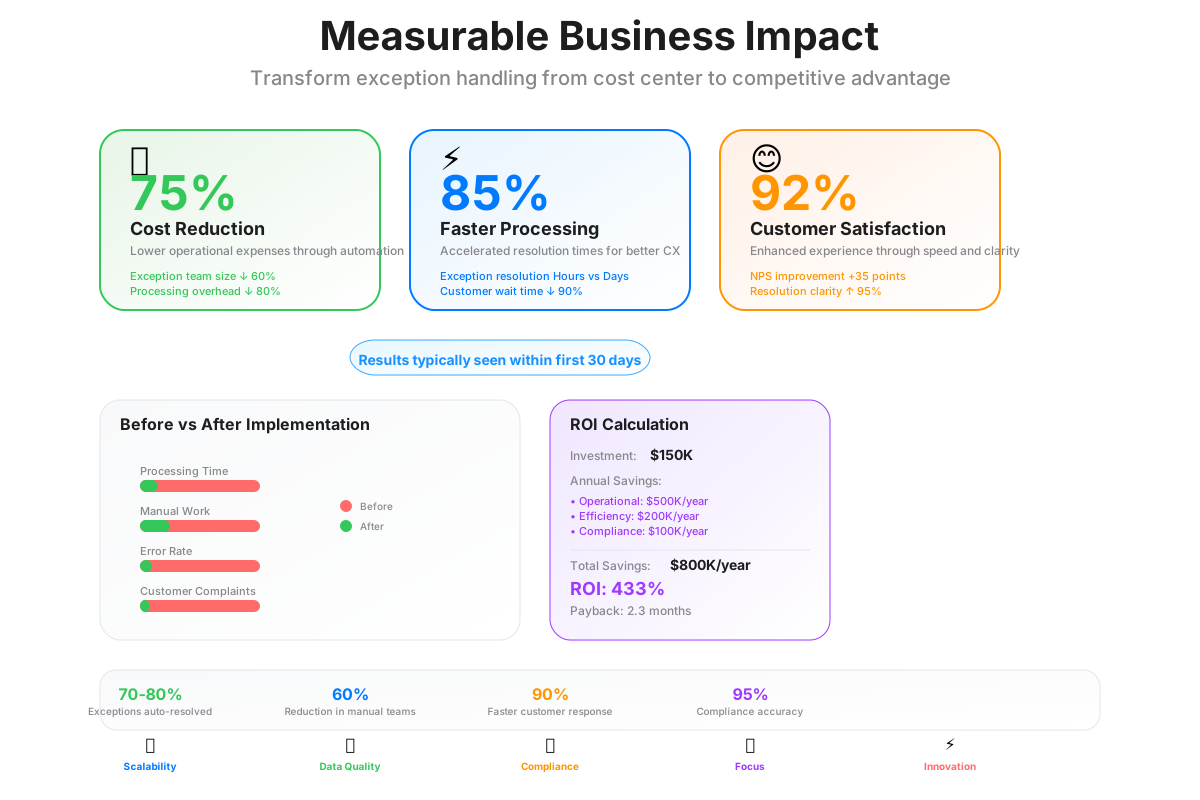
The business impact of AI-driven exception handling extends far beyond simple cost reduction, creating value across multiple dimensions that contribute to competitive advantage and operational excellence. Organizations implementing Artificio's approach typically see 70-80% of exceptions resolved without human intervention, but this statistic only tells part of the story. The real value lies in how intelligent exception handling transforms entire business processes and customer experiences.
The reduction in manual intervention creates dramatic improvements in processing speed and consistency. Documents that previously required days or weeks for exception resolution now flow through automated correction processes within hours or minutes. This acceleration has cascading effects throughout business operations, enabling faster customer responses, shorter cycle times for critical processes, and improved cash flow through accelerated transaction processing. Financial institutions can approve loans faster, insurance companies can settle claims more quickly, and logistics companies can resolve shipping issues before they impact delivery schedules.
The consistency of AI-driven resolution eliminates the variability that characterizes human exception handling. Different operators approach similar problems in different ways, creating inconsistent customer experiences and potential compliance risks. AI agents apply the same logic and standards to every exception, ensuring that similar situations receive similar treatment regardless of timing, workload, or operator availability. This consistency improves customer satisfaction and reduces the risk of errors or oversights that can occur when human operators are rushed, fatigued, or unfamiliar with specific exception types.
Customer experience improvements represent perhaps the most significant long-term business benefit of intelligent exception handling. Instead of waiting days for generic "your application is under review" notifications, customers receive specific, actionable communication about exactly what information is needed and how to provide it. The proactive communication approach eliminates the frustration of repeatedly contacting customer service for status updates, while the speed of resolution reduces anxiety and improves overall satisfaction with the organization's services.
The operational cost reductions go beyond simple labor savings, though those are substantial. Organizations can dramatically reduce the size of exception handling teams while simultaneously improving processing quality and speed. The remaining human operators can focus on truly complex issues that require human judgment and creativity, making their work more engaging and valuable. Training costs decrease because AI agents don't require extensive onboarding or ongoing education about new exception types or process changes.
Compliance and audit trail improvements provide critical value for regulated industries where documentation and process consistency are essential. AI agents automatically log every decision, action, and communication related to exception resolution, creating comprehensive audit trails that demonstrate compliance with regulatory requirements. The consistency of AI-driven processes reduces the risk of compliance violations that can occur when human operators make errors or fail to follow proper procedures. Regulatory audits become more straightforward when organizations can demonstrate systematic, well-documented exception handling processes.
The scalability benefits of AI-driven exception handling enable organizations to manage business growth without proportional increases in operational overhead. Traditional exception handling requires adding more human operators as document volumes increase, creating linear cost scaling that can undermine business economics. AI agents can handle increasing exception volumes without additional hiring, enabling organizations to maintain or improve profitability as they grow. This scalability advantage becomes particularly valuable during seasonal peaks or rapid business expansion periods.
Data quality improvements represent an often-overlooked benefit that creates long-term value across the organization. AI agents don't just resolve exceptions; they continuously improve the quality of data flowing through business systems. By catching and correcting inconsistencies, validating information against authoritative sources, and maintaining data integrity standards, AI agents enhance the overall quality of organizational data assets. Better data quality supports improved decision-making, more accurate reporting, and enhanced customer insights that drive business value.
The learning capabilities of AI systems create continuous improvement benefits that compound over time. As AI agents handle more exceptions, they become better at recognizing patterns, predicting potential issues, and suggesting more effective resolution strategies. This continuous learning means that exception handling performance improves automatically without manual intervention or process redesign. Organizations benefit from increasingly intelligent and efficient exception handling that adapts to changing business conditions and emerging exception types.
The versatility of AI-driven exception handling becomes evident when examining how different industries apply these capabilities to solve sector-specific challenges. Each industry faces unique exception types and resolution requirements, but the underlying intelligence and automation principles remain consistently valuable across diverse business contexts.
Banking and financial services organizations deal with some of the most complex exception scenarios due to strict regulatory requirements and the critical nature of financial transactions. Loan application processing exemplifies the challenges and opportunities in this sector. When KYC documentation is incomplete or inconsistent, traditional processes require loan officers to contact applicants, request additional information, and manually verify compliance with banking regulations. Delays in this process frustrate customers and can result in lost business when competitors offer faster approval times.
Artificio's AI agents transform this scenario by automatically identifying missing or inconsistent KYC information and immediately initiating targeted outreach to applicants. The LLM Rules Agent crafts personalized emails or text messages that explain exactly what information is needed, why it's required, and how to submit it through secure channels. The Data Validation Agent simultaneously cross-references existing customer information with regulatory databases to verify what information is already available and compliant. In many cases, the system can resolve apparent inconsistencies by recognizing that variations in name formatting or address notation refer to the same verified customer, eliminating the need for additional documentation.
The compliance benefits in banking are particularly significant because AI agents maintain detailed logs of every verification step and decision point. When regulators audit loan approval processes, banks can demonstrate systematic compliance with KYC requirements through comprehensive digital trails that show exactly how each exception was identified, investigated, and resolved. This documentation capability reduces regulatory risk while improving the efficiency of compliance reporting.
Healthcare organizations face unique challenges related to patient privacy, insurance coverage verification, and medical record accuracy. Insurance form processing represents a common exception scenario where patient information doesn't match insurance company records due to recent policy changes, name variations, or coverage transitions. Traditional resolution requires manual coordination between healthcare providers, insurance companies, and patients, often resulting in delayed treatments and frustrated patients.
AI-driven exception handling in healthcare enables real-time insurance verification and automatic resolution of common discrepancies. When a patient's insurance information doesn't match insurer records, the Classification Agent immediately identifies the specific discrepancy type, whether it's a changed policy number, updated beneficiary information, or coverage lapse. The Communication Agent can automatically contact the patient through their preferred communication method to verify current insurance details while simultaneously checking with insurance company databases for recent policy changes.
The Data Validation Agent provides critical capabilities for healthcare exception handling by maintaining awareness of common insurance industry practices and policy formats. The agent recognizes that different insurance companies use different policy number formats and can often resolve apparent discrepancies by reformatting information rather than requiring manual verification. When genuine issues exist, the agent can initiate three-way communication between the healthcare provider, insurance company, and patient to resolve coverage questions quickly and accurately.
Privacy protection represents a crucial consideration in healthcare exception handling, and AI agents provide superior data security compared to traditional manual processes. Automated systems can verify patient information and resolve exceptions without exposing sensitive medical details to unnecessary personnel. The agents maintain HIPAA compliance by limiting access to patient information based on specific job functions and resolution requirements, creating detailed audit trails that demonstrate proper handling of protected health information.
Logistics and supply chain organizations encounter exceptions related to incomplete shipping documentation, address verification, and regulatory compliance for international shipments. Shipping manifest errors can delay entire shipments and create cascading problems throughout supply chains, making rapid exception resolution critical for maintaining delivery commitments.
When shipping manifests contain incomplete or conflicting information, AI agents can automatically verify addresses against postal databases, contact shipping companies for clarification, and coordinate with customs authorities for international shipments. The LLM Rules Agent understands complex shipping regulations and can identify potential compliance issues before shipments reach borders, preventing costly delays and penalties.
The real-time nature of logistics exception handling provides particular value because shipping delays have immediate and visible impacts on customer satisfaction. AI agents can resolve address discrepancies within minutes of shipment processing, ensuring that packages reach their intended destinations without delays. The Communication Agent keeps all stakeholders informed about shipment status and any resolution actions, eliminating the need for customers to contact customer service for updates.
Legal organizations deal with contract discrepancies, missing signatures, and conflicting terms that can prevent deal completion or create liability issues. Contract processing represents a complex exception scenario where document variations might indicate substantive disagreements between parties or simple administrative oversights.
AI agents in legal settings can analyze contracts to identify discrepancies between different versions, flag missing required clauses, and suggest standard language for common agreement types. The LLM Rules Agent understands legal terminology and can distinguish between significant contract modifications and minor formatting differences. When signature blocks are incomplete or unclear, the agent can automatically contact the appropriate parties with specific instructions for completing the signature process.
The intelligence of AI-driven legal exception handling extends to understanding the broader context of legal agreements and the relationships between different contract terms. The agent can identify when seemingly minor changes might have significant legal implications and escalate those issues for attorney review while automatically resolving straightforward administrative problems.
The future of document automation lies not in perfecting the processing of clean, standardized documents, but in conquering the messy, unpredictable exceptions that have historically required human intervention. Organizations that recognize this shift and invest in intelligent exception handling capabilities will gain decisive competitive advantages through faster processing times, superior customer experiences, and dramatically reduced operational costs.
The traditional approach of routing exceptions to human operators represents an outdated paradigm that fails to leverage the sophisticated AI capabilities now available. As artificial intelligence technologies continue to advance, the gap between organizations that embrace intelligent automation and those that rely on manual processes will only widen. Companies that continue to treat exceptions as unavoidable disruptions rather than solvable problems will find themselves at an increasing disadvantage in markets where speed and efficiency determine competitive success.
Artificio's multi-agent approach represents a fundamental reimagining of how exception handling can work when powered by artificial intelligence. By deploying specialized agents that collaborate to diagnose, resolve, and prevent document processing issues, organizations can transform their most challenging operational problems into automated processes that improve continuously over time. This transformation enables businesses to achieve true end-to-end automation that doesn't break down when faced with real-world complexity.
The business case for AI-driven exception handling extends far beyond cost reduction, though the financial benefits are substantial. Organizations implementing these capabilities see improvements in customer satisfaction, compliance posture, data quality, and operational scalability that create lasting competitive advantages. The ability to process documents quickly and accurately, regardless of their condition or complexity, becomes a differentiating capability that supports business growth and customer retention.
The technologies enabling intelligent exception handling will continue to evolve rapidly, with advances in machine learning, natural language processing, and computer vision expanding the range of problems that can be solved automatically. Organizations that establish these capabilities early will benefit from continuous improvements in AI performance while building operational expertise that compounds their advantages over time.
The question facing business leaders isn't whether AI will eventually handle document exceptions intelligently. The question is whether their organizations will be among the early adopters who gain competitive advantages from these capabilities or among the followers who struggle to catch up after their competitors have already transformed their operations.
Artificio provides the platform and expertise that enables organizations to make this transformation successfully, delivering not just document automation, but intelligent exception resolution that conquers the last 10% of complex workflows that have historically consumed the majority of operational resources. The future belongs to organizations that can handle complexity as efficiently as they process standard cases, and that future is available today for leaders ready to embrace truly intelligent automation.
The investment in AI-driven exception handling represents more than a technology upgrade; it's a strategic decision to compete on operational excellence in an increasingly automated business environment. Organizations that make this commitment will find that mastering exceptions doesn't just solve current problems but creates capabilities that enable entirely new business models and customer experiences previously thought impossible.
True automation success requires conquering complexity, not avoiding it. Artificio provides the intelligence and capabilities that make this conquest not just possible, but profitable and sustainable for organizations ready to lead their industries into the future of intelligent document processing.

Head IT Operations - Co Founder of Artificio
See it in your SAP environment
Bring us a document, a process, or a bottleneck. We'll show how Artificio captures, validates, and posts into SAP — then scale from there.
Security & compliance
ISO 27001:2013 certified, SOC 2 Type 2 compliant, GDPR and HIPAA ready. Every agent action is logged, auditable, and runs in isolated environments.