

Blog
Automate Semantic Search & Q&A with AI Agents
Leverage AI agents to automate semantic search and Q&A across your enterprise documents for better insights.

Blog
Leverage AI agents to automate semantic search and Q&A across your enterprise documents for better insights.
The enterprise document landscape has undergone a dramatic transformation in recent years. Organizations that once struggled with basic data extraction from scanned papers now deploy sophisticated AI systems to classify, extract, and validate information at scale. But there's a critical question that remains largely unaddressed. Once we've extracted all this data, how do we make it truly accessible and actionable for the people who need it most?
This is where semantic search and intelligent Q&A systems come into play. These technologies represent the natural evolution of document automation, moving us beyond the simple question of "what data can we extract?" to the more nuanced and valuable challenge of "how do we find the right answers when we need them?" The shift might seem subtle, but it's actually revolutionary. Instead of forcing employees to navigate through folders of processed documents or memorize where specific information lives, we're creating systems that understand context, interpret meaning, and deliver precise answers to natural language questions.
Think about how this changes the daily workflow of a contracts manager who needs to quickly verify termination clauses across hundreds of agreements. Or consider the accounts payable clerk searching for patterns in historical invoices to identify potential duplicates or fraud. These aren't just efficiency gains we're talking about. They represent a fundamental reimagining of how organizations interact with their document repositories. By combining the power of AI agents with semantic understanding, we're not just processing documents faster. We're transforming static text into dynamic knowledge that actively supports decision-making.
The timing couldn't be better for this evolution. As organizations continue to digitize their operations and accumulate vast amounts of processed document data, the challenge has shifted from extraction to accessibility. We've solved the problem of getting data out of documents, but we haven't fully addressed how to make that data work for us in real-time, context-aware scenarios. That's exactly what semantic search and Q&A capabilities bring to the table, and it's why forward-thinking companies are rushing to implement these technologies as the next logical step in their document automation journey.
Let's face it. Most organizations today are sitting on mountains of extracted document data that nobody can effectively use. You've invested in OCR technology, implemented classification systems, and maybe even deployed some basic extraction tools. The data is there, sitting in databases and file systems, technically accessible but practically invisible. This creates a frustrating paradox where companies have more information than ever before but struggle to find what they need when they need it.
The root of this problem lies in how we've traditionally approached document processing. We've been so focused on the extraction phase that we forgot to consider what happens next. Sure, you can pull invoice numbers, dates, and amounts from thousands of documents. You can identify contract types and extract key clauses. But when someone asks, "What were our payment terms with Vendor X last quarter?" or "Which contracts have force majeure clauses that specifically mention pandemics?" the traditional extraction approach falls short. These questions require understanding context, recognizing relationships between different pieces of information, and synthesizing answers from multiple sources.
The situation gets even more complex when you consider the variety of formats and structures involved. A single organization might have contracts in PDF format, invoices as scanned images, emails with attachments, and spreadsheets with supporting data. Each document type has its own extraction requirements, storage location, and access patterns. Employees end up spending hours searching through different systems, opening countless files, and manually piecing together information that should be instantly available. It's not just inefficient. It's demoralizing and error-prone.
This fragmentation also creates significant risks for organizations. Critical information gets overlooked because it's buried in an obscure document that nobody remembered to check. Compliance violations occur because relevant clauses weren't identified in time. Business opportunities are missed because market intelligence scattered across various reports couldn't be synthesized quickly enough. The cost of these failures goes far beyond lost productivity. They can result in financial penalties, damaged relationships, and competitive disadvantages that take years to recover from. 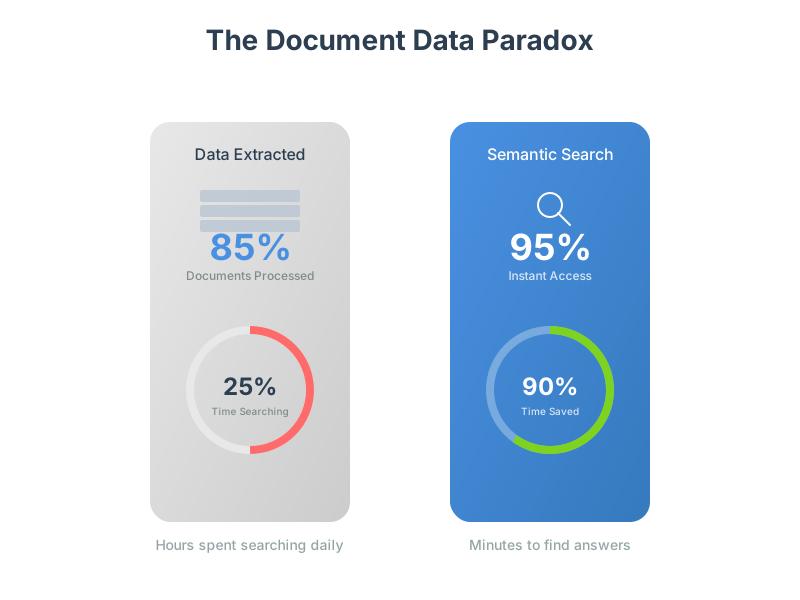
Building an effective semantic search and Q&A system for enterprise documents requires more than just bolting on a search engine to your existing infrastructure. You need a thoughtfully designed pipeline that transforms raw documents into searchable, queryable knowledge. This starts with your existing document processing capabilities but extends them in powerful new directions.
The foundation begins with the traditional document processing stack that many organizations already have in place. OCR technology converts scanned documents and images into machine-readable text. Classification systems categorize documents by type, urgency, or department. Key-value extraction pulls out structured data like dates, amounts, and reference numbers. These components remain essential because they provide the raw material that semantic search systems need to work with. But instead of stopping there, we add new layers that transform this extracted data into something far more valuable.
The magic happens when we introduce embedding generation and vector storage to the pipeline. Every processed document, every extracted clause, and every identified entity gets converted into a mathematical representation called an embedding. These embeddings capture the semantic meaning of the text, allowing the system to understand that "termination clause" and "contract cancellation terms" are referring to similar concepts, even though they use different words. These embeddings get stored in specialized vector databases that can perform lightning-fast similarity searches across millions of documents.
On top of this foundation, we deploy AI agents that orchestrate the entire retrieval and response process. When a user asks a question, these agents don't just search for keyword matches. They understand the intent behind the query, identify the most relevant documents and sections, and synthesize comprehensive answers from multiple sources. The Document Intelligence Agent continuously learns from user interactions, improving its understanding of your organization's specific terminology and context. The Retrieval Agent handles the complex task of searching across different document types and formats, ensuring nothing relevant gets missed. And the Communication Assistant Agent takes the raw search results and transforms them into clear, actionable answers that directly address the user's needs.
What makes this architecture particularly powerful is its flexibility and scalability. You can start with a focused implementation covering just one document type or department, then gradually expand to encompass your entire document ecosystem. The system learns and improves over time, becoming more accurate and helpful with each interaction. New document types can be added without disrupting existing capabilities. And because everything is built on modern AI technologies, you benefit from continuous improvements in natural language processing and machine learning without having to rebuild your infrastructure.
The true value of semantic search and Q&A capabilities becomes clear when you see them in action across different business scenarios. Let's explore some concrete examples that demonstrate how these technologies transform everyday document-related tasks.
Consider the world of contract management, where legal teams and procurement departments deal with thousands of agreements, each containing dozens of clauses and provisions. Traditional approaches require manually reviewing contracts or maintaining complex spreadsheets to track key terms. With semantic Q&A, a user can simply ask, "What's the termination notice period for our agreement with Acme Corp?" The system instantly locates the relevant contract, identifies the termination clause, and provides a clear answer like "90 days written notice required, as specified in Section 7.2 of the Master Service Agreement dated March 15, 2023." But it goes beyond simple retrieval. The system can handle complex queries like "Show me all contracts with automatic renewal clauses expiring in the next quarter" or "Which vendor agreements don't have data protection provisions compliant with GDPR?" These aren't just keyword searches. They require understanding legal concepts, recognizing date relationships, and interpreting regulatory requirements.
The accounts payable department offers another compelling use case. Invoice processing typically involves matching incoming invoices against purchase orders, checking for duplicates, and verifying pricing agreements. Semantic search transforms this process by enabling queries like "Find all invoices from this vendor that are similar to this one" or "What's the historical pricing trend for this product category?" The system can identify potential duplicate invoices even when vendors use different invoice numbering schemes or slightly different company names. It can flag unusual patterns, like sudden price increases or invoices that don't match typical purchasing patterns. This level of intelligent analysis would be impossible with traditional keyword-based searches.
Customer service operations see dramatic improvements when semantic search is applied to support documentation and ticket resolution. Instead of agents manually searching through knowledge bases and previous tickets, they can ask natural questions like "How do we handle returns for items purchased with cryptocurrency?" or "What solutions have we provided for error code X47 in the past?" The system not only finds relevant documentation but also surfaces similar resolved tickets, suggested solutions, and escalation procedures. Response times drop from minutes to seconds, and first-call resolution rates improve significantly because agents have instant access to comprehensive, contextual information.
Human resources departments use semantic search to navigate the complex landscape of employee documentation, policies, and compliance requirements. Questions like "What's our remote work policy for employees in California?" or "Which employees have certifications expiring this month?" get answered instantly. The system understands the nuances of employment law, recognizes geographic variations in policies, and can synthesize information from multiple sources including employee handbooks, state regulations, and individual employment agreements. This capability is especially valuable during audits or when responding to legal inquiries, where finding all relevant documentation quickly can make the difference between compliance and costly violations. 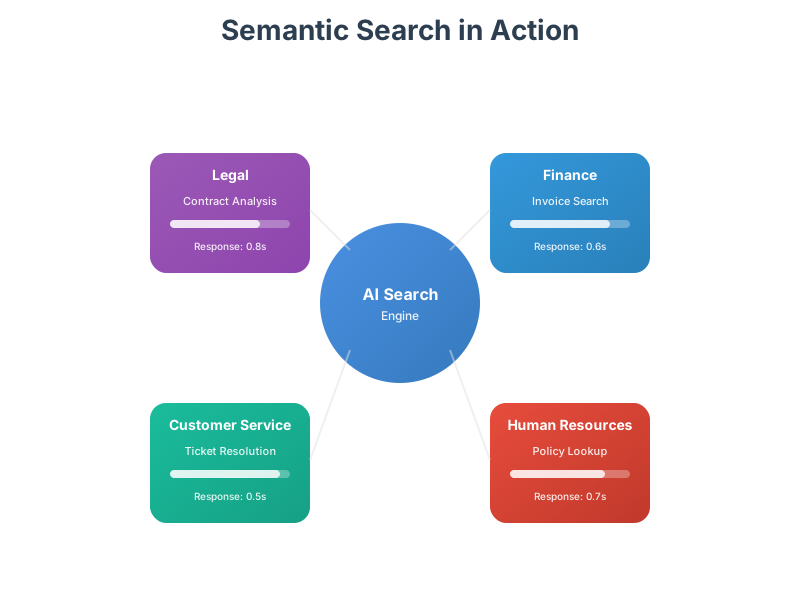
The success of a semantic search and Q&A system depends heavily on the AI agents that power it. These aren't just simple bots following predetermined scripts. They're sophisticated systems that work together to understand, process, and respond to complex document-related queries. Each agent has a specific role, and together they create an intelligent ecosystem that continuously learns and improves.
The Document Intelligence Agent serves as the knowledge architect of the system. This agent doesn't just passively store information. It actively analyzes every document that enters the system, identifying patterns, relationships, and contextual nuances that might not be immediately apparent. When a new contract arrives, the Document Intelligence Agent recognizes that it's similar to previous agreements with the same vendor but notices subtle differences in payment terms or liability clauses. It builds a rich understanding of your organization's document landscape, learning the specific terminology, abbreviations, and conventions that are unique to your business. Over time, this agent becomes an expert in your domain, understanding that when someone in your organization mentions "the Johnson account," they're probably referring to Johnson Industries Inc., not Johnson & Associates LLC.
The Retrieval Agent acts as the system's search expert, handling the complex task of finding relevant information across diverse document types and storage systems. When a query comes in, this agent doesn't just look for exact matches. It understands synonyms, related concepts, and contextual clues. If someone searches for "employee termination procedures," the Retrieval Agent knows to also look for documents mentioning "separation processes," "exit protocols," or "offboarding guidelines." It can search across structured databases, unstructured text, and even metadata to find every piece of relevant information. The agent also handles the challenging task of ranking results by relevance, considering factors like document recency, source authority, and user context to ensure the most useful information appears first.
The Communication Assistant Agent bridges the gap between raw search results and actionable insights. This agent takes the documents and data fragments identified by the Retrieval Agent and transforms them into coherent, useful responses. Instead of simply presenting a list of documents that might contain the answer, the Communication Assistant synthesizes information from multiple sources to provide comprehensive, direct answers. When asked about vacation policy for remote employees, it doesn't just point to the employee handbook. It combines information from the handbook, recent policy updates, and relevant legal requirements to provide a complete picture. The agent also adapts its communication style based on the audience, providing detailed technical explanations for specialists while offering simplified summaries for executives.
These agents don't work in isolation. They constantly communicate and collaborate, sharing insights and learning from each interaction. When the Communication Assistant notices that users frequently ask follow-up questions about certain topics, it alerts the Document Intelligence Agent to pay special attention to related documents in the future. When the Retrieval Agent struggles to find relevant results for certain queries, it provides feedback that helps the Document Intelligence Agent adjust its embedding strategies. This collaborative approach creates a system that gets smarter and more helpful over time, adapting to your organization's specific needs and patterns.
The agent architecture also provides remarkable flexibility for customization and extension. You can add specialized agents for specific document types or business processes. A Compliance Monitoring Agent might continuously scan documents for regulatory risks. A Translation Agent could provide multilingual search capabilities for global organizations. A Workflow Integration Agent might automatically trigger business processes based on document content. The possibilities are limited only by your organization's needs and imagination.
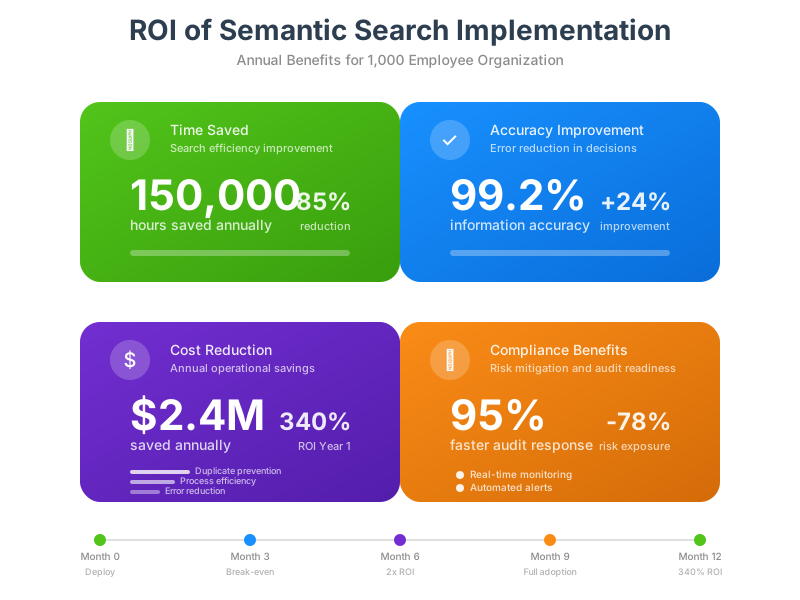
Implementing semantic search and Q&A capabilities delivers concrete, measurable benefits that directly impact your bottom line. These aren't theoretical improvements or distant promises. Organizations implementing these technologies are seeing immediate returns that justify the investment many times over.
The most obvious benefit is the dramatic reduction in time spent searching for information. Studies consistently show that knowledge workers spend between 20% and 30% of their time looking for documents and information. With semantic search, this drops to just a few minutes per day. For an organization with 1,000 office workers, even a conservative 15% time saving translates to 150,000 hours per year. That's the equivalent of adding 75 full-time employees without hiring anyone. The productivity gains alone often pay for the entire system implementation within months.
Accuracy improvements provide another layer of value that's sometimes harder to quantify but equally important. When employees can quickly find the right information, they make better decisions. Contract managers catch problematic clauses before agreements are signed. Accounts payable teams identify duplicate invoices before payments are processed. Customer service agents provide correct information on the first call instead of needing callbacks or escalations. Each of these improvements prevents costly mistakes that can range from minor embarrassments to major financial losses. One financial services firm reported saving over $2 million annually just from catching duplicate invoice payments that their semantic search system identified.
The impact on decision-making speed can't be overstated. In today's fast-paced business environment, the ability to quickly access and synthesize information from multiple documents can mean the difference between winning and losing deals. Sales teams can instantly pull together comprehensive proposals using information from previous successful bids. Legal teams can respond to due diligence requests in hours instead of days. Executive teams can make strategic decisions based on comprehensive analysis of historical data that would have taken weeks to compile manually. This agility provides a competitive advantage that goes beyond simple cost savings.
Employee satisfaction and retention improve significantly when workers have the tools they need to be successful. Nothing frustrates skilled professionals more than spending their time on mundane search tasks when they could be doing meaningful work. Semantic search systems eliminate this frustration, allowing employees to focus on activities that use their expertise and creativity. This leads to higher job satisfaction, better employee retention, and an easier time recruiting top talent who want to work with cutting-edge technologies. Several organizations have reported that their semantic search capabilities have become a key selling point in recruiting, particularly for younger workers who expect modern, AI-powered tools.
Compliance and risk management see substantial improvements as well. The ability to quickly search across all documents for specific terms, clauses, or patterns means that organizations can respond to regulatory changes much faster. When new privacy regulations are announced, you can instantly identify all documents that need updating. When a vendor is flagged for compliance issues, you can immediately find all contracts and transactions involving that vendor. This proactive approach to compliance reduces the risk of penalties and legal issues while also demonstrating to regulators and auditors that you have robust information governance systems in place.
Implementing semantic search and Q&A capabilities successfully requires more than just deploying the technology. You need to consider various factors that can make the difference between a system that transforms your organization and one that becomes just another underused tool. Let's explore the key best practices that ensure your semantic search implementation delivers on its promise.
Managing embedding drift represents one of the most critical yet often overlooked challenges. As your business evolves, so does your language. New products get launched, terminology changes, and industry jargon evolves. The embeddings that perfectly captured your document semantics six months ago might not accurately represent your current context. Successful organizations implement regular retraining cycles for their embedding models, typically quarterly or whenever significant business changes occur. They also maintain feedback loops where users can flag when search results don't match their expectations, providing valuable data for model improvement. Some companies have found success with a hybrid approach, maintaining both stable historical embeddings for archived documents and dynamic embeddings for current content.
Privacy and compliance in semantic search require careful consideration from the very beginning. Not everyone in your organization should have access to all documents, and your search system needs to respect these boundaries. Implementing robust access controls that work seamlessly with semantic search can be challenging but is absolutely essential. The system needs to understand not just what documents exist but who's allowed to see them. This becomes particularly complex when dealing with personal information, financial data, or confidential business intelligence. Successful implementations use a combination of document-level security tags, user role definitions, and dynamic filtering to ensure that search results never expose information to unauthorized users. Regular security audits and penetration testing should be standard practice, not afterthoughts.
The human element remains crucial even in highly automated systems. While AI agents can handle most queries effectively, there will always be edge cases, ambiguous questions, or situations requiring human judgment. Building human-in-the-loop feedback mechanisms ensures continuous improvement while maintaining quality control. This might involve having subject matter experts review and validate the system's answers for complex queries, or implementing an escalation path where difficult questions get routed to human experts. The key is making this process seamless and learning from every human intervention. When an expert corrects or enhances an AI-generated answer, that knowledge should be captured and used to improve future responses.
Data quality and preparation can make or break your semantic search implementation. Garbage in, garbage out applies here just as much as anywhere else in technology. Documents with poor OCR quality, inconsistent formatting, or missing metadata will produce poor search results no matter how sophisticated your AI agents are. Investing in document cleanup and standardization before implementing semantic search pays dividends. This includes establishing naming conventions, ensuring consistent metadata tagging, and potentially reprocessing older documents with better OCR technology. Some organizations have found success with a phased approach, starting with their highest-quality, most important documents and gradually expanding to include legacy content as it gets cleaned up.
Change management and user adoption require deliberate planning and execution. Even the best semantic search system will fail if users don't understand how to use it effectively or don't trust its results. Start with a pilot program involving enthusiastic early adopters who can become champions for the technology. Provide comprehensive training that goes beyond basic functionality to include best practices for formulating queries and interpreting results. Create success stories and case studies from your own organization that demonstrate real value. Make the system easily accessible, ideally integrated into existing workflows and tools that employees already use daily. And most importantly, listen to user feedback and continuously improve the system based on real-world usage patterns.
Performance optimization becomes increasingly important as your document corpus grows. A system that works brilliantly with 10,000 documents might struggle with 10 million. Planning for scale from the beginning saves painful migrations later. This includes choosing the right vector database technology, implementing efficient caching strategies, and potentially using distributed processing for large-scale operations. Monitor system performance continuously, tracking metrics like query response time, result relevance scores, and system resource usage. Set up alerts for performance degradation and have plans in place for scaling infrastructure as needed.
One of the biggest hurdles organizations face when implementing semantic search isn't the technology itself but rather integrating it effectively with existing systems and workflows. Your document management systems, ERP platforms, CRM tools, and other business applications all contain valuable information that should be searchable. Creating a unified semantic search experience across these disparate systems requires careful planning and robust integration strategies.
The first step involves mapping your current document landscape. Where do documents currently live? How do they flow through your organization? Which systems generate them, store them, and consume them? This assessment often reveals surprising complexity. A single invoice might touch half a dozen systems from initial receipt through final payment. A contract might exist in multiple versions across legal, procurement, and vendor management systems. Understanding these patterns helps you design an integration approach that captures all relevant documents without creating duplicates or missing critical information.
API-based integration provides the most flexible approach for connecting semantic search with existing systems. Modern platforms typically offer REST APIs that allow your semantic search system to pull documents and push back enriched information. But you need to consider more than just technical connectivity. How often should documents be synchronized? Should it happen in real-time, batch processing, or on-demand? What happens when source systems are temporarily unavailable? Building resilient integration patterns that handle errors gracefully and maintain data consistency requires careful architecture and extensive testing.
Legacy system integration presents unique challenges that often require creative solutions. Older document management systems might not have APIs or might store documents in proprietary formats. Some organizations have found success with robotic process automation (RPA) tools that can navigate legacy interfaces and extract documents for processing. Others have implemented file system watchers that detect when new documents are added to shared drives or network folders. The key is finding approaches that work reliably without requiring massive changes to systems that might be mission-critical and difficult to modify.
Workflow integration makes semantic search truly valuable by embedding it directly into business processes. Instead of requiring users to switch to a separate search interface, the capability should be available wherever they work. This might mean adding search widgets to your intranet, integrating with collaboration tools like Microsoft Teams or Slack, or building browser extensions that provide instant access to semantic search from any web application. The goal is making search so convenient and natural that it becomes an unconscious part of how people work rather than an extra step they need to remember.
The convergence of semantic search with document processing represents just the beginning of a larger transformation in how organizations handle information. As AI technologies continue to advance and businesses generate ever-increasing volumes of documents, we're moving toward a future where documents aren't just processed or searched but truly understood and acted upon autonomously.
The next frontier involves predictive and proactive document intelligence. Instead of waiting for users to ask questions, future systems will anticipate information needs and surface relevant insights automatically. Imagine a system that notices you're drafting a proposal and automatically suggests relevant case studies, pricing precedents, and successful proposal sections from similar past projects. Or consider a compliance system that continuously monitors all your contracts and alerts you to clauses that might become problematic under newly proposed regulations. These capabilities are already emerging in advanced implementations and will become standard features in the coming years.
Multi-modal document understanding represents another exciting development. Documents aren't just text. They contain images, charts, diagrams, and increasingly, embedded videos and audio. Next-generation semantic search systems will understand all these elements holistically. A search for "network architecture" won't just find text descriptions but also network diagrams, presentation slides, and even relevant sections of recorded meetings where the architecture was discussed. This comprehensive understanding will make information truly accessible regardless of its original format.
The integration of semantic search with generative AI opens up entirely new possibilities. Instead of just finding and presenting information, systems will be able to create new documents based on learned patterns and organizational knowledge. Need a contract for a new type of engagement? The system can draft one based on similar past agreements, automatically incorporating your standard terms while highlighting areas that need human review. Preparing a board presentation? The system can automatically compile relevant metrics, create visualizations, and even suggest narrative themes based on successful past presentations.
Cross-organizational knowledge sharing through federated semantic search will become increasingly important as businesses form closer partnerships and supply chain relationships. Imagine being able to search not just your own documents but also authorized sections of your suppliers', customers', and partners' knowledge bases. This federated approach maintains security and privacy while enabling unprecedented collaboration and information sharing. Industry consortiums are already exploring shared semantic search platforms for regulatory compliance and best practice sharing.
The journey from basic document processing to intelligent semantic search and Q&A capabilities might seem daunting, but it doesn't have to be. Organizations that approach this transformation thoughtfully, starting with focused pilot projects and gradually expanding their capabilities, consistently achieve remarkable results. The technology is mature, the benefits are proven, and the competitive advantage is real.
Start by identifying a specific pain point in your organization where better document search could make an immediate impact. Maybe it's your legal team drowning in contracts, your customer service struggling to find answers, or your accounts payable dealing with invoice chaos. Choose an area where success can be clearly measured and where enthusiastic stakeholders will champion the initiative. This focused approach allows you to prove value quickly while learning lessons that will inform broader rollout.
Take inventory of your current document processing capabilities and identify gaps that need to be addressed. If you're still struggling with basic OCR and extraction, you'll need to shore up those foundations before adding semantic search layers. But don't let perfect be the enemy of good. Modern platforms like Artificio.ai can help you implement comprehensive document processing pipelines that include semantic search capabilities from the start, eliminating the need for complex multi-vendor integrations.
Engage with your teams to understand their real information needs. What questions do they struggle to answer? What information do they waste time searching for? What decisions could they make better or faster with improved access to document intelligence? These insights will shape your implementation strategy and ensure that you're building something that actually solves real problems rather than just implementing technology for its own sake.
Consider partnering with experienced providers who can accelerate your journey. The semantic search and document AI landscape is complex and rapidly evolving. Working with specialists who have already solved these challenges for similar organizations can save months of development time and help you avoid common pitfalls. Look for partners who offer not just technology but also expertise in change management, integration strategies, and best practices for your specific industry.
The transformation from document processing to document intelligence through semantic search isn't just a technology upgrade. It's a fundamental shift in how your organization creates, captures, and leverages knowledge. Companies that make this transition successfully don't just work faster. They work smarter, make better decisions, and create sustainable competitive advantages in an increasingly information-driven economy.
The question isn't whether to implement semantic search and Q&A capabilities for your documents. The question is how quickly you can start and how far you're willing to go. Every day you delay is another day your competitors might be pulling ahead, another day your employees struggle with inefficient searches, and another day valuable insights remain hidden in your document repositories.

Head IT Operations - Co Founder of Artificio
See it in your SAP environment
Bring us a document, a process, or a bottleneck. We'll show how Artificio captures, validates, and posts into SAP — then scale from there.
Security & compliance
ISO 27001:2013 certified, SOC 2 Type 2 compliant, GDPR and HIPAA ready. Every agent action is logged, auditable, and runs in isolated environments.