

Blog
Solving the Enterprise API Integration Challenge
Unlock Document AI's potential with enterprise-grade integration. Overcome challenges, scale securely.

Blog
Unlock Document AI's potential with enterprise-grade integration. Overcome challenges, scale securely.
The promise of artificial intelligence in document processing has captured the imagination of enterprise leaders worldwide. Organizations envision AI systems that can seamlessly extract, analyze, and process documents at unprecedented scale, transforming how businesses handle everything from invoices and contracts to compliance documents and customer communications. However, beneath the surface of this technological promise lies a critical challenge that many enterprises discover only after significant investment: the integration gap between AI capabilities and enterprise architecture requirements.
Modern document AI systems possess remarkable technical capabilities. They can extract text from scanned documents with high accuracy, identify key data points within complex forms, classify documents by type and content, and even understand contextual relationships between different pieces of information. These capabilities represent genuine technological breakthroughs that would have seemed impossible just a few years ago. Yet for all their sophistication, most AI vendors deliver these capabilities through relatively simple API interfaces that fail to address the complex integration requirements of large enterprises.
This disconnect between AI capability and integration architecture creates what we might call the "last mile problem" of enterprise AI adoption. Organizations find themselves in the frustrating position of having access to powerful AI tools that they cannot effectively deploy within their existing technology ecosystem. The result is often a series of isolated AI implementations that fail to deliver the transformative business impact that originally justified the investment.
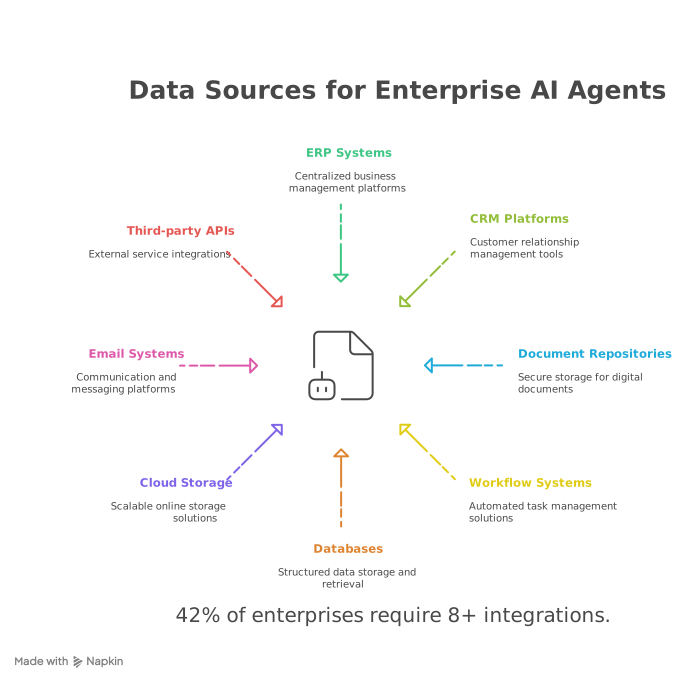
To understand why document AI integration presents such significant challenges, we must first examine the nature of enterprise technology environments. Modern enterprises operate complex technology ecosystems that have evolved over decades of business growth and technological change. These ecosystems typically include multiple generations of software systems, ranging from legacy mainframe applications that may be decades old to cutting-edge cloud-native platforms deployed just months ago.
Within this ecosystem, data flows through intricate networks of connections between different systems. Customer information might originate in a CRM system, flow to an ERP platform for order processing, connect to a document management system for contract generation, and ultimately feed into business intelligence platforms for analysis and reporting. Each connection point in this network represents both an opportunity for AI enhancement and a potential point of failure if integration is not properly architected.
The challenge becomes even more complex when we consider that enterprise document processing rarely occurs in isolation. A single invoice processing workflow might need to extract data from the document itself, validate that data against information stored in an ERP system, check vendor details in a supplier management platform, route approvals through a workflow system, and finally update financial records in an accounting application. Each step in this process requires seamless integration between the AI system and existing enterprise infrastructure.
Traditional API approaches to integration, while suitable for simple use cases, quickly become inadequate when faced with this level of complexity. A basic REST API might allow an AI system to receive documents and return extracted data, but it provides no guidance on how to handle the sophisticated orchestration, error handling, security, and governance requirements that enterprise deployments demand.
Consider the seemingly straightforward task of processing purchase orders. In a small business, this might involve a simple workflow where documents are uploaded to an AI system, data is extracted, and results are returned to a single application. In an enterprise environment, the same task might require integration with procurement systems to validate vendor information, ERP systems to check budget availability, approval workflow systems to route documents based on amount thresholds, contract management systems to verify terms and conditions, and financial systems to create appropriate accounting entries. Each integration point introduces additional complexity in terms of data formats, security requirements, error handling protocols, and performance expectations.
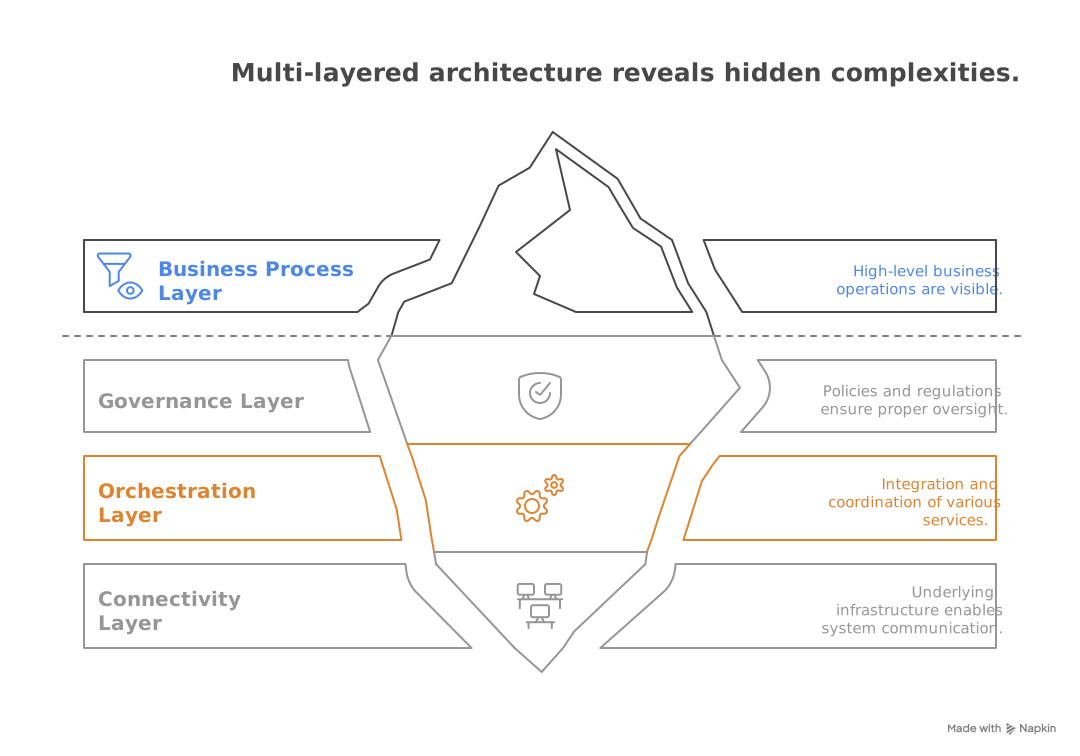
Enterprise-grade integration architecture for document AI systems requires a fundamentally different approach than simple API connectivity. It demands a comprehensive framework that addresses multiple layers of integration complexity, from technical connectivity to business process orchestration and governance oversight.
At the foundational level, enterprise integration architecture must address connectivity patterns that go far beyond basic HTTP requests and responses. Modern enterprises require support for multiple communication protocols, including synchronous and asynchronous messaging patterns, event-driven architectures, and batch processing workflows. Document processing systems might need to respond immediately to high-priority documents while queuing lower-priority items for batch processing during off-peak hours. They might need to publish events to enterprise service buses when specific types of documents are processed, or subscribe to events from other systems to trigger document processing workflows.
Security and compliance requirements add another layer of architectural complexity. Enterprise document processing systems must support sophisticated authentication and authorization mechanisms that integrate with existing identity management systems. They need to enforce role-based access controls that determine not just who can access the system, but what types of documents they can process, what data they can extract, and how that data can be used. Audit logging must capture detailed information about every interaction with the system, creating comprehensive audit trails that satisfy regulatory requirements and internal governance policies.
Data governance presents yet another architectural challenge. Enterprise document processing systems must support complex data lineage tracking, ensuring that organizations can trace the flow of information from original documents through extraction processes to final destinations in downstream systems. They must enforce data quality standards, validate extracted information against business rules, and provide mechanisms for human review and correction when automated processes encounter uncertainty or errors.
Performance and scalability requirements in enterprise environments often exceed what simple API-based approaches can deliver. Document processing workloads can be highly variable, with periods of intense activity followed by relative quiet. During month-end closing processes, for example, an organization might need to process thousands of invoices in a compressed timeframe, requiring the AI system to scale dynamically to meet demand. This scalability must extend not just to the AI processing itself, but to all aspects of the integration architecture, including data transformation, routing, and downstream system updates.
Successful enterprise document AI implementations rely on proven integration patterns that address common architectural challenges. These patterns provide blueprints for solving recurring integration problems while maintaining flexibility to accommodate specific business requirements and technical constraints.
The Hub and Spoke pattern represents one of the most fundamental integration architectures for document processing systems. In this pattern, the document AI system serves as a central hub that coordinates interactions with multiple enterprise systems. Rather than creating point-to-point connections between every system that needs to share document data, organizations establish connections only between each system and the central hub. This approach significantly reduces integration complexity while providing a single point for implementing cross-cutting concerns like security, logging, and data transformation.
When implementing the Hub and Spoke pattern for document processing, the central hub typically includes several key components. A document ingestion service manages the receipt and initial processing of documents from various sources, handling format conversion, quality validation, and routing to appropriate processing engines. An orchestration engine coordinates the flow of data between different processing steps and downstream systems, implementing business rules that determine how different types of documents should be handled. A data transformation service ensures that extracted information is converted to the formats required by downstream systems, while a monitoring and logging service provides visibility into system operations and performance.
The Event-Driven Architecture pattern offers another powerful approach for document processing integration, particularly in environments where real-time responsiveness is critical. In this pattern, document processing activities generate events that other systems can subscribe to and respond to automatically. When an invoice is processed, for example, the system might generate events indicating that vendor information has been extracted, that approval routing has been initiated, and that financial data is ready for posting. Downstream systems can subscribe to these events and take appropriate actions without requiring direct coupling to the document processing system.
Event-driven architectures excel in scenarios where document processing needs to trigger multiple downstream actions. A single contract processing event might need to update a CRM system with new customer information, create tasks in a project management system, generate calendar entries for key milestone dates, and initiate compliance review processes. Rather than requiring the document processing system to understand and directly interface with each of these downstream systems, the event-driven approach allows each system to independently subscribe to relevant events and take appropriate actions.
The Microservices pattern provides yet another architectural approach that can be particularly effective for large-scale document processing implementations. Rather than building document AI capabilities as a monolithic system, the microservices approach breaks functionality into smaller, independently deployable services that can be developed, scaled, and maintained separately. A document processing microservices architecture might include separate services for document ingestion, text extraction, data validation, format conversion, and downstream system integration.
The microservices approach offers several advantages for enterprise document processing systems. Different types of documents might require different processing capabilities, and microservices allow organizations to optimize each service for its specific requirements. Invoice processing services can be optimized for high-volume, standardized document handling, while contract processing services can be designed to handle complex, variable-format documents that require more sophisticated analysis. Microservices also enable organizations to adopt different technologies for different aspects of document processing, using the most appropriate tools for each specific challenge.
The successful deployment of document AI systems in enterprise environments requires robust governance frameworks that ensure consistent, compliant, and effective use of AI capabilities across the organization. These frameworks must address multiple dimensions of governance, from technical architecture standards to business process compliance and risk management.
Technical governance for document AI systems begins with establishing clear standards for system architecture, integration patterns, and development practices. Organizations need to define approved integration technologies, preferred communication protocols, and required security mechanisms. They must establish guidelines for error handling, logging, and monitoring that ensure consistent behavior across different document processing implementations. Data governance standards must specify how extracted information should be validated, transformed, and propagated to downstream systems, while ensuring compliance with privacy regulations and business policies.
One of the most critical aspects of technical governance involves establishing clear boundaries and responsibilities between different systems in the integration architecture. Document AI systems must have well-defined interfaces with upstream document sources and downstream data consumers. These interfaces should specify not just the technical protocols for data exchange, but also the business rules that govern when and how data should be shared. For example, governance frameworks might specify that financial document data can only be shared with authorized financial systems, or that personally identifiable information must be masked when shared with certain downstream applications.
Business process governance addresses how document AI systems fit into broader organizational workflows and decision-making processes. This includes establishing clear roles and responsibilities for system administration, data quality management, and exception handling. Organizations need to define who has authority to configure document processing rules, who is responsible for reviewing and correcting AI processing errors, and who makes decisions about integrating new document types or downstream systems.
Exception handling governance is particularly important for document AI systems, as these systems will inevitably encounter documents or scenarios that exceed their automated processing capabilities. Governance frameworks must specify how such exceptions should be identified, routed for human review, and resolved. They must define escalation procedures for different types of exceptions and establish metrics for measuring and improving exception handling effectiveness.
Compliance governance ensures that document AI systems operate within the regulatory and policy constraints that apply to the organization. This includes ensuring that document processing activities comply with data privacy regulations, industry-specific compliance requirements, and internal security policies. For organizations in regulated industries, compliance governance must address how AI processing decisions are documented, reviewed, and audited to demonstrate regulatory compliance.
Risk management governance addresses the various risks associated with deploying AI systems in enterprise environments. This includes technical risks such as system failures or security breaches, business risks such as processing errors or regulatory violations, and strategic risks such as vendor dependence or technology obsolescence. Governance frameworks must establish processes for identifying, assessing, and mitigating these risks while ensuring that risk management activities do not unduly constrain the business benefits of document AI implementation. 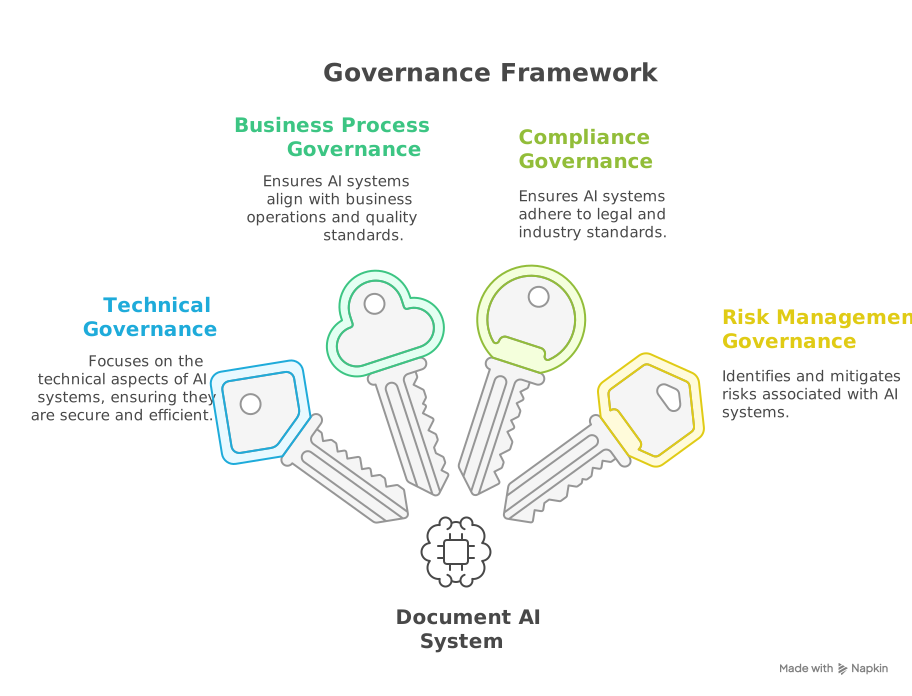
The theoretical frameworks for enterprise document AI integration become truly meaningful when examined through the lens of real-world implementation challenges. Organizations attempting to deploy document AI systems at enterprise scale encounter a predictable set of obstacles that can derail even well-planned implementations if not properly anticipated and addressed.
One of the most common challenges involves the complexity of existing enterprise data architectures. Many organizations discover that their current systems lack the APIs, data formats, or integration capabilities needed to support sophisticated document AI workflows. Legacy systems that have operated effectively for years or decades may not support the real-time data exchange patterns that modern AI systems require. Mainframe systems that process millions of transactions efficiently may lack the web service interfaces needed to participate in modern integration architectures.
Consider the case of a large manufacturing company attempting to implement AI-powered invoice processing. The organization's existing ERP system could process invoices effectively through batch uploads and manual data entry, but it lacked the real-time APIs needed to validate vendor information during AI processing or to provide immediate feedback on processing errors. The company faced a choice between significant modifications to their core ERP system or implementing complex workaround solutions that introduced additional points of failure and maintenance overhead.
The solution involved implementing an integration middleware layer that could bridge the gap between the real-time requirements of the AI system and the batch-oriented architecture of the existing ERP system. This middleware layer cached frequently accessed data from the ERP system, provided real-time lookup capabilities for the AI system, and queued updates for batch processing during appropriate maintenance windows. While this approach required additional infrastructure and complexity, it allowed the organization to realize the benefits of AI-powered document processing without requiring disruptive changes to critical business systems.
Data quality and consistency present another significant implementation challenge. AI systems require consistent, high-quality data to operate effectively, but enterprise systems often contain data that has accumulated inconsistencies over years of operation. Customer names might be entered differently in different systems, vendor identification numbers might follow different formats, and product codes might have evolved through multiple system upgrades. These inconsistencies can cause AI systems to fail in unexpected ways or to produce results that appear correct but contain subtle errors that propagate through downstream processes.
Addressing data quality challenges requires implementing comprehensive data validation and cleansing processes within the integration architecture. These processes must identify and resolve data inconsistencies before they impact AI processing, while also providing feedback to upstream systems to prevent similar issues in the future. This often requires developing sophisticated mapping and transformation logic that can handle the variations in data formats and standards that exist across different enterprise systems.
Performance and scalability challenges become particularly acute when document AI systems must integrate with multiple enterprise systems simultaneously. A single document processing workflow might require lookups against customer databases, validation against inventory systems, and updates to financial applications. If each of these interactions requires individual API calls to separate systems, the cumulative latency can make real-time processing impractical, while high document volumes can overwhelm downstream systems that were not designed for intensive API usage.
Effective solutions to performance challenges often involve implementing sophisticated caching strategies, connection pooling, and batch processing optimizations within the integration architecture. Rather than making individual API calls for each piece of data needed during document processing, integration systems can prefetch commonly needed data, batch multiple requests together, and implement intelligent caching that reduces the load on downstream systems while maintaining data freshness requirements.
Security and compliance challenges in enterprise document AI implementations often exceed what organizations initially anticipate. Document processing systems typically handle sensitive business information that must be protected throughout the entire processing workflow. This protection must extend beyond the AI system itself to include all integration points, data transformation processes, and downstream system interactions. Audit requirements may mandate detailed logging of every step in document processing workflows, while privacy regulations may require that certain types of information be masked or encrypted during processing.
Implementing comprehensive security for document AI integration architectures requires careful attention to multiple layers of protection. Network security must ensure that communications between systems are encrypted and authenticated. Application security must implement role-based access controls that restrict access to sensitive functions and data. Data security must protect information both in transit and at rest, while audit logging must capture sufficient detail to support compliance requirements without creating excessive storage or performance overhead.
As document AI technology continues to evolve and mature, the integration challenges facing enterprises are also evolving. Organizations that successfully navigate current integration challenges will be better positioned to take advantage of emerging capabilities, while those that fail to address fundamental integration architecture requirements may find themselves increasingly constrained in their ability to realize the benefits of advancing AI technology.
One significant trend shaping the future of document AI integration is the increasing sophistication of AI capabilities themselves. Modern document AI systems are moving beyond simple text extraction to provide more sophisticated analysis and understanding of document content. These systems can identify relationships between different pieces of information, understand contextual meanings that go beyond literal text, and even generate summaries or insights based on document analysis. However, these advanced capabilities also create more complex integration requirements, as downstream systems must be able to consume and act upon richer, more nuanced information than traditional document processing systems provide.
The emergence of conversational AI interfaces represents another significant trend that will impact enterprise document AI integration. Rather than requiring users to learn complex interfaces for different document processing systems, conversational interfaces can provide natural language access to document AI capabilities. Users might request "Show me all contracts with renewal dates in the next 90 days" or "Find invoices from vendors we haven't paid in over 60 days" using natural language queries that are translated into appropriate system interactions. However, implementing such capabilities requires integration architectures that can support complex, dynamic queries across multiple enterprise systems while maintaining security and governance requirements.
The integration of document AI with broader enterprise AI initiatives presents both opportunities and challenges for integration architecture. Organizations are increasingly implementing AI agents that can perform complex business processes autonomously, and these agents often need to interact with document processing systems as part of their workflows. An AI agent responsible for contract management might need to process incoming contracts, extract key terms, validate information against existing systems, identify potential issues, and route documents for appropriate approvals. Supporting such scenarios requires integration architectures that can support sophisticated orchestration and coordination between different AI systems while maintaining human oversight and control.
Cloud-native architectures are becoming increasingly important for enterprise document AI implementations, as organizations seek to take advantage of the scalability, flexibility, and cost-effectiveness that cloud platforms provide. However, cloud adoption also introduces new integration challenges, particularly for organizations with significant on-premises infrastructure. Hybrid integration architectures that can seamlessly connect cloud-based AI services with on-premises enterprise systems require careful attention to network connectivity, security, and data governance requirements.
The growing emphasis on explainable AI is also impacting integration architecture requirements. Regulatory requirements and business needs are increasingly demanding that AI systems provide clear explanations of their decision-making processes. For document AI systems, this means not just extracting information from documents, but also providing detailed explanations of how that information was identified, what confidence levels apply to different pieces of extracted data, and what alternative interpretations might be possible. Supporting such requirements in enterprise integration architectures requires sophisticated logging and audit capabilities that can track and explain every step in complex document processing workflows.
The integration gap between document AI capabilities and enterprise architecture requirements represents one of the most significant obstacles to successful AI adoption in large organizations. While the technical capabilities of modern document AI systems continue to advance rapidly, the integration challenges that prevent organizations from effectively deploying these capabilities in enterprise environments are often underestimated and inadequately addressed.
Success in enterprise document AI implementation requires a comprehensive approach that addresses technical integration requirements, business process alignment, governance frameworks, and risk management considerations. Organizations must move beyond simple API connectivity to implement sophisticated integration architectures that can support the complex, multi-system workflows that characterize enterprise document processing. They must establish governance frameworks that ensure consistent, compliant, and effective use of AI capabilities across the organization. They must address the performance, security, and scalability requirements that enterprise-scale deployments demand.
The organizations that will be most successful in realizing the transformative potential of document AI are those that recognize integration architecture as a strategic capability rather than a tactical implementation detail. These organizations invest in building robust, flexible integration platforms that can support not just current document AI capabilities, but also the more sophisticated AI systems that are emerging. They establish governance frameworks that provide appropriate oversight and control while enabling innovation and experimentation. They build partnerships with AI vendors that understand enterprise integration requirements and can provide the architectural guidance and support that successful implementations require.
The promise of document AI in enterprise environments is real and significant. Organizations that can successfully bridge the integration gap will be able to automate complex document processing workflows, improve accuracy and consistency, reduce processing costs, and free human workers to focus on higher-value activities. However, realizing this promise requires more than just deploying AI technology; it requires building the integration architecture, governance frameworks, and organizational capabilities that enable AI systems to operate effectively within complex enterprise environments.
The path forward requires collaboration between business leaders who understand the strategic potential of document AI, technical teams who can implement sophisticated integration architectures, and AI vendors who can provide enterprise-grade capabilities and support. By working together to address the integration challenges that currently limit enterprise AI adoption, these stakeholders can unlock the full potential of document AI technology and drive genuine business transformation.
As we look toward the future, the organizations that invest now in building robust document AI integration capabilities will be best positioned to take advantage of the even more sophisticated AI capabilities that are on the horizon. The integration architecture decisions made today will determine whether organizations can successfully scale their AI implementations, adapt to new technologies, and realize the long-term strategic benefits that document AI promises to deliver.

Head IT Operations - Co Founder of Artificio
See it in your SAP environment
Bring us a document, a process, or a bottleneck. We'll show how Artificio captures, validates, and posts into SAP — then scale from there.
Security & compliance
ISO 27001:2013 certified, SOC 2 Type 2 compliant, GDPR and HIPAA ready. Every agent action is logged, auditable, and runs in isolated environments.