

Blog
Artificio: Zero-Touch Sales Order Processing Efficiency
Tired of slow, error-prone sales orders? Artificio's zero-touch system offers a fast, accurate solution.

Blog
Tired of slow, error-prone sales orders? Artificio's zero-touch system offers a fast, accurate solution.
In today's rapidly evolving business landscape, enterprises face mounting pressure to optimize operational efficiency while maintaining high levels of customer satisfaction. Among the most persistent challenges for organizations is the sales order processing workflow a critical function that directly impacts revenue recognition, customer experience, and overall operational efficiency. Traditional sales order processing methods often involve labor-intensive manual data entry, which not only consumes valuable time and resources but also introduces the risk of human error. These inefficiencies can lead to delayed order fulfillment, inaccurate deliveries, customer dissatisfaction, and ultimately, reduced profitability.
Recent studies indicate that manual sales order processing costs businesses an average of $15-25 per order, with processing times ranging from several hours to multiple days depending on order complexity. Furthermore, manual processing introduces error rates of 3-5%, creating costly downstream issues that require additional resources to resolve. For organizations processing thousands of orders monthly, these inefficiencies translate into substantial operational costs and missed opportunities for strategic growth.
Artificio, a pioneer in artificial intelligence and machine learning solutions for document processing, has developed a groundbreaking zero-touch sales order processing system designed to address these challenges comprehensively. By leveraging advanced AI technologies, Artificio's solution automates the entire sales order workflow, from initial receipt to ERP system integration, transforming what was once a labor-intensive process into a streamlined, efficient operation.
This article explores the technological foundations, key features, implementation considerations, and transformative benefits of Artificio's zero-touch sales order processing solution. By examining real-world applications and quantifiable outcomes, we will demonstrate how this innovative technology is reshaping the future of business operations and creating sustainable competitive advantages for forward-thinking enterprises.
The journey from traditional sales order processing to today's intelligent automation solutions reflects the broader digital transformation reshaping modern business operations. Understanding this evolution provides important context for appreciating the innovative nature of Artificio's zero-touch approach.
Historically, sales order processing has been characterized by manual workflows involving multiple touchpoints and significant human intervention. In these traditional systems, orders received via email, fax, or mail would require staff to manually extract data and input it into enterprise systems a process fraught with inefficiencies and error potential.
The typical workflow would include several labor-intensive stages: initial order receipt, data extraction, manual entry into ERP systems, validation against inventory and customer data, error resolution, and order confirmation. Each stage represented a potential bottleneck and error source. Studies have shown that in manual environments, order processing could take anywhere from 15 minutes to several hours per order, depending on complexity and system compatibility.
Most concerning, error rates in manual processing environments typically range from 3-5%, with each error potentially causing significant downstream issues from shipping delays to incorrect product deliveries or pricing discrepancies. For large enterprises processing thousands of orders monthly, these errors represent substantial operational costs and customer satisfaction challenges.
The initial response to these challenges came in the form of template-based automation solutions that could extract data from standardized forms. While these solutions improved efficiency for highly structured documents, they struggled with the variability inherent in real-world sales orders. Different customers would submit orders in various formats, with inconsistent layouts and information organization. Template-based solutions required extensive configuration for each new document type, making them impractical for businesses dealing with diverse customer bases.
Additionally, these early automation tools typically required significant IT involvement for implementation and maintenance, limiting their accessibility and increasing total cost of ownership. Any changes in document formats necessitated system reconfiguration, creating ongoing operational dependencies on technical resources.
The next evolutionary stage introduced intelligent document processing (IDP) capabilities, incorporating basic machine learning to improve data extraction across semi-structured documents. These solutions could identify patterns and extract relevant information with less reliance on rigid templates, representing a significant improvement over their predecessors.
However, early IDP solutions still faced limitations in accuracy and adaptability. They typically required substantial training data and often struggled with complex table structures, handwritten annotations, or poor-quality scans. Furthermore, most solutions addressed only the data extraction component of the workflow, leaving significant manual intervention requirements for validation, error handling, and system integration.
Artificio's zero-touch sales order processing system represents the cutting edge of this evolutionary trajectory, introducing a fundamentally different approach that leverages advanced AI technologies to automate the entire order processing workflow. Unlike its predecessors, Artificio's solution combines multiple AI capabilities from computer vision and natural language processing to machine learning creating a comprehensive system that can handle diverse document formats with minimal human intervention.
What distinguishes Artificio's approach is its end-to-end perspective, addressing not just data extraction but the complete order processing lifecycle. The system integrates seamlessly with existing ERP infrastructure while providing intelligent validation, error detection, and resolution capabilities. Most importantly, Artificio's solution is designed with adaptability in mind, continuously learning from new document types and business rules to improve performance over time.
As illustrated in Figure 1 below, the evolution from manual processing to zero-touch automation has drastically reduced processing times and error rates while simultaneously increasing scalability and business intelligence capabilities.
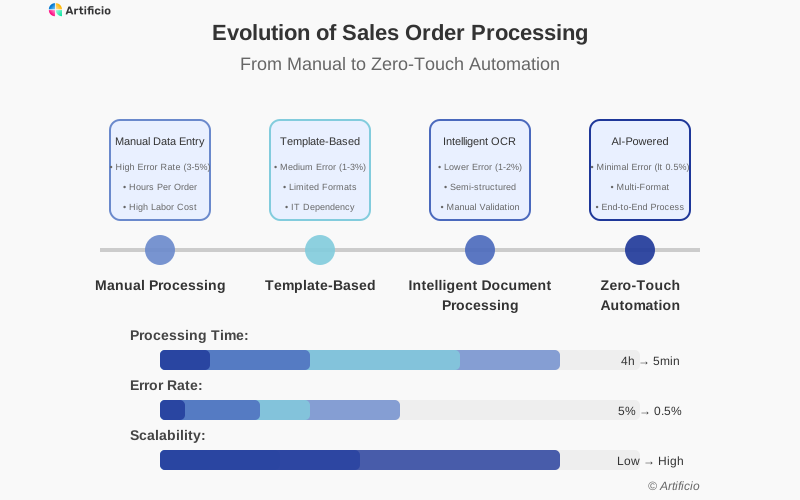
This evolutionary perspective provides essential context for understanding how Artificio's solution represents not merely an incremental improvement but a transformative approach to sales order processing one that fundamentally redefines operational possibilities for modern enterprises.
Artificio's zero-touch sales order processing system rests on a sophisticated technological foundation that combines multiple advanced AI disciplines. Understanding these underlying technologies helps illuminate how the system achieves its remarkable accuracy and adaptability across diverse document types and processing scenarios.
At the core of Artificio's solution is a multi-modal AI architecture that integrates several specialized technologies:
These technologies work in concert to create a processing engine that can handle the complexity and variability inherent in real-world sales order documents.
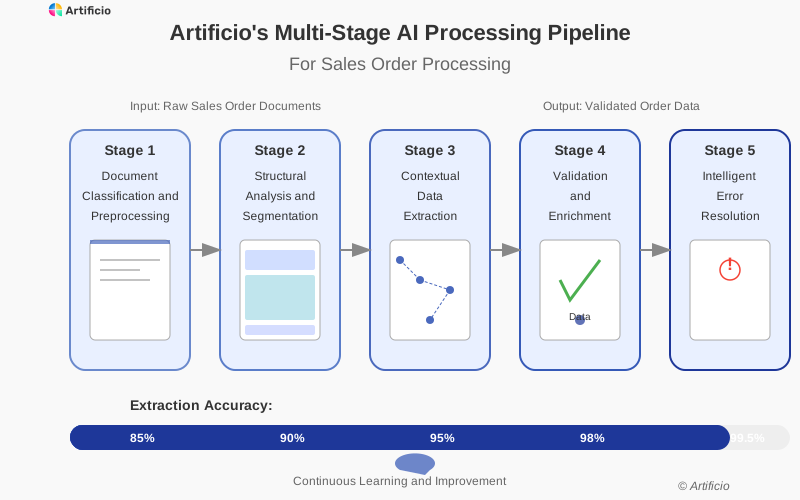
Artificio's solution implements a sophisticated multi-stage processing pipeline that progressively refines data extraction and validation:
Stage 1: Document Classification and Preprocessing
The initial stage involves identifying the document type, language, and format. The system applies appropriate preprocessing techniques to optimize the document for subsequent analysis, including deskewing, noise reduction, and resolution enhancement when necessary.
Stage 2: Structural Analysis and Segmentation
The system analyzes the document's structure, identifying header sections, line items, tables, and footer information. This structural understanding enables targeted extraction strategies for different document components.
Stage 3: Contextual Data Extraction
Rather than treating each data point in isolation, Artificio's system employs contextual extraction that considers relationships between data elements. For example, when extracting line item information, the system understands the relationship between product codes, descriptions, quantities, and prices, allowing it to correctly associate related information even when layout varies.
Stage 4: Validation and Enrichment
Extracted data undergoes multiple validation checks against business rules, historical data, and external systems. The system can automatically enrich extracted information by pulling additional details from integrated systems, such as current pricing information or customer-specific discounts.
Stage 5: Intelligent Error Resolution
When discrepancies or potential errors are detected, the system applies confidence scoring and probabilistic reasoning to determine appropriate actions whether to proceed with high-confidence data, flag for human review, or apply automatic corrections based on historical patterns.
Figure 2 illustrates this multi-stage processing pipeline and the flow of information through the system:
Perhaps the most powerful aspect of Artificio's technological foundation is its continuous learning capability. The system implements several mechanisms to improve performance over time:
This continuous learning approach means that Artificio's solution becomes increasingly valuable over time, as each processed document contributes to system improvement and adaptation to specific customer needs.
Given the sensitive nature of sales order information, Artificio has implemented a security-first architecture that maintains data protection throughout the processing workflow:
This technological foundation enables the comprehensive feature set that distinguishes Artificio's zero-touch sales order processing solution in the marketplace, which we will explore in the following section.
Artificio's zero-touch sales order processing solution incorporates a comprehensive set of features designed to address the full spectrum of challenges associated with traditional order processing. These features work in concert to create a seamless, highly automated workflow that minimizes manual intervention while maximizing accuracy and efficiency.
One of the most significant challenges in sales order processing is the diversity of formats in which orders are received. Artificio's solution excels in this area, providing robust capabilities for handling multiple document formats:
This multi-format capability eliminates the need for standardized order submissions, allowing customers to continue using their preferred ordering methods while the business still benefits from automated processing.
Business operations often involve various order types, each with unique processing requirements. Artificio's solution supports this diversity through specialized handling for different order scenarios:
This versatility ensures that organizations can maintain consistent processing efficiency regardless of order type or complexity.
A foundational capability of Artificio's solution is its automatic classification system that intelligently categorizes incoming orders:
This automated classification eliminates the manual sorting and routing that typically consumes significant time in traditional processing environments.
Perhaps the most technically impressive feature of Artificio's solution is its data extraction capability, which achieves remarkable accuracy across diverse document formats:
As shown in Figure 3, the multi-layered extraction approach achieves progressively higher accuracy rates:
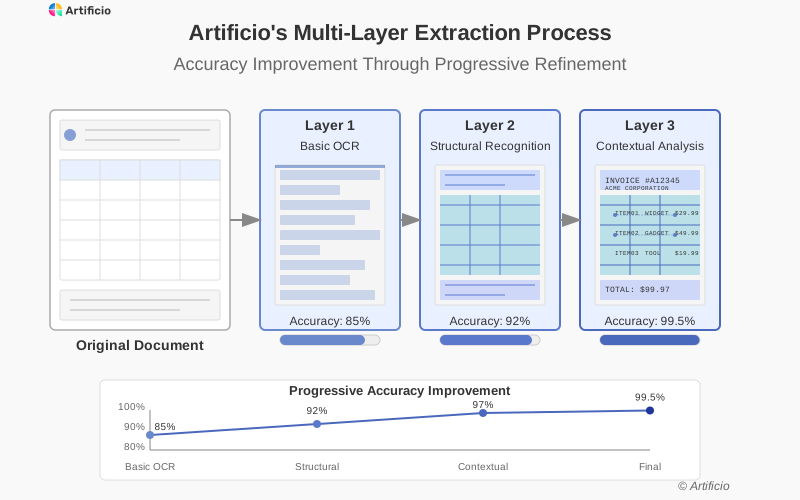
The system routinely achieves extraction accuracy rates of 97-99.5% even for complex documents, significantly outperforming industry benchmarks for automated data extraction.
Extracting data is only valuable when it can be seamlessly integrated into business systems. Artificio's solution excels in this critical area:
This seamless integration capability ensures that the efficiency gains from automated extraction translate directly into operational benefits throughout the order-to-cash cycle.
Data accuracy is paramount in sales order processing, and Artificio's solution incorporates comprehensive validation capabilities:
These validation capabilities ensure that only accurate, business-compliant orders progress to fulfillment, minimizing costly errors and exceptions.
When discrepancies or potential errors are identified, Artificio's solution provides sophisticated mechanisms for resolution:
This approach transforms error handling from a time-consuming manual process to an efficient, continuously improving component of the workflow.
For scenarios requiring human oversight, Artificio's solution includes comprehensive verification and approval workflows:
These collaborative capabilities ensure that when human intervention is required, it occurs in the most efficient and effective manner possible.
A particularly valuable feature of Artificio's solution is its no-code approach to workflow customization:
This no-code approach significantly reduces implementation time and total cost of ownership while increasing business agility and responsiveness to changing requirements.
The culmination of the processing workflow is seamless integration with enterprise systems:
These integration capabilities ensure that automated order processing delivers tangible benefits throughout the order-to-cash cycle, not just in the initial data capture phase.
Successful deployment of zero-touch sales order processing requires more than advanced technology it demands a thoughtful implementation approach that addresses organizational, process, and change management considerations. Artificio has developed a comprehensive implementation methodology based on extensive experience across diverse industry sectors.
The implementation journey begins with a thorough assessment of current order processing operations:
Process Analysis: Artificio's implementation team conducts detailed analysis of existing order processing workflows, documenting current states, pain points, and performance metrics. This analysis typically reveals opportunities for process optimization beyond simple automation.
Document Analysis: A representative sample of sales order documents is analyzed to understand format variations, information organization, and special processing requirements. This analysis informs system configuration and training requirements.
System Integration Assessment: Existing ERP systems and related infrastructure are evaluated to determine optimal integration approaches and identify any technical prerequisites for implementation.
ROI Modeling: Based on current processing volumes, costs, and performance metrics, a detailed return on investment model is developed, establishing clear expectations for implementation outcomes and benefits realization timeframes.
This assessment phase typically requires 2-4 weeks depending on organizational complexity and culminates in a detailed implementation roadmap.
Artificio implements its solution using a phased approach that minimizes business disruption while rapidly delivering value:
Phase 1: Core System Configuration
The initial implementation phase focuses on establishing the foundational system components:
This phase typically requires 4-6 weeks and establishes a functional system capable of processing standard order formats.
Phase 2: Expansion and Refinement
The second phase extends system capabilities to address more complex scenarios:
During this 3-4 week phase, the system progressively handles a broader range of order scenarios while accuracy continues to improve through ongoing learning.
Phase 3: Advanced Optimization
The final implementation phase focuses on maximizing automation rates and system performance:
Throughout implementation, a parallel change management program ensures that affected personnel understand system capabilities, new processes, and their evolving roles in the automated environment.
Successful deployment requires thoughtful attention to the human elements of the transformation:
User Training: Comprehensive training programs are developed for different user roles, focusing on exception handling, system monitoring, and workflow management rather than routine processing tasks that become automated.
Process Transition: Clear guidance is provided for transitioning from manual to automated processes, with defined cutover points and fallback procedures to ensure business continuity.
Performance Support: Just-in-time learning resources, including video tutorials and interactive guides, help users navigate new workflows and system interfaces.
Change Communication: Structured communication plans ensure all stakeholders understand implementation progress, expected changes, and realized benefits throughout the deployment journey.
This human-centered approach significantly enhances adoption rates and accelerates time-to-value for the overall solution.
Implementation extends beyond initial deployment through a structured continuous improvement approach:
Performance Monitoring: Key metrics are continuously tracked against baseline measurements and target objectives, providing visibility into improvement areas.
Regular Model Retraining: AI models are periodically retrained with new document examples, ensuring ongoing adaptation to evolving document formats and business requirements.
Workflow Optimization: Processing workflows are regularly reviewed and refined based on performance data and user feedback, further increasing automation rates over time.
Quarterly Business Reviews: Structured review sessions assess solution performance against business objectives, identify new optimization opportunities, and plan enhancement initiatives.
This continuous improvement framework ensures that the value delivered by Artificio's solution increases over time, with automation rates typically improving by 5-10% annually even after initial implementation targets are achieved.
Organizations implementing Artificio's zero-touch sales order processing solution typically experience transformative business impacts across multiple dimensions. The following section examines these benefits with reference to actual implementation outcomes across diverse industry sectors.
The most immediate and visible benefit is dramatic improvement in operational efficiency:
Processing Time Reduction: Average order processing times decrease from hours or days to minutes or seconds. Organizations typically report 85-95% reductions in end-to-end processing times, with standard orders routinely processed in under five minutes versus industry averages of 4+ hours for manual processing.
Labor Productivity Enhancement: Staff previously dedicated to manual data entry and validation can be redirected to higher-value activities such as customer service, sales support, or exception management. Most organizations achieve 60-80% reduction in labor requirements for routine order processing, often without workforce reduction through natural attrition and role evolution.
Volume Scalability: The solution enables organizations to handle substantial order volume increases without proportional staffing growth. Several Artificio customers have managed 30-50% growth in order volumes with existing staff resources, eliminating historical correlations between business growth and processing headcount.
Peak Period Management: The elastic capacity of the automated solution eliminates processing backlogs during seasonal peaks or promotional periods. Retailers implementing the solution have reported elimination of holiday season processing delays that previously ranged from 3-7 days during peak periods.
These efficiency gains translate directly to bottom-line benefits, with organizations typically achieving full return on investment within 6-12 months of implementation completion.
Beyond efficiency, zero-touch processing delivers substantial quality enhancements:
Error Rate Reduction: Organizations implementing Artificio's solution report error rate reductions from typical manual processing levels of 3-5% to automated processing error rates below 0.5%. This represents an order of magnitude improvement in processing quality.
Downstream Impact Reduction: Lower error rates dramatically reduce costly downstream issues such as incorrect shipments, customer disputes, and reconciliation efforts. Several manufacturing companies have reported 70-85% reductions in order-related customer service calls following implementation.
Consistent Application of Business Rules: The solution ensures that all orders undergo identical validation processes, eliminating the variability inherent in manual processing. This consistency is particularly valuable for regulated industries or organizations with complex compliance requirements.
Exception Identification Precision: When potential issues are identified, the system provides specific information about the nature and location of exceptions, enabling precise and efficient resolution. This precision typically reduces exception handling time by 40-60% compared to manual processes.
These quality improvements contribute significantly to overall ROI while simultaneously enhancing customer satisfaction and compliance posture.
Zero-touch processing creates substantial opportunities for customer experience differentiation:
Faster Order Confirmation: Automated processing enables near-immediate order confirmation, providing customers with rapid acknowledgment and fulfillment information. Organizations typically reduce order acknowledgment times from hours or days to minutes.
Increased Order Visibility: Integration between processing and fulfillment systems provides customers with enhanced visibility throughout the order lifecycle. Several distribution companies have implemented customer portals showing real-time order status enabled by the automated processing infrastructure.
Error Reduction Impact: Fewer processing errors translate directly to improved customer experiences through accurate, on-time deliveries and correct invoicing. Multiple implementation case studies show correlation between reduced processing errors and improved customer satisfaction metrics.
Capacity for Personalization: With staff relieved of routine processing tasks, organizations can dedicate more resources to personalized customer interactions and service enhancements. Several Artificio customers have repurposed former data entry staff into customer success roles, providing proactive order management and relationship development.
These customer experience improvements often translate to measurable business outcomes including increased retention rates, higher share of wallet, and improved competitive positioning.
Zero-touch processing delivers compelling financial benefits beyond the obvious efficiency gains:
Direct Cost Reduction: Beyond labor savings, organizations experience reductions in error correction costs, processing overtime, temporary staffing needs, and physical storage requirements. These combined savings typically range from $10-20 per order processed.
Cash Flow Improvement: Faster processing enables quicker fulfillment and invoicing, improving cash flow velocity. Manufacturing organizations have reported average invoicing time improvements of 2-3 days, with corresponding improvements in days sales outstanding metrics.
Revenue Leakage Prevention: Improved accuracy in pricing application and discount management prevents revenue leakage that occurs in manual environments. Several distribution companies have identified 1-2% revenue recovery through elimination of pricing errors and missed charge opportunities.
Resource Optimization: With staff focused on exception handling rather than routine processing, organizations achieve better utilization of skilled personnel. This optimization frequently allows handling of increased business volumes without proportional headcount growth.
The combined financial impact typically delivers ROI within 6-12 months, with ongoing benefits accruing as automation rates improve through continuous learning.
Beyond operational and financial benefits, zero-touch processing creates strategic advantages for forward-thinking organizations:
Business Scalability: Automated processing removes traditional constraints on growth, allowing organizations to scale operations without proportional increases in administrative overhead. This scalability enables pursuit of new market opportunities with confidence in operational capabilities.
Data-Driven Decision Making: The structured data generated through automated processing creates unprecedented visibility into ordering patterns, customer behaviors, and operational performance. This visibility enables more informed strategic decision making across multiple business dimensions.
Competitive Differentiation: Enhanced processing capabilities create meaningful competitive differentiation through improved responsiveness, accuracy, and customer experience. Several organizations have successfully incorporated their advanced processing capabilities into sales messaging and customer value propositions.
Organizational Agility: The configurable nature of Artificio's solution enables rapid adaptation to changing business conditions, new product offerings, or market requirements. This agility represents a substantial advantage in volatile business environments.
These strategic benefits, while less immediately quantifiable than operational improvements, often represent the most significant long-term value of zero-touch processing implementation.
As transformative as current zero-touch processing capabilities are, the technology continues to evolve rapidly. Artificio maintains an aggressive development roadmap focused on expanding capabilities and addressing emerging business needs.
Several advanced capabilities are already in development or early deployment stages:
Predictive Analytics Integration: Next-generation processing systems will incorporate predictive capabilities that identify potential supply chain issues, forecast order patterns, and proactively suggest inventory adjustments based on processing trends.
Natural Language Interaction: Future systems will provide natural language interfaces for exception handling and system interaction, allowing users to resolve complex issues through conversational interaction rather than form-based interfaces.
Autonomous Decision Making: Advanced AI capabilities will enable systems to make independent decisions for certain exception types based on historical patterns and business rules, further reducing human intervention requirements.
Cross-Functional Process Integration: Zero-touch processing will extend beyond traditional boundaries to create seamless connections between sales, procurement, production, and logistics processes, enabling truly integrated supply chain operations.
These emerging capabilities will further extend the value proposition of zero-touch processing beyond current implementation outcomes.
Organizations considering zero-touch processing implementation should keep several key factors in mind:
Process Optimization Opportunity: Implementation provides an ideal opportunity to optimize underlying business processes rather than simply automating existing workflows. Organizations achieve greatest benefits when they rethink process fundamentals rather than merely applying automation to current approaches.
Change Management Priority: Successful implementation requires thoughtful attention to workforce transition, with clear communication about evolving roles and new value creation opportunities for affected staff. Organizations that invest in comprehensive change management consistently achieve faster adoption and higher satisfaction.
Integration Strategy: The transformative potential of zero-touch processing is maximized when the solution is thoughtfully integrated with adjacent systems including customer portals, inventory management, and analytics platforms. Developing a comprehensive integration strategy prior to implementation enhances long-term value realization.
Phased Implementation Value: While comprehensive deployment delivers maximum benefits, organizations can achieve significant value through phased approaches that begin with highest-volume order types or customers. This incremental approach reduces implementation complexity while delivering early ROI to fund broader initiatives.
These considerations should inform strategic planning and implementation approaches for organizations pursuing zero-touch processing capabilities.
Artificio's zero-touch sales order processing solution represents a paradigm shift in business operations transforming what was once a labor-intensive, error-prone process into a streamlined, intelligent workflow that enhances efficiency, accuracy, and customer experience simultaneously. By leveraging advanced AI technologies including computer vision, natural language processing, and machine learning, the solution addresses longstanding challenges in sales order management while creating new possibilities for business optimization.
The comprehensive feature set spanning multi-format order handling, diverse order type processing, high-accuracy data extraction, and seamless ERP integration enables truly end-to-end automation of the order processing lifecycle. This automation delivers quantifiable benefits across multiple dimensions, from dramatic efficiency improvements and error rate reductions to enhanced customer experiences and strategic advantages.
For forward-thinking organizations seeking operational excellence and competitive differentiation, zero-touch sales order processing represents not merely an incremental improvement but a transformative capability that redefines what's possible in modern business operations. As the technology continues to evolve, early adopters position themselves to capture sustainable advantages in efficiency, quality, and customer experience that will increasingly differentiate market leaders from followers.
The future of business operations is intelligent, automated, and customer-centric and Artificio's zero-touch sales order processing solution provides a compelling path to that future for organizations ready to embrace transformative change.
Artificio is a pioneer in artificial intelligence and machine learning solutions for document processing. The company's flagship platform offers both pre-trained and custom-trained models, allowing users to tailor extraction processes to their specific needs. With an intuitive annotation tool, automated data extraction capabilities, and in-depth analytics, Artificio helps businesses streamline data management, improve accuracy, and make more informed decisions. The company's solutions are designed with security, scalability, and regulatory compliance as foundational principles, ensuring that clients can implement transformative technologies with confidence.

Head IT Operations - Co Founder of Artificio
See it in your SAP environment
Bring us a document, a process, or a bottleneck. We'll show how Artificio captures, validates, and posts into SAP — then scale from there.
Security & compliance
ISO 27001:2013 certified, SOC 2 Type 2 compliant, GDPR and HIPAA ready. Every agent action is logged, auditable, and runs in isolated environments.