

Blog
Why Your Business Needs an AI Chatbot That Actually Understands Documents (and Websites Too)
Stop wasting time searching. Modern AI chatbots read PDFs, websites, and text across multiple sources to give you instant, cross-referenced answers.
Blog
Stop wasting time searching. Modern AI chatbots read PDFs, websites, and text across multiple sources to give you instant, cross-referenced answers.
Picture this. You've got a 300-page contract sitting on your desk, a competitor's website open in another tab, and a client asking questions that require information from both. The traditional approach means hours of scrolling, switching between tabs, and manually connecting the dots.
But what if you could just ask a question and get an answer that pulls from all your sources at once?
That's exactly what modern document AI chatbots are designed to do. And the best ones don't limit you to just PDFs anymore.
Most professionals spend about 20% of their workweek searching for information buried in documents. That's essentially one full day every week lost to hunting through PDFs, contracts, reports, and spreadsheets.
But here's what makes the problem even worse. Business decisions rarely depend on a single document. You need to cross-reference contracts with website terms, compare internal reports with industry data online, or verify claims in a proposal against a company's public information.
Traditional search tools don't help with this. They find keywords in one place at a time. They can't understand context across multiple sources. They definitely can't tell you how information in a PDF relates to what's on a live website.
This is where AI-powered document chatbots are changing everything, especially the ones that can work with more than just documents.
The real breakthrough in document AI isn't just about reading PDFs faster. It's about breaking down the walls between different types of information.
Think about what you actually work with every day. You've got PDFs and Word documents, sure. But you also have websites you need to research, text snippets from emails you've copied, Excel files with data you need to reference. Traditional document chatbots force you to deal with each of these separately.
Artificio's Document Chat takes a different approach. You can upload a document, paste in some text, and add a website URL, then chat with all of them together as a single knowledge base. The AI maintains context across every source, understanding how information in your uploaded contract relates to what's published on a company's website.
This opens up entirely new workflows.
Want to verify that a vendor's proposal matches their public pricing? Upload the proposal and add their website URL. Need to compare your internal policy document against industry standards published online? Combine them in one chat. Researching a company before a meeting? Pull in their annual report, their website, and any news articles you've found. 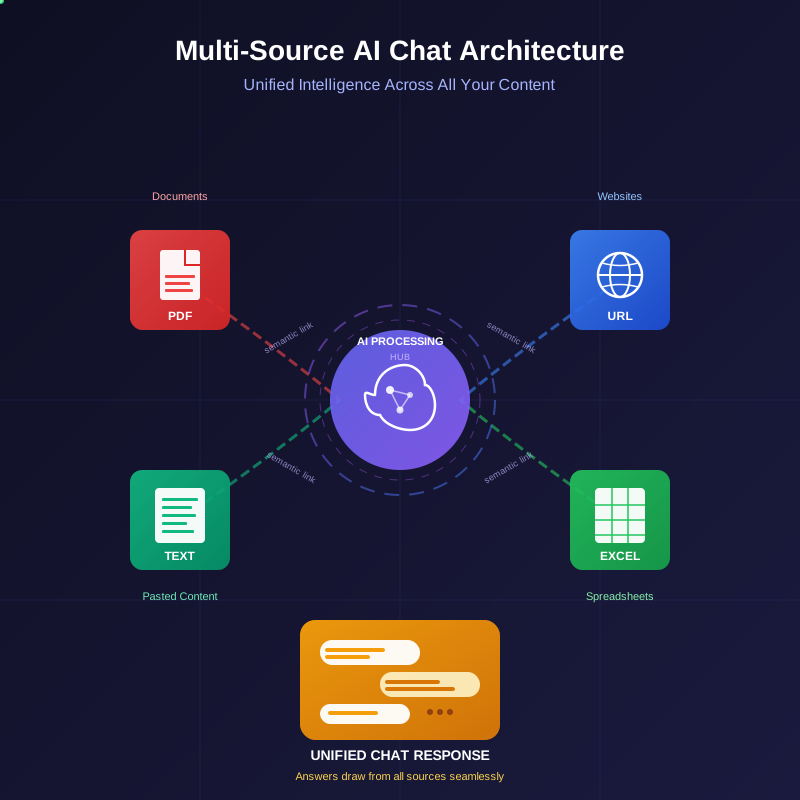
The real question isn't whether AI can read documents. It can. The question is whether it can understand them the way a human expert would, and whether it can do that across multiple sources simultaneously.
A truly useful document chatbot needs to excel in four areas.
Handling large files without breaking. Most chat platforms cap file sizes at 10-25MB, which means you're forced to split large documents into fragments. This destroys context and severs the relationships between different sections. When you're analyzing a comprehensive annual report or a complex legal agreement, losing that context is a dealbreaker. Artificio supports files up to 500MB, letting you upload complete documents as single coherent units.
Semantic understanding across sources. Keyword matching isn't enough. The AI needs to grasp meaning, recognize when different sections reference each other, and maintain those connections throughout your conversation. When you're working with multiple sources, this becomes even more critical. The AI needs to understand that "pricing" in your uploaded proposal relates to the "rates" section on the vendor's website.
Website crawling that actually works. Adding a URL to your chat should give you the full picture, not just a snapshot. The AI needs to understand web page structure, extract meaningful content, and connect that information to whatever documents you've also included.
Speaking your language. Global businesses deal with documents and websites in dozens of languages. A useful chatbot handles that without requiring translations beforehand, supporting over 50 languages with native understanding.
Here's something most people don't realize about document AI platforms. The file size limit isn't just an inconvenience. It's a fundamental architectural limitation that affects accuracy.
When you split a 500MB document into smaller chunks, you're not just creating more files. You're breaking cross-references, severing data relationships, and forcing the AI to analyze fragments without the full picture.
The same principle applies to multi-source analysis. If you have to analyze your documents and research websites in separate sessions, you lose the ability to make connections between them. The AI can't tell you that clause 12 in your contract contradicts what's stated on the vendor's FAQ page if it can't see both at once.
Artificio's approach keeps everything together. Upload your massive annual report, add the company's investor relations website, paste in relevant text from analyst notes, and chat with all of it as one unified knowledge source.
Let's look at how this multi-source capability plays out in practice.
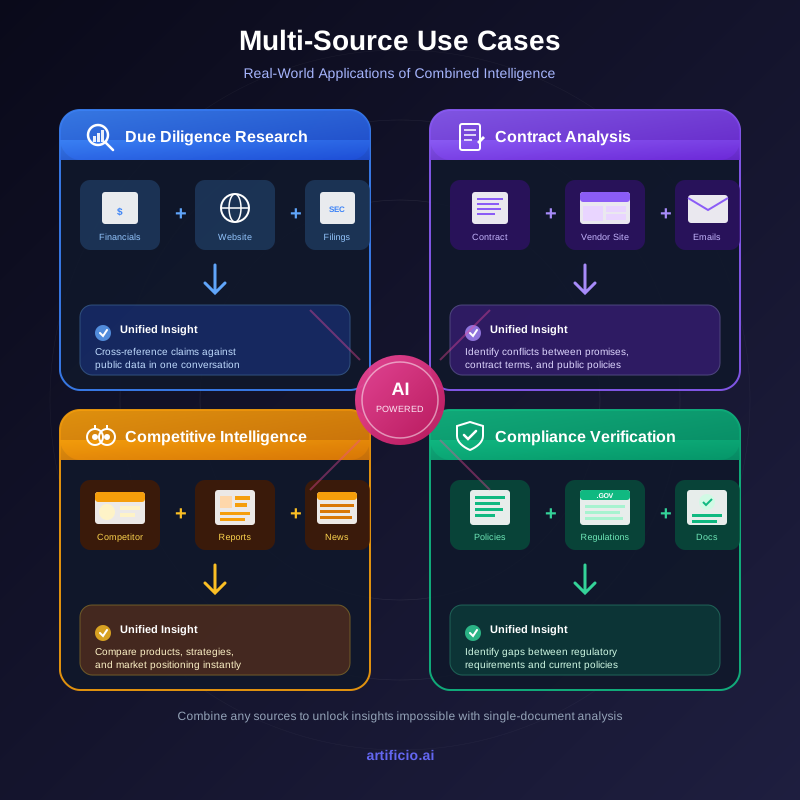
Due Diligence Research. You're evaluating a potential acquisition target. Upload their financial statements, add their corporate website, include any SEC filings, and start asking questions. The AI can cross-reference claims in their investor presentation against their actual financial data and public disclosures, all in one conversation.
Contract Analysis. You've got a vendor contract to review. Upload the contract PDF, add the vendor's terms of service page, and paste in any email correspondence about the deal. Ask the AI to identify any conflicts between what was promised in emails, what's in the contract, and what their public terms say.
Competitive Intelligence. Research a competitor by combining their public website, any product documentation you've obtained, industry reports you've downloaded, and news articles. Ask comparative questions that draw insights from all sources simultaneously.
Compliance Verification. Upload your internal policies, add relevant regulatory websites, and include any compliance documentation. The AI can help identify gaps between what regulations require and what your policies actually cover.
When you're uploading sensitive documents and pointing AI at confidential information, security isn't optional.
Artificio processes documents in isolated, encrypted environments. Files aren't stored permanently on servers and get automatically deleted after processing. The platform complies with GDPR, HIPAA, and other major privacy regulations.
This matters even more when you're combining multiple sources. You need confidence that your internal documents aren't being mixed with other users' data, and that the AI isn't retaining information from your sessions.
How does AI actually maintain context across a 400-page PDF, two websites, and a pasted text snippet all at once?
The secret is semantic relationship mapping. Rather than treating each source as separate information, advanced document AI builds a unified understanding of all your content. It creates connections between related concepts regardless of which source they came from.
When you ask a question, the AI doesn't search each source independently and combine results. It queries its unified understanding of all your content, returning answers that naturally draw from wherever the relevant information lives.
This is why you can ask complex questions like "Does the vendor's website pricing match what's in our contract?" and get a coherent answer. The AI understands both sources as parts of one knowledge base.
Most document chat platforms make you choose between power and simplicity. Artificio's approach is different.
The free plan includes 5 documents per month with files up to 100MB and basic chat features. That's enough to test the multi-source workflow and see how it fits your needs. You can mix documents with URLs and pasted text right from the start.
For teams with heavier requirements, paid plans expand the document limits and file size capacity. Enterprise options add advanced security controls and compliance certifications.
Document AI chatbots have moved beyond simple PDF reading. The real value now comes from platforms that can work across multiple source types, maintain context between them, and handle the large files businesses actually deal with.
If you're still switching between tabs, manually cross-referencing documents against websites, and losing context in the process, there's a better way.
Upload your documents. Add your URLs. Paste your text. Start asking questions. That's the workflow modern businesses need.

Head IT Operations - Co Founder of Artificio
See it in your SAP environment
Bring us a document, a process, or a bottleneck. We'll show how Artificio captures, validates, and posts into SAP — then scale from there.
Security & compliance
ISO 27001:2013 certified, SOC 2 Type 2 compliant, GDPR and HIPAA ready. Every agent action is logged, auditable, and runs in isolated environments.