

Blog
Document AI: Your Accidental Business Intelligence Detective
Discover how routine document processing AI uncovers hidden fraud, pricing secrets, and workflow flaws.

Blog
Discover how routine document processing AI uncovers hidden fraud, pricing secrets, and workflow flaws.
It started with a routine Tuesday morning. The accounts payable team at a mid-sized manufacturing company was processing vendor invoices like they'd done thousands of times before. Their document AI system was humming along, extracting line items, purchase order numbers, and payment terms with its usual precision. Everything looked normal until the system flagged something unusual in its weekly anomaly report.
Three different vendor names. Three different tax IDs. Three different bank accounts. But all three vendors had submitted invoices with identical phone numbers buried in the fine print of their contact information.
Nobody had asked the AI to look for this. Nobody had programmed it to cross-reference phone numbers across vendor databases. The system was just doing its job, extracting data from invoices, and somewhere in its processing, it noticed a pattern that didn't make sense. What the team discovered when they investigated changed everything. Those three "vendors" were actually the same business, inflating costs by billing through multiple entities. The fraud had been running for eighteen months, costing the company over $480,000.
The AI wasn't playing detective. It was just paying attention.
This is the story nobody tells you about document processing AI. Everyone focuses on what these systems are designed to do: extract data, classify documents, validate information. That's the job description. But there's something else happening in the background, something far more valuable than accurate data extraction. While your AI is processing millions of documents, it's building a massive web of connections, patterns, and relationships. It's seeing things that humans can't possibly see because humans don't have the capacity to hold 50,000 invoices in their head at once and spot the subtle patterns weaving through them.
Your document AI isn't just extracting data. It's accidentally becoming the most observant business analyst you've ever had.
Think about what happens when you hire a business intelligence analyst. You give them specific questions to answer. You want to know your top-performing products, your most reliable suppliers, your seasonal trends. They run reports, build dashboards, create presentations. They answer the questions you knew to ask.
Document AI does something different. It doesn't wait for questions. It processes every invoice, every contract, every purchase order, every claim form that flows through your business. While it's extracting the data you need, it's also noticing everything else. The timestamps. The approval chains. The subtle variations in pricing. The patterns in vendor behavior. The anomalies in payment terms. The relationships between seemingly unrelated documents.
A procurement manager at a logistics company discovered this by accident. Their AI system had been processing supplier invoices for eight months when someone asked a simple question during a budget meeting: "Why does it feel like we're paying more for the same stuff this year?" The finance team started digging through the data, and that's when they noticed something the AI had been quietly documenting all along.
One of their largest suppliers was charging different prices for identical items based on which department placed the order. Not by a little bit either. The facilities team was paying 18% more for the exact same industrial cleaning supplies that the warehouse team was buying from the same vendor. Same part numbers, same quantities, different prices. The pattern was consistent across dozens of purchase orders spanning six months.
The AI had extracted all this data faithfully. It had captured every line item, every unit price, every department code. But the real value wasn't in the extraction. It was in the fact that the AI had processed enough documents to see the pattern that no human could have spotted by manually reviewing invoices one at a time.
When they confronted the supplier, the response was almost casual: "Different departments, different pricing agreements." Except there were no different pricing agreements. There was just a vendor testing whether anyone was paying attention. They weren't, but the AI was.
The company renegotiated their entire contract, standardized pricing across all departments, and saved $340,000 in the first year alone. All because their document AI noticed something it was never specifically asked to look for.
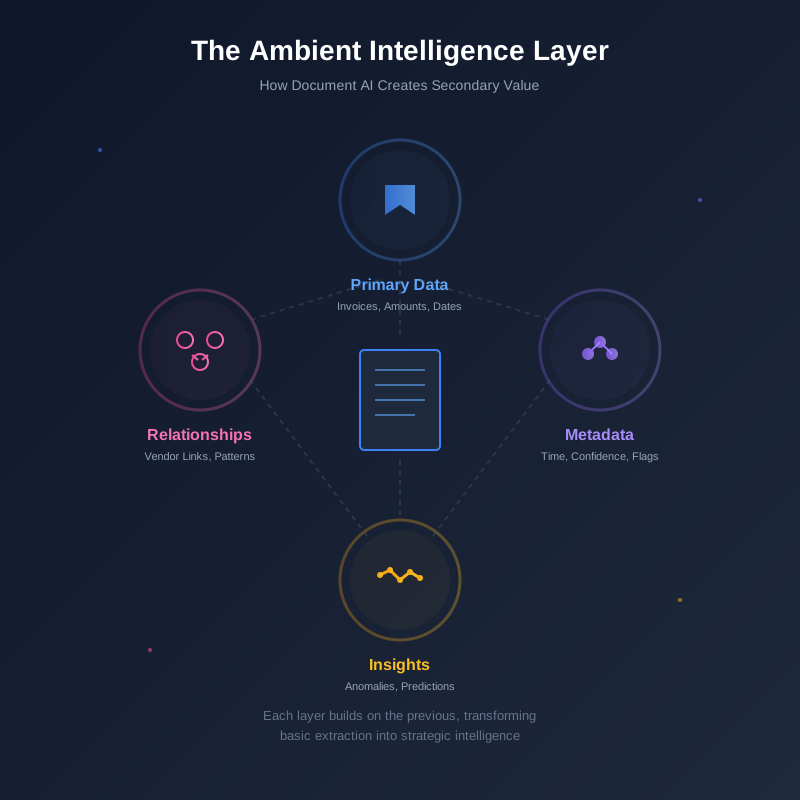
Here's what most companies don't realize about document processing. The data you extract from documents is valuable, but the metadata the AI generates while processing those documents can be even more valuable.
Every time your AI touches a document, it creates a trail of information. When was the document received? How long did it take to process? Which fields required manual review? Which data points triggered validation rules? How many times was the document accessed? Who approved it? How does this document relate to others in the system?
This metadata forms a kind of ambient intelligence layer, a secondary dataset that captures not just what's in your documents, but how your business actually works. And once you have enough of this metadata, patterns start emerging that tell you things you didn't know you needed to know.
An insurance company processing claims discovered this when they started looking at their AI system's processing logs. They wanted to know why certain claims were taking longer to resolve than others. What they found was more interesting than a simple bottleneck.
The AI had been tracking which claims adjusters handled which types of claims. Standard stuff. But when they looked at the approval patterns, something jumped out. One particular adjuster approved 94% of property damage claims over $10,000 but only 67% of claims under that threshold. The exact opposite pattern of every other adjuster in the department, who were more cautious with high-value claims and more lenient with smaller ones.
This wasn't fraud. It turned out the adjuster had developed an unofficial policy of fast-tracking larger claims to maintain customer satisfaction with high-value clients, while scrutinizing smaller claims more carefully to hit department accuracy targets. Nobody had asked them to do this. It had just evolved over time as a personal workflow optimization.
The problem was that this approach was statistically backwards. Smaller claims actually had a higher fraud rate in their specific market segment. By focusing scrutiny on the wrong claims, this well-intentioned adjuster was inadvertently creating a vulnerability. The AI didn't flag this as suspicious. It just processed the claims and documented the patterns. But once someone looked at the metadata, the pattern was impossible to miss.
There's a particular category of accidental discovery that comes from something most people think of as completely mundane: timestamps. Every document has them. Creation dates, submission dates, approval dates, modification dates. They're the kind of data that gets extracted and stored and then promptly ignored because everyone assumes timestamps are just timestamps.
Except they're not. Timestamps are behavior patterns written in numbers. And when you have enough of them, they start telling stories about how work really happens in your organization.
A commercial real estate company learned this lesson through their contract management system. They'd implemented document AI to handle their lease agreements, which was working beautifully. The system extracted terms, dates, parties, obligations, everything they needed. But someone in operations noticed something odd in the processing logs.
Every contract that came through the regional office got a final signature timestamp between 11:45 PM and 12:15 AM. Not most contracts. Not many contracts. Every single one, for eight months straight.
This wasn't a fraud pattern. It wasn't even necessarily a problem. But it was definitely weird enough to investigate. What they found was a bottleneck nobody knew existed. The regional manager had been processing contract approvals in batch at the end of each day. But because of how their approval workflow was set up, their signature had to be the last one, which meant every contract was waiting until this manager finished their entire workload each day. The manager was staying until midnight every night to get through the stack.
The contracts were getting signed. The deals were closing. Everything was technically working. But the company was systematically adding 6-12 hours of unnecessary delay to every deal because of a workflow design that made sense on paper but created a human bottleneck in practice.
They restructured the approval chain. The midnight signatures stopped. Deal velocity increased by 23%. And the regional manager started getting home at a reasonable hour. All because the document AI was quietly documenting timestamps that told a story nobody was looking for.
The timestamp pattern also revealed something else. Before the workflow change, contracts that arrived Monday through Wednesday moved noticeably faster than Thursday and Friday contracts, which tended to roll into the following week because they hit the manager's desk when the backlog was largest. The company hadn't been considering submission timing as a factor in deal velocity, but the data showed it was costing them competitive opportunities. Armed with this insight, their sales team started strategically timing contract submissions to avoid the end-of-week crunch.
Vendor management is supposed to be straightforward. You have suppliers, they have vendor IDs in your system, you pay them for goods and services. But anyone who's worked in accounts payable knows the truth is messier. Vendors change names, get acquired, restructure, open new divisions. The same business might be in your system three different ways, and nobody notices until you're trying to negotiate volume discounts and realizing your spend is more fragmented than you thought.
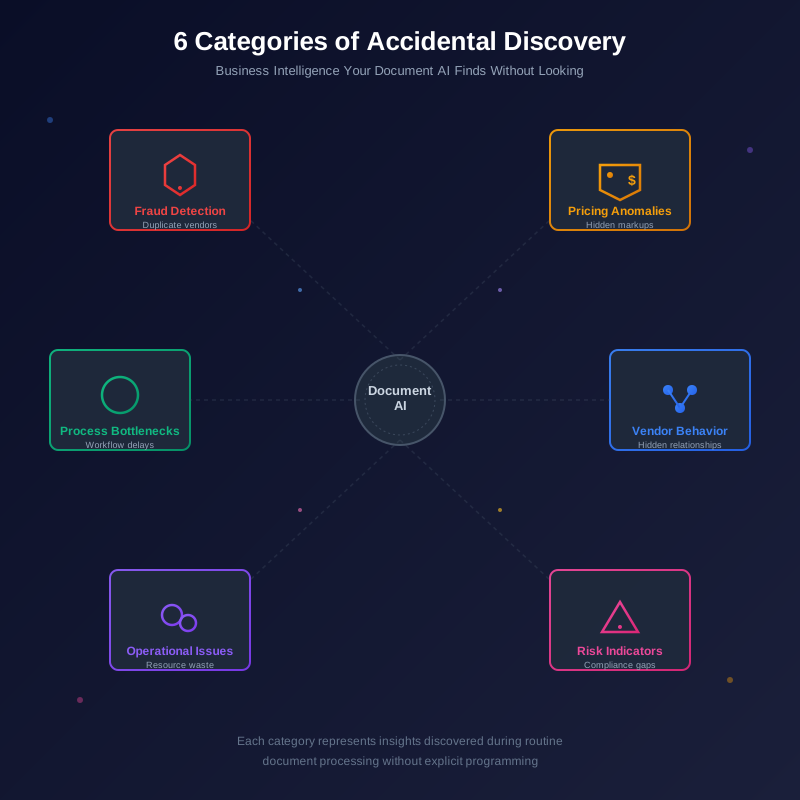
Document AI tends to notice these things before humans do. Not because it's programmed to look for duplicate vendors, but because it processes enough documents to spot patterns in the data that suggest the same entity is operating under different identities.
A healthcare system discovered this when their AI flagged an anomaly in medical supply invoices. Three different vendor names were submitting invoices for similar products, similar volumes, similar delivery schedules. Nothing suspicious there. Lots of vendors sell medical supplies.
But the AI noticed that all three vendors' invoices had a specific quirk in how they formatted line item descriptions. It was subtle, a particular way of abbreviating product codes that wasn't standard industry practice. It was the kind of thing a human might see once and not think about. But the AI had seen it hundreds of times across thousands of line items, and it was only these three vendors doing it.
When procurement investigated, they found that all three "vendors" were actually subsidiaries of the same parent company. Not disclosed as such in their vendor records. Not coordinated in their pricing or contracting. Each subsidiary was operating as an independent vendor, which meant the healthcare system was negotiating separate contracts, maintaining separate vendor relationships, and missing out on volume discounts that should have applied to their total spend across all three entities.
Once they consolidated the relationship and renegotiated as a single customer, their supply costs dropped by 12%. The contract terms improved. The administrative overhead of managing three vendor relationships collapsed into one. And it all started because the AI noticed that three supposedly independent businesses formatted their invoices the same weird way.
This pattern repeats itself across industries. Manufacturing companies discover that multiple parts suppliers are actually different divisions of the same manufacturer. Professional services firms find that various consultants they've hired are all operating under the same parent agency. Retailers realize that several wholesale distributors are subsidiaries of a single conglomerate.
The AI isn't hunting for these connections. It's just processing invoices and noticing patterns in how data is structured and formatted. But those patterns reveal relationships that aren't obvious from looking at vendor names and tax IDs alone.
Price fluctuations are normal in business. Supply and demand, seasonal changes, market conditions, all the usual factors. Companies expect prices to vary and generally accept it as part of doing business. But there's a difference between legitimate market fluctuations and vendors selectively adjusting their pricing based on whether they think you're paying attention.
Document AI doesn't understand market conditions. It just knows what prices were charged and when. But when you process enough invoices over a long enough timeline, pricing patterns become visible that reveal whether you're getting market rates or getting played.
A restaurant chain found this out when they started analyzing their food supplier invoices. Their AI had been extracting pricing data for over a year, and when the finance team pulled a report on year-over-year costs, something didn't look right about one particular supplier.
The supplier provided produce, and everyone knew produce prices fluctuated seasonally. That was expected. What wasn't expected was the specific pattern the AI's data revealed. This supplier's prices for certain items increased by an average of 22% during the company's busiest season, which happened to be a time when produce for those specific items was actually more abundant and should have been cheaper.
The supplier wasn't responding to market conditions. They were responding to the restaurant chain's business cycle. During peak season when the restaurants were slammed and everyone was focused on operations, not procurement, the prices quietly crept up. During slow months when the finance team had more time to review invoices, the prices came back down.
It was clever in a frustrating sort of way. The increases were gradual enough that no single invoice looked wrong. There was always a plausible explanation rooted in general seasonal trends. But the AI had processed enough invoices to see the real pattern. This wasn't seasonal pricing based on supply availability. This was seasonal pricing based on the customer's distraction level.
When confronted with the data, the supplier's response was about what you'd expect: lots of talk about commodity markets and supply chain complexity, very little about why their peak prices coincided precisely with their customer's busiest operational period rather than with actual produce scarcity.
The restaurant chain switched suppliers. Not because they minded dynamic pricing, but because they minded pricing that was dynamic in response to their attention span rather than actual market conditions. The AI made this visible by simply documenting what was paid and when, which created a dataset large enough to reveal the pattern.
Every document-intensive business has approval workflows. Invoices get approved, contracts get reviewed, claims get processed. These workflows are designed to maintain control and ensure proper oversight. But the actual behavior inside these workflows often looks very different from what the process map suggests.
Document AI sees the real workflow, not the official one. It tracks every approval action, every time a document sits waiting for someone's attention, every instance where the process jumps the rails and takes an unexpected path. And after processing thousands of documents, patterns emerge that show how work really flows through your organization.
A financial services company got an unexpected view into this when they started analyzing their loan approval data. Their document AI had been processing loan applications for two years, extracting all the standard information: income, credit scores, employment history, requested loan amounts. But the metadata around the approval process told a more interesting story.
Loan applications under $50,000 moved through the system in an average of 3.2 days. Applications between $50,000 and $100,000 took 4.1 days. You'd expect larger loans to take longer. More money at stake, more scrutiny required, makes sense.
But then something weird happened in the data. Applications between $100,000 and $150,000 took only 2.8 days to process. Faster than the small loans. And applications over $150,000 went back to taking longer, averaging 5.4 days.
This wasn't a system issue. The AI wasn't processing large loans faster. The approvers were. And when the company looked into why, they discovered an unofficial workflow optimization that had emerged organically across their approval team.
Loans in that $100,000 to $150,000 range hit a sweet spot. They were large enough to matter, so they got priority attention from senior approvers. But they were just below the threshold that required committee review, which meant they could be approved by a single senior underwriter. So these applications were essentially queue-jumping. They got attention from the most experienced people and didn't have to wait for committee meetings.
Smaller loans sat in junior underwriters' queues longer because those staff members had higher workloads. Larger loans sat in committee review queues waiting for scheduling. The medium-large loans sailed through because they landed on the desks of people who had both the authority to approve them and the experience to process them quickly.
This wasn't anyone's fault. It was actually a logical outcome of how the approval structure was designed. But nobody had realized it was happening until the AI's processing data made the pattern visible. And once visible, it raised interesting questions about whether the company's approval structure was actually optimized for customer experience or just for risk management.
They didn't change the system based on this information, but they did start tracking approval velocity as a customer experience metric, which led to some workflow adjustments that smoothed out the inconsistencies. The AI hadn't been asked to evaluate workflow efficiency. It was just documenting approval timestamps. But those timestamps told a story about how human decision-makers actually behaved inside the system.
Here's a weird one. Document AI gets better at predicting which documents are going to cause problems before it even finishes processing them. Not because it's analyzing the content for red flags, but because it's learning to recognize subtle patterns in document quality that correlate with downstream issues.
A mortgage processing company noticed this pattern in their exception queue. Their AI system was flagging certain loan applications for manual review, which was expected. But what was odd was that the AI was flagging some documents before it even attempted to extract key data fields. The system was basically saying "something's off here" before it knew what was off.
When they dug into the pattern, they found something surprising. The AI had learned to recognize subtle quality indicators in document images that predicted problems. Things like inconsistent page formatting, variations in text density across pages, mismatched font rendering between different sections of the same document, slight color shifts that suggested pages had been scanned on different equipment.
None of these things meant fraud. Most of the time they just meant that someone had compiled their loan application from documents created at different times or pulled from different sources. But statistically, documents with these quality inconsistencies were three times more likely to have data extraction errors, missing information, or require additional verification.
The AI hadn't been trained to look for this. It had just processed enough documents to recognize that certain visual patterns correlated with increased processing difficulty. And once it learned this pattern, it started using it as an early warning system. Documents with quality inconsistencies got routed to more experienced processors who knew to double-check everything, while clean documents went through standard automation.
This improved processing efficiency because it prevented documents likely to need manual review from going through multiple automated extraction attempts first. But it also revealed something about document quality that the mortgage company hadn't been explicitly tracking: borrowers who submitted visually inconsistent applications were often juggling documents from multiple sources and timeframes, which sometimes indicated financial instability or complexity that deserved extra attention.
The AI wasn't making judgments. It was just noticing that certain document characteristics predicted certain outcomes. But that information became useful for prioritizing work and allocating experienced human reviewers where they'd have the most impact.
Every business has relationships. Customers, vendors, partners, subsidiaries, contractors. What most businesses don't have is a clear view of how all these relationships connect to each other. You might know that Company A is your customer and Company B is your vendor, but you might not realize that Company A owns Company B, which creates all kinds of interesting questions about pricing, conflicts of interest, and negotiating leverage.
Document AI builds this relationship map accidentally. Not because it's doing network analysis, but because it processes documents that reference multiple entities and naturally starts building connections. An invoice from Vendor A that references Customer B's purchase order. A contract between Company C and Company D that mentions Company E as a subcontractor. A claim form from Individual F that lists Company G as their employer.
Process enough documents and these references start forming a web. And occasionally that web reveals relationships nobody knew existed.
A manufacturing company discovered this when their procurement team was negotiating a major parts contract. They were choosing between two suppliers based on price and quality. The evaluation had been going on for weeks, with both suppliers submitting proposals, samples, and references. The decision was basically a coin flip.
Then someone in procurement happened to mention the negotiation to the finance team, who were in the middle of reviewing vendor invoices. One of the finance analysts remembered seeing something odd in the AI's extracted data and went digging. Turned out both suppliers had submitted change-of-address notifications within the past year, and both new addresses were the same office building in the same mid-sized city.
Same building wasn't proof of anything. Lots of companies share office space. But it was curious enough to warrant a deeper look. That's when they found it: both companies had invoices that referenced the same accounts payable contact name, just in different roles at each company. Same person handling AR for one supplier and AP for another.
More digging revealed that the two "competing" suppliers were actually sister companies under the same parent organization. Not disclosed in their vendor registration. Not mentioned in their proposals. They were running parallel bids to increase the odds that one of them would win the contract, and possibly to anchor pricing expectations by having one bid high and one bid low.
The manufacturers canceled both proposals and chose a third supplier. Not because the sister companies were doing anything illegal, but because the company wanted actual competitive bids, not theater. The AI hadn't been doing background checks on vendors. It had just extracted addresses and contact information from various documents over time, and someone happened to notice the pattern.
This kind of accidental relationship discovery happens more often than you'd think. Companies find out their vendor is owned by their competitor. They discover their customer is a subsidiary of their largest supplier. They learn their contractor is using their own subcontractors to deliver services. None of this is necessarily problematic, but it's information worth knowing, and it often stays hidden until document AI processes enough paperwork to connect the dots.
Compliance is usually thought of as a checkbox exercise. Do you have the right fields filled in? Are the signatures present? Does the documentation meet regulatory requirements? Yes or no, pass or fail. But document AI that processes compliance documents at scale starts to notice patterns in how different entities approach compliance, and those patterns can be revealing.
A healthcare organization processing patient consent forms discovered this accidentally. Their AI system was validating that consent forms had all the required signatures, disclosures, and acknowledgments. Standard compliance checking. But the system also tracked which healthcare providers submitted forms and how those forms were structured.
After processing tens of thousands of consent forms, a pattern emerged. Most providers submitted consent forms that were 85-95% consistent in their structure and language. Makes sense since they were probably using the same template or legal review process. But one clinic consistently submitted forms that were only 60-70% similar to everyone else's forms.
The forms had all the required information. They met regulatory requirements. They were valid. But they were structurally different enough from the norm that the AI's similarity analysis flagged them as outliers.
When the compliance team investigated, they found that this clinic was using an older consent form template that hadn't been updated in several years. It was technically still compliant, but it was missing some newer language around data privacy and patient rights that had become standard practice across the industry. Nothing illegal, but definitely behind the curve.
This mattered because the healthcare organization was in the middle of updating their data systems and needed to ensure all patient consents covered the new data handling processes. Most clinics would be fine because their newer consent forms already included the relevant language. This one clinic was going to need special attention to re-consent patients for the new systems.
The AI hadn't been checking for outdated consent language. It had just been processing forms and documenting structural patterns. But those patterns revealed a compliance maturity issue that deserved attention. And this kind of pattern detection works across different compliance contexts: tax documents that reveal inconsistent reporting practices, safety certifications that show equipment inspection patterns, contractor documentation that highlights training gaps.
When you process enough compliance documents, you start seeing not just whether entities meet requirements, but how they meet them. And the how often tells you more than the yes or no.
So your document AI is accidentally discovering valuable business intelligence. Now what? How do you go from random observations to systematic intelligence gathering?
The first step is accepting that this is actually happening. Most companies don't realize their document processing systems are generating this kind of ambient intelligence because they're focused on the primary extraction tasks. The invoice data got extracted correctly, move on to the next invoice. But there's a whole layer of insight sitting in the processing metadata, the validation logs, the exception reports, and the relationship mapping that happens naturally as the AI works.
Start paying attention to anomaly reports. Most document AI systems generate these as part of their standard operation. Unusual patterns, outliers, documents that don't fit expected formats. These reports usually get filed away because anomalies often represent data quality issues rather than business insights. But buried in those anomaly reports are the kinds of patterns we've been discussing. Set aside time to actually review what the AI is flagging as unusual and ask whether the unusual pattern reveals something worth knowing.
Create feedback loops between your document processing team and your business intelligence team. In most organizations, these groups operate independently. The document processing team focuses on throughput and accuracy. The BI team focuses on reports and dashboards. But the document processing team is sitting on a goldmine of behavioral data that the BI team could turn into insights if they knew it existed. Regular meetings where the processing team shares interesting patterns they've noticed can turn accidental discoveries into systematic intelligence gathering.
Configure your AI to surface metadata alongside extracted data. Most document AI systems can be configured to output not just the data they extracted, but also information about how they processed the document. Processing time, confidence scores, validation results, document relationships, field-level metadata. This information usually gets logged but not actively analyzed. Make it visible and accessible so people can spot patterns.
Build simple dashboards that visualize processing patterns over time. You don't need sophisticated BI tools for this. Just basic visualizations of document volume, processing times, validation failures, approval patterns, and other operational metrics. Watch these dashboards for unexpected changes or interesting patterns. That spike in processing time for a specific document type might indicate a data quality issue, or it might indicate that the documents themselves are changing in ways that matter to your business.
Train your team to ask why. When the AI flags something unusual, when a pattern appears in the data, when an exception occurs, dig into why it happened. Not just "why did the extraction fail" but "why did this document behave differently than others." The answer often reveals something about your business processes, your vendors, your customers, or your operations that's valuable beyond just fixing the immediate issue.
Consider that the value of ambient intelligence grows exponentially with scale and time. A single unusual invoice doesn't tell you much. A hundred unusual invoices processed over six months start to show patterns. Ten thousand documents processed over two years reveal behavioral trends that are genuinely predictive. The longer your AI runs and the more documents it processes, the more valuable this accidental intelligence layer becomes.
And recognize that sometimes the most valuable insights are the ones you didn't know you needed. You implement document AI to extract data faster and more accurately. That's the job you hired it to do. But the secondary value—the patterns it reveals, the relationships it maps, the anomalies it surfaces, the behavioral trends it documents—can end up being more valuable than the primary task. A system that saves you 20 hours a week in data entry is valuable. A system that also reveals $340,000 in hidden costs is transformative.
Most companies think about document AI as a tool. It's software that does a job, specifically the job of extracting data from documents. You feed it documents, it gives you structured data, and you move on with your business. That's not wrong, but it's incomplete.
What we're really talking about is document AI as an intelligence layer that sits across your business operations. It's not just extracting data. It's learning how your business works. It's building a map of your vendor relationships. It's documenting your approval patterns. It's tracking your pricing history. It's creating a detailed behavioral record of how documents flow through your organization and what those flows reveal about your operations.
This intelligence layer is always running, always observing, always documenting. It never gets tired, never loses focus, never forgets what it saw three months ago. It processes every document with the same attention to detail and builds connections across all of them. It's not trying to be a detective, but it sees patterns that human observers miss simply because it's processing at a scale and consistency that humans can't match.
The companies that extract the most value from document AI are the ones that stop thinking about it as a data entry replacement and start thinking about it as a business intelligence asset. They're not just asking "did we extract the invoice data correctly" but "what are our invoice patterns telling us about our vendor relationships." They're not just checking whether contracts are processed quickly but asking what the processing patterns reveal about workflow efficiency. They're not just validating that claims meet requirements but looking at what validation patterns indicate about compliance maturity.
This shift in perspective matters because it changes how you design, deploy, and operate document AI systems. If you think of it as a tool, you optimize for throughput and accuracy. If you think of it as an intelligence layer, you also optimize for insight capture, pattern recognition, and relationship mapping. You configure the system to surface anomalies, not just handle them. You preserve metadata that might reveal operational patterns. You build feedback mechanisms that let humans learn from what the AI is noticing.
And you accept that some of the most valuable insights will be accidents. Things the AI wasn't asked to look for but found anyway. Patterns that emerge from processing at scale. Relationships that become visible only after thousands of documents pass through the system. The invoice that knew too much wasn't programmed to know too much. It just paid attention while doing its job, and that attention revealed information worth knowing.
Your document AI is already doing this, whether you're paying attention to it or not. It's already building relationship maps, documenting approval patterns, tracking pricing trends, and flagging anomalies. The question is whether you're creating the systems and processes to capture this ambient intelligence and turn it into business value, or whether you're letting it sit in log files and metadata tables, invisible but potentially transformative.
The most sophisticated document processing systems aren't just faster and more accurate. They're more observant. They surface insights alongside extractions. They turn document processing from a cost center into a strategic intelligence function. They transform the mundane task of data extraction into an opportunity for continuous business learning.
Because at the end of the day, documents aren't just containers for data. They're records of how your business operates, how your partners behave, how your customers engage, how your processes actually work versus how they're supposed to work. And AI that processes these documents at scale isn't just extracting information. It's building a comprehensive, detailed, behavioral map of your business operations.
The invoice that knew too much didn't know anything. It just paid attention. And that attention turned out to be more valuable than anyone expected.

Head IT Operations - Co Founder of Artificio
See it in your SAP environment
Bring us a document, a process, or a bottleneck. We'll show how Artificio captures, validates, and posts into SAP — then scale from there.
Security & compliance
ISO 27001:2013 certified, SOC 2 Type 2 compliant, GDPR and HIPAA ready. Every agent action is logged, auditable, and runs in isolated environments.