

Blog
SAP Material Shortage Prevention: Beyond MRP Coverage
Learn why SAP MRP can show planned coverage while production remains at risk. Explore supplier reliability, lead-time gaps and AI-driven shortage prevention.
Blog
Learn why SAP MRP can show planned coverage while production remains at risk. Explore supplier reliability, lead-time gaps and AI-driven shortage prevention.
Your SAP MRP run finished successfully. Your stock/requirements list shows enough incoming supply. But your buyers are still chasing suppliers, and your production schedule is still at risk. Why?
A purchase requisition is not a purchase order. A purchase order is not necessarily a supplier commitment. And a supplier commitment does not guarantee usable material will arrive before production needs it.
This distinction is central to SAP material shortage prevention.
SAP Material Requirements Planning (MRP) calculates requirements, creates procurement proposals, and generates exception messages to help planners manage imbalances between supply and demand.
However, an MRP result that appears covered does not always mean procurement execution is sufficiently advanced or that the supplier can realistically meet the required date.
As discussed in our article on SAP MRP exception automation, the challenge is not just identifying exceptions. It is investigating their causes, determining which ones require action, and ensuring that the right people follow through.
For manufacturers running SAP ECC or SAP S/4HANA, the opportunity is to move beyond reviewing exception lists and start identifying which materials are genuinely at risk, when intervention is necessary, and what actions can protect production.
Consider a manufacturer that requires 1,000 units of raw material for production.
SAP calculates the requirement and generates a purchase requisition for 1,000 units. The requisition's expected receipt date aligns with the material requirement date.
From the perspective of the planned stock/requirements calculation, the shortage may appear covered.
But the purchasing team has not converted the requisition into a purchase order.
The supplier has not received an order.
No confirmed delivery commitment exists.
Does this mean every unconverted purchase requisition represents a shortage risk? Absolutely not.
An MRP-generated purchase requisition with an opening date several weeks in the future may be perfectly normal.
Creating urgent cases for every such requisition would overwhelm buyers with false alarms.
The real question is whether the purchasing action is approaching or has already missed its latest feasible date.
A useful shortage-prevention process distinguishes three situations:
| Situation | Meaning | Appropriate response |
|---|---|---|
| Normal | The procurement proposal has sufficient time before its opening/action date | Continue monitoring |
| At risk | The action date is approaching and procurement has not advanced sufficiently | Alert the appropriate buyer or planner based on priority |
| Late | The action date has passed, or an MRP exception indicates an overdue planning action | Create an actionable case and investigate recovery options |
This distinction separates routine procurement planning from genuine material shortage risk.
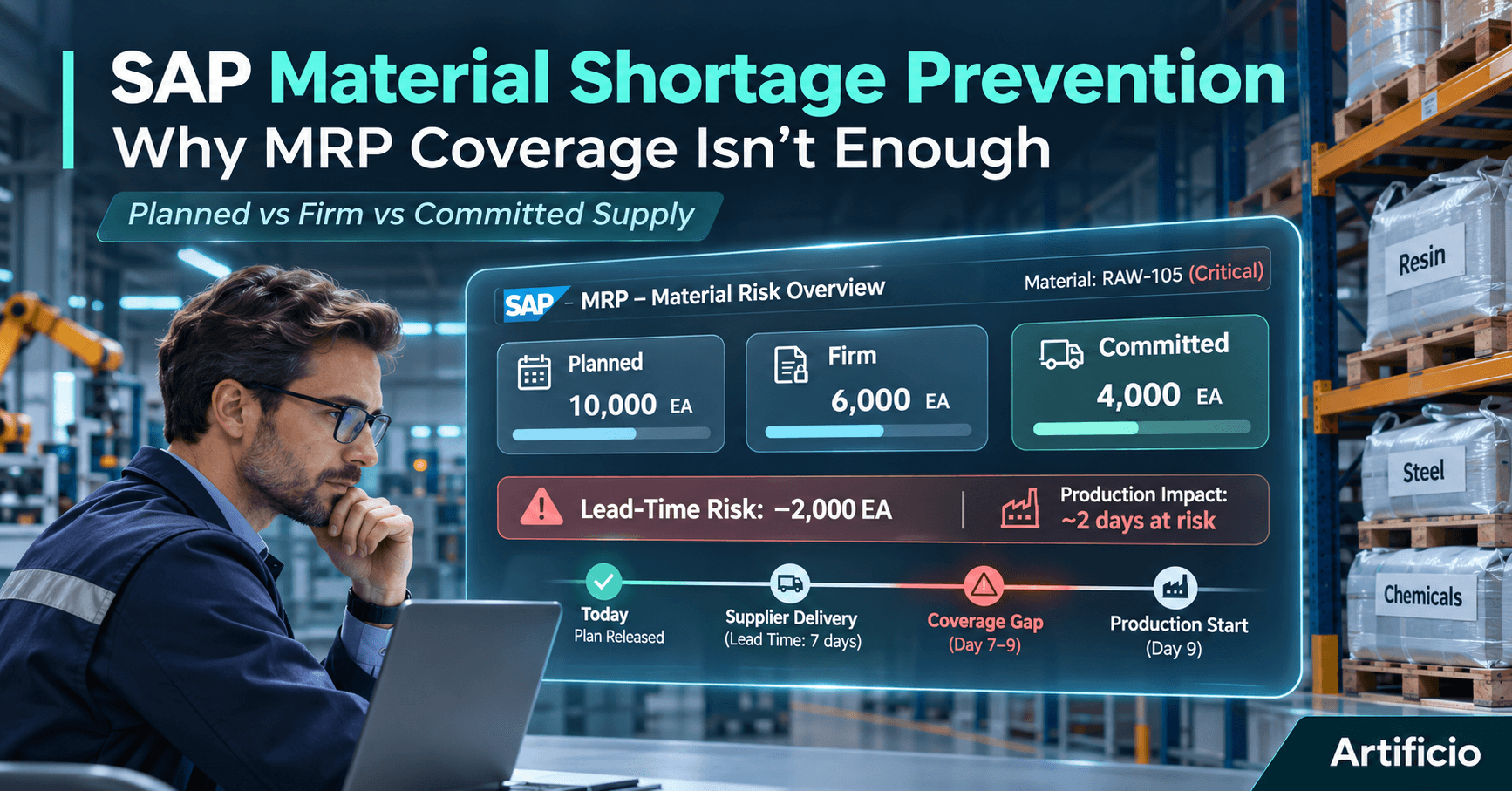
A useful way to evaluate raw-material coverage is to examine it from three perspectives.
These are risk-analysis views, not three standard SAP transaction screens.
Planned coverage considers supply proposals and incoming receipts that MRP uses to balance requirements, according to the customer's planning configuration.
These may include:
It answers:
If the current material plan executes as scheduled, will demand be covered?
That is a valuable planning view, but it does not tell the entire procurement-execution story.
Firm coverage emphasizes eligible stock, valid purchase orders, relevant scheduling agreements and other supply elements that have advanced beyond ordinary unconverted proposals.
An MRP-generated purchase requisition may be firmed, but firming does not mean that a supplier has accepted an order.
It may still require buyer action.
Firm coverage answers:
How much of the required supply has progressed beyond an uncommitted planning proposal?
Committed coverage examines supplier confirmations where available, purchase order status, expected delivery dates and supplier delivery performance.
Not every SAP environment consistently uses PO confirmation control.
Where formal confirmations are unavailable, the purchase order's scheduled date can be used as an unconfirmed planning assumption, with an appropriate confidence rating.
However, it should never be represented as a verified supplier commitment.
Committed coverage answers:
How credible is the incoming supply date, based on the evidence available?
These coverage views are only as reliable as the underlying SAP information.
Incorrect planned delivery times, inaccurate material master settings, outdated supplier information and inventory discrepancies can undermine the assessment.
That is why SAP MRP data readiness is important before an AI agent recommends corrective actions.
The objective is not to generate more alerts.
It is to determine whether the difference between planned, firm and committed supply creates a genuine operational risk.
Imagine the following scenario.
| Planning factor | Value |
|---|---|
| Raw material | RM-100 |
| Days until projected shortage | 20 days |
| Effective new-procurement lead time | 35 days |
| Direct production orders potentially affected | 2 |
| Procurement action slack | −15 days |
The shortage is still 20 days away.
A prioritization approach based only on the shortage date might classify it as a medium-term concern.
But the material requires 35 days to replenish through normal procurement.
The buyer is already beyond the normal purchasing action deadline.
Action Slack = Time Until Material Is Needed − Effective Recovery Lead Time
In this example:
20 − 35 = −15 days
This means normal replenishment would need to have started 15 days earlier to meet the requirement.
It does not necessarily mean production will stop.
An existing purchase order, alternate supplier, stock transfer or expedited shipment may still provide a viable recovery option.
But it does mean that placing a standard new order today is unlikely to solve the shortage on time.
The calculation should consider the relevant parts of replenishment time, including:
The calculation must avoid double-counting lead-time components already represented in SAP planning data.
For an existing PO, the full new-procurement lead time may not be the correct assumption.
The relevant question may instead be whether the supplier can expedite the remaining quantity to an earlier achievable date.
This is why validating SAP planning data before AI-driven decisions is essential.
A negative action-slack result should prompt both recovery investigation and validation of the assumptions behind the calculation.
The real insight is not simply that material will be short. It is that the window for normal corrective action may already have closed.
Consider two suppliers with the same planned delivery time of 30 days.
Supplier A delivers on time on 95% of comparable orders.
Supplier B meets the expected date on only 60% of comparable orders.
The same planned receipt date should not automatically carry the same level of operational confidence.
Historical supplier performance provides important context.
Useful metrics include:
For example, an SAP purchasing info record may specify a planned delivery time of 30 days, while goods receipt history indicates that the supplier often requires 42 days.
That discrepancy deserves investigation.
It does not automatically mean the planned delivery time should be changed to 42 days. The difference may result from temporary capacity constraints, transportation disruptions, order characteristics or other business conditions.
Yes. Where configured and accessible, SAP Supplier Evaluation provides performance information that can support delivery-risk assessment.
An AI-assisted supplier-risk process can combine available SAP supplier evaluation metrics with purchasing info records, purchase orders, supplier confirmations and goods receipt history.
The objective is not to duplicate SAP Supplier Evaluation. It is to connect supplier performance evidence with future material requirements.
But identifying an unreliable supplier is only the beginning.
Buyers still need to obtain realistic delivery commitments, review proposed dates and coordinate corrective actions.
Artificio's SAP AI agents and enterprise workflows support the broader approach of connecting SAP information with governed purchasing, supplier communication and operational processes.
SAP MRP exception messages are valuable signals.
However, their business importance depends on procurement status, actual dates, planning settings and the production requirements involved.
These messages commonly identify situations where the opening, start or finish date of a planning element is in the past.
The right response depends on the procurement element.
For an unconverted purchase requisition, the buyer may need to create or release a PO, investigate source availability or consider alternative procurement.
For a planned order, the planner may need to assess the relevant production or procurement action.
Message 10 commonly indicates that a receipt should be moved earlier.
The system should evaluate:
A one-day movement with no meaningful production consequence should not automatically trigger urgent supplier outreach.
SAP may continue to display open purchase order quantities as expected incoming supply even when the receipt is overdue.
A PO can also be awaiting release approval or may not have been transmitted to the supplier.
These situations deserve explicit attention because the purchasing document and the supplier's awareness of the order are not necessarily the same thing.
A material can be exposed even when total inventory appears sufficient.
Examples include:
The analysis must determine which quantities are genuinely usable by the requirement date.
Suppose a supplier cannot meet the requested earlier delivery date.
The buyer accepts a later supplier commitment.
The next MRP run may again recommend rescheduling that receipt earlier.
Repeatedly sending the same request does not solve the problem.
A governed workflow should remember the accepted supplier position and investigate alternative recovery options unless the underlying requirement or commitment changes.
For a broader discussion of the technology and operational features needed to manage these situations, see our guide to AI agents for SAP MRP exception management.
An exception becomes much more useful when planners understand its operational impact.
For an initial material shortage prevention deployment, a practical approach is to focus on production orders and planned orders that directly consume the raw material.
Consider the following example:
| Direct order | Material | Required quantity | Potential uncovered quantity |
|---|---|---|---|
| Production order 450001 | RM-100 | 80 | 0 |
| Production order 450002 | RM-100 | 100 | 40 |
| Planned order 900012 | RM-100 | 60 | 60 |
Illustrative SAP date-sequence netting, not a formal inventory allocation decision.
This analysis shows which direct requirements may become exposed as available supply is consumed.
It should consider the relevant requirement dates, order statuses and supply quantities.
It should not automatically decide which order deserves scarce inventory.
That remains a production-planning decision governed by customer priorities and operational policies.
The Artificio SAP MRP Exception Agent is designed to help investigate SAP planning exceptions, understand underlying supply and demand, evaluate corrective actions and coordinate decisions with the responsible owners.
A focused direct-production analysis can provide useful, explainable results without requiring multilevel BOM tracing or speculative customer-order impact calculations.
Detecting a shortage is only the first step.
The next question is who can resolve it.
Purchasing teams typically handle:
Production planners and MRP controllers typically handle:
A supplier should not receive a vague email asking it to expedite an order.
A useful request should specify the relevant PO item, quantity, requested delivery date and response options.
If the supplier agrees to the requested date and quantity, the workflow can record the acceptance.
Where a supported SAP confirmation interface and the necessary confirmation configuration exist, the response may also be synchronized according to the customer's approved automation policy.
A changed date, reduced quantity or split delivery should be reviewed by the buyer before an authorized SAP update.
Where SAP confirmation control is unavailable, the response may be tracked in the collaboration workflow without falsely claiming that the PO has a formal SAP supplier confirmation.
Supplier outreach should also be grouped.
A supplier with 30 affected PO lines should not automatically receive 30 separate emails.
A nightly SAP MRP run provides a planning baseline.
But manufacturing and procurement conditions change throughout the day.
A supplier might announce a delay after the morning planning meeting.
A goods receipt could be posted at midday.
A production order might require additional material before the next MRP execution.
A shortage-prevention workflow should therefore support:
Scheduled evaluations: Analyze planning results after completed MRP runs.
On-demand material checks: Allow an authorized planner or buyer to evaluate a selected material and plant.
Case re-evaluation: Refresh the relevant SAP information and reassess an existing risk case.
Purchasing document checks: Evaluate an open PO or eligible firmed PR and its potential shortage exposure.
These evaluations must distinguish freshly retrieved SAP information from the last completed MRP calculation.
Refreshing purchasing documents does not mean that SAP MRP has been rerun.
The process should also prevent duplicate cases and unnecessary repeat supplier communications.
AI agents become more valuable when they connect planning information to governed operational decisions.
A practical SAP MRP agent can help with five activities.
Compare planned supply, firm procurement and credible supplier commitments without treating every future PR or unconfirmed PO as an urgent shortage.
Determine whether normal replenishment can still meet the material requirement date.
If not, evaluate alternative recovery paths.
Differentiate supplier delays from inaccurate planning assumptions, unusable inventory, missing procurement actions and changes in requirements.
Prepare specific recommendations and supplier requests while preserving human control over consequential business decisions.
Recalculate material coverage after relevant changes and compare subsequent MRP results.
Do not close a shortage case simply because a supplier has acknowledged a request.
This approach reflects a broader shift toward SAP AI agents for ECC and S/4HANA that support purchasing, manufacturing, quality, master data and other business processes.
The objective is not to replace SAP MRP. It is to make the decisions and follow-up actions around MRP more timely, consistent and evidence-based.
Artificio's SAP MRP Exception Agent is designed to work with existing SAP ECC and SAP S/4HANA environments.
Its approach combines SAP planning information, configurable business rules, AI-assisted exception investigation, supplier communication and governed workflows.
Rather than replacing the planning engine, Artificio focuses on operational work around MRP:
For material shortage prevention, this approach can be extended with supplier-performance analysis, lead-time-aware urgency, differentiated supply coverage and direct production-order impact assessment.
The exact capabilities, SAP write-back methods and automated actions enabled in a customer environment depend on the agreed implementation scope, SAP configuration and approved operating policies.
Organizations can begin with a focused assessment or shadow-mode evaluation before authorizing supplier communication or SAP updates.
Before undertaking a major supply-chain transformation, start with one plant, a defined group of raw materials and a recent planning history.
Evaluate:
These questions can reveal whether the highest-value improvement lies in better SAP master data, procurement execution, supplier collaboration or exception handling.
A pilot should measure actionable-case precision, planner acceptance, response time, recovery resolution and, where enough outcome data exists, missed shortages and avoidable expediting.
That creates a stronger business case than simply measuring how many MRP exceptions an agent processed.
Yes. SAP MRP can include purchase requisitions and planned orders as incoming supply elements. These are valid planning proposals but do not necessarily represent supplier-accepted orders. Whether they create risk depends on their action dates, lead times and procurement status.
MRP exception monitoring highlights planning conditions that may require action. Material shortage prevention additionally evaluates procurement deadlines, supplier reliability, supply credibility and potential production impact, then supports coordinated recovery.
In SAP ECC and applicable S/4HANA environments, planners commonly use MD04 for the current stock/requirements situation, MD05 for individual MRP lists, and MD06/MD07 for collective planning analysis where available. SAP S/4HANA also offers Fiori material coverage applications, depending on edition and release.
An AI-assisted workflow can evaluate purchasing info records, open POs, available supplier confirmations, historical goods receipts and SAP Supplier Evaluation results. It should communicate uncertainty and never assume that an unconfirmed delivery is necessarily late.
An inaccurate planned delivery time can cause procurement actions to be scheduled too late or too early. Comparing master-data assumptions with actual receipt history helps buyers identify materials that need review.
Yes. A governed workflow can start with read-only exception analysis, supplier requests, buyer notifications and case tracking. SAP updates can be enabled separately using authorized, supported interfaces and approval policies.
Artificio supports integration approaches for both SAP ECC and SAP S/4HANA. Specific data services and write-back functions depend on the customer's release, configuration and authorizations.
No. SAP MRP remains the planning engine and system of record. AI agents can enhance the operational processes that follow planning by evaluating risks, coordinating actions and verifying outcomes.
Your SAP MRP run can finish successfully while important purchasing decisions remain unresolved.
A purchase requisition may not yet be due for conversion.
Another may already be late.
A purchase order may have a valid schedule date but no supplier acknowledgment.
A supplier may consistently take longer than the planned delivery time maintained in SAP.
And a shortage expected in 20 days may already be impossible to resolve through a normal 35-day replenishment cycle.
Each situation requires a different decision.
The manufacturers that gain the most value from intelligent MRP exception management will be those that distinguish routine planning from genuine supply risk—and act before the recovery window closes.
Explore the Artificio SAP MRP Exception Agent to learn how AI-assisted exception investigation, supplier communication, recovery recommendations and governed SAP workflows can help manufacturers move from reactive exception handling toward proactive material shortage prevention.
Request a demonstration to discuss how this approach could work with your SAP ECC or S/4HANA environment.
About Artificio
Artificio Products Inc. develops AI-powered automation and workflow solutions for enterprise processes, including SAP ECC and SAP S/4HANA. Its SAP-focused solutions combine enterprise integration, configurable business rules, human approvals and AI-assisted exception handling.

Lal Singh, SAP AI Automation Expert
CEO & Founder of Artificio
See it in your SAP environment
Bring us a document, a process, or a bottleneck. We'll show how Artificio captures, validates, and posts into SAP — then scale from there.
Security & compliance
ISO 27001:2013 certified, SOC 2 Type 2 compliant, GDPR and HIPAA ready. Every agent action is logged, auditable, and runs in isolated environments.