Best AI Agents for SAP MRP Exception Management: What Manufacturers Should Look For
Discover what makes the best AI agent for SAP MRP exception management. Learn how to evaluate SAP integration, root-cause analysis, supplier coordination, approval controls, and verified resolution.
Best AI Agents for SAP MRP Exception Management: What Manufacturers Should Look For
An enterprise buyer's guide to choosing AI-powered MRP exception agents for SAP ECC and S/4HANA.
Introduction: The Best MRP Agent Doesn't Just Find Problems. It Helps Fix Them.
Every manufacturing company running SAP knows the routine.
The MRP run finishes overnight. By morning, planners have hundreds or thousands of exception messages waiting for attention.
Some materials need to arrive earlier. Others are arriving too soon. Purchase orders need rescheduling. Production orders have unrealistic dates. Suppliers haven't confirmed deliveries. Master data problems keep generating the same exceptions.
SAP identifies these planning issues.
But who actually resolves them?
Traditionally, planners and buyers investigate each exception manually, navigate between SAP transactions, contact suppliers, compare alternatives, and make the necessary changes.
This is precisely why manufacturers are beginning to evaluate AI agents for SAP MRP exception management.
However, not every solution marketed as an "AI agent" offers the same capabilities.
Some solutions summarize exceptions. Others prioritize shortages or recommend actions. More advanced solutions coordinate supplier communication, prepare SAP updates for approval, and verify whether the changes actually resolved the problem.
The best SAP MRP exception agent should do more than explain what SAP already knows. It should help turn planning exceptions into verified business outcomes.
This guide explains what manufacturers should look for, how to evaluate different approaches, and why closed-loop exception resolution is becoming an important capability for SAP-driven supply chains.
1. What Is an AI Agent for SAP MRP Exception Management?
An SAP MRP exception agent is an AI-powered application that analyzes planning exception messages, investigates the underlying supply-and-demand situation, recommends corrective actions, and coordinates resolution workflows.
Its purpose is not to replace SAP MRP.
SAP remains responsible for material requirements calculations, planning parameters, and the creation of procurement and production proposals.
The AI agent works alongside SAP, helping planners and buyers investigate and act on the resulting exceptions.
For example, SAP might generate:
Exception 10: Reschedule an incoming receipt earlier.
Exception 15: Reschedule an incoming receipt later.
Exception 20: Cancel an unnecessary receipt.
Exception 56: Shortage within the planning time fence.
Exception 96: Safety stock has fallen below the required level.
The exact messages and their relevance depend on the SAP release and configuration.
A traditional exception report displays these messages.
A basic AI assistant might explain what they mean.
An advanced AI agent investigates the business circumstances and proposes a specific, executable next step.
Consider Exception 10.
SAP indicates that a purchase order should arrive earlier.
A capable AI agent investigates:
Which customer or production requirement is affected?
How much material is actually needed?
Can the supplier confirm an earlier date?
Would a partial shipment be sufficient?
Is stock available at another plant?
What happens if the receipt date changes?
Who must approve the proposed action?
The result is not simply an explanation.
It is an actionable recommendation supported by SAP data and supplier evidence.
That distinction should be central to every manufacturer's evaluation.
2. Not All SAP MRP AI Solutions Are the Same
Manufacturers evaluating AI-powered planning tools will encounter several categories of solutions.
Understanding the differences helps avoid investing in technology that does not solve the intended problem.
Solution category
Primary purpose
Important limitation to evaluate
SAP-native MRP tools
Calculate requirements and identify planning exceptions
Manual investigation and coordination may remain
BI dashboards
Visualize shortages, exception counts, and trends
Reporting alone does not resolve exceptions
AI copilots
Explain information and assist planners
May not execute end-to-end business workflows
Advanced planning platforms
Optimize supply-chain planning and scenarios
May require broader planning transformation
Specialized MRP exception agents
Diagnose, coordinate, recommend, execute approved changes, and verify
Must demonstrate reliable SAP integration and business controls
These categories are not mutually exclusive.
A manufacturer might use SAP S/4HANA for MRP, an advanced planning platform for scenario analysis, and a specialized AI agent to coordinate operational exception resolution.
The key question is not which solution uses the most advanced AI model.
It is which solution can reliably resolve the planning problems consuming your team's time.
3. The 10 Capabilities Manufacturers Should Demand
Capability 1: Native Understanding of SAP MRP Exceptions
An AI agent must understand SAP planning processes—not simply interpret text.
It should recognize the meaning of exception messages and identify the relevant material, plant, MRP area, planning segment, and supply element.
For example, an Exception 10 on a raw material may require supplier communication.
An exception involving an incorrect production version may require master-data or engineering intervention.
These problems should not follow the same workflow.
What to ask vendors:
"Can your agent identify the exact SAP object behind an exception and explain the underlying cause using actual demand and supply data?"
Ask for a demonstration using real exception scenarios, not a predefined chatbot response.
Capability 2: Live SAP ECC and S/4HANA Integration
Many manufacturers still operate SAP ECC, while others use S/4HANA or a hybrid landscape.
An enterprise-ready agent should support the customer's actual SAP environment.
Integration should provide access to relevant information such as:
Material master planning parameters.
Stock and requirements.
Purchase orders and purchase requisitions.
Planned orders and production orders.
Supplier confirmations.
Planning dates and lead times.
MRP exception results.
The solution should also use supported SAP interfaces for approved transaction changes.
A critical evaluation point is whether the vendor can demonstrate the required read and write operations in your specific SAP release.
What to ask vendors:
"Can you demonstrate the complete process in our SAP environment without relying on unsupported interfaces or screen-scraping?"
For ECC, confirm which RFC, BAPI, or other supported interfaces are required. For S/4HANA, confirm the relevant APIs and deployment-specific availability.
Capability 3: Root-Cause Analysis, Not Just Exception Classification
A shortage is a symptom.
The actual cause might be an unrealistic lead time, a delayed supplier, a missing goods receipt, incorrect inventory, or a production schedule conflict.
A useful AI agent must distinguish these situations.
Consider a purchase order that appears overdue.
Before recommending an expedite, the agent should investigate whether the material has already arrived but is awaiting goods receipt posting or quality inspection.
Otherwise, automation may simply accelerate the wrong action.
What to ask vendors:
"Can the agent distinguish a genuine supplier delay from a warehouse posting delay or a master-data problem?"
The vendor should demonstrate how the diagnosis is supported by evidence.
Capability 4: Evaluation of Multiple Resolution Alternatives
A rescheduling recommendation is not always the best business decision.
Suppose SAP identifies a shortage of 2,000 units.
Possible alternatives include:
Expediting the existing purchase order.
Receiving a partial delivery.
Transferring available stock from another plant.
Using an approved alternative supplier.
Rescheduling production where permitted.
Accepting a temporary shortage when its business impact is lower than the intervention cost.
The agent should evaluate feasible options against projected demand and supply.
It should also consider downstream effects.
Moving supply from Plant A to Plant B is not a successful resolution if it creates a more critical shortage at Plant A.
What to ask vendors:
"Does your agent compare alternatives and show the expected material coverage before recommending an action?"
Ask to see the before-and-after planning impact.
Capability 5: Automated Supplier Communication
Supplier communication is often one of the largest sources of delay in MRP exception resolution.
A planner identifies a shortage.
A buyer contacts the supplier.
The supplier responds two days later.
The buyer updates SAP.
The planner checks whether the change resolved the issue.
An AI agent should reduce the coordination effort.
Look for capabilities to:
Request purchase order acknowledgments.
Ask for earlier or later delivery dates.
Request partial-shipment availability.
Interpret supplier responses.
Compare confirmed quantities and dates.
Escalate unanswered requests.
Prepare approved SAP confirmation updates.
The agent should also recognize when a supplier refuses a request or proposes an alternative.
What to ask vendors:
"Can your agent contact suppliers, interpret their responses, and prepare the resulting SAP changes for buyer approval?"
A notification feature alone is not equivalent to supplier coordination.
Capability 6: Human Approval Before Business-Critical SAP Changes
Manufacturers should be cautious about AI agents that make unrestricted changes to procurement and production transactions.
A purchase order cancellation can affect contractual commitments.
A production order change can disrupt manufacturing.
An incorrect master-data update can create problems across multiple planning cycles.
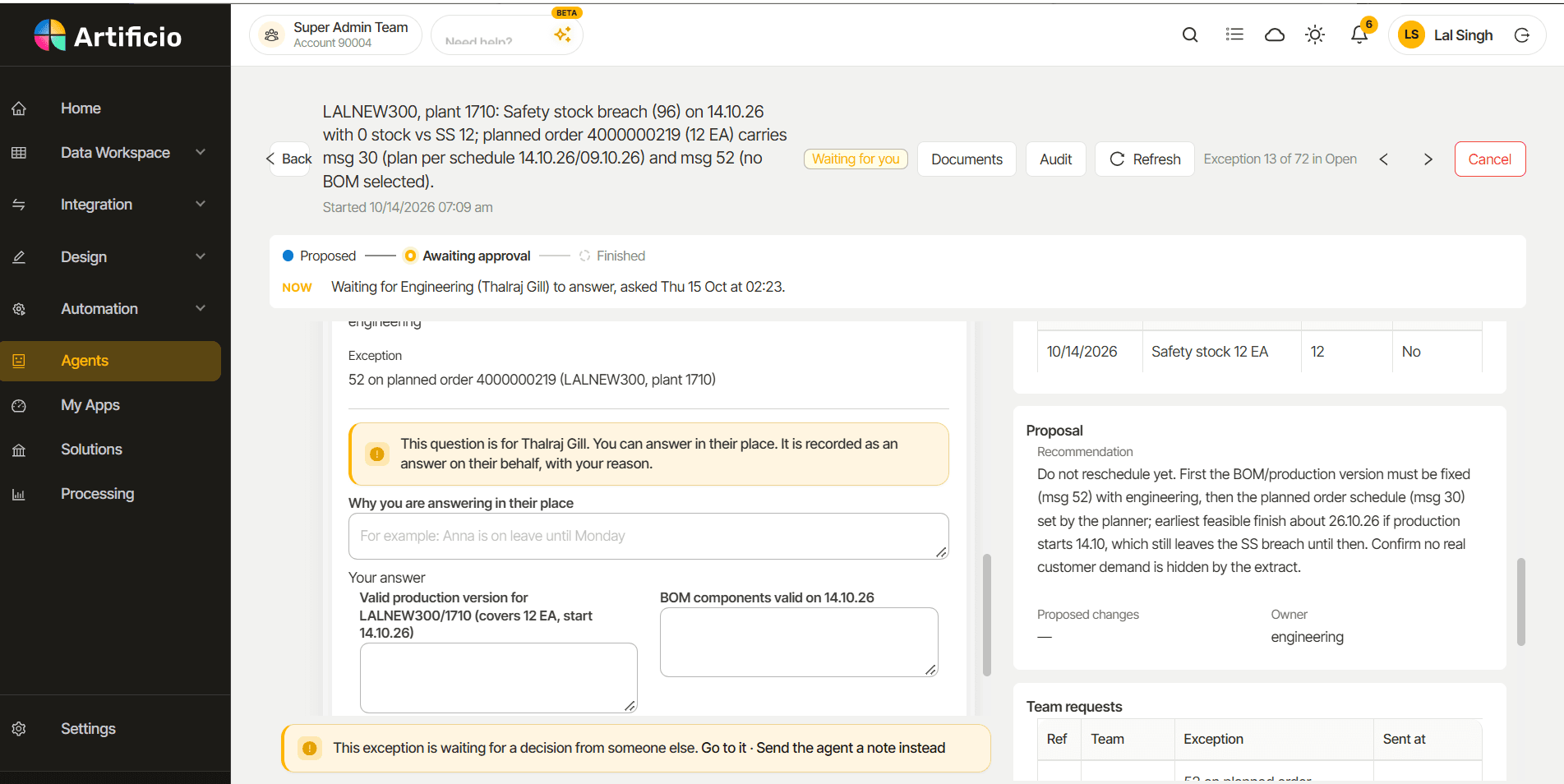
An enterprise AI agent should support configurable approval workflows.
For example:
Proposed action
Typical approval owner
Purchase order date change
Buyer
Purchase order cancellation
Buyer
Purchase requisition change
Planner or authorized procurement owner
Production order change
Production planner or scheduler
BOM correction
Engineering
Material master planning change
Master-data or planning owner
The exact responsibility should follow the organization's authorization model.
What to ask vendors:
"Can we configure which actions require approval, who approves them, and which actions the agent must never perform?"
Human-in-the-loop controls should be part of the operational workflow, not merely a disclaimer.
Capability 7: Verification After the Next MRP Run
This is one of the most important evaluation criteria.
Many automation systems consider a process complete when an SAP transaction is successfully updated.
But updating SAP does not guarantee that the supply problem has been resolved.
For example, a buyer approves moving a purchase order from November 20 to November 13.
The transaction saves successfully.
Does that mean the exception is resolved?
Not necessarily.
The material may still be short because the supplier confirmed only part of the quantity.
A different requirement may now be uncovered.
Goods-receipt processing time may prevent the material from being available when production needs it.
The best agent should verify the planning outcome, not just the transaction status.
After the next MRP run, it should determine whether the affected demand is covered and whether the action introduced another material-coverage problem.
What to ask vendors:
"How does your system prove that an exception was actually resolved after the next MRP run?"
This question quickly separates basic workflow automation from closed-loop exception management.
Capability 8: Master-Data Quality Detection
An AI agent can investigate exceptions quickly, but it cannot compensate indefinitely for incorrect planning assumptions.
Suppose SAP has a planned delivery time of 14 days for a raw material.
Actual supplier confirmations consistently indicate 23 days.
MRP continues calculating procurement dates using an assumption that no longer reflects reality.
The same shortages may keep appearing.
A useful agent should identify recurring patterns and flag possible master-data corrections.
Examples include:
Planned delivery times inconsistent with actual supplier performance.
Incorrect procurement types.
Missing or invalid production versions.
Inconsistent planning parameters.
Repeated shortages caused by inaccurate safety-stock assumptions.
The agent should recommend a review rather than automatically changing sensitive master data.
What to ask vendors:
"Can your agent identify recurring exceptions caused by inaccurate master data and route them to the correct owner?"
Capability 9: Exception Prioritization Based on Business Impact
Not every MRP exception deserves equal attention.
A shortage affecting a critical production order may be more urgent than a rescheduling recommendation on a low-value material with no immediate demand.
A strong agent should support prioritization using business context.
Relevant factors may include:
Production interruption risk.
Customer delivery impact.
Material criticality.
Shortage quantity and duration.
Inventory coverage.
Supplier constraints.
Planning time fence.
Potential financial impact.
What to ask vendors:
"Can the agent explain why one exception deserves attention before another?"
The objective is to help planners focus on business risk rather than merely the age or number of messages.
Capability 10: Auditability, Security, and Deployment Readiness
SAP planning decisions must be traceable.
Manufacturers should expect a clear record of:
The original exception.
Data used for the recommendation.
Alternatives evaluated.
Supplier responses.
Proposed changes.
Approval decisions.
SAP execution results.
Post-MRP verification outcomes.
The solution should also support enterprise identity, role-based permissions, secure connectivity, and appropriate data handling.
For regulated industries, additional validation and change-control requirements may apply.
What to ask vendors:
"Can you demonstrate the complete audit trail for one exception, from detection through verified resolution?"
A convincing demo should show both a successful action and how the system handles a rejected, stale, or failed recommendation.
4. How Artificio Approaches SAP MRP Exception Management
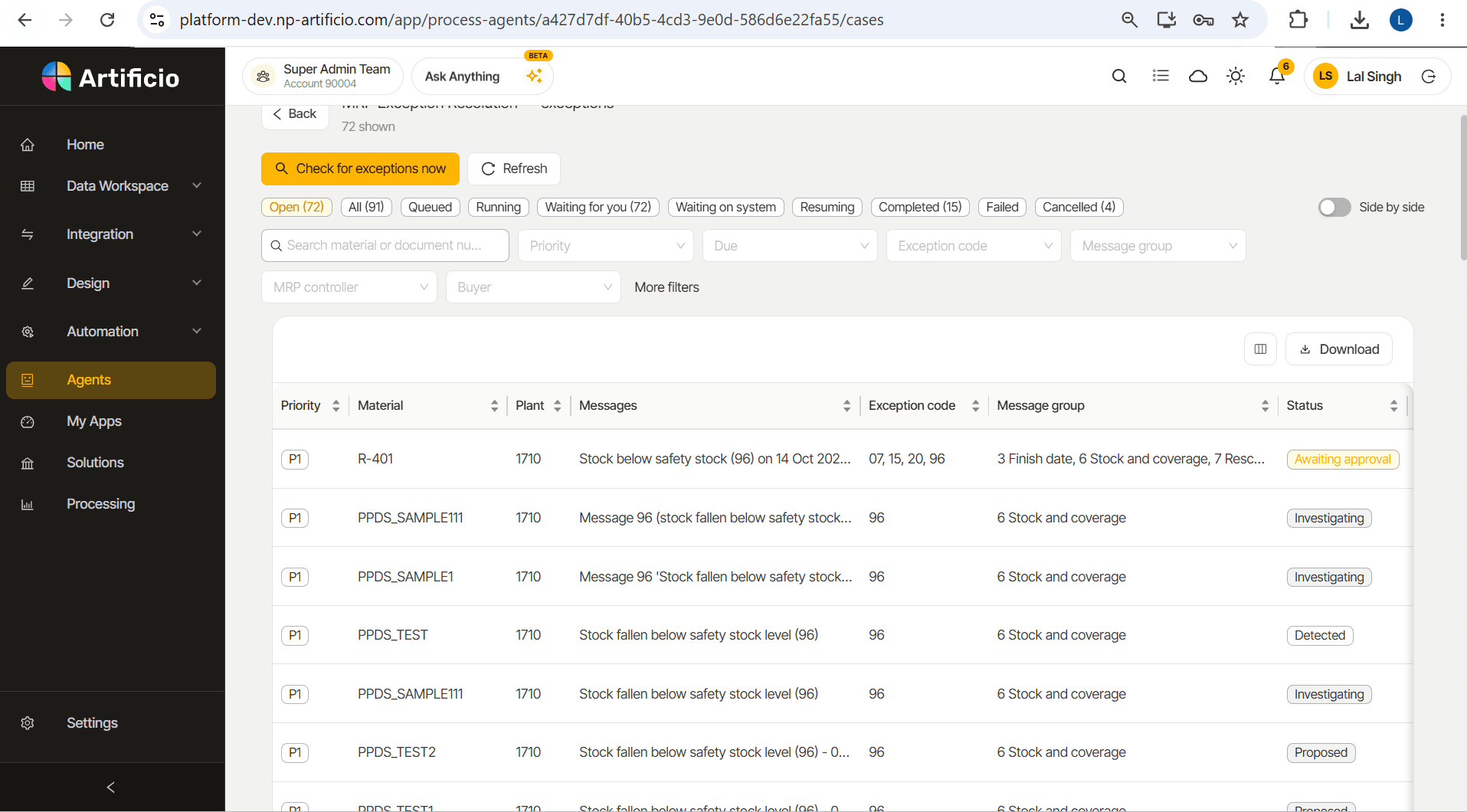
Artificio's SAP MRP Exception Agents are designed to work alongside existing SAP ECC and S/4HANA planning processes.
Rather than replacing the MRP engine, Artificio focuses on the operational work that follows an MRP run.
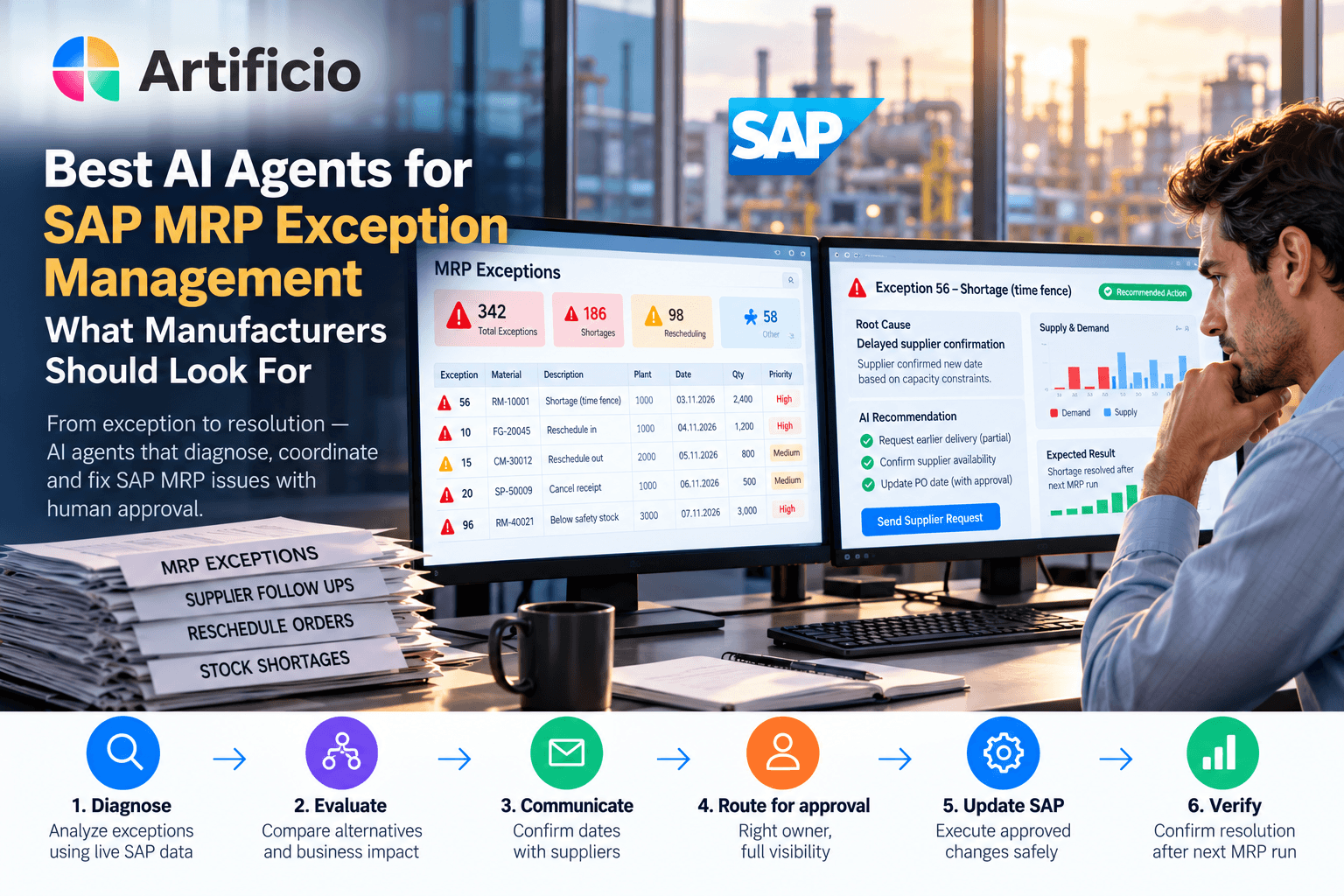
The workflow follows six connected activities.
1. Diagnose
Artificio analyzes exception messages using relevant SAP demand, supply, stock, and planning information.
It identifies the underlying issue and the SAP documents involved.
2. Evaluate
The agent evaluates feasible alternatives, including supplier date changes, partial receipts, and stock transfers where applicable.
Recommendations include the expected impact on material coverage.
3. Communicate
For supplier-related exceptions, Artificio supports purchase order acknowledgment and supplier-date confirmation through email workflows.
Responses are compared against the requested dates and quantities, with conflicts routed to the buyer.
4. Route for approval
Proposed actions are assigned to the accountable business owner.
Buyers approve purchase order changes, planners review planning proposals, and other teams handle exceptions within their responsibilities.
5. Execute approved changes
Artificio uses SAP integration interfaces to process approved changes.
Before execution, decision-critical data is checked again so that stale recommendations are not blindly posted.
6. Verify
After the next MRP run, the agent evaluates whether the intended planning outcome was achieved.
Cases that remain partially unresolved are identified for further action.
This approach is designed to create a closed-loop process:
Before selecting a vendor, manufacturers should establish a structured evaluation process.
The following scorecard can help compare solutions using the same criteria.
Evaluation criterion
Suggested weight
SAP ECC/S/4HANA integration
15%
Root-cause diagnosis
15%
Alternative evaluation and impact analysis
15%
Supplier communication
10%
Approval and governance controls
15%
Post-MRP resolution verification
15%
Master-data issue detection
5%
Security, auditability, and deployment
10%
Total
100%
Score each vendor from 1 to 5 for every criterion.
Require evidence from a working demonstration rather than relying exclusively on product descriptions.
For manufacturers with high procurement exception volumes, supplier communication may deserve greater weight.
For highly regulated manufacturers, approval controls, auditability, and validated integration may be more important.
There is no universal weighting that fits every organization.
The best solution is the one that addresses the manufacturer's highest-cost planning problems while meeting its operational and technical requirements.
6. Five Red Flags When Evaluating SAP MRP AI Agents
AI demonstrations can look impressive even when the underlying solution is not ready for enterprise planning operations.
Watch for these warning signs.
Red flag 1: The agent only summarizes exception messages.
Explaining an exception is useful, but it does not eliminate the investigation and coordination workload.
Red flag 2: The demo uses static data without live SAP validation.
Recommendations based on outdated purchase orders or inventory can become unsafe before they are executed.
Red flag 3: The solution cannot show downstream planning impact.
Changing a receipt date without evaluating affected demand may simply move the problem elsewhere.
Red flag 4: The agent executes changes without configurable approval controls.
Business-critical procurement and production decisions require appropriate governance.
Red flag 5: Success is measured only by completed transactions.
A successfully saved SAP document is not proof that a shortage was resolved.
Manufacturers should insist on outcome-based verification.
7. How to Calculate the ROI of an SAP MRP Exception Agent
The business case should start with the current manual workload.
Consider an illustrative manufacturer with:
1,500 MRP exception messages per week.
Five minutes of manual investigation and follow-up per exception.
An annual fully loaded planner cost of $110,000.
A potential 70% reduction in the measured manual workload.
The annual baseline workload is:
1,500 × 5 minutes × 52 weeks = 6,500 hours.
At a 70% reduction, the potential recovered capacity is 4,550 hours annually.
Assuming 1,880 productive working hours per planner, this represents approximately 2.4 full-time-equivalent years of capacity.
The equivalent annual capacity value is approximately $266,000.
These are illustrative assumptions, not verified customer savings. The actual financial return must account for implementation costs, software fees, ongoing reviews, exception complexity, and whether recovered time produces measurable economic benefits.
The larger opportunity may include fewer production shortages, reduced premium freight, better supplier reliability, and lower excess inventory.
A credible vendor should help establish a baseline and measure the results of a pilot.
8. The Best Way to Start: A Controlled SAP MRP AI Pilot
Manufacturers do not need to automate every exception category on day one.
A focused pilot is usually a better starting point.
For example, select one manufacturing plant and a defined group of raw materials.
Begin with rescheduling exceptions, such as Exception 10 and Exception 15.
Establish the current baseline for:
Exception volume.
Investigation time.
Supplier response time.
Repeat exceptions.
Approval turnaround.
Verified resolution rate.
Then introduce the AI agent in shadow mode.
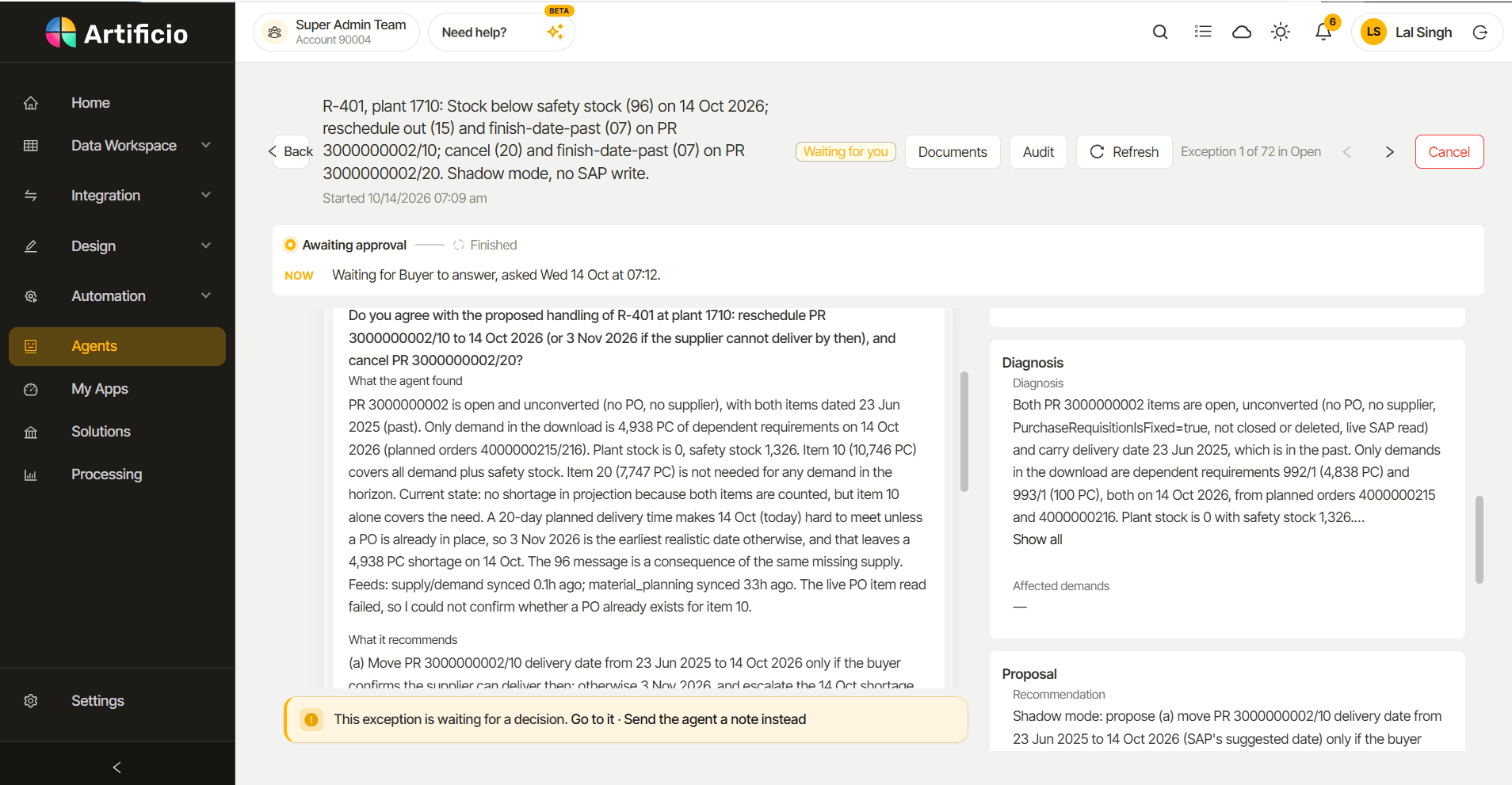
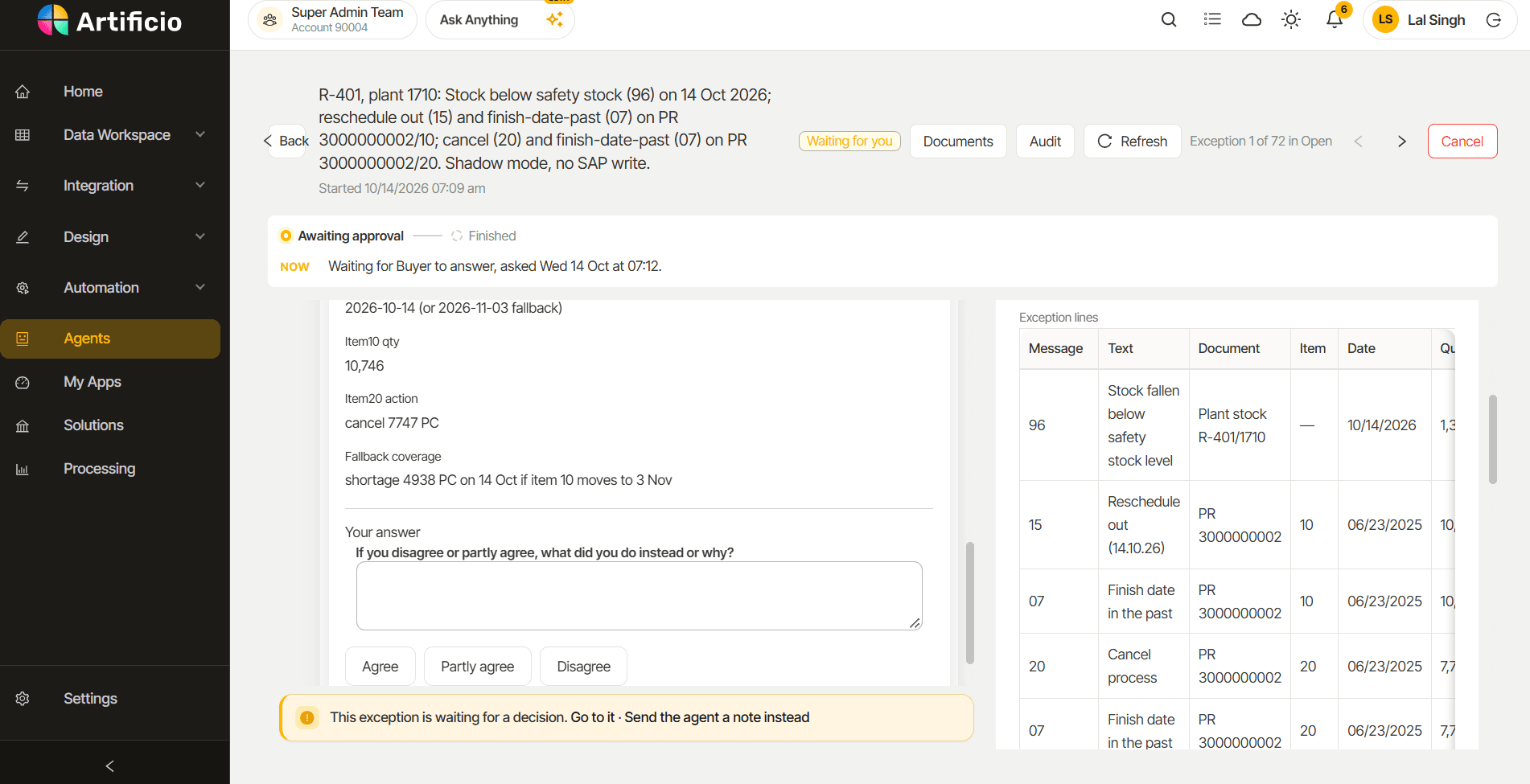
During shadow mode, the agent analyzes exceptions and prepares recommendations without changing SAP.
Planners and buyers review the recommendations, evaluate their accuracy, and identify necessary business-rule refinements.
Once the process is validated, controlled execution can be enabled with the appropriate approvals.
Artificio describes a four-week deployment approach covering connectivity, ownership configuration, shadow-mode validation, and controlled execution. Actual timing depends on the SAP landscape, available interfaces, data quality, security reviews, and pilot scope.
The objective should be a measurable operational improvement—not simply demonstrating that an AI model can interpret an SAP exception message.
9. Frequently Asked Questions
What is the best AI agent for SAP MRP exception management?
The best solution depends on the manufacturer's SAP landscape and business requirements. Look for an agent that can diagnose exceptions using live SAP data, evaluate alternatives, coordinate supplier responses, enforce approvals, and verify outcomes after the next MRP run.
Artificio is one specialized option designed around this closed-loop workflow.
Can AI agents automate SAP MD04 exceptions?
AI agents can analyze planning information associated with MD04 and related MRP outputs, investigate supply-and-demand issues, and coordinate approved corrective actions.
Actual automation capabilities depend on the SAP release, integration interfaces, authorization model, and the specific exception.
Can an AI agent work with SAP ECC?
Yes, an external AI agent can be integrated with SAP ECC using appropriate supported interfaces.
However, vendors should demonstrate compatibility with the customer's exact ECC release and enhancement package rather than assuming that S/4HANA APIs are available in ECC.
Should AI agents automatically change SAP purchase orders?
Not without appropriate business controls.
Purchase order changes can affect supplier commitments, production availability, and procurement costs.
A controlled approach requires validation, authorization, execution checks, and an audit trail.
Can AI agents eliminate every MRP exception?
No.
Some exceptions represent genuine supply constraints, unavailable capacity, incorrect master data, or business decisions that require human intervention.
The objective is to accelerate investigation, improve recommendations, coordinate action, and reduce avoidable recurrence—not promise that every planning constraint can be eliminated.
How do manufacturers measure success?
Measure verified resolution time, repeat exception rates, supplier response time, planner hours recovered, recommendation acceptance, and production-shortage impact.
These metrics provide a stronger picture than the number of exception messages processed.
10. Final Thoughts: Choose an AI Agent That Resolves Problems, Not One That Creates Another Dashboard
Manufacturers already have powerful planning engines.
SAP MRP calculates requirements and identifies supply problems.
The challenge is what happens next.
Planners still investigate exceptions, coordinate with buyers, contact suppliers, evaluate alternatives, and update transactions.
And when the next MRP run executes, many of the same issues may return.
The best AI agents for SAP MRP exception management should help close that operational gap.
They should understand SAP planning data, identify root causes, evaluate feasible alternatives, coordinate supplier communication, preserve business ownership, and verify results.
The goal is not autonomous decision-making without accountability. It is faster, more reliable planning execution with the right human controls.
For manufacturers running SAP ECC or S/4HANA, the opportunity is to improve the existing planning process without replacing the system that already runs the business.
Ready to Evaluate AI-Powered SAP MRP Exception Management?
Whether your planning team is managing recurring shortages, supplier-date discrepancies, rescheduling recommendations, or master-data-related exceptions, the first step is understanding where automation can deliver measurable value.
Bring your real MRP exceptions. See how Artificio diagnoses the problem, evaluates the alternatives, and prepares the right action for approval.