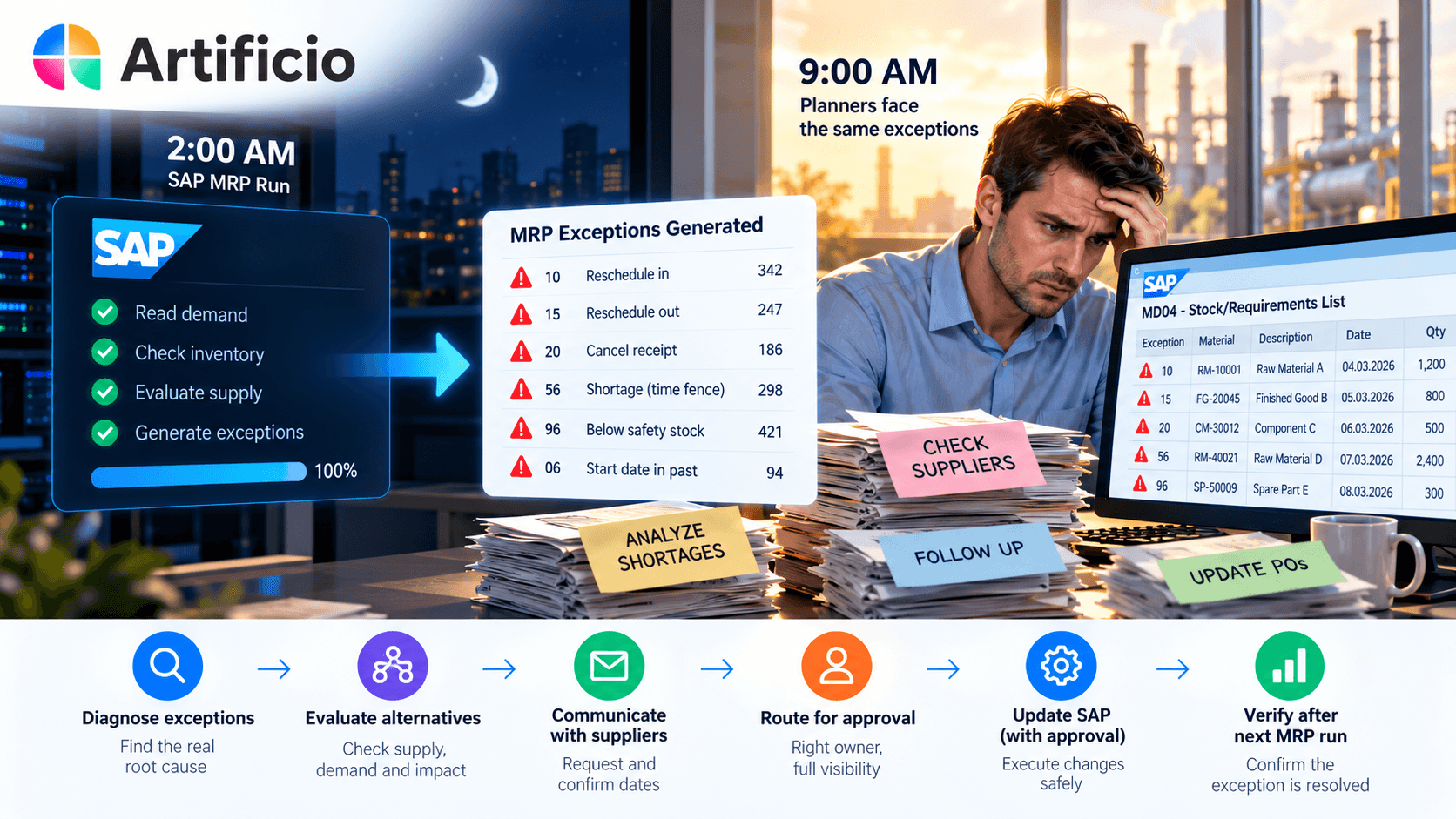
SAP MRP Runs Every Night. Why Do Planners Face the Same Exceptions Every Morning?
Discover why SAP MRP planners face the same exceptions every morning and how Artificio AI Agents automate root-cause analysis, supplier follow-ups, approvals, and exception resolution in SAP ECC and S/4HANA.
Your SAP MRP Runs Every Night. Why Are Your Planners Still Fighting the Same Exceptions Every Morning?
SAP tells you what is wrong with your supply plan. But who is responsible for fixing it before production is affected?
Every night, SAP Material Requirements Planning (MRP) processes thousands of materials, evaluates demand and supply, calculates shortages, and generates exception messages.
By morning, the MRP run is complete.
But for many manufacturing companies, the real work is just beginning.
Planners open MD04, MD05, or MD06. They investigate shortages, review purchase orders, check production schedules, contact suppliers, and determine which exception messages actually require action.
They spend hours investigating problems that SAP has already identified.
And the following morning?
Many of the same exceptions are back.
The problem isn't that SAP MRP isn't working. The problem is that identifying an exception and resolving it are two entirely different activities.
This is where AI-powered SAP MRP exception agents can fundamentally change the planning process.
1. The Hidden Problem Behind SAP MRP Exception Lists
SAP MRP is one of the most important planning engines in manufacturing.
It evaluates requirements, inventory, receipts, lead times, lot-sizing procedures, and planning parameters to determine what materials are needed and when.
When the plan cannot be executed as expected, SAP generates exception messages.
Common examples include:
Exception 10: Reschedule an incoming receipt earlier.
Exception 15: Reschedule an incoming receipt later.
Exception 20: Cancel an unnecessary procurement proposal or receipt.
Exceptions 06/07: Start or finish dates are in the past.
Exception 56: Shortage inside the planning time fence.
Exception 96: Stock falling below the safety-stock threshold.
These messages are valuable because they identify potential planning problems.
However, an exception message does not necessarily tell the planner the safest corrective action.
Consider a purchase order that SAP recommends moving forward by seven days.
The planner still needs to determine:
Which demand is affected by the delayed receipt?
Can the supplier deliver seven days earlier?
Is there sufficient inventory at another plant?
Could the shortage be covered through an alternative source?
Would changing the purchase order create excess inventory later?
Does the supplier have capacity to meet the revised schedule?
SAP identifies the timing conflict.
The planner must investigate the surrounding business reality.
That investigation—not the MRP calculation itself—is where much of the manual workload exists.
2. Why Planners Keep Resolving the Same Problems
In many SAP environments, exception management follows a familiar process.
A planner reviews an exception, investigates the material, and determines that the supplier must confirm a new delivery date.
An email is sent.
The supplier does not respond immediately.
The planner moves on to another material.
The next MRP run executes.
Because the underlying supply situation has not changed, the same exception appears again.
This cycle can continue for days.
The problem becomes more complicated when exceptions involve several departments.
For example, a material shortage may originate from:
A supplier delivery date that is no longer realistic.
An incorrect planned delivery time in the material master.
A production order that has not been confirmed.
A goods receipt that has physically arrived but has not been posted.
Inventory sitting in quality inspection.
An incorrect BOM or production version.
A planning parameter that no longer reflects operational reality.
Not every MRP exception belongs to the planner.
Some require procurement action. Others require production, warehouse, quality, master data, or engineering intervention.
Without clear ownership and automated follow-up, exceptions remain unresolved.
The real problem is the gap between detection and action.
Traditional exception management depends heavily on individual planners remembering which issues need follow-up, which suppliers have responded, and which changes have been approved.
That approach becomes difficult to scale as material volumes and supply-chain complexity increase.
3. The Cost of Manual MRP Exception Management
Let's consider a hypothetical manufacturing company operating SAP ECC or S/4HANA.
The company generates 1,500 MRP exception messages every week.
Assume each exception requires an average of five minutes of manual investigation and follow-up.
Across 52 weeks, that equals 6,500 hours annually.
Now assume an AI agent handles 70% of that manual workload.
The potential capacity recovered is:
4,550 planner hours per year.
Using a fully loaded annual planner cost of $110,000 and 1,880 working hours per year, the equivalent annual labor capacity value is approximately $266,000.
Metric
Illustrative value
MRP exceptions per week
1,500
Average manual effort
5 minutes
Annual manual workload
6,500 hours
Workload handled by AI agents
70%
Potential annual hours recovered
4,550
Annual capacity value
~$266,000
These figures are an illustrative planning scenario, not measured customer results or guaranteed cost savings. Actual benefits depend on exception complexity, automation eligibility, review time, and adoption. Recovered capacity does not automatically translate into reduced payroll expense.
And this calculation excludes potentially significant operational benefits:
Reduced premium freight and expediting.
Fewer production interruptions caused by unresolved shortages.
Lower excess inventory from unnecessary or early receipts.
Improved supplier delivery-date accuracy.
More time for planners to focus on preventive planning.
For many manufacturers, the larger opportunity is not simply reducing administrative work.
It is improving the speed and quality of supply-chain decisions.
4. Why Dashboards and Exception Reports Are Not Enough
Many organizations attempt to improve MRP exception management by introducing additional reports, dashboards, spreadsheets, or custom SAP transactions.
These solutions can help planners prioritize work.
A dashboard might show:
Critical material shortages.
Rescheduling recommendations.
Past-due purchase orders.
Exception counts by plant.
High-risk materials.
Suppliers with repeated delivery delays.
But a dashboard does not automatically contact the supplier.
It does not determine whether moving a purchase order will create another shortage.
It does not secure approval from the responsible buyer.
And it does not necessarily verify whether the original problem was resolved.
Better visibility is useful. But visibility alone does not close the exception.
Manufacturers need to move beyond exception monitoring toward exception resolution.
That requires an approach capable of investigating problems, evaluating alternatives, coordinating actions, and validating outcomes.
5. Enter the SAP MRP Exception Agent
An SAP MRP exception agent is an AI-powered system designed to work through planning exceptions and help the responsible teams resolve them.
Instead of presenting another list of problems, the agent prepares actionable recommendations using relevant SAP data.
The distinction is important.
Traditional exception monitoring asks:
"Which materials have a problem?"
An AI-powered exception agent asks:
"Why does this problem exist, what are the feasible alternatives, who needs to act, and how will we verify the result?"
At Artificio, our approach is built around five activities.
Step 1: Diagnose the exception
After an MRP run, the Artificio agent analyzes exception messages in the context of relevant demand and supply.
Depending on the exception, this includes:
Current and projected inventory.
Purchase orders and purchase requisitions.
Planned and production orders.
Material master planning parameters.
Safety stock and lead times.
Supplier confirmations.
Affected customer or dependent requirements.
The objective is to identify the actual business problem rather than simply repeat the SAP exception description.
Step 2: Evaluate the alternatives
A shortage does not always require expediting a purchase order.
The agent can evaluate alternatives such as:
Requesting an earlier supplier delivery.
Using available stock from another plant.
Adjusting a planned receipt.
Splitting a delivery.
Using an approved alternative source.
Escalating a production scheduling conflict.
Accepting a temporary deviation where business policy permits.
The evaluation considers projected material coverage and potential downstream consequences.
The objective is to recommend the smallest feasible change that resolves the issue without introducing another planning problem.
Step 3: Coordinate with the supplier
For procurement-related exceptions, supplier communication is frequently the slowest part of the process.
Artificio supports supplier acknowledgment and exception-driven communication through email.
For example, the agent can request confirmation of an earlier delivery date, interpret the supplier's response, compare it with the requested quantity and date, and prepare the result for buyer review.
If the supplier does not respond, the workflow follows a configured escalation process.
This helps prevent unresolved supplier questions from disappearing into email threads.
Step 4: Route the decision to the right owner
Not every planning change should be made automatically.
Artificio routes proposed actions to the responsible person or department.
A purchase order change goes to the buyer.
A planned-order recommendation goes to the planner.
A production scheduling issue goes to production.
A BOM or master-data problem goes to the appropriate engineering or master-data team.
Each recommendation includes supporting evidence, the proposed action, and the expected planning impact.
The AI performs the investigation. The accountable business owner approves the decision.
Step 5: Verify the result after the next MRP run
This is one of the most important differences between simply automating SAP transactions and managing exception resolution.
A successful SAP update does not necessarily mean the original planning problem has been solved.
After the next MRP run, Artificio re-evaluates the affected supply and demand.
Did the shortage disappear?
Is the customer requirement covered?
Did the revised receipt create excess inventory?
Was another material or requirement negatively affected?
If the problem is only partially resolved, the exception remains open with the outstanding gap identified.
A saved SAP date is not proof of a resolved shortage.
6. A Realistic Example: An Exception 10 That Requires More Than a Date Change
Consider a manufacturer producing a critical assembly.
SAP identifies an incoming raw-material purchase order scheduled for November 20.
The material is required earlier to support a customer commitment.
MRP generates Exception 10, recommending that the receipt be rescheduled.
Traditional approach
The planner opens MD04 and reviews the material.
They identify the purchase order and check the related requirements.
They contact the buyer.
The buyer emails the supplier requesting an earlier delivery.
The supplier responds with a proposed date.
The buyer reviews the response and updates SAP.
The planner checks the material again.
Depending on the supplier's response time, this process may span multiple days.
AI-assisted approach with Artificio
The agent identifies the rescheduling exception and investigates the underlying shortage.
It determines the affected demand and evaluates the available alternatives.
The supplier is asked whether an earlier delivery is possible.
Suppose the supplier confirms November 13.
The agent evaluates whether that date, including goods-receipt processing time, covers the requirement.
It then prepares a recommendation showing:
Field
Example
Material
RM-40021
Exception
10 – Reschedule in
Purchase order
4500018832 / 10
Current delivery
November 20
Supplier-confirmed date
November 13
Affected demand
2,400 units
Recommended action
Buyer-approved PO date update
Verification
Recheck coverage after next MRP run
The buyer receives the supporting evidence and approves the change.
Before posting, the agent checks that the SAP document has not changed since the recommendation was prepared.
After the next MRP run, the agent verifies whether the affected demand is covered.
This is an illustrative workflow, not a reported customer implementation result.
The business value comes from reducing the time spent gathering information, coordinating follow-ups, and validating the result.
7. Not Every MRP Exception Should Be Handled the Same Way
One of the biggest mistakes in AI automation is treating every exception as an opportunity for automatic transaction updates.
Different exception categories require different decisions and safeguards.
Exception category
Recommended AI-agent response
Reschedule in (10)
Evaluate shortage and request earlier supply confirmation
Reschedule out (15)
Check future demand and propose a safe postponement
Cancel (20)
Validate true surplus and supplier commitments before approval
Dates in the past
Investigate actual receipt, production, or posting status
Planning time fence (56)
Escalate urgent shortages and evaluate feasible alternatives
Safety stock (96)
Determine whether replenishment or intervention is justified
Master-data issues
Identify the incorrect object and route to the owner
Abnormal planning termination
Escalate for investigation and rerun before relying on results
Exception meanings and applicability should be validated against the customer's SAP release, configuration, and planning process.
For example, automatically changing a purchase order date may be acceptable after buyer approval.
Automatically changing a BOM, safety-stock policy, or production version without proper governance may create serious operational risks.
That is why AI-powered MRP exception management needs configurable rules, ownership, approval workflows, and auditability.
8. The Data Quality Problem Nobody Should Ignore
AI agents can accelerate investigation and decision preparation.
But they cannot make unreliable SAP master data trustworthy simply by processing it faster.
Consider a raw material with a planned delivery time of 14 days.
The supplier has consistently been confirming deliveries closer to 23 days.
SAP may continue generating purchase requisitions based on the outdated 14-day assumption.
An AI agent might successfully expedite individual orders, but the underlying planning problem will continue until the lead-time data is reviewed.
This creates a critical distinction:
Resolving today's exception is not the same as preventing tomorrow's exception.
A capable MRP exception agent should also help identify recurring patterns such as:
Planned delivery times that consistently differ from supplier performance.
Repeated rescheduling for the same material.
Frequent shortages inside the planning time fence.
Incorrect or incomplete production master data.
Repeated past-due receipts caused by posting delays.
Materials generating high exception volumes without meaningful business impact.
Artificio compares supplier-confirmed lead times against SAP planning assumptions and flags discrepancies for review.
The responsible master-data or planning team determines whether a permanent correction is appropriate.
The goal is to improve planning data over time, not simply automate repeated workarounds.
9. Why Human-in-the-Loop AI Matters for SAP MRP
Supply-chain decisions carry real operational consequences.
An incorrect purchase order change can disrupt a supplier's production schedule.
An unnecessary cancellation can create a future shortage.
An incorrect production-order adjustment can affect material availability and customer commitments.
That is why enterprise AI agents need more than technical connectivity to SAP.
They need business controls.
Artificio's MRP exception workflow is designed around several safeguards:
Approval before SAP changes: The responsible business owner authorizes proposed transaction updates.
Live validation: Decision-critical SAP data is checked again before executing an approved change.
Stale recommendation protection: If the underlying document has changed, the recommendation is reassessed rather than blindly applied.
Clear ownership: Procurement, planning, production, engineering, and master-data teams receive actions relevant to their responsibilities.
Audit trail: Recommendations, approvals, and outcomes are recorded.
Post-action verification: The next MRP run is used to evaluate whether the intended result was achieved.
The objective is not to remove planners from the process.
It is to remove repetitive investigation and coordination so planners can focus on decisions requiring business judgment.
10. How to Measure Whether MRP Exception Automation Is Working
The success of an MRP exception agent should not be measured solely by how many messages it processes.
A more meaningful measurement framework includes operational outcomes.
Exception resolution time
How long does it take from the initial MRP exception to a verified resolution?
Repeat exception rate
What percentage of the same material and supply-element issues recur across planning runs?
Supplier response time
How quickly do suppliers acknowledge requests or confirm revised delivery dates?
Planner effort
How much manual investigation and follow-up time is eliminated?
Recommendation acceptance rate
How often do planners and buyers accept the agent's recommendations without major revisions?
Shortage prevention
How many critical supply gaps are resolved before affecting production or customer commitments?
Data-quality improvement
Are recurring exceptions caused by incorrect lead times or master-data issues declining?
These metrics help distinguish genuine operational improvement from automation activity that merely creates more notifications.
11. How Manufacturers Can Start Without Replacing SAP MRP
A common concern among SAP customers is whether adopting AI-powered MRP exception management requires replacing their existing planning system.
It does not have to.
Artificio is designed to work with existing SAP ECC and S/4HANA environments through supported integration interfaces.
The existing MRP process remains the planning foundation.
Artificio adds an exception investigation, recommendation, workflow, and verification layer.
A practical implementation approach can be organized into four stages.
Week 1: Connect and assess
Establish the appropriate SAP connectivity and review MRP exceptions, relevant master data, open supply, and demand.
Week 2: Define business rules and ownership
Identify which exceptions are in scope, who owns each decision, what approvals are required, and how suppliers should be contacted.
Week 3: Run in shadow mode
Allow the agent to analyze exceptions and prepare recommendations without changing SAP.
Planners review recommendations and identify where the logic needs refinement.
Week 4: Enable controlled execution
Begin processing approved exception categories with human authorization and post-action verification.
This is an illustrative four-week deployment approach. Actual timelines depend on SAP connectivity, system versions, data readiness, security approvals, and business complexity.
Starting with a narrow scope—such as raw-material rescheduling exceptions for one plant—can make the initial business case easier to measure.
12. The Future of SAP MRP Is Not Another Exception Dashboard
Manufacturers have invested heavily in ERP systems, planning engines, reporting tools, and supply-chain analytics.
Yet many planning teams still depend on emails, spreadsheets, and manual follow-up to turn MRP recommendations into operational actions.
The next stage of supply-chain automation is not simply producing better exception reports.
Instead of starting the morning with hundreds of messages requiring investigation, the planner can begin with prioritized recommendations, supporting evidence, supplier responses, and decisions awaiting approval.
The planner remains accountable for the plan.
The AI agent handles much of the repetitive work required to move that plan forward.
SAP MRP has been identifying supply and demand problems for decades.
But many organizations still rely on planners to manually investigate, communicate, coordinate, and follow up on those problems.
That model becomes increasingly difficult as supply chains grow more complex.
AI-powered MRP exception agents offer a different approach.
They connect the exception message to the underlying business problem, evaluate alternatives, involve the right decision-maker, and verify the outcome.
For manufacturers running SAP ECC or S/4HANA, this creates an opportunity to improve planning execution without replacing the existing MRP engine.
Your SAP MRP already tells you what needs attention.
The next step is giving your planners an AI agent that helps turn those exceptions into verified resolutions.
See How Artificio Works with Your SAP MRP Exceptions
Artificio helps manufacturers move from manual SAP MRP exception investigation to AI-assisted resolution.
Our SAP MRP Exception Agents are designed to diagnose exceptions, evaluate supply alternatives, coordinate supplier confirmations, route recommendations for approval, and verify outcomes after subsequent MRP runs.
If your planners spend every morning reviewing the same exceptions, let's evaluate what that workload is costing your business.
Bring your real SAP MRP exception scenarios. Let's identify which ones can be investigated faster, resolved more consistently, and prevented from recurring.
Artificio Products Inc. | AI-Powered SAP Business Process Automation | SAP ECC & S/4HANA