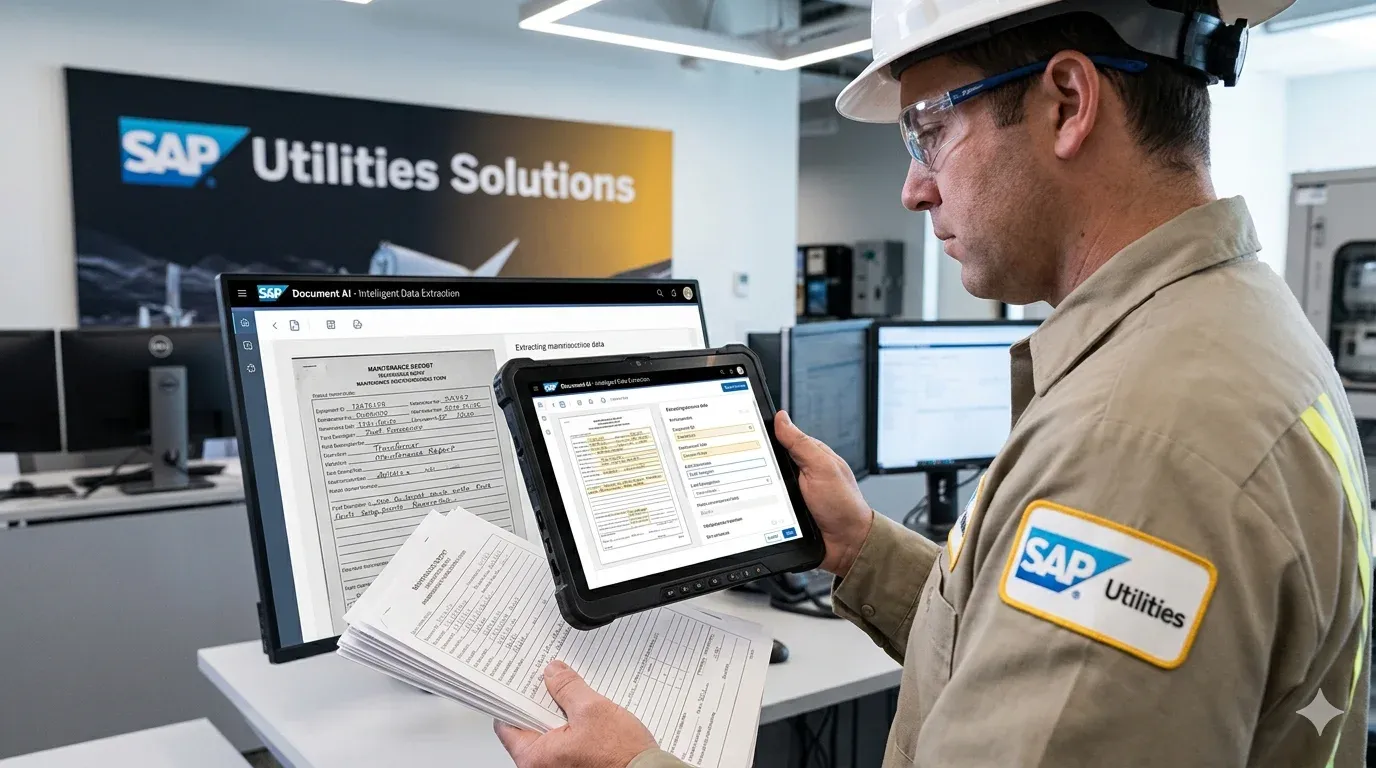
A meter technician finishes a routine inspection on a residential gas meter in the field. The reading is fine. The seal is intact. The installation looks good. He fills out a paper form, takes three photos on his phone, and drives back to the depot. Back at the office, someone keys the results into SAP IS-U manually, attaches the photos by hand, and creates the corresponding Plant Maintenance notification. If the technician's handwriting is unclear, they go back and ask. If the document gets lost in the pile, the inspection record is just... missing.
This is not a niche problem. Across power, gas, water, and district heating utilities, field service teams generate thousands of documents every week. Meter inspection reports. Grid maintenance logs. Contractor completion certificates. Fault investigation records. Pressure test results. The volume is enormous, and the gap between "document exists in the field" and "document is live in SAP" is wide, slow, and full of risk.
The good news is that this gap is exactly what modern document AI is built to close.
The Real Cost of Manual Document Handling in Utilities
Most utilities have already invested heavily in SAP. IS-U handles customer accounts, meter management, and billing. PM (Plant Maintenance) manages assets, work orders, notifications, and maintenance histories. The systems work well when data is in them. The problem is getting operational field data in accurately and fast.
The manual route creates several compounding problems.
Data latency is the most visible one. When a contractor completes a grid maintenance job on a Thursday afternoon and the paperwork lands on someone's desk on Monday, SAP is running blind for the weekend. If a fault report comes in for that same asset on Saturday, no one can see the maintenance work that just happened. Decisions get made on incomplete information.
Data quality is the quieter problem. Manual entry introduces transcription errors at every step. A meter serial number copied wrong means the inspection gets attached to the wrong asset. A maintenance date entered incorrectly throws off PM scheduling. These errors compound over months and years until the asset history in SAP becomes unreliable, which undermines the entire maintenance planning function.
Then there is the labor cost. Utilities running large field operations can have multiple back-office staff whose primary job is document intake and SAP data entry. This is expensive work with very little value added. The staff are not making decisions or adding insight; they are moving data from paper to screen.
Compliance pressure makes all of this worse. Gas networks, electricity distribution companies, and water utilities operate under regulatory frameworks that require documented proof of inspection, maintenance, and contractor qualification. When an audit happens, someone needs to produce complete, accurate records. If the records are patchy, the organization is exposed.
Traditional document processing for utilities meant template-based OCR. You trained the system on a fixed form layout, and it extracted fields from that layout. This worked reasonably well when every contractor used the same form and never changed it. In practice, contractors use dozens of different formats. Forms change when regulations change. Handwritten sections appear next to printed ones. Photos and attachments come in as separate files.
AI-native document processing handles this differently. Instead of matching a layout, it understands the document. It reads a meter inspection report the way a trained human would, identifying what each field means regardless of where it appears on the page. It handles handwritten annotations, unstructured notes, and multi-page documents without needing a new template for each variation.
For utilities specifically, this matters because the document universe is genuinely heterogeneous. A maintenance log from one major contractor looks completely different from the same type of document from another. A pressure test certificate from a certified engineer follows no standard format. An inspection photo with handwritten annotations next to the meter needs to be understood in context, not just attached as an image file.
The AI reads all of these. It extracts the relevant data fields. It validates them against what SAP already knows about the asset. And it routes the data directly into the right records. 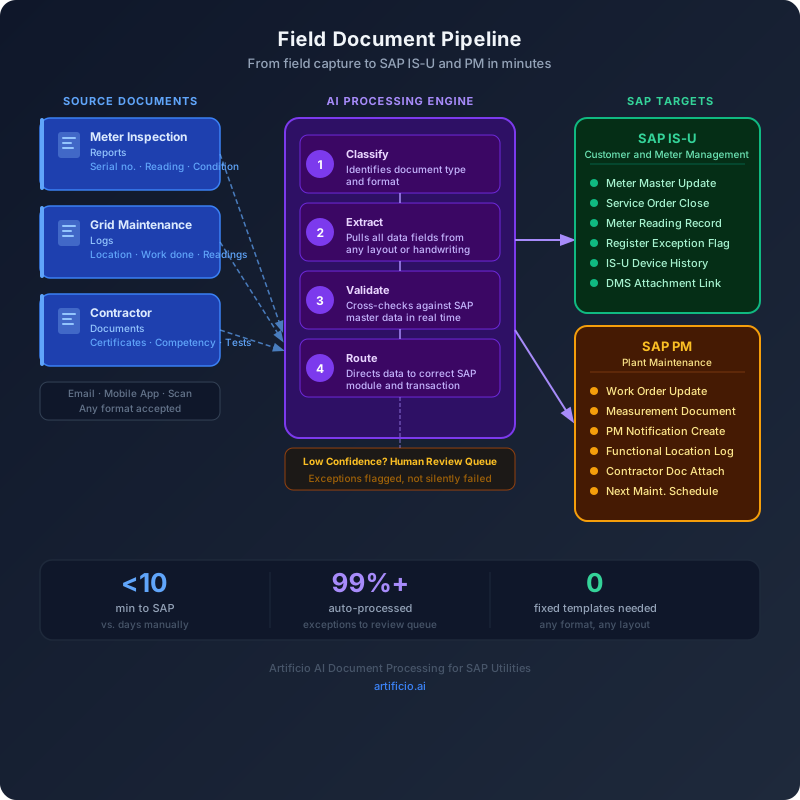
Three Document Types That Drive the Most SAP Integration Value
Meter Inspection Reports
Meter inspection is one of the highest-volume field activities in any utility. Gas, electricity, and water meters all require periodic inspection and often replacement. Each visit generates a structured report covering meter serial number, location details, reading at time of inspection, condition assessment, seal status, photos, and the inspector's sign-off.
Getting this into SAP IS-U correctly means updating the meter technical master, creating or closing the relevant service order, recording the reading, and flagging any follow-up actions. Done manually, this is a multi-step process across several SAP transactions. Done through AI automation, the document arrives, the AI extracts all relevant fields, validates the serial number against the IS-U meter master, and writes the data to the correct records.
The validation step matters more than it might seem. Serial number mismatches are one of the most common data quality issues in utility SAP systems. An AI that cross-checks extracted serial numbers against the IS-U asset registry before writing catches these errors at the point of entry. A human keying data at the end of a long shift does not always catch them.
Grid Maintenance Logs
Transmission and distribution maintenance is the domain of SAP PM. When a maintenance crew carries out work on a substation, a pressure regulation station, or a section of distribution network, they generate a log documenting what was done, what materials were used, what measurements were taken, and what the next scheduled maintenance date should be.
These logs need to land in PM as completed work order updates, with the right functional location, the right measurement documents, and any new notification items triggered by observations in the field. If a technician noted signs of corrosion that need follow-up, that observation needs to become a PM notification before anyone forgets about it.
AI document processing reads the maintenance log, creates or updates the work order record, writes measurement readings to the correct PM measurement points, and generates notifications for any flagged observations. The maintenance supervisor can see completed work in SAP the same day it happened, not three days later when the paperwork eventually arrived.
Third-party contractors perform a significant portion of field work for most utilities, especially capital projects and specialist maintenance activities. They generate their own documentation: completion certificates, test records, method statements with sign-off, personnel competency records, and as-built drawings.
These documents need to reach SAP in two ways. The data from completion certificates needs to update PM work orders and asset records. The documents themselves need to be stored as attachments against the relevant SAP objects so they are retrievable during audits.
The compliance dimension here is particularly high-stakes. If a gas contractor carries out work and cannot demonstrate that the personnel on site held current competency cards, the utility carrying the regulatory responsibility needs that proof on file. AI document processing can extract the relevant competency information from contractor-submitted documents, flag anything that looks expired or incomplete, and route the documents to the right SAP attachment records automatically.
How the Integration Architecture Works
The practical integration between an AI document processing platform and SAP involves a few key components.
Documents arrive through multiple channels. Some come via email from field teams or contractors. Some come through a mobile app used by technicians. Some arrive as scanned batches from a depot. The AI platform needs to accept all of these without requiring a single standardized submission method.
The AI processes each document regardless of format. This is where the heavy lifting happens: classification (what type of document is this?), extraction (what are the key data fields?), validation (do the extracted values match what SAP already knows about this asset, location, or work order?), and enrichment (adding context that makes the SAP write more accurate).
Once the data is validated, the integration layer writes to SAP. For IS-U, this typically means updating meter records, creating readings, or closing service orders via BAPI or web service calls. For PM, it means updating work orders, writing measurement documents, creating notifications, or updating functional location records. Documents themselves get stored as attachments in SAP's Document Management System (DMS) or linked directly to the relevant PM object.
Exceptions go to a human review queue. Not every document processes perfectly, and the system should not silently fail. When confidence scores fall below a threshold, or when extracted data cannot be validated against SAP master data, a human reviewer sees the document with the extraction results highlighted for their confirmation. This means humans are spending their time on genuine edge cases, not routine data entry.
The result is a continuous pipeline. Documents come in from the field in real time, data lands in SAP within minutes, and the back-office team is working through an exceptions queue rather than a document pile.
What Changes for Field Teams and Operations
The operational impact extends beyond back-office efficiency.
Field technicians stop carrying paper and stop waiting for office staff to confirm that their work is recorded. A mobile submission takes thirty seconds. The technician can see confirmation that the document was received and processed. If there is an issue with the document, the flag comes back to them quickly while the job is still fresh in their mind.
Maintenance planners and asset managers get SAP records that reflect what is actually happening in the field. PM schedules based on up-to-date maintenance histories are genuinely accurate. Predictive maintenance models that rely on measurement data from field inspections are fed consistently. Asset condition assessments reflect the most recent inspection, not an inspection from six months ago that is still sitting in someone's in-tray.
Operations teams dealing with faults and incidents can pull up full asset histories in real time. When a gas escape call comes in and the control room is trying to understand the recent maintenance status of a regulator station, they get the full picture immediately. That matters for the decisions made in the first hour.
Contract managers get visibility into contractor performance and documentation compliance without chasing emails. Completion certificates, test results, and competency records all flow into SAP against the relevant work orders and assets. A contract performance review can pull real data rather than relying on self-reported contractor summaries. 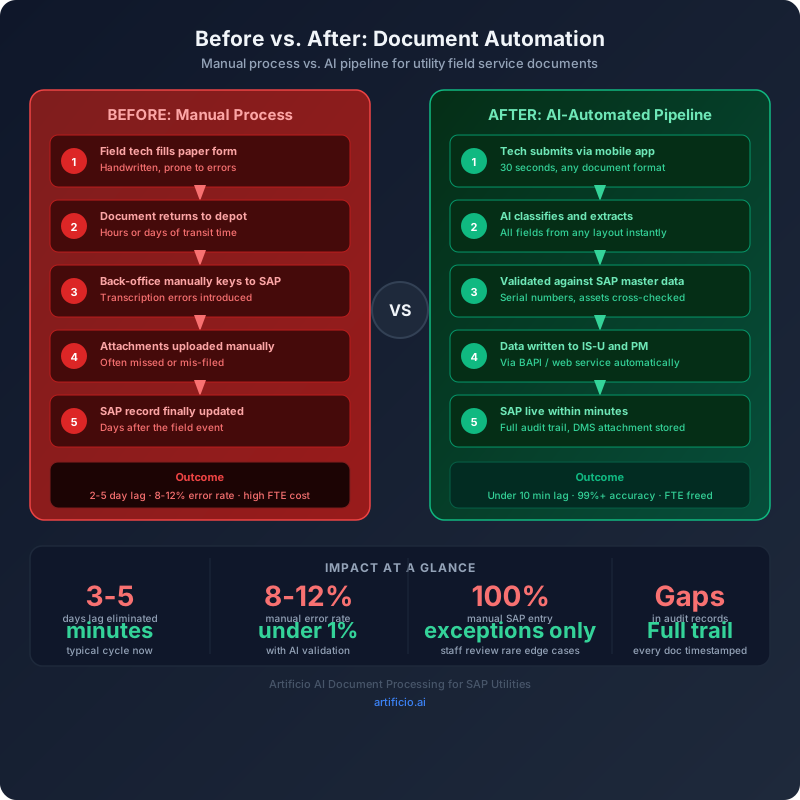
Addressing the SAP Customization Reality
One of the legitimate concerns about any SAP integration is the variation in how utilities have customized their SAP implementations. IS-U configurations differ. PM setups differ. The functional locations hierarchy, the work order types, the notification categories, the custom fields added over years of implementation projects, all of these create variation that a rigid integration cannot handle.
AI-native platforms approach this differently from point-to-point integrations. The extraction layer adapts to the document content rather than requiring the document to conform to a fixed template. The integration layer connects to SAP through configuration rather than hard-coded field mappings. When a utility has a custom Z-field on their PM functional location for grid segment classification, the integration maps to it. When a utility uses non-standard work order types, the routing logic accommodates them.
This configurability is what makes the difference between a platform that works in a demo environment and one that works in the actual SAP implementation a utility has been running for fifteen years.
Compliance and Audit Readiness as a Structural Benefit
Beyond operational efficiency, there is a structural compliance benefit that matters particularly for regulated utilities.
Every document that flows through an AI processing platform creates a full audit trail. The original document is preserved. The extraction results are logged. The validation steps are recorded. The SAP writes are timestamped. When an auditor from a regulatory body asks for evidence that meter inspections were carried out on schedule and recorded correctly, the answer is a filtered report from the system, not a physical archive dig.
For utilities operating under safety case regimes (gas pipelines, high-voltage networks, high-consequence infrastructure), the documentation requirements are extensive and the consequences of gaps are serious. An automated pipeline that reliably captures and stores every relevant document against the correct SAP asset record is not just operationally convenient. It is a meaningful risk reduction.
This also matters for asset lifecycle management. Utilities routinely make investment decisions about ageing infrastructure based on maintenance history and condition records. If those records are incomplete because manual data entry processes created gaps, investment decisions get made on incomplete information. Assets that should be replaced get deferred. Assets that could run longer get replaced earlier. The financial impact over a large asset base is real.
Getting Started: What Practical Deployment Looks Like
For utilities considering this approach, the practical starting point is usually a single document type and a single SAP target.
Meter inspection reports into IS-U is a common first deployment. The document type is high-volume, the SAP target is well-defined, and the business case is easy to measure. After the first three months, the data entry cost reduction and the data quality improvement are both quantifiable.
From there, the scope expands. Maintenance logs into PM. Contractor documents into DMS and PM work orders. Each expansion builds on the integration layer already in place.
The implementation timeline for a focused first deployment is typically six to ten weeks. That includes AI model configuration for the specific document types, integration testing against the SAP environment, exception handling workflow setup, and user acceptance testing with the back-office team.
The larger question is not whether the technology works but whether the organization is ready to change the process around it. Field teams need to know they are submitting digitally instead of carrying paper. Contractors need to know the submission channel. Back-office staff need to shift from document entry to exception review. These are change management questions as much as technical ones.
The Bigger Picture for Utility Asset Management
What document automation into SAP IS-U and PM ultimately enables is a utility that runs on current information. The SAP system stops being a lagging record of what happened weeks ago and becomes a live operational picture.
That matters more now than it has before. The energy transition is creating new asset complexity. More distributed energy resources, more network connections, more inspection and maintenance activity. The document volumes are increasing. The regulatory scrutiny is increasing. The consequence of incomplete asset records is increasing.
Manual document handling was always a weak point. At the current pace of change, it becomes a genuine operational risk.
The utilities that close this gap now, building reliable pipelines from field documents into SAP, are building the operational foundation for the next decade. Every meter inspected, every maintenance job logged, every contractor document captured lands in the asset record accurately and fast. The SAP investment the organization made years ago finally reflects what is actually happening in the field.
That is what document AI is built to deliver. Not a replacement for SAP. A reliable feed into it.