The maintenance technician finishes a complex equipment inspection at 4:30 PM. He has a thick paper checklist, a handwritten inspection report, a calibration certificate from the third-party vendor, and a signed maintenance completion form. He knows what needs to happen next: everything goes into SAP PM. He also knows what will actually happen next: the stack of papers will sit on his desk until tomorrow morning, when a coordinator spends ninety minutes manually entering data into the system.
This scenario plays out every day across manufacturing plants, utilities, oil and gas facilities, and any other operation that runs SAP Plant Maintenance. The maintenance work gets done. The documentation gets created. But the gap between paper and system stays stubbornly wide, and the cost of bridging that gap manually adds up fast.
AI document automation is changing this. Not by replacing the maintenance workflow, but by eliminating the manual transfer step entirely.
The Document Bottleneck Inside SAP PM
SAP Plant Maintenance handles everything from preventive maintenance schedules to corrective repair tracking. It is the system of record for equipment health across the plant. But keeping it accurate requires constant feeding with real-world data, and that data arrives in formats that SAP was not designed to ingest directly.
Work orders come back from the field with handwritten completion notes. Inspection reports follow structured templates but often carry handwritten annotations in the margins. Maintenance certificates arrive as scanned PDFs from external contractors who have no connection to your SAP environment. Equipment service records from OEM service teams arrive in their own formats, not yours.
Each of these documents needs someone to read it, understand what it means in the context of SAP PM's data structure, and type the relevant fields into the correct transaction. That person is usually a maintenance coordinator or planner who could be doing higher-value work. And even when that person is skilled and careful, the data entry process introduces delays, creates backlogs during peak maintenance periods, and carries the inherent error risk that comes with any manual re-keying process.
The problem is not that SAP PM is inadequate. It is that the document layer sitting between field maintenance and the system was never properly connected. 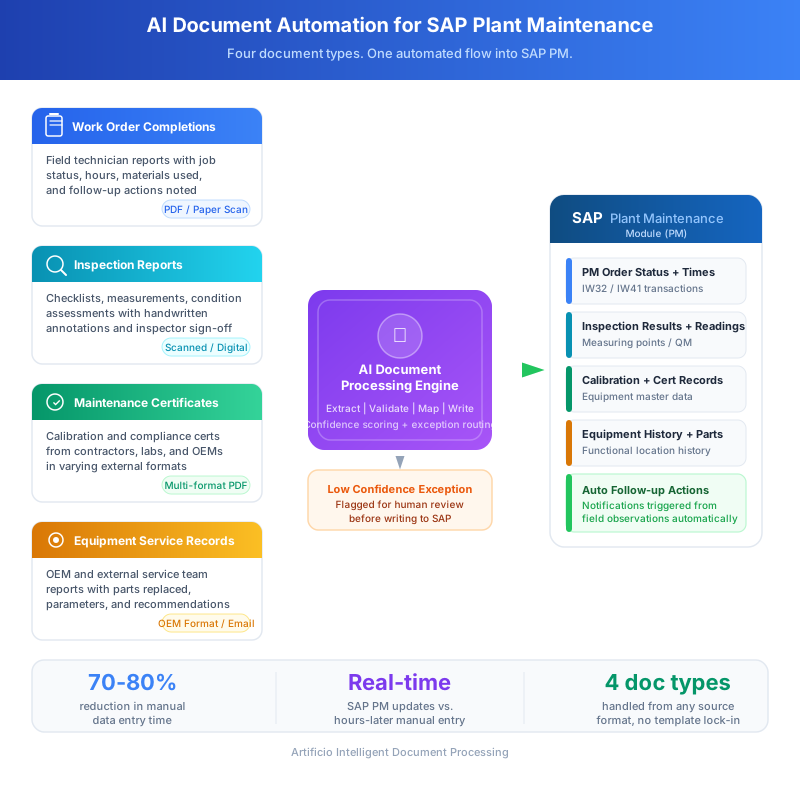
AI document processing platforms built for enterprise environments can read maintenance documents the way an experienced coordinator does. They understand context, not just text.
When a work order completion form arrives, the system does not just extract the words on the page. It understands that "job done, needs follow-up lubrication" in the technician notes means the work order status should be set to technically complete with a follow-up notification created. It maps the equipment tag number from the form to the functional location in SAP. It captures labor hours, materials used, and failure codes from free-text descriptions that a simpler system would miss entirely.
This context-awareness is what separates modern AI document processing from the optical character recognition tools that maintenance teams tried years ago and found disappointing. OCR reads characters. AI understands maintenance language.
The specific capabilities that matter for SAP PM integration break down across four core document types.
Work Order Completion and Processing
Field work orders generate the highest document volume in most maintenance operations. Technicians complete them on paper or on simple mobile forms that produce PDFs. The completed document carries everything SAP needs to close or update the work order: actual start and finish times, materials consumed, work performed descriptions, equipment condition observations, and whether follow-up actions were identified.
AI processing extracts all of this and writes it to the corresponding PM order fields without manual intervention. The system handles variations in how different technicians describe the same type of work. It recognizes common maintenance abbreviations. It can parse multi-page work orders where different sections were completed by different crew members at different times.
The resulting SAP updates are timestamped to when the work was actually completed, not when a coordinator finally got to the data entry queue. For operations that track maintenance KPIs and compliance timelines, this distinction matters significantly.
Inspection Reports and Condition Assessments
Inspection documents are structurally more complex than work orders because they combine structured checklist data with narrative condition descriptions and often include measurements, readings, and observations that need to map to specific equipment parameters in SAP.
A pressure vessel inspection report might contain fifty checkpoints, a series of thickness measurements at mapped locations, observations about surface condition, and a summary recommendation from the inspector. Getting all of that into SAP PM manually is a substantial exercise. Getting it right requires someone who understands both the inspection methodology and the SAP data structure.
AI processing handles this by learning the inspection templates used by the organization and its contractors. Once trained on a template type, the system can reliably extract structured data from every inspection report that follows that format, even when reports are scanned at an angle, have handwritten additions, or are partially obscured. The system flags anything it cannot read with high confidence, creating an exception queue for human review rather than silently entering potentially wrong data.
Maintenance Certificates and Compliance Documentation
Third-party maintenance certificates and compliance documents carry a different set of challenges. These come from contractors, calibration labs, and OEM service teams, each with their own document formats. Unlike internal forms, these documents were not designed with your SAP structure in mind.
The AI system maps external certificate data to internal SAP fields by understanding what the information represents rather than where it appears on the page. A calibration certificate from a metrology lab looks different from one issued by an OEM service team, but both contain calibration date, next calibration due date, measured values, acceptance criteria, and technician or lab credentials. The extraction logic works across formats because it understands maintenance certification content, not just document layout.
These certificates then populate the relevant measuring point records, equipment master data, and maintenance notification fields in SAP PM. Compliance tracking that previously required manual filing and periodic audits to verify becomes automatic and auditable at the transaction level.
Equipment Service Records from OEM and External Providers
When external service teams complete work on equipment, the service record is often the only documentation of what was done. OEM engineers who service critical machinery typically work to their own protocols and produce their own reports. Getting that information into SAP PM has traditionally meant emailing the report to a coordinator who enters it manually, with the usual risks and delays.
AI processing handles OEM service records by extracting work performed, parts replaced, operational parameters checked, and any deviations or recommendations noted. The system creates or updates the relevant equipment history in SAP PM, associates the service record with the appropriate functional location, and can trigger follow-up notifications if the service record contains actions required before the equipment returns to service. 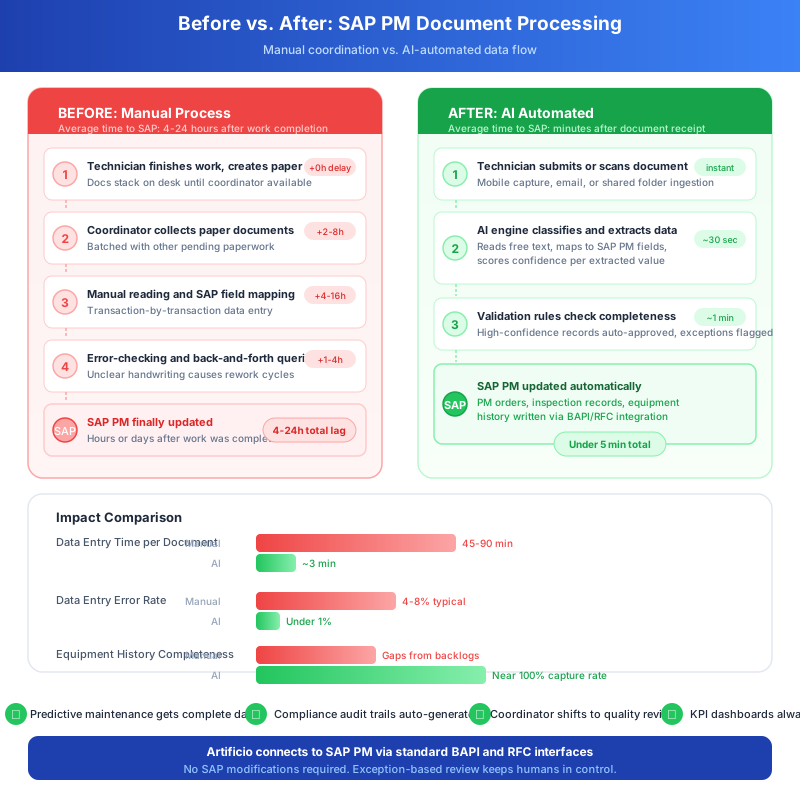
How the Integration Works With SAP PM
The practical question for operations teams is always how this connects to the existing SAP environment without a major implementation project.
Modern AI document automation platforms are built to integrate with SAP through standard interfaces. SAP PM exposes its data objects through RFCs, BAPIs, and increasingly through REST APIs, and AI processing platforms use these same channels to write extracted data into the system. The integration does not require modifications to SAP, and it does not require migrating to a cloud SAP environment.
The typical deployment architecture works in a few stages. Documents arrive at an ingestion point, which can be an email inbox, a shared network folder, a mobile capture app used by field technicians, or a direct feed from a contractor portal. The AI processing layer classifies each document, extracts the relevant data, applies validation rules to check for completeness and consistency, and then pushes confirmed data to SAP PM through the integration layer. Documents that fail validation or score below confidence thresholds go to a review queue where a coordinator can verify and correct before the data is written to SAP.
This exception-based review model is what makes the system practical for environments where document quality varies. The AI handles the high-confidence majority automatically. People handle the exceptions. The coordinator role shifts from data entry to quality assurance, which is a considerably more efficient use of that expertise.
The Numbers That Justify the Conversation
Maintenance operations that have moved to AI document processing typically see data entry time reduced by seventy to eighty percent across the document types the system handles. For a facility processing a few hundred maintenance documents per week, that translates to meaningful FTE hours redirected to higher-value work.
Beyond the efficiency numbers, there are data quality benefits that show up in downstream reporting. SAP PM reports and KPI dashboards become more reliable when they are not dependent on manual entry that happens hours or days after the fact. Equipment history becomes more complete when every service record and inspection result gets captured automatically rather than depending on whether a coordinator had time that week.
Compliance functions gain audit trails that are created at the point of work completion, not reconstructed later. When a regulatory auditor asks for the inspection history of a pressure vessel or the calibration records for a critical instrument, the documentation exists in SAP exactly as it should, without the weekend scramble to pull paper files and reconcile what was captured against what was done.
What to Look for in a Platform
Not every AI document processing platform is equally suited to the SAP PM environment. A few criteria separate capable solutions from those that will require heavy customization or ongoing maintenance to keep working.
SAP-native integration depth matters. Platforms that understand SAP data objects at a functional level, not just as an API target, produce better extraction mappings and handle edge cases more reliably. The difference shows up when documents contain data that could map to multiple SAP fields and the system needs to make the right decision about where it goes.
Configurability without code development is important for maintenance operations where document templates change periodically and the IT queue is already long. The best platforms let maintenance or operations staff configure new document templates and adjust extraction rules without writing software.
Confidence scoring and exception handling determine the practical reliability of the system. A platform that silently enters low-confidence data into SAP is more dangerous than no automation at all. Exception-based review with clear confidence indicators keeps people appropriately involved where they add value.
Auditability rounds out the requirements. Every extraction decision, every data write to SAP, and every exception review should be logged with timestamps and user identifiers. For compliance-heavy industries, this audit trail is not optional.
Maintenance Operations That Benefit Most
The business case for AI document automation in SAP PM is strongest in operations with a few specific characteristics.
High maintenance document volume is the primary driver. Facilities processing hundreds or thousands of maintenance documents per week see the biggest time savings. Facilities with lower volumes can still benefit, but the payback period is longer.
Regulatory compliance requirements add urgency. Industries operating under standards that require detailed equipment maintenance records, such as oil and gas, pharmaceuticals, utilities, and aerospace, face consequences for documentation gaps that make automation both an efficiency and a risk management decision.
Mixed document sources amplify the value. Operations that receive maintenance documentation from multiple contractors, OEM service teams, and internal crews deal with format variability that makes manual entry slow and inconsistent. AI processing handles that variability more reliably than any standardization effort aimed at making external providers use your forms.
Geographically distributed maintenance operations also benefit significantly. When technicians complete work across multiple sites and someone at a central location has to process all the resulting documentation, backlogs accumulate quickly and data freshness suffers. Automation eliminates the geographic bottleneck entirely.
The Shift That Actually Matters
The deeper change that AI document automation brings to SAP Plant Maintenance is not about efficiency metrics. Those are real, but they are table stakes. The real shift is in what becomes possible when equipment history is complete, current, and reliable.
Predictive maintenance programs depend on historical equipment data to build accurate failure models. When that data is incomplete because manual entry creates gaps, or stale because backlogs delay entry by days, the predictive models are built on a degraded foundation. AI processing feeds SAP PM with the complete, timely data that makes predictive maintenance actually work.
Maintenance planning improves when planners can see the full picture of what has been done on each piece of equipment, what conditions were observed, and what follow-up actions were captured from field reports. Work that used to get missed because the inspection report was still in the data entry queue gets planned and executed because the information arrives in SAP when the inspection is complete.
The maintenance coordinator sitting with that stack of papers at 4:30 PM is not the problem. That person is one connection point in a process that was designed around paper documents and manual transfer steps that made sense before AI processing was available. Replacing those manual steps changes what the entire maintenance operation can accomplish, not just how efficiently documents get entered.
That is the transformation worth building toward.