

Blog
AI-Powered Document Automation in Logistics Operations
Discover how AI document automation eliminates logistics paperwork bottlenecks, boosts efficiency, reduces errors, and enhances supply chain agility.

Blog
Discover how AI document automation eliminates logistics paperwork bottlenecks, boosts efficiency, reduces errors, and enhances supply chain agility.
In the intricate ecosystem of global supply chains, documentation serves as both the backbone and, paradoxically, one of the most significant bottlenecks in operational efficiency. The logistics industry, despite its technological advancements in tracking, routing, and physical automation, continues to grapple with mountains of paperwork that impede the velocity of goods movement, introduce costly errors, and consume disproportionate human resources. This phenomenon, which we might call the "logistics document bottleneck," represents a critical vulnerability in supply chain resilience and competitiveness in an era defined by speed, accuracy, and adaptability. The contemporary logistics landscape demands a fundamental reimagining of document processing one that leverages artificial intelligence to transform what has historically been a liability into a strategic advantage.
The persistence of manual document workflows in logistics operations presents a multifaceted challenge that reverberates throughout the entire supply chain. Consider the typical workflow for processing shipping documents: data must be manually extracted from bills of lading, carrier agreements need individual review and signature, rate confirmations require painstaking verification, invoices demand reconciliation against multiple source documents, and compliance forms necessitate careful completion to avoid regulatory penalties. Each of these processes introduces friction points where time is lost, errors are introduced, and costs accumulate. According to industry analyses, logistics professionals spend approximately 30-40% of their workday on document-related tasks, with error rates in manual data entry approaching 4% in high-volume environments. These inefficiencies translate directly to delayed shipments, billing disputes, compliance risks, and ultimately, compromised customer satisfaction.
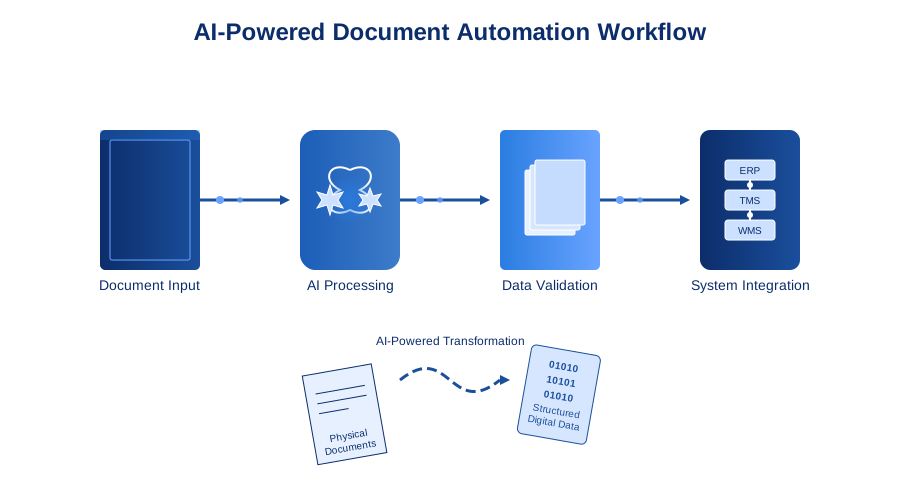
The emergence of artificial intelligence, particularly in the domains of document processing and natural language understanding, represents a watershed moment for logistics operations. AI-powered document automation transcends the limitations of traditional document management systems by introducing capabilities for intelligent data extraction, contextual understanding, and autonomous decision-making. Rather than simply digitizing documents for storage and retrieval, these systems can interpret unstructured information, recognize entities and relationships within text, validate data against established rules, and seamlessly integrate extracted information with enterprise systems. The result is a paradigm shift from document management to document intelligence a transition that promises to eliminate the documentation bottleneck while simultaneously enhancing data quality, compliance adherence, and operational visibility.
As we explore the transformative potential of AI-powered document automation in logistics, we must recognize that this is not merely an incremental improvement but rather a fundamental reimagining of how information flows through supply chains. The logistics organizations that embrace this transformation stand to gain significant competitive advantages in terms of operational efficiency, cost reduction, customer satisfaction, and market agility. In the following sections, we will examine the specific use cases where AI document automation is delivering the most substantial impact, delve into the technological underpinnings of these systems, outline implementation best practices, quantify the return on investment, and consider the future evolution of document intelligence in logistics operations.
The practical applications of AI-powered document automation in logistics are numerous and far-reaching, addressing pain points across the operational spectrum. Artificio.ai has developed specialized solutions for five high-impact use cases that represent critical document workflows in logistics operations. Each of these use cases demonstrates the transformative potential of intelligent document processing to eliminate manual effort, reduce processing time, minimize errors, and enhance compliance. Let's explore these use cases in detail to understand how AI is fundamentally changing document workflows in logistics.
Carrier packets represent one of the most document-intensive processes in logistics operations, typically comprising multiple agreements, insurance certificates, operating authority documentation, W-9 forms, and various compliance attestations. The traditional approach to processing carrier packets involves manual review, data extraction, verification against established criteria, and individual document signing a process that can take days or even weeks to complete. This delay directly impacts carrier onboarding timelines, limiting operational flexibility and potentially causing missed business opportunities when capacity needs to be quickly scaled.
Artificio.ai's approach to carrier packet automation leverages advanced document understanding capabilities to transform this process. The system intelligently identifies and classifies each document within the carrier packet, extracts relevant data points using specialized natural language processing models, and validates the information against both internal requirements and external databases. For instance, the system can automatically verify insurance coverage against minimum requirements, cross-reference USDOT numbers with federal databases, and ensure that all mandatory fields are completed with valid information. Once the validation process is complete, the system pre-populates signature fields, routes documents to appropriate signatories through secure digital channels, and maintains a comprehensive audit trail of the entire process.
The impact of this automation is profound. Carrier onboarding time can be reduced from days to minutes, enabling logistics providers to rapidly expand their carrier networks in response to changing market conditions. The validation capabilities ensure consistent application of compliance standards, reducing the risk of working with carriers that fail to meet insurance or regulatory requirements. Furthermore, the digital audit trail provides complete visibility into the onboarding process, facilitating both internal governance and external compliance demonstrations. For carriers themselves, the streamlined process reduces administrative burden and accelerates time-to-revenue, creating a positive experience that strengthens the business relationship from the outset.
The carrier packet automation use case illustrates how AI document processing extends beyond simple data extraction to encompass complex workflow automation, compliance validation, and relationship management. By transforming what was previously a cumbersome administrative process into a streamlined digital workflow, logistics organizations can achieve greater operational agility while simultaneously enhancing risk management and compliance posture.
Rate confirmation sheets serve as the contractual backbone of individual shipments, documenting the agreed-upon pricing, service requirements, pickup and delivery specifications, and other critical terms between shippers, carriers, and intermediaries. The traditional process for generating and processing rate confirmations involves manual data aggregation from multiple sources, individual calculations based on complex rate structures, document creation, revision cycles during negotiation, and finally, signature collection. This process is not only time-consuming but also prone to errors in rate calculations, specification details, and terms documentation errors that can lead to disputes, payment delays, and damaged business relationships.
Artificio.ai's solution for rate confirmation automation transforms this process through intelligent data orchestration and document generation. The system integrates with transportation management systems, customer databases, carrier rate tables, and fuel surcharge indices to automatically compile all necessary information for accurate rate calculation. Machine learning algorithms apply appropriate rate structures based on lane, equipment type, commodity, service level, and current market conditions, ensuring precise pricing that reflects all relevant factors. The system then generates professionally formatted rate confirmation documents with all required fields pre-populated, routes them for approval, and facilitates digital signature collection from all parties.
What distinguishes Artificio.ai's approach is its ability to handle the nuanced variations in rate structures across different business relationships and market segments. The system can accommodate contract rates, spot market pricing, accessorial charges, and special service requirements, applying business rules that reflect the organization's pricing strategies and operational constraints. Additionally, the system maintains version control during negotiation processes, tracking changes and maintaining a clear record of the evolution of terms. This comprehensive approach not only accelerates the rate confirmation process but also enhances pricing accuracy and contractual clarity.
The business impact of automating rate confirmations extends throughout the logistics operation. Sales and operational teams can respond to customer requests with immediate, accurate quotes rather than engaging in time-consuming manual calculations. The risk of pricing errors that erode margins or create customer dissatisfaction is substantially reduced. The negotiation cycle time decreases dramatically, allowing for faster booking confirmation and operational planning. Perhaps most importantly, the system creates a centralized, searchable repository of rate agreements that provides visibility into pricing patterns, margin performance, and contract compliance valuable business intelligence that can inform future pricing strategies and operational decisions.
The Internal Revenue Service's W-9 form represents a seemingly simple yet surprisingly problematic document in logistics operations. Required for all independent contractors and business vendors, including carriers, this tax information document demands accurate collection and management to ensure proper tax reporting and avoid potential penalties. The traditional approach to W-9 processing involves requesting paper or scanned forms from vendors, manually extracting tax identification numbers and business information, verifying the accuracy of this information, storing the documents in compliance with data security requirements, and integrating the tax data with accounting systems. Each step in this process presents opportunities for errors, delays, and compliance failures.
Artificio.ai's W-9 automation solution addresses these challenges through specialized document understanding capabilities. The system employs AI-powered Optical Character Recognition (OCR) optimized for form documents to accurately extract structured information from W-9 forms regardless of format variations or image quality issues in scanned documents. Named Entity Recognition (NER) algorithms identify and categorize critical information such as legal business names, tax identification numbers, business types, and address components. Validation routines check the extracted data against formatting rules and external databases to flag potential errors or discrepancies. Once validated, the information is securely stored in compliance with data protection requirements and integrated with accounting and vendor management systems.
A distinctive feature of Artificio.ai's W-9 processing capability is its ability to handle the diverse formats in which this information might be received. While the IRS provides a standard form, variations occur in how this form is completed, scanned, or submitted. Some vendors may provide the information in corporate letterhead format rather than on the official form. The AI system is trained to recognize and process these variations, extracting the same standardized data regardless of the input format. Additionally, the system incorporates TIN matching validation to verify that the provided tax identification numbers correspond to the registered business names, reducing the risk of tax reporting errors.
The business impact of W-9 automation extends beyond operational efficiency to encompass risk management and financial compliance. By ensuring accurate tax information collection and validation, organizations reduce their exposure to IRS penalties for incorrect information reporting. The automated integration with accounting systems eliminates data transcription errors that could lead to incorrect tax filings. The secure, centralized storage of W-9 documents simplifies audit preparation and demonstration of compliance. Furthermore, the automation of this process accelerates vendor onboarding, allowing finance departments to process payments more quickly and maintain positive vendor relationships.
Invoice processing represents one of the most transaction-intensive document workflows in logistics operations, involving the creation, validation, approval, and payment of invoices for transportation and related services. The traditional invoicing process is fraught with inefficiencies: manual data entry from various source documents, reconciliation against multiple systems, approval routing through complex organizational hierarchies, and manual payment processing. These inefficiencies result in extended payment cycles, increased processing costs, missed early payment discounts, strained vendor relationships, and limited visibility into financial obligations.
Artificio.ai's automated invoicing solution transforms this process through end-to-end intelligent document processing. On the creation side, the system automatically generates accurate invoices based on completed shipment data, pulling information from bills of lading, proof of delivery documentation, rate agreements, and accessorial charge records. For incoming vendor invoices, the system employs advanced OCR and NER capabilities to extract line-item details, charge amounts, payment terms, and reference numbers. In both scenarios, the extracted data undergoes rigorous validation against expected values, historical patterns, and business rules to identify potential errors or fraudulent charges.
What distinguishes Artificio.ai's invoicing automation is its comprehensive reconciliation capabilities. The system automatically compares invoice details against rate confirmations, contracted terms, proof of delivery documentation, and accessorial approval records to verify the accuracy of all charges. When discrepancies are detected, the system can either automatically adjust the invoice according to predetermined rules or route the exception for human review with detailed annotations explaining the identified issues. This intelligence extends beyond simple data matching to incorporate contextual understanding of industry practices, service agreements, and company policies regarding charge verification.
The business impact of automating the invoicing process is substantial and multifaceted. Processing costs decrease dramatically, with industry benchmarks showing reductions of 60-80% compared to manual methods. Payment cycles accelerate, allowing organizations to capture early payment discounts while improving vendor satisfaction. Cash flow forecasting becomes more accurate due to real-time visibility into invoice status and payment timelines. Perhaps most significantly, the detailed data captured through automated invoice processing creates opportunities for spend analysis, vendor performance evaluation, and identification of cost optimization opportunities. These insights enable more strategic financial management and stronger negotiating positions in future rate discussions.
The Bill of Lading stands as perhaps the most fundamental document in transportation logistics, serving simultaneously as a receipt, a contract of carriage, and a document of title for the transported goods. Traditional BOL processing involves manual data extraction from paper or scanned documents, entry into transportation management systems, verification against shipping orders, and transmission to various stakeholders including carriers, consignees, customs authorities, and financial institutions. This manual handling introduces delays in shipment visibility, increases the risk of transcription errors, and creates inefficiencies throughout the supply chain.
Artificio.ai's BOL automation solution addresses these challenges through specialized document intelligence capabilities designed for this complex document type. The system employs advanced OCR techniques optimized for the varied formats and quality levels of BOL documents, which may range from professionally printed forms to handwritten notations on standard templates. NER algorithms extract and categorize critical information including shipper/consignee details, commodity descriptions, piece counts, weights, dimensions, special handling instructions, and hazardous materials declarations. The system also recognizes and interprets specialized notation such as INCOTERMS, freight classifications, and carrier-specific reference numbers.
What sets Artificio.ai's BOL processing apart is its semantic understanding of the relationship between BOL elements and supply chain operations. The system doesn't simply extract data points; it interprets their meaning within the context of the shipment life cycle. For example, when processing hazardous materials information, the system validates compliance with documentation requirements specific to the identified materials and transportation modes. When extracting delivery terms, the system interprets their implications for responsibilities and costs throughout the shipment journey. This contextual intelligence enables not just data extraction but true operational insights from BOL documentation.
The business impact of automated BOL processing extends throughout the supply chain. Operational teams gain immediate visibility into shipment details, enabling proactive planning and exception management. Customer service representatives can access accurate, real-time shipment information to respond to inquiries. Compliance teams benefit from standardized extraction and validation of regulatory information such as hazardous materials declarations. Finance departments receive accurate, validated data for invoicing and payment processing. Perhaps most importantly, the centralized, structured data created through BOL automation becomes a foundation for analytics that can identify optimization opportunities, performance trends, and service improvement potentials across the logistics operation.
The transformative capabilities of Artificio.ai's document automation solutions are built upon a sophisticated technological architecture that combines advanced artificial intelligence with enterprise-grade data processing infrastructure. Understanding the underlying technology stack illuminates not only how these systems deliver their current capabilities but also how they continuously evolve to address new challenges and opportunities in logistics document processing. Let's examine the key components of this architecture and how they work together to enable intelligent document automation.
At the foundation of Artificio.ai's document automation capabilities lies a sophisticated document ingestion pipeline that transforms unstructured document inputs into structured, machine-actionable data. This pipeline begins with advanced Optical Character Recognition (OCR) technologies that transcend traditional text extraction to handle the diverse document formats, quality variations, and structural complexities encountered in logistics operations. Unlike conventional OCR systems that simply convert images to text, Artificio.ai employs deep learning models specifically trained on logistics documents to recognize industry-specific layouts, terminology, and notation systems.
The OCR capabilities are enhanced through specialized pre-processing techniques that optimize document images before text extraction. These techniques include adaptive binarization to handle varying background conditions, skew correction to address misaligned scans, noise reduction to improve recognition accuracy, and resolution enhancement to handle low-quality submissions. For handwritten components—common in fields such as driver signatures, delivery notes, and quantity adjustments—the system employs handwriting recognition models trained specifically on logistics document annotations. The result is exceptional text extraction accuracy even under challenging conditions such as poor scan quality, mixed print and handwriting, or non-standard form layouts.
Once text is extracted, the Named Entity Recognition (NER) layer identifies and categorizes critical information within the unstructured text. This involves both static entity detection based on predetermined categories (addresses, identification numbers, dates, monetary amounts) and dynamic entity recognition that adapts to document context. For instance, when processing a bill of lading, the NER system recognizes that a numeric value following specific terminology likely represents a piece count rather than a weight, while a similar number in a different context might be interpreted as a reference number. This contextual understanding is achieved through domain-specific NER models trained on millions of logistics documents.
The pipeline also incorporates table extraction capabilities essential for processing the tabular data common in logistics documents. Deep learning models identify table structures even when they lack explicit borders or consistent formatting, extracting row and column relationships to preserve the semantic structure of the data. This capability is crucial for accurately processing line-item details in invoices, commodity listings in bills of lading, or charge breakdowns in rate confirmations.
What distinguishes Artificio.ai's document ingestion pipeline is its continuous learning architecture. The system monitors processing results and user interactions to identify patterns in recognition challenges or errors. This feedback loop enables continuous refinement of the underlying models, with particular attention to document variations specific to individual clients or industry subsets. The result is an intelligent extraction system that grows more accurate and adaptable with each document processed, progressively reducing the need for human intervention in the extraction process.
Document extraction, while foundational, represents only the first step in intelligent document processing. Equally critical is the validation of extracted data to ensure accuracy, consistency, and compliance with business rules and regulatory requirements. Artificio.ai's validation engine combines rule-based logic with statistical analysis and machine learning to provide comprehensive data validation that goes far beyond simple format checking.
The validation engine operates on multiple levels, beginning with format and consistency validation that verifies basic properties such as date formats, numeric ranges, and required field presence. At a more sophisticated level, the system performs relational validation that checks consistency across different data elements within the same document. For example, in a bill of lading, the system might verify that the total weight matches the sum of individual line item weights, or that hazardous materials classifications align with the commodity descriptions provided.
Cross-document validation extends this capability by comparing information across related documents within a business process. For instance, when processing an invoice, the validation engine might compare charge amounts against the original rate confirmation, verify delivery dates against proof of delivery documentation, and check accessorial charges against service authorizations. This multi-document validation capability ensures consistency throughout the document lifecycle and identifies discrepancies that might indicate errors or potential fraud.
The rule engine itself employs a combination of explicit business rules defined by domain experts and implicit rules learned through statistical analysis of historical document processing. Explicit rules encode known business constraints, regulatory requirements, and operational policies for example, maximum weight limitations for specific equipment types or documentation requirements for international shipments. Implicit rules are derived from pattern analysis across large document sets, identifying unusual relationships or values that deviate from historical norms even if they don't violate explicit rules. This hybrid approach enables the system to catch both known constraint violations and anomalous patterns that merit human review.
What makes Artificio.ai's validation engine particularly powerful is its ability to evolve alongside business operations. The system incorporates a rules management interface that allows business users to define, test, and deploy new validation rules without technical intervention. This empowers operational specialists to encode their domain expertise directly into the validation process, ensuring that the system reflects current business practices and regulatory requirements. Additionally, the machine learning components continuously refine anomaly detection based on resolution outcomes, progressively improving their ability to distinguish between legitimate variations and true errors.
The value of intelligent document processing is fully realized only when the extracted and validated information flows seamlessly into the operational and financial systems that drive business processes. Artificio.ai has developed a comprehensive integration framework that enables bidirectional data flow between its document automation platform and the diverse enterprise systems used in logistics operations.
The integration architecture supports multiple connection methodologies to accommodate varying technical environments and system capabilities. For modern systems with well-defined APIs, the platform offers pre-built connectors that enable real-time data exchange with major enterprise applications including SAP, Oracle, QuickBooks, and industry-specific transportation management systems. For legacy systems or those with limited API capabilities, the platform provides scheduled data synchronization through secure file transfers in various formats including CSV, XML, JSON, and EDI. This flexibility ensures that organizations can implement document automation without disruptive changes to their existing technology infrastructure.
Beyond basic data transfer, Artificio.ai's integration capabilities include sophisticated data transformation and enrichment. The system maintains comprehensive mapping tools that align the document extraction outputs with the specific field structures, naming conventions, and data formats required by destination systems. These mappings can incorporate business logic to derive additional values, combine multiple source fields, or conditionally process information based on business rules. For example, when integrating invoice data with an ERP system, the mapping might include logic to determine the appropriate general ledger coding based on service type, business unit, and customer characteristics.
The integration framework also incorporates robust error handling and reconciliation capabilities to ensure data integrity across systems. Validation checkpoints verify successful data transmission and processing, with automated notification and retry mechanisms for failed integrations. Audit trails maintain comprehensive records of all system interactions, enabling troubleshooting and compliance verification. For bidirectional integrations, conflict resolution protocols manage scenarios where overlapping changes occur in multiple systems, preserving data consistency while preventing unintended overrides.
What distinguishes Artificio.ai's integration approach is its focus on business process continuity rather than merely technical connectivity. The platform includes workflow capabilities that orchestrate complex multi-system processes, ensuring that document data flows through all required systems in the appropriate sequence with proper handoffs between automated and manual process steps. This process-centric integration approach ensures that document automation enhances rather than disrupts established business operations, facilitating adoption while maximizing efficiency gains.
Successfully implementing AI-powered document automation in logistics operations requires more than technological deployment; it demands a strategic approach that addresses organizational, process, and change management considerations. Drawing from extensive implementation experience across diverse logistics environments, Artificio.ai has developed a set of best practices that maximize the value and minimize the disruption associated with document automation initiatives. These practices provide a framework for organizations at any stage of their automation journey, from initial exploration to enterprise-wide transformation.
The foundation of successful document automation lies in a comprehensive understanding of existing document workflows and their relationship to broader business processes. Before deploying automation technologies, organizations should conduct a detailed mapping exercise that documents the complete lifecycle of each target document type. This mapping should identify document origins, processing steps, decision points, handoffs between departments or systems, exception handling procedures, and ultimate disposition. The resulting workflow maps serve multiple purposes: they highlight inefficiencies in current processes, identify automation opportunities, and provide crucial context for AI model training.
Effective AI model training for document automation requires not just document examples but also an understanding of how those documents function within business operations. When mapping document workflows for automation, organizations should pay particular attention to the decision logic applied during manual processing. Which fields trigger specific actions? How are ambiguities or exceptions handled? What validation rules are applied, formally or informally? What contextual knowledge do experienced processors bring to the task? These insights inform both the technical implementation of the AI models and the business rules that govern the automated process.
The mapping process should also identify and quantify the pain points in current document workflows. Areas of measurement should include processing time distributions, error rates by document type and field, exception frequencies and resolution times, and resource allocation across different process steps. These metrics establish a performance baseline against which automation improvements can be measured and help prioritize which document types and process steps will deliver the greatest return on automation investment.
Organizations that derive the greatest value from document automation take an iterative approach to workflow mapping and model training. Rather than attempting to map and automate all document processes simultaneously, they begin with a focused scope typically high-volume, standardized documents with clear processing rules. The insights gained from these initial implementations inform subsequent phases, allowing for progressive refinement of both the workflow understanding and the AI models. This iterative approach accelerates time-to-value while building organizational capabilities and confidence in the automation journey.
Effective governance structures are essential to balancing automation efficiency with appropriate controls and oversight. Document automation governance encompasses the policies, procedures, responsibilities, and control mechanisms that ensure automated processing aligns with business requirements, regulatory obligations, and risk management objectives. A well-designed governance framework should address three primary areas: validation rule management, exception handling protocols, and compliance monitoring.
Validation rule management defines how business rules are created, tested, approved, and maintained within the document automation system. Organizations should establish a clear delineation of responsibilities for rule definition, with subject matter experts providing business requirements and technical teams implementing and testing the resulting rules. A formal change management process should govern rule modifications, including impact assessment, testing procedures, approval workflows, and deployment controls. Version control mechanisms should maintain a historical record of rule changes, enabling both troubleshooting and compliance demonstration.
Exception handling protocols define how the system responds when documents fail validation rules or when confidence scores for extracted data fall below acceptable thresholds. These protocols should establish clear escalation paths based on exception type and severity, routing cases to appropriate specialists for resolution. Well-designed exception handling includes not just routing but also context provision ensuring that human reviewers receive all information necessary to efficiently resolve the exception, including the specific rule violation, confidence scores, and access to source documents. Additionally, exception handling should incorporate feedback mechanisms that capture resolution decisions to improve future automation performance.
Compliance monitoring establishes the oversight mechanisms that verify the automation system's adherence to internal policies and external regulations. This includes audit trail requirements, sampling procedures for quality assurance, periodic validation of rule effectiveness, and reporting structures for governance committees. For regulated industries such as transportation of hazardous materials or international trade, compliance monitoring should specifically address documentation requirements imposed by relevant authorities, ensuring that automated processes maintain or enhance regulatory compliance.
Organizations that implement robust governance frameworks find that they not only mitigate automation risks but also accelerate adoption by building stakeholder confidence in the system's reliability and appropriateness. Moreover, well-documented governance procedures often facilitate regulatory discussions by demonstrating thoughtful controls around automated document processing. As automation capabilities evolve, governance frameworks should be periodically reviewed and updated to address new capabilities, changing regulatory requirements, and lessons learned from operational experience.
Document automation represents a significant change to established operational practices, particularly in logistics environments where document processing has traditionally been manual and relationship-driven. A phased implementation approach minimizes operational disruption while allowing for organizational learning and controlled expansion of automation capabilities. Successful phased rollouts typically follow certain patterns that balance quick wins with sustainable transformation.
The selection of initial automation targets should consider both technical feasibility and organizational impact. Ideal candidates for early phases combine relatively standardized document formats, clear processing rules, moderate but meaningful volume, and limited regulatory complexity. These characteristics enable faster implementation and validation while still delivering measurable benefits. Common starting points in logistics include internal document generation (rate confirmations, shipping labels), standardized regulatory forms (W-9, BOL), or structured vendor documents (invoices from major carriers). By beginning with these document types, organizations can demonstrate value while building capabilities for more complex automation targets.
Implementation phasing should consider not just document types but also process scope. Many organizations achieve better results by initially implementing "assisted automation" rather than fully autonomous processing. In this approach, the AI system extracts and validates information but routes all or most transactions for human review before system integration. As confidence in the system's accuracy develops, validation requirements can be progressively relaxed based on demonstrated performance, moving from 100% human verification to exception-based review and finally to straight-through processing for transactions that meet confidence thresholds.
Change management represents a critical success factor in phased rollouts. Each phase should include comprehensive stakeholder communication that explains both the what and the why of the automation initiative, addresses concerns proactively, and sets appropriate expectations for both benefits and transition challenges. Training programs should prepare users not just for technical interaction with the new system but also for their evolving roles as the automation matures. As manual processing diminishes, many organizations repurpose document processing staff toward exception handling, quality monitoring, and process improvement roles that leverage their domain expertise while adding greater value than routine processing.
Measurement and feedback mechanisms should be established from the outset of the implementation, with clear metrics that track both technical performance (accuracy rates, exception frequencies) and business outcomes (processing time, cost per transaction, staff utilization). Regular review sessions should examine these metrics, capture user feedback, and identify refinement opportunities. By demonstrating measurable improvements and responsive enhancement, these reviews build organizational confidence and support for expanding the automation footprint.
Organizations that master the phased rollout approach find that each successive implementation phase proceeds more smoothly and delivers benefits more quickly than its predecessors. The experience gained, best practices established, and stakeholder buy-in developed during early phases create a foundation for accelerated transformation as the automation initiative matures.
The investment in AI-powered document automation represents a significant commitment of financial and organizational resources, making a clear understanding of return on investment essential for both initial justification and ongoing program support. While the specific ROI calculation varies based on organizational context and automation scope, a comprehensive assessment should consider both quantitative metrics and qualitative impacts across operational, financial, and strategic dimensions.
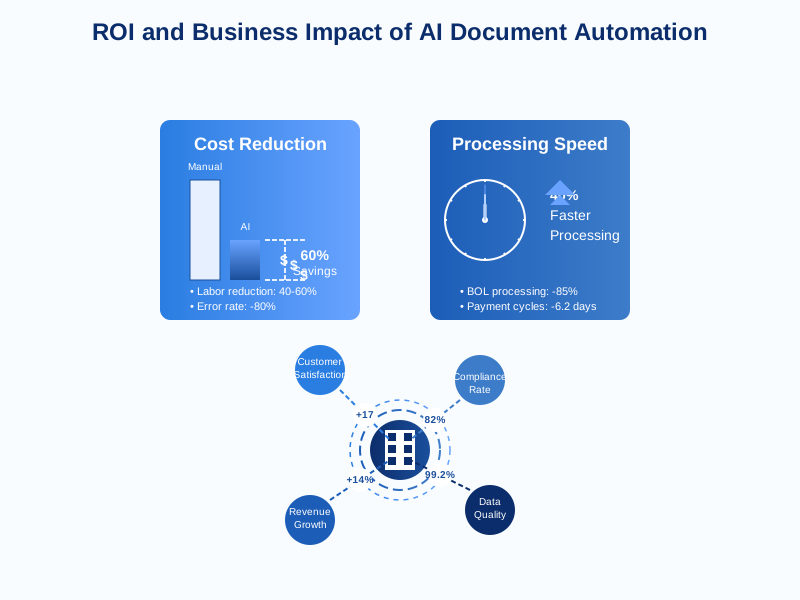
The most immediate and measurable impacts of document automation typically appear in operational efficiency metrics. Organizations implementing AI-powered document automation in logistics consistently report labor requirement reductions between 40% and 60% for automated document processes. These efficiency gains derive from multiple sources: elimination of manual data entry, reduction in document handling and filing activities, decreased verification requirements, and streamlined exception processing. The labor impact extends beyond direct document processors to include supervisory oversight, quality control, and IT support for manual workarounds resources that can be redirected to higher-value activities.
Processing cycle time reductions represent another significant quantitative benefit, with typical improvements of 30-40% in end-to-end document processing timelines. These gains arise from multiple factors: elimination of queuing delays between process steps, 24/7 processing capability for automated components, reduced batch processing in favor of continuous flow, and faster exception resolution due to better context provision. In logistics operations, where document processing often sits on the critical path for shipment execution, invoicing, and payment, these time reductions translate directly to improved cash flow, enhanced service levels, and increased operational capacity without proportional resource expansion.
Error reduction delivers both operational and financial benefits, with automated processing typically reducing error rates by 80-90% compared to manual methods. These accuracy improvements manifest in multiple ways: fewer data transposition errors during entry, consistent application of business rules, elimination of overlooked fields, and reduced risk of document misplacement. The financial impact of these error reductions includes decreased exception handling costs, fewer payment adjustments, reduced compliance penalties, and lower dispute resolution expenses. Additionally, the improved data accuracy creates downstream benefits in reporting, analytics, and decision support activities that rely on document-derived information.
Infrastructure and material cost reductions provide additional ROI components, though typically smaller than labor and error-related savings. Organizations implementing document automation report reductions in physical storage requirements, printing and scanning equipment needs, consumable expenses, and maintenance costs for legacy document management systems. While the transition to AI-powered automation requires initial technology investment, the ongoing operational costs typically prove substantially lower than maintaining traditional document infrastructure, particularly when considering the scalability of cloud-based automation platforms.

Head IT Operations - Co Founder of Artificio
See it in your SAP environment
Bring us a document, a process, or a bottleneck. We'll show how Artificio captures, validates, and posts into SAP — then scale from there.
Security & compliance
ISO 27001:2013 certified, SOC 2 Type 2 compliant, GDPR and HIPAA ready. Every agent action is logged, auditable, and runs in isolated environments.