

Blog
Beyond Digitization: The Journey to 'Invisible AI' in Document Workflows
Go beyond digitization with Invisible AI. Understand, reason, and act on documents automatically, transforming your business workflows.

Blog
Go beyond digitization with Invisible AI. Understand, reason, and act on documents automatically, transforming your business workflows.
Every Monday morning, inboxes across corporate America fill up with the same familiar burden: vendor contracts waiting for review, insurance claims needing verification, loan applications requiring data entry, and HR forms demanding manual processing. Each document represents hours of tedious work that someone, somewhere, will need to complete before the week ends. The process hasn't changed much in decades, even though the documents now arrive digitally instead of in manila folders.
For years, companies believed they'd cracked the code by going paperless. They invested heavily in scanners, document management systems, and basic optical character recognition (OCR) technology. The promise was simple: digitize everything and watch productivity soar. But something unexpected happened along the way. The same bottlenecks that plagued paper-based processes simply moved online. Instead of shuffling physical documents between desks, employees found themselves shuffling digital files between folders and systems.
The fundamental problem wasn't the format of the documents, it was the lack of intelligence in processing them. A scanned insurance claim might live in a digital folder instead of a filing cabinet, but it still required a human to read every field, validate the information, and manually enter data into multiple systems. The documents had gone digital, but the workflows remained stubbornly manual.
This is the critical distinction between basic digitization and true document intelligence. Most companies are stuck in the middle, having solved the storage problem but not the processing problem. This gap is exactly what 'Invisible AI' addresses, creating systems that don't just store documents but actually understand, reason about, and act on them without human intervention.
Modern offices might look more efficient without towers of paper documents, but a closer look reveals the same old inefficiencies wearing digital disguises. A finance team might receive hundreds of digital invoices each day, but someone still needs to open each PDF, verify the vendor information, check purchase order numbers, and manually enter data into the accounting system. The format changed, but the manual labor didn't disappear.
This creates what industry experts call the "last mile problem" in document processing. Basic OCR can read the text "Invoice #12345" from a scanned document, but it has no understanding of what an invoice actually is, whether the number format is correct, or if this particular invoice has already been processed. The technology can see the words but can't comprehend their meaning or context.
Think of it like having a team of people who can read every word in a complex legal contract but have no idea what the terms mean or how they relate to your business. They can tell you that the document contains the word "liability," but they can't tell you whether your company is protected or exposed. This lack of contextual understanding is where most document processing systems fail, leaving humans to bridge the gap between raw text extraction and actual business intelligence.
The consequences of this "digital paper" approach extend far beyond simple inefficiency. In regulated industries like banking and insurance, manual data entry errors can trigger compliance violations that cost millions in fines. A single transposed digit in a loan application can delay approval for weeks. A missed signature on an insurance claim can result in denied coverage and angry customers. These aren't just operational hiccups, they're business-critical failures that stem directly from treating documents as static files rather than dynamic sources of actionable information.
The financial impact is staggering when you add up all the hidden costs. Employee time spent on manual document processing, the opportunity cost of delayed decisions, the expense of fixing errors after they've cascaded through multiple systems, and the compliance risks of human oversight failures. Companies that thought they'd solved their document problems by going digital often discover they've simply digitized their inefficiencies.
Moving beyond the limitations of basic digitization requires a fundamental shift in how we think about document processing. Instead of treating documents as passive files that humans need to interpret, true document intelligence creates systems that actively understand, reason about, and act on document content. This transformation rests on three essential pillars that work together to create what we call 'Invisible AI.'
The first breakthrough comes from teaching AI systems to see documents not as collections of text, but as structured information with specific purposes and relationships. This goes far beyond traditional OCR, which simply converts images of text into searchable characters. Modern document intelligence uses advanced machine learning techniques to understand the semantic meaning and contextual relationships within documents.
When an advanced AI system encounters a document, it doesn't just extract a list of words and numbers. Instead, it immediately identifies what type of document it's looking at, a contract, an invoice, a loan application, or an HR form, and then understands how each piece of information relates to the others. This semantic understanding allows the system to recognize that "John Smith" isn't just a name, but specifically the customer name in a loan application, while the same name might represent a vendor contact on an invoice.
This level of understanding is powered by sophisticated technologies like Named Entity Recognition (NER) and Large Language Models (LLMs) that have been trained on millions of business documents. These systems can instantly spot patterns and relationships that would take humans significant time to identify. They understand that the number next to a dollar sign represents a monetary amount, that certain date formats indicate contract expiration dates, and that specific phrases signal important legal terms or conditions.
In practical terms, this means deploying intelligent agents that can handle different aspects of document processing automatically. A Classification Agent acts like a perfectly trained mailroom clerk, instantly sorting incoming documents and routing them to the appropriate workflows. An Extraction Agent functions like an expert data entry specialist, pulling out relevant information while maintaining complete context about what each piece of data represents and how it fits into the larger document structure.
The power of this approach becomes clear when you consider the alternative. Traditional systems require humans to manually categorize documents and then carefully extract data field by field, often using rigid templates that break down when document formats vary slightly. AI-powered deep understanding handles format variations naturally, adapts to new document types quickly, and maintains accuracy even when dealing with poor-quality scans or unusual layouts.
Understanding what a document says is only the beginning. The real value comes from an AI system's ability to think about that information, validate its accuracy, and make intelligent decisions about what to do next. This reasoning capability transforms document processing from simple data extraction into comprehensive business intelligence.
A truly intelligent document processing system doesn't just extract a customer's address from a loan application, it validates that the address format is correct, checks whether it matches previous applications from the same customer, and verifies that it falls within approved lending territories. It doesn't just read a contract amount, it compares that figure against previously approved quotes, checks whether it falls within authorized limits, and flags any discrepancies for human review.
This reasoning layer is powered by sophisticated validation and verification agents that can apply complex business rules automatically. These agents understand regulatory requirements, company policies, and industry standards, applying them consistently to every document without the fatigue or oversight issues that affect human processors. They can check for required signatures, verify that Social Security numbers follow proper formatting, confirm that insurance policy numbers are valid, and ensure that all mandatory fields contain appropriate information.
The reasoning capability extends beyond simple rule-checking to include contextual analysis and cross-referencing. When processing a vendor invoice, the system can automatically compare the billed amount against the original purchase order, verify that the vendor is approved and in good standing, and check whether similar invoices have been submitted recently. This level of analysis catches errors and potential fraud that often slip through manual review processes.
Rules agents powered by LLMs can handle even more sophisticated reasoning tasks. They can analyze contracts for unusual terms, identify potential compliance issues in regulatory filings, and flag documents that don't match expected patterns for the business context. When something doesn't look right, these agents can automatically escalate to human reviewers with detailed explanations of what triggered the alert.
This intelligent reasoning creates a robust system of automated checks and balances that happens seamlessly in the background. Instead of relying on overworked humans to catch every error and validate every data point, the AI handles routine validation automatically while escalating only the cases that truly require human judgment. This approach dramatically reduces errors while freeing skilled employees to focus on strategic decision-making rather than repetitive verification tasks.
The final pillar transforms document processing from an isolated task into an integrated part of your entire business ecosystem. True document intelligence doesn't stop at extracting and validating information, it automatically takes action on that information, updating relevant systems, triggering appropriate workflows, and communicating with stakeholders as needed.
When a new vendor application is processed, the extracted and validated information should automatically flow into your ERP system to create a vendor master record, update your procurement database with new contact information, and trigger approval workflows for department heads. When an insurance policy is issued, the system should instantly update your core insurance platform, generate customer communications, and create the necessary regulatory filings. This end-to-end automation eliminates the manual handoffs that create delays and introduce errors.
The integration capabilities extend beyond simple data transfer to include intelligent communication and workflow management. An Intelligent Communication Suite can automatically generate and send personalized emails or messages when documents are missing required information. Instead of a busy employee having to notice the missing field, draft an appropriate message, and track the follow-up, the AI handles the entire communication process automatically.
This automated communication isn't limited to simple template messages. Advanced systems can generate contextually appropriate communications that explain exactly what information is needed and why, provide clear instructions for how to submit the missing data, and even include relevant forms or links to make the process as easy as possible for the recipient. The system can also handle responses intelligently, automatically updating records when new information arrives and routing complex inquiries to appropriate human staff members.
The integration layer also includes sophisticated workflow management that can adapt to changing business conditions and priorities. If a high-value customer submits a loan application, the system can automatically fast-track the processing while ensuring all compliance requirements are still met. If regulatory requirements change, the system can automatically update validation rules across all relevant document types without requiring manual configuration updates.
This seamless integration creates a true end-to-end automated workflow where documents enter the system and trigger a cascade of appropriate actions without human intervention. Employees see the results clean, validated data in their systems, completed workflows, and satisfied customers, but they don't see the complex orchestration happening behind the scenes.
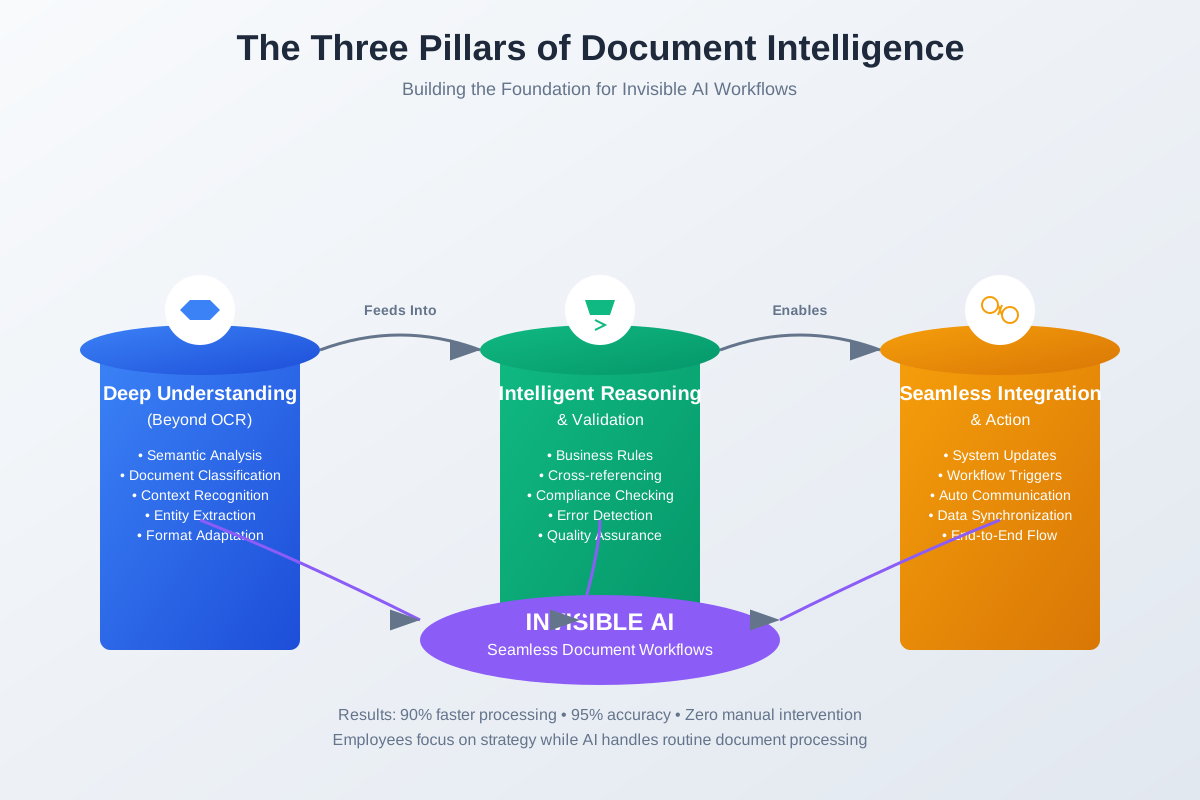
When these three pillars work together, something remarkable happens. The complexity of document processing disappears from the user's perspective, creating what feels like magic but is actually sophisticated automation working seamlessly in the background. Employees no longer need to think about document workflows, data extraction, or validation processes. They simply submit documents and receive results.
This represents a fundamental paradigm shift in how businesses handle information processing. Instead of technology being something that employees need to learn, manage, and work around, it becomes an invisible enabler that makes their jobs easier and more productive. The AI handles all the routine, repetitive tasks while humans focus on the strategic, creative, and relationship-building work that only they can do.
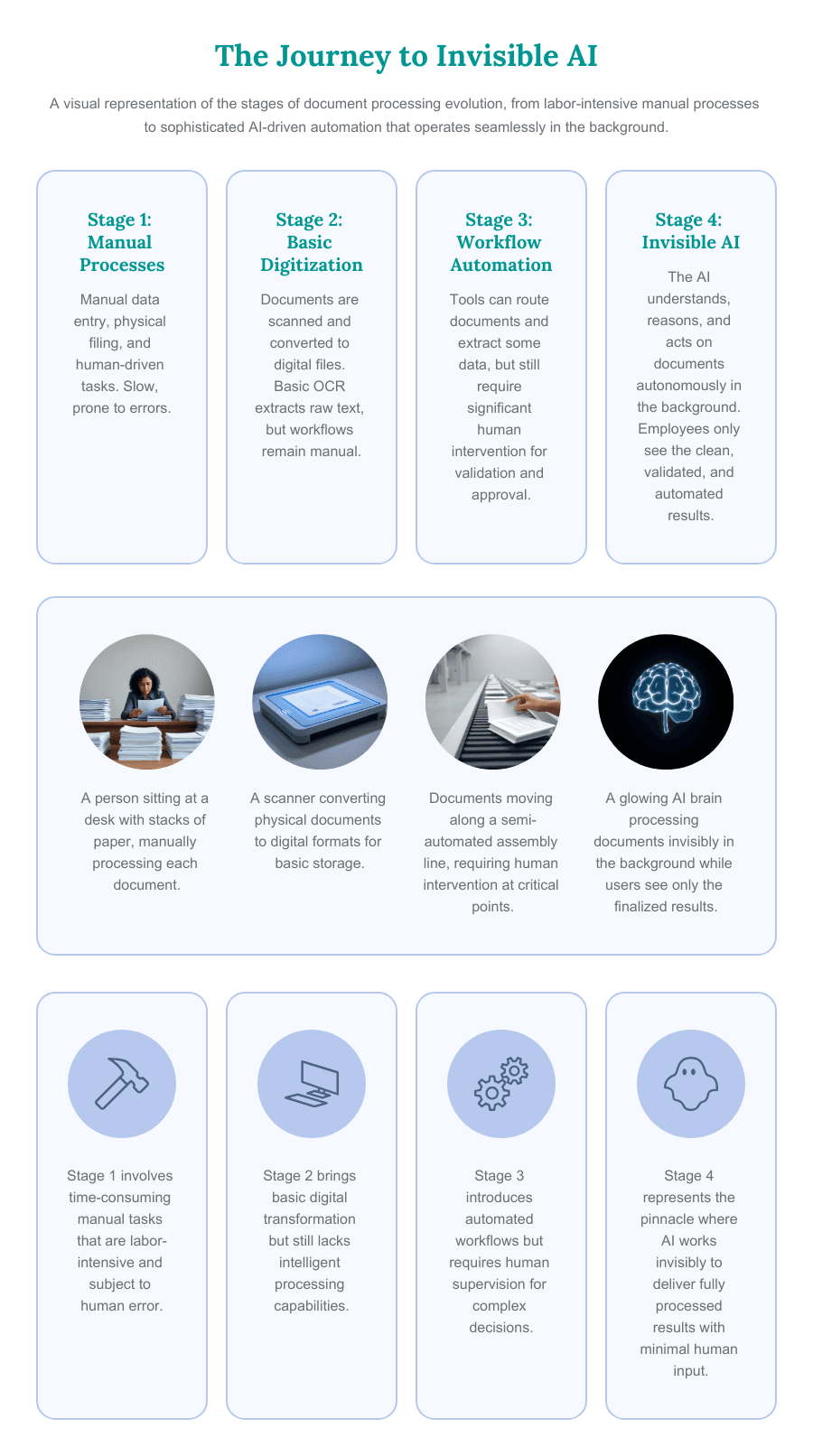
The transformation typically follows a predictable progression across four distinct stages. In Stage 1, organizations rely entirely on manual processes. Employees spend their days on data entry, document validation, and chasing down missing information. Errors are common, cycle times are long, and job satisfaction suffers because people spend most of their time on tedious tasks rather than meaningful work.
Stage 2 brings basic digitization. Documents get scanned and converted to PDFs, and simple OCR tools extract some text automatically. But the bulk of the work remains manual. Employees still need to validate every piece of extracted data, cross-reference information across systems, and handle all the edge cases that basic automation can't manage.
Stage 3 introduces workflow automation with more sophisticated tools that can route documents automatically and extract data more reliably. But these systems still require significant human intervention for validation, approval, and exception handling. They reduce some of the manual work but don't eliminate the need for people to understand and act on document content.
Stage 4 represents the invisible AI breakthrough. The system understands documents contextually, reasons about their content intelligently, and takes appropriate actions automatically. Employees interact with the results rather than the process. A loan officer submits an application and receives a notification when it's ready for final approval, with all the background processing, validation, and system updates happening automatically.
This progression has profound implications for how work gets done. In the invisible AI stage, a loan officer can focus entirely on building customer relationships and providing expert financial advice rather than spending hours on paperwork. An insurance claims processor can concentrate on complex cases that require human judgment while routine claims get handled automatically. An accounts payable clerk can focus on vendor relationship management and strategic purchasing decisions while invoices get processed seamlessly in the background.
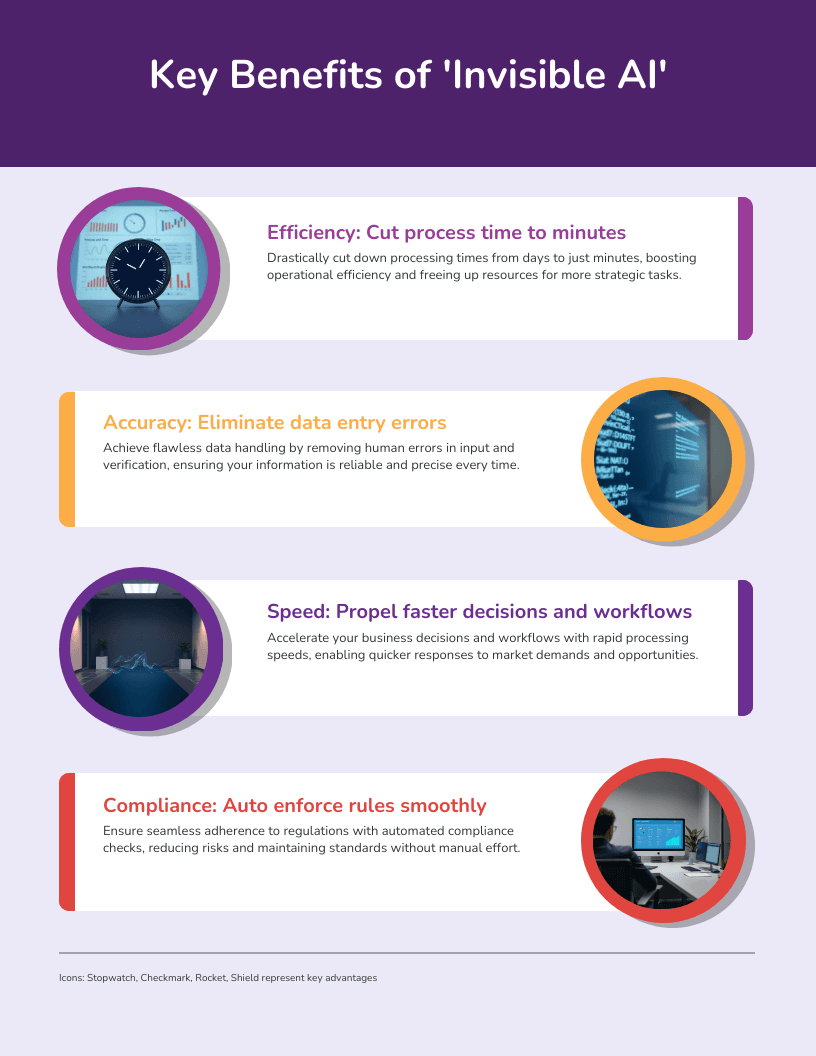
The impact extends beyond individual productivity to transform entire business processes. Decision-making becomes faster because information is available instantly rather than after days of manual processing. Customer service improves because responses are immediate rather than delayed by processing bottlenecks. Compliance becomes more reliable because automated systems apply rules consistently without the fatigue and oversight issues that affect human processors.
The transition to invisible AI document processing creates measurable improvements across every aspect of business operations. Companies that have successfully implemented these systems report dramatic reductions in processing time, from days or weeks down to minutes or hours. Error rates drop by 90% or more as automated validation catches mistakes that human processors might miss. Employee satisfaction increases as people move from tedious data entry to strategic, creative work.
Consider how this transformation affects a typical insurance company. Before invisible AI, processing a new policy application might take several days. A customer service representative would receive the application, manually enter data into multiple systems, validate information against various databases, request missing documents, and coordinate with underwriters for approval. Each step introduced potential delays and errors.
With invisible AI, the same process becomes seamless. The application arrives electronically and gets instantly classified and routed to the appropriate workflow. Data extraction happens automatically, with the system understanding not just what information is present but what each piece means in the context of insurance underwriting. Validation occurs immediately, checking everything from address formats to coverage limits against regulatory requirements and company policies.
If information is missing, the system automatically generates personalized communication to the customer, explaining exactly what's needed and providing easy ways to submit the missing data. When complete information is available, the application moves automatically to underwriting review, with all the routine verification work already completed. The underwriter receives a comprehensive summary with all relevant data pre-validated and organized for quick decision-making.
The result is faster processing, fewer errors, better customer experience, and more satisfied employees. The customer gets quicker responses and clearer communication. The customer service representative can focus on complex inquiries and relationship building rather than data entry. The underwriter can concentrate on risk assessment and strategic decisions rather than administrative tasks.
This same pattern repeats across industries and use cases. Banks see loan processing times drop from weeks to days while improving accuracy and compliance. Healthcare organizations process insurance claims faster while reducing billing errors. Manufacturing companies handle vendor invoices more efficiently while catching discrepancies that previously went unnoticed.
The financial impact goes far beyond simple cost savings. Faster processing enables new business opportunities that weren't practical with manual workflows. Better accuracy reduces the hidden costs of error correction and regulatory compliance issues. Improved employee satisfaction leads to lower turnover and higher productivity. Enhanced customer experience drives loyalty and competitive advantage.
The sophisticated capabilities of invisible AI document processing rest on several breakthrough technologies working together seamlessly. Large Language Models (LLMs) provide the contextual understanding that allows systems to comprehend document meaning rather than just extracting text. These models have been trained on vast datasets of business documents, giving them deep knowledge of how different document types work and what various pieces of information mean in different contexts.
Computer vision technologies handle the visual aspects of document processing, understanding layouts, identifying form fields, and extracting information even from poorly scanned or photographed documents. These systems can adapt to format variations automatically, handling everything from formal business documents to handwritten forms.
Machine learning algorithms continuously improve performance by learning from each processed document. The system gets better at handling edge cases, recognizing new document types, and adapting to changing business requirements. This self-improving capability means that accuracy and efficiency increase over time rather than degrading as they often do with manual processes.
Natural language processing enables sophisticated communication capabilities, allowing the system to generate appropriate messages for different situations and stakeholders. Whether sending a follow-up email to a customer about missing documentation or creating a summary report for executive review, the system can adapt its communication style to the audience and context.
Robotic process automation (RPA) handles the integration aspects, automatically updating multiple systems, triggering workflows, and coordinating between different business applications. This creates the seamless end-to-end automation that makes the entire process invisible to end users.
The combination of these technologies creates capabilities that exceed what any individual technology could achieve alone. The result is a system that can understand documents like a human expert, process them faster than any manual system, and integrate seamlessly with existing business infrastructure.
Moving from traditional document processing to invisible AI requires careful planning and a strategic approach. The most successful implementations follow a proven methodology that minimizes risk while maximizing business value. The key is to start with focused, high-impact use cases rather than trying to automate everything at once.
The first step involves identifying the document processing workflows that cause the most pain for your organization. Look for processes that handle high volumes of similar documents, have clear business rules for validation, and involve multiple manual handoffs between systems or people. Common starting points include invoice processing, customer onboarding, insurance claims, loan applications, or vendor management.
Once you've identified target workflows, focus on understanding the desired business outcomes rather than just the technical requirements. Instead of saying "we need to automate invoice processing," frame the goal as "we need to reduce invoice processing time from five days to one day while eliminating payment errors and improving vendor satisfaction." This outcome-focused approach helps ensure that technology implementation drives real business value.
The next critical decision involves selecting the right technology platform. While it might seem tempting to use different specialized tools for each type of document or workflow, this approach typically creates new silos and integration challenges. The most successful implementations use comprehensive platforms that combine all three pillars of document intelligence in a single, integrated system.
Look for platforms that offer pre-built connectors to your existing enterprise systems like ERP, CRM, and industry-specific applications. The power of invisible AI comes from seamless integration, so the ability to automatically update downstream systems is essential. Make sure the platform can handle two-way data flow, not just pushing data from documents to systems but also pulling data from systems for validation and verification.
Start with a pilot implementation focused on one specific document type or workflow. This allows you to prove the value, refine the configuration, and build confidence before expanding to additional use cases. During the pilot, pay special attention to edge cases and exception handling, as these often reveal opportunities for improvement in business processes as well as technology configuration.
Training and change management deserve significant attention during implementation. While invisible AI reduces the need for employees to learn complex new tools, people still need to understand how the new workflows operate and what their roles become in the automated environment. Focus on helping employees understand how automation will enhance their jobs rather than replace them.
Plan for continuous improvement from the beginning. The most successful invisible AI implementations treat the initial deployment as the starting point rather than the finish line. Regular review of processing accuracy, cycle times, and user feedback helps identify opportunities for optimization and expansion to additional use cases.
The impact of invisible AI document processing should be measurable across multiple dimensions of business performance. Establishing clear metrics before implementation helps track progress and demonstrate ROI to stakeholders. The most important indicators typically fall into four categories: efficiency, accuracy, employee satisfaction, and customer experience.
Efficiency metrics focus on time and cost savings. Track processing time for key document types, measuring the reduction from submission to final processing. Monitor the number of documents processed per employee and the total cost per processed document. These metrics typically show dramatic improvements, with processing times dropping by 80-90% and cost per document falling significantly.
Accuracy indicators measure error rates and compliance performance. Track data entry errors, compliance violations, and the number of documents that require rework due to mistakes. Monitor the percentage of documents that process completely automatically versus those requiring human intervention. Well-implemented invisible AI systems typically achieve 95%+ accuracy rates while processing 80-90% of documents without human intervention.
Employee satisfaction metrics help ensure that automation enhances rather than undermines the work experience. Survey employees about job satisfaction, time spent on repetitive tasks versus strategic work, and overall productivity. Track employee turnover rates and time-to-productivity for new hires. Successful implementations typically see significant improvements in job satisfaction as employees move from tedious manual work to more engaging strategic tasks.
Customer experience indicators measure the external impact of improved document processing. Track customer satisfaction scores, time to respond to customer inquiries, and resolution times for issues requiring document processing. Monitor customer complaints related to processing delays or errors. Companies typically see substantial improvements in customer satisfaction as processing becomes faster and more reliable.
Financial metrics tie everything together by measuring the overall business impact. Calculate ROI based on cost savings, productivity improvements, and revenue impact from faster processing. Track compliance-related costs and penalties, which typically decrease significantly with automated validation. Measure the value of employee time redirected from manual processing to strategic activities.
The field of invisible AI document processing continues to evolve rapidly, with new capabilities emerging that will further enhance business value. Advanced AI models are becoming better at understanding complex documents like legal contracts, technical manuals, and regulatory filings. These improvements will expand the range of documents that can be processed automatically and increase the sophistication of automated reasoning.
Integration capabilities are becoming more sophisticated, with better support for real-time processing and event-driven workflows. Future systems will be able to process documents instantly as they arrive and trigger immediate actions across multiple systems simultaneously. This will enable new use cases like real-time fraud detection and instant credit decisions.
Communication capabilities are advancing toward more natural, conversational interactions. Future systems will be able to handle complex customer inquiries about document status, explain processing decisions in plain language, and even negotiate simple business terms automatically. This will further reduce the need for human intervention while improving customer experience.
Industry-specific capabilities are developing to handle specialized document types and regulatory requirements. Banking, insurance, healthcare, and other regulated industries will see increasingly sophisticated automated compliance checking and regulatory reporting capabilities.
The emergence of multimodal AI, which can understand both text and visual elements simultaneously, will enable processing of more complex documents that combine text, images, charts, and diagrams. This will open up new possibilities for automating analysis of technical drawings, medical images, and visual inspection reports.
The journey from basic digitization to invisible AI document processing represents more than just a technological upgrade. It's a fundamental transformation in how businesses handle information, make decisions, and serve customers. Companies that embrace this shift will gain significant competitive advantages through faster processing, higher accuracy, better compliance, and more satisfied employees and customers.
The technology is mature and accessible today. Organizations don't need to wait for future developments or invest in experimental systems. Proven platforms already exist that can deliver immediate value while providing a foundation for continuous improvement and expansion.
The question isn't whether invisible AI will transform document processing, it's whether your organization will be an early adopter that gains competitive advantage or a late follower that struggles to catch up. The companies that move first will establish more efficient operations, better customer relationships, and stronger market positions.
The future of work isn't about working harder or even working smarter in the traditional sense. It's about building intelligent systems that handle routine tasks automatically while freeing people to focus on the creative, strategic, and relationship-building work that only humans can do. Invisible AI document processing is a crucial step toward that future, turning document workflows from a business bottleneck into a competitive advantage.
The paperless office was just the beginning. The real revolution is the intelligent, invisible workflow that processes information seamlessly while people focus on what they do best. That future is available today for organizations ready to move beyond simple digitization and embrace true document intelligence.

Head IT Operations - Co Founder of Artificio
See it in your SAP environment
Bring us a document, a process, or a bottleneck. We'll show how Artificio captures, validates, and posts into SAP — then scale from there.
Security & compliance
ISO 27001:2013 certified, SOC 2 Type 2 compliant, GDPR and HIPAA ready. Every agent action is logged, auditable, and runs in isolated environments.