There's a frustrating paradox at the heart of most document intelligence platforms today. You spend months implementing a sophisticated AI system that can extract data, answer questions, and generate insights from your documents. The platform works beautifully. Your team loves it. The accuracy is great. Everything runs smoothly.
And then someone outside your organization needs to access that intelligence.
Maybe it's a customer asking about their warranty terms. Maybe it's a supplier checking your procurement specifications. Maybe it's a partner reviewing compliance documentation. Maybe it's just your sales team trying to answer a prospect's question from their CRM without logging into yet another system.
Suddenly, you realize all that document intelligence is trapped inside a walled garden. The insights are there. The AI understands the documents perfectly. But there's no way for anyone outside the platform to tap into that knowledge without creating user accounts, managing permissions, dealing with login credentials, and navigating an interface designed for your internal team.
This is what we call the platform prison problem. Your documents have become intelligent, but that intelligence can't escape the boundaries of the system where it lives.
The Intelligence Accessibility Gap
Think about how your business actually operates. Information doesn't flow in neat, contained channels. A customer service rep needs to pull product specifications while talking to a client on the phone. A logistics coordinator needs to verify shipping requirements from inside their transportation management system. A field technician needs to check installation procedures from a mobile app. An outside auditor needs to review compliance documentation without accessing your internal systems.
Every one of these scenarios requires document intelligence to be accessible from somewhere other than your primary document processing platform. And traditionally, you've had three equally unsatisfying options.
Option one is to manually copy the information. Someone logs into the document intelligence platform, finds the answer, and transfers it to wherever it's needed. This defeats the entire purpose of automation. You've built a system that reduces manual work, only to create new manual work in sharing what the system knows.
Option two is to create user accounts for everyone who might need access. This sounds reasonable until you realize you're now managing login credentials for customers, partners, vendors, and external stakeholders. You're dealing with permission structures that need constant updating. You're paying for user seats that get used once a month. You're creating a security headache by giving outside parties direct access to your internal systems.
Option three is to build custom integrations for every system that needs document intelligence. Your CRM needs an integration. Your customer portal needs an integration. Your mobile apps need integrations. Your partner platforms need integrations. Each one is a separate development project with ongoing maintenance requirements. Six months later, you're spending more time maintaining integrations than improving your core document intelligence capabilities.
All three options share the same fundamental problem. They treat document intelligence as something that must be pulled from a central system rather than something that can be pushed to wherever it's needed.
The Conversational Endpoint Revolution
External Chat solves this by fundamentally changing how document intelligence gets accessed. Instead of forcing everyone to come to your platform, it creates conversational endpoints that bring intelligence to wherever people already work.
Think of it as turning your documents into APIs, but instead of technical API calls that return JSON data, you get natural language conversations that maintain context and understand follow-up questions. Each document collection or knowledge base becomes a chat endpoint that can be integrated into any application, workflow, or system.
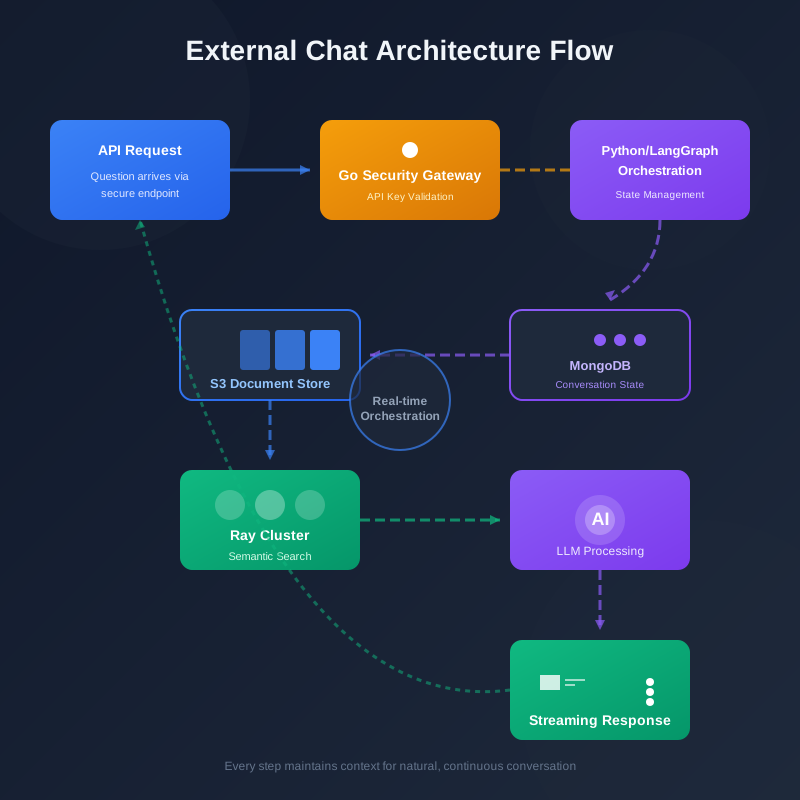
The technical architecture makes this possible through a sophisticated orchestration between security, state management, semantic search, and streaming AI responses. When someone sends a question to an External Chat endpoint, several things happen in rapid succession.
First, the request passes through a security gateway built in Go that validates the API key. This isn't a simple credential check. The system verifies that the key is active, hasn't been revoked, belongs to the organization authorized to access these specific documents, and hasn't exceeded rate limits. This happens in milliseconds, but it creates an enterprise-grade security boundary that protects your document intelligence.
Second, the validated request moves to a Python-based AI orchestration layer powered by LangGraph. This is where things get interesting. Unlike stateless systems that treat every question as isolated, External Chat maintains conversation state. It remembers what you asked before. It understands pronouns and references. If you ask "What's the warranty period?" and then follow up with "What about the extended version?", the system knows "the extended version" refers to the warranty you just asked about.
This state management solves one of the biggest frustrations with document AI systems. Most implementations feel like talking to someone with amnesia. Every question stands alone. You can't have a real conversation because the system forgets the context immediately. External Chat maintains that context throughout the entire conversation, making it feel like you're talking to someone who's actually listening and remembering.
Third, the system performs semantic search across your documents stored in S3. This isn't keyword matching. The AI understands conceptual relationships. If someone asks "How do I handle damaged shipments?", the system knows to look for sections about returns, replacements, claims processes, and quality issues even if those exact words don't appear in the document. It's using embedding-based search powered by a Ray cluster to find the most relevant information based on meaning, not just matching text strings.
Fourth, the retrieved information gets passed to an LLM (either Groq's Llama models or OpenAI's reasoning models depending on the complexity required) which generates a thoughtful, contextualized response. The AI doesn't just regurgitate what it found in the documents. It synthesizes information, provides relevant details, and frames answers in ways that directly address the question asked.
Finally, the response streams back in real-time. Users don't wait for a complete answer to generate. They see the response forming as the AI thinks through the question. This creates a responsive, interactive experience that feels natural rather than mechanical.
Real-World Applications That Change How Businesses Operate
The technical architecture is impressive, but what really matters is what you can build with it. External Chat unlocks use cases that were previously impossible or prohibitively expensive to implement.
Consider a manufacturing company with hundreds of suppliers. Each supplier needs access to specific procurement policies, technical specifications, quality standards, and compliance requirements relevant to their contracts. Traditionally, you'd either send them 200-page PDF manuals that nobody reads, or give them portal access that requires training and rarely gets used.
With External Chat, you create a dedicated endpoint for supplier inquiries. Suppliers can ask questions directly from their own systems or via a simple chat interface. "What's the acceptable tolerance for part XYZ?" "What documentation do I need for chemical certifications?" "How do I report a potential delay?" The AI pulls from your specifications, policies, and procedures to give accurate, contextual answers.
The game-changing part is that conversations are isolated. Supplier A's questions don't mix with Supplier B's questions. The state management keeps each conversation separate while the AI pulls from the same underlying document intelligence. You've effectively created hundreds of personal assistants, each one knowledgeable about your documentation but dedicated to a single supplier relationship.
Or take a financial services firm with complex investment products. Each product has detailed prospectuses, terms and conditions, risk disclosures, and regulatory documentation. Clients need answers to questions about their specific investments, but you can't have them calling your support team for every clarification.
External Chat creates personalized endpoints for each client or each product line. A client asks "What are the early withdrawal penalties for my account?" and the AI knows which account they're asking about, pulls the relevant terms from the correct product documentation, and explains the penalties in clear language. The conversation remains in context, so follow-up questions like "Are there any exceptions?" get answered with continuity.
The same architecture works for internal knowledge sharing across departments. Your HR team maintains complex benefits documentation, policy manuals, and procedure guides. Rather than hoping employees find the right section of the right document, you create an HR chat endpoint that employees can query from Slack, Microsoft Teams, or your intranet. Questions get answered instantly using the authoritative HR documentation, and the conversation history helps HR identify which policies need clearer explanation.
Customer service teams get particularly powerful benefits. Instead of support reps toggling between your document platform and their CRM or helpdesk software, the External Chat endpoint lives right inside their existing tools. A customer asks about return policies, and the rep gets AI-generated answers pulled from your current policy documentation without leaving the support ticket screen.
The technical elegance is in how the system handles complexity without showing that complexity to users. Behind the scenes, the AI is managing authentication, maintaining state, searching through potentially millions of document pages, synthesizing information from multiple sources, and streaming responses. To the user, it just feels like having a conversation with someone who knows your documents inside and out.
The Statefulness Advantage
The conversation state management deserves special attention because it's the difference between a utility and an actual assistant. Most document search tools are stateless. You ask a question, get an answer, and the system immediately forgets you existed. The next question starts from scratch with no memory of the previous context.
This creates an awful user experience. Imagine calling customer service and having to re-explain your entire situation every single time you ask a follow-up question. That's how most document AI systems work. They're functionally conversation-blind.
External Chat maintains state throughout the entire conversation using LangGraph's sophisticated memory management. When you ask your first question, the system records not just the question and answer, but the context around what was discussed. When you ask your second question, the AI has access to that history and can interpret your new question in light of what came before.
This matters tremendously for how people actually communicate. Nobody talks in perfectly formed, context-free questions. We use pronouns. We reference things we mentioned earlier. We assume the listener remembers what we just discussed. Natural conversation is inherently stateful.
"What's covered under the standard warranty?" gets answered from the warranty documentation. When you follow up with "Does that include water damage?", the AI knows "that" refers to the standard warranty coverage just discussed. When you then ask "What if I upgrade to the premium plan?", the system understands you're now asking about an alternative warranty tier, and it maintains the context that you're specifically interested in water damage coverage.
Without statefulness, each of those questions would need to be completely explicit. "What is covered under the standard warranty?" "Is water damage covered under the standard warranty?" "Is water damage covered under the premium warranty plan?" Nobody wants to communicate that way. It's tedious, unnatural, and requires users to think like developers writing database queries instead of humans having conversations.
The state management also enables the AI to ask clarifying questions when ambiguity exists. If someone asks "What's the cost?", the AI can respond "I can help with that! Are you asking about the product cost, shipping cost, or installation cost?" The system knows enough context to understand the question is ambiguous and intelligent enough to narrow down the likely interpretations.
Security Without Friction
One of the trickiest aspects of making document intelligence externally accessible is balancing security with usability. You can't just open your documents to the public internet, but you also can't create such complex security requirements that nobody can actually use the system.
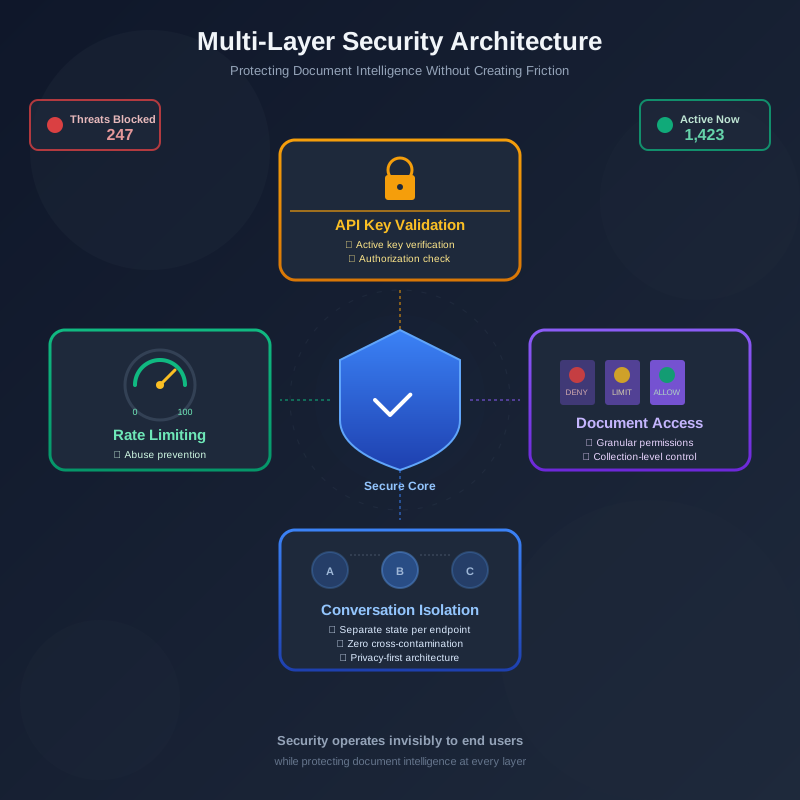
External Chat handles this through API key-based authentication combined with granular access controls. Each endpoint gets a unique API key that determines exactly what documents and information that endpoint can access. A supplier endpoint can only access supplier-relevant documentation. A customer endpoint can only access customer-facing materials. An internal department endpoint accesses internal knowledge bases.
The security happens at multiple layers. The Go-based gateway validates the API key itself - is it active, is it authorized, is it within rate limits? The Python orchestration layer enforces document-level permissions - which document collections can this key access? The MongoDB state management layer isolates conversations - this endpoint's conversation history never mixes with another endpoint's history.
Rate limiting prevents abuse without making the system feel restrictive. A legitimate user asking questions in a normal conversation pattern won't hit any limits. But automated scraping or attempts to download entire document sets get throttled automatically.
The beauty of this security model is that it happens invisibly to the end user. Someone querying an External Chat endpoint doesn't think about authentication. They just ask questions and get answers. The security infrastructure operates entirely in the background, protecting your document intelligence without creating friction in the user experience.
Integration Patterns That Actually Work
External Chat's power comes from its flexibility in how it can be integrated into existing systems and workflows. The API-first design means you can embed document intelligence anywhere that can make HTTP requests, which is basically everywhere.
The simplest integration pattern is a standalone chat widget. You embed a small JavaScript component on a webpage, mobile app, or internal tool. The widget handles the conversation interface, manages the API communication with the External Chat endpoint, and presents the AI responses. Users get a chat box that feels native to wherever they're working, but behind the scenes it's connecting to your document intelligence.
More sophisticated integrations embed External Chat directly into business applications. Your CRM can have a document query panel that support reps use during customer calls. Your ERP system can have a policy assistant that answers procurement questions. Your logistics platform can have a compliance checker that verifies shipping requirements against regulatory documentation.
The API design supports both synchronous and streaming responses. For applications that need complete answers before displaying anything, you can wait for the full response. For applications that benefit from progressive revelation, you can stream the response token-by-token as it generates. This flexibility means External Chat adapts to the user experience requirements of whatever system you're integrating with.
Some organizations build dedicated mobile applications around External Chat endpoints. A field service company might create an app where technicians can photograph equipment and ask questions about repair procedures. The image gets processed, the question gets routed to the relevant technical documentation endpoint, and the AI provides step-by-step guidance specific to that equipment model.
Others use External Chat as the backend for voice assistants. The conversation handling and context management work identically whether the input comes from typed text or transcribed speech. You can literally have phone systems where callers ask questions about your documentation and get spoken answers generated by the AI reading your authoritative documents.
The multi-modal capabilities extend to documents with images, diagrams, and complex layouts. The AI doesn't just read text. It understands visual elements in the documents and can reference them in responses. "Where is the safety release valve located?" gets answered with both text description and references to the diagram on page 23 of the equipment manual.
The Economics of Trapped vs. Liberated Intelligence
There's a significant cost to keeping document intelligence trapped inside platforms. Every time information needs to be manually transferred, you're paying for that labor. Every time someone can't find an answer because they don't have platform access, you're paying for that inefficiency. Every time you build a custom integration, you're paying for that development and maintenance.
External Chat inverts that economic model. Instead of paying repeatedly to extract intelligence from your platform, you pay once to create conversational endpoints that make intelligence freely accessible.
Consider a mid-size insurance company processing claims. Adjusters need access to policy language, coverage terms, exclusions, and regulatory requirements. Traditionally, this means either giving every adjuster full platform access to your document intelligence system (expensive in user licensing) or building custom integrations into your claims management system (expensive in development time).
With External Chat, you create a policy documentation endpoint that lives directly in the claims system. Adjusters ask questions, get answers, and the conversation history helps identify gaps in your documentation or areas where policies need clarification. The same endpoint serves adjusters in the office, mobile adjusters in the field, and even external adjusters contracted for overflow work.
The cost savings compound over time. You're not paying for user seats for occasional users. You're not maintaining brittle point-to-point integrations that break every time either system updates. You're not hiring support staff to answer questions that the AI could handle. The intelligence flows to where it's needed with minimal friction and minimal ongoing cost.
The economics get even more compelling when you consider the opportunity cost of trapped intelligence. How many customers didn't get answers because they couldn't easily access your documentation? How many partners made errors because they couldn't quickly verify specifications? How many internal projects stalled because team members couldn't find the right information? Liberating your document intelligence from platform boundaries directly impacts revenue, customer satisfaction, and operational efficiency.
Building Documents That Talk Back
The conceptual shift External Chat enables is profound. You stop thinking about documents as static files that need to be read and start thinking about them as conversational entities that can be queried.
Your product manuals become experts that customers can interview. Your compliance documentation becomes advisors that employees can consult. Your technical specifications become references that partners can interrogate. The documents don't change, but their accessibility and usefulness increase dramatically.
This has surprising implications for how you create and maintain documentation. When documents become conversational endpoints, you start to notice patterns in what people ask. The questions reveal gaps, ambiguities, and areas where your documentation fails to address real-world needs. That feedback loop improves the underlying documents in ways that traditional documentation management never captures.
A company creating External Chat endpoints for their HR policies might discover that 40% of questions are about the vacation accrual policy, but the actual policy document only has three paragraphs on the topic. That's a clear signal that the documentation needs expansion. The conversation patterns tell you what's missing or unclear in ways that documentation surveys or complaint tickets never could.
The statefulness of conversations also reveals how people actually navigate information. They don't read linearly. They ask about one topic, then pivot to a related question, then drill into a detail, then back up to a broader concept. Watching these conversation patterns helps you structure documentation in ways that align with how people actually seek information rather than how authors prefer to organize content.
The Multi-Endpoint Strategy
Smart organizations don't create just one External Chat endpoint. They create multiple endpoints, each tailored to specific audiences and use cases with appropriate document access and context.
A healthcare provider might have separate endpoints for patients, providers, insurance companies, and internal staff. Each endpoint accesses different documentation sets and has different permission boundaries. Patients query clinical education materials and administrative policies. Providers access clinical protocols and formularies. Insurance companies reference coverage agreements and billing procedures. Internal staff access everything but through different interfaces optimized for their workflows.
The same underlying document intelligence serves all these endpoints, but the access patterns, conversation contexts, and integration points differ. This multi-endpoint approach lets you give everyone appropriate access without either creating security holes or forcing everyone through a single generic interface.
Some organizations create ephemeral endpoints for specific projects or time-limited needs. During a merger integration, you might create temporary endpoints that both companies' staff can use to query combined policies and procedures. After integration completes, those endpoints get decommissioned. The flexibility to spin up and tear down endpoints as needs change makes External Chat adaptable to business realities.
What This Means for How Organizations Share Knowledge
External Chat represents a fundamental evolution in how organizations think about knowledge accessibility. The traditional model was centralized repositories with controlled access. Information lived in specific systems, and you either had permission to access those systems or you didn't.
The External Chat model is distributed intelligence with secured endpoints. Information still lives in centralized repositories, but the intelligence derived from that information flows freely to wherever it's needed through conversational interfaces. Access control happens at the endpoint level rather than forcing everyone through a central platform.
This matters because information needs change faster than platform access can be managed. A customer needs an answer today. A partner needs clarification on a specification right now. An employee needs to verify a policy before making a decision in the next hour. Waiting for system access, or manually transferring information, or building custom integrations are all too slow for how business actually moves.
When your documents become conversational endpoints that work everywhere, information moves at the speed of questions rather than the speed of authentication workflows. That's the difference between document intelligence that technically exists but practically remains inaccessible, and document intelligence that actually serves the business.
The platform prison problem isn't about the platforms themselves. Most document intelligence platforms are excellent at what they do. The problem is treating those platforms as the only place where document intelligence can be accessed. External Chat breaks that boundary, turning your carefully built document intelligence into an asset that enhances every system it touches rather than being confined to a single environment.
Your documents already contain valuable intelligence. External Chat just makes sure that intelligence can go wherever your business needs it to be.