

Blog
Document Intelligence: The New ERP Foundation
Discover how AI document intelligence is revolutionizing enterprise architecture, moving beyond traditional ERP and CRM to build AI-first business operations.

Blog
Discover how AI document intelligence is revolutionizing enterprise architecture, moving beyond traditional ERP and CRM to build AI-first business operations.
The corporate world is about to experience a fundamental shift that will make the ERP revolution of the 1990s look like child's play. Over the next five years, we're going to witness enterprise resource planning and customer relationship management systems being completely restructured around AI document intelligence, rather than the other way around. This isn't just another incremental upgrade or add-on feature we're talking about. This is a complete reimagining of how businesses will operate at their core.
For decades, companies have built their entire operational framework around rigid ERP systems that demand data be entered in specific formats, following predetermined workflows, and adhering to inflexible rules. Employees spend countless hours feeding information into these systems, translating real-world business interactions into the digital language that legacy software can understand. But what if we flipped this entire paradigm on its head? What if, instead of forcing human intelligence to conform to system limitations, we built systems that could understand and work with information the way humans naturally process it?
This transformation is already beginning, and executives who don't recognize document intelligence as the new core layer of enterprise data architecture will find themselves managing increasingly obsolete systems while their competitors race ahead with AI-native approaches to business operations. The question isn't whether this shift will happen, but rather how quickly leadership teams can position their organizations to capitalize on this fundamental change in how enterprise software will function.
Walk into any corporate office today, and you'll witness an almost comical scene that has somehow become normalized over the past three decades. Highly educated professionals sit at expensive computers, manually typing information from one digital document into another digital system. Purchase orders arrive as PDFs and get manually transcribed into ERP systems. Contracts come in via email and require someone to extract key terms and dates into CRM workflows. Insurance claims, loan applications, vendor invoices, and countless other business-critical documents all follow the same inefficient pattern. Humans act as expensive translation layers between information that already exists in digital format and systems that should theoretically be able to process that information automatically.
This manual data entry represents one of the most significant productivity drains in modern business operations, but it's also symptomatic of a much deeper architectural flaw in how we've designed enterprise systems. Traditional ERP and CRM platforms were built during an era when most business information existed on paper, and digital transformation meant creating structured databases that could store and retrieve information more efficiently than filing cabinets. The assumption was that humans would continue to serve as the intelligent layer that could interpret unstructured information and translate it into the structured formats that computers required.
Document intelligence powered by large language models represents a complete departure from this paradigm. Instead of requiring human interpretation to bridge the gap between unstructured information and structured systems, AI can now understand context, extract relevant data points, validate information against business rules, and even make intelligent decisions about how to handle exceptions and edge cases. When a contract arrives with non-standard language, AI doesn't just extract the obvious fields like dates and dollar amounts. It can analyze the intent behind specific clauses, identify potential risks or opportunities, and flag items that require human attention based on sophisticated understanding of business context rather than simple keyword matching.
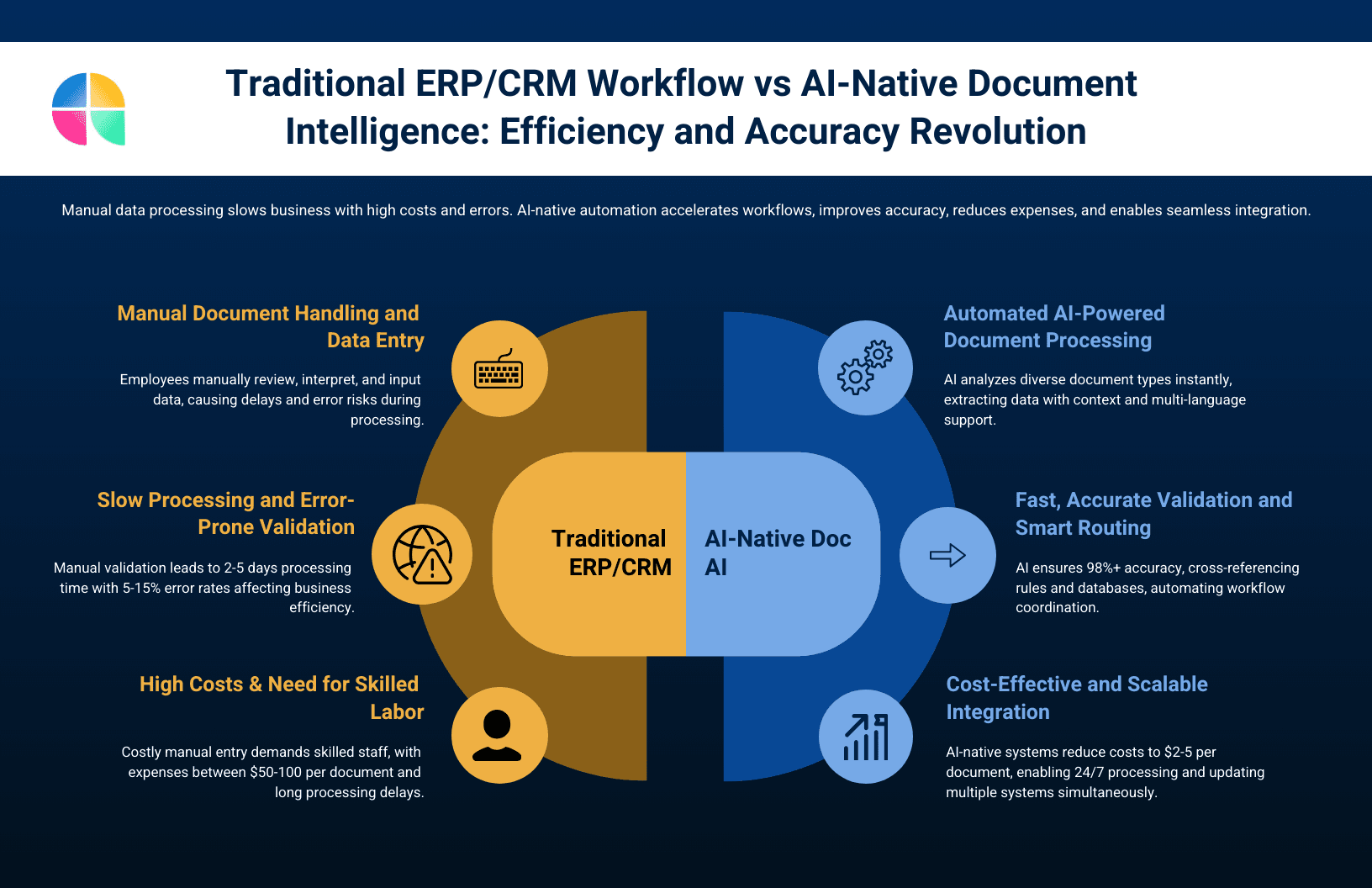
The implications extend far beyond just eliminating data entry tasks. When AI can understand and process documents with human-level comprehension, the entire concept of what constitutes a "system of record" begins to change. Instead of forcing all information into predetermined database schemas, businesses can maintain their data in more natural, flexible formats while still achieving the benefits of structured analysis and automated processing. Purchase orders don't need to be converted into specific ERP formats if the AI can understand purchase intent regardless of how that information is presented. Customer communications don't need to follow rigid CRM templates if the system can extract relationship insights and action items from natural language conversations.
This shift enables what we're calling "document-native" business processes, where the original documents themselves become the primary data layer, and systems are designed to work intelligently with information as it naturally exists rather than requiring it to be transformed into artificial structures. Companies implementing document intelligence platforms are already seeing productivity improvements that go far beyond simple automation. They're discovering that when systems can work with information more naturally, entire categories of business processes that were previously bottlenecks can be streamlined or eliminated entirely.
Enterprise resource planning systems were revolutionary when they emerged in the 1990s, but their fundamental architecture reflects the technological constraints and business realities of that era. These systems were designed around the principle that business data needed to be highly structured, carefully categorized, and entered through specific interfaces to ensure consistency and reliability. This approach made perfect sense when most business information existed on paper, when computing resources were expensive and limited, and when the primary goal was simply to digitize and centralize information that had previously been scattered across filing systems and departmental databases.
The problem is that this architectural foundation has become a constraint that limits rather than enables business agility. Modern ERP systems still require businesses to conform their operations to predetermined data models, forcing companies to either modify their natural workflows to match system requirements or invest heavily in customization that becomes increasingly difficult to maintain as business needs evolve. The result is a paradox where the systems designed to make businesses more efficient actually create friction between how people naturally work and how technology demands they work.
Document intelligence platforms represent a fundamentally different approach to enterprise data architecture. Instead of requiring businesses to structure their information to match system requirements, these platforms are designed to understand and work with information as it naturally exists in business contexts. When a supplier sends a quote with non-standard formatting, traditional ERP systems require someone to manually extract and reformat the information to match expected fields and data types. Document intelligence systems can understand the intent and content of that quote regardless of its format, automatically extract relevant information, validate it against business rules and historical data, and integrate it into appropriate workflows without any manual intervention.
This difference in architectural philosophy has profound implications for how businesses can adapt to changing market conditions, customer requirements, and operational challenges. Companies built around traditional ERP architectures often find themselves constrained by their systems when they need to respond quickly to new opportunities or challenges. Adding new data fields, modifying workflows, or integrating with new partners typically requires extensive IT involvement, system customization, and careful change management to avoid disrupting existing processes.
Organizations that embrace document intelligence as their primary data layer gain unprecedented flexibility in how they structure and modify their operations. When the system can understand business context rather than just data structure, companies can experiment with new approaches, adapt to partner requirements, and respond to customer needs without being limited by the rigid constraints of traditional database schemas and workflow engines.
The financial implications of this architectural shift are staggering. Companies typically spend between 15% and 25% of their IT budgets on ERP maintenance, customization, and integration projects. Much of this expense comes from the ongoing effort required to bridge the gap between how businesses naturally operate and how their systems require them to operate. Document intelligence platforms can eliminate many of these integration challenges because they're designed to work with information in its natural form rather than requiring extensive transformation and mapping.
We're already seeing early adopters achieve remarkable results by treating document intelligence as their primary business intelligence layer and using traditional ERP systems primarily for compliance and reporting functions. These companies are discovering that when AI can handle the intelligent interpretation and processing of business documents, many of the complex workflows and data management processes that traditional ERP systems require become unnecessary overhead rather than value-adding activities.
The enterprise technology stack of the future will look fundamentally different from today's layer cake of integrated systems, each with its own data model, user interface, and operational requirements. Instead of building upward from traditional ERP foundations, tomorrow's enterprise architecture will be built around intelligent document processing as the core data ingestion and interpretation layer, with other systems serving more specialized functions within an AI-coordinated ecosystem.
At the foundation of this new stack sits document intelligence platforms that can understand, validate, and act upon information regardless of its source or format. These systems serve as universal translators that can interpret everything from handwritten forms to complex legal contracts, extracting not just obvious data points but understanding context, intent, and business implications. Above this foundation layer, specialized systems handle specific operational functions, but they're no longer responsible for the complex data transformation and integration work that currently consumes so much IT resources and creates so many operational bottlenecks.
Consider how this architecture would transform something as basic as vendor management. In traditional enterprise stacks, vendor information might be scattered across purchasing systems, accounts payable modules, contract management platforms, and compliance databases, with each system maintaining its own partial view of vendor relationships and requiring separate data entry and maintenance processes. An AI-native approach would use document intelligence to automatically understand and process all vendor-related communications and documents, maintaining a comprehensive, always-current understanding of vendor relationships that can serve all downstream systems without requiring manual data synchronization or complex integration middleware.
This architectural shift enables what we call "intelligent orchestration" of business processes, where AI agents can coordinate activities across multiple systems and stakeholders based on understanding of business context rather than rigid workflow rules. When a customer submits a service request through any channel, the AI can understand the nature of the request, identify the appropriate resources and processes needed to address it, coordinate with relevant systems and team members, and manage the entire resolution process while keeping all stakeholders informed through their preferred communication channels.
The implications for business agility are profound. Companies built on AI-native architectures can adapt to new requirements, integrate with new partners, and respond to market changes without the lengthy system integration projects and workflow redesign efforts that currently make enterprise change management so complex and expensive. When the core intelligence layer can understand and adapt to new information types and business processes, adding new capabilities becomes a matter of training and configuration rather than development and integration.
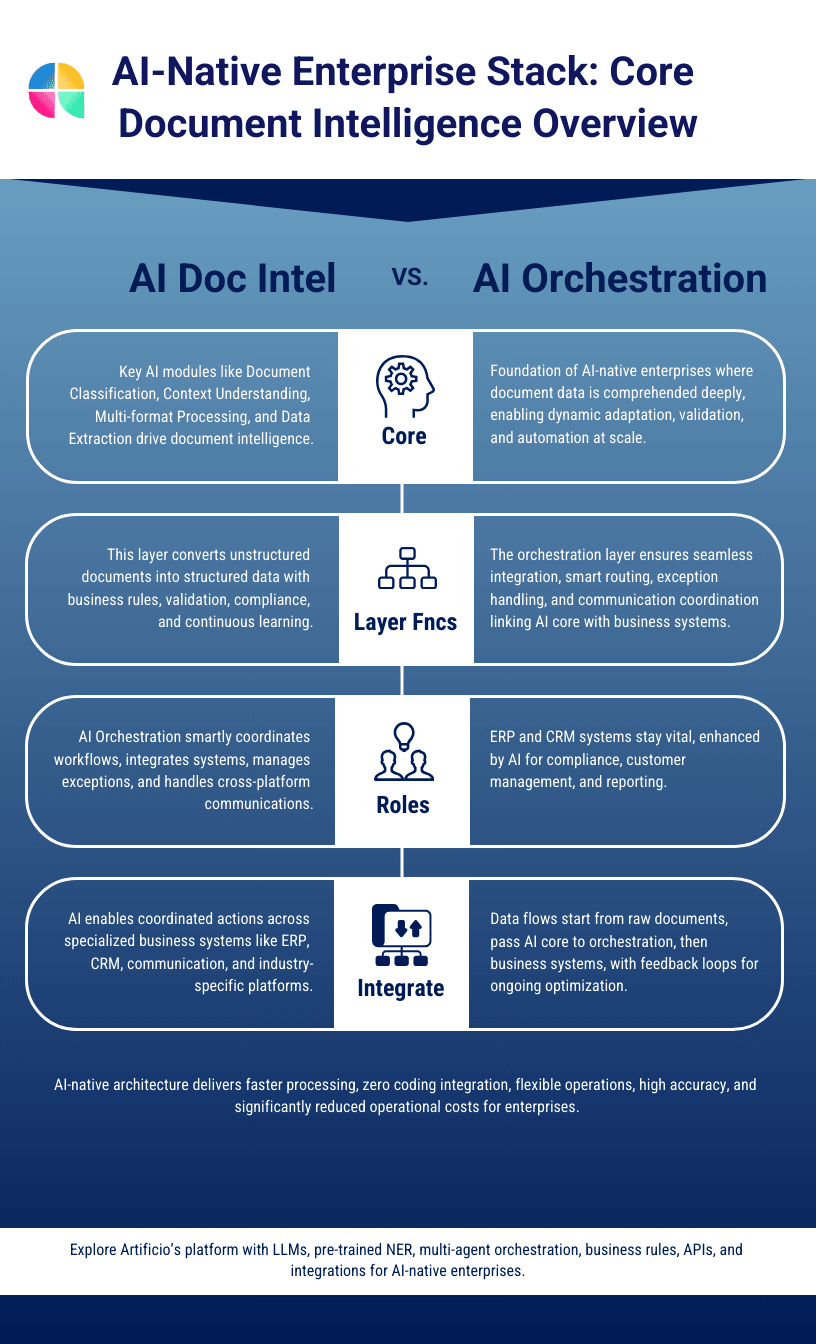
We're seeing early implementations of this architecture in industries where document complexity and volume create the most significant operational challenges. Financial services companies are using document intelligence to automatically process loan applications, insurance claims, and regulatory filings while coordinating with traditional core banking systems, credit bureaus, and compliance platforms. Manufacturing companies are implementing AI-native approaches to purchase order processing, quality documentation, and supply chain coordination that can adapt to varying supplier formats and requirements without requiring costly EDI implementations or manual data transformation processes.
The talent implications of this shift are equally significant. Instead of needing specialists who understand the intricacies of specific ERP modules and integration technologies, organizations will need professionals who understand how to design and optimize AI-driven business processes. The skills required to manage AI-native enterprise operations focus more on understanding business context and training intelligent systems rather than managing complex technical integrations and data transformation workflows.
The transition to AI-native enterprise operations isn't a theoretical future scenario. Companies across multiple industries are already implementing document intelligence as their primary data processing layer and seeing transformational results that demonstrate the practical viability of this architectural shift. These early implementations provide concrete evidence of how businesses can achieve both operational efficiency gains and strategic competitive advantages by embracing document intelligence as foundational enterprise infrastructure.
In the financial services sector, we're seeing particularly dramatic transformations in lending operations. Traditional loan origination processes require borrowers to submit extensive documentation that loan officers and underwriters then manually review and input into lending systems. This process typically takes days or weeks, creates significant opportunities for errors, and requires substantial human resources to manage routine applications. Banks implementing document intelligence platforms are now able to automatically process complete loan applications in minutes rather than days, with AI systems that can understand and verify income documentation, employment history, asset statements, and other required information regardless of format or source.
One mid-sized regional bank recently reported that their AI-native loan origination process reduced their average application processing time from 14 days to less than 4 hours for standard applications, while simultaneously improving their accuracy rate for data extraction and risk assessment. More importantly, this wasn't just about automation of existing processes. The AI system's ability to understand context and identify patterns in application data enabled the bank to offer more personalized lending products and identify cross-selling opportunities that their traditional rule-based systems had been missing.
Insurance companies are experiencing similar transformations in claims processing. Traditional claims workflows require adjusters to review documentation, extract relevant information, validate coverage details, and coordinate with multiple systems and stakeholders throughout the resolution process. Document intelligence platforms can now automatically process claims documentation, understand the nature of reported incidents, validate policy coverage, identify potential fraud indicators, and coordinate appropriate response workflows without requiring manual intervention for routine claims.
A major property and casualty insurer implemented document intelligence across their claims processing operations and achieved a 78% reduction in average claim processing time while improving customer satisfaction scores significantly. The AI system's ability to understand complex claims documentation and coordinate with repair vendors, medical providers, and legal representatives through automated but personalized communications meant that customers received faster resolution and better service while the company reduced its operational costs and improved risk management.
Manufacturing and supply chain operations represent another area where document intelligence is delivering transformational results. Companies dealing with hundreds or thousands of suppliers often struggle with the complexity of managing purchase orders, invoices, shipping documentation, and quality certifications that arrive in countless different formats and contain varying levels of detail and accuracy. Traditional ERP systems require this information to be manually standardized and entered into specific modules, creating bottlenecks that slow procurement processes and increase the risk of errors that can disrupt production schedules.
A global automotive manufacturer recently replaced their traditional supplier document processing workflows with an AI-native system that can automatically understand and process supplier communications regardless of format, language, or level of detail. The system not only extracts standard data points like prices and delivery dates but also understands quality requirements, identifies potential supply chain risks, and automatically coordinates with production planning systems to optimize inventory levels and manufacturing schedules. This implementation reduced their supplier onboarding time from several weeks to less than 48 hours while improving their ability to identify and mitigate supply chain disruptions before they impact production.
Healthcare organizations are discovering that document intelligence can transform not just administrative processes but clinical workflows as well. Medical practices and hospitals deal with enormous volumes of documentation from patients, insurance providers, pharmaceutical companies, and regulatory agencies, much of which requires manual review and processing by clinical and administrative staff. AI systems that can understand medical terminology, insurance requirements, and regulatory compliance issues are enabling healthcare organizations to focus their human resources on patient care rather than administrative tasks.
These real-world implementations share several common characteristics that demonstrate the practical advantages of treating document intelligence as foundational enterprise infrastructure. Companies report not just efficiency gains but improved accuracy, better customer experiences, enhanced ability to identify opportunities and risks, and greater organizational agility in responding to changing market conditions. Most importantly, these benefits compound over time as AI systems learn from processing more documents and handling more business scenarios, creating competitive advantages that become increasingly difficult for competitors using traditional approaches to match.
The shift toward AI-native enterprise operations represents both an unprecedented opportunity and a significant risk for business leadership. Executives who recognize document intelligence as the foundation of next-generation business architecture can position their organizations to capture competitive advantages that will compound over the coming years. Those who treat AI as merely an add-on to existing systems risk finding themselves managing increasingly obsolete operational models while their competitors achieve superior efficiency, agility, and customer experiences through fundamentally better enterprise architecture.
The leadership challenge goes far beyond technology selection and implementation. This transformation requires executives to rethink fundamental assumptions about how business operations should be structured, how technology investments should be prioritized, and how organizational capabilities should be developed. The most successful leaders will be those who can envision and execute a transition that leverages AI capabilities to reimagine business processes rather than simply automating existing workflows.
Strategic planning must account for the reality that document intelligence capabilities are advancing rapidly, with new models and techniques emerging regularly that can handle increasingly complex business scenarios. Organizations need to develop implementation approaches that can evolve with these technological advances rather than locking themselves into rigid system architectures that will become constraints as AI capabilities expand. This requires a different approach to enterprise architecture planning, one that prioritizes flexibility and adaptability over the stability and standardization that traditional ERP implementations have emphasized.
The talent implications of this transition are equally critical for executive attention. Organizations will need professionals who understand how to design AI-driven business processes, manage intelligent automation workflows, and optimize system performance based on business outcomes rather than technical metrics. This represents a significant shift from traditional IT skill sets focused on system integration and database management toward capabilities centered on AI training, process optimization, and business intelligence analysis.
Change management becomes more complex when the transformation involves not just new software but fundamentally different approaches to work itself. Employees who have built their careers around manual data processing and system navigation will need to develop new skills focused on exception handling, quality assurance, and strategic analysis. The most successful implementations we've observed involve extensive training programs that help existing staff transition to higher-value roles while ensuring that the organization can fully capitalize on AI capabilities.
Financial planning for this transition requires different metrics and investment approaches than traditional system implementations. While upfront costs may be lower than major ERP projects, the value realization happens differently, with benefits accumulating over time as AI systems learn and improve rather than delivering immediate step-function improvements. CFOs need to develop frameworks for measuring and managing investments in AI capabilities that account for their learning and improvement characteristics rather than treating them as static technology assets.
Risk management also takes on new dimensions when core business processes depend on AI systems. Organizations need to develop capabilities for monitoring AI performance, managing model updates, ensuring compliance with evolving regulatory requirements, and maintaining appropriate human oversight of automated decisions. This requires new governance frameworks and risk assessment approaches that many organizations are still developing.
The competitive dynamics of this transition mean that timing matters significantly. Early adopters gain advantages that compound over time as their AI systems accumulate more data and operational experience. However, moving too quickly without proper planning and capability development can create operational risks and implementation challenges that undermine the potential benefits. The most effective executive approach balances urgency with careful planning to ensure successful transformation.
The transition to AI-native enterprise operations requires a systematic approach to redesigning data architecture that goes far beyond implementing new software tools. Organizations need to fundamentally rethink how they capture, process, and utilize business information, moving from rigid, system-centric approaches to flexible, intelligence-driven architectures that can adapt to evolving business needs and technological capabilities.
The foundation of effective AI-first architecture lies in establishing document intelligence as the primary data ingestion layer rather than treating it as an add-on to existing systems. This means designing workflows where business documents in their natural formats become the authoritative source of information, with AI systems responsible for understanding, validating, and routing information to appropriate downstream processes. Instead of requiring documents to be converted into specific database schemas before they can be processed, the architecture should be designed so that AI can work with information in whatever format it naturally exists while still achieving the structure and reliability that business operations require.
Data quality management becomes more sophisticated in AI-driven architectures because the systems can understand context and identify inconsistencies that rule-based validation systems typically miss. Traditional data quality approaches focus on ensuring that information matches predetermined formats and falls within expected ranges. AI systems can validate information based on business logic and contextual understanding, identifying potential issues like conflicting dates, unusual patterns that might indicate errors, or missing information that could impact downstream processes.
Integration architecture must also evolve to support AI-native operations. Instead of the point-to-point integrations that characterize traditional enterprise systems, AI-first architectures use intelligent orchestration layers that can understand the relationships between different systems and coordinate data flow based on business context rather than predetermined mapping rules. This enables much more flexible and adaptive integration approaches that can accommodate new data sources, changing business requirements, and evolving system capabilities without requiring extensive reconfiguration.
Security and compliance frameworks need to account for the reality that AI systems will be processing and making decisions about sensitive business information. This requires new approaches to access control, audit trails, and regulatory compliance that can provide appropriate oversight and transparency while still enabling the flexibility and efficiency that make AI-native operations valuable. Organizations need to develop governance frameworks that balance the need for intelligent automation with requirements for human oversight and regulatory compliance.
The technical infrastructure supporting AI-first data architecture must be designed for scale and adaptability rather than just stability and performance. AI systems require significant computational resources for training and inference, but their resource needs can vary dramatically based on document volume, complexity, and the sophistication of processing required. Cloud-native architectures typically provide the flexibility and scalability needed to support AI operations effectively, but organizations need to carefully design their infrastructure to optimize for AI workloads while maintaining the reliability and security that enterprise operations require.
Data governance takes on new importance when AI systems are making autonomous decisions about business processes. Organizations need clear policies and procedures for training AI models, monitoring their performance, managing updates and improvements, and ensuring that automated decisions align with business policies and regulatory requirements. This requires governance frameworks that can provide appropriate oversight without creating bureaucratic obstacles that undermine the agility advantages that AI-native operations can provide.
Performance monitoring and optimization for AI-driven systems require different approaches than traditional system management. Instead of focusing primarily on technical metrics like response time and system availability, organizations need to monitor business outcomes like accuracy rates, exception handling effectiveness, and the quality of automated decisions. This requires developing new measurement frameworks and analytical capabilities that can assess AI performance from business perspectives rather than just technical ones.
The organizational capabilities required to manage AI-first data architecture represent a significant departure from traditional IT operations. Teams need to understand not just how to deploy and maintain AI systems but how to train them, optimize their performance, and ensure they continue to deliver business value as requirements and conditions evolve. This requires new skill sets and organizational structures that can bridge the gap between technical AI capabilities and business operational needs.
Successfully transitioning to AI-native enterprise operations requires a carefully planned approach that balances the urgency of competitive pressures with the practical realities of organizational change management and technical implementation. The most effective roadmaps we've observed follow a staged approach that enables organizations to capture early value while building the capabilities and confidence needed for more comprehensive transformation.
The initial phase should focus on identifying high-impact, low-risk use cases where document intelligence can deliver immediate value without requiring extensive changes to existing systems or processes. These pilot implementations serve multiple purposes: they demonstrate the practical benefits of AI-native approaches, provide learning opportunities for technical and business teams, and generate early wins that build organizational confidence and support for broader transformation efforts.
Typical first-phase implementations focus on document types that currently require significant manual processing and have clear, measurable business impacts. Invoice processing, contract analysis, and customer communication management represent common starting points because they involve high volumes of documents, create obvious bottlenecks in business operations, and deliver easily quantifiable benefits when automated effectively. These use cases also provide valuable learning opportunities for understanding how AI systems perform with real business documents and operational requirements.
The second phase typically involves expanding successful pilot implementations to handle more document types and business processes while beginning to integrate AI capabilities more deeply with existing enterprise systems. This phase focuses on developing the organizational capabilities needed to manage AI-driven operations effectively, including training programs for staff, governance frameworks for AI operations, and technical infrastructure optimized for intelligent document processing.
During this expansion phase, organizations begin to realize the compound benefits that make AI-native operations so powerful. As AI systems process more documents and encounter more business scenarios, they become more accurate and capable of handling complex cases that initially required human intervention. Teams develop expertise in optimizing AI performance, managing exceptions, and designing workflows that capitalize on AI capabilities while maintaining appropriate human oversight.
The third phase involves more fundamental changes to business architecture, where traditional ERP and CRM systems begin to serve more specialized roles within an AI-coordinated enterprise ecosystem. This phase requires more extensive planning and change management because it involves modifying core business processes and potentially replacing or significantly reconfiguring existing systems.
Organizations reaching this phase typically report transformational improvements in operational efficiency, customer responsiveness, and competitive agility. They're able to adapt to new business requirements quickly, integrate with new partners seamlessly, and respond to market opportunities with speed and flexibility that competitors using traditional enterprise architectures find difficult to match.
Timeline planning for this transition varies significantly based on organizational size, technical complexity, and change management capabilities, but most successful implementations follow an 18 to 36-month timeline for achieving substantial operational transformation. The key is maintaining momentum through early wins while building the capabilities needed for more comprehensive change.
Risk management throughout the implementation requires careful attention to both technical and organizational factors. Technical risks include ensuring AI system performance meets business requirements, maintaining data security and compliance, and managing integration complexity as AI capabilities expand. Organizational risks involve change management challenges, skill development needs, and the potential for disruption to existing operations during the transition period.
Success metrics should focus on business outcomes rather than just technical performance indicators. While system reliability and processing speed are important, the real value of AI-native operations comes from improvements in decision quality, operational agility, customer experience, and competitive positioning. Organizations need measurement frameworks that can capture these strategic benefits rather than focusing solely on efficiency gains.
The most successful implementations we've observed involve close collaboration between business leaders, IT teams, and external partners with expertise in AI-native enterprise architecture. This collaborative approach ensures that technical capabilities align with business requirements while building internal expertise that can support ongoing optimization and expansion of AI operations.
The transition to document intelligence as the foundation of enterprise operations represents more than a technology upgrade. It's a fundamental shift in how businesses will operate, compete, and create value in an increasingly AI-driven economy. Organizations that embrace this transformation now will build competitive advantages that compound over time, while those that delay risk finding themselves constrained by increasingly obsolete operational models.
The evidence from early implementations demonstrates that AI-native enterprise architecture isn't just theoretically superior to traditional approaches, it's delivering practical business results that validate the investment and effort required to make this transition. Companies are achieving dramatic improvements in operational efficiency, customer responsiveness, and competitive agility while reducing costs and improving accuracy across core business processes.
Perhaps most importantly, organizations implementing document intelligence as their primary data processing layer are discovering that this architectural approach enables innovations and business model improvements that weren't possible with traditional enterprise systems. When AI can understand and work with information in its natural formats, businesses can experiment with new approaches, respond to customer needs more flexibly, and adapt to market changes without being constrained by rigid system requirements.
The window for gaining competitive advantage through early adoption of AI-native enterprise architecture is closing rapidly. As more organizations recognize the strategic value of document intelligence and AI-driven operations, the benefits of being an early mover will diminish. Business leaders need to act decisively to position their organizations at the forefront of this transformation rather than finding themselves playing catch-up with competitors who embraced the future of enterprise operations while it was still emerging.
The next five years will determine which organizations will lead their industries in the AI-native economy and which will struggle to adapt to new competitive realities. The choice is clear: embrace document intelligence as the foundation of next-generation business operations, or continue managing increasingly obsolete systems while competitors race ahead with fundamentally better enterprise architectures.
The future belongs to organizations that recognize AI not as a tool to enhance existing processes, but as the foundation for entirely new ways of doing business. Document intelligence represents the first practical implementation of this AI-native approach to enterprise operations, and the companies implementing it now are building the competitive advantages that will define industry leadership for decades to come.
For executives ready to lead this transformation, the opportunity has never been clearer or more compelling. The technology exists, proven implementations demonstrate its value, and the competitive advantages are both immediate and cumulative. The only question is whether your organization will be among the leaders shaping the AI-native future of business operations, or among those struggling to adapt to changes that others saw coming and prepared for while there was still time to gain advantage from being ahead of the curve.
The revolution in enterprise operations has already begun. The only question is whether your organization will lead it or be disrupted by it.

Head IT Operations - Co Founder of Artificio
See it in your SAP environment
Bring us a document, a process, or a bottleneck. We'll show how Artificio captures, validates, and posts into SAP — then scale from there.
Security & compliance
ISO 27001:2013 certified, SOC 2 Type 2 compliant, GDPR and HIPAA ready. Every agent action is logged, auditable, and runs in isolated environments.