

Blog
Generative AI for Document Summarization & Insights
Transform documents like PDFs into actionable insights with generative AI. Streamline workflows, make faster decisions, and reduce manual work.

Blog
Transform documents like PDFs into actionable insights with generative AI. Streamline workflows, make faster decisions, and reduce manual work.
The modern enterprise drowns in paperwork. Every day, businesses process thousands of documents ranging from complex contracts and financial reports to regulatory filings and vendor applications. These documents contain critical information that drives decision-making, but extracting meaningful insights from dense, multi-page PDFs has traditionally required hours of manual review by skilled professionals. This approach doesn't scale, creates bottlenecks, and often leads to important details being overlooked or decisions being delayed.
Generative AI is transforming this landscape by enabling organizations to automatically extract, summarize, and act on document content at unprecedented speed and accuracy. Rather than forcing human reviewers to wade through pages of legal jargon or technical specifications, AI-powered summarization can distill key information into digestible insights while simultaneously identifying actionable next steps. This shift represents more than just efficiency gains it's fundamentally changing how businesses process information and make decisions.
Artificio's platform sits at the forefront of this transformation, combining advanced document processing capabilities with generative AI to create intelligent workflows that don't just summarize content, but actively guide users toward optimal outcomes. By integrating optical character recognition (OCR), natural language processing, and AI-powered decision support, organizations can transform their document-heavy processes from time-consuming bottlenecks into streamlined, intelligent operations.
Most enterprises struggle with document processing inefficiencies that compound across departments and business functions. Consider a typical accounts payable department that processes hundreds of invoices daily. Each invoice requires verification of vendor information, approval routing based on amount thresholds, compliance checking, and exception handling for discrepancies. Traditional workflows rely on manual review, spreadsheet tracking, and email-based approvals a process that's not only slow but prone to errors and inconsistencies.
The problem extends far beyond invoices. Legal teams review contracts that can span dozens of pages, searching for specific clauses, renewal dates, and liability terms. Human resources departments process employment applications, background checks, and compliance documentation. Healthcare organizations manage patient records, insurance claims, and regulatory filings. In each case, the core challenge remains the same: extracting actionable intelligence from unstructured documents while maintaining accuracy and compliance standards.
Traditional document management systems often exacerbate these problems by treating documents as static files rather than sources of actionable data. They excel at storage and retrieval but provide little help in understanding content or identifying patterns across document sets. This limitation forces organizations to rely on human expertise for interpretation, creating scalability constraints and knowledge silos that become more problematic as document volumes grow.
The cognitive load on human reviewers is substantial. Reading comprehension fatigue sets in after processing multiple complex documents, leading to decreased accuracy and missed details. Important deadlines get overlooked, exceptions aren't flagged consistently, and decision-making slows as reviewers struggle to synthesize information from multiple sources. These challenges have only intensified as remote work has increased document volumes and distributed review processes across teams.
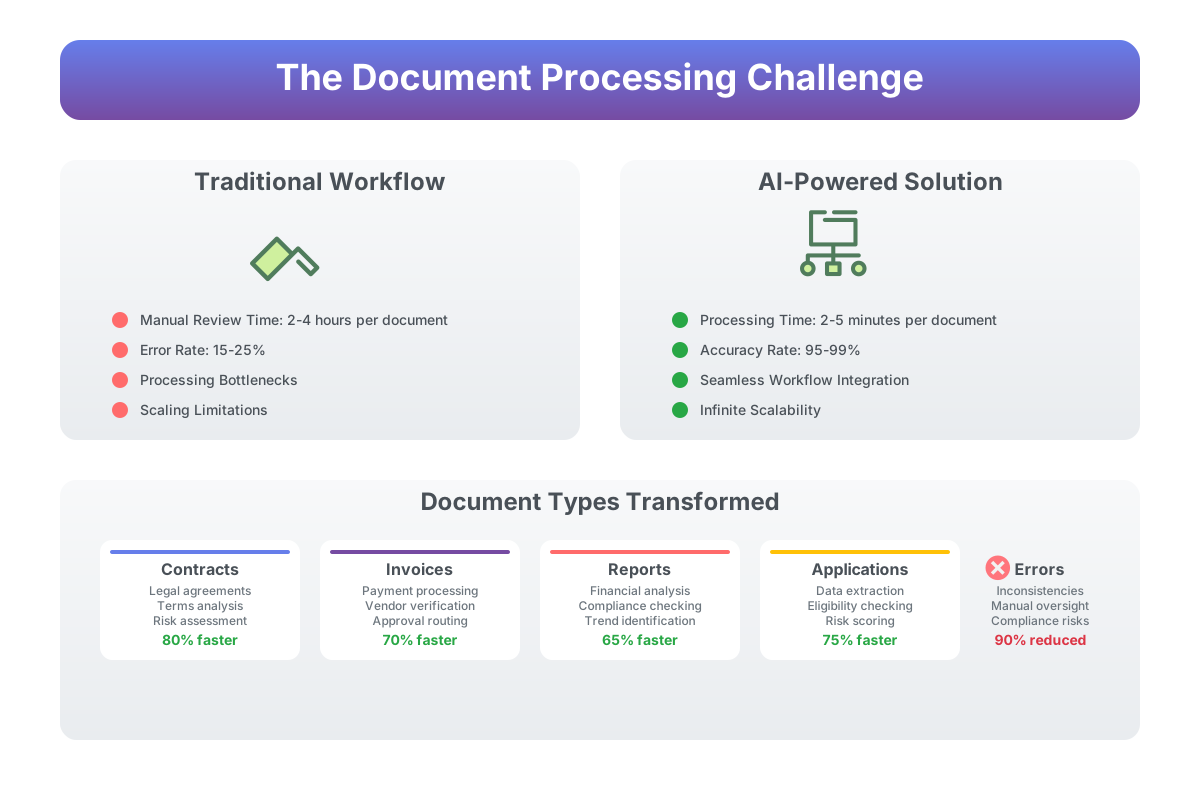
Generative AI represents a paradigm shift in how machines can understand and work with human-created content. Unlike traditional rule-based systems that require explicit programming for each document type and extraction scenario, generative AI models can understand context, interpret meaning, and generate human-like summaries of complex information. This capability enables a more flexible and intelligent approach to document processing that adapts to varying formats, languages, and content structures.
The key advantage of generative AI in document processing lies in its ability to understand context and relationships within text. Traditional keyword-based extraction might identify contract dates or dollar amounts, but generative AI can understand the significance of those dates within the broader agreement context. It can recognize when a payment term is unusual, identify potential conflicts between clauses, or highlight areas where additional review might be warranted.
Modern large language models (LLMs) have been trained on vast datasets that include legal documents, financial reports, technical specifications, and other business content. This training enables them to understand domain-specific terminology, recognize standard document structures, and apply business logic to their analysis. When processing a commercial lease agreement, for example, an LLM can identify not just the rent amount and lease term, but also escalation clauses, maintenance responsibilities, and termination conditions then summarize these elements in plain language that enables faster decision-making.
The generative aspect of these models enables them to create customized outputs tailored to specific audiences and use cases. The same contract might be summarized differently for legal review, financial analysis, and operational planning. Legal teams might need detailed clause analysis and risk assessment, while finance teams require cash flow implications and budget impacts. Generative AI can create multiple perspectives from the same source document, ensuring each stakeholder gets relevant information in an appropriate format.
This adaptability extends to different document types and industries. A generative AI system trained on healthcare documents can understand medical terminology and regulatory requirements, while the same underlying technology can be adapted for financial services compliance or manufacturing quality documentation. This flexibility reduces the need for custom development while maintaining accuracy across diverse business functions.
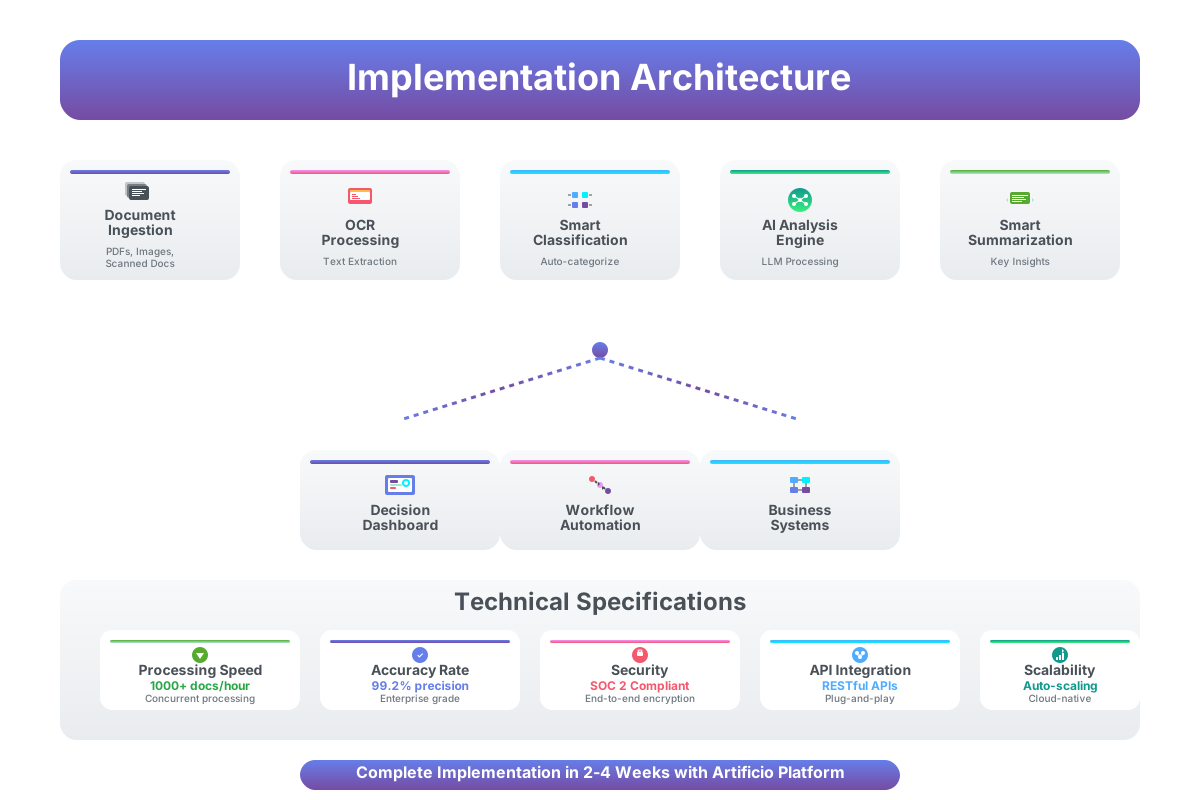
Artificio's platform provides an end-to-end solution for intelligent document processing that combines multiple AI technologies into a cohesive workflow. The architecture begins with robust document ingestion capabilities that can handle various file formats, from scanned PDFs and images to digital documents and structured data files. Advanced OCR technology ensures accurate text extraction even from poor-quality scans or complex layouts with tables, charts, and mixed content types.
The document classification engine automatically categorizes incoming documents based on content, format, and context clues. This classification enables targeted processing workflows invoices follow different processing paths than contracts or compliance reports. Machine learning models continuously improve classification accuracy by learning from user feedback and processing patterns, reducing manual sorting requirements while ensuring documents reach appropriate review queues.
Artificio's extraction capabilities go beyond simple text recognition to understand document structure and relationships. The platform can identify headers, sections, tables, and footnotes while maintaining the logical connections between different document elements. This structural understanding enables more accurate summarization and ensures that important context isn't lost during processing. For complex documents like merger agreements or technical specifications, maintaining these relationships is crucial for accurate interpretation.
The generative summarization engine represents the platform's core innovation, applying advanced LLMs to create intelligent document summaries that highlight key information, identify potential issues, and suggest next steps. The system doesn't just extract existing text it synthesizes information, identifies patterns, and generates insights that might not be immediately apparent to human reviewers. This analysis can reveal trends across document sets, flag unusual patterns, or identify opportunities for process improvement.
Integration with Artificio's AI Agents extends the platform's capabilities beyond summarization into active workflow management. The Workflow Optimization Agent can suggest process improvements based on document patterns, while the Exception Resolution Agent can automatically flag unusual terms or conditions that require special handling. The Communications Assistant can generate alerts, summaries, and status updates for stakeholders, ensuring everyone stays informed about document processing progress.
The practical applications of AI-powered document summarization span across industries and business functions, with each implementation showcasing different aspects of the technology's transformative potential. In accounts payable operations, the traditional process of manually reviewing vendor invoices can consume significant staff time while introducing opportunities for errors and delays. Artificio's platform can automatically extract key invoice data including vendor information, amounts, dates, and line items, then cross-reference this information against purchase orders and contracts to identify discrepancies.
The system generates concise summaries that highlight critical information for approval workflows flagging invoices that exceed approved amounts, identifying new vendor accounts that require additional verification, or noting payment terms that deviate from standard agreements. This automated analysis enables accounts payable teams to focus their attention on exceptions and complex cases while routine invoices move through approval workflows with minimal manual intervention. The result is faster processing times, improved accuracy, and better cash flow management.
In loan and mortgage processing, document review represents a significant bottleneck that affects customer experience and operational efficiency. A typical mortgage application includes income verification, employment history, credit reports, property appraisals, and various disclosure documents. Loan officers traditionally spend hours reviewing these documents to assess risk factors and ensure compliance with lending regulations. Artificio's platform can automatically summarize applicant information, identify potential risk factors, and generate compliance checklists that ensure all regulatory requirements are met.
The system's ability to understand context enables sophisticated risk analysis that goes beyond simple data extraction. It can identify income patterns that might indicate seasonal employment, flag credit report items that require explanation, or note property characteristics that affect valuation. This analysis is presented in clear, actionable summaries that enable loan officers to make faster decisions while maintaining appropriate risk management standards.
Healthcare organizations face particularly complex document processing challenges due to regulatory requirements, privacy concerns, and the critical nature of medical information. Patient records, insurance claims, and treatment authorizations must be processed accurately while maintaining strict confidentiality and compliance standards. Artificio's platform can automatically extract relevant medical information, identify coverage limitations, and flag potential compliance issues while maintaining full audit trails for regulatory purposes.
The system's summarization capabilities are particularly valuable for care coordination, where medical professionals need quick access to patient history from multiple sources. Instead of reviewing lengthy records from various providers, clinicians can access concise summaries that highlight relevant conditions, medications, allergies, and treatment responses. This streamlined access to information improves care quality while reducing the time clinicians spend on administrative tasks.
Government agencies and regulated industries often deal with complex compliance documentation that requires careful review and analysis. Environmental impact reports, safety audits, and regulatory filings can span hundreds of pages while containing critical information that affects public safety and regulatory compliance. Artificio's platform can automatically identify key compliance points, flag potential violations, and generate summary reports that enable faster regulatory review while ensuring nothing important is overlooked.
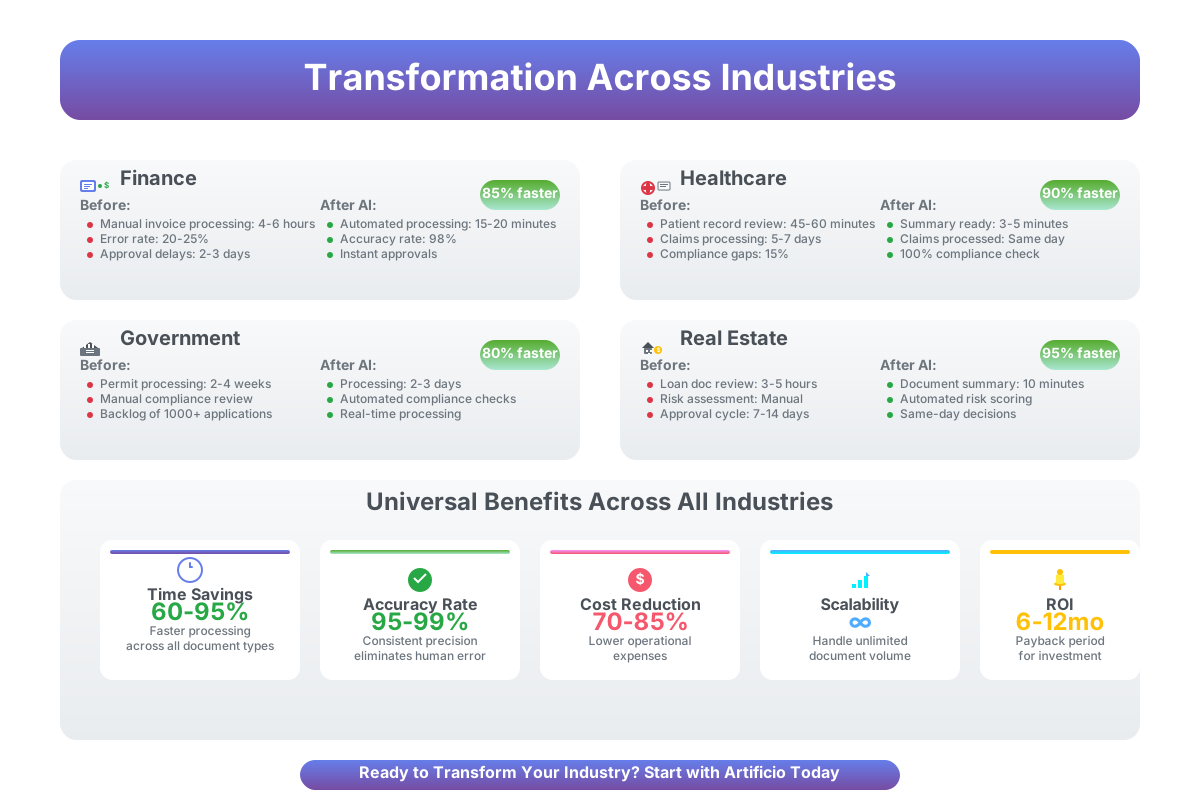
The implementation of AI-powered document summarization delivers measurable benefits across multiple dimensions of business performance, with organizations typically seeing significant improvements within the first few months of deployment. Time savings represent the most immediate and visible benefit, with many organizations reporting 60-80% reductions in document review time. What previously required hours of manual analysis can often be completed in minutes, freeing skilled professionals to focus on higher-value activities that require human judgment and expertise.
Accuracy improvements are equally significant, particularly for processes that involve complex compliance requirements or financial calculations. Human reviewers, especially when processing large volumes of similar documents, are prone to fatigue-related errors and inconsistent application of review criteria. AI systems maintain consistent performance regardless of volume or complexity, applying the same analytical rigor to every document. This consistency reduces errors, improves compliance rates, and minimizes the risk of costly oversights.
The scalability benefits become apparent as organizations grow or face seasonal volume fluctuations. Traditional document processing workflows require proportional increases in staff to handle additional volume, but AI-powered systems can scale dynamically without linear cost increases. During peak periods like end-of-quarter financial closes or seasonal lending cycles, the same AI infrastructure can handle significantly increased document volumes without compromising processing speed or quality.
Risk mitigation represents another crucial benefit area, particularly for organizations in regulated industries. AI systems can consistently apply complex compliance rules and identify potential issues that human reviewers might miss. The platform's ability to maintain detailed audit trails and processing logs also supports regulatory compliance and provides documentation for any questions that arise during audits or reviews.
Cost reduction extends beyond direct labor savings to include improved cash flow management, reduced processing delays, and enhanced vendor relationships. Faster invoice processing enables organizations to take advantage of early payment discounts while avoiding late payment penalties. Accelerated loan processing improves customer satisfaction and increases competitive advantage in financial services markets. Streamlined compliance documentation reduces the risk of regulatory penalties and associated costs.
The data insights generated through AI-powered document processing create additional value through improved business intelligence and process optimization. Organizations gain visibility into processing patterns, vendor performance, compliance trends, and operational efficiency metrics that were previously difficult to track. This data enables continuous improvement initiatives and strategic decision-making based on comprehensive operational intelligence.
Implementing an effective AI-powered document processing system requires careful planning and integration across multiple technology components and business processes. The technical architecture must balance performance, scalability, and security requirements while providing flexibility for future enhancements and changing business needs. Artificio's platform is designed to integrate seamlessly with existing enterprise systems while providing the extensibility needed for custom workflows and specialized requirements.
The implementation process typically begins with document audit and classification to understand the variety and complexity of documents that will be processed. This analysis helps determine the appropriate AI models and processing workflows for different document types. Organizations often start with high-volume, standardized documents like invoices or applications before expanding to more complex document types like contracts or technical specifications.
Data preparation and training represent crucial steps in ensuring optimal AI performance. While modern generative AI models come with extensive pre-training, fine-tuning for specific industries, document types, and business requirements significantly improves accuracy and relevance. Artificio's platform includes tools for managing training data, monitoring model performance, and implementing continuous improvement processes that leverage user feedback and processing outcomes.
Integration with existing enterprise systems requires careful attention to data flow, security, and user experience considerations. The platform must connect with document management systems, enterprise resource planning (ERP) software, customer relationship management (CRM) platforms, and workflow management tools. API-based integrations enable seamless data exchange while maintaining security and audit trail requirements.
Security and compliance considerations are paramount, particularly for organizations handling sensitive financial, medical, or personal information. The platform implements enterprise-grade security measures including encryption, access controls, and audit logging. Privacy-preserving techniques ensure that sensitive information is protected throughout the processing workflow while still enabling effective AI analysis and summarization.
User interface design plays a critical role in adoption and effectiveness. The system must present AI-generated summaries and insights in formats that match existing workflows and decision-making processes. Customizable dashboards enable different user roles to access relevant information while maintaining appropriate security controls. Mobile accessibility ensures that approvals and reviews can be completed from anywhere, improving workflow efficiency.
Change management and training programs are essential for successful implementation. Users must understand how AI-powered summaries complement rather than replace human judgment. Training programs should cover system capabilities, limitations, and best practices for integrating AI insights into existing decision-making processes. Clear escalation procedures ensure that complex or unusual cases receive appropriate human review.
Modern AI-powered document processing platforms offer sophisticated capabilities that extend far beyond simple text summarization. Artificio's platform includes advanced features that enable organizations to extract maximum value from their document processing investments while addressing complex business requirements that traditional systems cannot handle effectively.
Multi-document analysis represents one of the most powerful advanced capabilities, enabling the platform to identify patterns, inconsistencies, and relationships across large document sets. For contract management, this might involve analyzing hundreds of vendor agreements to identify standard terms, unusual clauses, or opportunities for better negotiation. In financial analysis, the system can compare performance reports across time periods or business units to identify trends and anomalies that require attention.
Predictive analytics capabilities leverage historical document data to forecast future outcomes and identify potential issues before they become problems. In accounts payable, the system might predict cash flow requirements based on invoice processing patterns and payment terms. For loan processing, predictive models can estimate processing times and identify applications that might require additional documentation or review.
Natural language querying allows users to ask complex questions about document content using plain English rather than learning specialized query languages or navigation interfaces. Users can ask questions like "Show me all contracts with renewal dates in the next 90 days" or "Identify invoices from new vendors that exceed $10,000" and receive immediate, accurate responses with supporting documentation.
Automated workflow routing uses AI analysis to determine the most appropriate next steps for each document based on content, context, and business rules. Simple documents might be routed directly to automated processing, while complex or unusual cases are escalated to appropriate human reviewers. This intelligent routing ensures that human attention is focused where it adds the most value while routine cases are handled efficiently.
Real-time collaboration features enable multiple stakeholders to review, comment on, and approve documents simultaneously while maintaining clear audit trails and version control. The system can automatically notify relevant parties when their input is needed and track progress toward completion. Integration with popular collaboration platforms ensures that document processing fits seamlessly into existing communication workflows.
Continuous learning mechanisms enable the platform to improve performance over time based on user feedback, processing outcomes, and changing business requirements. Machine learning algorithms analyze user corrections, approval patterns, and exception handling to refine extraction accuracy and summarization quality. This adaptive capability ensures that the system becomes more valuable as it processes more documents and learns organizational preferences.
Establishing appropriate metrics and measurement frameworks is essential for demonstrating the value of AI-powered document processing initiatives and guiding continuous improvement efforts. Organizations should track both quantitative performance indicators and qualitative improvements in user experience and decision-making quality. These metrics provide the foundation for ROI calculations and help justify continued investment in AI technologies.
Processing time metrics represent the most straightforward measurement category, tracking the time required to complete various document processing tasks before and after AI implementation. Organizations typically measure average processing time per document, total throughput capacity, and time-to-completion for complex workflows like loan approvals or contract reviews. Many organizations achieve 60-80% reductions in processing time while maintaining or improving accuracy levels.
Accuracy and quality metrics assess the reliability of AI-generated summaries and extracted information. These measurements might include error rates for data extraction, accuracy of risk assessments, and consistency of compliance checking. User feedback scores and correction rates provide additional insight into practical accuracy from the perspective of end users. Quality metrics should be tracked continuously to identify areas for improvement and ensure that AI performance meets business requirements.
Cost efficiency measurements compare the total cost of document processing before and after AI implementation, including direct labor costs, technology expenses, and indirect costs like processing delays or errors. Return on investment calculations should include both hard savings from reduced labor requirements and soft benefits like improved customer satisfaction or faster decision-making. Many organizations achieve positive ROI within 6-12 months of implementation.
User adoption and satisfaction metrics track how effectively staff are utilizing AI capabilities and whether the technology is improving their work experience. These measurements might include system usage rates, feature utilization, and user satisfaction surveys. High adoption rates and positive user feedback indicate successful implementation and help identify opportunities for additional training or system enhancements.
Business impact metrics connect document processing improvements to broader organizational outcomes like customer satisfaction, compliance rates, or competitive advantage. For financial services organizations, this might include loan approval times, customer satisfaction scores, or regulatory compliance ratings. Healthcare organizations might track patient care quality measures or insurance claim processing efficiency.
The field of AI-powered document processing continues to evolve rapidly, with new capabilities and applications emerging regularly. Understanding these trends helps organizations plan for future enhancements and ensure their technology investments remain current and competitive. Artificio's platform is designed to incorporate new AI advances as they become available, protecting organizations' investments while providing access to cutting-edge capabilities.
Multimodal AI represents one of the most significant emerging trends, enabling systems to understand and process documents that combine text, images, charts, and other visual elements. This capability is particularly valuable for technical documentation, architectural plans, medical records, and financial reports that rely heavily on visual information. Future systems will be able to analyze complex diagrams, interpret charts and graphs, and understand the relationships between textual and visual elements.
Real-time processing capabilities are advancing rapidly, enabling organizations to process and analyze documents as they are created or received rather than in batch operations. This real-time capability enables immediate alerts for urgent situations, faster response times for customer inquiries, and more dynamic workflow management. Real-time processing also supports better integration with other business systems and enables more responsive customer experiences.
Advanced reasoning capabilities are emerging that enable AI systems to make more sophisticated inferences and connections across multiple documents and data sources. These systems can understand causation, identify contradictions, and make recommendations based on complex business logic. For contract analysis, this might involve understanding the implications of specific clauses across multiple agreements or identifying opportunities for renegotiation based on market conditions.
Industry-specific AI models are becoming more sophisticated and accurate, with specialized training for healthcare, financial services, legal, and other industries. These specialized models understand domain-specific terminology, regulatory requirements, and business processes, enabling more accurate analysis and more relevant insights. Organizations benefit from AI systems that understand their specific industry context and requirements.
Integration with emerging technologies like blockchain, IoT sensors, and augmented reality will create new opportunities for document processing and analysis. Blockchain integration could provide immutable audit trails for critical documents, while IoT data could automatically trigger document processing workflows. Augmented reality interfaces might enable hands-free document review and approval processes.
Successfully implementing AI-powered document processing requires careful planning, appropriate resource allocation, and a phased approach that allows organizations to learn and adapt as they gain experience with the technology. Organizations that follow proven implementation practices achieve better outcomes with lower risk and faster time-to-value.
The implementation process should begin with a comprehensive assessment of current document processing workflows, identifying pain points, bottlenecks, and opportunities for improvement. This assessment helps prioritize use cases and ensures that AI implementation addresses the most significant business challenges. Organizations often achieve the best results by starting with high-volume, standardized documents before expanding to more complex use cases.
Pilot programs enable organizations to test AI capabilities in controlled environments while building internal expertise and confidence. Successful pilots typically focus on specific document types or business processes with clear success metrics and limited scope. Pilot results provide valuable data for full-scale implementation planning and help identify any technical or process adjustments needed for broader deployment.
Data quality and preparation are crucial for AI success, requiring organizations to ensure that training data is representative, accurate, and properly formatted. This preparation often involves cleaning existing document archives, establishing data collection procedures, and implementing quality control processes. Organizations with high-quality training data achieve better AI performance and faster implementation timelines.
Change management and user training programs are essential for successful adoption, helping staff understand how AI capabilities complement their existing skills and workflows. Training should cover both technical system operation and best practices for interpreting and acting on AI-generated insights. Clear communication about AI capabilities and limitations helps set appropriate expectations and build user confidence.
Continuous monitoring and improvement processes ensure that AI performance remains optimal as document types, business requirements, and organizational needs evolve. Regular performance reviews, user feedback collection, and model retraining help maintain accuracy and relevance. Organizations that invest in ongoing optimization achieve better long-term results and higher returns on their AI investments.
The transformation of document processing through generative AI represents more than just an efficiency improvement it's a fundamental shift in how organizations access, understand, and act on information. As businesses continue to generate and receive ever-increasing volumes of documents, the ability to quickly extract meaningful insights and generate actionable recommendations becomes a competitive necessity rather than a luxury.
Artificio's comprehensive platform demonstrates the potential of AI-powered document processing to revolutionize business operations across industries and functions. By combining advanced OCR, intelligent classification, generative summarization, and workflow automation, organizations can transform document-heavy processes from time-consuming bottlenecks into streamlined, intelligent operations that drive better decision-making and improved outcomes.
The success stories emerging from early adopters across healthcare, financial services, government, and other industries provide compelling evidence of the technology's transformative potential. Organizations are achieving dramatic improvements in processing speed, accuracy, and scalability while reducing costs and improving compliance. These benefits compound over time as AI systems learn and improve, creating sustainable competitive advantages for forward-thinking organizations.
The future of document processing will be characterized by even greater intelligence, integration, and automation. As AI capabilities continue to advance, organizations will gain access to increasingly sophisticated analysis, prediction, and recommendation capabilities. The integration of document processing with other AI technologies and business systems will create comprehensive intelligent workflows that adapt and optimize themselves based on changing business conditions.
Organizations that begin their AI-powered document processing journey today position themselves to benefit from current capabilities while building the foundation for future enhancements. The technology landscape will continue to evolve, but the fundamental value proposition of extracting actionable intelligence from unstructured documents will only become more important as information volumes and complexity continue to grow.
Success in this transformation requires more than just technology implementation it demands thoughtful planning, appropriate resource allocation, and a commitment to continuous learning and improvement. Organizations that approach AI-powered document processing as a strategic initiative rather than a tactical solution achieve the best results and create lasting competitive advantages.
The opportunity to transform document processing represents one of the most accessible and immediately valuable applications of artificial intelligence for most organizations. With platforms like Artificio providing comprehensive, enterprise-ready solutions, organizations of all sizes can begin realizing the benefits of intelligent document processing while building capabilities for an increasingly AI-driven future. The question is not whether AI will transform document processing, but how quickly organizations can adapt to capture the advantages it provides.

Head IT Operations - Co Founder of Artificio
See it in your SAP environment
Bring us a document, a process, or a bottleneck. We'll show how Artificio captures, validates, and posts into SAP — then scale from there.
Security & compliance
ISO 27001:2013 certified, SOC 2 Type 2 compliant, GDPR and HIPAA ready. Every agent action is logged, auditable, and runs in isolated environments.