

Blog
AI Streamlines Cross-Border Identity Verification & KYC
Solve global KYC compliance with AI-powered workflow automation. Reduce costs, boost conversions, and enhance security in cross-border identity verification.

Blog
Solve global KYC compliance with AI-powered workflow automation. Reduce costs, boost conversions, and enhance security in cross-border identity verification.
The digital economy has erased borders for business, but identity verification hasn't kept pace. While companies can instantly serve customers across continents, verifying who those customers actually are remains a bureaucratic nightmare that costs billions and frustrates everyone involved. Financial institutions alone burn through over €5.7 billion annually just on inefficient onboarding processes, and that's before counting the regulatory fines, abandoned applications, and security breaches that follow.
Cross-border identity verification represents one of the most complex challenges facing global businesses today. Companies expanding internationally find themselves caught between conflicting regulatory frameworks, incompatible technology systems, and a bewildering array of document formats that change with every border crossing. What works perfectly for verifying customers in New York falls apart completely when applied to Mumbai, Lagos, or São Paulo.
The stakes couldn't be higher. Banks paid $26 billion in global fines last year for KYC and AML non-compliance, while fraudsters have become increasingly sophisticated in exploiting the gaps between different national verification systems. Meanwhile, legitimate customers abandon transactions at alarming rates when faced with cumbersome, repetitive verification processes that seem designed more for bureaucratic compliance than actual security.
This is where artificial intelligence and workflow automation can transform an industry stuck in analog thinking. Instead of treating each country's verification requirements as separate, insurmountable challenges, AI-powered systems can create dynamic, adaptive workflows that automatically adjust to local regulations while maintaining global consistency and security standards.
The numbers tell a stark story about the current state of cross-border identity verification. Beyond the immediate costs of inefficient processing, businesses face a cascade of hidden expenses that multiply as they expand globally. Customer acquisition costs skyrocket when verification processes drive away legitimate users. Compliance teams require specialized expertise for each new market, creating staffing nightmares and knowledge silos. Technology infrastructure gets fragmented across different regional requirements, leading to maintenance complexity and security vulnerabilities.
Consider the journey of a typical fintech company expanding from Europe to Asia. Their carefully crafted verification workflow, perfectly tuned for GDPR compliance and European banking standards, suddenly becomes obsolete. Singapore's monetary authority requires different documentation than what Hong Kong accepts. India's Aadhaar system operates on completely different principles than European national ID cards. Japan's approach to biometric data handling conflicts with assumptions built into European systems. Each market requires not just new compliance procedures, but fundamental rethinking of how identity verification actually works.
The regulatory landscape alone presents mind-bending complexity. Europe's GDPR sets strict boundaries around personal data handling, requiring explicit consent and providing users with extensive rights over their information. The United States takes a more sectoral approach, with different rules for financial services, healthcare, and general commerce, while states like California impose their own additional requirements. Asian markets often emphasize government-issued digital ID systems, African countries may rely more heavily on mobile phone verification due to infrastructure realities, and Latin American markets might prioritize different types of documentation entirely.
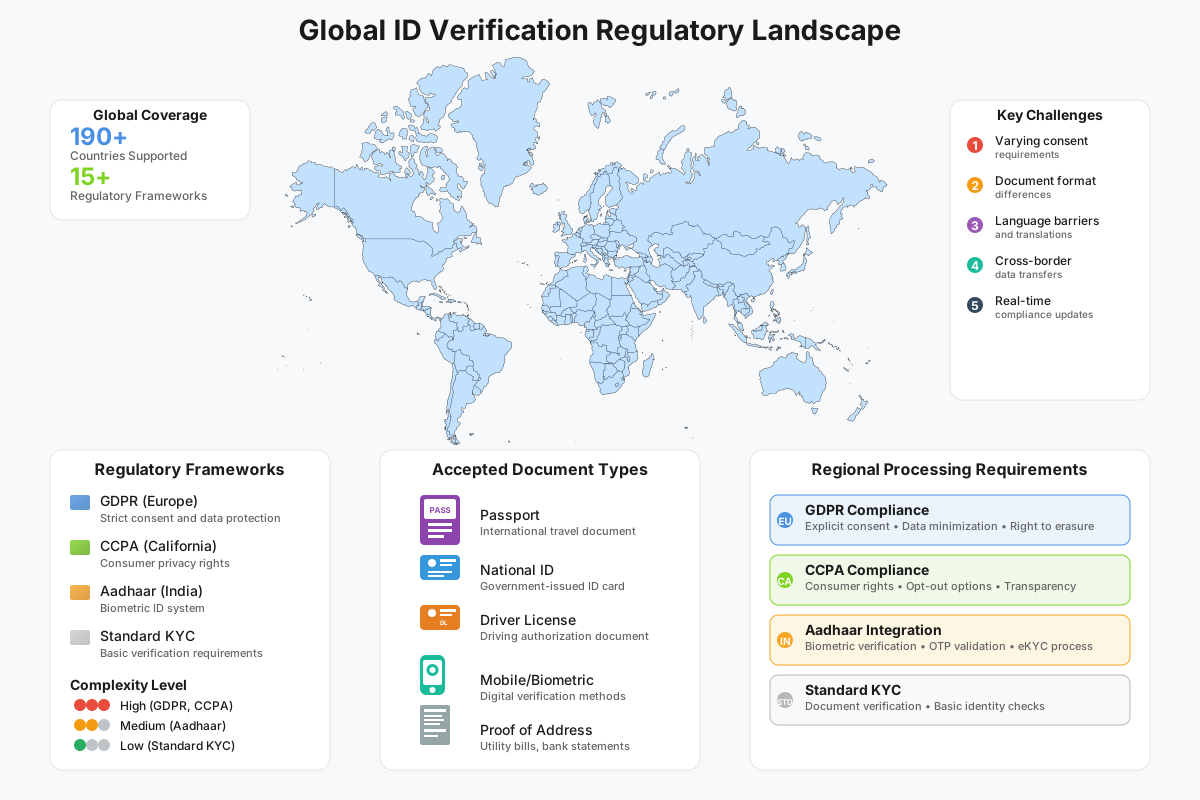
Document diversity compounds these regulatory challenges exponentially. A verification system needs to handle not just passports and driver's licenses, but also national ID cards from over 200 countries, each with unique security features, layouts, and data formats. European ID cards embed chips with cryptographic verification, while some developing nations still rely primarily on paper documents with minimal security features. Biometric standards vary wildly, with some countries prioritizing facial recognition, others focusing on fingerprints, and still others developing iris or voice recognition systems.
Language barriers create another layer of complexity that goes far beyond simple translation. Document formats, naming conventions, and even basic concepts like "middle name" don't translate directly across cultures. A verification system designed for Western naming patterns breaks down completely when encountering cultures with different family name traditions, honorifics, or transliteration systems. Address formats that work perfectly in countries with postal codes become useless in regions where locations are described relative to local landmarks.
The technological infrastructure challenges run even deeper. Some countries have invested heavily in digital identity systems with sophisticated APIs and real-time verification capabilities. Others maintain paper-based systems that require manual processes and human verification. Network connectivity, data processing capabilities, and even basic internet infrastructure vary dramatically across markets, requiring verification systems to work reliably in environments ranging from high-speed fiber networks to intermittent mobile connections.
Fraud patterns also shift dramatically across borders, requiring verification systems to adapt their risk models and detection algorithms for different threat landscapes. Techniques that signal fraud in one market might be perfectly normal behavior in another. Cultural differences in how people interact with technology, share personal information, and respond to verification requests can trigger false positives in systems designed for different populations.
The cost implications cascade through every aspect of international business expansion. Legal costs multiply as companies need specialized compliance expertise for each new market. Technology development becomes fragmented as different regional requirements force parallel system development. Customer support complexity explodes when users face different verification processes depending on their location. Training requirements expand exponentially as staff need to understand the nuances of multiple regulatory frameworks and cultural expectations.
Artificial intelligence offers a fundamentally different approach to these challenges by creating adaptive systems that learn and adjust rather than requiring manual programming for every scenario. Instead of building separate verification workflows for each market, AI-powered systems can analyze regulatory requirements, document types, and risk patterns in real-time, automatically configuring appropriate verification steps for each unique situation.
The core innovation lies in intelligent workflow orchestration that treats verification as a dynamic process rather than a static checklist. When a user begins verification, AI agents immediately analyze multiple data points to determine the optimal verification pathway. They consider the user's location, the documents they're presenting, applicable regulatory requirements, current risk levels, and even factors like network connectivity and device capabilities. This analysis happens in milliseconds, creating a customized verification experience that meets all necessary requirements while minimizing friction for the user.
Document recognition represents one of the most impressive applications of this technology. Modern AI systems can analyze uploaded document images and immediately identify not just the document type, but its country of origin, security features, and expected data fields. The system knows that a German national ID card should have specific holographic elements in particular locations, that an Indian Aadhaar card follows certain formatting rules, and that a Nigerian international passport contains particular security threads. This knowledge allows for real-time authentication that goes far beyond simple optical character recognition.
But the real power emerges in how these systems handle regulatory compliance automatically. Rather than requiring human experts to interpret complex legal requirements, AI agents can map regulatory frameworks in real-time, ensuring that verification processes meet all applicable requirements without over-collecting data or creating unnecessary friction. The system understands that GDPR requires explicit consent for biometric processing, that certain Asian markets prohibit cross-border data transfers without specific safeguards, and that financial services regulations in different countries impose varying levels of identity verification requirements.
Risk assessment becomes dramatically more sophisticated when powered by AI that can analyze patterns across global datasets while respecting local privacy requirements. Traditional rule-based systems rely on static thresholds and predetermined red flags, but AI-powered risk assessment can identify subtle patterns that indicate potential fraud while avoiding the cultural biases that plague many verification systems. The technology can distinguish between legitimate cultural differences in behavior and actual suspicious activity, reducing false positives that drive away legitimate customers while improving detection of actual threats.
Adaptive learning capabilities allow these systems to continuously improve their performance across different markets. As the system processes more verification requests from various countries, it learns about normal document variations, common user behaviors, and effective verification techniques for each market. This learning happens in compliance with local privacy regulations, ensuring that insights gained in one market don't compromise user privacy in another.
Real-time regulatory mapping represents another breakthrough capability. Rather than requiring months of legal analysis each time regulations change, AI systems can analyze new regulatory requirements and automatically adjust verification workflows to maintain compliance. When India updates its data localization requirements or Europe modifies its biometric data handling rules, the system can implement necessary changes across all affected workflows without manual intervention.
The technology also enables sophisticated fraud detection that adapts to local threat landscapes while sharing appropriate insights across markets. Fraud patterns identified in one region can inform risk models globally, but the system respects data sovereignty requirements and privacy regulations that govern how information can be shared across borders. This creates a global intelligence network that improves security everywhere while maintaining compliance with local requirements.
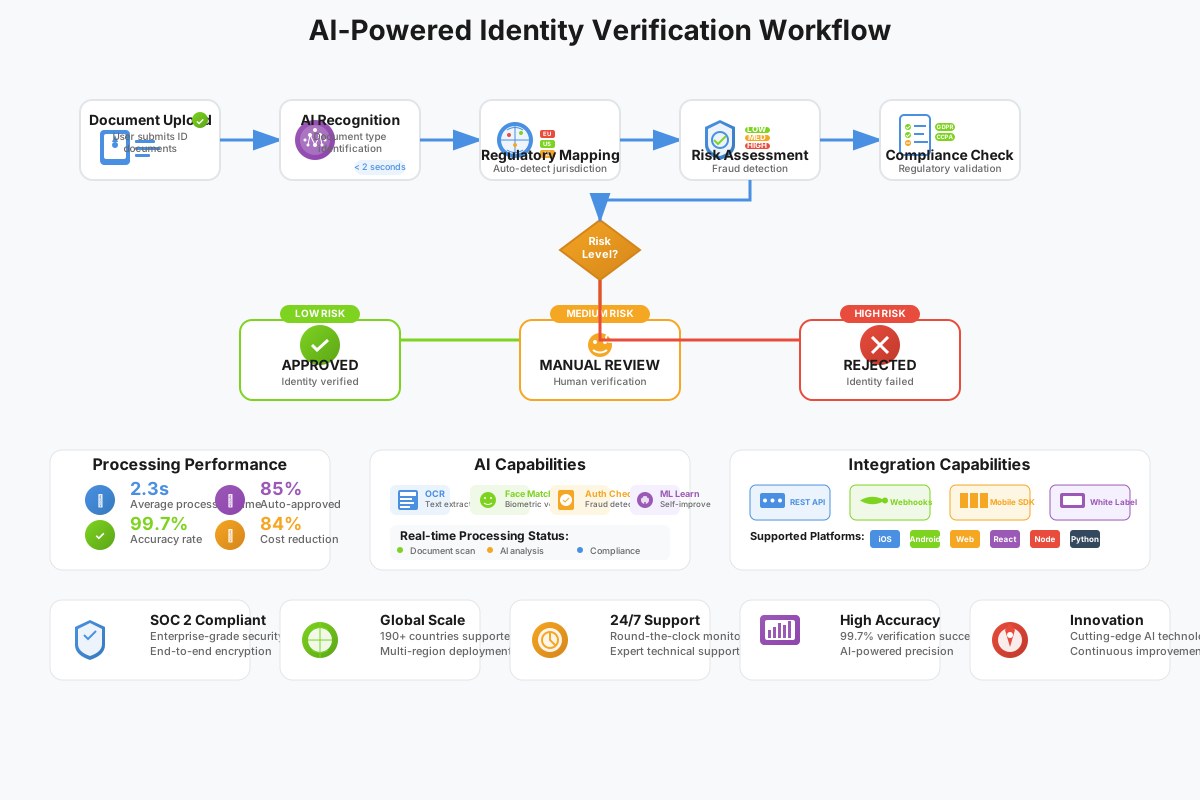
Integration capabilities allow these AI-powered systems to work with existing technology infrastructure rather than requiring complete replacement of current systems. API-first architectures enable seamless integration with existing customer onboarding platforms, regulatory reporting systems, and fraud detection tools. This approach allows businesses to enhance their current capabilities rather than starting from scratch, dramatically reducing implementation time and costs.
The scalability advantages become apparent as businesses expand into new markets. Instead of requiring separate system development for each country, AI-powered verification can be configured for new markets through data training and regulatory mapping rather than custom coding. This approach transforms international expansion from a technology challenge into a configuration exercise, allowing businesses to enter new markets weeks or months faster than traditional approaches.
The practical applications of AI-powered cross-border verification span every industry that operates internationally, with each sector facing unique challenges that benefit from intelligent automation. Financial services represent the most obvious application, but the technology's impact extends far beyond banking to e-commerce, remote work, healthcare, education, and any field where secure identity verification enables global operations.
In the fintech sector, companies expanding internationally face the classic challenge of adapting verification processes that work perfectly in their home market to completely different regulatory and technological environments. A digital bank that has perfected customer onboarding in the United States discovers that their entire approach needs restructuring for the European market, where different privacy laws, banking regulations, and customer expectations create entirely different requirements. AI-powered verification eliminates this problem by automatically adapting verification workflows to meet local requirements while maintaining consistent security standards.
Consider a real-world scenario where a European cryptocurrency exchange wants to expand into the Asian market. Traditional approaches would require months of legal analysis, technology development, and regulatory approval processes. AI-powered verification systems can analyze the regulatory requirements in target markets, map them to existing capabilities, and automatically generate compliant verification workflows. The system understands that Singapore requires different identity verification standards than Hong Kong, that Japan has specific requirements for biometric data handling, and that India's regulations around digital asset trading impose particular KYC obligations.
E-commerce platforms face similar challenges but with different requirements. A marketplace connecting buyers and sellers globally needs to verify merchant identities across multiple jurisdictions while ensuring that the verification process doesn't create barriers to legitimate business participation. The system must handle business registration documents from different countries, verify corporate structures that vary dramatically across legal systems, and assess risk levels that account for different business practices and regulatory environments.
Remote work verification represents an emerging application area where traditional approaches completely break down. Companies hiring international contractors need to verify identities for compliance, tax, and security purposes, but the verification requirements vary dramatically depending on where the worker is located and what type of work they'll be performing. A software company hiring developers in Eastern Europe faces different verification requirements than when hiring content creators in Southeast Asia or financial analysts in Latin America. AI-powered systems can automatically determine appropriate verification levels and processes based on the worker's location, the nature of their work, and applicable regulations.
Healthcare applications present particularly complex challenges because medical data privacy requirements vary dramatically across countries and the stakes of verification failures are extremely high. Telemedicine platforms expanding internationally must verify both healthcare provider credentials and patient identities while navigating completely different medical privacy regulations. The system needs to understand that healthcare provider licensing works differently in different countries, that patient consent requirements vary dramatically, and that cross-border data transfer restrictions might affect how medical information can be shared.
Educational credential verification represents another growing application area where AI-powered systems can eliminate months of manual verification processes. Universities accepting international students, employers hiring global talent, and professional licensing bodies all need to verify educational credentials from institutions worldwide. Traditional verification requires manual contact with foreign institutions, translation services, and expert analysis of unfamiliar educational systems. AI-powered verification can automatically analyze educational documents, verify them against institutional databases, and assess their equivalency to local standards.
Supply chain applications require verification of business partners, suppliers, and distributors across multiple countries, each with different corporate registration systems, beneficial ownership requirements, and regulatory frameworks. A manufacturing company establishing a global supply chain needs to verify that suppliers meet compliance requirements in their local markets while ensuring that the overall supply chain meets standards in destination markets. This requires understanding how business registration works in different countries, what documentation proves corporate legitimacy, and how to assess risk levels appropriately across different business cultures.
Investment and wealth management applications face particularly stringent verification requirements because they must comply with both source and destination country regulations while meeting international anti-money laundering standards. A wealth management firm accepting international clients must verify identity and source of wealth in ways that satisfy regulators in multiple jurisdictions simultaneously. The verification process must account for different approaches to beneficial ownership disclosure, varying requirements for politically exposed person screening, and different standards for ongoing monitoring and reporting.
The technology's impact on customer experience represents perhaps its most significant advantage. Instead of forcing international customers through verification processes designed for domestic markets, AI-powered systems create locally appropriate experiences that feel natural and familiar while maintaining necessary security standards. A customer in Mumbai doesn't have to struggle with verification processes designed for New York, and a user in Lagos doesn't face barriers created by assumptions about European infrastructure.
The financial impact of implementing AI-powered cross-border verification extends far beyond simple cost reduction to encompass fundamental improvements in business operations, customer acquisition, and regulatory compliance. Organizations implementing these technologies typically see returns on investment within six to twelve months, with benefits accelerating as they expand into additional markets.
Direct cost savings represent the most immediately measurable benefit. Manual verification processes that currently cost financial institutions $15-50 per customer can be reduced to $2-8 per customer through intelligent automation. For institutions processing hundreds of thousands of verifications annually, this represents millions in direct savings. These savings multiply exponentially as businesses expand internationally, because traditional approaches require proportionally increasing manual effort for each new market, while AI-powered systems achieve economies of scale across markets.
Customer acquisition improvements often provide even greater financial impact than direct cost savings. Verification processes that take days or weeks drive away legitimate customers who expect instant digital experiences. Industry studies consistently show that reducing verification time from hours to minutes can improve conversion rates by 40-60% for digital financial services. For e-commerce marketplaces, streamlined merchant verification can increase seller acquisition rates by similar percentages, directly impacting revenue through increased transaction volume.
Compliance cost reduction represents another substantial benefit area. Organizations typically spend 10-15% of their compliance budget on identity verification activities, including staff time, technology systems, and regulatory reporting. AI-powered automation can reduce these costs by 60-80% while actually improving compliance quality through more consistent application of regulatory requirements and better documentation of verification decisions.
Risk reduction benefits are harder to quantify but often represent the largest financial impact. Identity verification failures can result in regulatory fines ranging from hundreds of thousands to hundreds of millions of dollars, depending on the severity and jurisdiction. More importantly, verification failures that allow fraudulent accounts can lead to direct financial losses that far exceed verification costs. Organizations implementing AI-powered verification typically see 40-70% reductions in false positive rates (legitimate customers incorrectly flagged as risky) and 20-40% improvements in fraud detection accuracy.
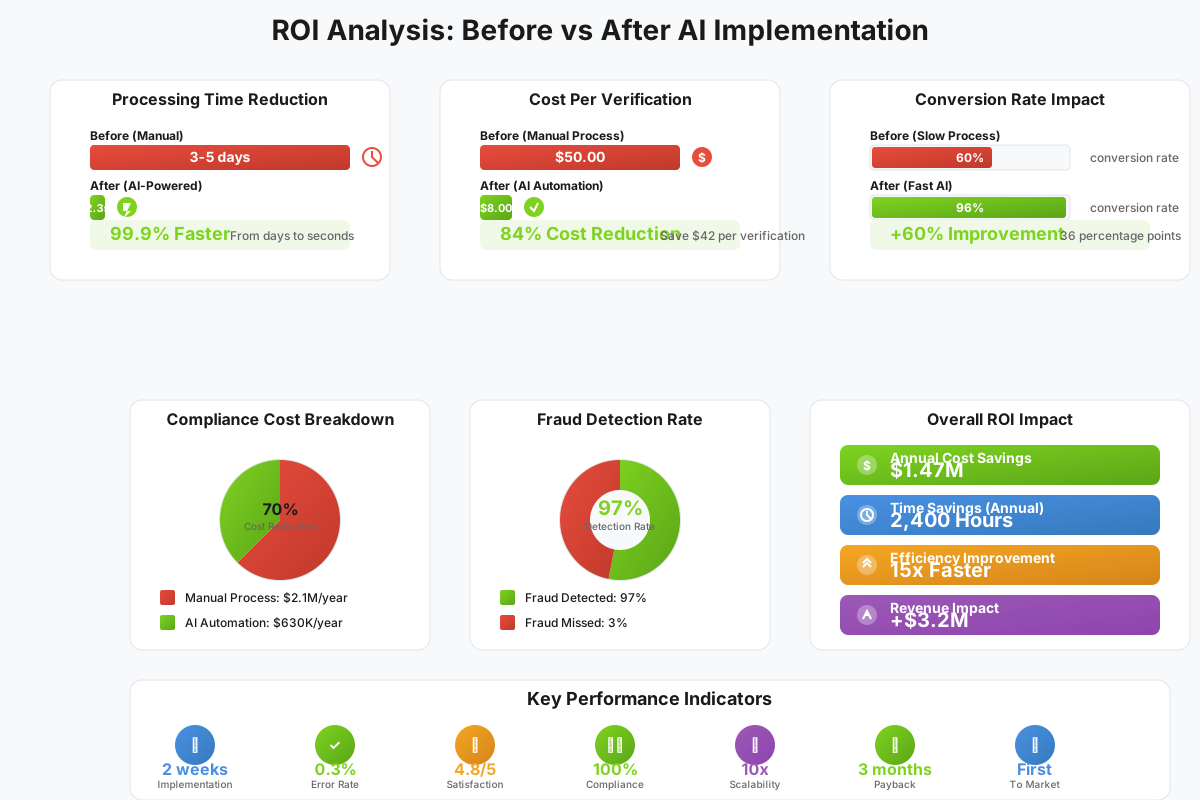
Operational efficiency improvements provide ongoing benefits that compound over time. Traditional verification processes require specialized staff who understand the regulatory and cultural nuances of each market. AI-powered systems reduce the need for this specialized knowledge, allowing organizations to scale internationally with smaller, more flexible teams. The technology also eliminates many manual handoffs and review processes that create delays and introduce human error.
Time-to-market acceleration represents a crucial competitive advantage in fast-moving digital markets. Organizations using AI-powered verification can typically enter new markets 50-75% faster than those relying on traditional approaches. This speed advantage allows first-mover benefits in emerging markets and faster response to competitive threats. For venture-backed companies, faster international expansion can significantly impact valuation and funding opportunities.
Customer satisfaction improvements create long-term competitive advantages that are difficult to quantify but crucial for sustainable growth. Verification processes that respect cultural differences and local preferences while maintaining security create positive first impressions that influence customer lifetime value. Organizations implementing locally-adapted verification typically see 20-30% improvements in customer satisfaction scores related to onboarding experiences.
Scalability benefits become more apparent as organizations grow. Traditional verification approaches require linear increases in staff and infrastructure for each new market. AI-powered systems achieve economies of scale that allow organizations to handle exponentially increasing verification volumes with minimal additional resources. This scalability advantage becomes crucial during rapid growth periods or when expanding into multiple markets simultaneously.
Data quality improvements provide ongoing operational benefits that extend far beyond verification processes. AI-powered verification captures higher quality customer data with fewer errors and inconsistencies, improving downstream processes like customer service, marketing personalization, and risk management. Better data quality reduces customer service costs, improves marketing effectiveness, and enables more sophisticated analytics and decision-making.
The technology also provides strategic advantages in market positioning and competitive differentiation. Organizations that can offer seamless, culturally-appropriate verification experiences gain significant advantages in customer acquisition and retention. These advantages are particularly pronounced in markets where competitors rely on legacy verification processes that create friction for local customers.
The trajectory of cross-border identity verification technology points toward increasingly sophisticated, automated, and user-centric systems that will fundamentally reshape how global businesses approach customer onboarding and ongoing relationship management. Several converging trends are accelerating this transformation, creating opportunities for organizations that adopt advanced verification technologies and challenges for those that don't.
Perpetual KYC represents perhaps the most significant shift in verification thinking, moving away from point-in-time verification toward continuous monitoring and dynamic risk assessment. This approach recognizes that customer risk profiles change over time and that static verification snapshots become outdated quickly. AI-powered systems enable perpetual KYC by continuously analyzing customer behavior, transaction patterns, and external data sources to maintain current risk assessments. This approach not only improves security but also reduces the burden on customers by eliminating repetitive verification requirements.
The integration of blockchain technology with AI-powered verification creates new possibilities for secure, privacy-preserving identity networks that work across borders. Blockchain provides a tamper-proof foundation for storing verification decisions and sharing appropriate information across organizations while maintaining user privacy and control. Combined with AI analysis capabilities, blockchain-based identity systems can enable verified identity portability, allowing users to prove their identity once and use those credentials across multiple services and jurisdictions.
Digital identity wallets are emerging as a user-centric approach to identity management that gives individuals control over their personal information while enabling efficient verification processes. These wallets store verified credentials that users can selectively share with organizations that need identity verification. AI-powered verification systems can analyze these credentials in real-time, determining their authenticity and relevance while respecting user privacy preferences. This approach reduces verification friction while improving security and giving users greater control over their personal data.
Biometric technology continues advancing rapidly, with new modalities like behavioral biometrics and voice recognition becoming mainstream. AI systems are becoming increasingly sophisticated at combining multiple biometric indicators to create robust identity verification that works across different technological environments and cultural contexts. The technology is also improving at detecting synthetic and manipulated biometric data, addressing the growing threat of deepfakes and other AI-generated fraudulent content.
Regulatory harmonization efforts are slowly reducing some of the complexity in cross-border verification, but they're also creating new requirements for organizations to meet. The European Union's digital wallet initiative and similar programs in other regions are creating new standards for digital identity verification that AI systems must accommodate. Organizations need verification technologies that can adapt quickly to changing regulatory landscapes while maintaining compliance across multiple jurisdictions.
Privacy-enhancing technologies are becoming increasingly important as regulations around personal data handling become more stringent globally. AI-powered verification systems are incorporating techniques like homomorphic encryption, secure multi-party computation, and differential privacy to enable verification without exposing unnecessary personal information. These technologies allow organizations to verify identities and assess risks while meeting the strictest privacy requirements.
Real-time regulatory intelligence represents an emerging capability that allows verification systems to automatically adapt to changing compliance requirements. AI systems can monitor regulatory developments across multiple jurisdictions and automatically update verification workflows to maintain compliance. This capability becomes increasingly important as the pace of regulatory change accelerates and the complexity of global compliance requirements continues growing.
The integration of Internet of Things devices and environmental intelligence into verification processes creates new possibilities for contextual identity verification. AI systems can analyze device characteristics, network information, and environmental factors to enhance verification accuracy while reducing friction for legitimate users. This approach is particularly valuable for remote verification scenarios where traditional document-based verification might be challenging.
Machine learning advances continue improving the accuracy and efficiency of verification processes while reducing bias and false positives. New techniques in natural language processing enable better analysis of documents in multiple languages, while computer vision advances improve the accuracy of document authentication and biometric verification. These improvements make verification more accurate and accessible across different populations and technological environments.
The emergence of decentralized identity protocols creates new opportunities for user-controlled identity verification that works across organizational and national boundaries. These protocols enable verification without requiring centralized authorities or extensive data sharing, addressing privacy concerns while enabling efficient cross-border verification. AI systems can participate in these decentralized networks while maintaining the intelligence and adaptability that make automated verification effective.
As these technologies mature and converge, the organizations that will thrive in the global digital economy are those that embrace AI-powered verification technologies today. The competitive advantages of seamless, intelligent verification processes will only increase as customer expectations rise and regulatory requirements become more complex. The future belongs to organizations that can verify identities securely and efficiently across any border, in any regulatory environment, while providing experiences that feel local and personal to every user.
The transformation of cross-border identity verification represents more than just a technological upgrade. It represents a fundamental shift toward truly global digital commerce where geographic borders don't create artificial barriers to legitimate business relationships. AI-powered verification technologies are the key to unlocking this future, enabling businesses to operate globally while maintaining the security, compliance, and user experience standards that modern markets demand.
Organizations implementing these technologies today are not just improving their current operations but positioning themselves for a future where seamless global verification becomes a competitive necessity rather than a differentiating advantage. The question is not whether to adopt AI-powered cross-border verification, but how quickly organizations can implement these capabilities and begin realizing their transformative benefits.

Head IT Operations - Co Founder of Artificio
See it in your SAP environment
Bring us a document, a process, or a bottleneck. We'll show how Artificio captures, validates, and posts into SAP — then scale from there.
Security & compliance
ISO 27001:2013 certified, SOC 2 Type 2 compliant, GDPR and HIPAA ready. Every agent action is logged, auditable, and runs in isolated environments.