

Blog
AI Automation: End $1.2M Manual PDF Waste & Drive ROI
Manual PDF workflows cost enterprises $1.2M annually in labor, errors & delays. Discover how AI automation stops the bleeding and drives rapid ROI.

Blog
Manual PDF workflows cost enterprises $1.2M annually in labor, errors & delays. Discover how AI automation stops the bleeding and drives rapid ROI.
Your finance team just spent three hours reformatting client proposals. Your HR department lost another qualified candidate because onboarding documents took too long to process. Meanwhile, your legal team is manually reviewing hundreds of contracts, each one a potential compliance landmine. If this sounds familiar, you're not alone. What you might not realize is that these seemingly minor inefficiencies are adding up to a staggering $1.2 million annual drain on your enterprise.
The numbers don't lie. The average enterprise wastes approximately 15,000 hours per year on manual PDF-related tasks like contract generation, data entry, document formatting, and version control. At an average loaded cost of $80 per hour for knowledge workers, that translates to $1.2 million in preventable losses annually. But the real cost goes far beyond labor hours. When you factor in errors, delays, missed opportunities, and the hidden technical debt of maintaining legacy document workflows, the true financial impact becomes even more alarming.
This isn't just about efficiency anymore. It's about survival in an increasingly competitive marketplace where speed, accuracy, and cost control can make or break your bottom line. Companies that continue to rely on manual PDF processes aren't just losing money, they're losing ground to competitors who've embraced intelligent automation. The question isn't whether you can afford to automate, it's whether you can afford not to.
Every minute your skilled professionals spend on document formatting, data entry, and manual PDF manipulation is a minute stolen from strategic, revenue-generating activities. Consider the typical enterprise scenario: your business development team spends 2.5 hours per week creating custom proposals, your HR team dedicates 4 hours weekly to processing onboarding paperwork, and your finance department burns 6 hours weekly on invoice generation and processing.
These aren't isolated incidents happening in a vacuum. Multiply these hours across your entire organization, factor in the fully-loaded cost of your employees (salary, benefits, overhead), and the numbers become staggering. A mid-sized company with 500 employees typically has at least 150 knowledge workers regularly handling PDF-intensive tasks. If each of these workers spends just 2 hours per week on manual document processes, that's 300 hours weekly, or 15,600 hours annually. At $80 per hour, you're looking at $1.25 million in direct labor costs alone.
But here's where it gets worse. These aren't entry-level employees performing these tasks. Your senior analysts, project managers, and department heads are the ones getting bogged down in document drudgery. When your $120,000-per-year business analyst spends 20% of their time reformatting spreadsheets into PDF reports, you're paying $24,000 annually for work that could be automated. Scale this across multiple high-value employees, and the opportunity cost becomes astronomical.
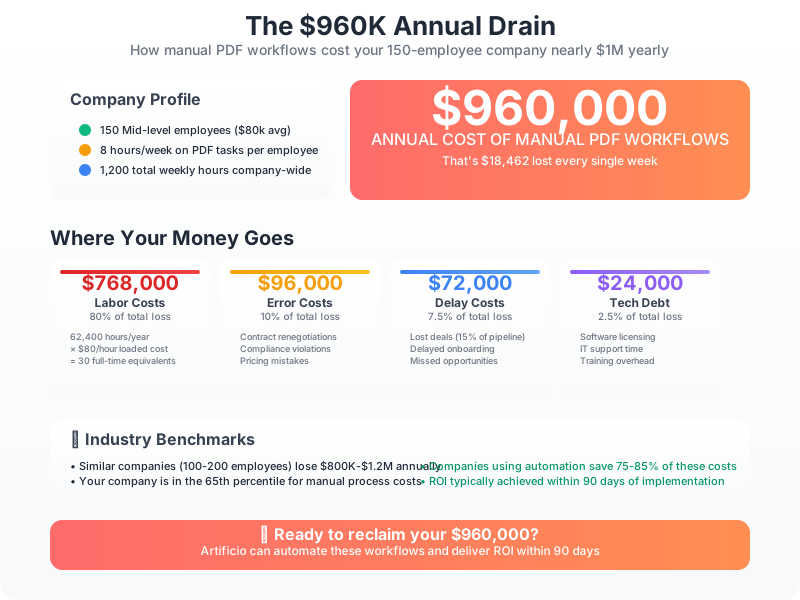
Manual processes don't just waste time, they generate costly errors that ripple through your entire organization. Every typo in a contract, every miscalculated figure in a proposal, every compliance oversight in a regulatory document represents a potential financial disaster waiting to happen. The healthcare industry learned this lesson the hard way, with manual HIPAA documentation errors resulting in an average of $50,000 in fines per violation.
Consider the cascading effect of a single error in a client proposal. Your sales team sends out a pricing document with incorrect figures due to manual transcription errors. The client accepts the proposal based on the lower price, but your company is now contractually obligated to deliver services at a loss. You've not only lost the profit margin on that deal, but you've also damaged the client relationship and potentially exposed your company to legal liability. Industry research shows that document errors lead to contract renegotiations in 23% of cases, with an average cost of $47,000 per renegotiation.
The financial services sector faces even higher stakes. A single error in loan documentation can result in regulatory violations, delayed closings, and potential legal action. One major bank reported that manual document processing errors cost them an average of $12,000 per loan file in remediation costs, not including the reputational damage and potential regulatory fines. When you're processing hundreds or thousands of loan applications monthly, these costs add up quickly.
Quality control becomes another hidden expense. Many organizations attempt to mitigate error risk by implementing multiple review cycles, but this approach doubles or triples the time investment without eliminating the underlying problem. You're essentially paying multiple people to catch mistakes that wouldn't exist in an automated system. It's like hiring more proofreaders instead of using spell-check.
In today's business environment, speed kills, and slow document processes are the silent assassins of revenue opportunities. Every day your proposal sits in a formatting queue is another day your competitor can swoop in with a faster response. Sales teams report losing an average of 15% of potential deals due to slow proposal generation, with each lost deal representing an average value of $85,000 in the B2B space.
The impact extends far beyond individual sales cycles. Your entire customer experience suffers when manual processes create bottlenecks. New client onboarding that should take days stretches into weeks because HR paperwork requires multiple manual touchpoints. Customer service requests that could be resolved immediately instead require "2-3 business days for document processing." These delays don't just frustrate customers, they drive them to competitors who can move faster.
Consider the compound effect on your sales pipeline. If your team can typically close 20 deals per quarter, but slow document processes cause you to lose 3 of those deals, you're not just losing the immediate revenue. You're losing the lifetime value of those customer relationships, the potential for upsells and renewals, and the referral opportunities that come from satisfied clients. In the software industry, where customer lifetime value can exceed $100,000, losing just a few deals to process delays can cost millions over time.
The opportunity cost extends to internal productivity as well. When your teams are constantly waiting for documents to be processed, reviewed, and approved, entire projects get delayed. Product launches get pushed back, marketing campaigns get postponed, and strategic initiatives lose momentum. The hidden cost of these delays often exceeds the direct cost of the manual labor involved.
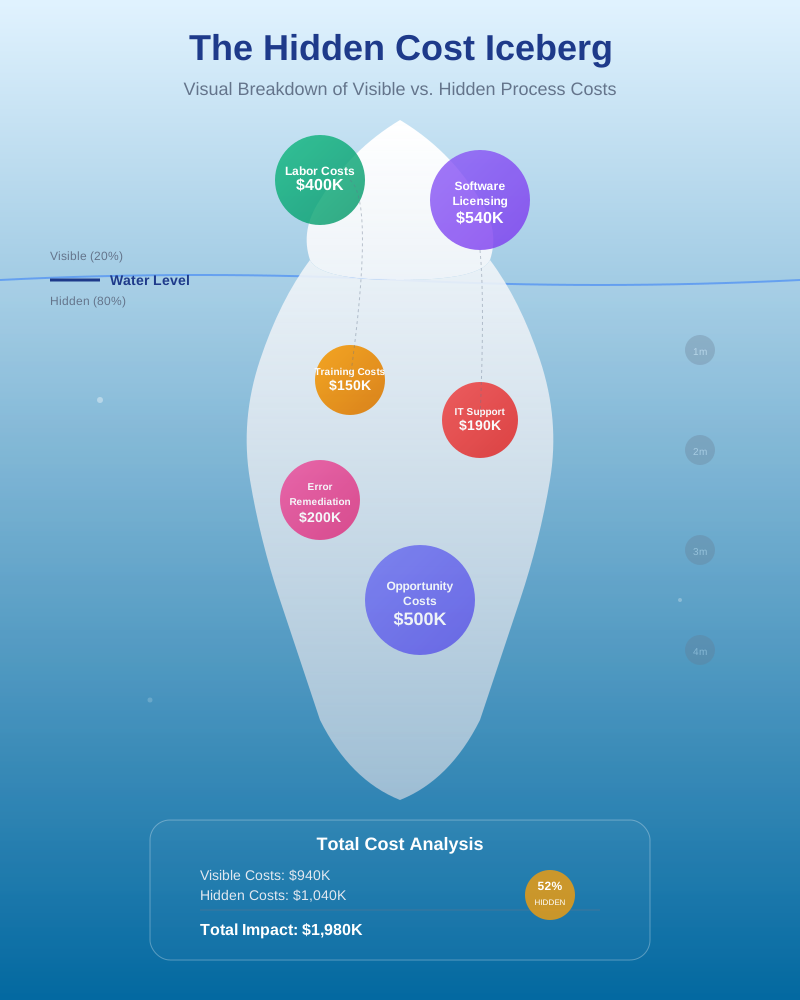
While labor costs and error-related losses are visible, technical debt from legacy document systems represents a hidden but significant financial drain. Most enterprises are running a patchwork of document tools: Adobe Acrobat for PDF editing, Microsoft Office for creation, various form builders for data collection, and multiple approval workflows that don't integrate with each other. Each of these systems requires licensing, maintenance, training, and IT support.
The annual software licensing costs alone can reach six figures for large organizations. Adobe Acrobat DC runs approximately $23 per user per month, Microsoft Office adds another $35 per user monthly, and specialized document management systems can cost $50-100 per user monthly. For an organization with 500 knowledge workers, you're looking at $540,000 annually just for basic document software licensing, before factoring in the enterprise features and integrations you actually need.
But licensing is just the tip of the iceberg. IT departments spend countless hours supporting these disparate systems, troubleshooting integration issues, managing user access, and trying to maintain security across multiple platforms. The average enterprise IT team dedicates 15-20% of their time to document-related support issues. For a team of 10 IT professionals earning $95,000 annually, that represents $142,500-$190,000 in annual support costs.
Artificio transforms your document workflows from cost centers into competitive advantages through intelligent automation that pays for itself within 90 days. Unlike traditional document tools that simply digitize manual processes, Artificio's AI-driven platform eliminates the underlying inefficiencies that drain your resources.
The immediate labor savings are substantial and measurable. Tasks that previously required 2-3 hours of manual work can be completed in minutes with Artificio's smart templates and automated data population. A typical enterprise implementing Artificio across their organization sees a 75-85% reduction in document-related labor hours within the first quarter. Using our earlier example of 15,600 annual hours at $80 per hour, this translates to $936,000-$1,056,000 in reclaimed labor costs annually.
But the real transformation happens when you redirect that reclaimed time toward revenue-generating activities. Your business development team can pursue 40% more opportunities when they're not bogged down in proposal formatting. Your analysts can focus on insights instead of report compilation. Your project managers can manage more initiatives instead of chasing document approvals. The productivity multiplier effect often generates returns that exceed the direct cost savings by 2-3x.
Consider the experience of TechFlow Solutions, a mid-market consulting firm that implemented Artificio across their proposal generation process. Previously, creating a comprehensive client proposal required 8-10 hours of work from multiple team members, including business analysts, graphic designers, and senior consultants. With Artificio's intelligent templates and automated data integration, the same proposal now takes 45 minutes to complete, with 95% fewer errors and significantly better visual consistency. The time savings allowed them to pursue 60% more opportunities per quarter, resulting in $2.3 million in additional revenue within the first year.
Artificio's AI validation and compliance checking capabilities serve as your first line of defense against costly errors and regulatory violations. The platform's intelligent review system catches inconsistencies, validates calculations, and ensures compliance with industry standards before documents ever leave your organization. This proactive approach eliminates the reactive costs of error remediation and the potential catastrophic costs of regulatory violations.
The financial protection is particularly valuable in highly regulated industries. Healthcare organizations using Artificio report a 92% reduction in HIPAA-related documentation errors, while financial services firms see similar improvements in regulatory compliance documentation. When you consider that a single HIPAA violation can cost $50,000 and a financial services compliance violation can reach $100,000 or more, the risk mitigation value alone often justifies the entire Artificio investment.
Beyond regulatory compliance, Artificio's validation capabilities prevent the cascading costs of business errors. Automated calculations eliminate pricing mistakes in proposals, intelligent data validation prevents contract inconsistencies, and standardized templates ensure brand consistency across all external communications. The reputational protection and relationship preservation value of error-free documentation often exceeds the direct cost savings from eliminated rework.
The speed advantages of Artificio automation translate directly into competitive advantages and revenue growth. Documents that previously required days or weeks to complete can now be generated in hours or minutes, allowing your organization to respond to opportunities faster than competitors still relying on manual processes.
Sales cycle acceleration represents one of the most significant revenue drivers. When your team can deliver proposals in 24 hours instead of a week, you're not just impressing prospects, you're capturing opportunities before competitors even submit their bids. Industry data shows that first-mover advantage in B2B sales increases close rates by 15-25%, and Artificio users consistently report being the first to market with complete, professional proposals.
The compound effect on pipeline velocity creates a sustainable competitive advantage. Faster document processes enable shorter sales cycles, which increase deal volume and revenue per sales rep. Higher close rates from first-mover advantage improve overall sales efficiency. Better document quality and consistency enhance brand perception and client confidence. These advantages build on each other to create a virtuous cycle of improved performance and increased profitability.
The journey toward document automation ROI begins with identifying your highest-impact opportunities. Rather than attempting to automate everything at once, successful Artificio implementations focus on the processes that generate the most immediate financial returns. Start by conducting a thorough audit of your current document workflows, measuring both the direct costs and hidden inefficiencies in each process.
High-impact areas typically include repetitive, high-volume processes where errors carry significant consequences. HR onboarding paperwork represents an ideal starting point for most organizations because it combines substantial labor investment with regulatory compliance requirements and direct impact on employee experience. The average enterprise spends 12-15 hours processing each new hire's documentation, and errors can result in payroll delays, compliance violations, and negative first impressions that affect retention.
Sales proposal generation offers another high-return opportunity, particularly for B2B organizations with complex service offerings. The combination of time pressure, customization requirements, and revenue impact makes proposal automation a natural quick win. Organizations typically see immediate improvements in response times, proposal quality, and sales team productivity, with measurable revenue impact within the first quarter.
Begin your implementation by selecting 2-3 pilot processes that represent different types of document workflows. This approach allows you to validate Artificio's capabilities across various use cases while building internal momentum and expertise. Document your baseline metrics carefully, including time investment, error rates, and associated costs. These measurements will become crucial for demonstrating ROI and securing buy-in for broader implementation.
Once your pilot processes demonstrate clear value, the focus shifts to integration with existing systems and scaling across additional workflows. Artificio's API-first architecture enables seamless integration with enterprise systems including SAP, Oracle, Salesforce, and Microsoft Office 365. This integration capability is crucial for realizing the full ROI potential because it eliminates the data silos and manual handoffs that create inefficiencies.
The integration phase requires careful planning to ensure data flows smoothly between systems without disrupting existing workflows. Work closely with your IT team to map data sources, establish security protocols, and create backup procedures. Most enterprises find that investing in proper integration architecture during this phase prevents costly rework and performance issues later.
Scaling across additional processes should follow a prioritized approach based on potential impact and implementation complexity. Focus on standardizing templates and workflows that can serve multiple departments or use cases. The goal is to create reusable assets that multiply your investment return while minimizing ongoing maintenance requirements.
Training and change management become critical success factors during the scaling phase. Develop a comprehensive training program that covers both technical skills and process changes. Most successful implementations include train-the-trainer programs that create internal champions who can support ongoing adoption and troubleshoot issues without external assistance.
The optimization phase focuses on maximizing ROI through advanced automation features and continuous process improvement. By this point, your organization has accumulated significant data about document workflows, user behavior, and performance metrics. Use this information to identify additional automation opportunities and fine-tune existing processes.
Advanced Artificio features like machine learning-powered content suggestions, predictive analytics for process optimization, and intelligent workflow routing can generate substantial additional value. These features become more effective as they learn from your organization's specific patterns and requirements, creating a continuous improvement cycle that increases ROI over time.
Consider expanding automation into adjacent processes that weren't included in your initial implementation. Contract management, regulatory reporting, and customer communications often become natural extensions once core document workflows are optimized. The infrastructure and expertise developed during earlier phases make these expansions more efficient and cost-effective.
Measure and communicate ROI achievements throughout the optimization phase. Document not just the direct cost savings, but also the strategic advantages like improved customer satisfaction, reduced risk exposure, and enhanced competitive positioning. These broader benefits often justify additional investment in advanced features and expanded implementation scope.
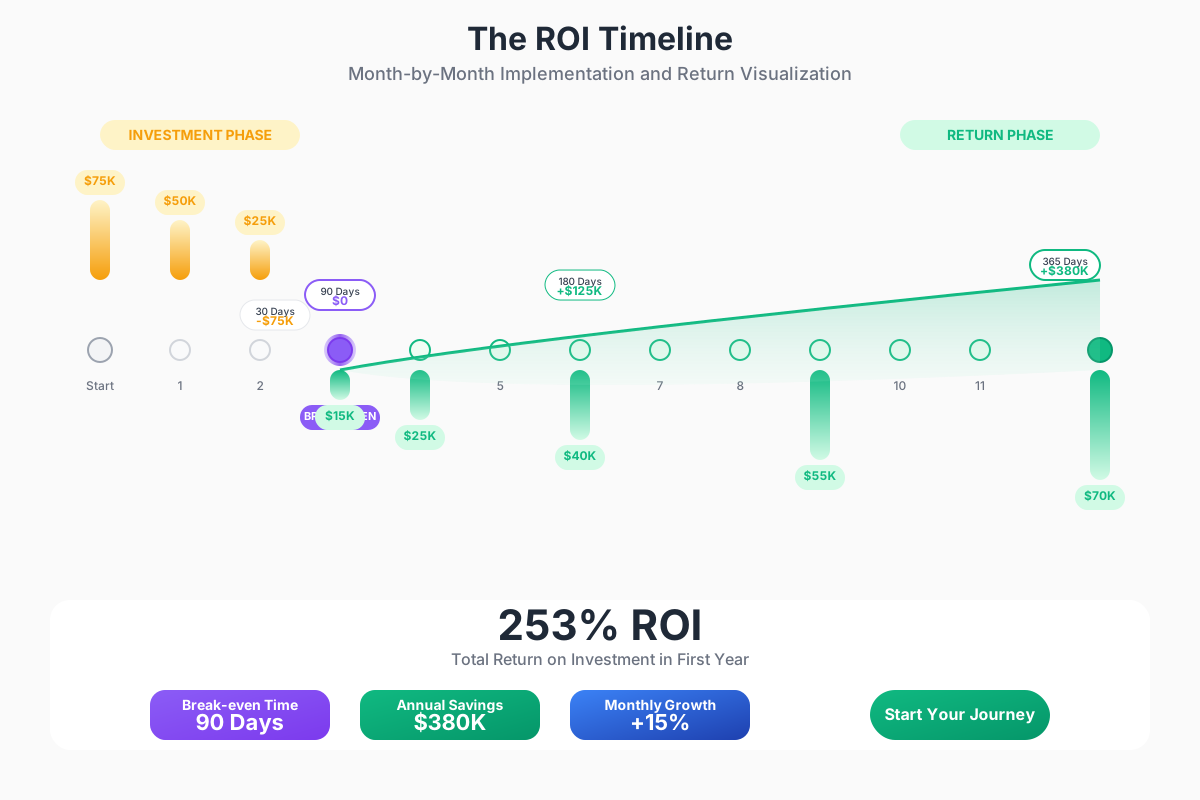
Artificio's ROI model is built on the principle that automation investments should pay for themselves quickly while generating compound returns over time. The typical enterprise implementation costs between $50,000-$150,000 annually, depending on organization size and complexity. However, the combination of direct labor savings, error reduction, and productivity improvements consistently generates returns that exceed this investment within 90 days.
The calculation is straightforward when you break it down by component. Direct labor savings alone typically justify 60-70% of the annual investment cost. If your organization currently spends $1.2 million on manual document processes and Artificio reduces that by 80%, you're saving $960,000 annually. Even accounting for implementation costs and learning curves, the net first-year savings exceed $800,000 for most mid-sized enterprises.
Error reduction and risk mitigation provide additional financial benefits that often equal or exceed the direct labor savings. When you eliminate just one major compliance violation per year, the cost avoidance can reach $50,000-$100,000. Preventing proposal errors that lead to contract renegotiations saves an additional $40,000-$60,000 annually. These risk mitigation benefits compound over time as your organization builds a reputation for accuracy and reliability.
The revenue acceleration benefits represent the largest long-term ROI component, though they're often the most difficult to measure precisely. Faster sales cycles, improved close rates, and enhanced customer satisfaction drive revenue growth that can exceed the cost savings by 3-5x. Organizations with strong measurement systems consistently report revenue impacts of $2-5 million within the first year of full implementation.
The true value of document automation extends far beyond the immediate cost recovery period. Organizations that successfully implement Artificio create sustainable competitive advantages that compound over time. The speed and accuracy advantages become more pronounced as competitors struggle with legacy manual processes. The data insights generated by automated workflows enable better decision-making and strategic planning.
Cultural transformation represents another significant long-term benefit. When your teams are freed from document drudgery, they can focus on higher-value activities that drive innovation and growth. Employee satisfaction improves, turnover decreases, and your organization becomes more attractive to top talent who want to work on meaningful challenges rather than administrative tasks.
The platform learning effect creates increasing returns over time. As Artificio's AI systems learn your organization's specific patterns and requirements, automation becomes more intelligent and effective. Templates become more accurate, processes become more streamlined, and the platform begins suggesting optimizations that your team might not have considered. This continuous improvement cycle means that your ROI actually accelerates in years two and three.
While the benefits of automation are compelling, the risks of maintaining the status quo are equally important to consider. Every month you delay implementation is another month of accumulating inefficiencies and lost opportunities. Your competitors who implement automation first gain advantages that become increasingly difficult to overcome.
The compound effect of delayed automation is particularly pronounced in competitive markets. While you're still manually processing proposals, your automated competitors are capturing market share with faster response times and more competitive pricing enabled by lower operational costs. The revenue gap widens each quarter, making it progressively more expensive to regain competitive position.
Technology debt also accumulates over time, making eventual automation more complex and costly. Legacy systems become more entrenched, workarounds multiply, and resistance to change increases. Organizations that delay automation often find that their eventual implementation costs are 40-60% higher than early adopters who faced less complexity.
The human cost of delayed automation shouldn't be underestimated either. Top performers become frustrated with inefficient processes and may leave for organizations that provide better tools and workflows. The combination of turnover costs and lost productivity from departed employees can easily exceed the cost of implementing automation.
The financial case for document automation is clear, but successful implementation requires decisive action and strong execution. Start by conducting a comprehensive audit of your current document processes, measuring both direct costs and hidden inefficiencies. Use this baseline to calculate your potential ROI and build the business case for investment.
Engage stakeholders across your organization to ensure broad support for the transformation. Include IT, finance, and end-user departments in planning discussions to address concerns and build enthusiasm for the change. The most successful implementations have strong executive sponsorship and clear communication about expected benefits and timelines.
Don't let perfect be the enemy of good when planning your implementation. While comprehensive automation is the ultimate goal, you can achieve significant ROI by starting with high-impact processes and expanding over time. The key is to begin the journey and maintain momentum toward full transformation.
The choice is clear: continue bleeding $1.2 million annually through manual inefficiencies, or invest in automation that pays for itself within 90 days and generates millions in ongoing value. Your competitors are making this decision right now. The question is whether you'll lead the transformation or play catch-up from behind.
The era of manual document processes is ending. Organizations that recognize this reality and act decisively will thrive in the automated future. Those that cling to legacy workflows will find themselves increasingly unable to compete on speed, cost, or quality. The time for action is now. Your bottom line depends on it.

Head IT Operations - Co Founder of Artificio
See it in your SAP environment
Bring us a document, a process, or a bottleneck. We'll show how Artificio captures, validates, and posts into SAP — then scale from there.
Security & compliance
ISO 27001:2013 certified, SOC 2 Type 2 compliant, GDPR and HIPAA ready. Every agent action is logged, auditable, and runs in isolated environments.