

Blog
From PDFs to Profits: Intelligent Document Automation
Discover how enterprises are breaking free from static PDFs, unlocking business intelligence with AI-powered document agents, and transforming workflows.

Blog
Discover how enterprises are breaking free from static PDFs, unlocking business intelligence with AI-powered document agents, and transforming workflows.
How enterprises are breaking free from the trillion-dollar PDF prison and unleashing intelligent agent economies
Right now, buried deep in your company's servers, lies a sleeping giant. Millions of PDFs, Word documents, and scanned files containing decades of business intelligence, customer insights, and operational wisdom all locked away in static, unsearchable formats. These aren't just files; they're the fossilized remains of countless human decisions, negotiations, and transactions that could reshape how your business operates tomorrow.
The numbers are staggering: the average enterprise manages over 2.5 million documents, with 90% of them being unstructured data trapped in legacy formats. That's not just inefficiency it's a trillion-dollar opportunity waiting to be unlocked by AI. But here's where it gets interesting. We're not just talking about digitizing old papers anymore. We're witnessing the birth of intelligent document ecosystems where every PDF becomes a living, breathing participant in your business workflows. Welcome to the age of document consciousness.
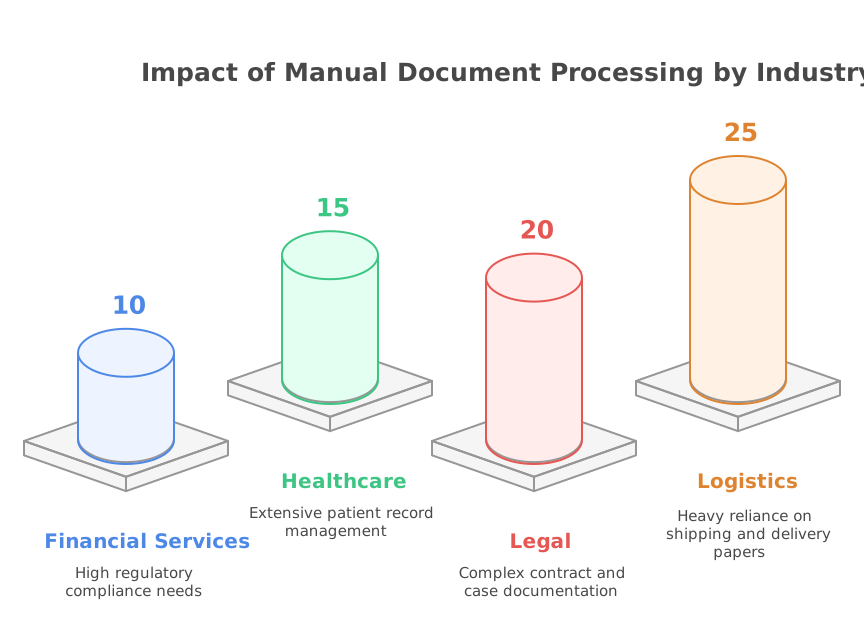
Every day, knowledge workers across industries perform the same soul-crushing ritual: opening PDFs, manually extracting information, copying data into spreadsheets, and hoping they didn't make a mistake. This isn't just inefficient it's a systematic destruction of human potential. The economic impact of this manual labor extends far beyond the obvious productivity losses. When financial services organizations dedicate 60% of their loan officers' time to manually extracting data from application documents, the cascading effects include delayed approvals, reduced customer satisfaction, and increased operational risk. Healthcare systems face similar challenges, where insurance claims processing takes an average of 30 days due to manual document review, directly affecting patient care quality and organizational cash flow dynamics.
The legal industry presents perhaps the most stark example of this inefficiency, where contract analysis requires between 15 and 20 hours per document, with error rates reaching 23% in manual data extraction processes. These errors don't just represent lost time; they create legal vulnerabilities, compliance risks, and financial exposures that can persist for years. In the logistics sector, customs documentation processing creates systematic delays averaging 48 hours at international borders, contributing to a global economic impact estimated at $2.6 trillion annually. These delays ripple through supply chains, affecting everything from consumer prices to international trade relationships.
But the hidden cost goes deeper than immediate operational inefficiencies. Every manual process creates knowledge silos that prevent organizations from leveraging their accumulated intelligence. That contract from three years ago contains pricing insights that could inform current negotiations. The customer complaint from last quarter reveals patterns that could prevent future service failures. The insurance claim from six months ago contains risk indicators that could reshape underwriting policies. All of this valuable intelligence remains locked away, inaccessible to the AI systems that could transform business decision-making processes.
Legacy documents don't just slow down operations they create regulatory nightmares that extend far beyond simple inefficiency. When regulatory auditors initiate investigations, organizations must mobilize teams of professionals to manually search through thousands of files, often working under tight deadlines and intense pressure. This manual search process is inherently unreliable, with studies showing that even experienced professionals miss critical information in 15-20% of document reviews. The consequences of these oversights can be catastrophic, leading to regulatory fines that often exceed millions of dollars, not to mention the reputational damage and ongoing compliance monitoring that follows.
The challenge becomes even more complex in multinational organizations that must comply with varying regulatory frameworks across different jurisdictions. A single document might need to satisfy compliance requirements in multiple countries, each with its own specific standards and reporting requirements. Manual compliance checking in such environments is not just inefficient it's practically impossible to execute with the precision and consistency that modern regulatory environments demand.
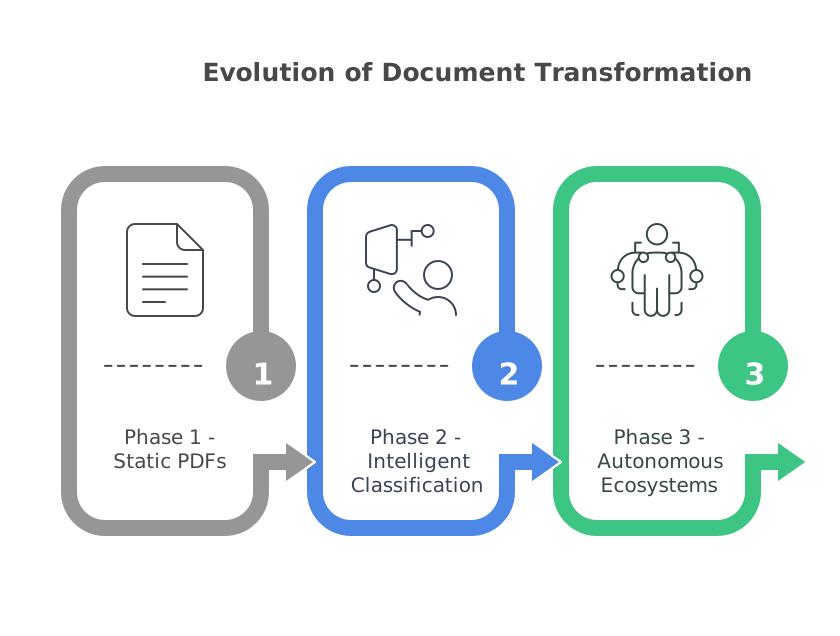
The transformation begins when we stop thinking about documents as static repositories of information and start treating them as intelligent entities capable of understanding context, maintaining relationships, and actively participating in business processes. This shift represents a fundamental paradigm change from traditional document management approaches, which focused primarily on storage and retrieval, to dynamic document intelligence systems that can interpret meaning, anticipate needs, and execute complex business logic autonomously.
Modern AI document processing transcends the limitations of traditional Optical Character Recognition by incorporating sophisticated natural language processing, computer vision, and machine learning capabilities that can understand not just what a document says, but what it means in the context of specific business operations. These systems can distinguish between subtle variations in document types, such as identifying the difference between a purchase order and a purchase requisition, while simultaneously understanding the business implications of each distinction. They can recognize patterns of urgency in communications, identify potential fraud indicators in financial documents, and understand the hierarchical relationships that exist between different organizational documents.
The intelligence extends beyond simple pattern recognition to encompass predictive capabilities that can anticipate future needs based on historical document patterns. For instance, when processing loan applications, these systems can predict approval likelihood based on subtle patterns in applicant documentation that might not be immediately apparent to human reviewers. In insurance contexts, they can identify emerging risk patterns across thousands of claims documents, enabling proactive policy adjustments before significant losses occur. Contract analysis systems can suggest optimal pricing strategies based on historical negotiation patterns and market conditions reflected in previous agreements.
The evolution toward document agent economies represents perhaps the most revolutionary aspect of this transformation. In this emerging paradigm, processed documents become intelligent agents capable of autonomous operation within complex business ecosystems. These agent-documents can validate their own accuracy against established business rules, automatically routing themselves to appropriate stakeholders based on content analysis and organizational hierarchies. They can proactively alert relevant parties when conditions change or deadlines approach, and most remarkably, they can collaborate with other document agents to solve complex business problems that span multiple information sources.
Consider the implications of contracts that can negotiate renewal terms automatically by analyzing market conditions, performance metrics, and stakeholder preferences. Imagine invoices that reconcile themselves with purchase orders, automatically resolving discrepancies through systematic analysis of historical patterns and approved exception criteria. Picture compliance documents that update themselves in response to regulatory changes, ensuring continuous adherence to evolving legal requirements without human intervention. This isn't speculative technology it's the inevitable evolution of document processing systems as they incorporate increasingly sophisticated AI capabilities.
The economic implications of these agent economies extend far beyond simple automation. When documents can operate as intelligent agents, they create new forms of value that were previously impossible to achieve. They can identify optimization opportunities across organizational boundaries, suggest strategic initiatives based on pattern analysis across vast document archives, and facilitate entirely new forms of collaboration between human workers and AI systems. The productivity gains from these capabilities don't just represent incremental improvements they enable entirely new business models and competitive strategies.
The journey toward intelligent document processing begins with awakening dormant documents from their static state and imbuing them with contextual awareness and processing capabilities. This initial phase involves deploying sophisticated classification systems that utilize multi-modal AI approaches, combining natural language processing with computer vision to understand not just textual content but also visual layouts, graphical elements, and structural relationships within documents. These systems must learn to interpret documents within specific business contexts, understanding that the same piece of information might have different meanings and implications depending on the industry, organizational structure, and regulatory environment in which it appears.
The classification process extends beyond simple categorization to include confidence scoring mechanisms that can identify edge cases requiring human validation while maintaining high throughput for routine document processing. This human-in-the-loop approach ensures accuracy while building organizational confidence in the AI system's capabilities. The development of deep content understanding capabilities involves implementing Named Entity Recognition systems that go far beyond simple keyword identification to understand relationships between entities, temporal contexts, and business implications of extracted information.
Quality assurance and validation mechanisms form the foundation of reliable document consciousness, incorporating automated accuracy checking against established business rules, anomaly detection systems that can identify potential errors or fraudulent content, and cross-reference validation capabilities that verify information consistency across multiple data sources. These validation systems must be designed to learn from organizational patterns and preferences, becoming more accurate and efficient over time as they process increasing volumes of documents.
Once documents achieve consciousness and intelligence, they must be integrated into existing business processes in ways that enhance rather than disrupt established workflows. This integration phase requires the development of real-time processing pipelines capable of handling continuous document ingestion while maintaining the responsiveness that modern business operations demand. These pipelines must be designed with scalability in mind, able to process single documents in seconds while simultaneously handling bulk uploads of thousands of files without degradation in performance or accuracy.
The automated routing capabilities that emerge from this integration represent a fundamental shift in how organizations handle information flow. Rather than relying on manual distribution processes that are prone to errors and delays, intelligent document systems can analyze content, determine appropriate recipients based on organizational hierarchies and business rules, and ensure that critical information reaches decision-makers with optimal timing. This routing intelligence extends to priority assessment, ensuring that urgent communications receive immediate attention while routine documents flow through standard processing channels.
Integration with existing enterprise systems requires sophisticated API development and data mapping capabilities that can accommodate the diverse technology stacks found in modern organizations. Customer Relationship Management systems, Enterprise Resource Planning platforms, and specialized industry applications must all be able to consume and contribute to the intelligent document processing workflow. This integration must be designed to work bidirectionally, allowing document intelligence to inform these systems while simultaneously drawing context and validation data from existing organizational databases.
The ultimate transformation creates living document ecosystems where individual documents become components of larger intelligent systems capable of generating insights, making predictions, and executing complex business strategies autonomously. These ecosystems incorporate sophisticated analytics capabilities that can identify patterns across vast archives of historical documents, revealing trends and insights that would be impossible for human analysts to detect through manual review processes. The predictive capabilities that emerge from these ecosystems enable organizations to anticipate market changes, identify emerging risks, and optimize operational strategies based on comprehensive analysis of their accumulated knowledge assets.
Conversational interfaces represent a crucial component of these intelligent ecosystems, enabling natural language interaction with document archives through sophisticated query processing and response generation systems. These interfaces must be capable of understanding complex queries that span multiple document types and time periods, synthesizing information from diverse sources to provide comprehensive answers to business questions. The integration of these conversational capabilities with popular communication platforms such as messaging applications and email systems ensures that document intelligence remains accessible and actionable within existing workflow patterns.
The continuous learning capabilities built into these ecosystems ensure that document processing accuracy and functionality improve over time through systematic analysis of user feedback, error patterns, and changing business requirements. These learning systems must be designed to adapt to evolving organizational needs while maintaining the security and compliance standards that regulated industries require. The knowledge transfer capabilities between similar document types and organizational contexts enable rapid deployment of successful processing strategies across different business units and operational scenarios.
A major international insurance provider was struggling with document processing inefficiencies that were undermining their competitive position and customer satisfaction metrics. Their claims processing workflow represented a textbook example of the inefficiencies created by legacy document management approaches. The initial three days of each claim cycle were devoted to manual document sorting and classification, a process that required experienced claims adjusters to review each submission individually, determining document types and routing them to appropriate processing queues. This manual sorting process was not only time-consuming but also prone to errors, with misclassified documents often causing significant delays later in the process.
The data extraction and validation phase, spanning days four through ten of the typical claims cycle, involved teams of specialists manually transcribing information from various document formats into standardized claim processing systems. This transcription process was inherently error-prone, with studies showing that manual data entry achieved accuracy rates of only 77%, meaning that nearly a quarter of all claims contained errors that required additional review and correction. The cross-referencing phase, extending from day eleven to day twenty, required claims processors to manually verify submitted information against policy databases and medical records, a process that was both time-intensive and subject to human oversight errors.
Fraud detection and risk assessment processes consumed days twenty-one through twenty-five of the claims cycle, relying on manual review by experienced investigators who applied subjective judgment criteria that varied significantly between individual reviewers. This inconsistency in fraud detection not only created potential legal vulnerabilities but also resulted in legitimate claims being unnecessarily delayed while fraudulent claims occasionally passed through undetected. The final approval and payment processing phase, spanning days twenty-six through thirty, involved multiple manual authorization steps and quality control reviews that added additional delays without meaningfully improving processing accuracy.
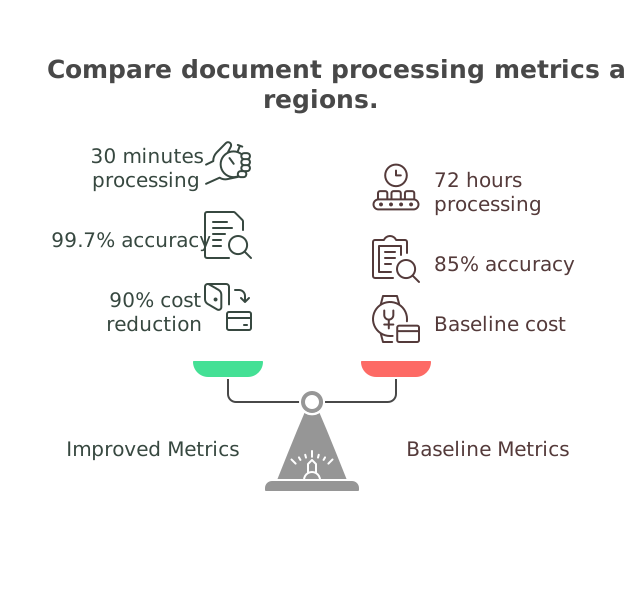
The implementation of intelligent document processing transformed this month-long ordeal into a streamlined two-hour process that maintained higher accuracy standards while dramatically improving customer satisfaction metrics. The AI-powered document ingestion and classification system could process incoming claims documents in under five minutes, automatically identifying document types, extracting relevant metadata, and routing materials to appropriate processing workflows. This automated classification achieved accuracy rates exceeding 99.7%, virtually eliminating the misrouting errors that had previously caused significant downstream delays.
Automated data extraction processes, completing their work within thirty minutes of initial document ingestion, utilized sophisticated natural language processing and computer vision capabilities to extract relevant information from diverse document formats while maintaining accuracy standards that exceeded human performance by significant margins. The real-time policy verification and medical record cross-referencing capabilities, operating within the thirty-to-sixty-minute timeframe, could simultaneously verify information across multiple databases while identifying potential discrepancies or missing information that required additional attention.
The AI-powered fraud detection and risk scoring systems, operating within the sixty-to-ninety-minute processing window, analyzed patterns across vast databases of historical claims while applying sophisticated machine learning algorithms that could identify subtle indicators of potentially fraudulent activity. These systems achieved fraud detection rates that exceeded human performance while dramatically reducing the number of legitimate claims subjected to unnecessary additional scrutiny. The final automated approval and intelligent escalation processes, completing their work within the ninety-to-one-hundred-twenty-minute timeframe, could make approval decisions for routine claims while escalating complex cases to human reviewers with comprehensive analysis and recommendations.
The transformation extended beyond simple efficiency improvements to encompass entirely new capabilities that had been impossible under the previous manual processing regime. The AI system began identifying patterns in claims data that human reviewers had missed, leading to a 15% reduction in fraudulent claims payouts through improved detection capabilities. More significantly, the system's ability to analyze patterns across thousands of claims enabled proactive policy adjustments based on emerging risk patterns, fundamentally changing how the organization approached risk management and pricing strategies.
In our interconnected global economy, documents rarely respect linguistic or cultural boundaries, creating complex challenges for organizations operating across multiple markets and regulatory jurisdictions. A single supply chain transaction might involve contracts drafted in English, invoices generated in Spanish, compliance documentation prepared in German, and shipping manifests completed in Mandarin Chinese. Traditional document processing systems create bottlenecks at every language boundary, requiring expensive human translation services and introducing delays that can cascade through entire operational workflows.
The multilingual challenge extends beyond simple translation to encompass cultural context, legal terminology, and regulatory compliance requirements that vary significantly between different jurisdictions. When financial institutions process loan applications from international customers, they must navigate not only language differences but also varying documentation standards, cultural approaches to financial disclosure, and regulatory requirements that differ between countries. The cost of maintaining multilingual document processing capabilities through traditional approaches often exceeds the practical capabilities of all but the largest multinational organizations.
Modern AI document processing systems address these challenges through sophisticated multilingual natural language processing capabilities that can simultaneously process documents in over one hundred languages while maintaining cultural and legal context across different linguistic frameworks. These systems utilize advanced neural network architectures trained on vast multilingual datasets, enabling them to understand not just literal translations but also cultural nuances and legal implications that vary between different linguistic and regulatory contexts. The real-time translation capabilities incorporate business context and industry-specific terminology, ensuring that translated documents maintain their original meaning and legal validity across different jurisdictions.
A major international shipping corporation provides an illustrative example of how cross-language document processing can transform global operations. Prior to implementing AI-powered multilingual document processing, the organization processed approximately 50,000 shipping documents daily across 80 countries, with average processing times of 72 hours per shipment due to language barriers and manual translation requirements. The error rate of 15% caused by language miscommunication created significant operational challenges, including customs delays, incorrect routing, and customer satisfaction issues that affected the organization's competitive position in international markets.
The annual cost of maintaining human translation services exceeded $2.3 million, representing a significant operational expense that provided limited scalability as the organization expanded into new markets. Frequent customs delays caused by documentation errors created cascading effects throughout the supply chain, affecting delivery schedules and customer relationships while generating additional costs through expedited shipping requirements and penalty payments to affected customers.
Following the implementation of cross-language AI document processing systems, the organization achieved remarkable improvements across all operational metrics. Average processing times decreased from 72 hours to 30 minutes per shipment, while error rates dropped from 15% to 0.3% through automated validation and quality control processes. The translation cost reduction of 90% enabled the organization to reinvest resources in expanding market coverage and improving customer service capabilities. Perhaps most significantly, the 95% reduction in customs delays eliminated a major source of customer dissatisfaction while improving the reliability and predictability of international shipping operations.
The emergence of AI agent marketplaces represents a fundamental democratization of document intelligence capabilities, enabling organizations of all sizes to access sophisticated processing capabilities without the enormous investments traditionally required to develop custom AI solutions. These marketplaces function as digital ecosystems where specialized document processing agents can be discovered, evaluated, and deployed based on specific organizational needs and industry requirements. Rather than building comprehensive document processing systems from scratch, organizations can browse curated collections of specialized agents designed for specific document types, industries, or processing requirements.
Contract analysis agents represent one of the most sophisticated categories within these marketplaces, offering capabilities that have been trained on millions of legal documents across different jurisdictions and practice areas. These agents understand not just the literal content of contracts but also the legal implications, risk factors, and negotiation strategies that experienced legal professionals would recognize. Compliance agents provide another crucial category, maintaining current awareness of regulatory changes across different industries and jurisdictions while automatically updating their processing capabilities to reflect evolving legal requirements.
Financial document processing agents incorporate built-in fraud detection capabilities developed through analysis of vast datasets of legitimate and fraudulent financial transactions. These agents can identify subtle patterns and anomalies that might indicate fraudulent activity while maintaining the processing speed and accuracy that modern financial operations require. Medical record processing agents incorporate healthcare-specific knowledge and regulatory compliance requirements, ensuring that patient privacy and data security standards are maintained throughout the processing workflow.
The customization capabilities offered by these agent marketplaces enable organizations to fine-tune existing agents for specific use cases, upload sample documents to train custom processing capabilities, and combine multiple agents to create complex workflows that address unique operational requirements. Successful agent configurations can be shared with the broader community, creating collaborative development environments where organizations can benefit from the innovations and improvements developed by their peers.
The democratization of document intelligence through agent marketplaces creates new economic opportunities and competitive dynamics that extend far beyond traditional technology adoption patterns. For enterprises, these marketplaces provide access to cutting-edge AI capabilities without the massive capital investments and specialized expertise traditionally required to develop custom solutions. Pay-per-use pricing models enable organizations to scale their document processing capabilities dynamically, paying only for the capacity they actually utilize while avoiding the fixed costs associated with maintaining dedicated infrastructure.
For software developers and AI specialists, these marketplaces create entirely new revenue streams through the development and licensing of specialized document processing agents. Successful agents can generate ongoing revenue through usage-based licensing while creating opportunities for developers to build expertise in specific industries or document types. The competitive dynamics within these marketplaces drive continuous innovation and improvement, as developers compete to create the most accurate, efficient, and user-friendly processing capabilities.
The standardization effects created by these marketplaces benefit entire industries by establishing common processing capabilities and quality standards that enable improved interoperability between organizations. When multiple companies within an industry utilize similar document processing agents, it becomes easier to standardize business processes, share information, and collaborate on complex projects that span organizational boundaries. The societal benefits include reduced barriers to automation adoption, enabling smaller organizations to compete more effectively with larger enterprises while increasing overall economic productivity through improved document processing efficiency.
The foundation of any successful document intelligence implementation requires a comprehensive understanding of the existing document landscape within the organization, including the types, volumes, and processing requirements of different document categories. This assessment process must extend beyond simple document counting to encompass detailed analysis of current workflows, identification of bottlenecks and inefficiencies, and evaluation of the business impact associated with different document processing scenarios. Organizations must catalog not only the obvious document types such as contracts, invoices, and reports, but also the less visible documents that consume significant processing resources, such as email attachments, form submissions, and regulatory filings.
The workflow mapping component of this assessment requires detailed documentation of how documents currently flow through the organization, identifying all stakeholders involved in processing, approval, and storage activities. This mapping process often reveals hidden inefficiencies and redundancies that have developed over time, providing opportunities for process improvement that extend beyond simple automation. Understanding the regulatory and compliance requirements associated with different document types ensures that any intelligence implementation will maintain necessary security and audit capabilities while improving processing efficiency.
Technology readiness assessment involves evaluating existing infrastructure capabilities, identifying integration points with current systems, and determining the extent to which data quality and standardization improvements might be necessary to support intelligent document processing. This assessment must consider not only technical capabilities but also organizational readiness for change, including the availability of staff resources for training and implementation support, management commitment to transformation initiatives, and the cultural factors that might influence adoption success.
The strategic implementation of document intelligence capabilities requires a phased approach that builds organizational confidence and expertise while delivering measurable value at each stage of the transformation process. The initial phase should focus on identifying and implementing quick wins that demonstrate clear value while building internal expertise and stakeholder buy-in for more comprehensive transformation initiatives. This approach typically involves selecting high-volume, low-complexity document processing scenarios where automated processing can deliver immediate productivity improvements without requiring significant changes to existing business processes.
The selection of initial implementation targets should consider not only technical feasibility but also organizational impact and visibility factors that will help build momentum for broader transformation initiatives. Invoice processing often represents an ideal starting point because it involves high volumes of standardized documents, clear success metrics, and immediate cost savings that can be easily measured and communicated to stakeholders. Contract analysis projects, while more complex, can deliver significant value in organizations where legal review processes create bottlenecks for business development and operational activities.
Workflow integration activities must be carefully planned to minimize disruption to existing business processes while maximizing the value delivered by intelligent document processing capabilities. This integration requires close collaboration between technical implementation teams and business process owners to ensure that new capabilities enhance rather than complicate existing workflows. The development of business rule engines and validation frameworks ensures that automated processing maintains the quality and accuracy standards that organizations require while reducing the manual oversight traditionally needed for document processing activities.
The evolution toward intelligence amplification involves implementing predictive analytics capabilities that can identify patterns and trends across historical document archives, enabling organizations to make more informed strategic decisions based on comprehensive analysis of their accumulated knowledge assets. Conversational interfaces and intelligent dashboards provide accessible ways for business users to interact with document intelligence systems, ensuring that sophisticated AI capabilities remain usable and actionable for non-technical stakeholders.
The trajectory toward fully autonomous document ecosystems represents the logical evolution of current document intelligence capabilities, incorporating advanced AI technologies that will enable documents to operate as independent agents within complex business environments. These autonomous systems will be capable of proactive behavior that anticipates business needs and executes appropriate responses without human intervention. Contracts will evolve beyond static legal documents to become dynamic agreements that can renegotiate terms automatically based on performance metrics, market conditions, and changing business requirements.
Invoice processing systems will develop sophisticated dispute resolution capabilities, automatically identifying and resolving discrepancies through analysis of historical patterns and approved exception criteria. Compliance documentation will maintain continuous currency with regulatory changes, automatically updating content and procedures to reflect evolving legal requirements while maintaining audit trails that demonstrate ongoing compliance adherence. The predictive capabilities inherent in these systems will enable them to generate business intelligence reports automatically, identifying trends and patterns that inform strategic decision-making processes.
The seamless integration of human expertise with AI capabilities will create collaborative workflows where artificial intelligence handles routine processing and analysis while escalating complex decisions to human experts with comprehensive context and recommendations. These human-AI collaboration models will enable organizations to leverage the best aspects of both human judgment and artificial intelligence processing power, creating decision-making processes that are both efficient and nuanced.
Organizations that successfully implement intelligent document processing capabilities will develop significant competitive advantages that extend far beyond simple operational efficiency improvements. The 10x improvement in processing speed combined with higher accuracy rates enables these organizations to respond more quickly to market opportunities while reducing the risk of errors that could damage customer relationships or create compliance vulnerabilities. Cost reductions of 60-80% in document-related processes free up resources that can be reinvested in strategic initiatives, product development, or customer service improvements.
Risk mitigation capabilities provided by intelligent document processing systems enable proactive identification and prevention of issues that could otherwise create significant business disruptions. The ability to analyze patterns across vast document archives provides insights that inform strategic planning processes, enabling organizations to anticipate market changes and adjust their strategies accordingly. Customer experience improvements resulting from faster, more accurate service delivery create competitive advantages that are difficult for competitors to replicate without similar technological capabilities.
The data-driven insights generated by intelligent document processing systems enable organizations to optimize their operations continuously, identifying opportunities for improvement that might not be apparent through traditional analysis methods. These capabilities create virtuous cycles of improvement where better data leads to better decisions, which in turn generate better outcomes and more valuable data for future analysis.
The transformation from static document management to intelligent document ecosystems requires careful planning and strategic implementation, but the competitive advantages available to early adopters make this transition both urgent and essential for long-term organizational success. The selection of appropriate pilot projects represents the most critical initial decision, requiring careful consideration of factors including business impact, technical complexity, stakeholder visibility, and measurable success criteria. Invoice processing projects often provide ideal starting points because they involve high volumes of standardized documents with clear success metrics and immediate cost savings that can be easily measured and communicated.
Contract analysis initiatives, while more complex, can deliver transformational value in organizations where legal review processes create bottlenecks for business development activities. Compliance documentation projects provide opportunities to reduce regulatory risk while improving operational efficiency, creating value propositions that appeal to both operational and executive stakeholders. Customer onboarding process automation can improve customer experience metrics while reducing operational costs, creating competitive advantages that directly impact revenue generation capabilities.
The selection of technology partners requires careful evaluation of capabilities including end-to-end solution completeness, industry-specific expertise, compliance and security standards, and scalability to support growing organizational needs. The most successful implementations involve partners who understand both the technical requirements and the business context of document processing transformation, enabling them to provide guidance and support throughout the implementation process.
Change management preparation ensures that organizations can successfully adopt new capabilities while maintaining operational continuity and stakeholder confidence. Staff training programs must address not only technical system usage but also the process changes and new responsibilities that result from intelligent document processing implementation. The establishment of new performance metrics and feedback loops enables continuous improvement and optimization of document processing capabilities over time.
The future belongs to organizations that can successfully leverage their accumulated knowledge assets through intelligent document processing capabilities. The question is not whether this transformation will occur, but whether your organization will be positioned to benefit from the competitive advantages that intelligent document processing provides. The time to begin this transformation is now, while the technology is mature enough to deliver reliable results but early enough in the adoption cycle to provide significant competitive differentiation.

Head IT Operations - Co Founder of Artificio
See it in your SAP environment
Bring us a document, a process, or a bottleneck. We'll show how Artificio captures, validates, and posts into SAP — then scale from there.
Security & compliance
ISO 27001:2013 certified, SOC 2 Type 2 compliant, GDPR and HIPAA ready. Every agent action is logged, auditable, and runs in isolated environments.