

Blog
AI Context Amnesia: Stateful Document Intelligence Remembers
AI forgets what it reads in documents, costing millions. Learn how stateful intelligence solves context amnesia for 85%+ straight-through processing.

Blog
AI forgets what it reads in documents, costing millions. Learn how stateful intelligence solves context amnesia for 85%+ straight-through processing.
You upload a 50-page contract to your document AI system. The system extracts the vendor name, "Acme Industries," on page 3 with perfect accuracy. Your team feels confident. The AI moves through the document, pulling out dates, payment terms, and deliverables. Everything seems to be working. Then, on page 47, when "Acme Industries" appears again in a termination clause, something bizarre happens. The system flags it as an unknown entity. It asks for clarification. It treats this vendor name like it's seeing it for the first time.
This isn't a bug. This isn't a glitch in your specific tool. This is exactly how most document AI systems work today. They process documents like someone with severe short-term memory loss, treating each page, each section, each data point as a completely isolated event with no connection to what came before.
Welcome to the Document Context Amnesia Problem, and it's costing enterprises millions in errors, rework, and lost productivity every single day.
Most organizations don't realize they have this problem until it's too late. The symptoms are subtle at first. A contract gets flagged for manual review because the AI can't reconcile party names that appear in different formats across the document. An invoice processing system extracts line items correctly but fails to connect them to the purchase order referenced on page one. A loan application moves through the system with vendor information that contradicts earlier sections, and nobody catches it until the deal is about to close.
These aren't rare edge cases. A recent study of enterprise document processing workflows found that context loss contributes to 41% of all document processing errors that require human intervention. That's not extraction failures or OCR mistakes. These are errors that happen precisely because the AI system can't remember what it processed five minutes ago, let alone maintain a coherent understanding across a multi-page document.
The financial impact is staggering. Companies processing 10,000 documents monthly with context-related errors face an average of $340,000 in annual rework costs alone. That doesn't include the downstream impacts like delayed transactions, compliance violations from inconsistent data capture, or the opportunity cost of employees spending 30% of their time fixing what should have been automated.
But here's what makes this crisis particularly insidious. When you ask your document AI vendor about accuracy rates, they'll show you impressive numbers. "99.2% extraction accuracy!" they'll proclaim. And they're technically telling the truth. Their system can read text with remarkable precision. What they're not telling you is that reading text and understanding documents are completely different things. A system can extract every single word perfectly and still have no idea what any of it means in relation to the rest of the document.
Think about how a junior employee might process a complex contract on their first day. They can read every word. They can type information into fields. But without context, without understanding how different sections relate to each other, without remembering what they saw on page 12 when they get to page 38, they're going to make mistakes. They'll input contradictory information. They'll miss critical connections. They'll need constant supervision. That's exactly what's happening with stateless document AI, except we've automated the problem and scaled it across millions of documents.
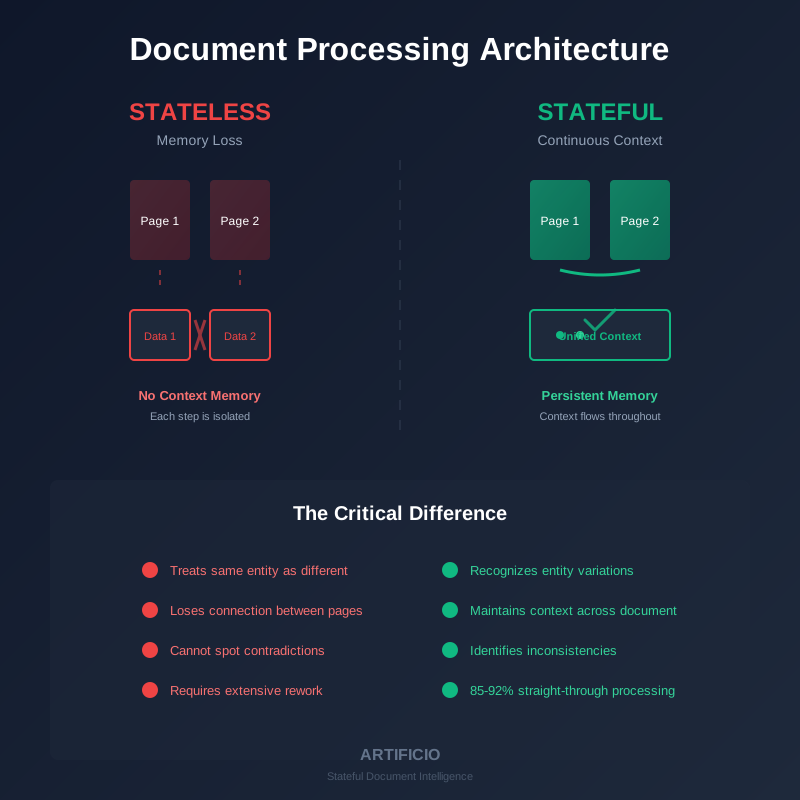
To understand why AI forgets, we need to look at how traditional document processing systems actually work. Most enterprise document AI follows what's called a "stateless" architecture. Each processing step is completely independent. The system extracts data from page 1, saves it, and moves on. When it gets to page 2, it starts fresh with no memory of page 1. It's like having a team where nobody talks to each other and nobody takes notes.
This architecture made sense in the early days of document automation. Traditional rule-based systems and even first-generation OCR tools were designed to process documents sequentially, one element at a time. Extract a field, validate it against a rule, move to the next field. The systems were fast and efficient for simple, highly structured documents where context didn't matter. An invoice with clearly labeled fields doesn't need the system to remember anything. Each data point stands alone.
But modern enterprise documents aren't simple forms. They're complex, interconnected information structures where understanding depends entirely on context. A merger agreement might reference the purchase price in three different ways across 80 pages. A loan application connects applicant information to employment history to financial statements to collateral descriptions. Insurance claims link policy details to incident reports to medical records to coverage determinations. You can't process these documents correctly without maintaining context throughout the entire workflow.
Stateful document intelligence works differently. Instead of treating each processing step as isolated, a stateful system maintains a persistent understanding of the document as it moves through the workflow. When the AI extracts "Acme Industries" on page 3, it doesn't just save that data and forget it. It builds a contextual model. It knows that Acme Industries is the vendor. It knows what role that entity plays in the document. When Acme appears again on page 47, the system recognizes it, connects it to the earlier reference, and processes it consistently.
The difference is like comparing someone with amnesia to someone with a functioning memory. A person with amnesia might be able to answer individual questions accurately but can't maintain a conversation because they forget what was said two minutes ago. They can't build on previous information. They can't spot contradictions. They can't see patterns. A person with memory can do all of these things naturally because they maintain context.
Let's look at what actually happens when context amnesia hits enterprise workflows. These aren't hypothetical scenarios. These are real situations that play out thousands of times daily across organizations that rely on stateless document AI.
A Fortune 500 insurance company implemented what they thought was a cutting-edge claims processing system. The AI could extract information from medical records, accident reports, and policy documents with impressive accuracy. Individual field extraction worked beautifully. The problems started appearing when claims examiners noticed inconsistencies. The system would extract a patient name as "Robert J. Mitchell" from the hospital intake form and "Bob Mitchell" from the physician's notes. Instead of recognizing these as the same person, the stateless system treated them as potentially different individuals. Claims got flagged for fraud investigation. Processing times doubled. Customer satisfaction plummeted.
The insurance company's IT team initially blamed the problem on data quality. They created elaborate rules to handle name variations. They built lookup tables. They added preprocessing steps. Each fix helped slightly but introduced new problems. The fundamental issue remained. The system couldn't maintain context across related documents. It couldn't build a coherent understanding of who was involved in the claim. It processed each document in isolation and hoped the pieces would fit together later.
After two years of patches and workarounds, they finally admitted the architecture itself was the problem. They needed a system that could maintain context across the entire claim lifecycle, not just extract data from individual documents. The replacement cost $2.3 million. The two years of reduced efficiency and customer complaints? Harder to quantify but estimated at over $8 million in total impact.
A commercial lending institution faced a different manifestation of the same problem. Their loan origination system processed financial statements from borrowers automatically. The AI extracted balance sheet items, income statement figures, and cash flow data with high accuracy. But when loan officers reviewed the extracted data, they found nonsensical results. Assets that didn't match across quarters. Revenue figures that contradicted supporting documentation. Financial ratios that made no sense.
The root cause was context amnesia. The AI processed each financial statement independently. When a company provided quarterly statements, the system had no memory of Q1 when it processed Q2. When supporting schedules referenced items from the main financial statements, the AI couldn't make the connection. The system produced technically accurate extractions that were practically useless because nothing tied together coherently.
The lending institution tried fixing this with post-processing validation rules. They built complex reconciliation systems that attempted to connect extracted data after the fact. They hired additional staff to review AI outputs and manually correct inconsistencies. They slowed down their entire loan origination process to accommodate the AI's limitations. Their competitive advantage in fast loan processing evaporated.
A manufacturing company's procurement department offers another telling example. They automated purchase order and invoice matching with document AI. The system could read invoices perfectly. It extracted vendor names, amounts, line items, and dates with 99% accuracy. But matching those invoices to purchase orders became a nightmare. The AI would see "ABC Manufacturing Co." on a purchase order and "ABC Mfg" on an invoice and treat them as different vendors. It couldn't connect line item descriptions that used slightly different wording. It had no memory of previous transactions with the same vendor that would have made matching obvious.
The procurement team ended up doing manual matching for 60% of invoices despite having "automated" the process. They were paying for sophisticated AI that created more work than it eliminated. The ROI calculation that justified the investment assumed straight-through processing for at least 80% of documents. They achieved 40%. The project was labeled a failure even though the AI's extraction accuracy was excellent. Accuracy without context isn't intelligence.
What's particularly frustrating about these situations is that humans spot these connections instantly. When a person sees "Acme Industries" and "Acme Ind." in the same document, they know it's the same company. When someone reviews financial statements across quarters, they naturally maintain context about the business. When a procurement specialist processes an invoice, they remember the purchase order they approved last week. This isn't advanced reasoning. It's basic contextual awareness. But stateless AI systems can't do it because they're architecturally incapable of maintaining context across processing steps.
Once organizations recognize the context amnesia problem, they typically try to solve it within their existing architecture. The thinking goes like this: if the AI can't maintain context, we'll build systems around it to maintain context artificially. We'll add preprocessing steps to normalize entity names. We'll create matching algorithms to reconcile data after extraction. We'll build elaborate validation rules to catch inconsistencies. We'll hire people to review outputs and fix context-related errors.
These workarounds are expensive, brittle, and ultimately ineffective. They're trying to solve an architectural problem with procedural patches.
The first issue is that preprocessing normalization can't anticipate every variation. You can build rules to handle "Acme Industries" and "Acme Ind." and "Acme Industries Inc." But what about "ACME" in all caps? What about "Acme, LLC"? What about when the document uses "the Company" to refer to Acme throughout certain sections? You can't write rules for infinite variations. Language is too flexible. Documents are too diverse. You end up in an endless cycle of adding rules to handle new edge cases while creating new problems with each addition.
Post-processing reconciliation attempts to fix context problems after the fact by comparing extracted data and looking for connections. This approach fails for several reasons. First, you're trying to reconstruct context from disconnected data points. You're guessing at relationships rather than understanding them. Second, by the time you're reconciling data, you've already made extraction decisions based on missing context. You might have extracted the wrong information or missed critical connections that would have been obvious with context. Third, reconciliation adds latency and complexity to workflows that were supposed to be streamlined through automation.
Some organizations try solving context amnesia by passing metadata between processing steps. The AI extracts vendor information on page 3 and tags it in a way that later steps can reference. This helps at the margins but doesn't solve the fundamental problem. Metadata passing still treats the document as disconnected pieces. It doesn't create true contextual understanding. It's like giving someone notes about a conversation they don't remember rather than helping them actually remember the conversation.
The most common workaround is simply accepting that humans need to be in the loop for anything requiring contextual understanding. The AI handles the simple, repetitive extraction tasks while people manage anything that requires connecting information across the document. This defeats the entire purpose of automation. You're not eliminating manual work. You're just changing what manual work looks like. Instead of data entry, you're doing data reconciliation and correction. Often, this is actually more cognitively demanding and time-consuming than the original manual process.
These traditional solutions fail because they're fighting against the fundamental limitations of stateless architecture. You can't build context awareness on top of a system designed to forget. You can't add memory to a system architected to be memoryless. You can't create coherent understanding from disconnected processing steps.
The analogy to human cognition is instructive here. If someone has anterograde amnesia, you can try to help them function by giving them notes, creating routines, having other people remember things for them. But they'll never function at the level of someone with intact memory. The workarounds help but don't solve the underlying problem. Similarly, no amount of procedural workarounds can make a stateless system function like a stateful one. The architecture determines the capability.
The solution to context amnesia isn't better workarounds. It's fundamentally different architecture. This is where AI agents and stateful document intelligence change everything.
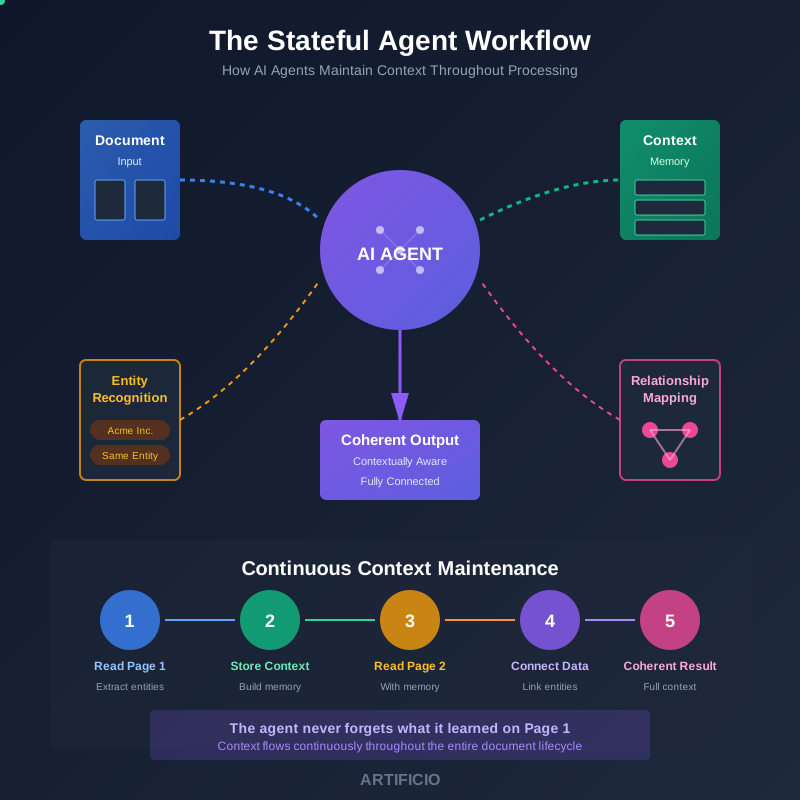
An AI agent-based system doesn't process documents step by step in isolation. Instead, it maintains a persistent cognitive model of the document throughout the entire workflow. When the agent encounters "Acme Industries" on page 3, it doesn't just extract that text and move on. It creates an entity in its understanding of the document. It knows Acme Industries is the vendor. It builds connections to other information about this entity. It carries this knowledge forward as it processes the rest of the document.
This is genuinely different from stateless processing with metadata tags. The agent isn't just referencing saved data points. It's maintaining an active, evolving understanding of what the document means. It's building a mental model of the business transaction, legal agreement, or financial situation represented in the document. It's thinking about the document the way a human would, not just reading it sequentially.
When that same agent encounters "Acme Ind." on page 47, it doesn't treat this as a new, unknown entity. It recognizes the connection to "Acme Industries" through contextual understanding. It might notice that "Acme Ind." appears in a section about termination clauses and connect that to payment terms associated with Acme earlier in the document. It can spot inconsistencies like different payment amounts for the same vendor in different sections. It maintains coherence throughout the document processing lifecycle.
The technical architecture enabling this is sophisticated but the concept is straightforward. Instead of processing documents through a pipeline of disconnected steps, agent-based systems maintain state throughout the entire workflow. State means the agent has memory. It remembers what it has seen, what it has learned, what connections it has made. This memory persists across pages, across documents in a workflow, even across different processing stages.
Agent-based systems can also reason about context in ways that stateless systems can't. If the agent sees contradictory information, it can recognize the contradiction and make intelligent decisions about how to handle it. If it encounters ambiguous references, it can use prior context to resolve the ambiguity. If it needs to classify a document type, it can use accumulated context rather than just looking at individual pages in isolation.
The difference in real-world performance is dramatic. That insurance company processing medical claims saw their fraud flag rate drop by 73% when they moved to agent-based processing. The system could maintain context across multiple documents in a single claim. It recognized when "Robert J. Mitchell," "Bob Mitchell," and "R. Mitchell" were all the same person. It connected medical treatments to accident descriptions to policy coverage in ways that made sense. Claims examiners went from spending 60% of their time resolving AI errors to spending 10% of their time handling genuine edge cases that required human judgment.
The commercial lender's financial statement processing went from 40% straight-through processing to 87% after implementing stateful document intelligence. The agent-based system could maintain context across quarterly statements. It connected supporting schedules to main financials automatically. It recognized when figures should reconcile and flagged genuine discrepancies rather than spurious variations. Loan officers went from skeptical of the AI to trusting it for initial analysis. Processing times dropped by 65% while accuracy improved.
The manufacturing company's invoice matching problem essentially disappeared with agent-based processing. The system maintained context about vendors, purchase orders, and historical transactions. It recognized vendor name variations instantly. It connected line items even when described differently on purchase orders and invoices. Manual matching dropped from 60% to 8%, and those 8% were genuine cases requiring human decision-making, not AI failures.
These improvements aren't incremental gains from better algorithms or training data. They're fundamental shifts in capability enabled by architectural change. Stateful processing makes previously impossible tasks routine.
When organizations evaluate document AI solutions, they focus heavily on extraction accuracy metrics. Can the system read text correctly? Can it identify fields? Can it handle various document formats? These metrics matter, but they miss the bigger picture. Extraction accuracy means nothing if the system can't maintain context to use that extracted data correctly.
The real business impact of stateful document intelligence shows up in metrics that traditional vendors don't want to talk about. Straight-through processing rates measure the percentage of documents that flow completely through your workflow without human intervention. With stateless systems, straight-through rates rarely exceed 60% for complex documents because context-related errors force manual review. With stateful agent-based systems, organizations routinely achieve 85-92% straight-through processing even for highly complex document types.
Exception handling costs provide another revealing metric. Stateless systems generate massive numbers of false exceptions. The AI flags potential issues that aren't real issues because it lacks context to understand what's happening. Each false exception requires human review, investigation, and resolution. This isn't just inefficient but demoralizing for workers who feel like they're constantly cleaning up after flawed automation. Agent-based systems generate 70-80% fewer false exceptions because they have the context to understand what's normal versus what genuinely requires attention.
Time to value is perhaps the most important metric. How long does it take from document arrival to actionable intelligence? Stateless systems might extract data quickly, but if that data requires extensive reconciliation, validation, and correction, the overall time to value is poor. Agent-based systems spend slightly more time on initial processing because they're building contextual understanding, but they eliminate most post-processing work. The net result is 40-60% faster time to value.
Data quality metrics tell an even more compelling story. Organizations using stateless document AI typically find that while extraction accuracy is high, data consistency across related documents is poor. Fields might be extracted correctly but refer to entities inconsistently. Relationships between data points are missed. Critical connections aren't made. This shows up as data quality issues downstream when people try to use the extracted information. Agent-based systems maintain consistency because they understand context. The data they produce isn't just accurate. It's coherent and actionable.
Customer satisfaction metrics reveal user-facing impacts. When document processing systems can't maintain context, customers notice. Loan applications take longer because of rework. Claims processing requires multiple rounds of clarification. Contract review cycles extend because of inconsistencies. Moving to stateful intelligence directly improves customer experience because workflows become smoother and faster. Organizations report 30-45% improvements in customer satisfaction scores for document-heavy processes after implementing agent-based systems.
ROI calculations shift dramatically when you account for these broader impacts. A stateless system might cost less upfront and show good accuracy metrics in vendor demos. But when you factor in exception handling costs, rework expenses, extended processing times, and lost productivity, the total cost of ownership is much higher than expected. Agent-based systems might have higher initial costs, but the elimination of context-related problems means they actually deliver on automation promises. Organizations typically see full ROI in 6-9 months versus 18-24 months for stateless solutions.
The strategic impact extends beyond cost savings. With stateful document intelligence, organizations can automate processes they previously considered too complex for automation. Multi-party contracts. Complex financial due diligence. Medical case reviews. Regulatory compliance workflows. These processes require maintaining context across multiple documents and understanding relationships between information scattered throughout massive document sets. Stateless systems can't handle this level of complexity reliably. Agent-based systems can, opening up entirely new categories of automation opportunity.
Understanding that agent-based stateful systems are architecturally superior is one thing. Actually deploying them is another. Organizations considering this shift need to understand what's involved in real implementation.
The first consideration is integration with existing systems. Most enterprises have substantial investments in document management platforms, business process automation tools, and line-of-business applications. A new document intelligence system needs to fit into this ecosystem. Agent-based platforms are typically designed with integration in mind because they're newer technologies built for modern enterprise architectures. They expose APIs, support standard protocols, and can plug into existing workflows relatively seamlessly. That said, any major system change requires integration work. Plan for 6-8 weeks of integration effort for typical enterprise deployments.
Change management presents a more significant challenge than technical integration. People are accustomed to working around the limitations of stateless systems. They've built entire processes around reviewing and correcting AI outputs. They've developed expertise in spotting and fixing context-related errors. When you introduce a system that doesn't need these workarounds, people's roles change. Some of that change is welcome - nobody enjoys doing rework. But some creates uncertainty. What will people do if the AI handles 90% of documents end-to-end? How do jobs and responsibilities shift?
Successful deployments address these concerns proactively. The goal isn't eliminating human involvement but elevating it. Instead of spending time on repetitive correction work, people focus on genuine exceptions, complex decisions, and process improvement. Instead of being quality checkers who fix AI mistakes, they become business analysts who use AI outputs to drive decisions. This reframing helps teams see the change as an upgrade rather than a threat. It requires clear communication, training on new workflows, and patience during the transition period.
Data considerations matter more with agent-based systems than with stateless ones. Stateful intelligence benefits from having access to historical context. If your system is processing invoices, it helps if the agent can reference past invoices from the same vendor. If you're processing contracts, previous agreements with similar parties provide valuable context. This doesn't mean you need massive training datasets. Agent-based systems using modern LLMs bring substantial general knowledge. But connecting them to your organization's document history enhances performance significantly.
Performance expectations need calibration. Agent-based systems don't magically solve every document processing problem instantly. They need time to learn your specific document types, terminology, and workflows. Early performance might not be dramatically better than your existing system. After processing thousands of documents and building contextual knowledge about your environment, performance improves substantially. Set realistic expectations for a learning curve of 30-60 days depending on document complexity and volume.
Security and compliance considerations are paramount when deploying AI systems that maintain state. If the agent remembers information across documents, how is that information secured? Who has access to the agent's contextual knowledge? How do you ensure sensitive information isn't leaked across security boundaries? Quality agent-based platforms include robust security models that isolate context appropriately, but organizations need to verify these controls meet their requirements. For regulated industries, you might need the ability to audit the agent's reasoning and understand how context influenced processing decisions.
Cost structure differs from traditional document AI licensing. Stateless systems typically charge per document processed or per API call. Agent-based systems might have more complex pricing because they're maintaining state and providing more sophisticated processing. Some vendors charge based on processing complexity rather than simple document counts. Others use capacity-based pricing. Understanding the total cost model, including compute resources required to maintain agent state, is important for accurate budgeting.
The technical skills required for managing agent-based systems are evolving. Traditional document AI required expertise in things like training OCR models and writing validation rules. Agent-based systems require different skills. You need people who understand how to work with LLMs, how to craft effective prompts for document understanding tasks, how to evaluate agent performance, and how to refine agent behavior through feedback. These skills overlap with but differ from traditional machine learning engineering. Organizations should plan for upskilling existing staff or bringing in expertise with modern AI agent architectures.
The document processing industry is at an inflection point. For years, we accepted that AI systems would have limitations. We built workarounds. We adjusted expectations. We created entire processes around compensating for AI's inability to maintain context. This was necessary when stateless architectures were the only option. But we're past that point now.
Agent-based stateful document intelligence isn't a future possibility. It's a present reality that leading organizations are already deploying at scale. The technology has matured beyond early experimental stages into production-ready systems handling millions of documents monthly. The question isn't whether this architecture is viable but whether organizations can afford to keep using systems with context amnesia when alternatives exist.
The competitive implications are significant. Companies still relying on stateless document processing are at a substantial disadvantage. They're slower. They have higher error rates. They require more manual intervention. They can't automate complex processes that competitors are handling routinely. This gap will only widen as agent-based systems continue improving while stateless systems hit fundamental architectural limitations.
For IT leaders evaluating document AI solutions, the message is clear. Don't get distracted by impressive-sounding accuracy metrics for extraction. Ask about context maintenance. Can the system remember information across pages? Can it build coherent understanding of multi-document workflows? Can it recognize when entities referenced different ways are actually the same? Can it maintain state throughout processing? If the answer to any of these questions is no, you're looking at a stateless system that will struggle with context amnesia, no matter how good the extraction accuracy might be.
For business leaders, understand that document processing is moving from back-office efficiency to strategic capability. Stateful intelligence enables automation of processes that previously required extensive human judgment. This isn't just about cost savings. It's about enabling new business models, faster transaction cycles, and better customer experiences. Organizations that deploy truly intelligent document processing gain significant competitive advantages.
The document context amnesia problem has plagued enterprise automation for too long. We've collectively spent billions on systems that forget what they read, then spent billions more trying to work around that limitation. The stateful revolution finally gives us what we actually need: AI that maintains context, builds understanding, and processes documents the way humans do, just faster and at scale. The question isn't whether to make this shift but how quickly you can get there before your competitors do.

Head IT Operations - Co Founder of Artificio
See it in your SAP environment
Bring us a document, a process, or a bottleneck. We'll show how Artificio captures, validates, and posts into SAP — then scale from there.
Security & compliance
ISO 27001:2013 certified, SOC 2 Type 2 compliant, GDPR and HIPAA ready. Every agent action is logged, auditable, and runs in isolated environments.