

Blog
The future of finance: AI revolutionizes AP/AR automation
Unlock efficiency in enterprise AP/AR. Learn how AI-powered automation tackles complex financial operations, reduces costs, and improves cash flow.

Blog
Unlock efficiency in enterprise AP/AR. Learn how AI-powered automation tackles complex financial operations, reduces costs, and improves cash flow.
In the modern business environment, enterprise organizations face an unprecedented challenge when it comes to managing their financial operations. The traditional methods of processing accounts payable and accounts receivable documents have become increasingly inadequate as companies scale their operations across multiple locations, manage hundreds of vendor relationships, and handle thousands of invoices monthly. What once worked for smaller organizations now creates significant operational bottlenecks that ripple through every aspect of business performance, from cash flow management to vendor relationship maintenance.
The complexity of modern financial document processing extends far beyond simple data entry tasks. Today's enterprises must navigate intricate approval workflows, maintain compliance with various regulatory standards, ensure accurate three-way matching between purchase orders, invoices, and receipts, and provide real-time visibility into financial operations across diverse geographic locations. These requirements have created a perfect storm of operational challenges that demand innovative technological solutions.
At Artificio, we've witnessed firsthand how these challenges impact organizations of all sizes. Through our extensive work with enterprise clients, we've identified the critical pain points that prevent companies from achieving optimal financial operations efficiency. More importantly, we've developed comprehensive solutions that address these challenges through intelligent automation, artificial intelligence, and strategic process optimization.
The landscape of enterprise financial operations has evolved dramatically over the past decade. Organizations that once managed relatively straightforward vendor relationships now find themselves coordinating complex supplier networks spanning multiple countries, currencies, and regulatory environments. This expansion has created a web of interconnected processes that, when managed manually, become increasingly prone to errors, delays, and inefficiencies.
Consider the typical invoice processing workflow in a large enterprise. A single invoice must pass through multiple departments for verification, approval, and processing. The purchasing department must confirm that the goods or services were ordered and received, the finance team must verify pricing and terms, and various levels of management must provide approval based on predetermined spending thresholds. Each step in this process represents a potential delay point, and when multiplied across hundreds or thousands of invoices monthly, these delays compound into significant operational inefficiencies.
The three-way matching process exemplifies these challenges perfectly. This critical financial control requires comparing purchase orders, invoices, and receiving documents to ensure accuracy and prevent fraud. When performed manually, this process is time-intensive and error-prone. Staff members must locate physical or digital documents across multiple systems, manually compare line items, identify discrepancies, and route exceptions for resolution. The cognitive load required for this type of detailed comparison work often leads to fatigue-induced errors, missed discrepancies, and inconsistent application of business rules.
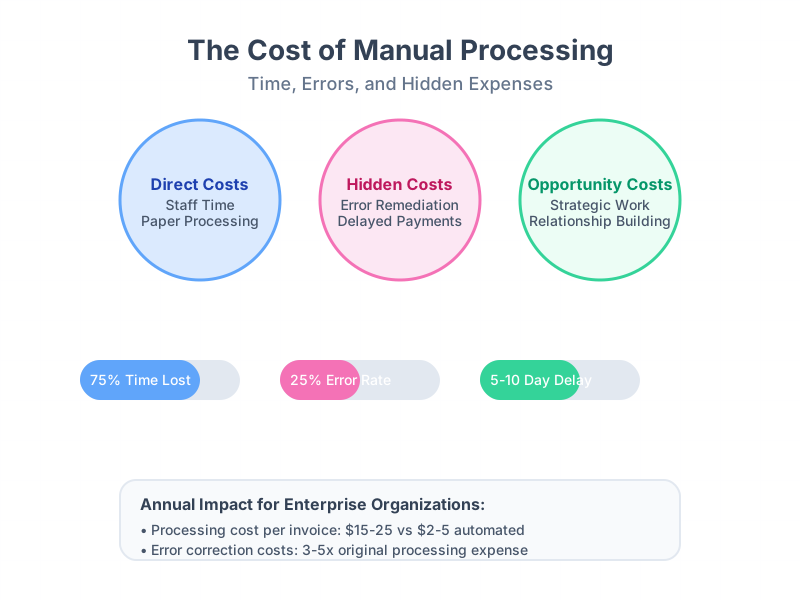
Vendor management presents another layer of complexity that manual processes struggle to address effectively. Modern enterprises often work with hundreds of suppliers, each with unique invoicing formats, payment terms, and communication preferences. Some vendors submit invoices via email, others through EDI systems, and still others through paper mail. Managing this diversity of input channels while maintaining consistent processing standards requires significant coordination and often results in vendor frustration when payments are delayed or disputes arise over missing or incorrect information.
The accounts receivable side of the equation presents equally challenging dynamics. Large organizations must manage billing for diverse customer bases, each with different payment terms, billing cycles, and collection requirements. Customer service teams frequently field inquiries about invoice status, payment applications, and account balances, requiring access to real-time information that manual systems often cannot provide efficiently. The result is often frustrated customers, delayed payments, and strained customer relationships that impact long-term business success.
Cash flow management becomes particularly complex when these manual processes create unpredictable timing for both payables and receivables. Finance teams struggle to maintain accurate cash flow forecasts when payment processing times vary significantly due to manual bottlenecks. This unpredictability makes it difficult to optimize working capital, negotiate favorable payment terms with vendors, or take advantage of early payment discounts that could improve the bottom line.
The true cost of manual AP/AR processing extends far beyond the obvious expenses of staff time and paper handling. While these direct costs are significant, the hidden costs often represent an even larger drain on organizational resources and efficiency. Understanding these hidden costs is crucial for building a compelling business case for automation and helps explain why leading organizations are prioritizing digital transformation of their financial operations.
One of the most significant hidden costs involves the opportunity cost of highly skilled financial professionals spending their time on routine data entry and document verification tasks. When experienced accounts payable clerks, financial analysts, and managers dedicate substantial portions of their workday to manual processing tasks, they have less time available for strategic activities that could drive greater business value. These professionals could be analyzing spending patterns to identify cost reduction opportunities, developing stronger vendor relationships through proactive communication, or implementing process improvements that enhance overall operational efficiency.
Error remediation represents another substantial hidden cost that manual processes generate. When mistakes occur in invoice processing, the cost of correction often exceeds the original processing cost by a significant margin. Duplicate payments must be identified and recovered, vendor relationships must be repaired when payment disputes arise, and customer relationships suffer when billing errors create confusion and frustration. The staff time required to investigate and resolve these errors, combined with the potential impact on vendor and customer relationships, creates a compounding effect that can significantly impact business operations.
Compliance-related costs also escalate significantly in manual processing environments. Maintaining proper documentation, ensuring consistent application of business rules, and generating audit trails becomes increasingly difficult as transaction volumes grow. The risk of compliance failures increases exponentially with manual processes, and the potential cost of regulatory penalties or audit findings can be substantial. Organizations often find themselves dedicating significant resources to maintaining compliance documentation and preparing for audit activities that could be largely automated with proper systems.
The impact on vendor relationships deserves particular attention because it affects the organization's ability to negotiate favorable terms and maintain reliable supply chains. When payments are consistently delayed due to processing bottlenecks, vendors may begin to question the organization's financial stability or administrative competence. This perception can lead to demands for more stringent payment terms, reduced credit limits, or even termination of supplier relationships. The long-term cost of these damaged relationships often far exceeds the short-term savings that might be achieved through delayed payments.
Customer relationships face similar risks on the accounts receivable side. When billing errors occur frequently or customer inquiries cannot be resolved quickly due to poor information accessibility, customer satisfaction declines. In competitive markets, this dissatisfaction can lead to customer churn, negative reviews, and damaged brand reputation. The cost of acquiring new customers to replace those lost due to poor billing experiences often represents a multiple of the revenue from the departed customers.
Working capital optimization becomes nearly impossible when manual processes create unpredictable timing for cash flows. Organizations cannot effectively negotiate early payment discounts when they cannot reliably process invoices within the discount period. Similarly, collection efforts become less effective when customer payment patterns cannot be analyzed efficiently to identify trends and optimize collection strategies. The cumulative impact of these missed opportunities can represent millions of dollars in lost value for large organizations.
The emergence of artificial intelligence and machine learning technologies has fundamentally transformed the possibilities for automating complex document processing workflows. Unlike earlier generations of automation tools that required rigid document formats and extensive manual configuration, modern AI-powered solutions can adapt to diverse document types, learn from processing patterns, and continuously improve their accuracy over time.
Optical Character Recognition (OCR) technology has evolved from simple text extraction tools to sophisticated document understanding systems that can interpret context, identify relationships between data elements, and extract meaningful information from complex layouts. Modern OCR systems can process invoices regardless of format variations, extract line-item details from tables with irregular structures, and identify critical information even when documents contain handwritten notes or annotations.
Machine learning algorithms now power intelligent data extraction capabilities that go far beyond basic OCR functionality. These systems can understand the semantic meaning of document content, identify patterns that indicate potential errors or fraud, and make intelligent decisions about how to handle exceptions and variations. For example, an AI-powered system can learn to recognize when an invoice amount seems inconsistent with historical patterns for a particular vendor and flag it for human review, potentially preventing costly errors or fraudulent transactions.
Natural Language Processing (NLP) capabilities enable these systems to understand unstructured text content and extract relevant information from sources like email communications, contract documents, and vendor correspondence. This capability allows for more comprehensive automation that can handle the full spectrum of communications and documents involved in AP/AR processes, not just formal invoices and purchase orders.
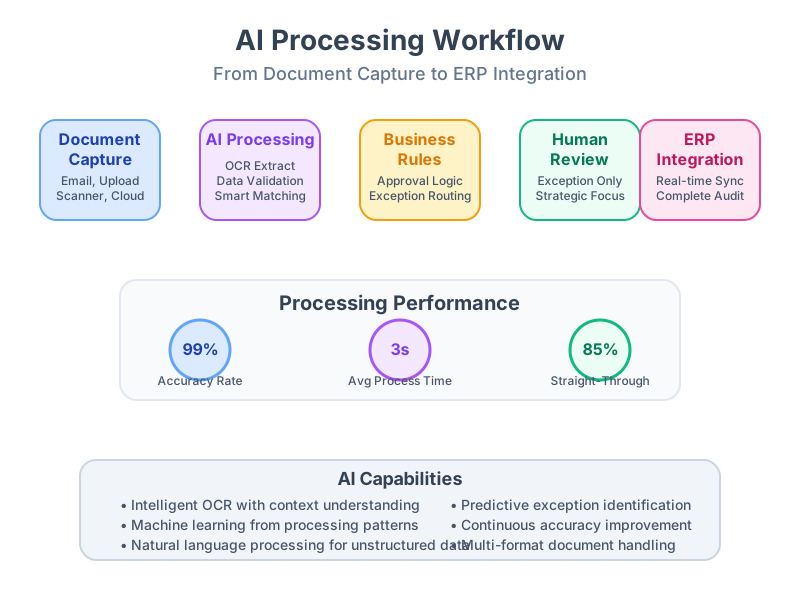
The integration capabilities of modern AI platforms represent a crucial advancement that enables seamless connectivity with existing enterprise systems. Rather than requiring organizations to replace their entire technology infrastructure, these solutions can integrate with established ERP systems, accounting platforms, and document management systems. This integration capability ensures that automated processing results flow seamlessly into existing business processes and reporting structures.
Workflow automation engines have become increasingly sophisticated in their ability to model complex business rules and approval processes. These systems can handle multi-dimensional approval matrices that consider factors like vendor type, purchase category, amount thresholds, and departmental budgets. They can automatically route documents through appropriate approval chains, escalate exceptions according to business rules, and maintain comprehensive audit trails throughout the process.
Real-time processing capabilities distinguish modern solutions from earlier batch-processing approaches. Documents can be processed immediately upon receipt, enabling faster decision-making and improved cash flow management. This real-time capability also enables immediate exception handling and allows organizations to respond quickly to urgent situations or time-sensitive opportunities.
The scalability of cloud-based AI platforms ensures that processing capabilities can grow with organizational needs without requiring significant infrastructure investments. These platforms can handle peak processing loads during busy periods and scale back during quieter times, optimizing cost efficiency while maintaining performance standards.
Effective accounts payable automation begins with intelligent document capture capabilities that can accommodate the full spectrum of invoice formats and delivery methods that modern enterprises encounter. Organizations typically receive invoices through email attachments, EDI transmissions, paper mail, vendor portals, and direct system integrations. A comprehensive AP automation solution must be capable of processing all these input channels seamlessly while maintaining consistent data quality and processing standards.
The document capture process leverages advanced image processing and OCR technologies to extract text and data from various document formats. This includes not only traditional PDF invoices but also scanned paper documents, smartphone photos of receipts, and even handwritten invoices from smaller vendors. The system must be capable of handling documents with varying quality levels, from high-resolution scans to poor-quality fax transmissions, while maintaining accurate data extraction.
Intelligent data extraction goes beyond simple OCR to understand the context and meaning of document content. The system learns to identify vendor information, invoice numbers, line items, tax amounts, and payment terms regardless of where this information appears on the document. This contextual understanding enables accurate processing of invoices from new vendors without requiring manual template configuration for each unique format.
The three-way matching process becomes highly automated when AI systems can intelligently compare purchase orders, invoices, and receiving documents to identify matches and discrepancies. The system can handle variations in product descriptions, unit of measure conversions, and minor pricing differences within tolerance thresholds. When discrepancies are identified, the system can automatically categorize them by type and route them to appropriate personnel for resolution.
Vendor management capabilities within AP automation platforms provide comprehensive vendor onboarding, maintenance, and communication tools. New vendors can be automatically validated against various databases to verify legitimacy and assess risk factors. Existing vendor information can be continuously updated based on invoice processing patterns and external data sources. The system can also provide vendors with self-service portals where they can submit invoices, check payment status, and update their information without requiring manual intervention from AP staff.
Exception handling workflows ensure that unusual situations are managed efficiently without disrupting the overall processing flow. The system can identify various types of exceptions, including missing purchase orders, pricing discrepancies, duplicate invoices, and coding errors. Each exception type can be automatically routed to appropriate personnel with all relevant information and context provided to enable quick resolution.
Approval workflows can be configured to match complex organizational hierarchies and spending authorities. The system can automatically determine the appropriate approval path based on factors like invoice amount, vendor type, cost center, and project codes. Approvers receive notifications with all relevant information and can provide approvals through mobile devices or web interfaces without needing to access the full system.
Payment processing integration ensures that approved invoices flow seamlessly into payment systems for efficient disbursement. The system can optimize payment timing to take advantage of early payment discounts while ensuring compliance with payment terms. It can also coordinate with cash management systems to optimize payment batching and timing for optimal cash flow management.
Duplicate detection capabilities prevent costly duplicate payments by identifying potential duplicates based on multiple matching criteria including vendor, amount, invoice number, and date ranges. The system can flag potential duplicates for review while allowing legitimate multiple invoices from the same vendor to process normally.
Accounts receivable automation addresses the complex challenges of managing customer billing, payment processing, and collection activities across diverse customer bases and billing scenarios. Modern AR automation solutions provide comprehensive capabilities that streamline every aspect of the customer billing lifecycle while improving customer satisfaction and accelerating cash collection.
Automated invoice generation capabilities enable organizations to create and distribute customer invoices based on various triggers including shipping confirmations, service completion notifications, and recurring billing schedules. The system can generate invoices in multiple formats to meet customer preferences, including traditional paper invoices, PDF attachments, EDI transmissions, and integration with customer procurement systems.
Customer billing portals provide self-service capabilities that improve customer satisfaction while reducing administrative overhead. Customers can access their account information, view current and historical invoices, make payments through various methods, and download necessary documentation for their records. These portals can be customized to match organizational branding and can provide role-based access for organizations with multiple contacts who need different levels of account visibility.
Payment processing automation handles the complex task of applying customer payments to outstanding invoices while managing partial payments, overpayments, and payment discrepancies. The system can automatically match payments to invoices based on multiple criteria and can handle complex scenarios like partial payments across multiple invoices or customer deductions for various reasons.
Collection workflow automation enables systematic and consistent collection activities that improve cash flow while maintaining positive customer relationships. The system can automatically generate reminder notices, schedule follow-up activities, and escalate overdue accounts according to predefined business rules. Collection activities can be personalized based on customer payment history, relationship value, and risk assessment.
Cash application automation streamlines the process of applying customer payments to outstanding invoices, handling the complex scenarios that arise in real-world payment processing. The system can process payments received through various channels including checks, wire transfers, ACH transactions, and credit card payments. It can automatically match payments to invoices based on invoice numbers, customer references, and amount matching while handling scenarios like partial payments, prepayments, and payment discrepancies.
Credit management integration provides real-time visibility into customer credit status and payment performance. The system can automatically check customer credit limits before processing new orders, flag accounts that exceed credit terms, and provide early warning of potential collection issues. This integration helps prevent bad debt losses while ensuring that good customers receive appropriate credit accommodation.
Customer communication automation ensures that all customer interactions are timely, professional, and consistent. The system can automatically generate and send various types of customer communications including invoice delivery notifications, payment confirmations, collection notices, and account statements. These communications can be personalized based on customer preferences and relationship history.
Dispute management capabilities provide systematic handling of customer disputes and deductions while maintaining comprehensive documentation for audit purposes. The system can track dispute status, coordinate resolution activities, and ensure that all disputes are resolved in a timely manner. This capability is particularly important for organizations that deal with large retail customers who frequently take deductions for various operational issues.
The analytical capabilities of modern AP/AR automation platforms provide unprecedented visibility into financial operations performance and enable data-driven decision making that can significantly improve business outcomes. These systems capture detailed information about every transaction and process step, creating rich datasets that can be analyzed to identify trends, bottlenecks, and improvement opportunities.
Processing performance analytics provide detailed insights into how efficiently documents are being processed through various workflow stages. Organizations can track metrics like average processing time by document type, exception rates by vendor, and approval cycle times by department. This information enables identification of specific bottlenecks and process inefficiencies that can be addressed through targeted improvements.
Vendor performance analytics help organizations evaluate and optimize their vendor relationships based on objective data about invoice quality, payment compliance, and processing efficiency. The system can identify vendors who consistently submit error-free invoices in preferred formats and those who require additional attention due to frequent exceptions or processing difficulties. This information supports vendor scorecarding initiatives and supplier development programs.
Payment performance analytics provide insights into payment timing, early payment discount utilization, and cash flow optimization opportunities. Organizations can analyze their payment patterns to identify opportunities to improve cash flow management while maintaining good vendor relationships. The system can also track the financial impact of early payment discounts and identify vendors where improved payment timing could generate significant savings.
Customer payment analytics enable organizations to better understand customer payment patterns and identify potential collection issues before they become serious problems. The system can track Days Sales Outstanding (DSO) trends by customer segment, identify customers whose payment patterns are deteriorating, and provide early warning of potential bad debt situations.
Exception analysis capabilities help organizations understand the root causes of processing exceptions and develop strategies to prevent them. The system can categorize exceptions by type, identify patterns that indicate systemic issues, and track the effectiveness of corrective actions. This information enables continuous process improvement and helps organizations optimize their automation investment.
Cost analysis functionality provides detailed insights into the total cost of AP/AR operations including both direct processing costs and indirect costs like exception handling and vendor relationship management. Organizations can track how automation is impacting overall operational costs and identify additional opportunities for improvement.
Compliance reporting capabilities ensure that organizations can demonstrate adherence to various regulatory requirements and internal policies. The system maintains comprehensive audit trails and can generate detailed reports for internal audits, external audits, and regulatory examinations. This capability is particularly important for publicly traded companies and organizations in heavily regulated industries.
Customizable dashboards enable different stakeholders to access the information most relevant to their roles and responsibilities. Finance executives can focus on high-level performance metrics and trend analysis, while operational managers can drill down into detailed process performance data. These dashboards can be configured to provide real-time updates and can include alerting capabilities for situations that require immediate attention.
Successful implementation of comprehensive AP/AR automation requires careful planning, stakeholder engagement, and a phased approach that minimizes disruption while maximizing benefit realization. Organizations that achieve the greatest success with automation initiatives invest significant effort in upfront planning and change management activities that ensure the technology deployment aligns with business objectives and user needs.
The initial assessment phase involves comprehensive analysis of current processes, systems, and performance metrics to establish baseline measurements and identify specific improvement opportunities. This assessment should include detailed process mapping to understand how documents currently flow through the organization, identification of key stakeholders and their requirements, and analysis of existing system integrations that will need to be maintained or enhanced.
Stakeholder engagement activities ensure that all affected parties understand the benefits of automation and are prepared to support the implementation process. This includes not only internal stakeholders like AP/AR staff, finance managers, and IT personnel, but also external stakeholders like vendors and customers who will interact with automated systems. Early engagement helps identify potential resistance points and ensures that implementation plans address legitimate concerns and requirements.
System design and configuration activities translate business requirements into specific system settings and workflow configurations. This phase requires close collaboration between business users and technical implementers to ensure that automated processes match organizational needs and preferences. Particular attention must be paid to exception handling procedures, approval workflows, and integration requirements to ensure seamless operation.
Data migration and system integration activities ensure that historical information is preserved and that automated systems work seamlessly with existing business applications. This often represents one of the most complex aspects of implementation, requiring careful planning and testing to ensure data integrity and system compatibility.
User training and change management activities prepare staff members to work effectively with automated systems while adapting to new roles and responsibilities. Many staff members will transition from routine data entry tasks to exception handling and relationship management activities, requiring new skills and different performance metrics. Effective training programs address both technical system usage and the broader changes in job responsibilities that automation enables.
Pilot program implementation allows organizations to test automated processes with a limited scope before full deployment. Pilot programs typically focus on specific vendor groups, document types, or organizational units to enable controlled testing and refinement of system configurations. This approach allows for identification and resolution of issues before they impact full-scale operations.
Performance monitoring and optimization activities ensure that automated systems continue to deliver expected benefits over time. This includes regular review of processing metrics, user feedback collection, and identification of additional optimization opportunities. Successful organizations treat automation implementation as an ongoing process of continuous improvement rather than a one-time project.
The success of AP/AR automation initiatives depends heavily on seamless integration with existing enterprise systems and business processes. Modern organizations typically have complex technology landscapes that include ERP systems, document management platforms, workflow tools, and specialized financial applications. Effective automation solutions must integrate with these existing systems without requiring expensive replacements or major architectural changes.
ERP integration represents the most critical connection point for AP/AR automation systems. The automation platform must be able to read master data like vendor records, customer accounts, and chart of accounts information from the ERP system while writing back transaction details like invoice processing results and payment information. This bi-directional integration ensures that automated processes remain synchronized with the organization's financial records and reporting systems.
Document management system integration enables automated processes to store and retrieve documents according to existing organizational standards and compliance requirements. Many organizations have significant investments in document management platforms that provide version control, retention management, and audit capabilities. Automation solutions must work within these existing frameworks while enhancing accessibility and searchability of financial documents.
Workflow system integration allows automated processes to leverage existing approval workflows and notification systems that users are already familiar with. Rather than requiring users to learn new approval interfaces, effective automation solutions can integrate with established workflow platforms to provide familiar user experiences while adding intelligent automation capabilities.
Banking system integration enables automated payment processing and cash application capabilities that streamline financial operations while maintaining appropriate controls and security measures. These integrations must handle various payment methods and banking relationships while providing real-time updates on payment status and cash positions.
Business intelligence and reporting system integration ensures that automated processing data contributes to existing management reporting and analytics capabilities. Organizations often have significant investments in business intelligence platforms that provide executive dashboards and performance monitoring capabilities. Automation solutions must provide data in formats that integrate seamlessly with these existing analytical frameworks.
Customer relationship management (CRM) system integration enables automated AR processes to leverage existing customer information and communication preferences while contributing to customer relationship tracking and management activities. This integration ensures that automated billing and collection activities support broader customer relationship strategies rather than operating in isolation.
Vendor portal integration provides suppliers with familiar interfaces for submitting invoices and checking payment status while enabling automated processing behind the scenes. Many organizations have existing vendor portals that suppliers are accustomed to using, and automation solutions must enhance these platforms rather than replacing them with entirely new interfaces.
Financial document processing involves handling sensitive information that requires robust security measures and compliance with various regulatory requirements. Modern AP/AR automation platforms must provide comprehensive security capabilities that protect against both external threats and internal risks while maintaining auditability and regulatory compliance.
Data encryption capabilities ensure that sensitive financial information is protected both in transit and at rest. This includes encryption of document images, extracted data, and communication between system components. Advanced encryption standards must be applied consistently across all data storage and transmission activities to prevent unauthorized access to financial information.
Access control systems provide granular control over who can access different types of information and perform various system functions. These systems must support role-based access control that aligns with organizational hierarchies and functional responsibilities while providing audit trails of all access activities. Integration with existing identity management systems ensures that access controls remain synchronized with organizational changes.
Audit trail capabilities maintain comprehensive records of all system activities including document processing actions, user access events, and data modifications. These audit trails must be tamper-proof and provide sufficient detail to support internal audits, external audits, and regulatory examinations. The system must also provide efficient search and reporting capabilities to enable quick retrieval of audit information when needed.
Fraud detection capabilities leverage artificial intelligence and machine learning to identify potentially fraudulent documents and transactions. These systems can analyze patterns in vendor behavior, detect duplicate invoices with subtle variations, and identify unusual payment requests that may indicate fraud attempts. Early detection of fraud attempts can prevent significant financial losses while maintaining vendor relationship integrity.
Compliance management features ensure that automated processes adhere to various regulatory requirements including financial reporting standards, tax regulations, and industry-specific compliance requirements. The system must provide configurable business rules that enforce compliance requirements while generating necessary documentation for compliance reporting.
Data retention and disposal capabilities ensure that financial documents are retained according to legal and regulatory requirements while disposing of information appropriately when retention periods expire. These capabilities must handle various retention requirements for different types of documents and jurisdictions while maintaining security throughout the retention lifecycle.
Business continuity and disaster recovery capabilities ensure that critical financial processes can continue operating even during system outages or disasters. This includes regular data backups, redundant system infrastructure, and documented recovery procedures that can restore operations quickly when disruptions occur.
Privacy protection measures ensure that personal information contained in financial documents is handled appropriately according to privacy regulations and organizational policies. This includes data minimization practices that limit collection and retention of personal information to what is necessary for business purposes.
Successful AP/AR automation initiatives require comprehensive measurement frameworks that track both quantitative and qualitative benefits over time. Organizations must establish baseline metrics before implementation and continuously monitor performance improvements to ensure that automation investments deliver expected returns and identify opportunities for further optimization.
Processing efficiency metrics provide direct measurement of automation impact on operational performance. These metrics include average processing time per document, percentage of documents processed without human intervention, and exception rates by document type and vendor. Organizations typically see dramatic improvements in these metrics, with processing times often reduced by 70-90% and exception rates declining significantly as systems learn to handle document variations more effectively.
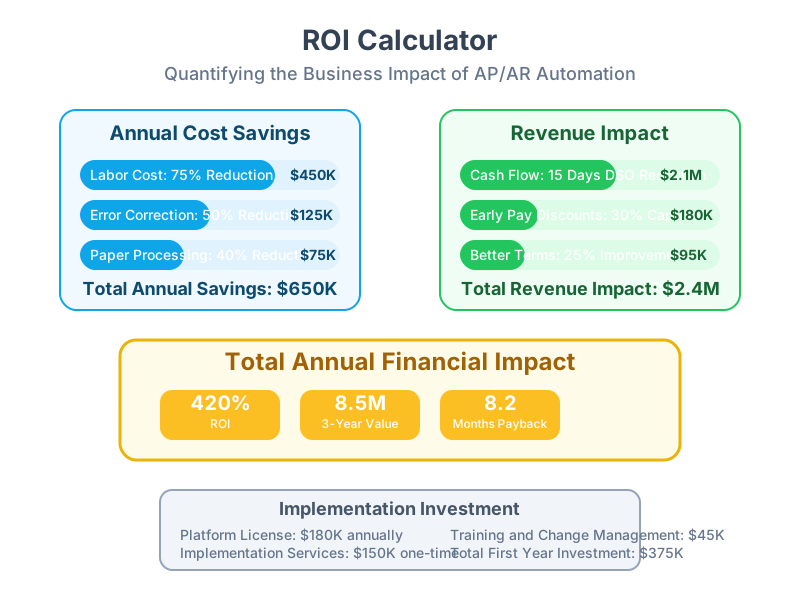
Cost reduction metrics track the financial impact of automation on overall AP/AR operational costs. These metrics include direct labor cost savings, reduced error correction costs, and elimination of paper-based processing expenses. Organizations must also track indirect cost savings like reduced audit preparation time, improved early payment discount capture, and decreased customer service costs related to billing inquiries.
Accuracy improvement metrics measure the impact of automation on data quality and processing errors. These metrics include reduction in duplicate payments, improvement in coding accuracy, and decrease in customer billing errors. Improved accuracy not only reduces direct correction costs but also improves vendor and customer relationships while reducing compliance risks.
Cash flow improvement metrics track the impact of automation on working capital management and cash flow timing. These metrics include reduction in Days Sales Outstanding (DSO), improvement in early payment discount capture rates, and more predictable cash flow timing. Many organizations find that automation enables them to optimize payment timing to improve cash flow while maintaining good vendor relationships.
Vendor and customer satisfaction metrics measure the impact of automation on external relationship quality. These metrics can include vendor payment satisfaction scores, reduction in vendor inquiry volume, customer satisfaction with billing processes, and reduction in customer service contacts related to billing issues. Improved external relationships often lead to better commercial terms and reduced relationship management costs.
Compliance and audit metrics track the impact of automation on regulatory compliance and audit efficiency. These metrics include reduction in audit findings, improvement in compliance documentation quality, and reduction in audit preparation time. Strong compliance performance reduces regulatory risk while enabling more efficient audit processes.
Employee satisfaction and productivity metrics measure the impact of automation on staff satisfaction and effectiveness. These metrics include employee satisfaction scores, reduction in turnover rates, and improvement in staff productivity as measured by higher-value activities. Many organizations find that automation enables staff to focus on more strategic and fulfilling work while reducing the stress associated with high-volume manual processing.
Innovation and scalability metrics track the organization's enhanced ability to adapt and grow with automated processes in place. These metrics include time to onboard new vendors or customers, ability to handle volume increases without proportional staff increases, and speed of implementing process improvements. Automation often provides organizations with greater agility and scalability than manual processes allow.
The landscape of financial process automation continues to evolve rapidly as new technologies emerge and existing capabilities become more sophisticated. Organizations planning automation investments must consider not only current capabilities but also how emerging trends will shape the future of financial operations and ensure that their automation platforms can adapt to these changing requirements.
Artificial intelligence capabilities are becoming increasingly sophisticated in their ability to understand complex document relationships and make intelligent processing decisions. Future AI systems will be able to handle more complex scenarios automatically, reducing the need for human intervention in exception processing while maintaining high accuracy standards. These systems will also become better at learning from organizational-specific patterns and preferences to provide increasingly customized automation experiences.
Blockchain technology offers potential for creating tamper-proof transaction records and enabling new forms of vendor and customer collaboration. Smart contracts could automate many aspects of vendor relationship management and customer billing while providing enhanced transparency and trust. Organizations should monitor blockchain developments to understand how this technology might impact their future automation strategies.
Robotic Process Automation (RPA) integration will enable even more comprehensive automation by connecting financial processing systems with other business applications that may not have direct integration capabilities. RPA can handle the complex system interactions that humans currently perform while providing seamless integration between automation platforms and legacy systems.
Mobile technology advancement will continue to enhance the accessibility and usability of financial automation systems. Future mobile capabilities will enable more sophisticated approval workflows, enhanced document capture capabilities, and improved user experiences for both internal staff and external vendors and customers.
Cloud computing evolution will provide enhanced scalability, security, and integration capabilities that enable smaller organizations to access enterprise-grade automation capabilities while providing larger organizations with greater flexibility and cost efficiency. Multi-cloud strategies will become more common as organizations seek to optimize performance and avoid vendor lock-in.
Internet of Things (IoT) integration may enable new forms of automated document creation and processing as physical devices generate transaction data automatically. This could include automated receiving confirmations, usage-based billing, and real-time service delivery verification that creates more accurate and timely financial processing.
Predictive analytics capabilities will become more sophisticated in their ability to forecast cash flow, identify potential problems before they occur, and optimize financial operations based on predictive insights. These capabilities will enable organizations to move from reactive to proactive financial management approaches.
The transformation of accounts payable and accounts receivable operations through intelligent automation represents one of the most significant opportunities for operational improvement that modern enterprises face. Organizations that embrace this transformation position themselves for enhanced efficiency, improved relationships with vendors and customers, better cash flow management, and greater agility in responding to changing business requirements.
The technology capabilities available today provide comprehensive solutions that can handle the full spectrum of financial document processing challenges while integrating seamlessly with existing business systems and processes. These solutions have moved beyond simple automation tools to become sophisticated platforms that leverage artificial intelligence, machine learning, and advanced analytics to deliver unprecedented levels of efficiency and insight.
The implementation of comprehensive AP/AR automation requires careful planning, stakeholder engagement, and commitment to change management activities that ensure successful adoption and benefit realization. Organizations that invest appropriately in these implementation activities typically achieve dramatic improvements in operational efficiency while positioning themselves for continued success as their business requirements evolve.
The future of financial operations will be increasingly automated, intelligent, and integrated with broader business processes. Organizations that begin their automation journey today will be better positioned to take advantage of emerging capabilities and competitive opportunities while avoiding the operational constraints that manual processes impose.
At Artificio, we remain committed to helping organizations navigate this transformation successfully by providing comprehensive automation solutions, implementation expertise, and ongoing support that ensures sustained success. The future of financial operations is automated, intelligent, and strategically aligned with business objectives. The question is not whether to embrace this transformation, but how quickly organizations can implement the capabilities that will drive their future success.
For organizations ready to begin their financial automation journey, the time for action is now. The competitive advantages available through intelligent automation will only increase over time, and early adopters will benefit from enhanced operational capabilities that position them for sustained success in an increasingly competitive business environment. The transformation of financial operations through automation is not just an operational improvement initiative, it is a strategic imperative that will define the future success of modern enterprises.
Artificio specializes in intelligent document processing and financial automation solutions that transform how organizations manage their accounts payable and accounts receivable operations. Contact us to learn how our comprehensive automation platform can deliver measurable improvements in efficiency, accuracy, and strategic capability for your organization.

Head IT Operations - Co Founder of Artificio
See it in your SAP environment
Bring us a document, a process, or a bottleneck. We'll show how Artificio captures, validates, and posts into SAP — then scale from there.
Security & compliance
ISO 27001:2013 certified, SOC 2 Type 2 compliant, GDPR and HIPAA ready. Every agent action is logged, auditable, and runs in isolated environments.