

Blog
Automating the End-to-End Process of Accounts Receivables | 11 Tips
Explore the evolution of AR, from manual paper processes to intelligent automation. Discover strategies for end-to-end AR transformation.

Blog
Explore the evolution of AR, from manual paper processes to intelligent automation. Discover strategies for end-to-end AR transformation.
Before diving into our strategies for automation, it's worth reflecting on how dramatically accounts receivable processes have evolved over recent decades. Thirty years ago, AR departments were drowning in paper physical invoices filled filing cabinets, checks arrived by mail, and reconciliation required manual ledger entries. The first wave of digitization in the 1990s moved these documents to basic digital formats, yet processes remained largely manual. The enterprise software revolution of the 2000s introduced integrated systems that centralized financial data but still required substantial human oversight for exceptions, approvals, and analysis. Today, we stand at the threshold of a new era one where artificial intelligence doesn't merely assist human operators but actively collaborates with them through agentic systems capable of autonomous reasoning and decision-making. This transformation from paper-based processes to intelligent operations represents not merely a technological evolution but a fundamental reimagining of financial operations. Organizations that embrace this shift position themselves not just for operational efficiency but for strategic advantage through financial intelligence that informs broader business decisions.
The accounts receivable (AR) function represents a critical component of any organization's financial ecosystem. Despite its fundamental importance to cash flow and operational sustainability, many businesses continue to manage their AR processes through predominantly manual methods that consume valuable time, introduce errors, and ultimately impede financial performance. As organizations face increasing pressure to optimize operations while maintaining accuracy, the automation of accounts receivable emerges as not merely advantageous but essential. Modern AI-powered document processing and workflow automation technologies now offer unprecedented opportunities to transform AR operations from labor-intensive administrative burdens into streamlined, intelligent processes that accelerate cash flow and enhance financial visibility.
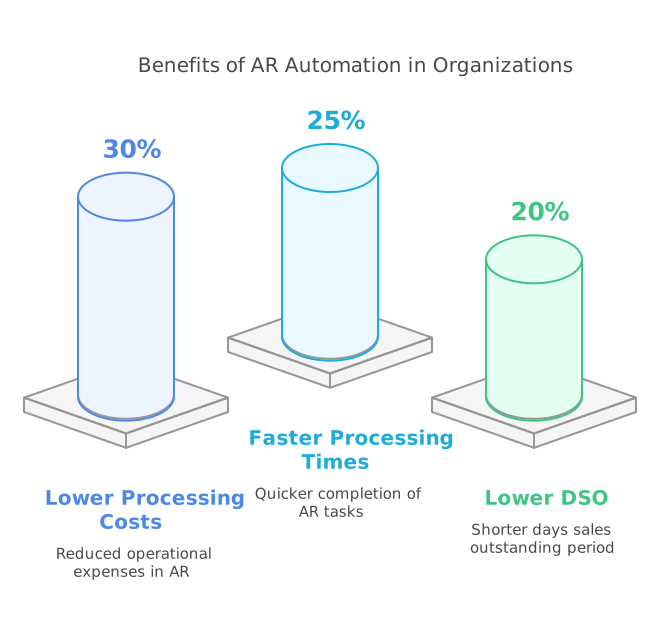
By the numbers: Research from the Institute of Finance and Management reveals that organizations with highly automated AR processes experience 30% lower processing costs, 25% faster processing times, and 20% lower DSO compared to organizations with minimal automation. Despite these compelling advantages, a recent survey conducted by Artificio found that only 37% of mid-market and enterprise organizations have implemented comprehensive AR automation, revealing substantial untapped opportunity for optimization.
This article explores eleven comprehensive strategies for implementing end-to-end accounts receivable automation, focusing on practical approaches that leverage cutting-edge technologies to address the most persistent challenges in the AR lifecycle.
Traditional invoice processing represents one of the most labor-intensive aspects of accounts receivable management. The manual extraction of key data elements from invoices, including invoice numbers, amounts, dates, and payment terms, invariably introduces errors while consuming disproportionate staff resources. Intelligent document processing powered by advanced AI algorithms offers a transformative solution to this persistent challenge. Contemporary AI systems can now accurately extract structured data from invoices across multiple formats whether they arrive as PDFs, scanned documents, images captured via mobile devices, or electronic files with remarkable precision. These systems leverage computer vision, natural language processing, and machine learning to recognize patterns and contextual relationships within documents, achieving extraction accuracy rates that frequently exceed 98%. More importantly, these systems continuously improve through machine learning, adapting to organization-specific document formats and terminology over time. The implementation of intelligent invoice capture substantially reduces processing time from days to minutes, eliminates data entry errors, and allows finance staff to redirect their attention from mundane data entry to exception handling and value-added analysis. Organizations implementing this technology typically report 80-90% reductions in invoice processing time and 60-70% decreases in processing costs.
Financial visibility represents the cornerstone of effective accounts receivable management. Without comprehensive, real-time insights into outstanding receivables, collection efforts remain reactive rather than strategic. Implementing a centralized AR dashboard that aggregates data across the entire receivables portfolio provides finance leaders with the information necessary for informed decision-making. A well-designed AR dashboard should display key performance indicators including days sales outstanding (DSO), aging reports, customer payment histories, and projected cash flows all updated in real-time as new information enters the system. This consolidated view eliminates the information silos that frequently plague financial operations, ensuring that all stakeholders work from a single, authoritative source of truth. Beyond mere reporting, sophisticated AR dashboards incorporate predictive analytics to forecast collection probabilities based on historical payment patterns, enabling proactive intervention for accounts showing early warning signs of payment difficulties. These systems can automatically prioritize collection activities based on risk profiles, amounts outstanding, and business impact, ensuring that collection specialists focus their efforts where they will generate the greatest return. Organizations implementing comprehensive AR dashboards typically report 15-20% improvements in DSO and significantly enhanced forecast accuracy, directly contributing to improved cash flow performance and financial planning capabilities.
The accounts receivable lifecycle begins long before an invoice is generated. The customer onboarding process establishes the foundation for the entire customer relationship, including payment expectations and terms. Automating this critical phase through digital onboarding workflows eliminates paper-based inefficiencies while ensuring consistent application of credit policies. Advanced onboarding systems automate credit checks, document collection, authorization workflows, and customer communication through a single integrated platform. These systems can directly interface with credit bureaus and financial information services to perform automated risk assessments based on predefined criteria, ensuring objective evaluation while accelerating the approval process. Digital signature capabilities eliminate delays associated with physical document routing, reducing onboarding cycles from weeks to days or even hours. Moreover, automated systems ensure complete documentation by tracking required forms and supporting materials, flagging missing information, and sending automated reminders to customers when additional documentation is needed. The resulting digital customer record becomes the foundation for all subsequent financial interactions, providing comprehensive visibility throughout the customer lifecycle. Organizations implementing automated onboarding typically report 70-80% reductions in onboarding time, substantially improved documentation compliance, and significantly reduced early-stage payment issues resulting from unclear terms or incomplete information.
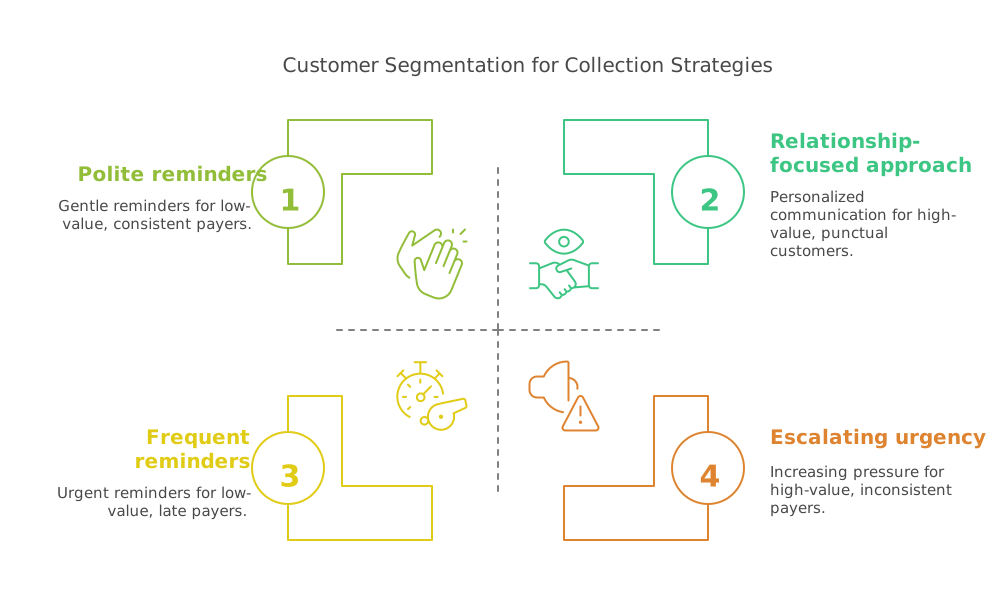
Customer payment behaviors exhibit distinct patterns that can be leveraged to optimize collection approaches. Rather than applying uniform collection procedures across the entire customer base, organizations can significantly improve outcomes by implementing AI-driven customer segmentation that adapts collection strategies to specific customer profiles. Advanced analytics systems can analyze historical payment data, transaction volumes, communication preferences, and seasonal patterns to automatically classify customers into distinct segments with tailored collection approaches. For high-value, consistently punctual customers, the system might apply a relationship-focused approach with polite reminders and personalized communication. For chronically late payers with smaller balances, the system could implement more frequent reminders with escalating urgency. Machine learning algorithms continuously refine these segmentation models based on payment outcomes, identifying which approaches prove most effective for specific customer types. This dynamic segmentation enables organizations to balance collection effectiveness with customer relationship considerations, applying appropriate pressure without damaging valuable business relationships. Companies implementing intelligent customer segmentation for collections typically report 25-30% improvements in collection effectiveness while maintaining or even enhancing customer satisfaction metrics, demonstrating that properly calibrated automation can simultaneously serve financial and relationship objectives.
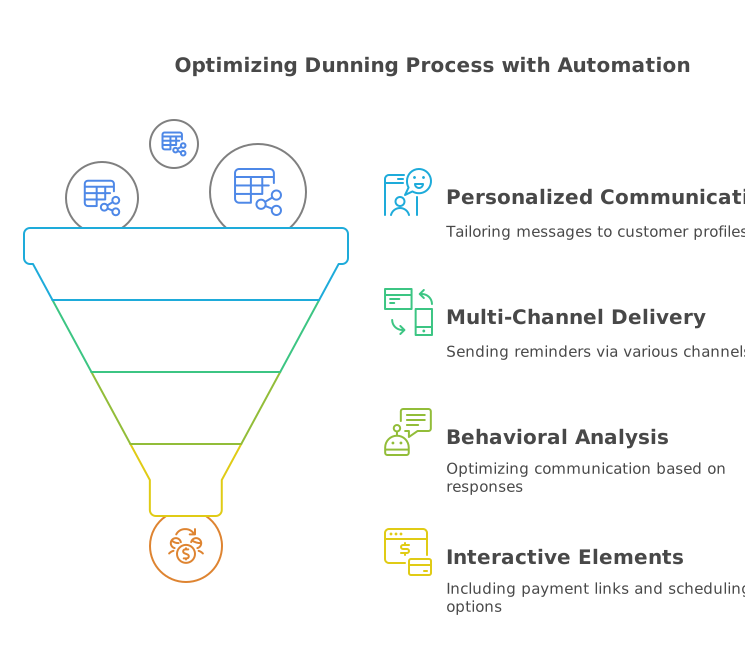
The dunning process the systematic communication with customers regarding outstanding payments represents another area where manual approaches frequently prove both inefficient and ineffective. Automated dunning systems leverage customer segmentation data and payment histories to implement multi-channel communication sequences tailored to specific customer profiles and payment situations. These systems automatically generate personalized reminders across email, SMS, physical mail, and phone channels based on predefined rules and triggers. Advanced platforms incorporate behavioral analysis to determine optimal communication timing, messaging, and channels for each customer segment, continuously optimizing based on response patterns. The most sophisticated systems now employ natural language generation to create personalized communication that strikes the appropriate tone for each situation, from friendly reminders for valued customers experiencing unusual delays to more assertive messaging for chronically delinquent accounts. These communications can include interactive elements such as embedded payment links, scheduling options for payment plan discussions, or direct connections to customer service representatives, removing friction from the payment process. Organizations implementing intelligent dunning automation typically report 30-40% improvements in first-reminder collection rates and 15-20% reductions in average days to payment, directly impacting cash flow performance while reducing collection costs.
Despite the proliferation of electronic payment options, many organizations continue to process payments through predominantly manual methods that delay posting and introduce reconciliation challenges. Implementing comprehensive electronic payment capabilities including credit card processing, ACH transfers, digital wallets, and real-time payment networks dramatically accelerates cash application while improving the customer payment experience. Advanced systems now incorporate customer payment portals that provide self-service options for viewing outstanding invoices, downloading statements, making payments, and managing payment methods through intuitive interfaces. The true power of electronic payment processing emerges when combined with automated reconciliation. AI-powered reconciliation engines can match incoming payments against outstanding invoices based on multiple data points, resolving even complex scenarios involving partial payments, payment consolidations, or missing reference information. These systems apply machine learning to recognize patterns in customer payment behaviors, continuously improving matching accuracy over time. Organizations implementing electronic payment processing with automated reconciliation typically report 80-90% reductions in payment application time, 50-60% decreases in unapplied cash, and significant improvements in customer satisfaction resulting from accurate, timely payment posting and transparent payment status information.
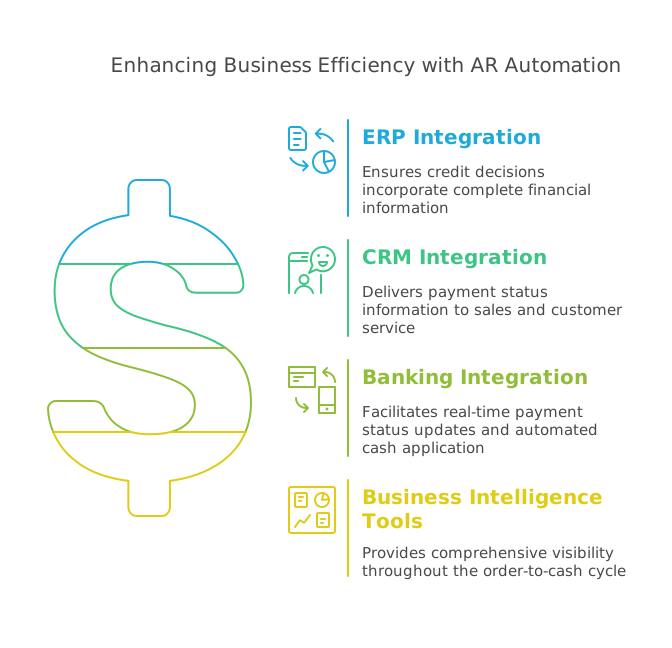
Accounts receivable processes intersect with multiple business functions including sales, customer service, operations, and financial planning. Isolated AR automation delivers limited value; integration with core enterprise systems unlocks transformative capabilities. Modern AR automation platforms offer pre-built connectors and APIs for seamless integration with enterprise resource planning (ERP) systems, customer relationship management (CRM) platforms, business intelligence tools, and banking systems. These integrations enable bidirectional data flows that eliminate manual data transfer, ensure information consistency across systems, and provide comprehensive visibility throughout the order-to-cash cycle. When integrated with CRM systems, AR automation can deliver payment status information directly to sales and customer service personnel, enabling informed customer interactions. Integration with ERP systems ensures that credit decisions incorporate complete financial information while enabling automated credit hold management based on AR status. Banking integration facilitates real-time payment status updates and automated cash application. The implementation of a comprehensive integration strategy transforms AR from an isolated financial function into an integral component of the enterprise data ecosystem, enhancing decision-making capabilities across multiple business domains. Organizations implementing comprehensive AR integration strategies typically report 15-20% improvements in order-to-cash cycle times and significant enhancements in cross-functional collaboration efficiency.
Traditional cash flow forecasting methodologies rely heavily on historical patterns and manual adjustments, resulting in projections that frequently prove inaccurate in dynamic business environments. AI-powered predictive analytics represents a step-change improvement in forecasting capabilities by incorporating multiple data dimensions into sophisticated projection models. Advanced forecasting systems analyze historical payment patterns, seasonal variations, economic indicators, customer financial health metrics, and industry-specific factors to generate multi-scenario cash flow projections with confidence intervals. These systems can identify specific receivables at risk of delayed payment or default based on early warning indicators such as changing payment patterns, increasing dispute frequency, or deteriorating customer financial metrics. The resulting risk scores enable proactive intervention before payment issues materialize, potentially averting collection problems through early engagement. Beyond risk identification, predictive systems can optimize working capital by identifying opportunities for early payment discounts, supply chain financing, or factoring based on forecasted cash positions and financing costs. Organizations implementing predictive AR analytics typically report 40-50% improvements in forecast accuracy and 10-15% reductions in bad debt expenses through early intervention, delivering substantial bottom-line impact while enhancing financial planning capabilities.
Payment disputes represent a significant source of AR delays and operational friction, frequently consuming disproportionate staff resources while negatively impacting customer relationships. Implementing structured dispute resolution workflows with automated routing and tracking capabilities streamlines resolution processes while ensuring consistent application of policies. Advanced dispute management systems capture dispute information through multiple channels including customer portals, email parsing, and call center interactions categorizing issues based on nature, complexity, and priority. The system then routes disputes to appropriate personnel based on expertise requirements, automatically assembling relevant documentation including contracts, delivery confirmations, and communication histories to facilitate rapid resolution. Throughout the process, the system maintains comprehensive audit trails while providing visibility to all stakeholders regarding dispute status and expected resolution timeframes. For common dispute types, machine learning algorithms can analyze historical resolution patterns to suggest potential solutions or even implement automated resolution for straightforward cases. Organizations implementing automated dispute resolution workflows typically report 60-70% reductions in dispute resolution times, 30-40% decreases in dispute-related processing costs, and significant improvements in customer satisfaction resulting from transparent, consistent resolution processes.
Despite advances in core AR automation, finance departments frequently remain burdened by numerous complex tasks that require contextual understanding and adaptive decision-making previously reserved for human operators. Agentic Process Automation (APA) represents the next evolutionary step beyond traditional automation by deploying AI agents capable of autonomous reasoning, learning, and decision-making across interconnected processes. Unlike conventional automation that follows rigid, predefined pathways, these intelligent agents can understand broader context, adapt to changing conditions, and autonomously navigate exceptions without human intervention. Within the AR function, agentic automation can transform numerous processes including complex reconciliations, nuanced credit decisions, contextual customer communications, exception handling, and strategic cash application scenarios. These AI agents interact with multiple systems simultaneously, integrating information across platforms to develop comprehensive understanding of situations before taking appropriate actions. Modern APA platforms incorporate advanced capabilities including natural language understanding, autonomous planning, reinforcement learning from outcomes, and multi-agent collaboration that enable handling of increasingly sophisticated financial scenarios. Organizations can implement agentic automation incrementally, beginning with semi-autonomous operations before progressing to fully autonomous execution as confidence develops. The deployment of comprehensive agentic capabilities within AR operations typically yields 85-90% reductions in exception handling time, 60-70% decreases in escalation rates, and unprecedented improvements in process resilience through autonomous adaptation to changing conditions, representing a fundamental paradigm shift from process execution to process intelligence.
The implementation of AR automation does not represent a discrete project but rather the beginning of a continuous improvement journey. Establishing robust monitoring capabilities that track key performance metrics across the AR lifecycle provides the foundation for ongoing optimization. Advanced process monitoring systems capture granular performance data including processing times, exception rates, approval cycles, and system utilization patterns, presenting this information through intuitive dashboards with drill-down capabilities. These systems can automatically identify bottlenecks, compliance issues, and optimization opportunities through pattern recognition and anomaly detection. The most sophisticated platforms incorporate process mining technology that reconstructs process flows from system logs, comparing actual execution patterns against intended processes to identify deviations and improvement opportunities. This continuous monitoring enables organizations to implement data-driven optimization initiatives that progressively enhance performance over time. Organizations implementing comprehensive AR process monitoring typically achieve 3-5% year-over-year improvements in key performance indicators including DSO, processing costs, and exception rates through systematic optimization, ensuring that initial efficiency gains represent the beginning rather than the culmination of the automation journey.
A leading global manufacturing company with operations across 27 countries faced persistent challenges in their accounts receivable function. With over 15,000 active customers generating approximately 30,000 monthly invoices across multiple currencies, payment methods, and terms, their AR department struggled with 45-day average DSO, 23% exception rates, and substantial write-offs due to unresolved disputes. The company implemented a comprehensive AR automation initiative centered on AI-powered document processing, intelligent workflows, and predictive analytics.
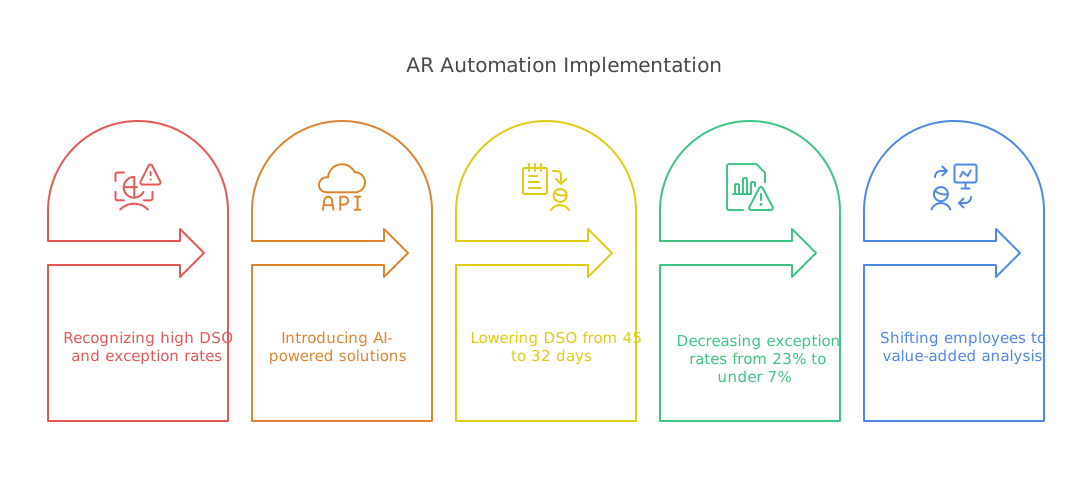
Within six months of implementation, the company achieved dramatic results: DSO decreased from 45 days to 32 days, releasing over $24 million in working capital; exception rates fell from 23% to under 7%; and the finance team reallocated eight full-time employees from transaction processing to value-added analysis. The most profound transformation occurred in customer relationships the enhanced visibility and proactive communication enabled by automation significantly improved customer satisfaction scores related to billing and payment experiences. The CFO noted that beyond the quantifiable financial benefits, the strategic advantage of having finance personnel focused on relationship management and financial strategy rather than transaction processing represented the most valuable outcome of the initiative.
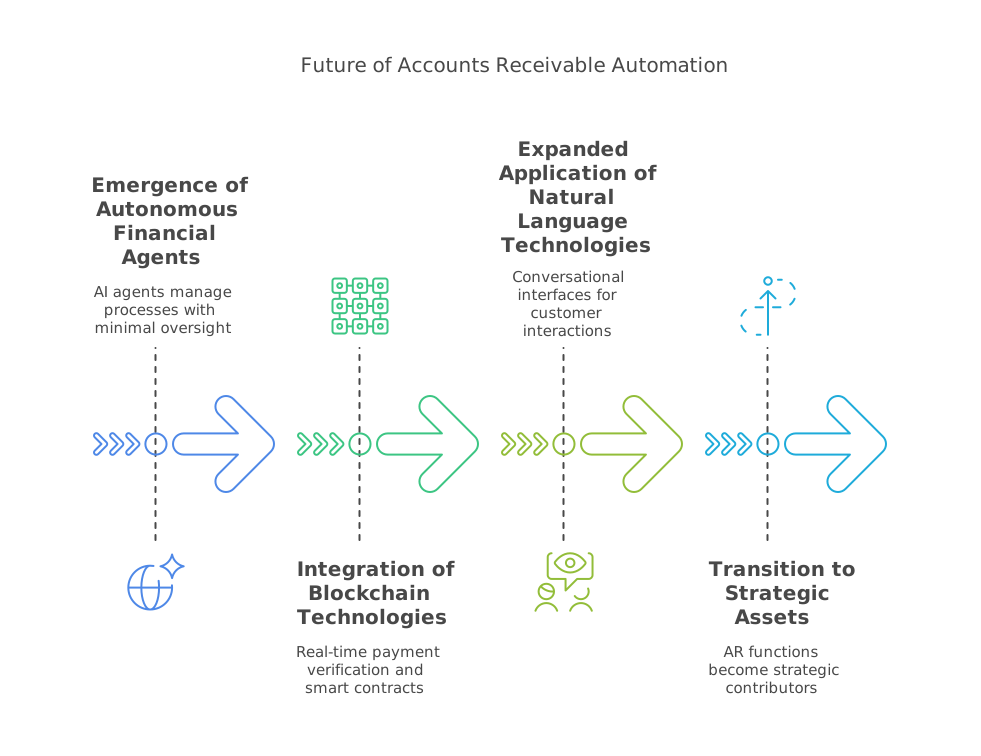
Looking beyond current capabilities, the next frontier in accounts receivable automation will likely center on three key developments. First, the emergence of autonomous financial agents capable of managing entire processes with minimal human oversight will transform exception handling and complex decision-making. These agents will leverage reinforcement learning to continuously improve performance based on outcomes, essentially creating self-optimizing financial operations. Second, the integration of blockchain technologies will enable real-time payment verification, automated contract enforcement through smart contracts, and transparent audit trails that substantially reduce disputes and compliance costs. Finally, expanded application of natural language technologies will transform customer financial interactions, enabling conversational interfaces for payment discussions, dispute resolution, and financial planning. These developments collectively point toward a future where AR functions transition from cost centers to strategic assets that actively contribute to customer relationships, market intelligence, and competitive advantage.
The automation of accounts receivable processes represents a strategic imperative for organizations seeking to optimize financial performance in increasingly competitive business environments. Through the implementation of intelligent document processing, centralized visibility, automated workflows, predictive analytics, and continuous optimization, organizations can transform AR from an administrative burden into a strategic advantage. The technologies enabling this transformation including artificial intelligence, machine learning, and agentic automation have now reached maturity levels that support comprehensive deployment across organizations of all sizes. The benefits extend far beyond mere cost reduction, encompassing accelerated cash flow, enhanced customer experiences, improved financial visibility, and more strategic allocation of human resources. Organizations that embrace end-to-end AR automation position themselves for sustained competitive advantage through financial operations that simultaneously deliver greater efficiency, accuracy, and strategic insight.

Head IT Operations - Co Founder of Artificio
See it in your SAP environment
Bring us a document, a process, or a bottleneck. We'll show how Artificio captures, validates, and posts into SAP — then scale from there.
Security & compliance
ISO 27001:2013 certified, SOC 2 Type 2 compliant, GDPR and HIPAA ready. Every agent action is logged, auditable, and runs in isolated environments.