

Blog
Why Vendor Onboarding Takes Weeks (And How AI Fixes the Part Nobody Talks About)
Don’t let document processing delay your supply chain. Learn how AI automates vendor data extraction and SAP integration to cut onboarding from weeks to days.

Blog
Don’t let document processing delay your supply chain. Learn how AI automates vendor data extraction and SAP integration to cut onboarding from weeks to days.
Your procurement team just approved a new supplier. The contract is signed, the pricing is locked, and everyone's ready to move. Then the waiting begins.
Someone emails the vendor a 14-field onboarding form. The vendor fills out half of it and attaches a scanned W-9 that's slightly cut off on the right side. Accounts payable pings procurement asking who approved this supplier. Compliance wants a copy of the vendor's insurance certificate. The legal team has questions about the indemnification clause. Three weeks later, the vendor still isn't set up in your ERP, and the department that needed them is already frustrated.
This is vendor onboarding as most mid-market and enterprise companies experience it. Not because the people involved are slow or careless, but because the process itself is built on documents that flow through human hands, one at a time, with no system connecting them.
Most companies focus their process improvement efforts on the approval chain: How many people need to sign off? Can we reduce the number of stakeholders? Can we parallelize reviews?
Those questions matter, but they're not where time actually disappears. The real bottleneck sits earlier, in the unglamorous work of collecting, reading, verifying, and entering vendor documents into systems of record.
Think about what a typical supplier onboarding requires. The vendor has to submit a tax form (W-9 or W-8 for international vendors), a certificate of insurance showing minimum coverage levels, bank account details for payment processing, a signed copy of your vendor agreement, and often a vendor questionnaire covering their cybersecurity posture, sustainability practices, and business continuity plans.
Someone on your team has to receive all of that, check that it's complete, verify that the insurance limits match your requirements, confirm the entity name on the tax form matches what's in your contract, and then manually key the relevant fields into your ERP, your vendor management system, or both.
That's where days turn into weeks. Not in approvals. In document handling.
Intelligent document processing changes this by treating vendor documents as structured data sources, not files to be read and re-typed. When a vendor submits their onboarding package, an AI agent reads each document, extracts the relevant fields, checks values against your requirements, flags discrepancies, and routes verified data directly into downstream systems.
No rekeying. No missed fields. No insurance certificates sitting in someone's inbox for four days because they were out sick.
The experience from the vendor's side improves too. Instead of a static PDF form that gets emailed back and forth, vendors get a portal that checks their submissions in real time, tells them immediately if something is missing or doesn't meet requirements, and confirms receipt. The back-and-forth that usually adds a week to onboarding collapses into a single submission cycle. 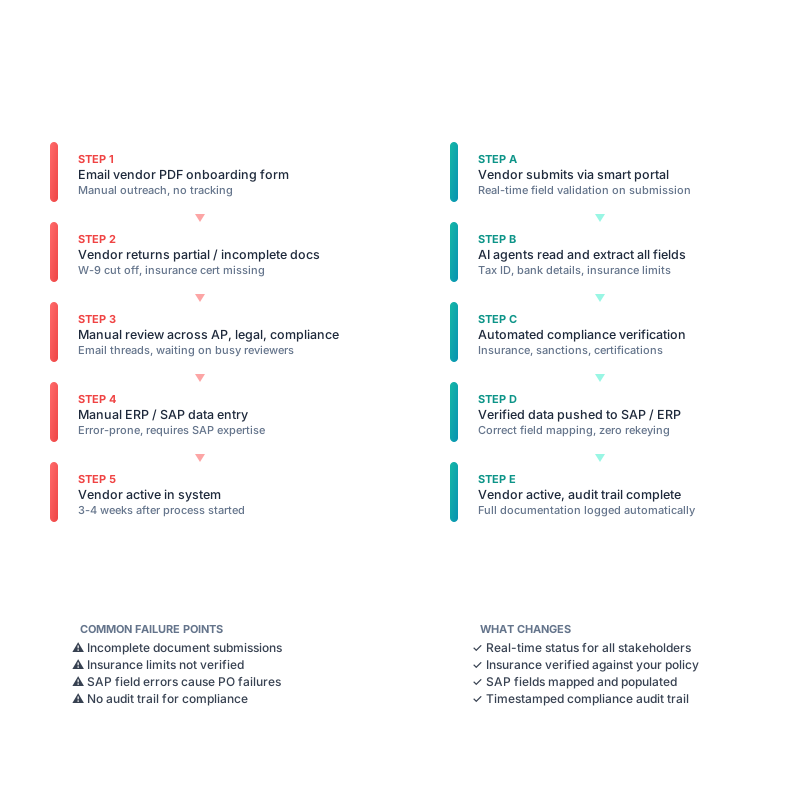
For companies running SAP, vendor onboarding carries an additional layer of complexity. SAP's vendor master data structure is notoriously specific. Getting a new supplier set up in SAP requires populating dozens of fields across multiple tabs: general data, company code data, purchasing organization data, payment terms, reconciliation accounts, and more.
The traditional approach has AP clerks or procurement analysts doing this entry manually, working from the documents the vendor submitted. It's slow, it's error-prone, and any mistakes in the vendor master create downstream problems in purchase orders, invoice matching, and payment runs.
Automated vendor onboarding solves this through direct ERP integration. When AI agents extract and validate vendor data from submitted documents, that structured data doesn't stop at a review screen. It maps directly to the appropriate SAP fields and either populates them automatically or stages them for a one-click approval by a human reviewer.
The key here is data mapping. A vendor's W-9 contains their legal entity name, address, and tax ID. Those values need to land in the right SAP fields with the right formatting. SAP's vendor master has specific field length limits, character requirements, and data type constraints that manual entry often violates, creating data quality issues that compound over time.
AI-powered extraction handles this mapping consistently. The legal entity name from the tax form becomes the NAME1 field in SAP. The tax ID populates STCD1 with proper formatting. Bank account details from a voided check or bank letter flow into the payment method configuration. What used to require someone who knew SAP inside out to do carefully now happens automatically, with the system catching formatting issues before they reach the database.
For companies running SAP S/4HANA, the integration options have improved significantly. Modern intelligent document processing platforms connect via standard SAP APIs, Business Application Studio integrations, or direct RFC connections, depending on your architecture. The vendor master record gets created or updated without manual touchpoints.
Compliance is where manual vendor onboarding breaks down fastest when volume increases. Every supplier relationship carries some level of compliance requirement: insurance minimums, sanctions screening, diversity supplier certifications, environmental standards, cybersecurity questionnaires, and more depending on your industry.
A company onboarding 10 vendors a month can manage this manually. A company onboarding 50 or 200 vendors a month cannot, not without either adding headcount or accepting that some verifications will be incomplete.
Automated compliance verification works differently. When a vendor submits a certificate of insurance, an AI agent reads the document and extracts the specific coverage amounts, policy period, named insured, and additional insured endorsements. It checks those values against your minimum requirements automatically. If the general liability limit is $1 million but your policy requires $2 million, the system flags it immediately and notifies the vendor, without any human having to read the document first.
The same logic applies to sanctions screening. Vendor name and address data extracted from submitted documents feeds directly into OFAC and other sanctions databases. Matches trigger review workflows automatically. Clean results get logged as verified. The audit trail builds itself.
For suppliers who need to provide diversity certifications, quality management certifications like ISO 9001, or industry-specific compliance documents, the system can track expiration dates and trigger renewal requests before certificates lapse. This is the kind of continuous compliance monitoring that procurement teams know they should be doing but rarely have bandwidth for when it depends on manual tracking.
Vendor onboarding doesn't happen in isolation. It sits at the intersection of procurement, accounts payable, legal, compliance, and often IT (for vendor system access). The document processing bottleneck is painful partly because it creates handoff failures between all of these groups.
AP needs the bank details and tax ID before they can process any invoices. Procurement needs the signed agreement before they can issue a PO. Legal needs the completed vendor questionnaire before they can confirm contract terms are appropriate. Compliance needs the insurance certificate before the vendor can start work.
When all of this moves manually, via email threads and shared drives, you get version control problems, missed handoffs, and a general lack of visibility into where a vendor actually stands in the onboarding process.
Intelligent document processing creates a shared data layer that all of these teams can see. When a vendor's documents are processed, the relevant data becomes available to each downstream system at the same time. AP sees the payment details. Procurement sees the contract status. Compliance sees the verification results. Nobody is waiting on an email from someone in another department.
The workflow routing becomes automatic too. If a vendor fails sanctions screening, that triggers a review workflow for the compliance team. If the contract value exceeds a threshold, it triggers a legal review. If the vendor is in a high-risk category, it triggers an enhanced due diligence process. These rules get configured once and run automatically from that point forward. 
Vendor onboarding automation is unusual in enterprise software because it genuinely affects multiple departments, which means it touches multiple buying personas in the same company.
The CFO or VP of Finance cares about cash flow accuracy, fraud prevention, and audit readiness. Automated vendor onboarding directly improves all three by ensuring bank details are verified before payments are made, sanctions screening is documented, and compliance verification results are logged with timestamps.
The CPO or Head of Procurement cares about supplier time-to-productivity. Every week a new vendor spends stuck in onboarding is a week they're not delivering value. Cutting onboarding from three weeks to three days is a meaningful improvement in how quickly procurement can execute on sourcing decisions.
The Compliance and Risk team cares about coverage gaps and audit trails. Manual processes leave documentation scattered across email threads. Automated processes create a complete, timestamped record of every verification step.
The AP Manager cares about invoice processing accuracy. Vendor master data errors, wrong bank accounts, mismatched entity names, cause payment failures and reconciliation headaches. Clean data from the start prevents those problems downstream.
This multi-persona impact is actually what makes vendor onboarding a compelling use case for intelligent document processing: the ROI story works for nearly every executive involved in the decision.
It's worth being direct about where vendor onboarding automation fails when it's done poorly. The most common mistake is automating the form collection without automating the document processing. Companies build vendor portals that digitize the submission process but still require humans to open the submitted documents and read them.
This cuts some email overhead but doesn't solve the core bottleneck. The documents still pile up, still require human review, and still get manually entered into ERP systems. You've added a portal but not actually automated the work.
The second common mistake is treating the extraction problem as solved by basic OCR. Traditional OCR technology reads text from images, but it doesn't understand document context. An OCR system can read the numbers on a certificate of insurance, but it doesn't know which number is the general liability limit versus the auto liability limit versus the umbrella coverage. Getting that distinction right requires understanding the document structure, not just the text.
AI agent-based document processing handles this differently. Rather than template-matching or field coordinate mapping (which breaks when documents are formatted slightly differently), AI agents read documents the way a knowledgeable human would, understanding context, identifying the relevant fields by their meaning, and handling the variation in how different vendors and insurers format the same information.
Most companies don't need to replace their ERP, their vendor management system, or their procurement platform to automate vendor onboarding. The most effective approach treats intelligent document processing as a layer that connects existing systems, feeding data into them rather than replacing them.
For SAP environments, this means integrating at the vendor master level. Documents come in through the onboarding portal, get processed by AI agents, and push structured data into SAP fields, working alongside the existing approval workflows and authorization controls your team has already configured.
For companies using Coupa, Ariba, or other procurement platforms, the same logic applies. The document processing layer extracts and validates data, then syncs it into the appropriate platform fields, so the rest of your procurement workflow continues operating exactly as it does today, just with better, faster, cleaner data at the foundation.
The onboarding experience improves for vendors too, which matters more than it might seem. Vendors who find your onboarding process cumbersome tend to deprioritize your business. When the process is clear, responsive, and fast, you signal that you're an easy company to work with. That reputation compounds over time in supplier relationships.
Three-week vendor onboarding timelines aren't inevitable. They're the product of a process built on document handling that hasn't been updated since email replaced fax.
The documents vendors need to submit aren't going away. Tax forms, insurance certificates, bank details, compliance questionnaires: these are real requirements that exist for good reasons. What's optional is the manual reading, rekeying, chasing, and waiting that happens in between.
Companies that automate this process aren't just saving procurement and AP teams time. They're building supplier networks that can scale without adding headcount, maintaining compliance without spreadsheet trackers, and connecting with new vendors in days instead of weeks. That speed advantage compounds quickly when you're running hundreds of supplier relationships across multiple spend categories.
The documents are still there. The weeks don't have to be.

Head IT Operations - Co Founder of Artificio
See it in your SAP environment
Bring us a document, a process, or a bottleneck. We'll show how Artificio captures, validates, and posts into SAP — then scale from there.
Security & compliance
ISO 27001:2013 certified, SOC 2 Type 2 compliant, GDPR and HIPAA ready. Every agent action is logged, auditable, and runs in isolated environments.