Last month, a global manufacturing company lost $340,000 because their document processing system couldn't understand that "lakhs" and "crores" are perfectly legitimate ways to express numbers. The AI had been trained on American financial documents, where everything gets counted in thousands and millions. When invoices from their Indian suppliers started flowing through the system, the AI treated these unfamiliar terms as errors and flagged thousands of documents for manual review. The delay in processing these invoices meant missed early payment discounts, strained supplier relationships, and three months of overtime for the accounts payable team trying to catch up.
This isn't a story about bad AI. It's about something far more invisible and far more expensive. Your documents speak dialects, and most AI systems are monolingual.
Think about it this way. When you receive an invoice from your supplier in Germany, another from your partner in Singapore, and a third from your vendor in Brazil, you're not just getting three invoices. You're getting three completely different cultural interpretations of what an invoice should look like, what information matters, how that information should be structured, and what assumptions the reader should already have. The document type is the same, but the dialect is entirely different.
And here's the thing that makes this problem so expensive: most businesses don't even realize they're paying the cultural translation tax until it's too late.
The Hidden Cost of Document Dialects
A multinational pharmaceutical company recently discovered that 23% of their document processing errors had nothing to do with OCR accuracy or data extraction failures. The AI was reading the documents perfectly. The problem was that the AI didn't understand what it was reading because it couldn't recognize regional business conventions.
Japanese suppliers structured their invoices with company seals (hanko stamps) carrying more legal weight than signatures. Middle Eastern contracts included both Gregorian and Hijri dates. Australian payroll documents referenced superannuation contributions that the American-trained AI interpreted as optional bonuses rather than mandatory retirement savings. Brazilian tax documents included NFe numbers that the system kept trying to validate as invoice numbers, creating cascading errors downstream.
Each of these misunderstandings created delays. Each delay cost money. But the real cost wasn't just financial. The company was spending thousands of hours explaining regional business practices to their AI system, manually correcting errors that shouldn't have been errors in the first place, and building custom rules for each new market they entered. They had a document AI system that was supposed to scale globally, but instead it required cultural training for every new geography.
The finance director put it bluntly during a quarterly review: "We thought we were buying a document processing system. What we actually bought was a system that needs a cultural anthropology degree for every country we operate in."
What Makes a Document Dialect
Before we talk about solutions, we need to understand what we're actually dealing with. Document dialects aren't just about language translation. They're about the invisible assumptions, structures, and conventions that every business culture bakes into their documents without even thinking about it.
Take something as simple as dates. In the United States, people write dates as MM/DD/YYYY. In most of Europe, it's DD/MM/YYYY. In many Asian countries, it's YYYY-MM-DD. Now imagine you're an AI system trying to process an invoice dated "05/06/2024." Is that May 6th or June 5th? The document doesn't tell you. The culture does.
Or consider names. Western naming conventions typically go first name, last name. But in many East Asian cultures, the family name comes first. In many Spanish and Portuguese cultures, people have two surnames representing both parents' families. In Indonesia, many people have single names with no surname at all. Russian names include patronymics (father's name) as a standard middle component. An AI trained on Western documents will consistently misidentify which part of a name belongs in which field when processing documents from other cultures.
Numbers create their own problems. In India, large numbers are counted in lakhs (100,000) and crores (10,000,000) rather than millions and billions. In some European countries, periods are used where Americans use commas, and commas appear where Americans use decimal points. So "1.234,56" in Germany means exactly the same thing as "1,234.56" in the United States, but most AI systems will treat one as correct and the other as an error.
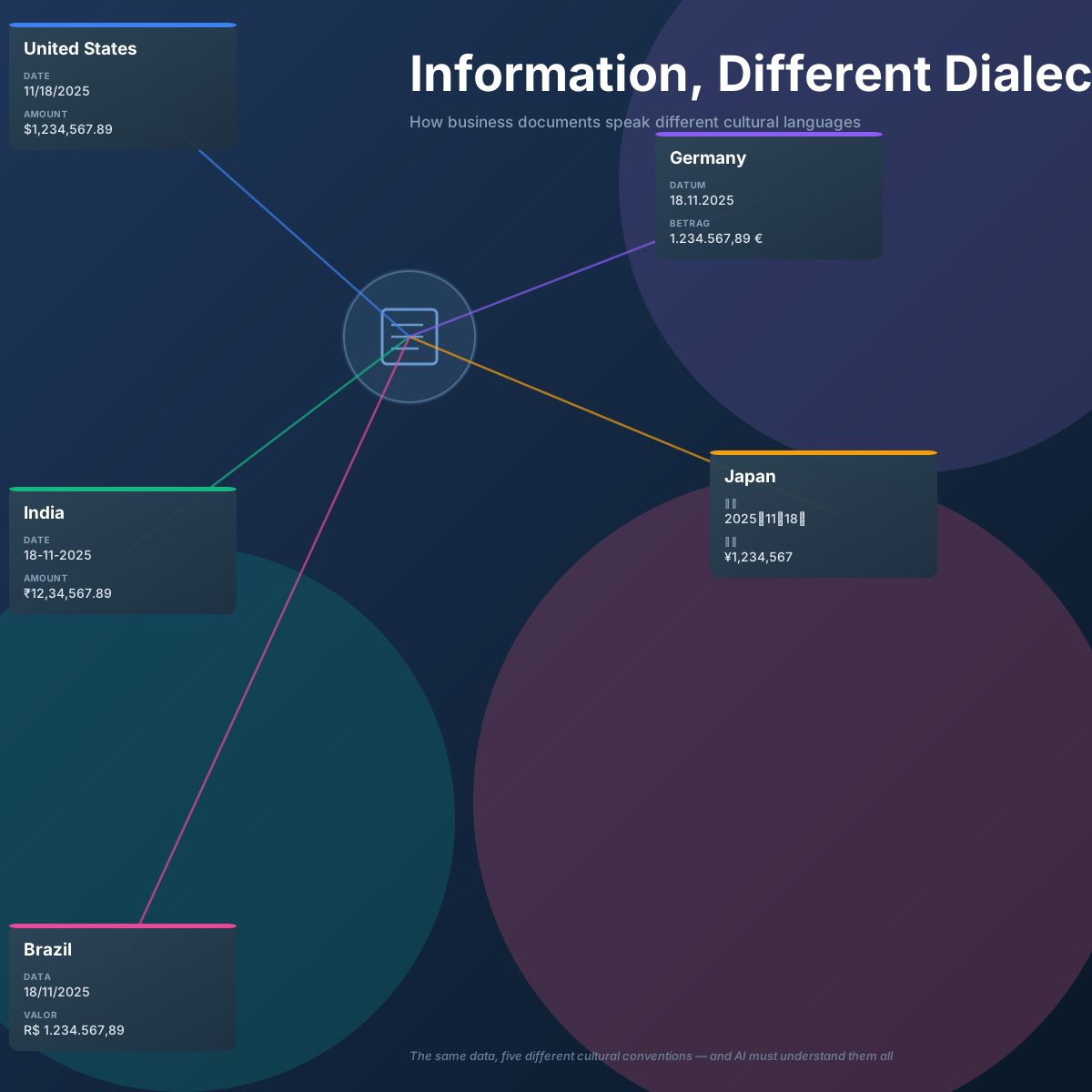
Address formats are another minefield. American addresses flow from specific to general (street number, street name, city, state, zip code). Japanese addresses flow from general to specific (prefecture, city, district, block number, building). British addresses include postal codes that look nothing like American zip codes. Indian addresses reference landmarks and building names that Western systems don't know how to categorize. Middle Eastern addresses often include emirate names or neighborhood designations that don't fit standard address parsing logic.
Then you get into business etiquette and formality conventions. German business documents tend to be extremely detailed and formal, with extensive legal disclaimers and precise technical specifications. American documents often prioritize brevity and bullet points. Japanese business communication includes layers of respectful language (keigo) that change the entire tone and structure of the document. Latin American business culture emphasizes relationship and context, so contracts and agreements often include personal relationship markers that North American systems might flag as irrelevant information.
Each of these differences is small on its own. But when you're processing thousands or millions of documents from dozens of different countries, these small differences compound into massive operational challenges.
The Regulatory Dialect Layer
Business culture differences are just the beginning. Every country has its own regulatory requirements that get baked into document structure, and these requirements create another layer of dialect complexity.
A global logistics company shared their experience processing shipping documents across 40 countries. Each country's customs documentation followed completely different formats, used different terminology for the same concepts, and required different supporting information. A bill of lading from Singapore looked nothing like a bill of lading from Rotterdam, even though both documents served the exact same legal and operational purpose.
The real challenge wasn't just the different formats. It was the different regulatory assumptions embedded in each document. European Union invoices require VAT numbers in specific formats and include reverse charge mechanisms that don't exist in American tax law. Indian GST invoices mandate HSN codes (Harmonized System of Nomenclature) that need to be validated against a government database. Australian invoices for businesses above a certain size must include ABN (Australian Business Number) details. Brazilian fiscal documents require specific NFe (Nota Fiscal eletrônica) numbers that connect to federal tax authorities in real-time.
An AI system trained on American invoices doesn't just need to learn how to read these different fields. It needs to understand what these fields mean, how they connect to each other, and what validation rules apply. It needs to know that a German VAT number follows a different format than a French VAT number, even though both are part of the same EU tax system. It needs to recognize that Indian GSTIN numbers encode geographic information in their structure. It needs to understand that Canadian invoices might need to be bilingual depending on the province.
Financial services face an even more complex regulatory dialect challenge. Banking documents in the United States reference routing numbers and account numbers in specific formats. European banking uses IBAN (International Bank Account Number) and BIC/SWIFT codes. Indian banking documents include IFSC codes. Each system has its own validation rules, its own structure, its own embedded assumptions about how banking works.
A multinational bank processing loan applications discovered that their document AI kept rejecting valid identity documents from certain countries because the AI expected identity documents to follow American conventions like Social Security numbers and state-issued driver's licenses. When applicants submitted Aadhaar cards from India, CPF documents from Brazil, or resident registration numbers from South Korea, the AI didn't know what to do with them. The documents were perfectly valid in their home countries, but the AI had no cultural context for understanding them.
When Formality Speaks a Different Language
One of the most subtle but expensive dialect differences shows up in business formality and communication conventions. This creates problems that go beyond simple data extraction and affect how AI systems understand document relationships and business context.
A European shared services center processing contracts from multiple countries noticed that their AI system consistently misidentified contract terms when processing agreements from different regions. The issue wasn't accuracy in reading the text. The problem was that different business cultures structure contracts differently, emphasize different information, and use different linguistic patterns to express the same legal concepts.
German contracts tend to be exhaustively detailed, with precise technical specifications and extensive legal clauses covering every conceivable scenario. The formality level is high, and the language is dense. American contracts often prioritize actionable bullet points and clear deliverables, with formality that varies by industry but generally aims for clarity over comprehensiveness. Japanese contracts frequently include relationship and context markers that Western readers might consider unnecessary, but which carry significant legal and business weight in Japanese business culture.
The AI system kept flagging Japanese contracts as missing critical information because it expected the direct, explicit deliverables common in American contracts. Meanwhile, it was getting overwhelmed by the sheer volume of detail in German contracts, struggling to identify which clauses were standard boilerplate and which represented the actual unique terms of this specific agreement. Latin American contracts included extensive relationship context and personal assurances that the AI interpreted as extraneous information rather than legally relevant relationship terms.
Business correspondence creates similar challenges. Email communication from North American business partners tends to be relatively informal and brief. German business emails follow more rigid formality structures. Japanese business emails include layers of respectful language and indirect communication that can seem verbose to American readers but which carry precise meaning within Japanese business culture.
An AI system processing business correspondence to extract action items, deadlines, and commitments needs to understand these cultural communication patterns. When a Japanese business partner writes "we will consider your request with great care," that's not a commitment to act. But when they write "we will make positive efforts toward your request," that's actually a much stronger commitment than the literal English translation suggests. An AI trained on American business communication might completely misinterpret the level of commitment in each statement.
For global supply chains, document dialect problems create operational chaos that ripples through entire networks. A major automotive manufacturer discovered this the hard way when they tried to automate their purchase order and invoice matching across their global supplier network.
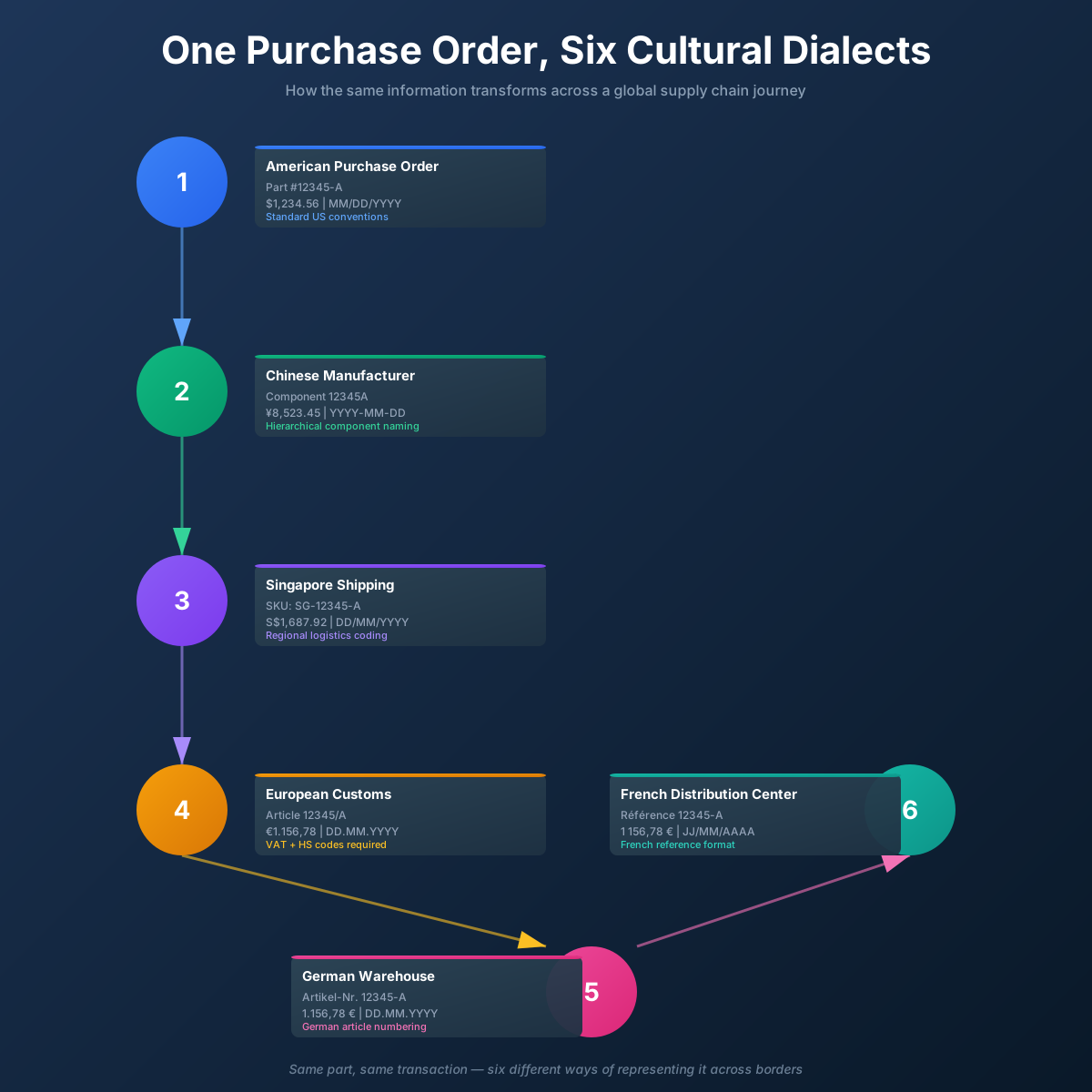
American suppliers sent purchase orders with line items organized by part numbers and SKUs. European suppliers organized the same information by product categories and subcategories. Asian suppliers included hierarchical component relationships that showed how parts related to assemblies. Each format was completely valid and functional within its regional business context, but the AI system couldn't recognize that these were all different dialects of the same fundamental information.
Invoice matching became a nightmare. The AI kept failing to match invoices to purchase orders because it couldn't understand that "Part #12345-A" in the American PO was the same as "Component 12345A" in the Asian invoice was the same as "Article 12345/A" in the European invoice. Different naming conventions, different formatting, different organizational logic, all pointing to the exact same physical part.
Shipping documents added another layer of complexity. Bills of lading, packing lists, and customs declarations all followed different formats depending on the origin and destination countries. Container tracking numbers followed different conventions in different regions. Incoterms (international commercial terms) got interpreted differently across cultures, leading to confusion about who was responsible for what during shipping.
The manufacturing company eventually calculated that these document dialect mismatches were causing an average of 3.7 days of delay in their supply chain, as documents got flagged for manual review and reconciliation. When you multiply those delays across thousands of shipments, the cost becomes staggering.
The Training Data Trap
Most enterprise AI systems learn from training data, and here's where the document dialect problem really starts to hurt. If your AI is trained primarily on documents from one geographic region or business culture, it's going to be biased toward that region's conventions.
A global accounting firm learned this lesson when they deployed a document processing system across their worldwide network of offices. The AI had been trained primarily on American and British financial documents. It worked beautifully in their New York, London, and Sydney offices. It struggled in their Mumbai, São Paulo, and Tokyo offices.
The problem wasn't that the AI couldn't read documents from these other regions. The problem was that the AI had learned to expect certain patterns, certain structures, certain conventions from its training data. When it encountered documents that followed different but equally valid patterns, it didn't know how to handle the variation.
Indian financial statements include different reporting categories than American GAAP or British IFRS standards. Brazilian tax documents reference a complex multi-tiered tax system that doesn't exist in other countries. Japanese accounting statements organize information according to different principles of what information matters most.
The accounting firm tried to fix the problem by adding more training data from each region. But this created a new problem: the AI started getting confused about which conventions to apply when. Should it look for VAT numbers or sales tax? Should it expect amounts in lakhs or millions? Should it interpret a date as DD/MM/YYYY or MM/DD/YYYY? The AI needed more than just diverse training data. It needed cultural intelligence to understand context.
The False Solution: Region-Specific Systems
Many companies try to solve the document dialect problem by building or buying separate AI systems for different regions. On the surface, this seems logical. Train one AI on American documents, another on European documents, a third on Asian documents. Each AI becomes an expert in its regional dialect.
A multinational insurance company went this route. They deployed different document processing systems in each of their major markets, each one carefully trained on local document conventions. Initially, the results looked promising. Their American system handled American claims beautifully. Their European system excelled at European documentation. Their Asian system understood Asian business culture.
Then reality hit. The company operated globally, which meant documents rarely stayed within regional boundaries. An American policyholder filing a claim for an incident that happened in Germany submitted both American and German medical documentation. A European corporate client with operations in Singapore needed to submit documents from multiple countries for a single claim. An Asian manufacturer shipping products to American customers generated documentation that blended Asian and American conventions.
The regional systems couldn't talk to each other effectively. Documents that mixed conventions fell into processing limbo. The insurance company found themselves manually routing documents to the "right" system, defeating the entire purpose of automation. They also discovered they were paying for and maintaining multiple separate AI systems when they really needed one system with genuine cross-cultural intelligence.
Building separate systems also created a maintenance nightmare. Updates and improvements had to be rolled out multiple times across different systems. Business logic that applied globally had to be coded separately for each regional system. When they wanted to add new capabilities, they had to build them three or four different times.
The regional approach also failed to capture the reality of modern business documentation. Today's business documents increasingly reflect the multinational nature of business itself. A contract negotiated between an American company and a Chinese manufacturer might be drafted in Singapore using British legal conventions. An invoice from a German company with manufacturing in Thailand might reference both European and Asian regulatory requirements. A financial statement from a Brazilian subsidiary of an American parent company needs to satisfy both Brazilian accounting standards and American SEC reporting requirements.
You can't solve a document dialect problem by building walls between regions. You need a system that actually understands cultural context and can navigate across dialects fluently.
What Cultural Intelligence Actually Means in Document AI
Real cultural intelligence in document processing goes way beyond recognizing different date formats or number conventions. It means understanding the deep context of how different business cultures think about documentation itself.
Take payment terms as an example. In Western business culture, payment terms are typically explicit and numerical. "Net 30" means payment is due 30 days after the invoice date. But in many Asian business cultures, payment terms are often contextual and relationship-based. The formal payment terms on the invoice might say "Net 45," but the actual expected payment timing depends on the business relationship, the current market conditions, and the mutual understanding between the trading partners. An AI that just extracts "45 days" from the document is missing the cultural context that makes that number meaningful.
Cultural intelligence means recognizing that formality levels in documents carry meaning. When a Japanese business partner sends an unusually formal communication, that formality itself is a signal. When a German supplier provides less detail than usual, that deviation from cultural norms indicates something worth noting. An AI with cultural intelligence doesn't just process the content of the document. It understands what the style and structure are communicating.
It also means understanding relationship markers. In many business cultures, the relationships between parties matter as much as the transactional details. Who signed the document? What's their position in the organizational hierarchy? What language choices did they make in the document? These relationship markers don't typically appear as structured data fields, but they carry significant meaning for anyone who understands the cultural context.
A truly culturally intelligent document processing system needs to recognize when a document is following conventions from multiple cultures. A shipping document that moves goods from Thailand to Germany through Singapore might legitimately incorporate Thai business conventions, Singaporean legal structures, and German regulatory requirements all in one document. The AI needs to recognize which elements come from which cultural context and interpret each appropriately.
Building the Translation Layer
So what does the solution actually look like? How do you build a document processing system that can handle cultural dialects without requiring a team of anthropologists to train and maintain it?
The answer lies in what we might call a cultural intelligence layer. This sits between the document and the processing logic, translating not just languages but cultural conventions into a universal understanding.
Think of it as having an experienced international business professional reviewing each document before processing. This person recognizes a German VAT number even though it's formatted differently from a French VAT number. They know that an Indian address referencing a landmark is just as valid as an American address with a street number. They understand that respectful language in a Japanese business email carries specific meaning beyond the literal translation. They can recognize when a document is blending conventions from multiple cultures because it's documenting a genuinely multinational transaction.
Advanced AI agents can now provide this cultural intelligence layer. Instead of just pattern-matching against training data, these agents understand context. They recognize that an invoice from India should be interpreted using Indian business conventions. They know that a contract drafted in Singapore might follow British legal structures. They understand that a shipping document moving between multiple countries needs to be interpreted with multiple cultural contexts in mind.
The cultural intelligence layer works by maintaining a rich understanding of business conventions across different regions and cultures, then applying the appropriate context to each document. When processing an invoice, the AI doesn't just extract fields. It first determines what cultural context this invoice comes from, then applies the right interpretive framework.
This approach solves several problems at once. It eliminates the need for multiple regional systems, since one culturally intelligent system can handle documents from any region. It handles documents that mix conventions, since the AI can recognize and appropriately interpret elements from multiple cultural contexts within a single document. It reduces the training data requirement, since the AI is learning cultural patterns rather than just memorizing specific document formats.
Most importantly, it scales gracefully. When your business expands into a new market, you don't need to train an entirely new AI system. You extend the cultural intelligence layer with knowledge of the new market's business conventions. The core processing logic remains the same. Only the cultural interpretation layer needs updating.
The Real-World Impact
A global pharmaceutical distributor implemented culturally intelligent document processing across their network of suppliers in 35 countries. Within the first six months, they saw remarkable changes in their operations.
Document processing errors dropped by 67%, but not because the underlying OCR accuracy improved. The errors dropped because the AI stopped flagging cultural variations as mistakes. An invoice from India using lakhs and crores was no longer an error requiring manual review. It was just Indian number formatting, which the AI now understood perfectly.
Processing time decreased by 43% on average, with even bigger improvements for documents from regions whose conventions differed most from the company's original (American-centric) AI training. The speed improvement came from eliminating manual review and correction of documents that were actually perfectly valid but just followed different cultural conventions.
The most dramatic improvement showed up in their supplier relationships. Suppliers in Asian and Latin American markets had been frustrated by constant requests to reformat their invoices to match American conventions. Many suppliers had been manually reformatting their documents to avoid processing delays, creating extra work and increasing the likelihood of errors. With culturally intelligent processing, suppliers could submit documents in their natural regional format, and the system handled them correctly the first time.
The finance team calculated that the cultural intelligence layer was saving them approximately $2.1 million annually in reduced processing costs, faster payment cycles that captured early payment discounts, and improved supplier relationships that led to better pricing terms. The system paid for itself in less than four months.
But the strategic value went beyond the immediate cost savings. The pharmaceutical company could now expand into new markets without worrying about document processing compatibility. When they acquired a distributor in Brazil, integrating their Brazilian supplier documents into the global processing system took weeks instead of months. The cultural intelligence layer just needed to learn Brazilian business conventions. The rest of the system didn't need to change.
Beyond Documents to Business Intelligence
The most interesting benefit of culturally intelligent document processing isn't just better document processing. It's the business intelligence that emerges when you can actually compare practices across cultures.
A global manufacturing company using culturally intelligent document AI started noticing patterns that their previous region-specific systems had completely missed. They discovered that their European suppliers consistently provided more detailed technical specifications in their invoices than their American suppliers, even for identical parts. This wasn't an error or an inconsistency. It was a cultural difference in how European and American manufacturing businesses think about documentation detail.
That observation led to a valuable insight. The detailed European specifications were actually preventing quality issues downstream in assembly. The company started encouraging their American suppliers to adopt more detailed specification documentation, improving quality across their entire supply chain. They never would have spotted this pattern if their AI had just been normalizing everything to American conventions instead of understanding and preserving the cultural variations.
Another company discovered that payment patterns varied significantly across cultures in ways their previous analysis had missed. When they looked at raw payment data, it seemed like some regions were consistently slower to pay. But when they analyzed the data with cultural intelligence, they realized that in certain markets, the formal payment terms on invoices didn't reflect the actual business practice. Suppliers in these markets were quoting longer payment terms on the invoice but expecting faster payment based on relationship and context. The company adjusted their working capital planning to reflect the actual payment dynamics rather than just the formal invoice terms, improving their cash flow forecasting accuracy by 28%.
Cultural intelligence in document processing also reveals competitive insights. When you can analyze supplier documents, customer contracts, and market materials from multiple regions while preserving their cultural context, you start to understand how business practices differ across markets. You can spot opportunities where a practice common in one market might create competitive advantage if applied in another market. You can identify risks where your company's standard practices might clash with local business culture in ways that hurt relationships or create compliance issues.
The Path Forward
Document dialects aren't going away. If anything, they're becoming more complex as businesses become more global and as emerging markets develop their own unique conventions for digital business documentation.
The old approach of trying to standardize everything to one cultural convention doesn't work in a genuinely global business environment. The regional systems approach creates more problems than it solves. The only viable path forward is building genuine cultural intelligence into document processing systems.
This requires thinking about document AI differently. Instead of just training systems to recognize patterns in documents, we need to teach systems to understand the cultural context that makes those patterns meaningful. Instead of treating cultural variations as errors to be corrected, we need to build systems that recognize cultural variations as valuable context to be preserved and understood.
The good news is that the technology to do this is available now. AI agents with sophisticated contextual understanding can learn cultural conventions and apply them appropriately. The challenge is recognizing that this is the right approach and building systems accordingly, rather than continuing to force global documents into a single cultural framework.
For businesses operating globally, the document dialect problem represents both a challenge and an opportunity. It's a challenge because ignoring cultural context in documents creates expensive errors, delays, and missed opportunities. It's an opportunity because businesses that solve the cultural intelligence problem gain a significant competitive advantage in global operations.
Your documents speak dialects. The question is whether your AI systems understand what they're saying. The companies that build genuine cultural intelligence into their document processing won't just process documents faster and more accurately. They'll understand their global operations at a deeper level, build stronger relationships with international partners, and compete more effectively in the genuinely global business environment that defines modern enterprise operations.
The cultural translation layer isn't just about fixing errors. It's about building the intelligence foundation for truly global business operations in an increasingly interconnected world.