

Blog
Why Staffing Agencies Are Drowning in Paper (and What to Do About It)
Stop the Friday afternoon chaos. Learn how document intelligence automates staffing operations, from rapid contractor onboarding to error-free timesheet processing.
Blog
Stop the Friday afternoon chaos. Learn how document intelligence automates staffing operations, from rapid contractor onboarding to error-free timesheet processing.
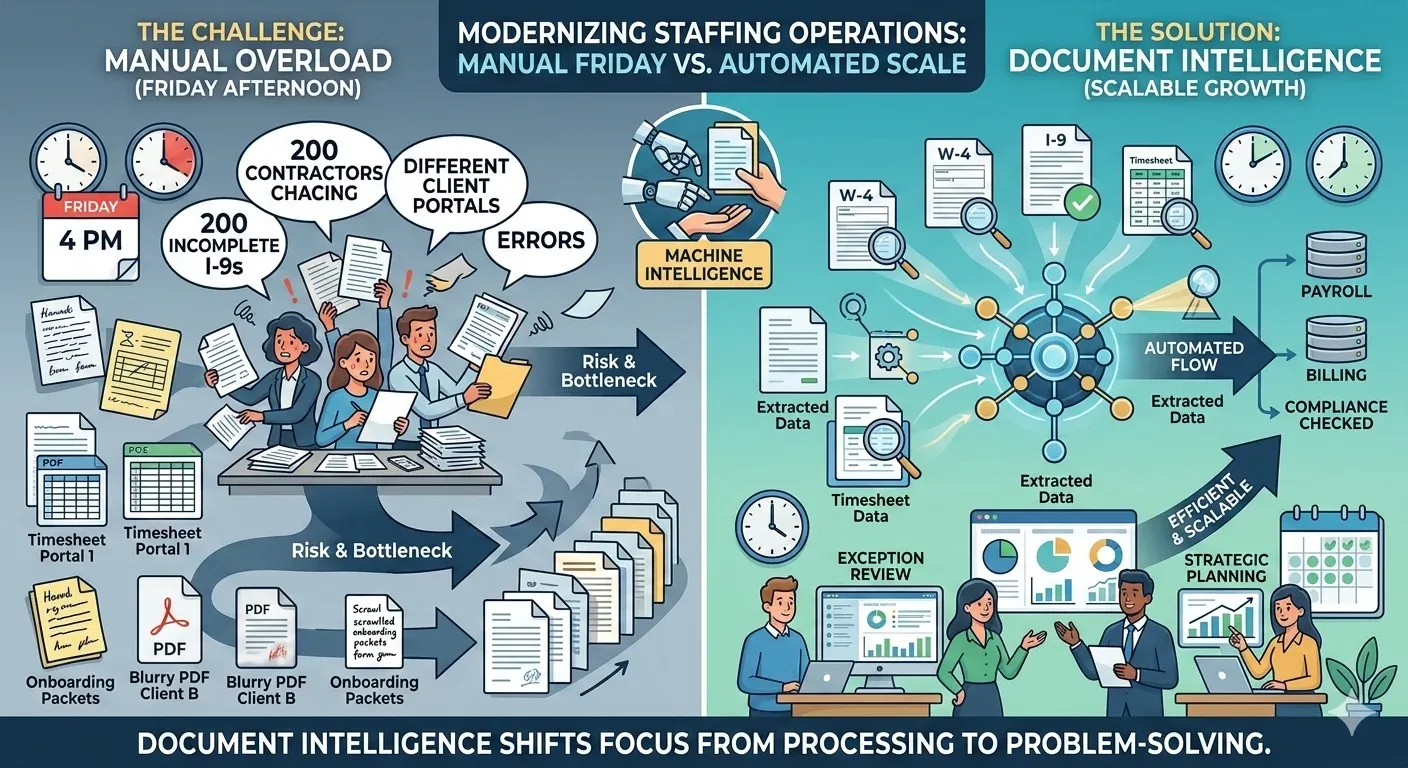
Picture this: It's Friday afternoon. Your operations team is chasing down 200 contractor timesheets, each one formatted differently, some handwritten, some exported from three different client portals, a few scanned and emailed as blurry PDFs. Meanwhile, the onboarding queue has backed up again. Eight new contractors start Monday, and their I-9s, direct deposit forms, and client-specific compliance docs still need to be processed, verified, and filed.
This isn't a staffing agency having a bad week. It's the industry standard.
Staffing and workforce solutions firms operate at a scale that makes manual document handling genuinely unsustainable. A mid-size agency placing 500 active contractors might process thousands of documents every week, from onboarding packets and certifications to weekly timesheets and expense reports. The administrative overhead is enormous, and it keeps growing as the contractor workforce expands.
The problem isn't that agencies lack good people. It's that those people are spending their time on work that shouldn't require humans at all.
Staffing agencies deal with many types of documents, but two categories create the most operational drag. Contractor onboarding documentation and timesheet processing together account for the majority of back-office hours in most agencies. They're also the two areas where manual handling introduces the most risk.
Onboarding at scale is brutal. When you're placing 50 contractors a month, every new hire triggers a cascade of documents. Employment eligibility forms, background check authorizations, tax withholding elections, direct deposit setups, client-specific NDAs, safety acknowledgments, benefits enrollment forms. Each one needs to be collected, reviewed for completeness, verified for accuracy, and routed to the right place. Miss something, and you delay the contractor's start date. Miss something bigger, and you've got a compliance problem.
Agencies that grow quickly discover that their onboarding process doesn't scale with them. What worked at 100 active contractors becomes a bottleneck at 300. The manual review steps that seemed manageable become the constraint that limits how fast the agency can grow.
Timesheet processing compounds the problem weekly. Contractors submit hours through a dozen different mechanisms: paper forms, PDFs, client portal exports, Excel spreadsheets, photos of written timesheets. Each submission needs to be read, matched to the right client and project code, validated against contract terms, and approved before payroll can run. When a timesheet is wrong, someone has to catch it, find the contractor, get a correction, and reprocess.
At scale, even a 5% error rate means dozens of corrections every pay period. Multiply that across a year and you're looking at thousands of manual intervention points, each one eating time and introducing delay risk.
The traditional answer to document volume is to hire more administrative staff. Add headcount when the queue backs up, add more when it backs up again. This works, but it's expensive, it's slow to ramp, and it doesn't get more accurate as you scale.
Document intelligence platforms approach the problem differently. Instead of routing documents to people for manual data entry, the system reads the documents directly, extracts the relevant data, validates it against business rules, and either processes it automatically or flags specific exceptions for human review.
The shift matters for two reasons. First, machines don't get tired or make transcription errors. A system that correctly reads a timesheet at 9 AM reads it just as correctly at 9 PM on a Friday, whether it's the 10th or the 10,000th document of the day. Second, the bottleneck moves. Instead of humans reviewing every document, humans only review documents that actually need attention. That changes the math significantly.
For staffing agencies, this means the same back-office team that previously handled 200 contractors can handle 500, or 1,000, without linear headcount growth. 
The onboarding process in most staffing agencies follows the same basic shape. A new contractor is placed. A coordinator sends them a packet of forms. The contractor fills them out, sometimes correctly, often not. The forms come back. Someone reviews them. Errors get flagged. The contractor gets contacted. Corrections are made. The file gets assembled and routed for approval. The contractor can start.
That cycle typically takes two to five days when handled manually. Longer if the contractor is slow to respond. Longer still if the reviewer catches something that requires going back to the client.
Automated onboarding changes the shape of the process. The contractor still fills out their forms, but instead of the completed documents sitting in a coordinator's queue, an AI reads them immediately. It checks that required fields are present. It validates Social Security numbers against expected formats. It compares signatures against document requirements. It flags anything that's missing or potentially incorrect, and it does this in seconds rather than hours.
The human coordinator now sees a processed file with clear flags rather than a raw stack of documents to review from scratch. They can focus on the flagged items and approve the complete ones quickly. That two-to-five-day cycle compresses to same-day or next-day for most cases.
For large-scale placements, the impact compounds. When a client needs 50 contractors placed in a two-week window, the difference between manual and automated onboarding isn't just administrative convenience. It's whether the placement is actually executable on the client's timeline.
Compliance is the other dimension that matters here. Employment eligibility documents have expiration dates. Certifications lapse. Background check authorizations have specific language requirements that vary by state. Manual review depends on coordinators knowing every rule and applying it consistently under time pressure. Automated systems apply rules consistently every time, and they can flag expiring documents proactively before they become compliance failures.
The financial stakes in timesheet processing are higher than they look. A wrong rate applied to 40 hours of work. A project code that routes billing to the wrong client account. An overtime calculation that doesn't reflect the contractor's actual start time. These aren't abstract data quality problems. They're billing errors, payroll errors, and client disputes waiting to happen.
Manual timesheet processing catches some errors, but not all. Reviewers get fatigued. Unusual edge cases get missed. And when an error makes it through to invoicing, the recovery process is expensive because it touches multiple systems and often requires client communication.
Document intelligence handles timesheet processing differently by reading the document itself, not just the data the contractor typed into a form. This matters because contractors submit timesheets in many formats. A system trained on the variety of timesheet types that staffing agencies actually receive can extract hours, dates, project codes, supervisor signatures, and exception entries regardless of whether the timesheet came from a client portal, a scanned PDF, or a formatted spreadsheet.
Extracted data gets validated against contract terms automatically. If the agency has placed a contractor at a client with an approved rate of $85 per hour, and the submitted timesheet shows $90, that gets flagged immediately. If the hours cross into an overtime threshold that requires client approval, the system routes for approval before processing. Exceptions that need human judgment get flagged. Everything else flows through.
The result is a much shorter list of things requiring human attention. A team that used to review 500 timesheets manually now reviews 40 exceptions. The 460 that were clean process automatically. Payroll runs faster, billing goes out sooner, and the error rate that drives costly corrections drops substantially.

Document intelligence adoption has been fastest in industries with high-volume, high-stakes document workflows. Healthcare does it for clinical records. Financial services does it for loan applications and KYC. Staffing is a natural fit for the same reasons, but with some additional characteristics that make the ROI particularly clear.
The document types in staffing are repetitive. An agency sees the same form types constantly: I-9s, W-4s, direct deposit authorizations, client-specific onboarding packets. This repeatability means a document AI that's trained on staffing documents performs very well from the start. It's not learning on the job; it knows what a W-4 looks like and what data to extract.
The volume is predictable. Agencies can forecast roughly how many new placements they'll make in a quarter and how many timesheets they'll process each pay cycle. That predictability makes it straightforward to calculate what automation would free up and plan accordingly.
The compliance stakes are real and growing. State-level employment law complexity has increased significantly over the past decade. Agencies operating across multiple states deal with a patchwork of rules around document requirements, pay frequency, overtime calculations, and record retention. Manual compliance management is a significant liability. Automated systems that apply rules consistently reduce that liability considerably.
And the competitive pressure is intensifying. Clients increasingly evaluate their staffing partners on operational reliability, not just placement quality. An agency that can onboard contractors faster, process timesheets accurately, and provide clean documentation on demand is a stronger partner than one that does the same work slower with more errors.
The staffing agencies seeing the most value from document automation aren't necessarily the largest ones. They're the ones growing fastest, or the ones with particularly document-heavy operations because of the industries they serve.
A healthcare staffing agency placing travel nurses deals with credential verification at a level that would be unmanageable without automation. Licenses, certifications, immunization records, background checks, HIPAA training confirmations: each placement generates a significant documentation load, and the stakes of getting it wrong are high.
An industrial staffing firm placing warehouse and manufacturing workers at seasonal scale faces a different version of the same problem. When client demand spikes, the agency needs to onboard large cohorts quickly. If that process takes five days per person manually, the math doesn't work. If it takes same-day with automated processing, the agency can actually meet the client's ramp schedule.
A professional services firm placing IT contractors deals with NDA complexity and client-specific onboarding requirements that vary widely. Tracking which contractors have signed which client-specific agreements, ensuring no one starts work without required documentation, and managing renewals: this is exactly the kind of structured document workflow that automation handles well.
The pattern across these examples is the same. High document volume, repetitive document types, compliance requirements, and time pressure. That's the environment where document intelligence earns its keep.
The implementation question matters because staffing agencies are operations-heavy businesses that can't afford significant disruption. You can't pause onboarding for a month while a new system goes live.
The practical approach for most agencies is to start with the highest-volume, most standardized document type: typically timesheets. Timesheets are processed weekly, they follow predictable formats, and the downstream impact of getting them right is immediate and measurable. An agency that automates timesheet processing in the first phase has a clean proof of concept, tangible time savings, and operational data to inform the next phase.
Onboarding automation typically follows, starting with the most common document types and expanding coverage as the system learns the agency's specific document mix. Client-specific requirements get added as configurations rather than requiring new training from scratch.
The agencies that succeed with this approach share a few characteristics. They have a clear picture of their current document volume and error rates. They set realistic expectations about what automation handles and what still needs human judgment. And they treat the first phase as a learning investment, not just a cost reduction exercise.
The agencies still running this on coordinator bandwidth and Friday afternoon chaos are the ones watching their costs climb while their competitors accelerate.
Staffing agencies that have moved to document intelligence describe a similar experience: the administrative bottleneck shrinks, and the team's attention shifts from processing to problem-solving. Coordinators spend less time reading documents and more time helping contractors navigate complex situations. Operations managers spend less time chasing corrections and more time building client relationships.
That's not a minor quality-of-life improvement. It's a fundamental change in what your back office actually does, and what it can accomplish at scale.
The agencies growing fastest right now aren't the ones with the largest teams. They're the ones that figured out which parts of their operation should be handled by people and which parts should be handled by software. Timesheet processing and contractor onboarding are well into the "software should handle this" category.
The sooner a growing agency makes that shift, the more of its growth it gets to keep.

Head IT Operations - Co Founder of Artificio
See it in your SAP environment
Bring us a document, a process, or a bottleneck. We'll show how Artificio captures, validates, and posts into SAP — then scale from there.
Security & compliance
ISO 27001:2013 certified, SOC 2 Type 2 compliant, GDPR and HIPAA ready. Every agent action is logged, auditable, and runs in isolated environments.