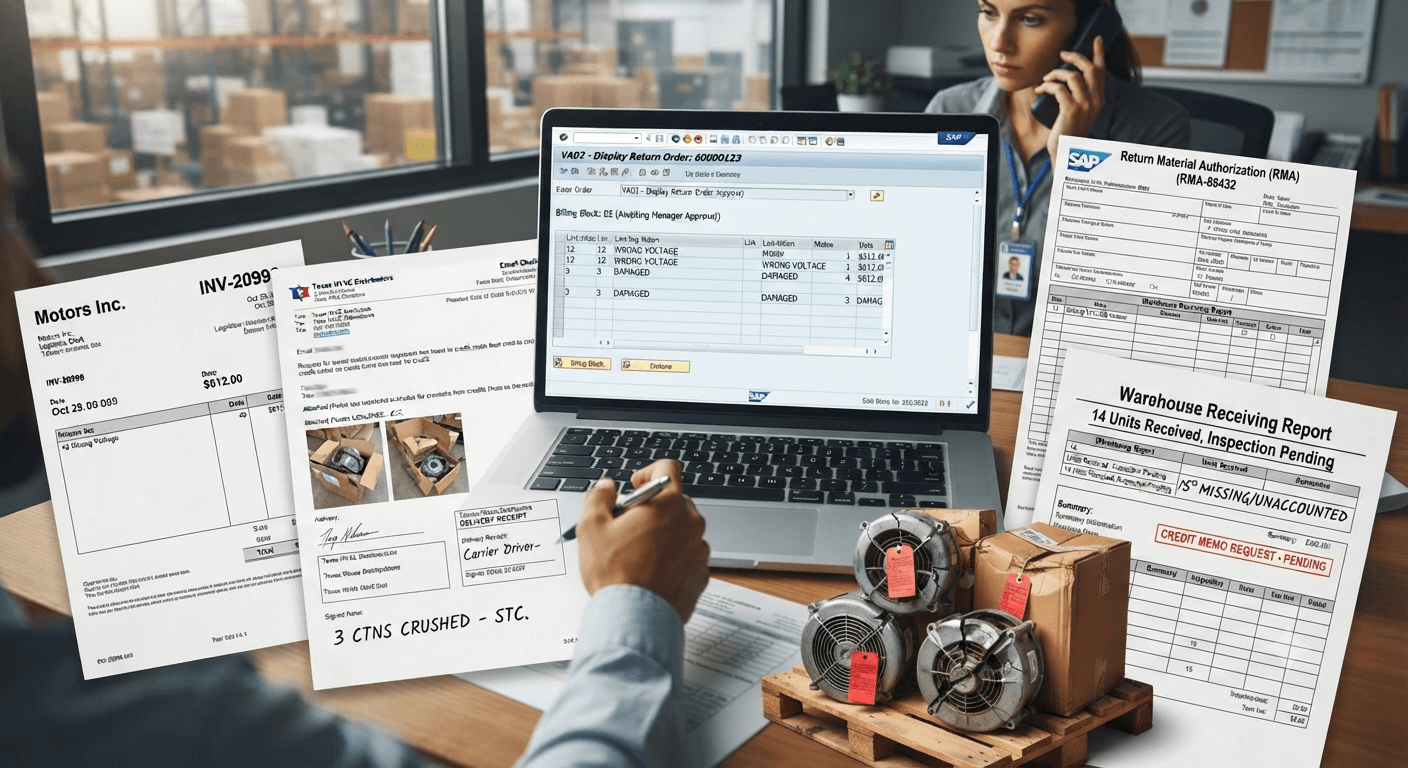
On 4 November, an HVAC distributor in Texas emails its supplier, a manufacturer of fan motors and controls. The message is short. Of the 40 motors delivered last week, 12 are the wrong voltage. They ordered 208-volt units and received 460-volt. Another three arrived with crushed boxes and cracked housings, and the driver's delivery receipt notes the damage. Photos are attached. The distributor wants to send all 15 back and asks for a credit.
The motors sold for $612.00 each, so the distributor is expecting $9,180.00.
A customer service representative reads the email and starts typing a return order into SAP. She has to find the original invoice first. The customer quoted their own purchase order number, not the invoice number, so that takes twenty minutes. She enters 15 units, picks a return reason from the list and emails the customer a return authorization number. Then she moves on to the next of the 30 emails in her queue.
Three weeks later, the distributor's accounts payable team pays the next invoice short by $9,180. They have decided they have waited long enough and are taking the credit themselves. The supplier's collections team sees a short payment it cannot explain and opens a dispute. The credit memo request, meanwhile, is sitting in SAP with a billing block on it, waiting for a sales manager who has been traveling for ten days. Of the 15 motors, 14 are in the warehouse. Nobody is sure where the fifteenth is.
The companies and figures in this story are a composite, built to make a common pattern concrete. Every company that sells physical products handles returns, and almost every one of them finds that returns cost more time, cause more friction and leak more money than their volume would suggest. Most writing about sales automation, including ours, focuses on getting orders in. This post is about what happens when the goods come back.
Why returns are harder than orders
A sales order has one owner and one direction. Customer service takes the order, the warehouse ships it, billing invoices it and finance collects the cash. Each step hands a clean document to the next.
A return runs the same process backwards, and almost every step involves a judgment that nobody was asked to make on the way out.
Is the customer entitled to return this? That depends on the reason, how long ago it was bought and what the contract or return policy says. What did they actually pay? That depends on the original invoice, including any discounts or rebates, not today's price list. Did all the goods come back? That depends on the warehouse. Are they in a fit state to resell? That depends on someone opening the boxes. Who pays for the damage? That depends on whether the carrier, the customer or the company caused it. And how much credit is owed? That depends on all of the above.
Those judgments sit with five different teams. Customer service talks to the customer. The warehouse receives the goods. Quality, or someone in the warehouse, inspects them. A sales manager approves the credit. Finance issues it and deals with the payment. Each team sees only its own piece, and the documents that connect those pieces are rarely in the same place.
Think of returning a jacket to a shop. You hand it over at the counter, the assistant checks the receipt, looks at the jacket and refunds your card. One person, one counter, two minutes. Now imagine that the receipt is in one drawer, the jacket is taken to a back room, someone else decides whether it is damaged, a manager in another city has to approve the refund, and a fourth person processes it. And you, the customer, are standing at the counter the whole time, wondering where your money is.
How SAP expects a return to flow
SAP handles returns with a sequence of documents that mirror a sale.
It starts with a return order, which records what the customer is sending back, why, and with reference to which original sale. The goods come back against a returns delivery and are received into a stock status that keeps them separate from salable inventory until someone has looked at them. Once the return is checked, a credit memo request is created. That request usually carries a billing block, so that nobody issues a credit until someone with authority has approved the amount. When the block is removed, SAP creates the credit memo, which reduces what the customer owes.
In S/4HANA, many companies use the advanced returns process, which links the inspection result directly to what happens next. The inspector can record whether the goods go back to stock, go back to the original supplier, get repaired or get scrapped, and whether the customer receives a full refund, a partial one or none.
On paper this is a tidy, well-controlled process. In practice, every step depends on a person reading a document that came from somewhere else and typing what it says into SAP. The return email, the photos, the delivery receipt, the warehouse's notes, the inspector's findings and the customer's payment remittance all live outside SAP. The process works when someone carries the information from one document to the next. It stalls when they do not.
Six ways a return goes wrong
The same patterns keep turning up.
The return order is keyed from an email. Customers rarely quote the invoice number. They quote their own purchase order, a delivery date or just a product code. The representative has to find the right sale, then re-type quantities, products and reasons from a message that may describe them loosely. Typing 15 when the customer meant 12 good returns plus 3 damaged ones with a different reason, or picking the wrong original invoice when the same product was bought twice that month, sets up every later step to go wrong.
The goods arrive with no return order at all. Some customers simply ship goods back. The warehouse receives a pallet with a handwritten note, or nothing, and has no return order to receive it against. In many warehouses those pallets sit in a corner, often called the returns cage, until someone works out what they are. Meanwhile the customer believes the return is done.
The credit is for what was asked, not what arrived. The customer asks to return 15 units. Fourteen arrive. If the credit memo request was created from the return order, not from the receipt, the customer is credited for a motor that never came back. The opposite happens too. The customer sends back more than they said and receives credit for less.
The credit uses the wrong price. The original sale may have had a 6 percent volume discount, a promotional price or a rebate. If the credit is calculated from today's price list instead of the original invoice, the customer gets more back than they paid, or less. Both are bad. One is lost money. The other is an angry customer who will check every future credit.
The credit sits on approval while the customer deducts. The billing block is there for good reason, but approvers are busy and often away from their desks. When the credit takes weeks, customers stop waiting. They deduct the amount they think they are owed from their next payment. Now there are two problems. The credit is still pending, and there is an unexplained short payment in collections that looks like a dispute. If the credit is later issued and the deduction is not matched to it, the customer can end up credited twice.
Nobody recovers the cost. Every return has a reason, and many reasons have someone else to bill. Goods damaged in transit can be claimed from the carrier, but only with the delivery receipt, the photos and a claim filed in time. A component that failed under warranty can be claimed back from the supplier who made it. A picking error in the warehouse is an internal cost that quality should know about. When the reason is not captured clearly, or the evidence is lost, the recovery never happens and the company absorbs the whole loss.

What slow and messy returns cost
The first cost is the customer relationship, and it is easy to underestimate. A customer who has received the wrong goods is already annoyed. If the fix takes three weeks, they remember the three weeks, not the mistake. Distributors and retailers compare suppliers on how easy they are to deal with when something goes wrong. A supplier that turns returns around in days earns patience on the next order. One that takes a month gets its invoices deducted, its calls ignored and its terms renegotiated.
The second cost is cash and the collections workload. Every unilateral deduction becomes an open item that someone has to investigate, explain and match. Collections teams spend a surprising share of their time on short payments that turn out to be returns nobody finished processing. Those items also inflate days sales outstanding, because an invoice that the customer considers settled sits open on your books.
The third cost is leakage. Credits for units that never came back. Credits at the wrong price. Double credits when a deduction and a credit memo are never matched. Restocking fees that the return policy allows but nobody applied. Each one is small. Across a year of returns, they add up to real money that nobody can see, because every individual credit was approved.
The fourth cost is recovery that never happens. US carriers commonly allow nine months from delivery to file a claim for damaged goods, the minimum the law allows, and they will ask for the delivery receipt with the damage noted, photos and proof of value. A claim for three crushed motors is worth $1,836. That money is only recoverable if someone files the claim, with the evidence, before the deadline. In many companies the evidence is in a customer service inbox, and nobody whose job it is to file claims ever sees it.
The fifth cost is inventory. Returned goods that sit in the returns cage or in a blocked stock status are neither sold nor written off. Good stock that could be resold this week sits for a month. Faulty stock that should go back to a supplier under warranty misses the warranty window. And the stock figures that planning relies on are wrong by exactly the amount sitting in limbo.
The last cost is the lesson that never gets learned. Twelve wrong-voltage motors is not just a return. It is a signal that something in picking, labeling or product master data is wrong, and that it will happen again. If returns are handled as one-off chores, nobody spots the pattern.
Why the usual fixes do not stick
Most companies have tried a few things.
A returns form on the website. This helps capture the request in a structured way, and it is worth having. But many business customers still send emails, because their buyer already has your representative's address, and a form does nothing about the warehouse, the inspection or the approval.
A dedicated returns desk. Putting one person or team in charge of returns gives the process an owner. It also creates a bottleneck, and that person still has to chase the warehouse, quality and the approver for information.
Higher approval limits. Raising the amount a representative can credit without approval speeds up small returns. It does nothing for larger ones, and it removes a check on exactly the cases where price and quantity mistakes are most likely to slip through.
A weekly returns meeting. Getting customer service, the warehouse and finance in a room once a week to clear open returns works, slowly. It also means that a return created on Tuesday waits until next week's meeting for anyone to notice it is stuck.
What these fixes share is that they speed up one step without connecting the documents. The real gap is that the customer's email, the original invoice, the delivery receipt, the warehouse receipt, the inspection notes and the customer's payment are all separate, and someone has to carry information between them by hand.
Treating each return as one connected case
The approach that works is to treat each return as a single case that pulls every related document together and follows the goods from the first email to the final credit. That is work an agent can take on, so the people involved only make the decisions that need them.
Go back to the Texas distributor's email and watch what happens when an agent reads it first.
The agent reads the email and the photos. It recognizes a return request for two different reasons, 12 units of the wrong voltage and 3 units damaged in transit. It reads the customer's purchase order number and uses it, together with the product code and the delivery date, to find the original sale, its delivery and its invoice. It reads the invoice. The motors were invoiced at $612.00 each, with no discount on that line.
It reads the delivery receipt for that shipment, which the carrier's driver signed on delivery. There is a handwritten note: "3 cartons crushed." That matters, because damage noted at delivery is the evidence the carrier claim will depend on.
It reads the return policy in the customer's contract. Returns caused by the supplier's error get full credit, no restocking fee and a prepaid return label. Damage in transit is credited in full when it was noted on delivery. Other returns within 30 days carry a 15 percent restocking fee.
From all of that, it drafts the return order. Two lines, not one. Twelve units with the reason "wrong item shipped" and three units with the reason "damaged in transit," both referencing the right invoice and the invoiced price. It drafts the return authorization email to the customer, with a prepaid label and a request to keep the damaged cartons as they are for the carrier's inspection. A customer service representative checks the draft and sends it. That took four minutes, not forty.
When the goods arrive
Nine days later, the warehouse receives 14 cartons against the return. The agent reads the receiving record and the warehouse's notes. Twelve wrong-voltage motors, sealed in their original boxes. Two damaged motors, cracked housings confirmed, with the receiving clerk's photos attached. One damaged motor not yet received.
It reads the inspection result. The 12 wrong-voltage motors are in perfect condition and can go straight back to salable stock. The two damaged ones cannot be resold.
Then it proposes the credit, and the credit follows what actually arrived and what the policy allows. Fourteen motors at $612.00, or $8,568.00, now, with the remaining $612.00 to follow when the last motor arrives or the carrier confirms it lost it. It sends that proposal to the sales manager for approval, with a one-paragraph summary at the top. "Our picking error on 12 units, carrier damage on 3, noted at delivery. 14 received and inspected. Credit $8,568 now, $612 pending. No restocking fee under the contract." The manager is in an airport. She reads it on her phone, sees everything she needs and approves. The billing block comes off, and the credit memo is issued the same day.

The rest of the case: deductions, claims and lessons
The credit is not the end of the return. Three more things need to happen, and these are the ones most companies miss.
The deduction gets matched. If the distributor had already deducted $9,180 from a payment, the agent reads the payment remittance, recognizes the deduction as this return and links it to the new credit memo. Collections sees one open item for $612, clearly labelled as waiting for the last motor, instead of an unexplained short payment. Nobody opens a dispute. We will look at deductions more closely in a later post on retailer chargebacks, where they are even more common.
The carrier claim gets filed. The agent assembles the claim for the two damaged motors received so far, $1,224.00, with the signed delivery receipt showing the damage, the customer's photos, the warehouse's photos, the invoice proving the value and the carrier's tracking reference. It sends the pack to the logistics team to file, long before the deadline. If the third motor turns up damaged, it is added to the claim. If it never arrives, the claim covers it as lost. This is the same kind of document matching we described in delivery automation and proof of delivery matching, pointed at a different question.
The lesson gets passed on. Twelve wrong-voltage motors is not random. The agent raises a note for the warehouse and quality team with the order, the picked product and the ordered product. When they look, they find that the 208-volt and 460-volt versions sit in neighboring bin locations with labels that look almost identical. That is a ten-minute fix that prevents the next return. Our post on automating the paper trail quality teams live in covers how these signals feed into formal quality records.
The other returns: fees, policies and judgment calls
Not every return is the supplier's fault, and the same approach handles the harder ones.
Take a customer who ordered 50 thermostats, used 20 and wants to return 30 because a project was cancelled. The original order was 40 days ago. The agent reads the return request, finds the sale and reads the contract. Returns outside 30 days need sales approval and carry a 15 percent restocking fee. It drafts the return order with the fee applied and flags the 40-day timing for the sales manager. The manager decides whether to waive the fee for a large customer, and the agent records the decision and the reason. Nobody has to remember the policy, and nobody applies it inconsistently because they were in a hurry.
Or take a pallet that arrives at the dock with no return order and a note that just says "return." The agent reads the packing slip inside, the customer's name and the product codes, finds the most likely original sale and asks customer service to confirm. The pallet leaves the returns cage on the day it arrives, not the week after.
Or take a warranty return of a motor that failed after eight months. The agent reads the customer's description of the failure, finds the sale, checks the warranty period and reads the inspection report, which confirms a bearing failure. The customer gets a replacement or credit under warranty, and the agent also prepares a claim against the bearing's supplier, if the supply agreement allows it. That turns a cost into a recovery.
In every case, the agent drafts and connects. People decide. The approval to credit stays with sales, the decision on condition stays with the inspector, and exceptions to policy stay with the person who owns the customer relationship. Every decision is recorded with the evidence behind it, which is what auditors look for when they test credits, as we explained in what auditors actually look for in an automated audit trail.
How returns connect to the rest of sales
Returns are the other end of order intake, and they share its documents. If your team already uses automation to read incoming purchase orders, as we described in automating the inbound side of sales order processing, the same reading and matching handles return requests that arrive in the same inbox.
They also connect to order to cash as a whole. A fast, accurate credit keeps the customer's account clean, which keeps collections focused on real overdue invoices. It keeps the customer's payments whole, because they have no reason to deduct. And it keeps the cash application process simple, because payments match invoices and credits without a pile of unexplained differences.
And they connect to inventory and quality. Returned goods that get inspected and moved back to salable stock quickly are inventory you do not have to buy again. Faulty goods that get sent back to their supplier within the warranty period are a cost someone else pays. Reasons that get captured consistently turn into a clear picture of what goes wrong, and where.
Getting started
A few steps make a big difference quickly.
Find out where return requests arrive today. Usually it is a mix of a customer service inbox, individual representatives' inboxes and a web form. Connect them so that every request starts a case in the same place.
Write down your return rules. Return windows, restocking fees, who pays return freight, how damage in transit is handled and which reasons need approval. Many companies find that their rules exist only in people's heads, or differ between contracts. Written rules make every credit consistent and make exceptions visible.
Make the warehouse receipt the trigger for credit. Credits should follow what arrived and was inspected, not what was asked for. That single change stops most over-credits.
Agree on approval limits that match risk. Small, clear-cut credits, such as the supplier's own picking error with goods received, can be approved quickly. Larger credits and policy exceptions go to a manager, with the evidence summarized so the approval takes a minute.
Connect deductions to returns. Ask collections how many short payments last quarter turned out to be returns. The answer usually makes the case for the whole project.
Measure three numbers. Days from return request to credit. Credits issued for goods not received. Carrier and supplier claims filed as a share of eligible returns. The first tells you how customers experience returns. The second tells you what you are losing. The third tells you what you could be recovering.
Back in Texas
Picture the distributor's next return, a month later. Four motors, the wrong model this time, the customer's own ordering mistake.
The buyer emails at 10:15. By 10:30, the representative has checked and sent a drafted return authorization with the 15 percent restocking fee explained and a return label attached. The motors arrive six days later and are inspected the same afternoon. The credit, less the fee, is approved by the sales manager from her phone and issued the next morning. The distributor's next payment matches the invoices and the credit to the cent. Nobody deducts anything, nobody opens a dispute and nobody wonders where the money is.
The 12 wrong-voltage motors from the first return were resold within a week. The carrier paid the damage claim in full. And the warehouse has not picked a 460-volt motor for a 208-volt order since the labels were changed.
Returns will never be anyone's favorite part of the business. But they do not have to be the part where good customers become frustrated ones. The documents that tell you what happened, what was paid, what came back and who should cover the cost already exist. They just need to be read together, by something that does not lose track of them between one team and the next.
If returns are where your sales process slows down, send us a few recent return cases with the emails and paperwork behind them. We will show you how they would look as connected cases.