Your accounts payable team has detailed standard operating procedures. You've invested in automated workflows. Your document extraction AI boasts impressive accuracy rates. Everything runs smoothly, invoices flow through the system, approvals happen on schedule, and payments go out on time. Then your senior invoice processor takes a two-week vacation. Within three days, the exception queue has exploded. Processing times have doubled. Errors that haven't happened in months are suddenly popping up everywhere. Your "automated" system, the one you spent significant budget on, seems to be falling apart at the seams.
What happened? The software didn't change. The procedures are the same. The documents coming in look identical to the ones processed last week. The answer lies in something nobody talks about in document automation circles: the invisible rule book. Your senior processor carries around 47 unwritten rules in their head, micro-decisions and contextual judgments that never made it into any documentation. These rules aren't formal policies. They're the accumulated wisdom of handling thousands of edge cases, the pattern recognition that comes from years of experience, and the institutional knowledge that fills the gaps between what your SOP says and what actually needs to happen for invoices to get processed correctly.
This invisible rule book exists in every organization that processes documents at any meaningful scale. And it represents one of the most significant yet overlooked risks in document workflow management. When the person holding these unwritten rules walks out the door, whether for vacation, sick leave, or permanent departure, they take a critical layer of your operational intelligence with them.
Every document processing operation runs on two distinct layers. The first layer is visible. It's the one you can point to, the policies and procedures manual sitting on the shelf, the workflow diagram on the wall, the step-by-step training guide for new hires. This layer says things like: validate the vendor exists in your system, extract the line items and match them to the corresponding purchase order, calculate the correct tax amount, route to the appropriate approver based on dollar threshold, and schedule for payment according to terms.
The second layer is invisible. It lives in the minds of experienced processors and rarely gets articulated, let alone written down. This layer contains knowledge like: when invoices come from a certain manufacturing supplier and the total exceeds a specific threshold, always check if the charges should be split across multiple cost centers because that vendor handles orders for three different departments but sends consolidated invoices. Or: when the invoice date falls on the first of the month and it's from a software provider, it's almost certainly a quarterly license renewal rather than a new purchase, so don't flag it as a missing PO situation. And: that particular shipping company sometimes sends duplicate invoices with invoice numbers that differ by just one digit, so always cross-reference against the last 30 days of payments before processing.
These aren't random observations. They're critical decision points that determine whether an invoice gets processed correctly or becomes an expensive problem. The documented layer provides the skeleton of your workflow, but the invisible layer provides the muscle and sinew that makes it actually function.
The gap between these two layers grows over time. When your organization is small, maybe the invisible rules number in the single digits. Everyone knows the quirks, and the knowledge spreads organically through daily conversation. But as volume increases and staff changes, the invisible rule book thickens. Each new edge case that gets resolved adds another unwritten rule. Each vendor relationship that develops its own patterns contributes more entries. Each workaround discovered to handle a system limitation becomes another piece of undocumented knowledge.
By the time your document processing operation reaches any significant maturity, you're not looking at a handful of informal notes. You're looking at dozens, sometimes hundreds, of micro-decisions that experienced processors make automatically without even realizing they're doing it.
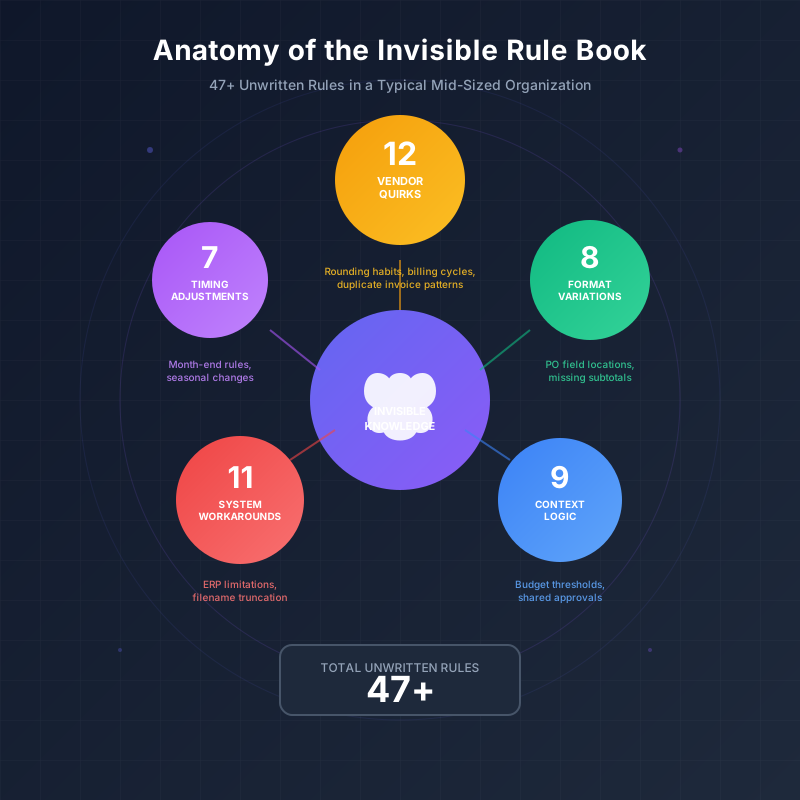
What 47 Unwritten Rules Actually Look Like
To understand the scope of this problem, it helps to see what these invisible rules actually contain. They tend to cluster into recognizable categories, each representing a different type of institutional knowledge that accumulates over time.
Vendor-Specific Quirks
Every vendor relationship develops its own patterns. A construction materials supplier always rounds line item totals to the nearest dollar, which means extracted amounts might differ from calculated totals by a few cents. That's not an error, it's just how they do business. A professional services firm sends invoices dated 15 days before the work actually starts because their billing system runs on a different schedule than their project delivery. An international supplier prices everything in their local currency but sometimes forgets to update exchange rates, so their invoices need manual verification against current rates rather than just accepting the stated total.
These vendor quirks multiply quickly. A mid-sized company working with 200 vendors might have 10 to 15 suppliers with specific handling requirements that deviate from standard processing. The formal procedure says to process all invoices the same way, but reality demands different approaches for different sources.
Format and Layout Variations
Documents don't arrive in standardized formats, despite everyone's best efforts. One vendor puts the purchase order reference number in a field labeled "Your Reference," another puts it in the memo line, and a third buries it in the description of the first line item. The documented procedure says to match invoices to POs, but it doesn't specify where to find that PO number when it's not in the expected location.
Some invoices include subtotal columns, and some don't. Some calculate tax separately by line item, others apply it to the whole invoice. Some use negative numbers for credits and adjustments, others use a separate credit memo format entirely. Each variation requires a different parsing approach, and experienced processors navigate these differences without conscious thought.
Contextual Business Logic
Here's where the invisible rules get particularly expensive when violated. Your formal approval matrix might say that invoices under a certain amount need department manager approval while those above require director sign-off. But during the fourth quarter budget crunch, the CFO wants to personally review anything over a lower threshold because they're monitoring cash flow more closely. That's not written anywhere. It was mentioned in a meeting three months ago, and now it's just "how things work."
Or consider the situation where three department heads share a combined budget for a joint initiative. Technically, only the department that incurred the expense should approve the invoice. But in practice, any of the three can approve for any of the others because they all have visibility into the shared budget. The system doesn't know this. The policy doesn't state this. But the experienced processor does.
System Workarounds
Every enterprise system has limitations, and people develop workarounds to handle them. Your ERP might not support negative line items on invoices, which means when a vendor issues a credit for a returned item, you can't just enter it as it appears on the document. Instead, you need to create a separate credit memo entry and link it to the original invoice. The steps to do this correctly involve specific field entries that aren't documented because the workaround evolved organically.
Another common example: your document management system truncates filenames after a certain number of characters. Experienced processors know to put the most important identifying information at the beginning of the filename, like vendor code and invoice number, so it doesn't get cut off. New processors who put the date first end up with files that are impossible to distinguish in the system.
Timing and Seasonal Adjustments
Business rhythms create their own rules. During month-end close, the usual approval workflows get compressed. Directors who normally review invoices individually might delegate to their administrative assistants for anything routine. During audit periods, certain documentation requirements get stricter. After fiscal year-end, budget codes change and old codes need to be translated to new ones, but only for specific date ranges.
These timing-based rules are particularly tricky because they're temporary and recurring. They're not permanent enough to document formally, but they happen often enough that ignoring them causes problems. The processor who's been through multiple year-ends just knows when these shifts happen.
The Real Cost of Undocumented Knowledge
The invisible rule book doesn't just create operational fragility. It generates measurable financial impact that compounds over time. Organizations rarely calculate these costs because they're distributed across multiple budget lines and don't show up as a single expense category. But when you add them together, the numbers are sobering.
Extended Training Timelines
A new invoice processor can learn the formal procedures in two to three weeks. They can read the manual, watch demonstrations, and practice with sample documents. By the end of that period, they understand the official workflow. What they don't understand is all the unwritten rules, and that knowledge takes much longer to acquire.
Research on organizational knowledge transfer suggests that it takes 8 to 14 months for new employees to reach the productivity level of experienced workers in knowledge-intensive roles. In document processing specifically, that means a new hire will technically know the procedure within weeks but won't have absorbed enough invisible rules to handle the full variety of real-world situations until nearly a year later.
During that extended learning period, they're either making mistakes that need correction or escalating situations they could have handled independently. Both scenarios cost money. Error correction requires senior staff time, payment reversals may incur fees, and vendor relationships can be strained by processing mistakes. Excessive escalations slow down workflows and burden the experienced processors who are already carrying the invisible knowledge burden.
Elevated Error Rates
New processors don't make mistakes because they're incompetent. They make mistakes because they're applying the formal rules to situations that require the informal ones. Studies of workplace knowledge transfer indicate that employees working without access to tribal knowledge experience error rates 300 to 350 percent higher than their experienced counterparts during their first six months.
In document processing terms, that means more duplicate payments, more missed discounts, more incorrect tax calculations, more improperly coded expenses, and more compliance violations. Each error type carries its own cost. Duplicate payments require recovery efforts and damage vendor relationships. Missed early payment discounts directly impact cash flow. Tax errors create audit risk. Improper expense coding distorts financial reporting.
A single processor handling 200 invoices per week might make 2 to 3 errors during their first six months that wouldn't have occurred if they knew the invisible rules. At an average resolution cost of $50 to $150 per error, those mistakes add up quickly across the team.
Operational Disruption During Absences
When the person holding critical invisible knowledge is unavailable, even for short periods, the impact is immediate and measurable. Each day of absence translates to delayed processing, increased exception rates, and time spent by other team members trying to puzzle out situations the absent person would have handled automatically.
Organizations report that absences of key document processors cost anywhere from $100 to $200 per day in direct productivity losses, not counting the downstream effects of delayed payments or processing errors. For a two-week vacation, that's easily over $1,000 in impact from a single absence.
Turnover Knowledge Loss
Perhaps the most significant cost occurs when an experienced processor leaves permanently. Various studies on knowledge retention estimate that organizations lose 20 to 25 percent of an employee's institutional knowledge when they depart, even with formal transition periods. For roles heavy in invisible rules, that percentage can be higher.
When a veteran processor with 47 unwritten rules in their head gives two weeks notice, there's simply not enough time to transfer all that knowledge. Some of it gets captured in rushed documentation sessions. Some of it gets passed to colleagues in hallway conversations. But a significant portion walks out the door permanently.
The organization then has to relearn those rules through trial and error, which means repeating mistakes the departing employee had already solved. Each relearned lesson costs time and money.
Aggregate Annual Impact
When you combine extended training costs, elevated error rates, absence impacts, and turnover losses, a mid-sized organization running a document processing operation can easily face $75,000 to $100,000 in annual costs directly attributable to the invisible rule book problem. Larger enterprises with multiple processing centers see these costs multiply accordingly.
And this calculation doesn't include opportunity costs. What could your experienced processors be doing if they weren't constantly being interrupted to share tribal knowledge? What strategic projects are being delayed because your senior staff is stuck answering the same edge-case questions repeatedly?
Why Traditional Documentation Approaches Fall Short
The obvious solution seems simple: just document everything. Have your experienced processors write down all their invisible rules, compile them into a comprehensive knowledge base, and make it available to everyone. Problem solved, right?
Except it doesn't work that way. Organizations have been trying to capture tribal knowledge through documentation initiatives for decades, and these efforts consistently underdeliver. The reasons are both practical and psychological.
The Unconscious Competence Problem
Experienced processors don't realize they're following invisible rules. They've internalized the knowledge so thoroughly that applying it feels like common sense rather than specialized expertise. Ask a veteran processor how they handle invoices from a particular vendor, and they'll likely describe the formal procedure. They won't mention the three additional checks they automatically perform because those checks have become invisible even to themselves.
This unconscious competence makes knowledge extraction difficult. You can't document what you don't realize you know. And sitting down for a knowledge transfer session often produces surface-level information while the deeper, more contextual knowledge remains untapped.
Context Dependency
Many invisible rules only apply in specific contexts, and those contexts are hard to anticipate in advance. A rule might say: if the invoice is from this vendor AND the amount is over this threshold AND it's during the fourth quarter AND the purchasing department hasn't confirmed receipt yet, then take this specific action. Trying to document all possible context combinations creates documentation that's either too voluminous to be useful or too generic to be helpful.
Real-world application of invisible rules involves judgment calls about which contexts are relevant. That judgment itself is part of the invisible knowledge and resists documentation.
Rapid Evolution
The invisible rule book isn't static. Vendor behaviors change, system updates introduce new quirks, business priorities shift, and regulatory requirements evolve. A rule that was critical six months ago might be obsolete today, while new rules are being created continuously.
Documentation efforts capture a snapshot in time, but they quickly become outdated. Maintaining comprehensive documentation of informal knowledge requires continuous effort, and that effort rarely gets prioritized. The gap between documentation and reality widens steadily.
The "It Depends" Factor
Ask an experienced processor about any edge case, and the answer is often "it depends." The correct handling depends on factors that are difficult to enumerate in advance. Does it depend on the time of month, the specific vendor, the dollar amount, the department involved, or the current business cycle? Usually, it depends on several of these factors in combination, and the processor evaluates them holistically rather than following a decision tree.
This holistic judgment resists capture in traditional documentation formats. You can't flowchart intuition, and you can't bullet-point wisdom.

Why This Isn't a Data Quality Problem
Organizations often misdiagnose the invisible rule book problem as a data quality issue or a training deficiency. If we just improve our data entry standards, the thinking goes, or enhance our training programs, the problem will resolve itself.
But the invisible rule book operates on a different level entirely. It's not about data accuracy or procedural knowledge. It's about the human judgment layer that sits between documents and decisions.
Relationship Knowledge vs. Process Knowledge
Traditional data quality focuses on individual records. Are the fields populated correctly? Do the values make sense? Are there duplications or inconsistencies? These are important questions, but they're not the questions the invisible rule book answers.
The invisible rule book deals with relationships and context. It's not asking whether this invoice has the correct vendor code, it's asking whether this invoice from this vendor in this situation requires a different handling approach than the standard procedure indicates. That's a fundamentally different type of knowledge.
Each System Has Its Own Logic
Here's where the problem gets particularly tricky. Each invisible rule makes perfect sense within its own context. When you look at any individual rule in isolation, it's "correct" based on local logic. The vendor quirk rule is correct because that's actually how that vendor behaves. The system workaround rule is correct because the workaround does solve the system limitation. The seasonal timing rule is correct because business rhythms do require different approaches.
So you can't identify invisible rules by looking for incorrectness. They're not wrong. They're just undocumented, and they exist outside the formal process framework.
The Judgment Gap
Standard reconciliation and quality checking tools look for discrepancies in data. They compare values, check for matches, identify outliers. They're excellent at catching data errors but terrible at recognizing judgment gaps.
When an invoice gets processed incorrectly because the processor didn't know an invisible rule, the data might look perfect. The amounts are right, the vendor is correct, the approval threshold was followed. But the invoice should have been coded to a different cost center based on contextual knowledge, and that mistake won't show up until financial reports reveal misallocated expenses weeks later.
No automated quality check catches missing judgment. Only humans familiar with the invisible rules can identify those gaps, and therein lies the circular problem.
The Intelligence Gap in Traditional Automation
Traditional document automation operates by encoding formal rules into software. If the invoice amount exceeds threshold X, route to approver Y. If the vendor is in category Z, apply this validation. These encoded rules represent the visible layer of your process, and they work well for standard scenarios.
But traditional automation has no mechanism for capturing the invisible layer. It follows the explicit rules precisely and ignores everything else. When a situation requires invisible rule application, traditional automation either gets it wrong or kicks it to a human exception queue.
This limitation explains why many organizations see their exception rates plateau after implementing automation. The easy cases get processed automatically, but the cases requiring invisible rules keep bouncing back for human handling. And the humans handling those exceptions are applying their mental rule books without any way to transfer that knowledge into the system.
The result is a perpetual dependency on specific individuals. You've automated the simple stuff but remain completely reliant on experienced staff for anything non-trivial. That's not true automation, it's automation with a human crutch.
Some organizations try to solve this by creating increasingly complex rule engines, attempting to encode every possible exception. But this approach quickly becomes unmanageable. The rules multiply, conflict with each other, and require constant maintenance. And you still can't encode judgment, only decisions.
How AI Changes the Equation
Artificial intelligence, particularly agent-based AI that learns from behavior rather than just following encoded rules, offers a fundamentally different approach to the invisible rule book problem.
Traditional automation asks: what rules should I follow? AI agents ask: what patterns do successful outcomes share? This shift in approach changes everything about how invisible knowledge gets captured.
Learning from Observation
When experienced processors handle documents, they demonstrate their invisible rules through action. They make decisions, apply contextual judgment, and resolve edge cases. Each of these actions is observable data.
AI agents can learn from this observational data. They watch how experts handle similar situations repeatedly and identify the patterns that distinguish successful processing from problematic processing. They notice that this vendor's invoices always get extra verification, that quarter-end timing triggers different approval paths, that certain amount thresholds prompt specific checks.
This learning happens without requiring the experts to articulate their knowledge explicitly. The AI observes the behavior and infers the rules, much like an apprentice learning by watching a master craftsperson.
Pattern Recognition at Scale
Human experts can hold maybe 50 to 100 invisible rules in their heads. Beyond that, cognitive limits kick in. AI systems don't have these limitations. They can identify and apply thousands of patterns simultaneously.
More importantly, AI can recognize patterns across contexts that humans might miss. A human expert knows their specific invisible rules developed through their experience. AI can identify rules that apply across the entire organization, even if no single person has complete visibility.
This pattern recognition capability means AI can surface invisible rules that exist collectively but not individually. The distributed knowledge of an organization can be synthesized into a coherent rule set that no single employee could articulate.
Contextual Application
Unlike traditional rule engines that follow if-then logic, AI agents can evaluate context holistically. They can weigh multiple factors simultaneously and determine which invisible rules apply based on the overall situation rather than rigid criteria.
This contextual sensitivity mirrors how human experts actually think. An experienced processor doesn't consult a mental checklist when evaluating an invoice. They absorb the context and respond appropriately based on their accumulated knowledge. AI agents can develop similar contextual sensitivity through exposure to enough examples.
Continuous Learning
Perhaps most importantly, AI agents can learn continuously. As new invisible rules emerge, as vendor behaviors change, as business contexts evolve, the AI adapts. It doesn't require manual updates or documentation maintenance. It observes the new patterns and incorporates them.
This continuous learning addresses the rapid evolution problem that defeats traditional documentation. The knowledge base stays current automatically, reflecting actual practice rather than outdated documentation.
Building Institutional Memory That Doesn't Leave
The ultimate goal isn't just to capture invisible rules. It's to build institutional memory that persists regardless of individual employee movements. When a veteran processor retires, their knowledge shouldn't retire with them. When a key person takes leave, operations shouldn't stumble.
AI-based document intelligence creates this persistent institutional memory by separating knowledge from individual knowers. The patterns are learned from human behavior but stored in systems that don't take vacations, don't leave for better opportunities, and don't keep secrets.
From Person-Dependent to System-Embedded
Traditional invisible rules live in human brains. They're accessible only when those specific humans are available and willing to share. This creates vulnerability and dependency.
AI-embedded invisible rules live in the system itself. They're accessible to every processor, every time, regardless of staffing situations. A new hire on their first day has access to the accumulated wisdom of years of expert processing, not through a manual they have to read, but through a system that guides their decisions.
This shift from person-dependent to system-embedded knowledge transforms organizational resilience. Key person risk diminishes. Succession planning simplifies. Training timelines compress.
Preserving Nuance Without Complexity
The challenge with any knowledge preservation approach is maintaining nuance without creating overwhelming complexity. Written documentation of invisible rules tends toward either oversimplification (losing the nuance) or excessive detail (becoming unusable).
AI preserves nuance naturally because it works with patterns rather than explicit rules. The system doesn't need to encode "if vendor is X and amount is Y and month is Z" type logic. It recognizes the pattern holistically and applies appropriate handling without requiring exhaustive specification.
Users experience this as intelligent assistance rather than rigid constraints. The system suggests appropriate actions based on context without forcing processors into narrow pathways. Nuance is preserved because the AI learned from nuanced human behavior.
Democratizing Expert Knowledge
In traditional settings, expert knowledge confers advantage. The processor who knows the invisible rules is valuable and often indispensable. This creates power dynamics that can be organizationally unhealthy.
When expert knowledge gets embedded in AI systems, it becomes democratized. Every team member benefits from accumulated wisdom. New hires become productive faster. Temporary staff can handle tasks previously reserved for veterans. The organization's capability becomes less dependent on specific individuals.
This democratization doesn't diminish the value of expertise. Experts still generate the knowledge through their experience and judgment. But that knowledge now benefits the broader organization rather than remaining locked in individual minds.
Moving Forward: From Invisible to Intelligent
The invisible rule book problem won't solve itself. Every week that passes, new invisible rules accumulate while old ones remain undocumented. Every departure loses institutional knowledge. Every absence reveals dangerous dependencies.
But the solution isn't to embark on massive documentation projects or implement more complex rule engines. Those approaches have been tried and found wanting. The solution is to build intelligence that learns the invisible rules the same way your best people did, through observation, experience, and pattern recognition.
The first step is recognition. Acknowledge that your document workflows run on two layers, and the invisible layer matters as much as the visible one. Audit your dependencies. Identify who holds critical invisible knowledge. Map where your operations would struggle if specific people were unavailable.
The second step is creating learning opportunities. Document the outcomes rather than the rules. Track which invoices require extra handling and why. Note which processors get pulled into exception resolution most frequently. This outcome data becomes the training material for AI systems.
The third step is implementing intelligence that can absorb and apply invisible rules. This means moving beyond traditional automation toward AI agents that learn contextual patterns. It means building systems that observe expert behavior and internalize the wisdom rather than just following encoded procedures.
The invisible rule book will always exist to some degree. Business is too complex and dynamic for every situation to be pre-specified. But that book doesn't have to live exclusively in human heads, vulnerable to departure and inaccessible during absence.
By building document intelligence that learns from human expertise and embeds that knowledge persistently, organizations can maintain operational continuity regardless of staffing changes. The next time your best processor calls in sick, your operations won't miss a beat. The institutional memory keeps running, the invisible rules keep getting applied, and the work keeps flowing.
That's the difference between automation that follows rules and intelligence that understands them.