

Blog
Solve the Document Frankenstein Problem with Cross-Page AI
Stop stitching data from multiple pages. Cross-page AI intelligence solves the Document Frankenstein Problem.

Blog
Stop stitching data from multiple pages. Cross-page AI intelligence solves the Document Frankenstein Problem.
Picture this. You're processing a commercial loan application, and the borrower's monthly income appears on page 3. Their employment history lives on page 7. Tax information gets scattered across pages 11, 15, and 18. The property details you need to validate the loan amount? That's buried on page 22, with additional clarifications referenced back on page 9. Now imagine trying to assemble all of this into a single, coherent borrower profile that makes sense for underwriting. That's not document processing. That's archaeology.
This is what we call the Document Frankenstein Problem, and it's killing productivity in industries that rely on complex, multi-page documents. The issue isn't that AI can't read individual pages. Modern document processing systems are pretty good at extracting data from a single page. The real challenge emerges when you need to synthesize information that's deliberately scattered across dozens of pages, where understanding one piece of data requires context from three other pages, and where the document's author assumed the reader would naturally connect the dots because, well, that's what humans do.
But AI doesn't naturally connect dots across pages. At least, not the way most document processing systems work today. And that gap between page-by-page extraction and document-wide synthesis is costing enterprises millions in manual review time, processing delays, and costly errors that emerge when critical connections get missed.
Most document AI systems treat pages like independent islands. They process page 1, extract what they can find, then move to page 2 with a clean slate. No memory of what came before. No awareness of what's coming next. Each page gets the same treatment - scan, extract, move on. It's efficient in a narrow sense, but it completely misses how real documents actually work.
Think about how a loan officer reads a mortgage application. They don't just extract data mechanically from each page. They build a mental model of the borrower as they read. When they see income on page 3, they're already thinking about employment history they'll need to verify. When they hit the employment section on page 7, they're connecting it back to the income figures, checking if the timeline makes sense, looking for gaps that need explanation. By the time they reach the tax returns, they're not just reading numbers - they're validating a narrative that's been building across the entire document.
That's synthesis. That's understanding. That's what makes a loan officer valuable. And it's exactly what traditional document AI can't do when it treats every page as a standalone unit.
The symptoms of page boundary blindness show up everywhere once you start looking. A contract review system that extracts payment terms from page 5 but misses the amendment clause on page 23 that changes everything. A medical records processor that captures a diagnosis on page 1 but overlooks the revised diagnosis on page 8 that supersedes it. An invoice processing system that pulls line items from page 2 without noticing the discount terms on page 7 that affect the total amount due.
These aren't extraction failures in the traditional sense. The AI successfully read the text. It correctly identified fields. The OCR was accurate. But the final output was wrong because the system never understood that data on page 5 was meaningless without context from page 12. That's the insidious thing about page boundary blindness. Everything looks fine at the page level, but the document-level understanding just isn't there.
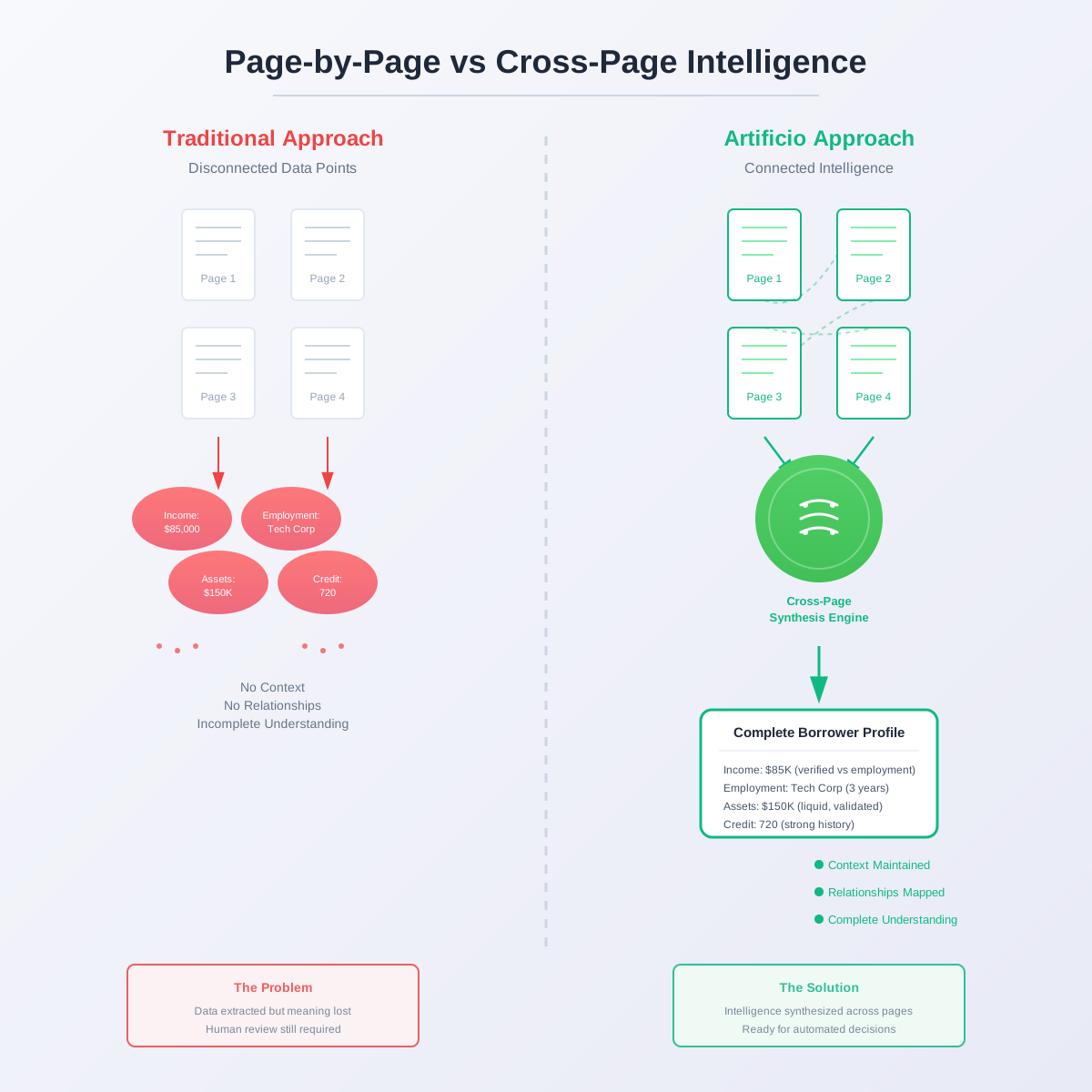
Let's talk about one of the most common patterns in complex documents: the cross-reference. "See Schedule A for details." "Refer to Section 3.2 for exclusions." "As stated in the definitions on page 2." "Continued from page 14." Authors do this for good reasons - it avoids repetition, keeps related information organized, and allows them to build on earlier concepts without constantly restating them.
But for AI systems that process pages independently, cross-references are complete blind spots. When a contract says "payment terms are subject to the conditions outlined in Exhibit C," a page-by-page processor will extract "payment terms are subject to conditions" and completely miss what those conditions actually are. Because Exhibit C lives on page 37, and by the time the system gets there, it has no memory that payment terms on page 8 were waiting for this information.
The same problem hits legal documents constantly. "This clause shall not apply in jurisdictions specified in Appendix B" means nothing if you don't actually go look at Appendix B and connect it back to the clause. Medical records are full of "see previous notes from visit on..." references that require tracking down earlier entries and bringing that context forward. Loan applications reference supporting documents - "W2s attached as pages 45-47" - and you can't validate the stated income without actually connecting those tax forms back to the income claim.
Real humans handle this instinctively. You see a cross-reference, you flip to that page or section, absorb the information, and carry it back with you to inform your understanding of the original passage. You might even take a note, create a mental bookmark, or physically tab important pages. You're constantly building and maintaining a web of connections across the entire document.
But AI systems that treat each page independently can't build that web. They see the reference but can't follow it. Or they process the referenced section later but don't connect it back to the original context that was waiting for it. The result is extracted data that's technically accurate at the field level but fundamentally incomplete at the meaning level.
This creates a particular nightmare for automated workflows. The system confidently extracts data, passes it downstream for processing, and nobody realizes that critical qualifying information got left behind because it lived on a different page. The payment gets processed based on incomplete terms. The contract gets executed without understanding key exceptions. The loan gets approved without verifying cross-referenced employment details. By the time someone catches the error, you're already dealing with consequences instead of preventing them.
Here's where things get really interesting. Some documents don't just scatter information randomly across pages - they deliberately distribute it in ways that require active synthesis to make sense. A borrower profile in a loan application isn't a neat form on page 1. It's a mosaic that emerges from bits and pieces across the entire document. Income from one section, employment from another, assets from a third section, credit history from yet another. Each piece lives where it logically fits in the document's structure, but understanding the complete borrower requires pulling all those pieces together and assembling them into a coherent whole.
This is fundamentally different from simple extraction. Extraction says "find the borrower's income and put it in a field." Assembly says "find all the pieces that collectively tell us about the borrower's financial situation, understand how they relate to each other, identify any contradictions or gaps, and synthesize them into a unified profile that makes sense for underwriting." That's not a data capture problem. That's an intelligence problem.
Medical records take this even further. A patient's current condition isn't stated in one place. It emerges from the chief complaint on page 1, the history of present illness that spans pages 2-4, the review of systems on page 5, the physical exam findings on pages 6-7, the lab results on pages 8-12, and the physician's assessment that synthesizes everything on page 13. Miss any one of these pieces and you don't just have incomplete data - you have a potentially dangerous misunderstanding of the patient's actual condition.
Contract analysis faces the same challenge. The complete picture of what the parties are agreeing to doesn't live in any single section. There are rights and obligations scattered throughout the document, conditions and exceptions that modify earlier provisions, definitions at the front that change how you interpret clauses at the back, schedules and exhibits at the end that contain crucial details referenced earlier. Understanding what the contract actually says requires weaving all of these threads together into a complete picture.
Traditional document processing systems can extract each piece, but extraction isn't assembly. You can pull out all the data points and still not understand what they mean together. It's like having all the parts of a car spread out on your garage floor. Sure, you've successfully identified and cataloged every component, but you don't have a functioning vehicle. You have parts that need to be assembled with knowledge of how they work together.
The assembly challenge gets even harder when you realize that not all information is explicitly stated. Sometimes understanding requires inference. The borrower lists employment start date as three years ago, but the tax returns only show two years of W2s. Those two pieces don't directly contradict each other, but the gap between them is meaningful. An AI system that just extracts both data points hasn't done the work. An AI system that notices the gap and flags it for review - that's assembly. That's synthesis. That's intelligence.
Complex documents aren't just repositories of disconnected facts. They tell stories. A loan application tells the story of a borrower's financial life. A medical record tells the story of a patient's health journey. A legal contract tells the story of what two parties agreed to and why. These stories have beginnings, middles, and ends. They have causes and effects. They have context that makes later information meaningful and later information that reframes earlier context.
But page-by-page processing destroys the narrative thread. When you treat every page independently, you lose the through-line that connects them. You miss the arc. You extract facts but you miss meaning, and meaning is what actually matters for real-world decisions.
Consider a patient medical record where page 3 mentions mild chest pain, page 8 notes a family history of heart disease, page 12 shows slightly elevated cholesterol, and page 15 documents the patient declined recommended cardiac testing. None of these individual facts, extracted in isolation, triggers major concern. But the narrative thread connecting them - a pattern of cardiac risk factors combined with avoidance of follow-up - tells a very different story. That story should influence treatment decisions, but a page-by-page processor will never see it because the story emerges from the connections, not the individual facts.
Legal documents often bury critical shifts deep in the narrative. A contract might establish general terms in the first section, then introduce exceptions in the middle that completely change who bears what risks, then add a dispute resolution clause at the end that makes those risk allocations even more important. Understanding the actual deal requires following that progression and recognizing how later provisions modify or limit earlier ones. Extract everything individually and you've captured the words but missed the deal structure that emerges from how those words relate to each other across the document.
The same pattern appears in loan underwriting. A borrower's income on page 3 seems solid until you notice on page 9 that it comes from commission-based sales at a startup. That context should make underwriters think differently about income stability. Assets listed on page 6 look impressive until you discover on page 14 that they're held in a trust with withdrawal restrictions. Each piece of information reshapes the meaning of earlier information, but only if you maintain the narrative thread that connects them.
This is where human document processors excel and traditional AI systems fail. Humans naturally maintain context as they read. They remember what they saw earlier and let it inform their interpretation of what they're seeing now. They anticipate what information they'll need based on what they've read so far. They notice when later information contradicts or qualifies earlier statements. They build a coherent narrative that makes the whole document meaningful.
AI systems that process pages independently don't build narratives. They collect facts. The difference matters enormously when those facts need to add up to actual understanding.
Documents don't just scatter information randomly - they organize it into sections that have relationships to each other. Definitions at the front of a contract modify how you interpret provisions in the middle. Exhibits at the end provide details that clauses in the body reference. Summary sections at the beginning establish context that makes detailed sections later meaningful. These structural relationships aren't arbitrary. They're how documents create coherent meaning from complex information.
But recognizing and leveraging these section relationships requires more than just identifying section headers. It requires understanding the document's architecture - how different parts were designed to work together, which sections depend on others, where information flows from one section to another, which sections modify or qualify others.
Take a legal services agreement. The scope of work section defines what services will be provided. The fees section sets pricing. But buried in the limitations section might be exclusions that dramatically restrict what's actually covered under that scope. And the termination section might allow either party to exit with minimal notice, which completely changes the value proposition. You can't understand what you're actually buying by reading any one section in isolation. The sections work together to create the complete picture.
Medical records follow similar patterns. The chief complaint and history of present illness sections establish the narrative. The review of systems section adds context about related symptoms and conditions. The physical exam findings provide objective data. The assessment section synthesizes everything into a diagnosis. The plan section outlines next steps based on that synthesis. Each section builds on the others, and understanding the patient's situation requires tracking how information flows through this structure.
Financial documents like loan applications deliberately distribute information across sections that correspond to different aspects of the borrower's financial life. There's an employment section, an income section, an assets section, a liabilities section, a credit history section. Each section provides a piece of the overall financial picture. But evaluating creditworthiness requires synthesizing across all these sections to understand the borrower's complete financial situation and how different factors relate to each other.
The intelligence gap emerges when AI systems treat these sections as independent units. They extract data from the employment section without connecting it to income stability questions. They capture assets without relating them to liabilities to understand net worth. They record credit history without connecting it to the borrower's explanation of past issues in another section. The section relationships that create meaning get lost.
Even worse, many documents have sections that explicitly modify other sections. Amendment clauses, exception lists, qualifying language, conditions and contingencies - these sections don't contain standalone information. Their entire purpose is to change how you should interpret information elsewhere in the document. Miss these relationships and you might extract data accurately but understand the document completely wrong. 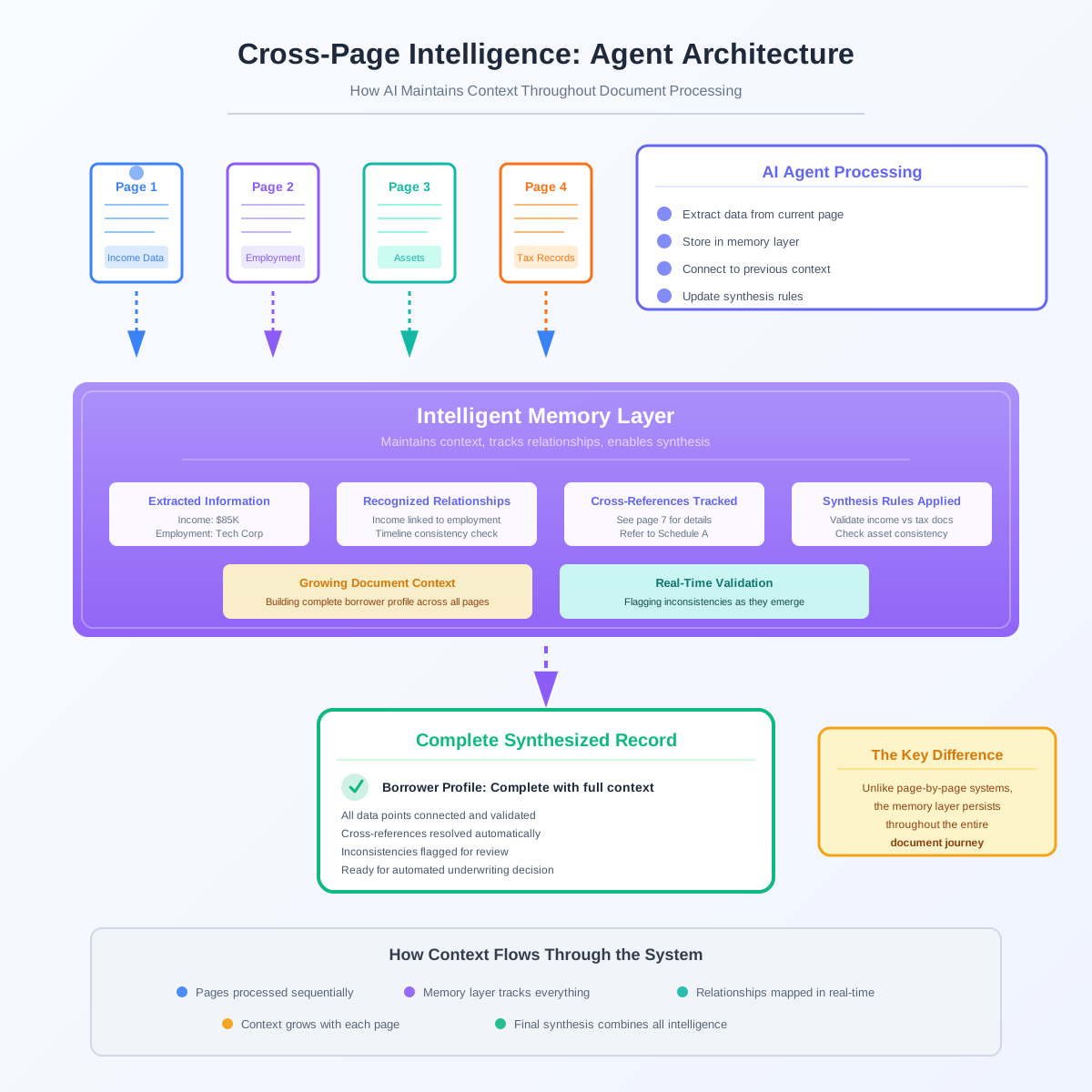
Here's the fundamental issue that ties all of this together. The document processing industry has spent years optimizing extraction - pulling data from documents accurately and efficiently. We've gotten really good at finding fields, reading text, capturing values, identifying document types. Extraction accuracy has improved dramatically. Processing speeds have accelerated. Costs have dropped.
But extraction was never the hard part. The hard part is synthesis - taking all those extracted pieces and assembling them into coherent understanding that supports real business decisions. And synthesis requires something fundamentally different from extraction. It requires intelligence that operates at the document level, not the page level.
Extraction is about reading. Synthesis is about understanding. Extraction asks "what does this page say?" Synthesis asks "what does this document mean?" Extraction can work page by page. Synthesis requires maintaining context across the entire document, recognizing relationships between sections, following narrative threads, assembling scattered information into coherent wholes, and making inferences that aren't explicitly stated anywhere.
The gap between extraction and synthesis is where most document AI systems fail in real-world enterprise applications. They extract beautifully but synthesize poorly or not at all. Organizations end up with databases full of accurately extracted data that still requires human review and interpretation because the system couldn't bridge from facts to meaning.
This creates what we call the "last mile problem" in document processing. The first 90% - extracting data from pages - is automated and fast. The last 10% - synthesizing that data into actionable intelligence - still requires humans because traditional systems can't do it. And that last 10% often takes more time than the first 90% because humans have to review all the extracted data, reconnect the pieces, rebuild the context that got lost, and do the synthesis work the system couldn't handle.
The synthesis gap also explains why document AI projects often disappoint after deployment. During evaluation, vendors demo impressive extraction accuracy on sample documents. Everything looks great. But in production, users discover that while extraction works fine, they still need to manually review and validate most documents because the system doesn't understand relationships, can't follow cross-references, misses qualifying information on different pages, and can't assemble scattered data into coherent records. The promised automation delivers data but not intelligence.
This is especially painful for complex documents where extraction was never the bottleneck anyway. Nobody complained that reading loan applications took too long. The complaint was that analyzing them and making good credit decisions took too long. Extracting data from medical records was already fast. Synthesizing that data into accurate diagnoses and treatment plans was the hard part. Extraction-only systems automate the easy part and leave the hard part untouched.
So what does it look like when AI systems actually solve this? When they can maintain context across pages, follow narrative threads, recognize section relationships, assemble scattered information, and synthesize document-level understanding? The answer lies in architecture - specifically, in moving from stateless page-by-page processing to stateful, agent-based systems that maintain document-level intelligence.
Traditional document processing flows one direction. Upload document, split into pages, process each page, output results. Each page gets processed independently, there's no shared context between pages, and once you move to the next page, the previous page is forgotten. That architecture is fundamentally incompatible with synthesis.
Agent-based systems work differently. Instead of treating each page independently, they maintain a persistent state throughout the entire document processing journey. As they process each page, they're building and updating a document-level understanding. They're tracking what they've learned, recognizing when new information relates to earlier information, following cross-references, assembling pieces into wholes, and continuously synthesizing their growing understanding of what the document actually means.
Think of it like the difference between taking notes as you read versus just reading. When you take notes, you're building a running summary, marking important points, noting connections between sections, flagging things to come back to, and creating a synthesized view that represents your understanding of the whole document. That's what stateful, agent-based processing does.
In practical terms, this means the system maintains a working memory as it processes. When it sees borrower income on page 3, it doesn't just extract that number and forget it. It stores it in context, marks it as pending verification against tax documents, and flags that it needs employment history to validate. When it encounters employment details on page 7, it connects those back to the income claim, checks if the timeline matches, and updates its confidence in the income figure. By the time it reaches tax returns on page 15, it already knows what income was claimed, what employment was reported, and exactly what it needs to verify from these documents.
The same applies to cross-references. When the system sees "subject to conditions in Exhibit C," it doesn't just extract that text and move on. It marks the dependency, continues processing, and when it reaches Exhibit C, it connects those conditions back to the original clause and synthesizes the complete understanding. The reference gets followed, the connection gets made, and the final output reflects the complete picture.
Section relationships work similarly. As the system processes a contract, it understands that definitions section establishes terms used throughout the document. When it encounters those terms later, it applies the defined meanings. When it hits an exceptions section, it knows these exceptions modify earlier provisions and adjusts its understanding accordingly. The document's structure informs how the system interprets individual pieces.
For scattered data assembly, agent-based systems don't just extract each piece independently. They recognize that multiple pieces contribute to a single business entity - a borrower profile, a patient diagnosis, a contract risk assessment. As they encounter each piece, they contribute it to the growing whole, check for consistency with other pieces, identify gaps that need filling, and flag contradictions that need resolution. By the end, you don't just have a list of extracted data points. You have a synthesized business record that actually makes sense.
This architectural shift from stateless extraction to stateful synthesis is what makes the difference between AI that reads documents and AI that understands them. And understanding is what actually matters for real business outcomes.
When document processing systems can actually synthesize across pages instead of just extracting from them, the business impact shows up in places that might surprise you. Yes, processing gets faster and accuracy improves. But the bigger wins come from enabling outcomes that weren't possible before.
First, true straight-through processing becomes realistic for complex documents. When systems could only extract data page by page, complex multi-page documents still required human review and synthesis. The last mile problem meant you got data but not decisions. Cross-page intelligence closes that gap. Systems that can synthesize can make the same judgment calls that required human review before. This means loan applications can be underwritten automatically, medical records can drive treatment protocols automatically, and contracts can trigger appropriate workflows automatically. The "human in the loop" step that was always necessary for complex documents becomes optional.
Second, exception handling gets dramatically better. When systems maintain document-level context, they can recognize exceptions in real time as they process. The contradiction between claimed income on page 3 and tax returns on page 15 gets flagged immediately instead of causing downstream errors. The qualifying clause on page 23 that changes payment terms established on page 5 gets caught and applied correctly. Missing information that cross-references never resolved gets identified for follow-up. You catch problems during processing instead of discovering them after the fact.
Third, data quality improves in ways that aren't obvious. When systems can synthesize across pages, they validate data against related information instead of accepting each field independently. Income gets validated against employment history and tax returns. Diagnosis gets validated against symptoms, exam findings, and test results. Contract obligations get validated against payment terms, limitations, and conditions. This multi-point validation catches errors that single-field extraction misses entirely.
Fourth, downstream processes that depend on document data work better. When the system outputs synthesized business records instead of lists of extracted fields, those records are immediately useful for decision-making. Underwriting systems get complete borrower profiles instead of disconnected data points they have to reassemble. Treatment systems get patient context instead of isolated facts. Contract management systems get coherent agreement summaries instead of raw field extracts. The downstream work becomes easier because the synthesis already happened upstream.
Fifth, and perhaps most important, organizations can actually trust automated processing for complex documents. This is the change that unlocks real transformation. When you know the system understands documents holistically, maintains context, follows relationships, and synthesizes intelligently, you can let it handle cases that previously required human judgment. The confidence threshold for automation drops because the system demonstrates document-level intelligence, not just page-level extraction.
The financial impact of these improvements adds up quickly. Faster processing, higher straight-through rates, better exception handling, improved data quality, and expanded automation all translate to significant cost reduction and capacity increase. But the strategic impact might matter even more. Organizations that can process complex documents with true intelligence gain competitive advantages in speed, accuracy, and scale that companies relying on extraction-only systems simply can't match.
If your organization deals with multi-page documents where information is scattered across sections, where cross-references matter, where synthesis is required, and where page-by-page extraction isn't enough, the Document Frankenstein Problem is costing you more than you probably realize. Every document that requires human review and synthesis after extraction is a case where your automation investment didn't deliver its full potential. Every error that emerges from missing relationships between pages is a failure of document-level intelligence. Every processing delay caused by manual assembly of extracted data is a symptom of the synthesis gap.
The good news is that this is a solvable problem. Cross-page intelligence isn't theoretical - it's a real architectural approach that organizations are deploying today to handle complex documents that extraction-only systems can't manage. Agent-based processing systems that maintain state, build document-level understanding, follow relationships, and synthesize coherent outputs are moving document automation from data capture to true intelligence.
The question for your organization is whether you're still trying to solve synthesis problems with extraction-only tools. If you're deploying document AI that treats every page independently, you're automating data capture but not document understanding. If your teams still spend significant time reviewing, validating, and assembling the output from your document processing systems, you're experiencing the Frankenstein Problem firsthand.
The shift to cross-page intelligence changes what's possible. Documents that required human synthesis become fully automatable. Processing that stopped at data extraction extends all the way to business decisions. Accuracy that plateaued at 92% jumps to 98% because the system validates across multiple related data points. Exceptions that caused processing failures get caught and resolved automatically because the system maintains full document context.
This isn't about incremental improvement in extraction accuracy. This is about crossing the threshold from systems that read documents to systems that understand them. From tools that capture data to platforms that deliver intelligence. From automation that handles simple cases to automation that handles complex reality.
The Document Frankenstein Problem is real, and it's expensive. But it's also solvable with the right architecture. The organizations that figure this out first are the ones who will stop stitching together Frankenstein's monsters and start delivering coherent, intelligent document processing that actually matches human-level understanding. And in a business world drowning in complex multi-page documents, that advantage matters enormously.

Head IT Operations - Co Founder of Artificio
See it in your SAP environment
Bring us a document, a process, or a bottleneck. We'll show how Artificio captures, validates, and posts into SAP — then scale from there.
Security & compliance
ISO 27001:2013 certified, SOC 2 Type 2 compliant, GDPR and HIPAA ready. Every agent action is logged, auditable, and runs in isolated environments.