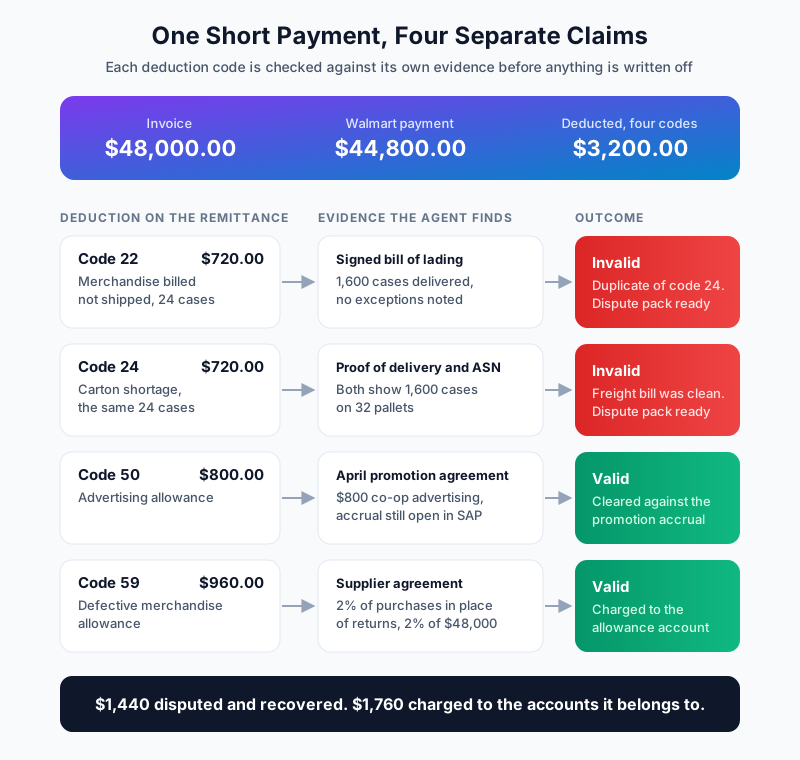
On a Tuesday morning in October, a payment from Walmart lands in the bank account of a housewares manufacturer in Ohio. It covers a single invoice for 1,600 cases of food storage containers, shipped to a Walmart distribution center in Indiana three weeks earlier. The invoice was for $48,000.00. The payment is $44,800.00.
The remittance explains the gap in four lines.
Code 22, merchandise billed not shipped, $720.00.
Code 24, carton shortage, $720.00.
Code 50, advertising allowance, $800.00.
Code 59, defective merchandise allowance, $960.00.
That is the whole explanation. Four numbers, four short labels and a total of $3,200.00. There are no photos, no receiving notes and no reference the supplier's own team would recognize. Whatever sits behind each code is somewhere else, in Walmart's supplier portal, in an agreement the sales team signed in the spring or in the carrier's paperwork.
The cash application analyst does what most analysts do with a payment like this. She clears the $44,800.00 against the invoice in SAP, leaves the $3,200.00 open as a single residual item with a general deduction reason code and adds a row to the deductions spreadsheet. It is the 341st open row. Then she moves on, because there are another 180 payments in the queue and the month closes on Friday.
Nobody looks at that row again for seven weeks. By then the window to dispute the shortage is almost closed, nobody can find the bill of lading quickly and the quarter-end cleanup writes off the whole $3,200.00 as the cost of doing business with a big retailer.
Two of the four deductions were wrong. The carrier's bill of lading, signed at the distribution center dock, shows all 1,600 cases delivered with no exceptions noted. Code 24 claims 24 cartons were missing. Code 22 charges for the same 24 cartons a second time. That is $1,440.00 the supplier was owed and gave away. The other two deductions, $1,760.00 in total, were valid. They were still written off to the wrong account, so the cost of the spring promotion and the agreed allowance for damaged goods never showed up where the sales team measures them.
The supplier and the figures in this story are a composite, built to make a common pattern concrete. The deduction codes are Walmart's own. Every large retailer has its own version of this, with its own codes, its own portal and its own deadlines. Our recent post on customer returns and credit memos ended with a promise to look at deductions more closely. This is that post.
A deduction is not a short payment
To a cash application team, a deduction looks like any other short payment. Money was expected, less arrived and the difference needs a home. That way of seeing it is the root of the problem.
A short payment from a distributor usually has one cause, like the returned motors in our last post. A retailer deduction is a claim. The retailer has decided, on its own evidence and under its own rules, that the supplier owes it money, and it has collected that money by keeping it. The burden of proof has moved. If the supplier thinks the claim is wrong, the supplier has to prove it, with the right documents, in the retailer's format and before the retailer's deadline.
The four codes on one remittance are usually four different kinds of claim, and each one belongs to a different part of the business.
Codes 22 and 24 are about logistics. Did the goods arrive, and in what quantity? The evidence is the bill of lading, the proof of delivery and the advance ship notice, and it sits with the shipping team or the carrier.
Code 50 is about sales. Did someone agree to fund advertising, and for how much? The evidence is a promotion agreement, often an email thread or a spreadsheet kept by the account manager who looks after Walmart.
Code 59 is about the contract. Many suppliers agree to a fixed allowance for defective goods instead of taking damaged products back, and Walmart deducts it as a share of what it buys. The evidence is the supplier agreement, which finance may never have seen.
Walmart also fines suppliers for deliveries that miss its On-Time In-Full target, widely reported at 3 percent of the cost of the goods on the cases that were late or incomplete. Those fines follow their own schedule and their own rules. They are not part of this payment, but they land on the same desk.
So a single remittance with four codes needs four separate investigations across three departments. And it arrives at the one team that owns none of the evidence.
The cost nobody budgets for
Companies budget for the deductions they plan. Trade spend, promotional allowances and co-op advertising sit in the sales plan, with accruals booked as the promotions run. Bad debt sits in the finance plan. What almost nobody budgets for is the gap between the deductions they planned and the deductions they actually receive, and the work it takes to tell the two apart.
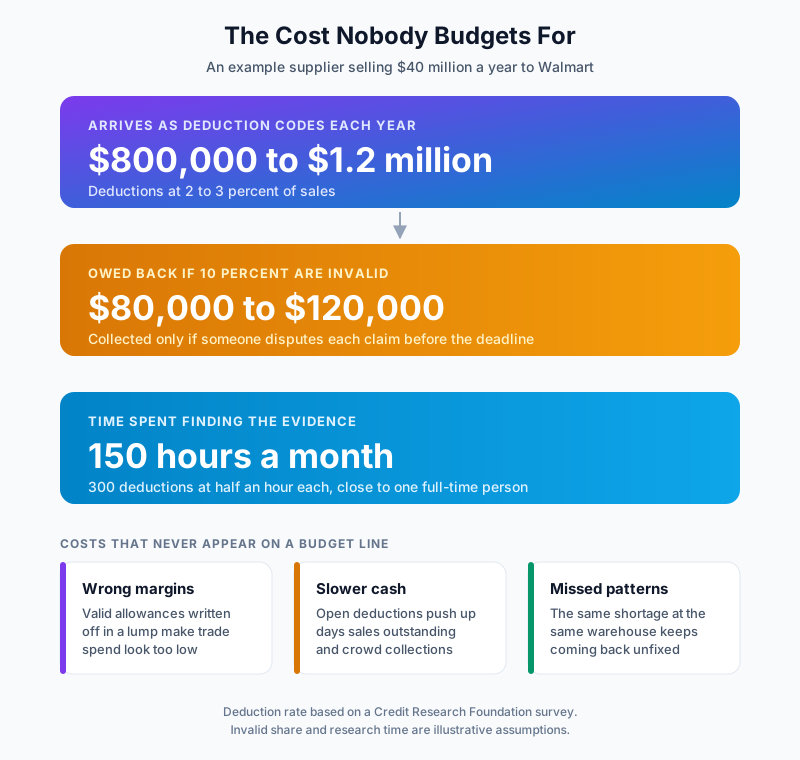
The amounts are not small. A Credit Research Foundation survey found that deductions ran at a median of 2 percent of sales for suppliers whose main customers were retailers, and 3 percent in food, beverage and grocery. For a supplier selling $40 million a year to Walmart, that is $800,000 to $1.2 million a year arriving as codes on remittances. Estimates of how much of that is invalid vary widely, from a few percent in older surveys to between 10 and 25 percent in more recent figures from recovery firms. At 10 percent, the same supplier is owed $80,000 to $120,000 a year that it will only collect if someone asks for it in time.
That is the first cost, and it is the easy one to see. The others are harder to spot.
The second cost is the margin picture. When valid deductions are written off in a lump, they land in the wrong place. The $800 advertising allowance should reduce the accrual the sales team booked for the spring promotion. The $960 defective allowance should sit against the contract it came from. Written off to a general deduction account, both vanish from the reports sales uses to judge whether a promotion paid for itself. Trade spend looks cheaper than it was, and next year's plan gets built on that number.
The third cost is time. Each deduction takes research. Someone has to log in to the retailer's portal, find the claim behind the code, ask logistics for the bill of lading, ask sales whether an allowance was agreed, read the supplier agreement and then decide. If each investigation takes half an hour, 300 deductions a month is 150 hours. That is close to a full-time person, and their work never appears on a budget line called "deductions."
The fourth cost is the clock. Retailers set short windows for disputes, and they hold suppliers to them. If Walmart sends a dispute back asking for more documents, the supplier has days to answer, not weeks. A deduction that sits in a spreadsheet for seven weeks has often been lost already, whatever the evidence says.
The fifth cost is the aging report. Open deductions sit in receivables, pushing up days sales outstanding and lengthening the collections list. Some of them get chased as overdue, which means a collector calling a retailer's accounts payable team about money the retailer believes it was entitled to keep. That call rarely goes well.
The last cost is the lesson that never gets learned. If one distribution center keeps signing for short deliveries that the carrier's paperwork says were complete, there is a receiving or labeling problem worth fixing. If nobody looks at deductions except to write them off, nobody sees the pattern. Our line-by-line ROI walkthrough for CFOs covers how to put numbers on costs like these.
Why the usual fixes do not stick
Most suppliers have tried some version of the following.
A write-off threshold. Anything under a set amount is written off automatically, because it costs more to research than it is worth. That logic holds for one deduction. It does not hold across a year. A threshold of $1,000 would have written off all four deductions in our example, including the $1,440 that was never owed.
A deductions specialist. Giving one person ownership helps. It also creates a queue behind that person, who still has to chase three departments for evidence on every claim.
A quarterly cleanup. Finance, sales and logistics meet at quarter end to work through the open list. It works, slowly. By quarter end many dispute windows have closed, and the meeting turns into a discussion about which account to write things off to.
A recovery firm. Outside firms audit past deductions and recover invalid ones in return for a share of what they get back. They can find real money. They also work after the fact, keep a cut of money that was the supplier's to begin with and do nothing for the margin picture or the lessons.
What these fixes share is that they treat the deduction as a balance to clear, not a claim to answer. The evidence for every deduction already exists. It is just spread across five places, and nobody connects it while there is still time to use it.
Treating each deduction as its own case
The approach that works is to split every short payment into its individual deductions and treat each one as a case, with its own evidence, its own owner and its own deadline. An agent can do the reading and the matching, which leaves people with only the decisions that need them.
Go back to Tuesday morning in Ohio and watch what happens when an agent reads the payment first.
The agent reads the remittance and matches the payment to the invoice. It sees four deductions and opens four cases, each with the code, the amount and the date the deduction was taken. It knows what each code means, what kind of claim it is and what evidence will answer it.
It pulls the claim details for each deduction from Walmart's supplier portal. For codes 22 and 24, the claim shows the purchase order, the distribution center and the receiving record, which says 1,576 cases were received against 1,600 invoiced. Both claims point at the same 24 cases.
For the two shortage cases, it finds the delivery in SAP and reads the documents attached to it. The carrier's bill of lading is signed by the distribution center's receiving clerk, shows 1,600 cases and has no exceptions noted. The proof of delivery matches. The advance ship notice the supplier sent before the truck left shows 1,600 cases across 32 pallets. Every piece of the supplier's evidence agrees.
So the agent marks code 24 as invalid, because the freight bill was not signed short. It marks code 22 as invalid for the same reason and flags it as a duplicate of code 24, because both claims charge for the same 24 cases. Then it assembles a dispute pack for each one, with the signed bill of lading, the proof of delivery, the advance ship notice and the invoice, laid out the way Walmart's dispute portal expects. It records the deadline on each case.
For code 50, it searches the promotion records. The sales team's spring plan includes an $800 co-op advertising commitment for an online feature in April, agreed by email with the Walmart buyer. The accrual for it is still open in SAP. The amounts match. The agent marks the deduction as valid and proposes clearing it against the accrual.
For code 59, it reads the supplier agreement. The agreement sets a defective merchandise allowance of 2 percent of purchases, in place of returns. Two percent of $48,000.00 is $960.00. Valid again, and the agent proposes charging it to the allowance account the contract maps to.
Then it writes a short summary at the top of the case for the cash application analyst. "Payment matched to invoice. $1,760 in valid deductions, $800 co-op advertising against the April promotion accrual and $960 defective allowance under the supplier agreement. $1,440 invalid. Codes 22 and 24 both claim 24 cases short, the signed bill of lading shows full delivery with no exceptions and code 22 duplicates code 24. Two dispute packs ready to file, earliest deadline in 11 days."
The analyst reads the summary, opens the bill of lading to check it for herself and approves. The whole payment took her six minutes, and most of that was spent looking at the signature on the bill of lading.
What lands in SAP
The posting matters as much as the investigation, because it decides what every other team sees afterward.
The payment clears the invoice. Instead of one $3,200 residual item with a general reason code, four items are created, each with a reason code that says what it actually is. The two valid deductions are cleared straight away, one against the promotion accrual and one against the allowance account. The sales team's trade spend report now shows the real cost of the April promotion, and the allowance shows up against the contract that created it.
The two invalid deductions stay open as disputed items. Each is linked to a dispute case in SAP with the evidence attached and Walmart's claim number recorded. Collections can see that $1,440 is in dispute, why and when it was filed, so nobody calls Walmart's accounts payable team asking for money that is already in a dispute. When Walmart repays, the payment is matched to the dispute cases and the items clear.
Every step carries a record of what the agent read, what it concluded and who approved it. Auditors look for exactly that when they test write-offs and credits, as we explained in what auditors actually look for in an automated audit trail.
People stay in charge of the decisions. Write-offs above an agreed amount still need approval. If the agent cannot find the promotion behind an allowance, it asks the account manager instead of guessing. If the evidence is mixed, like a bill of lading signed for 1,600 cases with a note about two damaged pallets, the agent lays out both sides and lets the analyst decide whether to dispute all of it, part of it or none of it.
The pattern behind the codes
Once every deduction is a case with a reason, the cases can be counted. That is usually where the biggest savings come from.
Three months after that Tuesday payment, the Ohio supplier's deduction report shows something nobody had noticed. Most of its shortage deductions from Walmart came from the same distribution center, and almost all of them were for the same two products. The bills of lading were clean every time.
When the logistics team looked, they found that the two products shared a case size and had nearly identical labels. The distribution center's scanners were counting some cases of one product as the other, so one product showed up short and the other showed up over. A label change fixed it, and the shortage deductions from that distribution center stopped.
The same reporting helps sales. Allowances and advertising deductions that tie back to specific promotions show the real cost of each one. Deductions that tie back to nothing, like an advertising charge for a promotion nobody agreed to, show up as exceptions to raise with the buyer instead of disappearing into a write-off.
How deductions connect to the rest of order to cash
Deductions sit at the point where the whole order to cash process meets. They depend on the same delivery paperwork as proof of delivery matching, because shortage disputes are won or lost on the signed bill of lading. They depend on the same remittance reading as cash application, because the deduction detail arrives with the payment or shortly after it. And they mirror the supplier claims we described on the purchasing side, where your company is the one deducting and your suppliers are the ones chasing.
They also connect to returns. A customer that waits weeks for a credit will often take it, and a large retailer does it as a matter of routine. Fast, accurate credits mean fewer deductions to begin with. Careful deduction handling means the credits that are owed get matched to the deductions already taken, instead of being paid twice.
And they need the kind of memory an AP agent needs, turned toward receivables. Knowing that one distribution center miscounts these two products, or that a particular buyer always deducts co-op advertising a month after the promotion ends, turns a research task into a quick confirmation. Our post on AI agents for accounts receivable covers the wider picture.
Getting started
A few steps make a big difference quickly.
Count what you have. Pull every open deduction and every deduction written off in the last twelve months, by retailer and by code. Most suppliers have never seen this number in one place, and it usually makes the case on its own.
Find out where the evidence lives. For each common code, write down which document answers it and who holds it. Bills of lading sit with logistics or the carrier. Promotion agreements sit with sales. Allowance terms sit in the supplier agreement. If a document cannot be found within a day, that is the first thing to fix.
Know every deadline. Each retailer sets its own dispute windows, and they often differ by type of deduction. Put the deadline on every case from the day the deduction arrives, not the day someone opens it.
Split every short payment into its deductions. One residual item per payment with a general reason code hides everything. One item per deduction, with a real reason code, is what makes counting, routing and reporting possible.
Connect valid deductions to the accruals they belong to. That keeps the trade spend numbers honest and stops valid deductions from inflating the write-off line.
Measure three numbers. The share of invalid deductions you actually recover. Days from deduction to decision. Deductions written off without any investigation. The first tells you what you are recovering. The second tells you whether you are beating the deadlines. The third tells you what you are still giving away.
Back in Ohio
Picture the next Walmart payment, two weeks later. It arrives $1,150.00 short with three codes.
By the time the analyst logs in, the agent has split it into three cases. Two are allowances, $840.00 between them, that match the supplier agreement and an open promotion accrual, and they are cleared to the right accounts. The third is a $310.00 shortage at a different distribution center, with a bill of lading that notes one damaged pallet. That one is a judgment call, so the agent lays out the evidence and asks. The analyst decides the claim is fair, approves the write-off against the freight damage account and asks logistics to file a claim with the carrier. Five minutes, start to finish.
The $1,440.00 from the first payment came back from Walmart five weeks after the disputes were filed, and it was matched to the open dispute cases on the day it arrived. Nobody had to go looking for it.
Deductions will not go away. Big retailers will keep taking them, because at their scale it is the simplest way to settle claims. But they do not have to be a cost nobody can explain. Every deduction is a claim, and the evidence to answer it already sits somewhere in the business. It just needs to be found, read and matched while there is still time to use it.
If deductions are where your cash application slows down, send us a few recent remittances with the codes and paperwork behind them. We will show you how they would look as cases.