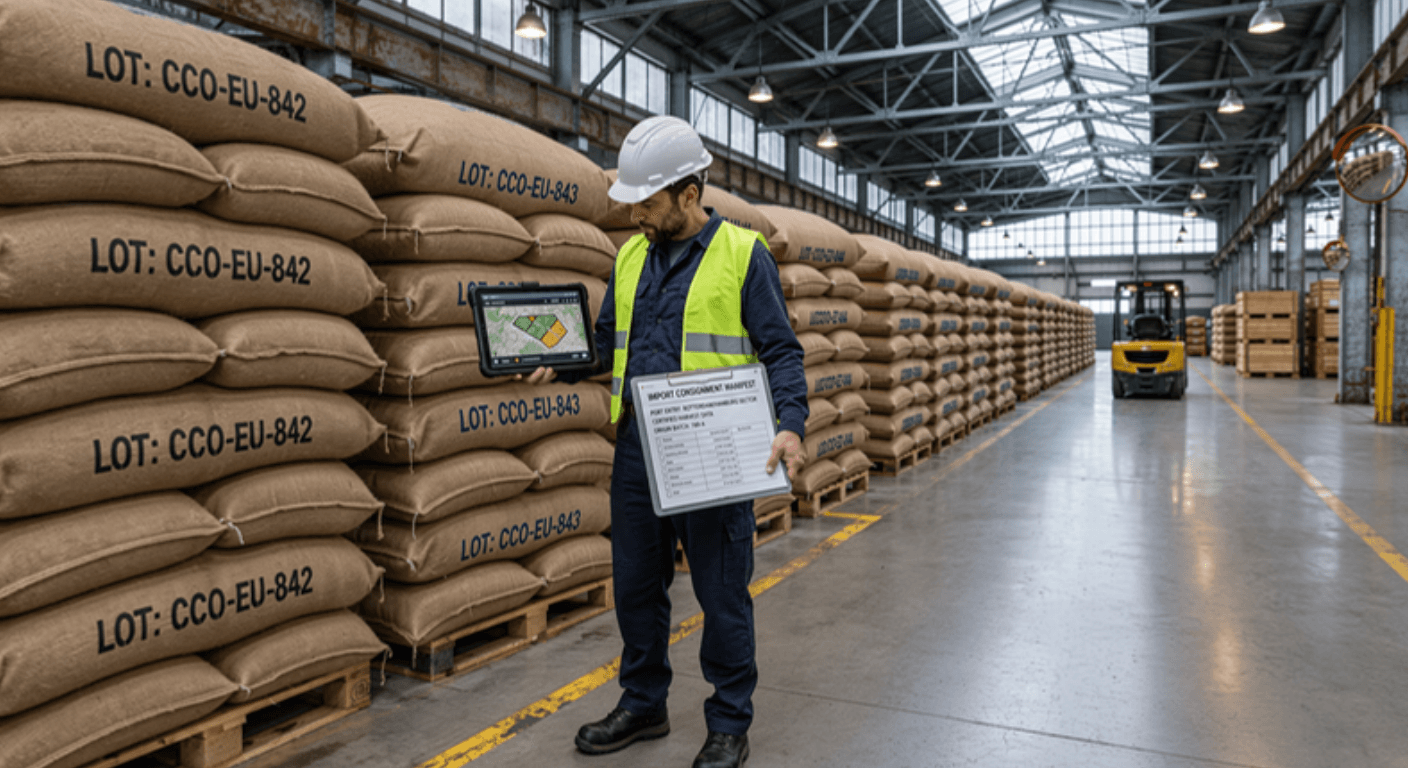
On a Monday in early December 2026, a buyer at a mid-sized chocolate maker near Amsterdam gets an email from a cocoa exporter in West Africa. Purchase order 4500118842 is on its way. Sixty tonnes of cocoa beans, 960 bags of 62.5 kilograms each, will be loaded in two weeks and should reach the plant in January.
The email has five attachments. There is a commercial invoice as a PDF and a packing list as another PDF. There is a spreadsheet with 499 rows of farm plots and their coordinates, a scanned letter from the exporter declaring which cooperatives the beans came from, and two sustainability certificates. The buyer forwards everything to the compliance mailbox, the way the team agreed in the autumn, and goes back to her other orders.
From December 30, those five files are no longer just paperwork. The chocolate maker is importing the beans itself, so under the EU deforestation rules it is the company that places them on the EU market. Before the beans can be released into the EU, it has to file a due diligence statement saying they were produced legally on land that was not deforested after December 31, 2020, with the location of every plot they came from. The statement gets a reference number, and that number has to follow the beans into SAP, into chocolate, and onto the invoices the company sends its own customers.
Nobody in the compliance team opens the spreadsheet for nine days. When they do, six of the 499 plots have no coordinates at all. Three plots larger than four hectares are described by a single point instead of a boundary. The packing list mentions a third lot that appears nowhere else. The ship sails anyway.
The chocolate maker in this story is a composite, built to make a common situation concrete, and the figures are illustrative. The situation is real for every company that buys cocoa, coffee, palm oil, soy, rubber, cattle products or wood into the EU. The hard part of the EU Deforestation Regulation is not reading the law. It is collecting the supplier evidence, matching it to the right purchase order and goods receipt, and being able to show months or years later what you bought, from whom, and under which reference number.
What the EUDR asks for from December 30, 2026
The EU Deforestation Regulation, usually shortened to EUDR, covers seven commodities. They are cattle, cocoa, coffee, oil palm, rubber, soy and wood, together with many products made from them, such as chocolate, leather, tyres, furniture and paper, and packaging sold as a product in its own right. A company may only place these products on the EU market, or export them, if they are deforestation-free, were produced in line with the laws of the country of production, and are covered by a due diligence statement.
The dates have moved twice, and they are now set. The rules apply from December 30, 2026 to large and medium operators and to all traders. Micro and small operators that were established as such by December 31, 2024 follow on June 30, 2027. The Commission's review in May 2026 proposed no further changes to the legal text, and as of mid-November 2026 no proposal to move the dates had been published. Planning around December 30 is the safe assumption.
The December 2025 amendment also changed who does what along the supply chain, and this is where many procurement teams need to look again.
The operator files the statement. Only the operator that first places a product on the EU market, typically the importer or the EU producer, files a due diligence statement in the EU information system. That statement carries the geolocation of every plot of land where the commodity was produced. For plots larger than four hectares, other than for cattle, the location has to be a polygon around the boundary rather than a single point. The system returns a reference number, and for imports that number is declared to customs.
The first company after the operator keeps the reference number. The first downstream operator or trader that buys from the operator must collect that statement's reference number and keep it for five years. It does not file a statement of its own. Companies further down the chain no longer have to pass reference numbers on.
Larger downstream companies register and keep records. Downstream companies that are not SMEs must register in the EU information system and keep records of their suppliers and customers.
Most mid-sized manufacturers play both roles at once. Our chocolate maker is the operator for the beans it imports itself. The same week, a tanker of cocoa butter arrives from a grinder in Germany that imported and processed its own beans. For that delivery the chocolate maker is the first downstream company, and the evidence it needs is a reference number printed on the grinder's invoice and delivery note. Two roles, two sets of evidence, one SAP system.
Where the evidence actually lives
Ask a compliance lead where the EUDR evidence for a shipment is, and the honest answer is usually "in several places". It arrives in pieces, from different senders, in different formats, at different times. None of it arrives in SAP.
The geolocation file. For the imported beans, the exporter sends a spreadsheet listing the plots the beans came from. In our story it has 312 plots for the first cooperative and 187 for the second. Each row should have coordinates, and larger plots should have a polygon. In practice, spreadsheets arrive with empty cells, coordinates in two different formats, columns renamed between versions, and sometimes a separate file per cooperative sent a week apart.
The traders' declaration. The exporter declares which cooperatives and which lots make up the shipment. Here it says lot L-0411 holds 544 bags from the first cooperative and lot L-0412 holds 416 bags from the second. It arrives as a scanned, signed letter, so the lot numbers exist only as text inside a PDF.
Certificates. Sustainability certificates for both cooperatives arrive as PDFs. They are useful supporting evidence, and they help the risk assessment, but they do not replace the geolocation or the due diligence. They also expire, and nobody tends to check the dates.
The commercial documents. The commercial invoice and the packing list carry the purchase order number, quantities, bag counts and lot numbers. These are the documents that will be matched to the purchase order and the goods receipt in SAP, so they are where the compliance evidence has to connect to the business transaction.
The reference numbers. For the imported beans, the reference number is created when the chocolate maker files its own statement. For the cocoa butter from the German grinder, the reference number arrives on the grinder's invoice and delivery note, as a line of text among the prices and tank numbers.
Every one of these documents is readable by a person. Very few of them are connected to each other, and none of them is connected to the purchase order, the goods receipt or the batch in SAP. That gap is where EUDR compliance actually fails.
Why the evidence falls apart between purchase order and goods receipt
The documents for an import arrive weeks before the goods. The goods receipt happens at the plant, often weeks after anyone last looked at the documents. In between, the evidence sits in a shared mailbox or a folder named after the supplier, and the link between "this spreadsheet" and "these 960 bags" lives in somebody's head.
Three things break that link more often than anything else.
Lots do not stay the way they were declared. A declaration says two lots. The packing list says three, because the exporter's warehouse split one lot across two stacks, or merged the end of one lot into another to fill a container. In our story, 80 of the bags are marked L-0413, a lot that appears in no declaration and no geolocation file. If those bags are received into SAP as part of an ordinary batch, nobody can later say which plots they came from.
Reference numbers get typed, and typed numbers drift. A reference number copied by hand from a PDF into a spreadsheet, then into a comment field in SAP, is a reference number that will eventually be wrong. On the German grinder's documents, the invoice shows a reference ending in 2290 and the delivery note shows one ending in 2209. One of them is a typing error. Without a check, both versions end up somewhere in the company's records.
Nobody owns the whole chain. Procurement owns the purchase order. Compliance owns the due diligence. The warehouse owns the goods receipt. Quality owns the batch. Finance owns the invoice. Each team handles its own document well, and the evidence falls through the gaps between them. Our post on automated certificates and manual batch records describes the same pattern in quality management.
There is also a timing problem. If the six missing plots are found only when the ship is in port, the statement cannot be filed, the beans cannot be released, and every day in port costs money. Found on the Monday the email arrived, the same six plots are a simple request to the exporter with weeks to spare.
Finance feels the consequences too. An import that cannot be released has to be stored somewhere, and someone pays for that. And if a statement is filed on evidence that later turns out to be incomplete, the problem lands on goods already turned into chocolate and shipped to customers. Getting the evidence right while the goods are still at sea is by far the cheapest point to fix it.
Following the shipment from purchase order to batch
Here is the same shipment again, run through a process built for the evidence rather than for the mailbox.
Step 1. Read every document the day it arrives
The exporter's email lands, and all five attachments are read straight away. The invoice and packing list are matched to purchase order 4500118842 by order number, material and quantity. The declaration is read for its lots and bag counts. The geolocation spreadsheet is read row by row, whatever its column names, and every plot is attached to its cooperative. The certificates are read for holder, scope and expiry date. Everything is linked to the purchase order, not just filed in a folder.
Step 2. Check the evidence against itself
The documents are compared with each other before anyone needs them. Do the bag counts in the declaration add up to the packing list? 544 and 416 make 960, so the totals agree. Do the lots on the packing list match the lots in the declaration? No. Lot L-0413 with 80 bags appears only on the packing list, and lot L-0412 shows 336 bags instead of 416. Does every plot in the geolocation file have usable coordinates? Six do not, and three plots over four hectares have a single point instead of a polygon. Are both certificates valid on the shipping date? Yes.
Step 3. Send the questions while the beans are still at sea
Each gap becomes a specific question to the exporter, in writing, on the day of arrival. Please send coordinates for these six plots. Please send boundaries for these three plots. Please explain lot L-0413, which cooperative it came from and why it is not in the declaration. The answers come back over the following week and are read and checked in the same way as the originals.
Step 4. Prepare the statement for a person to file
Once the evidence is complete, the information for the due diligence statement is assembled from the documents: the commodity, the quantity, the supplier, and the geolocation for every plot. A compliance officer reviews it, decides that the risk is negligible, and files it. The statement returns a reference number, which goes onto the customs declaration and is stored against the purchase order.
Step 5. Receive the goods into the right batches
When the container reaches the plant, the delivery is matched to the purchase order as usual. The bags from lot L-0411 are received as one batch and the bags from lot L-0412 as another, each linked to the reference number and its evidence. Many teams store the reference as a batch characteristic, so it travels with the batch automatically. If the exporter's explanation for the 80 bags of L-0413 is not good enough, those bags go to blocked stock until a person decides what to do with them.
The cocoa butter from the German grinder goes through a shorter version of the same flow. The reference number is read from the invoice and the delivery note, and the two are compared. They disagree, 2290 against 2209, so the grinder is asked which one is right before the tanker is unloaded. The confirmed number is stored against the purchase order, the goods receipt and the batch, and kept for five years.
When chocolate made from those batches is sold to a confectionery brand, the chocolate maker's invoice and delivery note carry the reference number of its own statement. Its customer, the first downstream company, now has the number it needs, already matched to what it bought.
Months later, a regulator asks a simple question about a batch of chocolate. Which cocoa went into it, from whom, under which reference? The answer is a few clicks away. The batch leads to the goods receipt, the goods receipt to the purchase order, and the purchase order to the documents, the questions asked, the answers received and the statement filed.
What an agent checks, and where a person still decides
An agent is very good at the parts of this work that are tedious, repetitive and easy to get wrong. It never gets tired of row 412 of a geolocation spreadsheet. The checks that matter most fall into three groups.
Reference numbers. Is there a reference number on the invoice and the delivery note when the supplier is an EU operator? Do the two match each other, character for character? Does the number match what was stored for that purchase order, and is it already linked to a different delivery?
Geolocation. Does every plot have coordinates? Are the coordinates usable, inside the country of production and not obviously swapped? Do plots larger than four hectares have a polygon rather than a single point? Do the plots in the file belong to the cooperatives named in the declaration?
Lots and quantities. Do the lots and bag counts in the declaration match the packing list and the delivery? Has a lot been split across deliveries, or merged with another one? Does any lot appear in one document but not in the others?
What an agent should not do is decide. The legal responsibility for a due diligence statement stays with the company and the person who files it. So a person decides whether the evidence is complete enough to file and whether the risk is negligible. A person decides whether a supplier's explanation for an unexpected lot is good enough, or whether those bags stay blocked. A person decides whether to accept a corrected reference number, and what to tell a supplier that keeps sending incomplete files. The agent prepares each decision with the documents side by side, and records who decided what and when.
This division matters for audits as much as for compliance. Our post on what auditors look for in an automated SAP audit trail explains why the record of each human decision is worth as much as the decision itself.
How Artificio handles EUDR evidence in SAP
Artificio does not add a separate compliance system next to SAP. Its agents read the documents that already arrive and connect them to the purchase orders, goods receipts and batches that already exist. For EUDR work, the same agents that run procurement and receiving are configured with extra checks.
Document capture into SAP reads invoices, packing lists, declarations, certificates and spreadsheets, whatever the layout, and links each one to the right purchase order. Table extraction handles geolocation spreadsheets and packing lists with hundreds of rows. The vendor collaboration agent reads supplier replies in any format and chases suppliers who do not answer, so questions about missing plots do not sit in an inbox.
At the dock, the PO goods receipt agent matches delivery notes to the purchase order by material, quantity and batch, and posts the goods receipt once the receiver confirms what arrived. The batch genealogy agent traces every batch from receipt through production to customer delivery and flags breaks in the chain, which is exactly the trail a regulator's question follows.
The EUDR checks themselves, for reference numbers, geolocation and lots, are set up as rules and validation, and every decision goes to a person through human-in-the-loop review. Nothing is filed, released or posted on a disagreement without someone approving it. Our post on why document AI should never post blind covers the reasoning.
If your receiving team already struggles with split deliveries, our posts on split-shipment matching and bill of lading and packing list reconciliation describe the same document problems that EUDR now raises the stakes on.
Getting ready before December 30
With the date fixed, most of the remaining work is practical. A short list for procurement, compliance and finance to work through together:
- Map your roles by supplier. For each in-scope material, decide whether you are the operator, because you import or produce it, or the first downstream company, because you buy it from an EU operator. Your evidence needs differ completely between the two.
- Register if you need to. If you are a non-SME downstream company, register in the EU information system and set up your records of suppliers and customers.
- Tell suppliers what you need, and where. Ask EU suppliers to print the reference number on both the invoice and the delivery note. Ask suppliers outside the EU for geolocation in one agreed format, with polygons for larger plots, before the goods ship.
- Decide where the reference number lives in SAP. Agree one place, such as a batch characteristic, so it travels with the batch into production and onto your own sales documents.
- Decide who decides. Name the people who approve a statement, accept a supplier explanation and release blocked stock, with a delegate for each.
- Test on one material. Run a few shipments of your highest-volume commodity through the full flow before December 30, and fix what breaks.
The EUDR is often described as a sustainability law, and it is one. For the teams who have to make it work, it is also a document matching problem that runs from the purchase order to the batch. Companies that connect the evidence to SAP as it arrives will answer a regulator's question in minutes. Companies that leave it in the mailbox will be answering it from memory. If you would like to see how this works on your own suppliers and materials, book a short demo and bring one shipment's worth of documents.