

Blog
Document Processing 3.0: Intelligent Workflows & AI Automation
Explore Document Processing 3.0, the next evolution in document handling. AI and intelligent workflows streamline operations.

Blog
Explore Document Processing 3.0, the next evolution in document handling. AI and intelligent workflows streamline operations.
The enterprise world runs on documents. Every day, millions of invoices, contracts, claims, and reports flow through organizations, carrying critical information that drives business decisions. Yet despite decades of technological advancement, most companies still treat documents like static artifacts rather than the dynamic intelligence goldmines they actually are.
Traditional document processing has been stuck in a rut. OCR technology converts images to text, but it can't understand what that text means. Template-based extraction pulls out specific fields, but it breaks down the moment a document format changes. Rule-based systems follow rigid logic, but they can't adapt to the countless variations that real-world documents present.
This disconnect creates a massive bottleneck in modern businesses. Finance teams spend hours validating invoice data. Legal departments manually review contracts for compliance risks. Supply chain managers struggle to process supplier documents quickly enough to maintain efficient operations. The result? Delayed decisions, increased costs, and missed opportunities.
But what if documents could do more than just store information? What if they could actively participate in business processes, making intelligent decisions and triggering appropriate actions? This isn't science fiction. It's the reality of Document Processing 3.0, where artificial intelligence transforms static text into intelligent, actionable workflows.
Document Processing 3.0 represents a fundamental shift in how we think about document handling. Instead of simply extracting data and hoping human reviewers can make sense of it, this new approach combines large language models, intelligent agents, and orchestration platforms to create systems that truly understand documents in context. These systems don't just read documents, they comprehend intent, apply business logic, validate information against multiple sources, and initiate appropriate next steps without human intervention.
The implications are staggering. Companies implementing Document Processing 3.0 are seeing processing times cut by 70% or more, accuracy rates approaching 99%, and compliance workflows that operate in real-time rather than days or weeks. More importantly, they're freeing up their human workforce to focus on strategic activities rather than mundane document review tasks.
This transformation isn't just about efficiency gains. It's about creating competitive advantages through speed, accuracy, and insight. In a business environment where milliseconds can mean millions in trading, where regulatory compliance can make or break entire industries, and where customer experience increasingly depends on instant gratification, the ability to process documents intelligently and immediately becomes a strategic necessity.
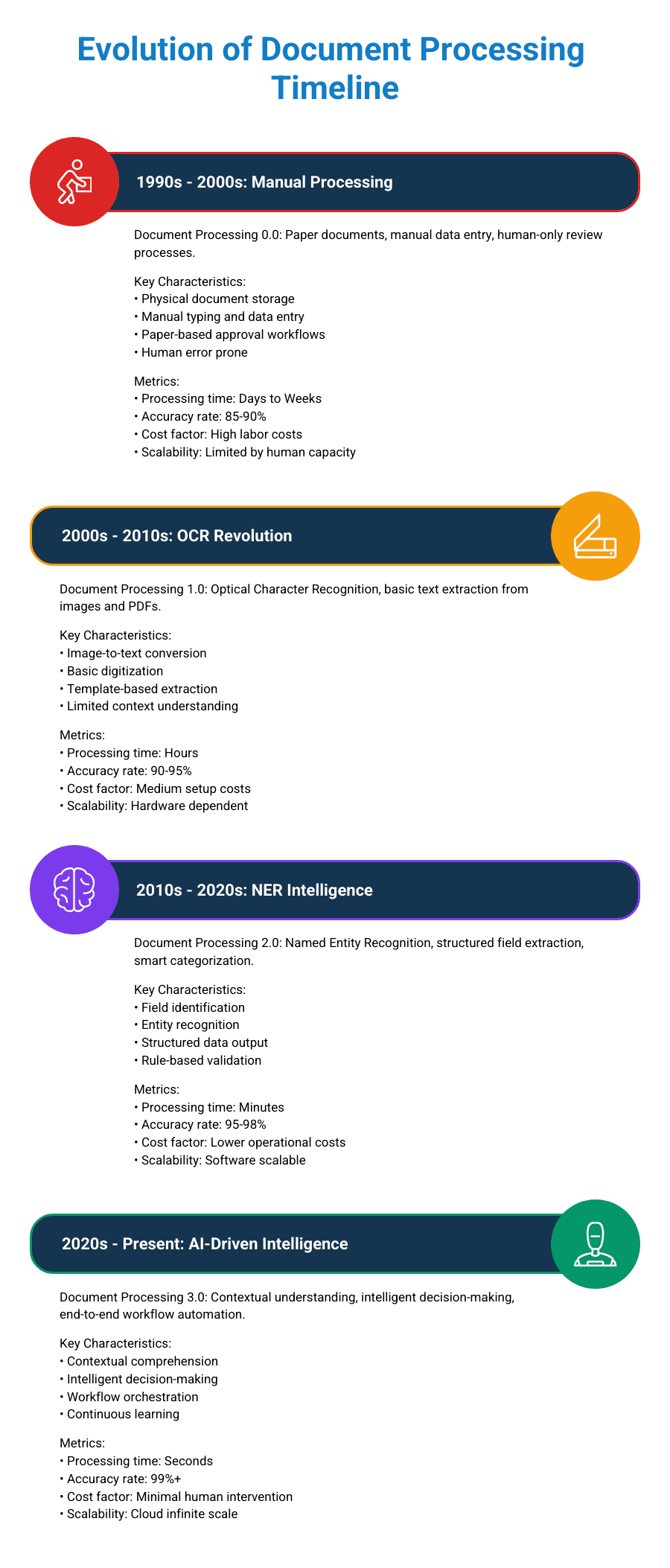
Understanding where we're headed requires a clear picture of where we've been. Document processing has evolved through distinct phases, each building on the limitations of its predecessor while introducing new capabilities that seemed impossible just years before.
Optical Character Recognition marked the first major breakthrough in automated document processing. For the first time, computers could look at a scanned document or image and convert the visual representation of text into actual digital characters. This was revolutionary in the 1990s and early 2000s, when businesses were drowning in paper documents and desperately needed ways to digitize their archives.
OCR technology solved the fundamental problem of data accessibility. Instead of having information locked away in filing cabinets or stored as unsearchable image files, businesses could suddenly convert their document libraries into searchable, editable digital text. The technology enabled basic automation workflows, like routing documents based on simple keyword recognition or allowing employees to search through previously inaccessible document collections.
But OCR had severe limitations that became apparent as businesses tried to scale their document processing operations. The technology could tell you that a document contained the text "Invoice Amount: $5,432.21" but it couldn't understand that this represented a financial obligation requiring payment processing. It could recognize a date like "March 15, 2024" but couldn't determine whether this was an invoice date, due date, or contract expiration date. OCR converted images to text, but it provided zero context about what that text actually meant.
These limitations created new problems even as they solved old ones. Businesses found themselves with massive amounts of digitized text that still required extensive human review to extract meaningful information. The conversion from paper to digital was just the first step in a much longer process that still depended heavily on manual interpretation and data entry.
Named Entity Recognition emerged as the next evolutionary step, addressing OCR's context problem by teaching computers to identify and categorize specific types of information within documents. Instead of seeing just random text, NER systems could recognize that "John Smith" was a person's name, "$5,432.21" was a monetary amount, and "March 15, 2024" was a date.
This represented a significant leap forward in document processing capabilities. NER systems could automatically extract structured data from unstructured text, identifying key fields like customer names, invoice amounts, product codes, addresses, and dates with remarkable accuracy. For the first time, businesses could implement semi-automated workflows that extracted the most important information from documents without requiring human operators to manually type everything into their systems.
NER technology enabled the creation of more sophisticated document processing pipelines. An invoice processing system could automatically identify the vendor name, invoice number, amount, and due date, then route this information to the appropriate approval workflow. A contract management system could extract key terms like contract value, expiration dates, and renewal clauses, making it easier for legal teams to track important deadlines and obligations.
But NER still fell short of true intelligence. While it could identify individual data points, it couldn't understand the relationships between them or apply business logic to determine appropriate actions. A NER system might correctly extract all the fields from an invoice, but it couldn't determine whether the invoice was valid, whether the amount matched the original purchase order, or whether the vendor was approved. These systems required extensive post-processing and human validation to ensure accuracy and compliance.
The technology also struggled with document variations. NER systems typically required training on specific document types and formats, making them brittle when faced with new layouts or unexpected document structures. A system trained to process standard invoices might fail completely when presented with a credit memo or a different vendor's invoice format.
Document Processing 3.0 represents the culmination of advances in artificial intelligence, particularly large language models and intelligent agent systems. Unlike its predecessors, this approach doesn't just recognize text or identify entities, it actually understands documents in much the same way humans do.
Large language models bring contextual understanding to document processing. They can read an invoice and understand not just that it contains a monetary amount, but whether that amount is reasonable given the context of the purchase, the vendor relationship, and historical patterns. They can analyze a contract and identify potential risks or opportunities that might not be explicitly stated in the text. They can review insurance claims and detect patterns that might indicate fraud or processing errors.
But LLMs alone aren't enough to create truly intelligent document processing systems. The real breakthrough comes from combining LLMs with intelligent agents and orchestration platforms that can take action based on what they understand. These systems don't just extract and analyze information, they make decisions and initiate appropriate workflows.
An intelligent document processing system might receive an invoice, extract all relevant data, validate that information against purchase orders and vendor databases, check compliance with payment terms and approval limits, identify any discrepancies or red flags, and then either automatically approve the payment or route the document to appropriate human reviewers with detailed explanations of any issues found. All of this happens in seconds rather than hours or days.
The key difference is that Document Processing 3.0 systems think about documents rather than just processing them. They apply business logic, consider context, learn from patterns, and make informed decisions. They turn documents from static information repositories into active participants in business workflows.
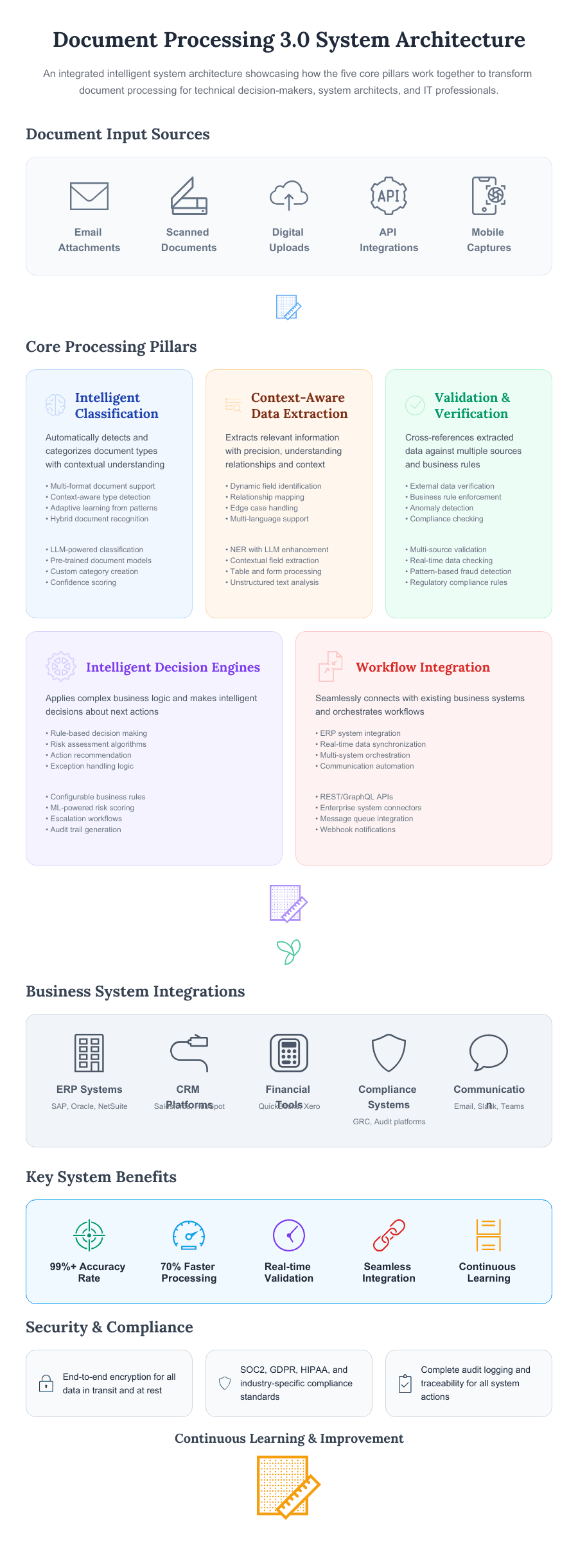
The transformation from traditional document processing to intelligent workflow automation rests on five fundamental pillars that work together to create systems capable of understanding, analyzing, and acting on document content with human-level comprehension but superhuman speed and consistency.
The foundation of any intelligent document processing system is its ability to automatically determine what type of document it's looking at and what that document is trying to accomplish. This goes far beyond simple keyword matching or template recognition. Intelligent classification systems understand document structure, content patterns, and contextual clues to make accurate determinations even when faced with unusual formats or hybrid document types.
Modern classification engines can distinguish between hundreds of different document types, from standard invoices and purchase orders to complex legal contracts and technical specifications. But more importantly, they understand the relationships between document types and can identify when a single document serves multiple purposes. A contract amendment might include pricing changes that need to be processed like a purchase order update, compliance requirements that need legal review, and implementation timelines that need project management coordination.
This classification capability enables the system to route documents to appropriate processing workflows from the moment they enter the system. Instead of relying on human operators to sort documents into different categories, intelligent classification happens automatically and instantaneously, dramatically reducing processing delays and ensuring that each document receives the specific handling it requires.
The technology also adapts and learns from new document types. When organizations introduce new forms or work with new vendors who use different formats, the classification system can quickly learn to recognize these variations without requiring extensive retraining or manual rule creation.
While traditional extraction systems focus on pulling specific fields from predetermined locations, context-aware extraction understands that the same piece of information can appear in different places and formats depending on the document source and purpose. These systems use advanced natural language processing to identify relevant information regardless of where it appears in the document or how it's formatted.
Context-aware extraction excels at handling edge cases that break traditional systems. It can extract invoice amounts whether they appear in a standard table format, embedded within paragraph text, or split across multiple lines due to formatting constraints. It understands that "Net 30" and "Payment due within 30 days" represent the same payment terms, and it can identify contract renewal dates even when they're described as "automatic extension for an additional twelve-month period commencing upon expiration of the initial term."
The technology goes beyond simple field extraction to understand relationships between different pieces of information. When processing a complex purchase agreement, the system doesn't just extract the total contract value, it also identifies how that value is distributed across different products or services, what payment schedules apply to each component, and how changes to one element might affect other parts of the agreement.
This contextual understanding enables much higher accuracy rates, especially when dealing with non-standard documents or documents from new sources. The system can handle variations in terminology, formatting, and document structure without requiring specific configuration for each new document type.
One of the most critical aspects of Document Processing 3.0 is its ability to validate extracted information against multiple sources and business rules. This goes far beyond simple format checking to include complex business logic validation, external data verification, and compliance rule enforcement.
Validation modules can cross-reference invoice information against purchase orders to ensure amounts match and items were actually ordered. They can verify vendor information against approved supplier databases and check payment terms against negotiated contracts. They can validate addresses against shipping records and confirm that tax calculations are correct based on applicable rates and regulations.
The verification process also includes sophisticated anomaly detection that can identify unusual patterns or potential fraud indicators. The system might flag invoices with amounts that are significantly higher than historical patterns, identify duplicate invoices that might represent attempted duplicate payments, or detect subtle changes in vendor payment information that could indicate compromised accounts.
Compliance validation ensures that all processing adheres to relevant regulations and corporate policies. For financial documents, this might include Sarbanes-Oxley compliance checks, anti-money laundering screenings, and approval workflow verification. For healthcare documents, it might involve HIPAA compliance validation and clinical protocol adherence. For government contracts, it might include specialized regulatory requirement verification.
The decision engine represents the most sophisticated component of Document Processing 3.0 systems. Rather than simply flagging issues for human review, these engines apply complex business logic to determine appropriate actions and can often resolve issues autonomously.
Decision engines operate using configurable rule sets that can be as simple as "automatically approve invoices under $1,000 from approved vendors" or as complex as multi-factor risk assessment models that consider vendor history, contract terms, budget availability, approval authority levels, and compliance requirements. The key is that these rules can be easily modified and updated as business requirements change, without requiring system reprogramming.
The engines also learn from patterns and outcomes over time. They can identify which types of exceptions typically require human intervention and which can be safely handled automatically. They can detect changing patterns in document processing that might indicate new risks or opportunities for further automation.
When issues arise that require human attention, decision engines don't just flag problems, they provide comprehensive context and recommended actions. Instead of simply indicating that an invoice amount doesn't match a purchase order, the engine might explain the specific discrepancy, identify potential causes, suggest resolution approaches, and route the issue to the most appropriate person for review based on the type and severity of the problem.
The final pillar of Document Processing 3.0 is seamless integration with existing business systems and workflows. Rather than creating another isolated system that requires manual data transfer, intelligent document processing platforms connect directly with ERP systems, customer relationship management platforms, financial management tools, and industry-specific applications.
These integrations go beyond simple data transfer to include bidirectional communication and process orchestration. When the document processing system approves an invoice, it can automatically create the payment record in the accounting system, update budget tracking, and notify relevant stakeholders. When it identifies a compliance issue, it can create tickets in project management systems, send alerts through communication platforms, and initiate appropriate remediation workflows.
The integration layer also enables real-time status updates and visibility across all connected systems. Stakeholders can see the current status of any document processing operation, track processing metrics and performance indicators, and receive proactive notifications about items requiring attention or approaching deadlines.
The theoretical advantages of Document Processing 3.0 become most apparent when examining how organizations across different industries are using these capabilities to transform their operations and create competitive advantages.
Financial institutions process enormous volumes of documents daily, from loan applications and insurance claims to regulatory filings and compliance reports. The speed and accuracy of this processing directly impacts customer experience, regulatory compliance, and business profitability.
Traditional loan origination processes often take weeks or months, with much of that time spent on document collection, verification, and manual review. Document Processing 3.0 systems can compress this timeline dramatically by automatically extracting information from applicant-provided documents, validating that information against external data sources, running compliance and risk assessment checks, and generating preliminary approval recommendations.
A regional bank implemented an intelligent document processing system for their commercial lending operations and saw remarkable results. The system automatically processes loan applications by extracting financial statements, tax returns, and business plans, then cross-references this information against credit bureau data, regulatory databases, and internal risk models. What previously took loan officers several days of manual review now happens in minutes, with the system flagging only those applications that require human expertise for unusual circumstances or complex risk factors.
The accuracy improvements are equally impressive. Manual document review is prone to errors, especially when processing large volumes of similar documents. The AI system maintains consistent accuracy regardless of volume, catching discrepancies and potential fraud indicators that human reviewers might miss due to fatigue or time pressure. The bank reports that their loan default rates have decreased by 23% since implementing the system, largely due to more consistent and thorough document analysis.
Insurance claim processing represents another area where Document Processing 3.0 creates significant value. Insurance companies receive thousands of claims daily, each requiring careful review of supporting documentation like medical records, repair estimates, police reports, and photographic evidence. Intelligent processing systems can analyze all of this documentation simultaneously, cross-reference information across multiple sources, identify potential fraud indicators, and determine appropriate settlement amounts based on policy terms and historical precedents.
One major insurance carrier reduced their average claim processing time from 14 days to 3 days by implementing intelligent document processing for property damage claims. The system automatically analyzes damage photos, validates repair estimates against local market rates, confirms policy coverage details, and calculates settlement amounts. Claims handlers now focus their time on complex cases that require human judgment rather than spending hours on routine documentation review.
Manufacturing companies and their suppliers exchange countless documents daily, including purchase orders, invoices, shipping confirmations, quality certificates, and compliance documentation. The accuracy and speed of processing these documents directly affects production schedules, cash flow, and supplier relationships.
Intelligent document processing transforms supplier invoice management by automatically validating invoice information against purchase orders, checking pricing against negotiated contracts, verifying receipt confirmations, and ensuring compliance with payment terms and tax requirements. The system can identify and resolve common discrepancies like quantity variations, pricing changes, or shipping cost adjustments without requiring human intervention.
A Fortune 500 manufacturing company implemented Document Processing 3.0 for their accounts payable operations and achieved remarkable results. The system processes over 50,000 supplier invoices monthly, automatically approving 78% of them for payment without human review. The remaining 22% are flagged for specific issues with detailed explanations and recommended resolution approaches. Processing time decreased from an average of 12 days to 2 days, and the company reduced their accounts payable staff by 40% while actually improving payment accuracy and vendor satisfaction.
The system also provides valuable business intelligence that wasn't available through manual processing. It can identify patterns in supplier performance, highlight opportunities for cost savings through early payment discounts, detect potential supply chain risks based on vendor financial health indicators, and provide detailed analytics on purchasing patterns and compliance metrics.
Quality management documentation represents another critical application area. Manufacturing companies must maintain detailed records of quality certifications, test results, and compliance documentation for regulatory purposes and customer requirements. Intelligent processing systems can automatically validate that incoming materials meet specified requirements, flag potential quality issues based on test result patterns, and ensure that all necessary documentation is complete and properly filed.
Legal departments handle vast amounts of documentation that requires careful analysis for compliance, risk assessment, and strategic decision-making. Contract review, regulatory filing analysis, and litigation document processing are all areas where intelligent automation can provide significant value while reducing risk exposure.
Contract lifecycle management benefits enormously from Document Processing 3.0 capabilities. Instead of requiring lawyers to manually read through hundreds of pages of contract terms, intelligent systems can automatically identify key provisions, flag unusual terms or potential risks, extract important dates and obligations, and compare contract terms against standard templates and corporate policies.
A multinational corporation implemented intelligent contract processing for their vendor management operations and saw transformative results. The system processes over 2,000 vendor contracts annually, automatically extracting key terms like pricing, payment conditions, liability limits, and renewal clauses. It flags contracts that deviate from standard terms, identifies potential compliance issues, and tracks important dates for renewals and renegotiations. Legal review time decreased by 65%, and the company reports significant improvements in contract compliance and risk management.
The system also provides strategic insights that support better business decisions. It can analyze contract terms across different vendors to identify optimization opportunities, track compliance with negotiated terms over time, and provide early warning of potential disputes or relationship issues based on contract performance patterns.
Regulatory compliance documentation presents another compelling use case. Organizations in heavily regulated industries must process and analyze enormous amounts of regulatory guidance, filing requirements, and compliance documentation. Intelligent processing systems can automatically identify relevant regulatory changes, assess their impact on current operations, and generate recommended action plans for compliance teams.
The business case for Document Processing 3.0 extends far beyond simple efficiency gains or cost reduction. In today's competitive business environment, the speed, accuracy, and insight provided by intelligent document processing systems create strategic advantages that can determine market leadership.
The pace of business continues to accelerate across all industries. Customer expectations for instant service and immediate responses put pressure on organizations to process information and make decisions faster than ever before. Manual document review processes that take days or weeks become competitive disadvantages when competitors can accomplish the same tasks in hours or minutes.
Consider the impact in financial services, where loan approval speed directly affects customer acquisition and retention. A bank that can provide loan decisions in 24 hours while competitors require a week or more will capture a larger share of time-sensitive opportunities like real estate purchases or business expansion financing. The difference isn't just operational efficiency, it's market positioning and revenue impact.
Accuracy requirements have also intensified as regulatory oversight increases and the cost of errors grows. A single compliance failure can result in millions of dollars in fines and regulatory sanctions. Manual document processing, no matter how careful, introduces human error risks that become unacceptable when dealing with critical compliance requirements or high-value transactions.
Intelligent document processing systems maintain consistent accuracy regardless of volume, timing, or complexity. They don't suffer from fatigue, distraction, or unconscious bias that can affect human review. They apply business rules and compliance checks consistently across all documents, ensuring that important requirements aren't overlooked due to time pressure or workload variations.
The audit and compliance benefits are particularly significant. Document Processing 3.0 systems maintain detailed logs of all processing activities, decision rationale, and validation steps. This creates comprehensive audit trails that demonstrate compliance with regulatory requirements and internal policies. The systems can also generate detailed reports on processing metrics, exception handling, and quality indicators that support continuous improvement and regulatory reporting requirements.
Data quality and business intelligence represent another strategic advantage. Manual document processing typically focuses on extracting just enough information to complete immediate tasks, leaving valuable insights buried in unprocessed documents. Intelligent systems can extract and analyze comprehensive information from every document, creating rich datasets that support strategic decision-making.
Organizations using Document Processing 3.0 systems report significant improvements in their ability to identify trends, predict potential issues, and optimize operations based on document-derived insights. They can track vendor performance patterns, identify customer behavior trends, detect emerging compliance risks, and optimize pricing strategies based on comprehensive analysis of contract and transaction data.
The scalability advantages become critical as organizations grow or face fluctuating document volumes. Traditional manual processing requires hiring and training additional staff to handle increased volumes, creating cost and quality challenges. Intelligent processing systems can handle dramatic volume increases without proportional cost increases or quality degradation.
Artificio's Document Processing 3.0 platform represents the culmination of advances in artificial intelligence, machine learning, and workflow orchestration, specifically engineered to transform how enterprises handle document-intensive processes. Rather than simply providing another document extraction tool, Artificio has built a comprehensive ecosystem that turns documents into intelligent workflow participants.
The platform's LLM-orchestrated document engine forms the foundation of this approach. Unlike traditional systems that rely on rigid rules or template matching, Artificio's engine uses advanced language models to understand documents in context, much like a human expert would. The system can process invoices from new vendors it's never seen before, analyze contracts with non-standard clauses, and handle regulatory documents with complex requirements, all without requiring specific configuration or training for each new document type.
The pre-trained NER and business rule agents represent a significant advancement in reducing implementation complexity and time-to-value. Traditional document processing implementations often require months of training and configuration before achieving acceptable accuracy levels. Artificio's platform comes with extensive pre-trained models that understand common business document types, industry-specific terminology, and standard business processes. Organizations can achieve production-level accuracy within days rather than months of implementation.
These agents continuously learn and improve from processing patterns within each organization. The system identifies document variations specific to each company's vendors, customers, and processes, automatically adapting its processing logic to handle these unique requirements. This results in accuracy levels that often exceed 99% for standard document types, with continuous improvement as the system processes more documents.
The seamless integration capabilities address one of the most significant challenges organizations face when implementing new document processing systems. Rather than creating isolated islands of functionality, Artificio's platform connects directly with existing enterprise systems like SAP, Oracle, NetSuite, Encompass, and dozens of other commonly used business applications.
These integrations go beyond simple data transfer to include bidirectional communication and process orchestration. When the system processes an invoice, it can automatically verify purchase order information in the ERP system, check vendor approval status in procurement systems, validate budgetary availability in financial management tools, and create payment records in accounts payable systems. The entire process happens seamlessly without requiring users to switch between different applications or manually transfer information.
The intelligent communication layer represents a particularly innovative aspect of Artificio's approach. Rather than requiring users to work within yet another software interface, the platform can communicate through familiar channels like email, chat applications, and even WhatsApp. When the system identifies exceptions that require human attention, it can send detailed explanations and resolution recommendations through whatever communication channel the user prefers.
This communication capability extends to collaborative workflows where multiple stakeholders need to review and approve documents. The system can orchestrate approval processes across different departments and organizations, automatically routing documents to appropriate reviewers, tracking response times, sending reminders for overdue items, and maintaining complete audit trails of all approval activities.
The platform's workflow orchestration engine enables organizations to model complex business processes that span multiple systems and involve various stakeholders. A contract approval workflow might include legal review, financial analysis, technical evaluation, and executive approval, with each step having specific requirements and timelines. The system can manage the entire process, ensuring that each step is completed properly and on time, while providing real-time visibility into status and potential bottlenecks.
Advanced analytics and reporting capabilities provide organizations with unprecedented visibility into their document processing operations. The platform generates detailed metrics on processing volumes, accuracy rates, exception patterns, and performance trends. Organizations can identify opportunities for further optimization, track compliance with service level agreements, and demonstrate return on investment through comprehensive reporting.
The system also provides predictive analytics that help organizations anticipate and prepare for future requirements. By analyzing historical patterns and current trends, the platform can forecast processing volumes, identify potential capacity constraints, and recommend optimal resource allocation. This enables proactive management rather than reactive problem-solving.
Security and compliance features are built into every aspect of the platform, addressing the concerns of organizations handling sensitive or regulated documents. The system includes comprehensive access controls, encryption for data in transit and at rest, detailed audit logging, and compliance reporting for various regulatory requirements. Organizations can maintain complete control over their data while benefiting from cloud-scale processing capabilities.
Organizations considering Document Processing 3.0 implementation often feel overwhelmed by the scope of potential applications and the complexity of their existing document workflows. The key to successful implementation lies in taking a strategic, phased approach that demonstrates value quickly while building the foundation for more comprehensive transformation.
The most effective implementations begin with identifying a single, high-impact workflow that can serve as a proof of concept. Accounts payable automation represents an ideal starting point for many organizations because invoice processing is typically high-volume, standardized, and measurable. Success in this area creates immediate value while providing lessons that can be applied to other document processing challenges.
The pilot phase should focus on achieving clear, measurable results that can be communicated to stakeholders and used to justify broader implementation. Organizations should establish baseline metrics for processing time, accuracy rates, manual effort requirements, and cost per document processed. These metrics provide the foundation for measuring improvement and calculating return on investment.
During the pilot implementation, organizations should pay particular attention to integration requirements and change management considerations. Even the most advanced document processing technology will fail if it doesn't integrate smoothly with existing systems or if users resist adopting new workflows. Successful implementations involve IT teams, business users, and process owners from the beginning to ensure that technical capabilities align with business requirements.
The optimization phase involves fine-tuning the system based on real-world processing patterns and user feedback. This is where the adaptive learning capabilities of Document Processing 3.0 systems provide significant value. The system identifies patterns specific to the organization's documents, vendors, and processes, automatically improving accuracy and reducing exceptions over time.
Organizations should use this phase to expand processing rules and validation logic based on the specific requirements of their business. While the system comes with extensive pre-trained capabilities, each organization has unique policies, approval workflows, and compliance requirements that need to be incorporated into the processing logic.
Scaling to additional workflows should follow a systematic approach that leverages lessons learned from the initial implementation. Organizations typically find that contract processing, compliance documentation, or customer onboarding represent logical next steps because these areas often involve similar document types and processing requirements.
Each additional workflow implementation should follow the same pattern of baseline measurement, pilot implementation, optimization, and scaling. This approach ensures that each expansion builds on previous success while minimizing risk and disruption to ongoing operations.
Throughout the implementation process, organizations should focus on measuring and communicating business impact rather than just technical metrics. Processing time reduction and accuracy improvement are important, but the real value comes from business outcomes like faster customer response times, improved compliance scores, reduced operational costs, and enhanced decision-making capabilities.
Change management becomes increasingly important as the scope of implementation expands. Users who were initially skeptical about automated document processing often become strong advocates once they experience the benefits firsthand. Organizations should leverage these early adopters to support broader change management efforts and help other users adapt to new workflows.
Training and support requirements vary significantly based on the sophistication of the Document Processing 3.0 platform. Systems that provide intuitive user interfaces and integrate seamlessly with existing workflows typically require minimal training. The focus should be on helping users understand how to handle exceptions and leverage the business intelligence capabilities rather than learning complex new software interfaces.
Document Processing 3.0 represents more than an evolutionary improvement in document handling technology. It fundamentally transforms how organizations think about and interact with the information that drives their operations. Instead of viewing documents as static repositories of data that require human interpretation, forward-thinking organizations are beginning to understand documents as dynamic, intelligent assets that can actively participate in business processes.
This transformation is already happening across industries, with early adopters setting new standards for operational efficiency, compliance management, and customer service. Organizations implementing Document Processing 3.0 solutions report processing time reductions of 70% or more, accuracy improvements that approach 99%, and cost savings that often exceed implementation investments within the first year of operation.
But the most significant impact may be the strategic advantages these systems create. Companies that can process and respond to critical documents in hours rather than days gain competitive advantages in customer acquisition, vendor relationships, and market responsiveness. They can offer service levels that competitors using traditional manual processes simply cannot match.
The compliance and risk management benefits are equally transformative. Organizations operating in heavily regulated industries report that intelligent document processing systems help them maintain higher compliance standards with less effort and expense than traditional approaches. The systems provide comprehensive audit trails, consistent application of business rules, and proactive identification of potential compliance issues.
The technology continues to evolve rapidly, with new capabilities emerging regularly that expand the scope of what's possible through automated document processing. Integration with emerging technologies like blockchain for document verification, IoT sensors for automatic document generation, and advanced analytics for predictive compliance monitoring will further enhance the value and applicability of these systems.
Artificio's platform represents the current state of the art in Document Processing 3.0 technology, but the company continues to innovate and expand capabilities based on customer requirements and emerging business needs. The platform's flexible architecture ensures that organizations can continue to benefit from technological advances without requiring complete system replacements or major reimplementations.
Organizations that delay implementation of Document Processing 3.0 capabilities risk falling behind competitors who are already leveraging these advantages. The technology has moved beyond experimental status to become a proven, essential capability for any organization that handles significant volumes of business-critical documents.
The future belongs to organizations that can transform their static document repositories into intelligent, responsive assets that actively support business objectives. Document Processing 3.0 isn't just about processing documents more efficiently, it's about creating intelligent enterprises that can adapt, respond, and compete more effectively in an increasingly complex and fast-paced business environment.
The intelligent document future isn't a distant vision waiting for technological breakthroughs. It's an operational reality that's available today for organizations ready to embrace the transformation. The question isn't whether Document Processing 3.0 will become the standard approach for handling business documents. The question is whether your organization will be among the early adopters who gain competitive advantages from this transformation, or among the laggards who struggle to catch up with more agile competitors.
The choice is clear, and the time to act is now. Document Processing 3.0 represents one of the most significant opportunities for operational improvement and competitive advantage available to modern enterprises. Organizations that recognize and act on this opportunity will position themselves for success in an increasingly document-driven business world.

Head IT Operations - Co Founder of Artificio
See it in your SAP environment
Bring us a document, a process, or a bottleneck. We'll show how Artificio captures, validates, and posts into SAP — then scale from there.
Security & compliance
ISO 27001:2013 certified, SOC 2 Type 2 compliant, GDPR and HIPAA ready. Every agent action is logged, auditable, and runs in isolated environments.