

Blog
Document AI's Failures & the Promise of AI Agents
Your document AI is likely making things worse, not better. Discover why traditional systems fail and how agentic AI can truly revolutionize document processing.
Blog
Your document AI is likely making things worse, not better. Discover why traditional systems fail and how agentic AI can truly revolutionize document processing.
Let's start with an uncomfortable truth that's been lurking in boardrooms across America: your expensive document AI solution is probably making things worse, not better. You paid six or seven figures for technology that promised to revolutionize how your enterprise handles documents. Instead, you got a glorified scanner with a chat interface that can't tell the difference between a purchase order and a parking ticket when the formatting changes slightly.
This isn't just another case of overpromised technology. This is a fundamental misunderstanding of what documents actually are and how businesses work. Most enterprise leaders bought into the document AI hype without asking the critical question: does this technology understand documents the way humans do, or is it just really good at finding text patterns?
The answer, for the vast majority of current solutions, is the latter. And that's a problem that's costing enterprises millions in productivity losses, compliance failures, and missed opportunities. The time has come to separate real document intelligence from expensive optical character recognition dressed up in marketing speak.
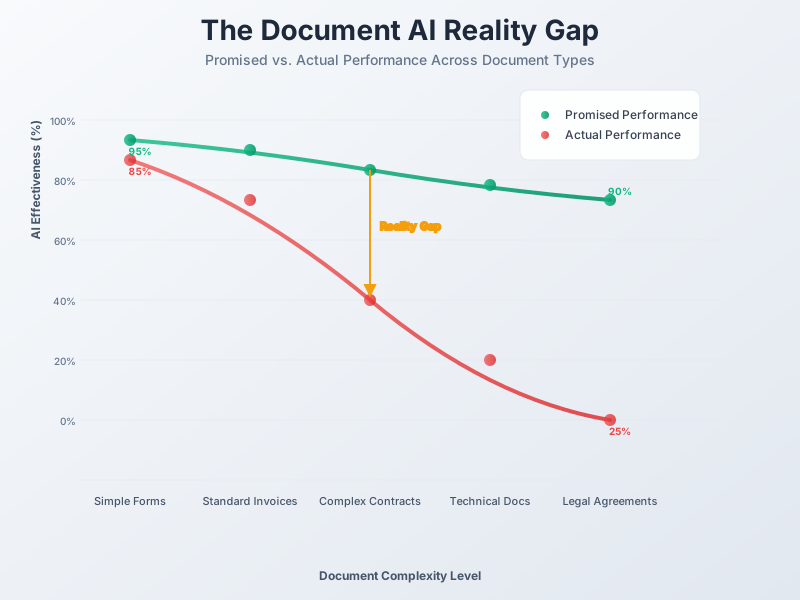
Walk into any enterprise technology conference, and you'll hear the same pitch repeated by dozens of vendors: "Our AI can process any document with 99% accuracy." They'll show you impressive demos where their system extracts data from invoices, contracts, and forms with seemingly magical precision. The audience nods approvingly, procurement departments get excited about efficiency gains, and another seven-figure deal gets signed.
Six months later, that same technology is sitting in a corner of the IT infrastructure, processing simple, standardized forms while the complex documents that actually drive business value still require manual review. The "99% accuracy" turns out to apply only to perfect document samples in controlled conditions. Real business documents with coffee stains, handwritten notes, multiple signers, and non-standard formatting break the system faster than you can say "machine learning."
This happens because most document AI solutions are built on a fundamental misconception about what documents are. They treat documents as containers for text that need to be emptied, rather than complex information structures that carry meaning, context, and business intent. It's like trying to understand a symphony by cataloging every note without recognizing the melody, harmony, or emotional content.
The technology industry has been selling OCR with additional bells and whistles as "artificial intelligence" for years. These systems can certainly read text faster than humans, and they can even classify documents based on layout patterns or specific keywords. But reading and understanding are entirely different capabilities. A human looking at a contract amendment doesn't just see text – they understand the relationships between clauses, the implications of specific language choices, and how this document fits into a broader business relationship. Most document AI systems see individual data points without the connective tissue that makes them meaningful.
This limitation becomes glaringly obvious when enterprises try to scale these solutions beyond simple, repetitive tasks. Processing standard invoices from known suppliers works reasonably well because the format is predictable and the data relationships are simple. But try to use the same technology to analyze a complex merger agreement, a regulatory filing with multiple annexes, or a technical specification document with embedded diagrams, and the wheels come off quickly.
The problem isn't just accuracy, though that's certainly an issue. The bigger problem is that these systems can't reason about what they're processing. They can't understand that a signature on page seven relates to the liability clause on page three, or that a pricing schedule in an appendix overrides general terms in the main contract. They process documents as collections of isolated data points rather than integrated information systems.
This fundamental limitation has created a massive gap between what enterprises need from document AI and what they're actually getting. Business leaders expected technology that could think about documents the way senior employees do – understanding context, recognizing exceptions, and making intelligent decisions about how to handle complex situations. Instead, they got sophisticated data extraction tools that work well for simple cases and fail spectacularly when faced with real-world complexity.
The consequences go far beyond disappointed IT departments. When document AI systems can't handle the complexity of real business documents, they create bottlenecks rather than eliminating them. Human reviewers still need to check the AI's work, but now they also need to correct its mistakes and handle all the cases it can't process. In many organizations, implementing document AI has actually increased the total time required to process documents because the technology adds steps without delivering the promised automation.
Real document intelligence doesn't start with text extraction. It starts with understanding what makes documents meaningful to human users and then building technology that can replicate that understanding at scale. When a senior procurement manager reviews a vendor contract, they're not just reading words – they're evaluating risk, assessing compliance with company policies, comparing terms to industry standards, and considering how this agreement fits into the broader vendor relationship.
True document intelligence requires AI systems that can perform the same type of contextual analysis. This means understanding not just what information is present in a document, but why that information matters and how it relates to other information both within the document and across the broader business context. It's the difference between a system that can identify a dollar amount and a system that can understand whether that dollar amount represents a reasonable price for the goods or services being purchased.
Consider how humans actually interact with complex documents. When reviewing a multi-page legal agreement, an experienced professional doesn't read every word sequentially. They scan for key sections, identify potential issues, cross-reference terms across different parts of the document, and evaluate the overall structure and logic of the agreement. They bring external knowledge about industry standards, regulatory requirements, and company policies to bear on their analysis. Most importantly, they can recognize when something doesn't make sense and investigate further.
Intelligent document AI should replicate this type of sophisticated analysis. Instead of simply extracting data points, it should evaluate the coherence and completeness of documents, identify potential issues or inconsistencies, and provide meaningful insights about business implications. This requires AI systems that can reason about relationships between different pieces of information, understand business context, and apply relevant external knowledge to their analysis.
The technology to build these capabilities exists today, but it requires a fundamentally different approach than most current document AI solutions. Instead of training models to recognize specific document layouts or extract predefined data fields, intelligent document AI should be built on foundation models that understand language, reasoning, and business concepts. These models need to be specifically trained and fine-tuned for document analysis tasks, but their underlying capability should be genuine understanding rather than sophisticated pattern matching.
Real document intelligence also requires the ability to handle uncertainty and ambiguity gracefully. Human documents are often incomplete, inconsistent, or contain conflicting information. Intelligent AI systems need to be able to identify these issues, flag them for human review, and provide suggestions for resolution. They should also be able to work with partial information and make reasonable inferences when complete data isn't available.
The user experience of truly intelligent document AI should feel more like working with a knowledgeable colleague than operating a data extraction tool. Instead of requiring users to structure their requests in specific ways or accept whatever output the system provides, intelligent document AI should be able to engage in meaningful dialogue about document content, answer questions about implications and risks, and provide explanations for its analysis and recommendations.
This type of sophistication requires AI systems that can maintain context across long documents and multiple related documents, understand temporal relationships and changes over time, and integrate information from various sources to provide comprehensive analysis. It's not enough for the system to process individual documents in isolation – it needs to understand how documents fit into broader business processes and relationships.
The gap between document AI marketing promises and enterprise reality has created some expensive lessons for organizations across industries. Take the case of a Fortune 500 manufacturing company that invested heavily in a highly rated document AI platform to streamline their supplier contract management. The system worked beautifully in demonstrations, accurately extracting key terms from standard contract templates. But when deployed on their actual contract portfolio, which included agreements spanning decades with varying formats, amendments, and custom clauses, the accuracy dropped to less than 60%. Worse, the system frequently missed critical terms buried in complex legal language, creating compliance and financial risks that weren't discovered until manual audits caught the errors months later.
A major healthcare organization experienced similar challenges when trying to automate patient record processing. Their document AI solution could handle standard forms efficiently, but struggled with physician notes, test results with annotations, and records from outside providers with different formatting standards. The system's inability to understand medical context meant it often misclassified urgent information or missed critical patient history details. After eighteen months of trying to make the technology work, they reverted to primarily manual processing while continuing to pay licensing fees for software they couldn't trust with critical healthcare decisions.
Financial services organizations have been particularly hard hit by the limitations of current document AI technology. One regional bank spent millions implementing a system to automate loan document processing, expecting to reduce approval times and increase processing capacity. The system performed adequately on residential mortgages with standard documentation, but failed completely on commercial loans with complex structures, multiple properties, or non-standard financing arrangements. The bank discovered that their most profitable loan products were precisely the ones their expensive AI system couldn't handle, forcing them to maintain parallel manual processes for their most important business.
These failures share common characteristics that reveal the fundamental limitations of current document AI approaches. First, they all involved documents that required understanding context and relationships rather than simple data extraction. Second, they dealt with document types that varied significantly in format, structure, and content. Third, they required business judgment and domain expertise that went beyond pattern recognition.
The most damaging aspect of these failures isn't just the wasted technology investment, though that's certainly significant. It's the opportunity cost of not having truly intelligent document processing capabilities. Organizations that could benefit enormously from automated document analysis are instead stuck with manual processes because the available technology can't meet their actual needs. This creates a competitive disadvantage against organizations that have found ways to genuinely automate complex document workflows.
The pattern repeats across industries because most document AI vendors have optimized for impressive demonstrations rather than real-world performance. Their systems work well on the types of simple, standardized documents that make for good sales presentations, but struggle with the messy, complex, business-critical documents that enterprises need to process. This mismatch between marketing promises and practical capabilities has created widespread skepticism about document AI technology among business leaders who've been burned by previous implementations.
Perhaps most frustrating for enterprises is that these limitations often don't become apparent until well into the implementation process. Initial pilots with carefully selected document samples show promising results, leading to larger investments in technology, training, and process changes. Only after full deployment do organizations discover that their document AI system can't handle the complexity and variability of their actual document portfolio. By that point, they've already committed significant resources and disrupted existing workflows, making it difficult to reverse course even when the technology isn't delivering promised benefits.
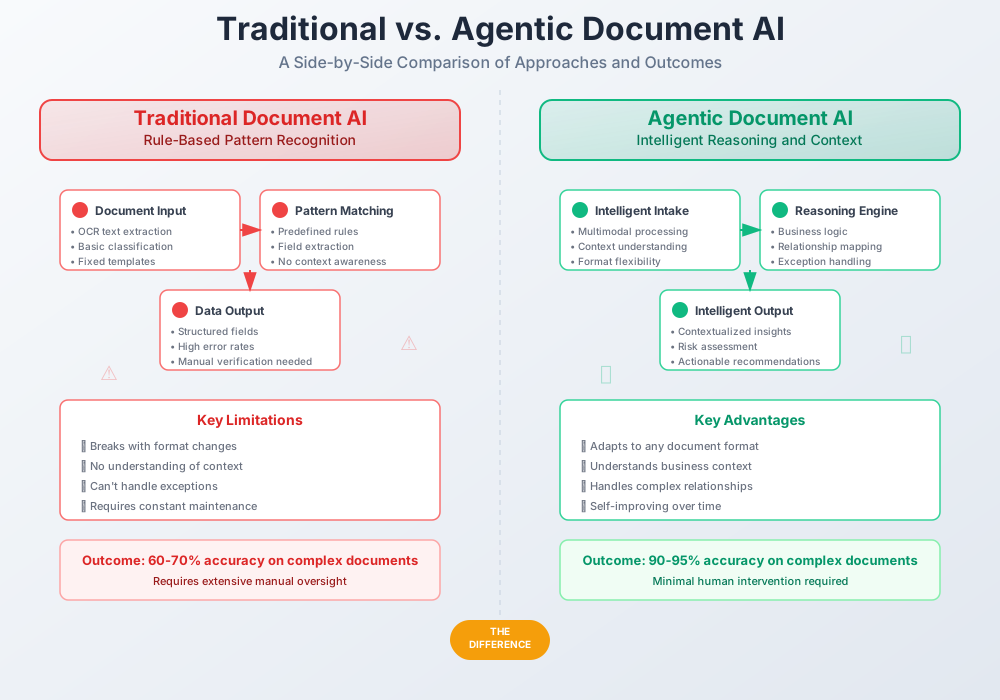
The solution to enterprise document AI challenges isn't better pattern recognition or more training data. It's a fundamental shift from rule-based systems to truly intelligent AI agents that can reason about documents the way humans do. Agentic AI represents a breakthrough in how machines can understand and interact with complex information, and it's perfectly suited to the challenges of enterprise document processing.
Unlike traditional document AI that treats each document as an isolated collection of data points, agentic AI systems can understand documents as part of broader business processes and relationships. These systems don't just extract information – they analyze it in context, identify potential issues, and make intelligent recommendations based on business logic and domain expertise. An agentic AI system reviewing a vendor contract doesn't just find the payment terms; it evaluates whether those terms align with company policies, compares them to industry standards, and flags any unusual provisions that might require legal review.
The key difference lies in the AI's ability to maintain context and apply reasoning across multiple documents and business scenarios. Traditional systems process documents sequentially and independently, losing valuable context about relationships between documents, changes over time, and broader business implications. Agentic AI systems can understand that a contract amendment relates to an original agreement, that a series of invoices might indicate a pattern of billing issues, or that changes in regulatory language across multiple documents might signal compliance risks.
This contextual understanding enables agentic AI to handle the types of complex, variable documents that break traditional systems. Instead of requiring documents to fit predetermined templates or formats, agentic AI can adapt its analysis approach based on document type, content, and business context. It can work with handwritten notes, unusual formatting, missing information, and all the other real-world complications that make enterprise document processing challenging.
Agentic AI also excels at handling uncertainty and incomplete information – common characteristics of business documents. Rather than failing when it encounters ambiguous language or missing data, agentic AI can make reasonable inferences, flag areas of uncertainty, and provide multiple interpretation options for human review. This ability to work effectively with imperfect information is crucial for enterprise applications where documents often contain gaps, inconsistencies, or require business judgment to interpret correctly.
The user experience with agentic AI is dramatically different from traditional document AI systems. Instead of rigid data extraction workflows, users can interact naturally with the system, asking questions, requesting specific analyses, and receiving explanations for the AI's conclusions. This conversational interface makes the technology accessible to business users who don't need technical training to benefit from automated document analysis.
Perhaps most importantly for enterprise adoption, agentic AI systems can be deployed incrementally and scaled gradually. Organizations don't need to replace their entire document management infrastructure or retrain their workforce on new processes. Agentic AI can work with existing systems, enhancing current workflows rather than replacing them entirely. This reduces implementation risk and allows organizations to prove value before making larger commitments.
The business impact of truly intelligent document AI extends far beyond efficiency gains. Organizations using agentic AI for document processing report improved compliance, better risk management, and enhanced decision-making based on more comprehensive analysis of their document portfolios. These systems can identify patterns and trends across large document collections that would be impossible for human reviewers to detect, providing strategic insights that inform business planning and risk management.
For enterprise leaders who've been disappointed by previous document AI implementations, agentic AI offers a path to the automated document processing capabilities they originally sought. These systems can handle the complex, variable, business-critical documents that traditional AI couldn't manage, delivering the productivity gains and insights that justify significant technology investments.
The transition to agentic document AI doesn't require abandoning existing technology investments or disrupting established workflows. Instead, it provides a pathway to enhance current capabilities with genuinely intelligent analysis that can grow with business needs and handle increasing complexity over time. For organizations ready to move beyond the limitations of traditional document AI, agentic systems offer the genuine intelligence and flexibility that enterprise document processing demands.
As we move into an era where document complexity continues to increase and business processes become more interconnected, the limitations of current document AI technology will only become more apparent. Organizations that embrace agentic AI for document processing will gain significant competitive advantages through more efficient operations, better risk management, and deeper insights into their business relationships and processes. The question isn't whether to upgrade from traditional document AI, but how quickly organizations can make the transition to systems that truly understand the documents that drive their business.

Head IT Operations - Co Founder of Artificio
See it in your SAP environment
Bring us a document, a process, or a bottleneck. We'll show how Artificio captures, validates, and posts into SAP — then scale from there.
Security & compliance
ISO 27001:2013 certified, SOC 2 Type 2 compliant, GDPR and HIPAA ready. Every agent action is logged, auditable, and runs in isolated environments.