Every week, your logistics team receives a stack of carrier invoices. Lane charges, fuel surcharges, accessorial fees, dimensional weight adjustments. Each invoice arrives with its own format, its own line item structure, and its own interpretation of the contract you negotiated six months ago. Someone has to check every one of them against the rates you actually agreed to.
If your company ships at volume, that someone is probably a small team working through spreadsheets, toggling between PDFs and rate cards, flagging discrepancies manually. It's painstaking work. And it's almost certainly leaving money on the table.
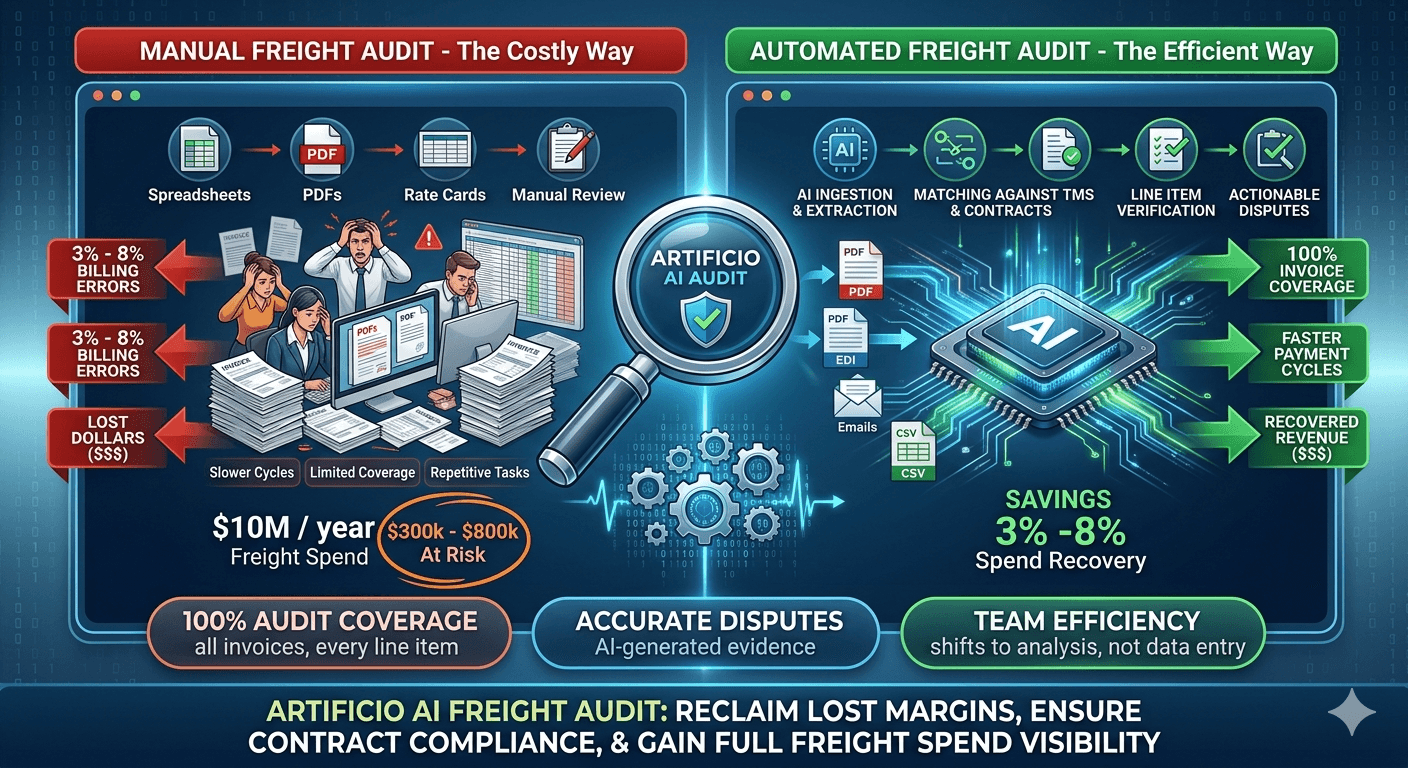
Industry data consistently shows that 3% to 8% of freight invoices contain billing errors. For a company spending $10 million a year on freight, that's $300,000 to $800,000 in potential overcharges, sitting quietly in invoices that looked fine at first glance. The problem isn't a lack of diligence. It's that manual reconciliation at scale is structurally broken.
The Hidden Complexity of Freight Billing
A single carrier invoice can reference dozens of charge types. The base linehaul rate is just the starting point. Fuel surcharges float weekly against published indexes. Residential delivery fees apply under conditions your team has to verify against shipment records. Dimensional weight rules vary by carrier and sometimes by lane. Accessorial charges like liftgate, inside delivery, or redelivery attempts get applied inconsistently. And when you're dealing with multiple carriers across different modes (truckload, LTL, parcel, intermodal), each with their own tariff structures and contract terms, the reconciliation surface becomes enormous.
The traditional approach puts humans in the middle of all of this. A freight auditor pulls up the carrier invoice, pulls up the relevant rate agreement, manually computes what the charge should be, and compares it to what was actually billed. Then they do it again for the next line item. And the next invoice. And the next carrier.
Even experienced teams working diligently catch only a fraction of the errors. Not because they're not good at their jobs, but because the volume makes comprehensive review impossible. Invoices that arrive under a certain dollar threshold often skip review entirely. Deadline pressure from carriers means invoices get approved to avoid late payment penalties, even when something looks slightly off. The math doesn't favor manual processes at scale.
What Automated Freight Audit Actually Means
Automated freight audit uses AI to do what manual auditors do, but across every invoice, every line item, every charge type, without shortcuts. The process starts with ingestion: carrier invoices arrive in whatever format the carrier sends them. PDFs, EDI files, CSV exports, emails with attachments. An AI document processing system handles the intake, classifies each document, and extracts the structured data inside without requiring manual data entry.
The extracted data (carrier identity, shipment reference numbers, charge codes, amounts, dates, weight, dimensions, origin and destination) gets matched against two things: the original shipment record from your TMS or order management system, and the contracted rate schedule for that carrier and lane. The AI computes what the invoice should say based on your actual agreement, then compares it line by line against what the carrier billed.
Discrepancies get flagged with context. Not just "this is wrong" but "the billed fuel surcharge of 18.5% doesn't match the contractual rate of 16.2% for this shipment date based on the weekly index published by the carrier." That level of specificity is what turns a flag into an actionable dispute.
How Rate Matching Works at the Line Item Level
The contract matching step is where most of the complexity lives. Rate agreements aren't simple lookup tables. They're tiered structures with breakpoints, accessorial schedules, lane-specific exceptions, and time-bound clauses. A rate card for an LTL carrier might have 50 freight classes, each with different base rates per hundredweight, adjusted by origin-destination pair, with separate fuel surcharge tables, a dimensional weight divisor, and accessorial rates that change based on whether the delivery point is residential, commercial, or a limited access location.
AI models trained on freight rate structures learn to navigate this complexity. They understand that a 500-pound shipment of freight class 85 from Chicago to Atlanta has a different applicable rate than a 500-pound shipment of the same class from Chicago to a rural zip code in Georgia, even if both shipments appear in the same carrier contract. They catch when a carrier applies a residential surcharge to a commercial address, or when fuel surcharge percentages don't align with the agreed index week.
This kind of granular matching would take a human auditor several minutes per invoice. An AI system processes it in seconds, and it doesn't slow down on invoice 500 the way it might on invoice 5.
The system also builds institutional memory over time. When a specific carrier consistently over-applies a particular accessorial charge, that pattern gets detected across the invoice history. What looks like a one-off discrepancy on a single invoice reveals itself as a systematic billing issue worth a formal dispute.
The Discrepancy Types That Matter Most
Not all billing errors are equal. Some are minor rounding differences. Others represent systematic overcharges that compound across hundreds of shipments. Automated audit systems catch both, but the high-value catches tend to cluster around a few categories.
Duplicate invoices are more common than most companies realize. Carriers occasionally submit the same shipment twice, sometimes with slightly different reference numbers or charge line structures that make the duplication non-obvious to a human reviewer. An AI system flags these immediately by matching against shipment history and previous invoice records.
Rate classification errors show up when carriers apply the wrong freight class to a shipment. Since rates vary significantly by class, misclassification on higher-weight shipments can mean substantial overcharges. The AI validates the applied class against the commodity description and shipment characteristics.
Accessorial charge disputes account for a large share of total discrepancy value. Carriers apply accessorial fees (liftgate, inside delivery, redelivery, appointment scheduling, hazmat handling) based on delivery event data that doesn't always align with what the shipper's system recorded. Cross-referencing the carrier's accessorial triggers against your delivery records surfaces the mismatches.
Minimum charge violations happen when a carrier bills a minimum charge on a lane where your contract specifies a negotiated below-minimum rate. These are easy to miss manually because the minimum charge often looks like a legitimate line item.
Contract expiry gaps create another exposure point. When a rate agreement renews, there's sometimes a period where shipments move under the old rates while the new contract hasn't been loaded into all systems. An AI system flags when the applied rate date range doesn't match the active contract period.
Integration with TMS, ERP, and Carrier Portals
Automated freight audit doesn't work in isolation. It connects to the systems that hold the data it needs: your TMS for shipment records and delivery confirmation, your ERP for payment processing and general ledger coding, and carrier portals or EDI feeds for direct invoice intake.
Artificio's approach uses AI agents that integrate with these systems through standard APIs and document connectors, without requiring full system replacements. Carrier invoices arrive through configured intake channels. Matched and approved invoices flow directly into the payment queue. Flagged items route to the appropriate team member with the supporting documentation already attached: the invoice, the relevant contract clause, the shipment record, and the computed correct charge.
The ERP integration matters for another reason: GL coding. Freight costs need to be allocated to the right cost centers, business units, and shipment categories. Manual GL coding is a second source of error and labor in most AP teams. An automated system applies coding rules at the same time it processes the invoice, so approved invoices arrive in the payment queue already coded correctly.

What Happens to the Disputes
Catching a discrepancy is only useful if you do something with it. An automated freight audit system needs a workflow for turning flagged items into resolved disputes.
Dispute handling works best when it's tiered by discrepancy type and value. Small, clear-cut errors (a duplicate invoice, a rate that's unambiguously wrong) can follow a streamlined path: the system generates a dispute notice with the supporting documentation, and the AP team approves it with one click before it goes to the carrier. Larger discrepancies or ones that require interpretation (a contested accessorial charge, a rate classification the carrier will push back on) route to a senior reviewer with full context already assembled.
The carrier communication itself can be partially automated. Dispute notices with structured evidence (shipment reference, contracted rate, billed rate, applicable contract clause, computed overbilling amount) are more likely to get resolved quickly than vague complaints. Carriers deal with hundreds of disputes. A well-documented, specific dispute notice cuts through the noise.
Over time, dispute resolution data feeds back into the system. If a carrier consistently resolves a particular dispute type in your favor, that becomes evidence in future disputes. If a carrier consistently rejects a specific claim, the system flags it for human review rather than automatically filing, saving time on disputes unlikely to pay off.
The Business Case Beyond Error Recovery
The direct ROI from catching billing errors is the most obvious part of the freight audit business case. But there are three other dimensions that matter just as much for companies processing high invoice volumes.
Audit coverage changes completely. Manual teams audit a fraction of invoices, prioritizing by value or by carrier. Automated systems audit everything, including the small parcel invoices that individually don't justify manual review but collectively represent significant spend. Full coverage changes the risk profile of your freight spend.
Processing cycle time drops from days to hours. Invoice approval backlogs that used to create payment delays (and occasionally penalty charges for late payment) shrink to a fraction of their previous size. Your carriers notice. Your cash flow management improves.
Your freight audit team's work shifts from repetitive data comparison to analysis and exception management. Instead of spending most of their time manually checking invoices, they spend it on carrier relationship management, contract optimization, and strategic freight cost analysis. That's a better use of their expertise, and it usually leads to better contract terms at renewal time because they have the data to negotiate from.
Getting Started with Automated Freight Audit
The starting point for most companies is a freight spend analysis. Before automating anything, it helps to understand the current state: what share of invoices are being audited, what's the average discrepancy rate on the ones that are reviewed, and which carriers and charge types account for the most billing errors.
That analysis usually makes the business case clearer than any vendor presentation. When you can see that your audit team is reviewing 60% of invoice value and catching a 4% error rate on what they review, the math on auditing 100% of invoice value becomes straightforward.
Artificio's document processing platform handles freight invoice ingestion and structured data extraction without custom integration projects for each carrier. Rate schedules and contract documents go through the same document intelligence layer, which means contract terms are extracted and structured alongside the invoices they need to match against. The matching logic runs on those structured outputs, not on fragile template rules that break whenever a carrier changes their invoice format.
Freight billing errors aren't going away. Carriers operate complex billing systems under time pressure, and mistakes happen. The question is whether your organization has the infrastructure to catch them systematically, or whether they're quietly eroding margins that better processes could protect.
The invoices are coming in either way. The difference is what happens after they arrive.