

Blog
What an 8-Year-Old Taught Me About Document Intelligence
Why enterprise document systems fail: Learn the 3 fatal assumptions & how to build AI based on human context.

Blog
Why enterprise document systems fail: Learn the 3 fatal assumptions & how to build AI based on human context.
Last Tuesday evening, I walked into what can only be described as a disaster zone. My daughter was sitting in the middle of her bedroom floor, surrounded by approximately 200 collectible cards scattered in every direction. Some were face-up, others face-down, a few were stuck under her bed, and several had somehow migrated to the bookshelf.
"I can't find my rare holographic card," she said, looking genuinely distressed. "And I need it for tomorrow."
As someone who spends their days thinking about document processing and data organization, I saw this as a perfect teaching moment. Time to introduce my daughter to the fundamentals of taxonomic classification.
"Okay," I said, settling down next to her. "Let's organize these properly. We'll sort them by type—Fire, Water, Grass, Electric, Psychic. You know, like a database with proper categories."
She looked at me like I'd just suggested we reorganize her cards using ancient hieroglyphics.
"Dad, that's not how it works," she said with the kind of patience usually reserved for explaining things to very small children. "That's not how I actually use them."
And then she proceeded to teach me more about intelligent document processing in fifteen minutes than I'd learned in the past fifteen years of working with enterprise systems.
My daughter ignored my brilliant categorization scheme entirely. Instead, she started organizing her cards into what initially looked like complete chaos but quickly revealed itself as something far more sophisticated.
She created her first pile and announced, "These are my battle deck. I use them together all the time." The pile included cards from completely different types, different power levels, different everything. What they had in common wasn't their official classification but their functional relationship. They worked together in her actual gameplay.
Then she made a second pile. "These are cards I'm probably going to need soon because Tommy has that new rare card, and I need these three to counter it." She was predicting future needs based on changing circumstances in her social network. She wasn't organizing by what the cards were but by what she'd likely need them for.
The third pile was perhaps the most interesting. "These are cards that go with my friend's deck, so I keep them ready in case we want to team up." She was organizing based on collaborative potential, on network effects, on relationships that extended beyond her own collection.
She had about seven more piles, each with its own contextual logic. Cards grouped by recent trades (high emotional value), cards organized by upcoming events (temporal relevance), cards kept together because they tell a story (narrative cohesion). Not a single pile was organized by the official type system printed on the cards themselves.
I sat there watching her work and realized I'd just witnessed something profound. This eight-year-old had intuitively grasped a principle that most enterprise document systems completely miss.
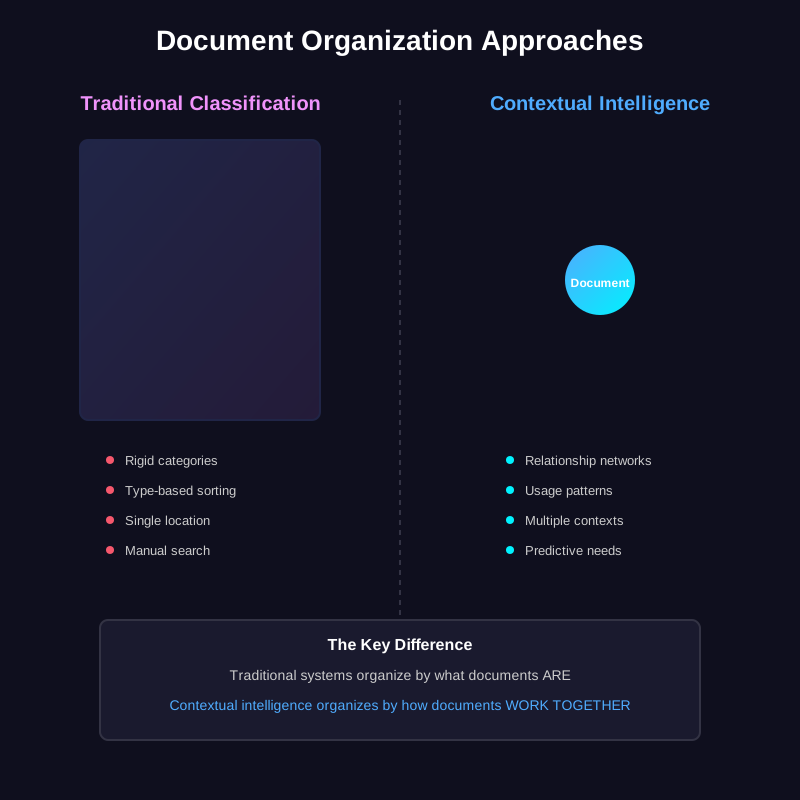
Let me tell you about a conversation I had last month with the operations director at a mid-sized insurance company. They'd just invested heavily in what their vendor called a "state-of-the-art document management system." The system was, by all technical measures, impressive. It could automatically classify documents into 47 different categories. It could extract data with 98.7% accuracy. It had integration with their core systems and a dashboard that would make any IT manager weep with joy.
Three months into deployment, nobody was using it.
"The problem," the director told me, "isn't that it doesn't work. The problem is that it works exactly as designed, and what it's designed to do isn't what we actually need."
Their system treated every insurance claim as an independent entity. A claim form went into the "claims" folder. Supporting medical documents went into "medical records." Correspondence went into "communications." The police report went into "incident documentation." Everything was beautifully categorized, perfectly organized, completely useless.
Here's what actually happens when a claims adjuster works a case. They don't think about seven separate document types. They think about one thing, one claim, one story that needs seven pieces of evidence. When they need to review that claim, they don't want to hunt through seven different perfectly organized folders. They want to see the complete picture, the relationships, the narrative that connects all those documents.
The system was organizing documents the way engineers design databases. The humans needed documents organized the way humans actually think and work.
Sound familiar? It should, because this is happening in every industry, in every company, right now. We've built document systems that classify, categorize, and file with mechanical precision. What we haven't built are systems that understand context, relationships, and actual human workflows.
Most enterprise document processing systems rest on three assumptions that seem reasonable until you examine them closely. These assumptions feel so obvious that questioning them sounds almost absurd, like questioning whether water is wet. But they're wrong, and they're the reason your document systems frustrate everyone who uses them.
Assumption One: Documents can be definitively classified by type. This sounds logical. An invoice is an invoice. A contract is a contract. A purchase order is a purchase order. Except that's not really true in practice. That invoice might also be a dispute record, a compliance document, an audit trail, and evidence in a supplier performance review. Its classification depends entirely on why you're looking at it. The same document can be five different things depending on context, but traditional systems force it to be one thing, filed in one place, findable through one category.
Assumption Two: Documents are independent entities. We treat each document as a standalone item that needs to be processed, classified, stored. But documents aren't independent at all. They're nodes in a web of relationships. That contract doesn't mean much without the proposal that preceded it, the statement of work that defines it, the invoices that execute it, and the change orders that modify it. Treating these as seven separate documents that happen to share a project number is like treating seven puzzle pieces as seven separate images instead of recognizing they form one picture.
Assumption Three: Organization should be based on document attributes rather than human usage patterns. We sort by date, by type, by department, by all these metadata fields that are easy to capture and easy to query. But people don't think, "I need that document we classified as a Type-7 form from the third quarter." They think, "I need that thing we used last time we dealt with this exact situation." They remember context, they remember relationships, they remember why something mattered. Our filing systems remember attributes.
These three assumptions made sense in a world of physical filing cabinets. If you had a piece of paper, it could only physically exist in one folder, in one drawer, in one cabinet. You had to choose one classification scheme and stick with it. Digital documents don't have this limitation, but we've carried the filing cabinet paradigm into the cloud anyway.
Let me give you a real example that might make this clearer. A manufacturing company processes about 3,000 documents per day. Purchase orders, invoices, quality certifications, shipping manifests, inspection reports, supplier contracts, the usual mix. They'd set up their document processing system to automatically classify everything by type and route it to the appropriate department.
The system worked perfectly from a technical standpoint. Documents were classified with high accuracy, routed correctly, filed appropriately. And yet the procurement team was spending hours every day hunting for documents. Not because the documents were lost or misfiled. The documents were exactly where they were supposed to be. The problem was that where they were supposed to be according to the system bore little resemblance to where humans actually needed them.
Here's a typical scenario. A procurement specialist gets an alert that a shipment has been delayed. To understand the situation and take action, they need to see the original purchase order (to understand what was ordered and when), the supplier contract (to understand penalty clauses and obligations), the quality certification for the last shipment (to know if this supplier has history of issues), the email thread discussing the order (to understand any special circumstances), and the shipping manifest (to understand what specifically is delayed).
In the old system, that meant searching five different databases, opening documents from five different folders, cross-referencing numbers, and mentally assembling the complete picture. The procurement specialist wasn't looking for five documents. They were looking for one situation that happened to be described across five documents. But the system didn't understand situations. It understood document types.
Think about what my daughter did with her cards. She didn't organize them by what they were. She organized them by how she used them, what they meant together, what she'd likely need in which situations. That's context. That's intelligence.
Real document intelligence means understanding that when a human is looking at a delayed shipment, they're not hunting for documents. They're trying to understand a situation. The system should present the complete context automatically, all the relevant documents regardless of type, assembled in a way that tells the story.
There's another layer to this that most document processing conversations completely miss. Documents don't just have relationships with other documents. They have relationships with people, with events, with decisions, with time.
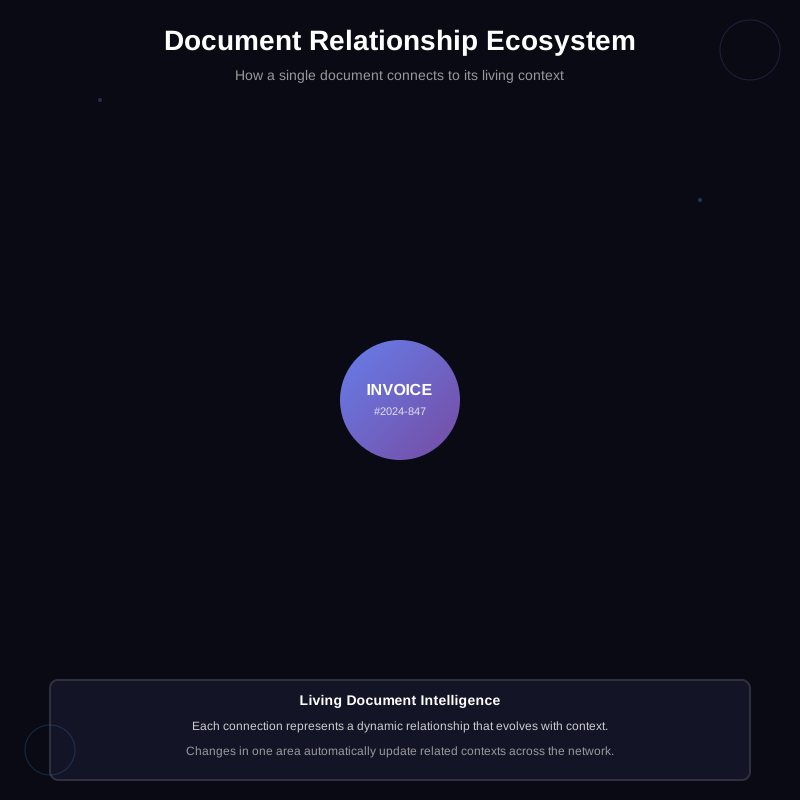
That invoice in your accounts payable system doesn't exist in isolation. It's connected to a purchase order, sure, but it's also connected to the person who approved the purchase, the budget meeting where that spending was allocated, the project timeline that determines when payment is due, the audit requirements that determine how long you need to keep it, the vendor relationship that determines payment terms, and probably a dozen other contextual threads.
Traditional document systems might capture some of this as metadata. Vendor name, project code, approval date. But metadata is just labels. Metadata doesn't capture the actual relationships, the dependencies, the meaning. It's the difference between knowing that two people have the same last name and understanding that they're siblings who grew up together and call each other every Sunday.
Here's where it gets interesting. These relationships aren't static. They evolve over time as context changes. That contract you signed three years ago meant one thing on the day you signed it. Today, after two amendments, one dispute, and a change in business strategy, it means something different. The words on the page haven't changed, but the context around it has. An intelligent system needs to understand not just what a document is, but what it means right now given everything that's happened since.
Every industry has these situations where documents aren't really documents at all but chapters in ongoing narratives. Healthcare is probably the most obvious example. A patient's medical record isn't a collection of independent doctor's notes, lab results, and prescription histories. It's a story. Each new element adds to the narrative, changes the interpretation of what came before, points toward what might happen next.
A doctor looking at a patient's file isn't doing research. They're catching up on a story so they can write the next chapter responsibly. They need to understand the arc, the recurring themes, the plot twists, the character development. Filing those documents by type (lab work here, prescriptions there, specialist notes over there) is like giving someone a novel with all the dialogue scenes in one pile, all the action scenes in another, and all the descriptive passages in a third, then asking them to understand the plot.
Or consider legal document processing. A corporate lawyer preparing for a negotiation doesn't need all contracts filed neatly by date. They need to understand the relationship history with this particular partner. What's worked, what's caused friction, what assumptions proved wrong, what terms got renegotiated and why. The relevant documents might span five years and include contracts, correspondence, dispute records, meeting notes, and informal agreements. The classification of those documents is far less important than the story they tell together.
Financial services has the same pattern. When an underwriter is reviewing a loan application, they're not collecting documents. They're assembling a narrative about risk. The credit report, bank statements, employment verification, and property appraisal aren't four separate data points. They're four perspectives on one question, does this loan make sense, and the answer comes from understanding how these pieces fit together to tell a coherent or incoherent story.
Most document processing systems are designed by people who think about data structures, not narratives. They're built to handle nouns (documents, types, attributes) when what we actually need is something that handles verbs (relationships, sequences, dependencies, meaning).
Here's something else my daughter did that most enterprise systems don't. She didn't just organize what she had. She organized based on what she anticipated needing. Remember that pile of cards for countering her friend's new deck? That's predictive intelligence.
Most document systems are purely reactive. You search for something, it retrieves it. You process something, it files it. The system waits for you to ask before it does anything. But humans don't work that way. Humans anticipate. We prepare. We think ahead.
An intelligent document system should do the same. If you're working on a client proposal and you open their account file, the system shouldn't just show you what you asked for. It should anticipate what you'll need next. The last proposal you sent them, because you'll want to build on that. The contract terms you negotiated, because you'll need to stay within those bounds. The emails where they mentioned future needs, because that's relevant to what you're proposing. The proposals you've done for similar clients, because those might have useful templates or approaches.
This isn't about showing you everything. That's just overwhelming. This is about understanding the task you're probably trying to accomplish and surfacing the documents that matter for that task. Not because you searched for them, but because the system understood context well enough to predict relevance.
Think about how modern smartphones work. When you open your camera app at sunset, it automatically adjusts settings for low light photography. It doesn't wait for you to manually adjust ISO and shutter speed. It sees the context and anticipates what you're trying to do. Document systems should be equally intelligent about understanding work context and anticipating needs.
So what would a truly intelligent document system look like? Not one that's better at classification or extraction or any of the traditional metrics. One that actually thinks the way humans think about documents.
First, it would understand that documents are almost never solo performers. They're ensemble casts. When you access one document, the system automatically surfaces related documents, not based on crude keyword matching or shared project codes, but based on genuine understanding of how these documents work together. The insurance claim example from earlier, the system would recognize that you're working a claim and automatically assemble all seven relevant documents without you having to hunt through seven folders.
Second, it would understand that relationships evolve. The system wouldn't just remember that Document A is related to Document B. It would understand how that relationship has changed over time. A contract and an invoice might be straightforwardly related when everything's going smoothly. But if a dispute emerges, suddenly correspondence and legal opinions become part of that relationship network too. The system needs to recognize these contextual shifts and adjust what it surfaces accordingly.
Third, it would learn from usage patterns, not just document attributes. If everyone who works on aerospace contracts also pulls up those two specific compliance guides, the system should learn that pattern and start surfacing those guides proactively. If procurement specialists always need the last three invoices when reviewing a new purchase order from a particular vendor, that's a pattern worth learning and anticipating.
Fourth, it would understand work context, not just document context. When you're responding to an urgent customer complaint, you need different documents than when you're doing quarterly planning, even if you're working with the same customer account. The system needs to recognize what you're trying to accomplish, not just what you're looking at, and adjust accordingly.
Finally, it would recognize that documents are how organizations think. They're not just records of decisions. They're the medium through which decisions get made. An intelligent system needs to support that thinking process, not just the storage and retrieval process. That means understanding workflows, decision points, approval chains, and all the human processes that documents enable.
After my daughter finished organizing her cards (in a way that made perfect sense to her and zero sense to my engineering brain), she explained her system to me. The explanation took about two minutes. At the end of it, I completely understood how her organization worked and could easily find anything she needed.
That's my new test for document intelligence. If you can't explain your document system to an eight-year-old in two minutes and have them understand it intuitively, your system is too complicated. Not too complicated for eight-year-olds, too complicated for humans, because eight-year-olds haven't yet learned to suppress their intuitive understanding of how information should be organized in favor of artificial systems that make engineers happy.
My daughter didn't need to be trained on her system. She didn't need a manual. She didn't need someone from IT to explain the taxonomy. Her system matched how she actually thought about her cards, so understanding it was automatic. That's what document intelligence should feel like.
When someone new joins your procurement team, how long does it take them to understand your document system? If the answer is longer than a coffee break, you don't have an intelligence problem. You have a design problem. You've built a system that matches the constraints of technology rather than the patterns of human thought.
The technology exists to build document systems that work the way humans think. Natural language processing can understand document content at a semantic level, not just keyword matching. Machine learning can identify patterns in how people actually use documents, not just how they're classified. Knowledge graphs can map complex relationships between documents, people, and events. All the pieces are there.
What's missing isn't technology. What's missing is a fundamental rethinking of what document processing is supposed to accomplish. Most current systems are optimized for storage and retrieval, because that was the hard problem in a paper-based world. In a digital world, storage is essentially free and retrieval is trivial. The hard problem now is understanding, context, and intelligence.
This means document processing systems need to be built around workflows, not folders. Around relationships, not classifications. Around anticipating needs, not just responding to searches. Around enabling human thought processes, not imposing artificial organizational schemes.
It means accepting that the same document might need to appear in multiple contexts simultaneously, connected to multiple workflows, relevant to multiple narratives. Your filing cabinet couldn't do that. Your database can, if you stop treating it like a filing cabinet.
It means letting AI learn from how people actually work instead of forcing people to learn how the AI was programmed. When documents are used together repeatedly, that's signal. When people regularly pull up the same supporting documents for specific tasks, that's signal. When timing matters (these documents are always needed before those documents), that's signal. Stop classifying and start learning.
Most of all, it means recognizing that document processing isn't a data management problem. It's a knowledge management problem. The goal isn't to file things efficiently. The goal is to help humans understand complex situations so they can make better decisions faster. Everything else is just infrastructure.
It's been three weeks since my daughter organized her collectible cards, and her system is still working perfectly. Nothing has migrated back to chaos. When she needs something, she knows exactly where to find it. When friends come over, they understand her organization well enough to put things back in the right place.
Meanwhile, at my office, we've had two new document processing systems implemented in the past three years. Both lasted about six months before people found workarounds. Both are still technically running, slowly accumulating documents that nobody can find when they actually need them. Both cost six figures to implement.
Maybe we should have consulted an eight-year-old.
The lesson here isn't that children are smarter than enterprise software architects, though sometimes I wonder. The lesson is that children haven't yet learned to ignore their intuitions about how information should work. They organize based on utility and context because that's what makes sense. They haven't been trained to think in terms of hierarchical taxonomies and normalized data structures.
There's a reason I'm telling you this story now, in late 2025, instead of five years ago. The technology to build truly intelligent document systems didn't really exist five years ago. Oh, we had decent OCR and some basic machine learning, but we didn't have the kind of sophisticated language models and contextual AI that can actually understand documents the way humans do.
Now we do. The AI capabilities that have emerged in the past few years can genuinely understand semantic relationships between documents. They can learn from usage patterns. They can predict needs based on context. They can maintain awareness of complex document ecosystems in ways that traditional systems simply couldn't.
But here's the problem. Most organizations are using these powerful new AI tools to do the same old things faster. Better classification, faster extraction, more accurate data capture. It's like getting a smartphone and only using it to make phone calls. You're not wrong, but you're missing the point entirely.
The opportunity isn't to classify documents better. It's to stop thinking about classification as the goal. The opportunity is to build systems that understand documents the way my daughter understands her card collection, as tools that work together in context to accomplish real goals.
This is where I should probably tell you that there are document intelligence systems being built with exactly this philosophy. Systems that understand documents aren't isolated items to be filed, but connected elements in complex workflows. Systems that learn from how people actually work instead of forcing people to adapt to rigid organizational schemes.
These systems use AI agents that can understand document relationships, predict what you'll need based on context, and automatically assemble complete pictures instead of making you hunt through folders. They're built around workflows and relationships, not classifications and hierarchies. They learn from usage patterns and get smarter over time.
The difference is fundamental. Traditional document processing asks, "What type of document is this and where should we file it?" Modern document intelligence asks, "What is this person trying to accomplish and what documents would help them accomplish it?" It's not a technical difference. It's a philosophical one.
When a claims adjuster opens a claim file, an intelligent system doesn't just show them the claim form. It assembles the complete context automatically. The claim form, the supporting documents, the relevant policy terms, similar previous claims, correspondence history, all of it presented as one coherent narrative instead of seventeen separate files scattered across different systems.
When a procurement specialist is reviewing a purchase order, the system doesn't wait for them to search for the supplier contract, the previous invoices, the quality reports. It knows those documents are part of the same workflow and surfaces them proactively. Not because someone manually created seventeen different links, but because the AI understood the relationships from watching how people work.
This is what document intelligence looks like when it's designed around human needs instead of database constraints. It feels less like using software and more like having a very smart assistant who anticipates what you need and hands it to you before you ask.
We tend to think about document processing in terms of efficiency metrics. Time saved, cost per document, accuracy rates. These matter, but they miss the bigger picture. The real cost of bad document systems isn't measured in minutes wasted searching for files.
The real cost is in decisions made with incomplete information because gathering complete information was too time-consuming. It's in opportunities missed because people couldn't connect dots that were scattered across disconnected systems. It's in institutional knowledge that never gets transferred because it's locked up in document relationships that only exist in people's heads. It's in talented people spending their days doing document archaeology instead of actual thinking work.
When your document system forces people to be the intelligence layer, manually connecting documents, remembering relationships, anticipating needs, that's not just inefficient. That's taking your most expensive and valuable resource, human intelligence, and using it for tasks that computers should handle.
My daughter spent fifteen minutes organizing her cards. Then she was done. She could play, trade, strategize, enjoy her collection. She wasn't spending hours every day maintaining her organizational system because her system matched how she actually thought about her cards.
How much time do your employees spend maintaining your document systems? Searching for files, connecting related documents, figuring out what's relevant, assembling complete pictures? That time isn't an unfortunate necessity. It's a symptom of systems designed around technical convenience instead of human cognition.
If you're reading this and thinking, "Our document systems are definitely more like filing cabinets than intelligent assistants," you're not alone. Most organizations are in the same situation. The question is what to do about it.
The good news is you don't have to rip out everything and start over. Modern document intelligence systems are designed to work alongside existing infrastructure. They can pull from your current document repositories, learn from your current workflows, and gradually become smarter over time. You're not replacing systems, you're adding intelligence on top of them.
The shift starts with changing how you think about the problem. Stop asking, "How do we classify and file documents more efficiently?" Start asking, "How do we help people understand situations more completely?" Stop treating documents as things to be stored and start treating them as information to be connected, contextualized, and delivered when needed.
Then look at your workflows. Where are people spending time manually connecting documents that should be automatically connected? Where are they repeatedly pulling up the same sets of documents for specific tasks? Where are they working with incomplete information because gathering complete information is too much work? These are your opportunities.
Start small. Pick one workflow where document intelligence could make a real difference. Maybe it's claims processing, maybe it's contract review, maybe it's procurement approval. Implement intelligent document processing for that one workflow. Let people experience what it feels like when the system anticipates needs instead of waiting for searches. Let the AI learn patterns and get smarter. Then expand from there.
The technology exists. The AI capabilities are ready. What's needed is a willingness to rethink what document processing should accomplish and how it should work.
My daughter came home from school yesterday excited about a new card she'd traded for. She pulled it out, looked at her organized collection, and immediately knew exactly where it belonged. Not because she had to think about classification schemes or filing rules. Because she understood her system intuitively, and her system reflected how she actually thought about her cards.
"Dad," she said, "this one goes with my strategy deck, but I also need to keep it near my trade pile because other kids will want it, and it should be near these three because they combo together."
She put the card down touching three separate piles, visible from multiple angles. In a physical system, you can't do that. A card can only be in one place. But she'd created a system where position and visibility created virtual connections without rigid boundaries.
I realized she'd invented her own version of a knowledge graph.
Eight years old.
Maybe the question isn't why enterprise document systems are so bad at intelligence. Maybe the question is why we ever thought organizing information should be complicated in the first place.
Document intelligence isn't the future. It's the present. The AI capabilities exist today. The platforms exist today. Organizations that are implementing truly intelligent document processing right now are seeing the difference immediately. Not in percentage points of efficiency improvement, but in fundamental shifts in how work gets done.
People stop being document archaeologists and start being decision makers. Complete information becomes the default instead of the aspiration. Institutional knowledge stops living only in people's heads and starts being captured in the relationships the AI learns. Work that used to take days takes hours. Work that used to take hours takes minutes.
This isn't about technology for technology's sake. It's about letting people do the work they were hired to do instead of spending half their time fighting with document systems. It's about building tools that match how humans actually think instead of forcing humans to think like databases.
My eight-year-old daughter figured this out in fifteen minutes with 200 collectible cards. Maybe it's time we did the same with our 200 million business documents.
The cards are still perfectly organized, by the way. The system still works. Because when you organize things the way humans naturally think, the organization maintains itself.
That's what intelligence looks like. That's what your document systems should feel like. And that's what's possible right now if you're willing to stop thinking like a filing cabinet and start thinking like an eight-year-old.

Head IT Operations - Co Founder of Artificio
See it in your SAP environment
Bring us a document, a process, or a bottleneck. We'll show how Artificio captures, validates, and posts into SAP — then scale from there.
Security & compliance
ISO 27001:2013 certified, SOC 2 Type 2 compliant, GDPR and HIPAA ready. Every agent action is logged, auditable, and runs in isolated environments.