

Blog
SAP Master Data Health Check Using AI | Artificio
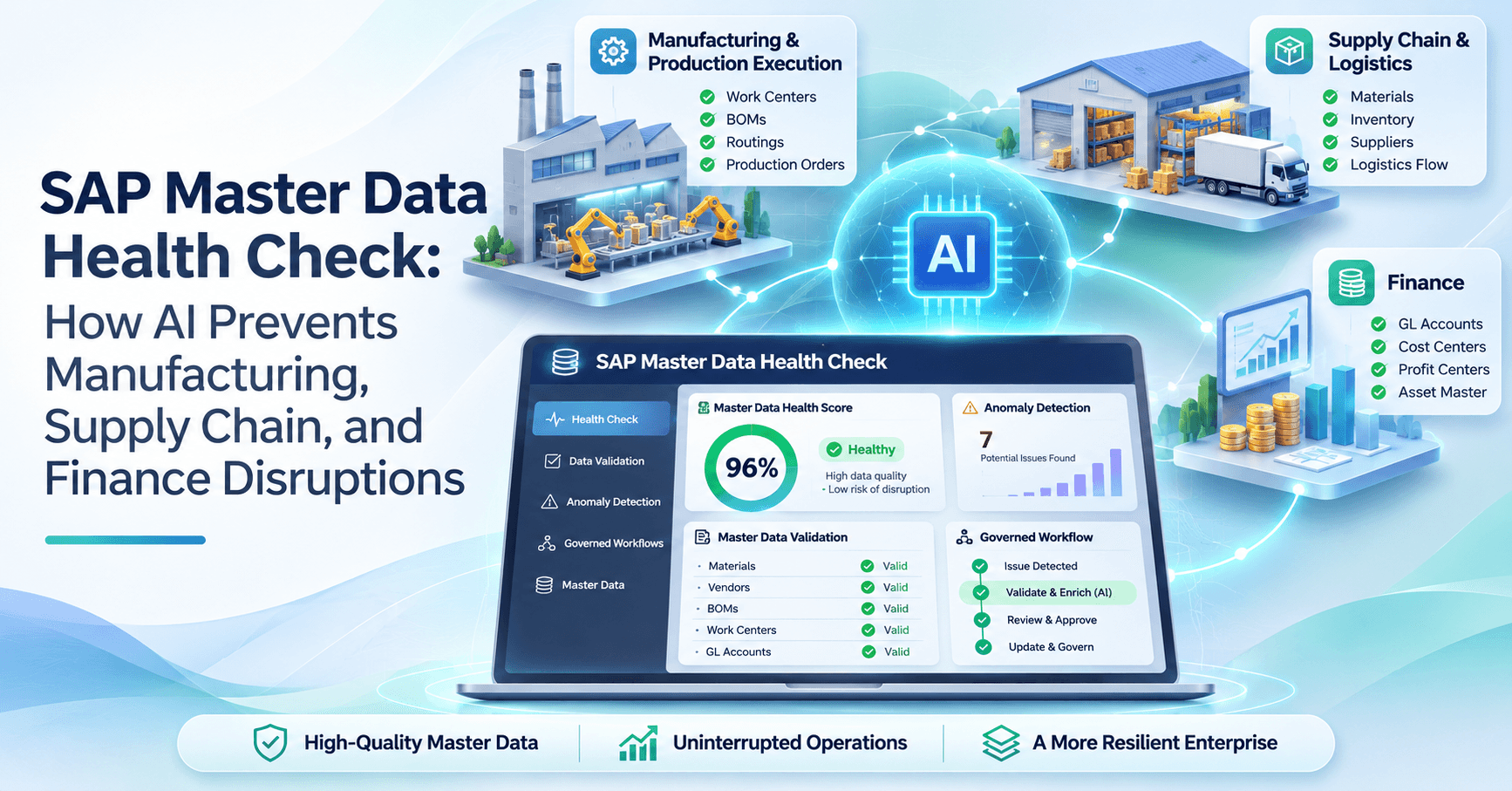
Discover how AI-powered SAP master data health checks identify errors in MRP, BOMs, routings, finance, and supply chain before they disrupt operations.
Blog
Discover how AI-powered SAP master data health checks identify errors in MRP, BOMs, routings, finance, and supply chain before they disrupt operations.
Your SAP system may be running perfectly. But can you trust the master data driving your business decisions?
Every day, manufacturers rely on SAP to plan production, purchase materials, manage inventory, calculate costs, and deliver products to customers.
Yet one of the biggest operational risks is often hidden inside the ERP system itself: inaccurate, incomplete, inconsistent, or outdated master data.
A production line stops because a component's planned delivery time is incorrect. A buyer orders excess inventory because the minimum lot size no longer reflects actual demand. A production order uses an outdated routing. Finance discovers unexpected manufacturing costs because material valuation or costing data was not properly maintained.
SAP may process all these transactions exactly as configured. The problem is that the underlying data does not reflect business reality.
This is where an AI-powered SAP Master Data Health Check can make a difference.
Instead of waiting for transactions to fail or planners to discover recurring exceptions, organizations can continuously evaluate master data, identify relationships between inconsistencies, assess business impact, and prioritize corrective action.
An SAP Master Data Health Check is a systematic assessment of the accuracy, completeness, consistency, validity, and business readiness of master data used across SAP processes.
Unlike a traditional data audit that primarily identifies missing or invalid fields, a business-focused health check asks a more important question:
Is our SAP master data accurate enough to support the business processes that depend on it?
For example, a material master might contain every mandatory field and still be operationally incorrect.
Traditional validation rules do not necessarily detect these business inconsistencies.
An AI-assisted health check combines SAP master data, business rules, transactional history, and operational context to identify potential problems that need investigation.
Master data problems rarely remain isolated in one SAP module.
A material planning error can affect procurement, inventory, manufacturing, customer commitments, and finance.
Consider a manufacturer producing industrial equipment across multiple plants.
Its raw material master contains an incorrect planned delivery time.
The consequences can spread across several functions:
| Business function | Potential impact |
|---|---|
| Supply chain | Purchasing releases orders later than required |
| Manufacturing | Critical components are unavailable when needed |
| Production planning | MRP generates unrealistic supply dates |
| Production execution | Orders are delayed or rescheduled |
| Sales | Customer delivery commitments become unreliable |
| Finance | Expediting costs, excess inventory, and working capital pressures increase |
The operational issue may appear to be a supplier problem, planning problem, or production problem.
But the underlying cause is inaccurate master data.
This is why SAP data quality should be evaluated from a cross-functional business perspective rather than solely as an IT maintenance activity.
Manufacturing organizations depend on master data to generate feasible production and material plans.
SAP Material Requirements Planning evaluates demand, supply, inventory, and planning parameters to determine procurement and production requirements.
But MRP calculations can only be as reliable as the inputs and configuration behind them.
Material Master and MRP Parameters
Evaluate critical settings, including:
AI can compare these settings against historical consumption, supplier performance, actual production lead times, and approved plant-specific planning policies.
For example, if a material has a planned delivery time of 14 days while actual supplier deliveries consistently require 28–35 days, the system can identify the mismatch and flag it for buyer review.
Bill of Materials (BOM)
An incorrect BOM can create shortages, excess consumption, inventory discrepancies, and inaccurate product costing.
A health check should evaluate:
Routings, Work Centers, and Production Versions
Production execution depends on accurate manufacturing process definitions.
Potential risks include incorrect operation sequences, unrealistic standard times, outdated work center assignments, incorrect capacity parameters, and production versions that reference unsuitable BOM or routing combinations.
For SAP S/4HANA environments, production-version consistency is particularly important because production versions link manufacturing alternatives to BOMs and task lists.
A manufacturer plans 1,000 units for next week.
SAP calculates that production can be completed within available lead times.
However, the routing contains outdated processing times, and the assigned work center has insufficient capacity.
An AI-assisted health check can compare routing standards against production history, identify unusual differences, and recommend a review before planners rely on the schedule.
The business benefit: More reliable MRP inputs, fewer avoidable production disruptions, and less manual troubleshooting.
For organizations already struggling with daily planning exceptions, see Artificio's SAP MRP Exception Agent, which helps investigate and coordinate the resolution of MRP exceptions.
Supply chain reliability depends on accurate supplier, purchasing, material, and inventory master data.
Even when inventory transactions are correctly recorded, outdated procurement parameters can generate poor purchasing decisions.
Supplier and Business Partner Data
Purchasing Master Data
Inventory and Warehouse Master Data
Imagine a raw material originally purchased in batches of 10,000 units.
Over time, average monthly demand falls to 2,000 units, but the purchasing lot-size parameters remain unchanged.
SAP can continue proposing procurement quantities based on those settings.
The result may be unnecessary inventory accumulation and increased working capital requirements.
An AI health check can detect this pattern by comparing lot sizes, historical demand, stock coverage, and relevant supplier constraints.
Instead of automatically changing the minimum lot size, it can recommend that the responsible planner or buyer evaluate the parameter against contractual commitments and operational requirements.
The business benefit: Better procurement decisions, reduced avoidable inventory, and stronger supplier planning.
SAP master data quality is equally important for finance.
Material valuation, cost centers, profit centers, activity types, and other financial master data influence accounting and controlling processes.
Errors may result in incorrect postings, unexpected variances, reconciliation issues, or misleading management reports.
Material Valuation
Cost Centers and Profit Centers
Product Costing
Supplier and Customer Financial Data
Suppose a production routing specifies 15 minutes of machine time, but the actual average processing time is 35 minutes.
If the routing standards are used in product costing, standard costs may materially understate the expected machine activity cost.
That discrepancy can influence variance analysis, margin evaluation, and pricing decisions.
AI can detect the difference between standard and actual processing times and identify materials requiring review by manufacturing engineering and controlling.
The business benefit: More reliable costing inputs, improved financial controls, and fewer unexpected reconciliation problems.
Production execution requires coordination between production orders, work centers, BOM components, inventory, labor, and quality management.
Even when production plans are accurate, incorrect execution master data can disrupt shop floor activities.
For example:
An AI-assisted health check can identify these issues before they cause operational interruptions.
More importantly, it can prioritize findings based on open orders, upcoming production requirements, and affected materials.
A missing parameter for an obsolete material should not receive the same priority as a master data defect affecting a production order scheduled to begin tomorrow.
That distinction turns a technical data-quality report into an operational decision-support process.
For an example of connecting shop floor records with SAP execution transactions, explore Artificio's SAP Production Confirmation Automation.
Traditional SAP data-quality solutions can already perform many important validation activities.
For example, SAP Master Data Governance (MDG) supports validation rules, data-quality evaluation, governance workflows, and corrective processes.
AI should build on these controls rather than replace them.
The opportunity is to move beyond individual field validation toward business-context-aware exception detection and prioritization.
Connect approved SAP data sources and inspect relevant material, purchasing, supplier, BOM, routing, work center, costing, and organizational master data.
The specific objects and fields depend on the SAP landscape, enabled processes, and authorized access.
Check for missing mandatory fields, invalid relationships, expired records, conflicting values, and violations of approved business policies.
These checks should be repeatable and explainable.
Where authorized and available, compare master data against transactional evidence:
A statistical deviation is not automatically an error. AI helps identify findings that deserve closer inspection.
This is where AI-assisted analysis can add substantial value.
Instead of presenting isolated fields, the system can relate issues to business consequences.
For example:
Incorrect procurement lead time → Late purchase requisition → Potential component shortage → Production risk → Customer delivery exposure
These relationships help business teams understand why the underlying data matters.
Not every master data defect carries the same risk.
A useful prioritization model considers:
AI can recommend a parameter review, identify supporting evidence, and route the finding to the appropriate owner.
Authorized SAP personnel remain responsible for approving changes to business-critical master data.
Many organizations evaluate master data during ERP implementations, migrations, major upgrades, or periodic internal audits.
But master data quality changes continuously.
Suppliers change delivery commitments. Production equipment is replaced. Demand patterns shift. New materials are created. Manufacturing processes evolve.
A health check performed six months ago cannot guarantee that today's master data remains suitable.
A more sustainable approach is continuous, risk-based SAP master data monitoring.
A practical operating model includes:
Organizations can begin with a focused pilot rather than attempting to audit every SAP master data object at once.
For manufacturers, a practical starting point is material master, BOM, routing, production version, and purchasing-related data for one plant or high-priority product family.
A useful dashboard should present business-facing information, not simply a list of invalid fields.
| KPI | Business question answered |
|---|---|
| Master data health score | How healthy are critical records according to our approved rules? |
| Critical exceptions | Which findings could affect operations or financial controls? |
| Materials at risk | Which materials have potentially problematic planning or execution parameters? |
| Production orders exposed | Which upcoming orders depend on flagged master data? |
| Purchasing risks | Which supplier or procurement parameters need attention? |
| Financial control findings | Which records may affect valuation, costing, or accounting? |
| Remediation aging | How long have unresolved findings remained open? |
| Repeat issue rate | Are corrected problems recurring? |
Health scores should use transparent, configurable rules and weights. They should not be presented as objective measures of business readiness without validation.
The ultimate goal is not simply to improve a data-quality percentage.
It is to reduce actual business disruption.
Artificio provides an AI automation platform designed to connect business documents, SAP information, validation, workflow orchestration, and governed enterprise processes.
For SAP master data health and governance initiatives, an Artificio-based approach can bring together several complementary capabilities.
SAP Data Analysis and Validation
Evaluate relevant SAP master data against configurable rules, approved business policies, and contextual information available from authorized data sources.
AI-Assisted Exception Investigation
Help explain unusual data patterns, identify potential root causes, and connect findings to related business processes.
Cross-Functional Workflows
Route findings to planners, buyers, manufacturing engineers, finance teams, or master data owners for investigation and approval.
Governed Corrective Actions
Support accountable review and controlled execution of approved corrective actions through appropriate SAP integration interfaces.
Integration with Existing SAP Investments
Work alongside SAP's existing planning, execution, and master data governance capabilities instead of attempting to replace them.
Explore Artificio's SAP AI Agents to learn more about its broader SAP automation portfolio, including master data and manufacturing-focused agents.
For a deeper discussion of master data risks specifically affecting planning, read Your SAP MRP Runs Daily. Can You Trust the Data Behind Your AI Agent?.
A successful health check does not require examining every SAP table or replacing existing governance processes.
Start by identifying the most expensive operational problems.
For example:
Manufacturing: Repeated production shortages, inaccurate routings, or unrealistic capacity assumptions.
Supply Chain: Excess inventory, unreliable supplier lead times, or recurring procurement exceptions.
Finance: Costing discrepancies, unusual valuation patterns, or inconsistent financial master data.
Production Execution: Incorrect work center settings, incomplete manufacturing data, or recurring order-processing issues.
Then select a manageable scope, such as one plant, one product family, or a clearly defined set of critical materials.
Establish an initial health baseline, validate findings with the business, assign owners, and measure whether approved corrections improve operational performance.
The strongest pilot is not the one that identifies the most errors.
It is the one that identifies meaningful business risks and helps eliminate them.
An SAP Master Data Health Check evaluates whether master data is accurate, complete, consistent, and suitable for business operations. It can cover materials, suppliers, customers, BOMs, routings, production versions, financial master data, and related objects.
AI can help detect unusual patterns, inconsistencies, potential duplicates, and deviations from historical or expected behavior. Deterministic rules remain essential for hard validations, and business owners should verify contextual findings before approving changes.
SAP MDG provides governance, validation, data-quality evaluation, and master data lifecycle capabilities. An AI-powered health check can complement these by interpreting operational patterns, investigating relationships, and prioritizing findings according to potential business impact.
Yes. Incorrect planning parameters, BOM components, procurement settings, lead times, and production-related master data can affect the quality and feasibility of MRP recommendations.
Critical records may benefit from daily or event-driven monitoring, while lower-risk data may be reviewed weekly, monthly, or according to governance policy. The appropriate frequency depends on operational risk and data volatility.
Yes, the concept applies to both. However, available APIs, data structures, planning functionality, authorization requirements, and integration methods differ by system and release. The implementation must be adapted accordingly.
Business-critical changes should follow established governance and approval policies. A safer starting point is read-only analysis, explained recommendations, and human-approved corrective workflows.
Companies invest heavily in SAP implementations, upgrades, analytics, automation, and AI.
But even sophisticated enterprise systems cannot consistently deliver reliable outcomes when critical master data is inaccurate.
An incorrect BOM can disrupt production. An outdated supplier lead time can cause shortages. Inconsistent costing data can undermine financial analysis. Incorrect manufacturing parameters can result in unrealistic schedules.
These are not merely technical data issues.
They are business execution risks.
AI-powered SAP master data health checks offer a practical way to identify those risks earlier, connect them to business consequences, and help the right teams take corrective action.
Before adding another layer of automation to your SAP landscape, ask one important question:
Can you trust the master data that your business—and your AI agents—depend on?
Artificio helps organizations explore AI-assisted SAP data validation, exception investigation, and governed business process automation across manufacturing, supply chain, finance, and production execution.
Explore Artificio's SAP AI Agents or learn more about the Artificio platform to discuss a focused SAP master data health assessment.
Start with trusted data. Build toward more reliable operations.

Lal Singh, SAP AI Automation Expert
CEO & Founder of Artificio
See it in your SAP environment
Bring us a document, a process, or a bottleneck. We'll show how Artificio captures, validates, and posts into SAP — then scale from there.
Security & compliance
ISO 27001:2022 certified, SOC 2 Type 2 compliant, GDPR and HIPAA ready. Every agent action is logged, auditable, and runs in isolated environments.