It is Wednesday morning, the third working day of the October close, at an industrial pump manufacturer in Ohio. The group reporting analyst runs the intercompany report she runs every month, the one that has to come out at zero before consolidation can finish on Thursday. It does not come out at zero.
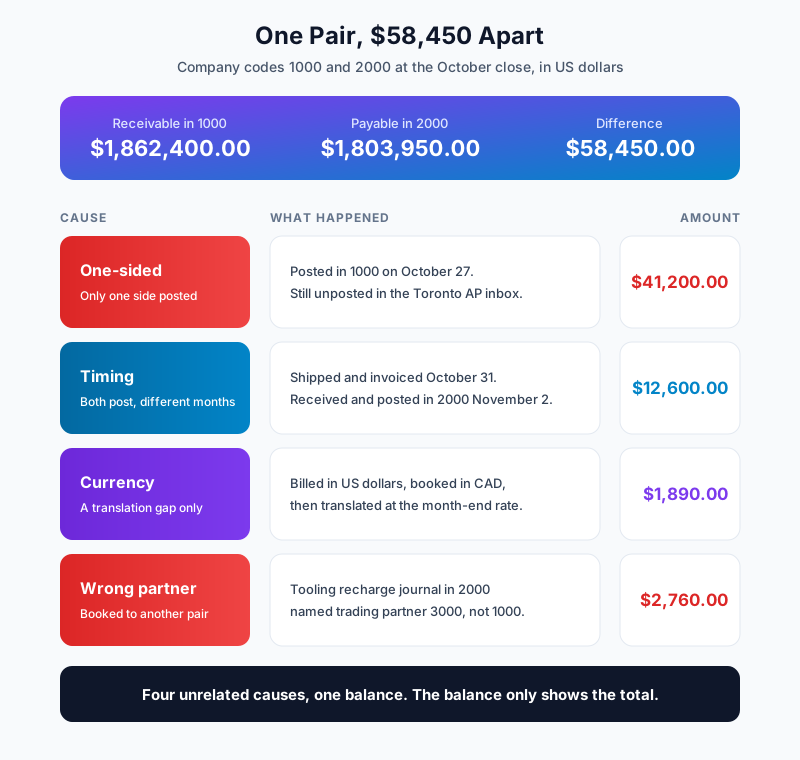
The US parent, company code 1000, shows a receivable of $1,862,400.00 from its Canadian distribution company, company code 2000. Company code 2000 shows a payable to the parent of $1,803,950.00 in group currency. The two figures are supposed to be the same money seen from both ends. They are $58,450.00 apart.
She emails the controller in Ohio and the controller in Toronto. By lunchtime there are two spreadsheets, one exported from each company code, and a long thread. Each controller is fairly sure the problem is on the other side. Nobody is wrong to think so, because both sides are partly right.
The difference turns out to have four separate causes. One invoice for $41,200.00 was posted in Ohio and never posted in Toronto. A $12,600.00 shipment was invoiced on October 31 and received in Canada on November 2. A currency gap of $1,890.00 came from how the Canadian side records US dollar invoices. And a $2,760.00 tooling recharge was booked in Toronto against the wrong sister company. Finding all four takes the two controllers a day and a half. Consolidation slips to Friday, and the group books a top-side adjustment for whatever is still unexplained so the numbers can go to the CFO.
The company, the people and the figures in this story are a composite, built to make a common pattern concrete. The pattern itself is real for almost every group that runs several company codes in SAP. Intercompany differences are found at the worst possible moment, by the people with the least time, using the tools least suited to the job.
Why two sides of the same transaction drift apart
An intercompany sale is one event recorded twice. Company code 1000 ships 400 pump housings at $103.00 each and posts a customer invoice. Company code 2000 receives the goods and the invoice, and posts a vendor invoice. In a perfect world, both postings happen on the same day, in the same currency, with the same reference and the right trading partner on both sides.
In practice, each side posts on its own timetable, through its own people and its own inbox. The seller posts when it bills. The buyer posts when the invoice reaches someone who can process it. Every gap between those two moments is a chance for the two books to disagree.
Most groups see the same four kinds of difference, month after month.
One-sided postings. One company code has posted and the other has not. The $41,200.00 invoice in our story reached the shared accounts payable mailbox in Toronto on October 28. Someone flagged it as intercompany, meaning it would not go through the normal payment run, and it sat in a folder with no clear owner. The receiving purchase order and the goods receipt were both in SAP. The invoice was not.
Timing differences. Both sides will post, but in different periods. The $12,600.00 shipment left Ohio on October 31 and crossed the border on November 2. Ohio invoiced in October, and Toronto posted in November when the goods arrived. Nothing is wrong with either posting. The difference is real at month end and will disappear on its own, but someone still has to prove that, every single month.
Currency differences. The parent bills in US dollars. The Canadian company keeps its books in Canadian dollars and converts each invoice at the rate on the day it posts. When group reporting translates those Canadian dollar balances back into US dollars at the month-end rate, the total no longer equals what Ohio billed. In October the gap was $1,890.00, spread thinly across dozens of invoices. No single document is wrong, so no single document explains it.
Wrong trading partner. The trading partner field on a posting tells SAP which group company the other side of the transaction belongs to, and consolidation uses it to pair balances for elimination. In our story, Toronto accrued a $2,760.00 tooling recharge from the parent with a manual journal, and the accountant entered trading partner 3000, the group's Mexican assembly plant. The 1000 and 2000 pair is now short by $2,760.00, and the 2000 and 3000 pair is out by the same amount in the other direction. One typing slip, two broken pairs.
Each of these on its own is small and ordinary. The trouble is that they arrive together, in the same balance, and the balance alone cannot tell you which is which.
Why the month-end spreadsheet keeps losing
The usual way to find intercompany differences is to compare balances first and investigate later. Someone exports the receivable from one side and the payable from the other, puts them next to each other in a spreadsheet and starts working down the list. In SAP that often means customer line items from FBL5N in one company code and vendor line items from FBL1N in the other, filtered by the partner, then matched by eye or with lookup formulas.
This approach fails in a few predictable ways.
It starts too late. Balances are compared after the period is closed, when the people who could fix the cause are already busy with the close itself. A one-sided invoice that could have been posted in five minutes on October 29 becomes an urgent problem on the third working day of November.
It works at the wrong level. A balance is a sum. The $58,450.00 difference is four unrelated stories added together, and a balance comparison shows only the total. To find the stories you have to go down to individual documents, and the spreadsheet is where that work slows to a crawl.
It depends on shared references that are not always shared. Matching is easy when both sides carry the same intercompany invoice number. It is hard when the buyer typed the reference differently, left it blank, or posted the whole delivery as one line while the seller billed it as three.
It splits the work between two people who are measured on different things. The controller in Ohio wants the receivable confirmed. The controller in Toronto wants the payable to be right for local reporting. Each one naturally starts by checking the other side, and the thread grows.
And it scales badly. A group with 12 company codes has 66 possible pairs. Not all of them trade with each other, but a group like our pump manufacturer might have 18 pairs that do, each with a few hundred documents a month. A day and a half for one pair is not a process anyone can repeat 18 times inside a five-day close.
So the close does what closes do under pressure. The unexplained remainder goes into a top-side adjustment at group level, consolidation finishes, and the real causes are left for later. Later rarely comes. The same kinds of difference turn up the next month, and the month after.
What an unexplained difference really costs
It is tempting to treat intercompany differences as a group reporting problem that nets to zero in the end. The money stays inside the group, after all. That view misses most of the cost.
The first cost is time at the worst moment. In our story, two controllers and an analyst spent most of a day and a half on one pair during the busiest week of the month. Across several pairs that becomes several people for several days, every close.
The second cost is wrong local books. The $41,200.00 invoice that never posted in Toronto means the Canadian company understated its inventory and its payables for October. Its local statutory accounts, its tax filings and its management reporting all rest on those books. A top-side adjustment at group level fixes the consolidated figures and leaves the local figures wrong.
The third cost is cash. An invoice that is not posted is not paid. If the parent depends on intercompany settlements to fund its own payments, a stuck $41,200.00 is a real gap in its cash plan, and nobody sees it until someone goes looking.
The fourth cost is audit attention. Recurring top-side adjustments for intercompany differences are exactly the kind of thing auditors ask about. They want to know what was adjusted, why, who approved it and whether the cause was fixed. Our post on what auditors look for in an automated SAP audit trail covers why a clear record of each decision matters as much as the decision itself.
The fifth cost is trust. When finance leaders know the intercompany figures will be forced to balance on Thursday, they stop believing them on Wednesday. Every review meeting carries a small asterisk.
What a better intercompany process looks like
The fix is not a better spreadsheet. It is a different order of work. Instead of comparing balances at month end and then hunting for documents, a good process matches documents continuously through the month, explains every difference by its cause as soon as it appears, and gets the right correction approved by the right people before the close begins.
Walk the October pair through that process and the picture changes.
Step 1. Compare every pair, every day, at the document level
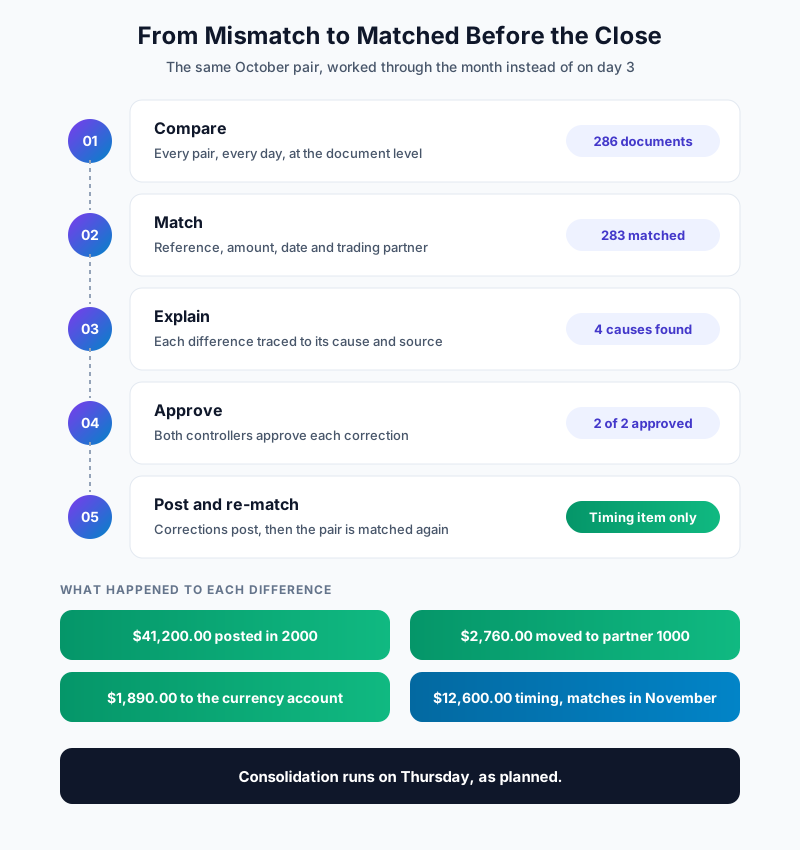
Rather than waiting for month end, the comparison runs daily for every active pair of company codes. It looks at intercompany receivables against payables, and at revenue against cost, in transaction currency as well as group currency. For the 1000 and 2000 pair, that means 286 intercompany documents in October, checked as they post rather than all at once on the third working day.
Step 2. Match documents on more than one field
Each document on one side is matched to its partner on the other using the reference, the amount, the date and the trading partner together. When the buyer typed the reference slightly differently, the amount, date and partner still point to the right document. When one delivery was billed as three lines and posted as one, the match groups them. Rounding and small currency movements fall inside agreed tolerances instead of showing up as false alarms.
In October, 283 of the 286 documents match cleanly on this basis. That leaves three documents and a currency gap to explain, instead of a $58,450.00 mystery.
Step 3. Explain every difference by cause
Each remaining difference is given one of the four causes and traced to its source.
The $41,200.00 invoice is one-sided. It was posted in 1000 on October 27. There is no matching vendor invoice in 2000, but the purchase order and goods receipt are there, and the PDF has been in the Toronto mailbox since October 28.
The $12,600.00 invoice is timing. It was posted in 1000 on October 31 and in 2000 on November 2, against the same reference. It will match in November with no action.
The $1,890.00 is currency. When both sides are compared in the US dollar amounts actually billed, they agree. The gap exists only in the translated balances, and the group's policy says where it goes.
The $2,760.00 journal in 2000 names trading partner 3000. The description, the cost center and the original recharge from 1000 all show that it belongs to the 1000 and 2000 pair.
Each explanation comes with the documents that prove it. The controllers no longer have to build the case themselves. They only have to check it.
Step 4. Propose the correction and ask both controllers
For each cause there is a proposed action. Post the $41,200.00 vendor invoice in 2000 for October. Reclassify the $2,760.00 journal in 2000 from partner 3000 to partner 1000. Post the $1,890.00 to the currency difference account the group policy names. Leave the $12,600.00 alone and list it as a timing item for November.
None of this posts on its own. Every correction needs the controller of each company code involved to approve it, because each one is responsible for their own books. The Ohio controller approves in the morning. The Toronto controller approves an hour later from a link in an email, with the invoice, the purchase order and the goods receipt in front of them.
Step 5. Post, re-match and carry the timing items forward
Once both approvals are in, the corrections post and the pair is matched again to confirm it now agrees. The $12,600.00 timing item is carried into November with its reference, so it matches the moment the Toronto posting is compared. Every step, every approval and every posting is kept with the case, so anyone can see later what was found, who decided and when.
The analyst runs her report on Wednesday morning, and the 1000 and 2000 pair is already at zero apart from one listed timing item. Consolidation runs on Thursday, as planned.
How Artificio handles intercompany reconciliation in SAP
Artificio's Intercompany Reconciliation Agent is built around exactly these steps. It works the way every Artificio SAP agent does, in four stages called read, validate, decide and act. The agent does the research and the paperwork, and your controllers make the decisions.
Read. The agent compares intercompany balances for every pair of company codes, receivables against payables and revenue against cost, in transaction currency and group currency. It runs on a schedule or before consolidation, whichever your close calendar needs, on SAP ECC or SAP S/4HANA.
Validate. It matches documents across each pair on reference, amount, date and trading partner, with tolerances for currency movements and rounding that you set.
Decide. It classifies every difference as one-sided, timing, currency or wrong partner, and traces each one back to its source document. In our story that is the unposted invoice in the Toronto mailbox, the shipment in transit, the translation gap and the mistyped trading partner.
Act. It proposes the correcting entries and sends them to the controllers of both company codes. Corrections post only after both approve, and the pair is matched again after posting. Timing differences are left to match in the next period.
Approvals use Artificio's human-in-the-loop checkpoints, so a controller can approve or reject from an email without hunting through SAP. Each case shows who it is waiting for, what the agent checked and exactly what each person is approving. That record is what turns a recurring top-side adjustment into a short, explainable list.
Intercompany work rarely lives on its own, and the agent sits alongside the others a finance team already uses. Intercompany invoices that arrive as PDFs can be captured and posted through the same SAP invoice automation as any supplier invoice, which stops many one-sided postings before they start. The accrual and period close agent works on the accruals that also have to be right before the close, and the GR/IR clearing agent deals with the receipts and invoices that never quite meet. Our post on the GR/IR account nobody wants to open at year end shows how the same kind of slow drift builds up there.
The same thinking applies outside the group, too. AP reconciliation matches supplier statements to SAP open items, and AR reconciliation matches customer payments. If your team already fights with supplier statements, our post on supplier statement reconciliation will feel familiar. Intercompany is the same problem with one difference. Both sides of the mismatch work for you.
What changes for the finance team
The most visible change is the third working day. The intercompany report stops being a surprise, because the differences were found and explained while the month was still open. In our story the $41,200.00 invoice would have been flagged on October 29, the day after it landed in the Toronto mailbox, and posted that week.
The controllers' work changes shape. Instead of building spreadsheets and trading emails, they review a short list of explained differences with the evidence attached, and approve or reject each one. A day and a half of shared detective work becomes a few minutes of review per pair.
Top-side adjustments shrink to what is genuinely unknown. When every difference has a cause and an approved correction, there is very little left to force through at group level. What remains is visible, listed and owned.
Local books get fixed at the source. The Canadian company's October payables and inventory are right in its own ledger, not just in the consolidated figures. That matters for local statutory reporting, for tax and for anyone in Toronto who reads their own management accounts.
Cash planning improves. Invoices that would have sat unposted for weeks are posted and scheduled for settlement, so the parent can count on intercompany payments arriving when the plan says they will.
And audit conversations get shorter. Each correction has a case behind it with the documents, the cause, both approvals and the posting. When an auditor asks about October, the answer is already written down.
If you are building the business case, the inputs are straightforward. Count the active pairs, the hours spent on intercompany differences each close, the size of the top-side adjustments over the last year and the number of days consolidation slipped. Our line-by-line ROI walkthrough for CFOs shows how to turn figures like these into a case your leadership will accept.
How to start with your own intercompany pairs
You do not need to fix every pair at once. Most groups get the clearest result by starting small and proving the process on one busy pair.
Pick the pair that hurts most. Usually that is the pair with the most documents, the most currency movement or the most recurring top-side adjustments. For our pump manufacturer, it would be Ohio and Toronto.
Gather three months of history. Pull the intercompany documents for that pair for the last three closes, along with the differences that were found and how they were resolved. This shows which of the four causes dominates for you, and it gives you a baseline to measure against.
Agree the matching rules. Decide which reference both sides should carry, what currency tolerance counts as noise, and whether the comparison runs in transaction currency, group currency or both. Write down what happens to currency differences under group policy, so the correction is never a debate.
Agree who approves. For each company code, name the controller who approves corrections and a delegate for when they are away. Corrections that need two approvals should have two named people from the start.
Run one close in parallel. Let the agent match and explain the pair alongside your usual process for one month. Compare what it found, how early it found it and how long the review took against the spreadsheet route. Then move the next pairs across.
Fix the causes you find. If most one-sided postings come from intercompany invoices stuck in an inbox, route those invoices into the same capture and posting flow as supplier invoices. If wrong trading partners keep appearing on manual journals, tighten the journal template. The reconciliation shows you where the leaks are, and closing them makes every following month easier.
Intercompany reconciliation is one of those tasks that every finance team accepts as part of the close, because it has always been hard. It is hard mostly because it is done late, in bulk, by hand. Done early, at the document level, with the evidence attached and both controllers in the loop, it becomes ordinary work again. If you would like to see how this runs on your own company codes, book a short demo and bring your busiest pair.