

Blog
Invoice Handoff Hell: Cut 23 Steps to 1 Touch
Stop the 23-step document dance. Learn the single-touch alternative to cut 94% of invoice handoffs.

Blog
Stop the 23-step document dance. Learn the single-touch alternative to cut 94% of invoice handoffs.
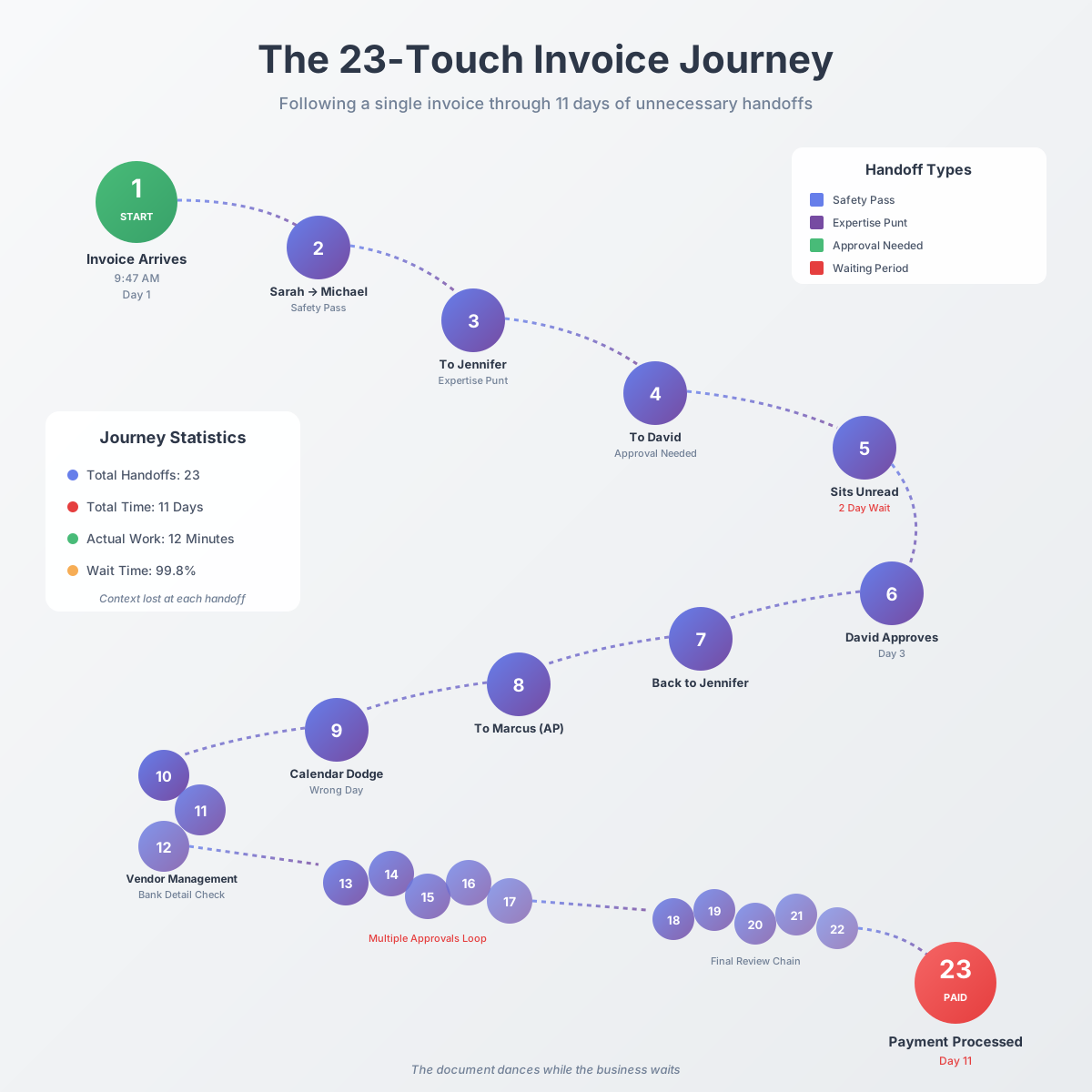
Picture this. An invoice arrives in your accounts payable inbox at 9:47 AM on a Tuesday. It's a simple document, really. Three line items, a vendor you've worked with for years, payment terms you could recite in your sleep. By all logic, this invoice should be processed and queued for payment within minutes. But here's what actually happens over the next eleven days.
The invoice lands in Sarah's inbox. She glances at it, sees it's addressed to the operations team, and forwards it to Michael in procurement. Michael opens it during his afternoon email catch-up, notices the invoice references a purchase order he doesn't recognize, and sends it to Jennifer in purchasing. Jennifer checks the PO number, confirms it matches a recent order, but notices the amount seems higher than expected. She forwards it to David, the department manager who approved the original purchase, asking for verification. David is in back-to-back meetings all day. The email sits untouched.
Two days later, David finally reviews the invoice, confirms the amount is correct (there was a price adjustment they'd negotiated), and sends it back to Jennifer with his approval. Jennifer forwards it to accounts payable, but this time it goes to Marcus instead of Sarah because it's Thursday and Sarah handles vendor queries on Thursdays, not invoice processing. Marcus looks at the email thread (now eight messages deep), sees it's been approved, and prepares to enter it into the system. But wait. The vendor's bank details look different from what's in their records. He forwards it to the vendor management team.
At this point, we're six days in and the invoice has changed hands nine times. We're not even halfway through the journey.
This isn't a story about incompetence or broken systems. This is the document handoff choreography, and it's playing out in your organization right now. Across thousands of invoices, contracts, purchase orders, and approval forms. Each one performing an elaborate dance, passing from person to person in a pattern so routine that nobody questions it anymore.
Here's what most organizations don't realize. That simple invoice we just followed? By the time payment is finally processed, it will have been touched by 23 different people. Not 23 times. 23 different people. Each one opening it, reviewing it, making a tiny decision, and passing it along to the next person in line.
The pattern repeats itself with such regularity that it becomes invisible. We see the delays, sure. We complain about how long it takes to get invoices processed or contracts approved. But we rarely stop to count the handoffs. We don't map the relay race. We just accept that documents need to flow through multiple people because that's how it's always been done.
But when you actually track a document through your organization, when you chart every single time it moves from one person's inbox to another's, the choreography becomes visible. And once you see it, you can't unsee it.
The finance director at a mid-size manufacturing company recently did this exercise. She picked five random invoices from the previous month and traced their complete journey from arrival to payment. The results shocked her. The shortest path involved 18 handoffs. The longest? 31. And here's the thing that really got her attention. The actual work, the real processing and decision-making that needed to happen, represented maybe four of those touches. The other 14 to 27? Pure choreography. Documents being passed along because that's what the dance requires.
Not all handoffs are created equal. When you study document workflows across different organizations and industries, five distinct patterns emerge. Each has its own logic, its own reason for existing. Understanding them is the first step to seeing why we're all trapped in this elaborate dance.
The Safety Pass is probably the most common. Someone receives a document, looks at it, feels a tiny flutter of uncertainty (is this my responsibility? am I authorized to approve this? what if I make a mistake?), and forwards it to someone else. It's not that they can't handle it. They probably could. But passing it along feels safer than taking ownership. The responsibility shifts, and with it, the risk. We see this constantly with invoices that fall into gray areas. The amount is just above someone's approval threshold. The vendor is slightly outside their usual scope. The purchase order has a minor discrepancy. Rather than resolve it, they pass it. The document keeps moving, and nobody's at fault if something goes wrong later because hey, they forwarded it to the right person.
The Expertise Punt looks similar but comes from a different place. Here, someone genuinely believes another person is better equipped to handle the document. They're not dodging responsibility; they're trying to be helpful. The invoice references technical specifications they don't understand. The contract includes legal language that makes them nervous. The form asks questions they think someone else can answer better. So they forward it, usually with a note like "You're better at this than me" or "This seems more your area." The logic is sound, but it ignores a critical fact. The next person will probably pass it along too, for the same reason. Documents that need "expertise" often bounce through five or six people before anyone actually processes them.
The Calendar Dodge is interesting because it's completely unnecessary but feels totally logical in the moment. Someone receives a document but sees that processing it isn't on their schedule for today. Maybe they handle invoices on Tuesdays and Thursdays. Maybe they're focused on month-end closes and don't want to break their concentration. Maybe they're just busy with other priorities. So they forward it to whoever's "turn" it is, or put it in a queue, or send it to a shared inbox. The document sits, waiting for someone's calendar to align with its needs. We lose days this way, sometimes weeks, not because anyone's shirking their duties but because we've created artificial processing windows that documents have to wait for.
The Approval Cascade is the only handoff pattern that seems truly necessary, but even here, the choreography often becomes excessive. A purchase requisition needs manager approval. Makes sense. But then it needs director approval. And VP approval. And in some organizations, C-level approval. Each level adds a handoff, and more critically, each level adds waiting time. The document sits in an inbox until someone senior enough gets around to reviewing it. The challenge is that most organizations never revisit their approval thresholds. Rules that made sense when the company had 50 employees persist when they have 500. Approval chains that were designed for a different era keep running on autopilot, and documents keep passing through unnecessary hands.
The Information Gap Pass might be the most frustrating because it represents a failure of context. Someone receives a document but doesn't have the information they need to process it. The invoice doesn't reference the original purchase order. The contract is missing background on what was negotiated. The form lacks details about who requested it or why. So they forward it to someone who might have that context. That person forwards it to someone else who might know. The document bounces around not because people are avoiding work but because the information it needs to be processed got separated from the document itself. It's out there somewhere, scattered across emails and conversations and someone's memory, but the document is traveling alone.
The delays are obvious. That invoice that takes eleven days to process when it should take eleven minutes. But the real costs of handoff choreography go deeper than timeline extensions.
Context dissolves with every pass. When Sarah first received that invoice, she had context. She knew it was from a regular vendor. She'd probably seen the purchase order when it was created. She might have even been part of the conversation about the price adjustment. But when she forwarded it to Michael, most of that context stayed in her head. Michael got the raw document with maybe a one-line email explanation. When he passed it to Jennifer, even more context evaporated. By the time the invoice reached its 15th handler, it was just data on a page. The story behind it, the nuances, the informal agreements that explain the numbers – all gone. This context loss creates problems. People make decisions based on incomplete information. They ask questions that were already answered three handoffs ago. They escalate issues that aren't actually issues because they're missing the background.
Accountability becomes diffuse. When 23 people touch a document, who's responsible for it? Everyone will tell you it's their job to review it, approve their piece, and pass it along. But nobody owns the entire journey. If something goes wrong, if the invoice gets paid incorrectly or the contract gets lost, there's no single person who was in charge. Instead, you get 23 people who each did their small part correctly but nobody who was accountable for the outcome. This diffusion of responsibility creates a peculiar organizational blindness. Problems don't get caught because everyone assumes someone else is checking. Errors slip through because no single person is looking at the whole picture.
Relationships get strained in weird ways. The constant forwarding creates micro-frictions that accumulate over time. People start to resent being the person who always gets the tricky invoices. Teams develop unspoken tensions about who's passing work to whom. Someone who forwards a lot of documents gets seen as not pulling their weight, even if they're following the official process. Someone who tries to process documents that "aren't their job" gets pushback for stepping on toes. The choreography creates invisible boundaries that people have to navigate carefully, and those boundaries generate friction.
Processing time becomes wildly unpredictable. When a document has to pass through 23 people, its processing time depends on 23 different schedules, 23 different workload situations, 23 different vacation schedules. One person being out sick for two days can add a week to processing time. One person having an unusually busy month can create a bottleneck that affects hundreds of documents. Organizations can't predict how long anything will take because there are too many human variables in the equation. This unpredictability creates its own problems. Vendors get frustrated. Late payment fees accumulate. Rush situations become crises because nobody can fast-track a document through 23 people.
The document becomes the task instead of the decision. Here's something subtle that happens. When people are constantly passing documents, the focus shifts from making good decisions to managing the handoff itself. Did I forward it to the right person? Did I include enough context in my email? Should I cc someone else? The meta-task of document management starts consuming more cognitive energy than the actual work the document represents. People spend more time thinking about where to send the invoice than whether the charges are accurate. They spend more energy managing the approval chain than evaluating what they're approving.
Organizations love talking about ownership. Take ownership of your work. Own the customer relationship. This is your area, you own it. But document workflows expose a strange disconnect between what we say about ownership and what we actually do.
In theory, when someone receives a document that's their responsibility, they should own it end-to-end. They should process it, make decisions about it, resolve any issues, and see it through to completion. That's what ownership means, right?
In practice, what we call ownership is really just custody. You have the document temporarily. You do your specific part, whatever that is, and then you pass custody to the next person. Nobody owns the document's complete journey. We've broken ownership into so many small pieces that it's barely recognizable.
This creates a fundamental problem. When nobody owns the complete journey, nobody can optimize the complete journey. Each person optimizes their little piece. They make their handoff as clean and efficient as possible. They try to pass the document quickly and accurately. But the system as a whole remains inefficient because nobody's looking at the system as a whole.
The manufacturing company we mentioned earlier tried something interesting. They picked their most problematic document type (expense reports, as it happens) and assigned one person to own the complete journey. Not to do all the work, but to shepherd documents through the process, identify bottlenecks, resolve issues, and make sure nothing got stuck. They called this person the "expense report coordinator."
Within two weeks, the coordinator had identified six completely unnecessary handoffs. Steps that added no value but existed because "that's how we've always done it." Within a month, expense report processing time had dropped by 60%. Not because anyone was working harder or faster, but because someone finally had visibility into and responsibility for the complete journey.
So what's the alternative? If handoff choreography is so inefficient, what does better look like?
The answer isn't to eliminate all handoffs. Some documents genuinely need multiple people's input. Complex contracts require legal review. Large expenditures need appropriate approvals. The goal isn't to reduce every document to a single person making all decisions in isolation.
The goal is to reduce handoffs that don't add value. To eliminate passes that happen because of process design rather than real necessity. To create what we might call "ownership persistence," where documents flow through required touchpoints but don't get lost in endless relay races.
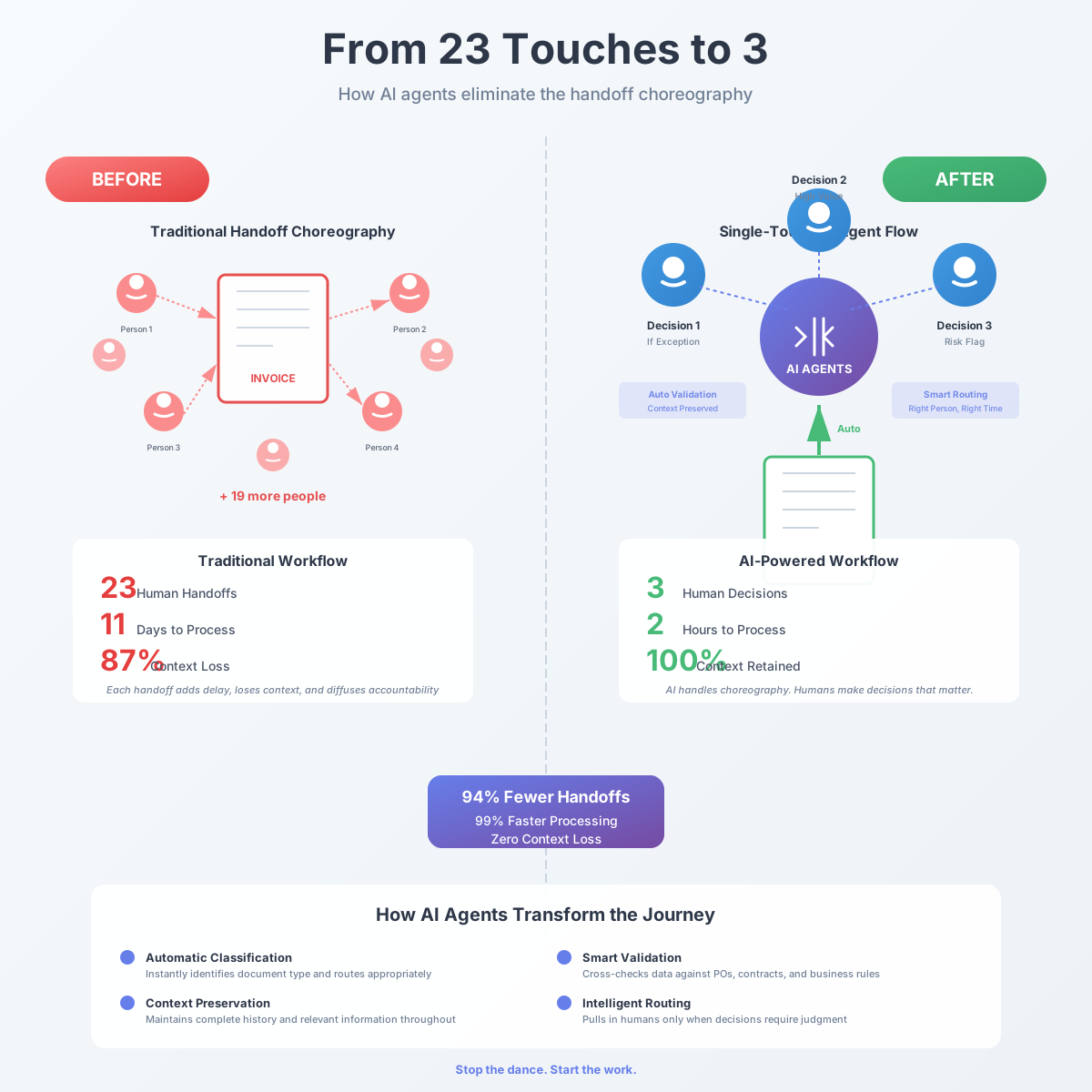
This is where intelligent automation changes the game, not by replacing humans but by changing what humans need to do. Instead of documents physically moving from inbox to inbox, accumulating forwards and delays, imagine a system where the document stays in one place but the right people get pulled in exactly when they're needed.
An invoice arrives and gets immediately classified, extracted, and validated against existing purchase orders and vendor records. If everything matches and the amount is within standard parameters, it routes directly to payment processing. No handoffs required. If there's a discrepancy, the system identifies exactly what's wrong and exactly who needs to resolve it. Not a chain of six people who might know, but the specific person who approved the original purchase. That person gets a notification with all the context they need, makes a decision, and the document continues. One handoff, not nine.
A contract comes in for review. Instead of being forwarded through a chain of people who each review their portion, the system identifies what needs review (legal terms, financial implications, operational requirements) and routes those specific aspects to the appropriate reviewers simultaneously. They all work in parallel instead of series. The document doesn't wait in someone's inbox for three days before getting passed to the next person. It gets reviewed by everyone who needs to see it at the same time.
This is what the single-touch alternative looks like. Not literally one person touching one document, but eliminating the choreography. The document doesn't perform an elaborate dance through your organization. It goes where it needs to go when it needs to go there, and only involves people who add actual value to the process.
Here's what makes this transition difficult. The handoff choreography isn't just a process problem. It's a psychology problem. We pass documents along because it feels safer, smarter, more responsible. Breaking that pattern requires addressing the underlying psychology.
People forward documents because they're afraid of making mistakes. The solution isn't telling them to stop being afraid. It's giving them tools that make mistakes less likely. If someone receives an invoice and the system has already validated it against the purchase order, cross-checked the vendor's information, and confirmed the pricing matches the contract, forwarding it "just to be safe" becomes unnecessary. The validation already happened.
People pass documents to experts because they genuinely don't know how to handle them. The solution isn't expecting everyone to become an expert in everything. It's embedding expertise into the system. If the document itself can flag issues, suggest resolutions based on past similar cases, and provide relevant context from previous interactions, the need for expertise hunting disappears. The expertise comes with the document.
People dodge documents because of calendar constraints and workload pressures. The solution isn't demanding they process everything immediately. It's creating systems that respect different people's roles and workflows while ensuring documents don't get stuck waiting. If a system knows that Sarah handles certain types of invoices on Tuesdays and someone else handles them on Wednesdays, it can route appropriately without requiring Sarah to manually forward things on a Wednesday.
The transition from handoff choreography to single-touch processing isn't about asking people to behave differently. It's about creating systems that make the choreography unnecessary.
If you want to understand how bad the handoff problem is in your organization, here's a simple exercise. Pick a common document type. Invoices work well. So do expense reports, purchase requisitions, or vendor contracts. Take five examples from the past month and trace their complete journey. Not just the official workflow, but every single time they actually changed hands.
Create a simple log for each one with these columns: timestamp, who had it, what they did with it, who they sent it to, and why they sent it there. Be specific about the "why." Don't accept "it's the process" as an answer. What actually caused that specific handoff at that specific moment?
When you map all five documents, look for patterns. How many handoffs happened for reasons other than actual decisions or approvals? How many times did someone pass a document because they weren't sure what to do with it? How many times did it get forwarded to someone who just forwarded it again? How much time elapsed while documents sat in inboxes waiting?
Most organizations that do this exercise discover they have no idea how their documents actually flow. The official process diagram shows a clean path with five or six steps. The reality is a tangle of 20+ handoffs with all kinds of unofficial detours, loops, and backtracking.
The patterns you find will probably fall into those five categories we discussed earlier. Safety passes, expertise punts, calendar dodges, approval cascades, and information gap passes. But you'll also find patterns unique to your organization. Cultural patterns. Historical patterns. Patterns that emerged from some long-ago situation that no longer exists but the behavior persists.
Once you see the patterns, you can start asking better questions. Which handoffs add value? Which ones exist because of how we've organized work rather than the work itself? Which ones could be eliminated if we designed the system differently? Which ones happen because people lack information or confidence that could be provided upfront?
Organizations that successfully reduce handoff choreography report some interesting changes. The obvious ones happen first. Processing times drop dramatically. Documents that took two weeks suddenly take two days. Backlogs that seemed permanent start clearing. People stop spending their days managing email forwards.
But the subtle changes might be more important. When documents stop bouncing from person to person, something shifts in how people relate to their work. They stop being document handlers and become decision makers again. The cognitive load of managing handoffs, tracking where things are, remembering who to forward what to – all of that mental overhead evaporates. People have space to think about the actual work.
Accountability becomes clearer. When a system handles the choreography and only pulls people in for specific decisions, it's obvious who made which decision and why. If something goes wrong, there's a clear trail showing not just who touched the document but what actually happened at each point. This clarity changes how people engage with the work. They're more careful with their specific part because they know it's visible. They ask better questions because they're not just passing things along.
The relationship dynamics change too. People stop resenting being the person who gets all the hard cases because the system distributes work more fairly. Teams stop developing weird tensions about who forwards what to whom because the forwarding happens automatically and transparently. The micro-frictions that accumulated around handoffs start to dissolve.
Organizations also discover flexibility they didn't know they had. When someone's out sick or on vacation, their work doesn't pile up in their inbox creating a disaster when they return. The system routes around them, pulling in backup reviewers or adjusting timelines appropriately. When workloads shift, the system adapts without requiring everyone to manually redirect their forwards.
Perhaps most importantly, the work becomes more predictable. Not in a soul-crushing "every day is exactly the same" way, but in a "we can actually plan and commit to timelines" way. When processing doesn't depend on 23 people's individual schedules and workload situations, organizations can make and keep promises. They can tell vendors when invoices will be paid. They can commit to contract review timelines. They can plan operations around reliable document processing. This predictability cascades into all kinds of other improvements.
Eliminating handoff choreography doesn't happen overnight. Organizations that have done this successfully usually follow a similar path.
They start by making the choreography visible. You can't fix what you can't see, and most document handoffs are invisible. They happen in email forwards and quick conversations and informal agreements. The first step is mapping what's actually happening, not what the process diagram says should happen. Those five-document exercises we mentioned earlier are a good starting point, but comprehensive mapping looks at hundreds of documents across different types and departments.
Next comes the conversation about why. For each handoff pattern, the question is simple. What purpose does this serve? What value does it add? What would break if we eliminated it? Some handoffs will have good answers. They genuinely add value or mitigate real risks. Others won't. They exist because of habit or fear or outdated rules. Distinguishing between necessary and unnecessary handoffs takes honest conversation and willingness to question how things have always been done.
Then the redesign begins. Not by forcing people to change their behavior, but by changing what the system asks of them. If people are forwarding documents to check with experts, embed that expertise into the system. If they're passing things along for approval, streamline the approval process so it happens in parallel rather than series. If they're dodging documents because of calendar constraints, build workflows that respect those constraints without creating bottlenecks.
The technology matters, but it's not the starting point. Organizations that jump straight to "we need an AI system to handle this" without first understanding their handoff patterns usually just automate the choreography. They end up with expensive technology that moves documents through the same inefficient dance, just faster. The insight has to come first. Understand why the choreography exists, what purposes it serves (real and imagined), and what a better design would look like. Then find or build technology that enables that better design.
Throughout this transition, the focus stays on making people more effective, not replacing them. The goal isn't to eliminate human involvement in document processing. It's to eliminate the busywork of managing handoffs so humans can focus on the decisions and relationships that actually matter. An invoice that needs 23 handoffs probably only needs three or four human decisions. Everything else is choreography. Remove the choreography, keep the decisions, and suddenly both the humans and the documents work better.
Imagine your organization without the handoff choreography. Documents arriving and flowing to exactly the people who need to see them, exactly when they need to see them, with exactly the context they need to make good decisions. No more chasing documents through email chains. No more wondering who has what or where things are stuck. No more spending your days forwarding and following up and keeping track.
What could your team do with that time back? What would change if everyone spent their days making decisions and solving problems instead of managing the document dance? How would your vendor relationships improve if you could actually commit to processing timelines? How would employee satisfaction change if work felt less like endless administrative overhead and more like meaningful contribution?
These aren't hypothetical questions. Organizations making this transition are finding real answers. They're processing more documents with the same staff. They're catching errors they used to miss because people have time to actually review instead of just forward. They're building better relationships with vendors and customers because they're reliable. They're retaining employees who were ready to quit because they were drowning in administrative busywork.
The document handoff choreography feels normal because it's everywhere. We've all learned the steps. We know when to pass, when to hold, when to forward just to be safe. But normal doesn't mean optimal. Sometimes the most valuable thing an organization can do is stop dancing and start walking in a straight line.
That invoice sitting in someone's inbox right now, the one that's going to change hands 23 times before it gets paid? It doesn't have to dance. It could just go straight to payment, making exactly the stops it needs along the way for real decisions by real humans at the right times. The choreography is optional. The work is what matters.
Time to change the dance.

Head IT Operations - Co Founder of Artificio
See it in your SAP environment
Bring us a document, a process, or a bottleneck. We'll show how Artificio captures, validates, and posts into SAP — then scale from there.
Security & compliance
ISO 27001:2013 certified, SOC 2 Type 2 compliant, GDPR and HIPAA ready. Every agent action is logged, auditable, and runs in isolated environments.