Every HR team knows the feeling. A new hire signs their offer letter on a Tuesday afternoon, and by Friday the employee record still has gaps, the onboarding checklist has stalled, and someone from IT is asking why system access has not been provisioned yet. The documents exist. The information is there. But moving it from one place to another requires three people, two inboxes, and a spreadsheet that only one person knows how to update.
This is not a people problem. It is a systems problem, and it is more common than most organizations admit.
Workday is one of the most widely deployed HR platforms in enterprise environments. It handles everything from headcount planning to payroll, learning, and performance. But even in a mature Workday deployment, document intake remains stubbornly manual. Offer letters arrive as PDFs. I-9s get scanned and emailed. Employment verification forms come in from third parties in formats nobody anticipated. Each one needs a human to open it, read it, extract the right fields, and update the correct record.
Artificio changes that dynamic entirely.
The Document Gap Inside Workday Deployments
Workday is excellent at structured data. Once information is in the system, it flows well. The challenge is getting information in.
Most HR workflows begin with an unstructured document: a signed offer letter, a background check report, a W-4 form, a certificate of prior employment. These documents do not arrive pre-formatted for Workday. They come as PDFs, scanned images, email attachments, and occasionally fax outputs that someone has taken a photo of with their phone.
The gap between "document received" and "Workday updated" is where HR teams lose hours every week. In high-volume hiring environments, that gap becomes a real operational problem. Onboarding delays cascade into provisioning delays, payroll setup delays, and in regulated industries, compliance exposure.
Traditional approaches to this problem involve either heavy manual data entry or brittle template-based OCR systems that break the moment a document does not match the expected format. Neither option scales well.
Artificio takes a different approach. Instead of matching documents against fixed templates, Artificio uses AI agents to read, interpret, and extract information from HR documents the same way a skilled human would: by understanding context, not just pattern-matching fields.
What the Artificio + Workday Integration Does
The integration connects Artificio's document processing engine to Workday's APIs, creating an automated pipeline that moves information from incoming documents directly into employee records, recruiting workflows, and HR data tables.
The connection works in both directions. Artificio reads documents coming into the HR function and pushes extracted data into Workday. It can also pull context from Workday to make extraction smarter: if Artificio knows a candidate's name and position from the Workday recruiting module, it can validate extracted fields against that context and flag discrepancies before they enter the system of record.
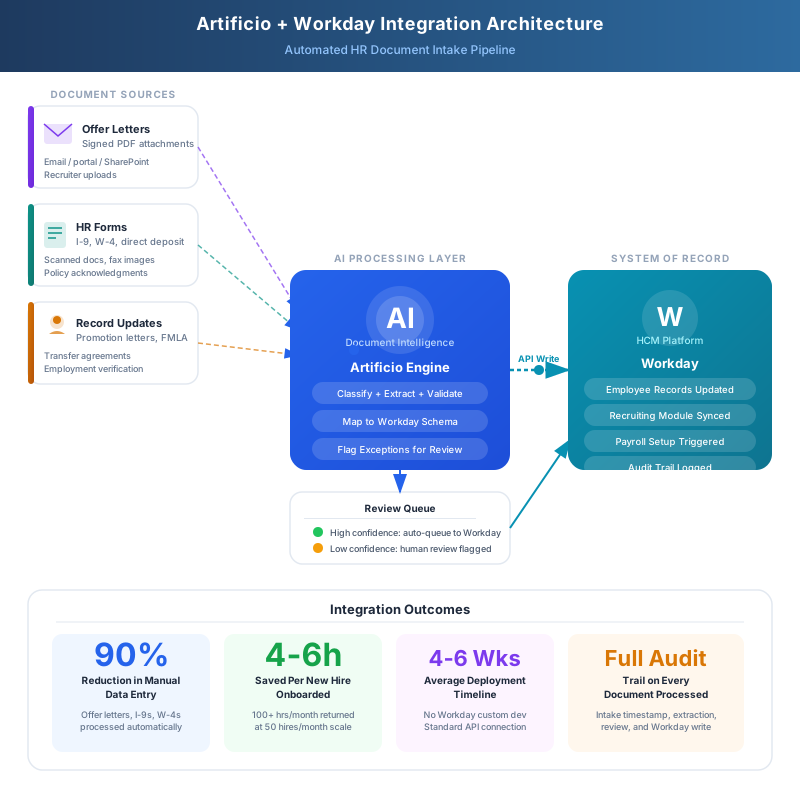
Three areas account for the majority of document processing work in most HR functions.
Offer Letter Processing: From Signed PDF to Workday Record in Minutes
Offer letters are the starting point for every employee relationship, and they carry a surprising amount of structured information: compensation details, start date, job title, reporting manager, location, employment type, and often equity or bonus terms. All of that information needs to land in Workday accurately.
The traditional process looks something like this. Recruiter sends offer. Candidate signs and returns a PDF. Someone in HR downloads it, opens it, checks that it is the right document, finds the relevant fields, and manually enters them into Workday. If the fields match an existing candidate record in the recruiting module, great. If not, someone needs to track down the discrepancy.
With Artificio connected to Workday, that process compresses to almost nothing. When a signed offer letter arrives, Artificio's document agent picks it up from the configured intake point (email folder, SharePoint location, HRIS integration point, or document upload portal). The agent reads the full document, extracts the key fields, validates them against the existing candidate record in Workday, and writes the confirmed data to the appropriate Workday objects.
Start date, compensation, job code, department, manager: all of it moves automatically. If Artificio detects a mismatch between what the offer letter says and what is already in Workday (say, the offer letter shows a different title than the one in the recruiting record), it flags the item for human review rather than writing bad data to the system.
This matters more than it might appear. Offer letter errors that slip into Workday cause downstream problems that take significant effort to unwind, from incorrect payroll setup to benefits enrollment issues. Catching them at the point of intake is far cleaner than discovering them during an audit.
HR Form Intake: I-9s, W-4s, and the Rest of the Stack
Offer letters are just one document type. The full onboarding document stack includes I-9 identity verification, federal and state tax withholding forms, direct deposit authorization, emergency contact forms, acknowledgment of policy documents, and in many industries, additional compliance forms specific to the role or location.
Each of these documents contains structured data that belongs in Workday. Each one currently requires manual handling in most organizations.
Artificio processes the full stack. The AI agent handles variability in form versions, multiple page layouts, handwritten fields on scanned documents, and mixed-language inputs. It extracts the relevant data from each form type and maps it to the correct Workday data fields based on pre-configured extraction schemas that HR teams define and own.
The practical impact is significant. An HR coordinator who previously spent two to three hours per new hire on document processing can shift that time to higher-value work. For an organization onboarding fifty people per month, that is over a hundred hours per month returned to the team.
Tax form handling deserves specific mention. W-4 data, state equivalents, and changes to withholding instructions require accurate, timely entry to avoid payroll errors. Artificio processes withholding form updates continuously, not just at onboarding, so mid-year changes flow into Workday without accumulating in an inbox somewhere.
Employee Record Updates: Keeping Workday Current Throughout the Employee Lifecycle
The document flow does not stop at onboarding. Throughout an employee's tenure, HR teams receive documents that require Workday updates: promotion letters, transfer agreements, benefits change forms, FMLA paperwork, performance improvement plans, employment verification responses, and offboarding documentation.
Each of these triggers record updates, and each update currently requires a human to open a document and make changes in Workday. At the individual level it seems manageable. Across a workforce of several thousand employees, it represents a constant background drain on HR capacity.
Artificio handles post-onboarding document processing using the same agent-based approach. When a promotion letter is issued and countersigned, Artificio extracts the new title, grade, compensation, and effective date and prepares a Workday update for review and execution. When FMLA paperwork is received, it extracts the relevant dates and flags the record accordingly. When an employment verification form comes in from an external party, Artificio reads and routes it without requiring HR to manually handle the intake.
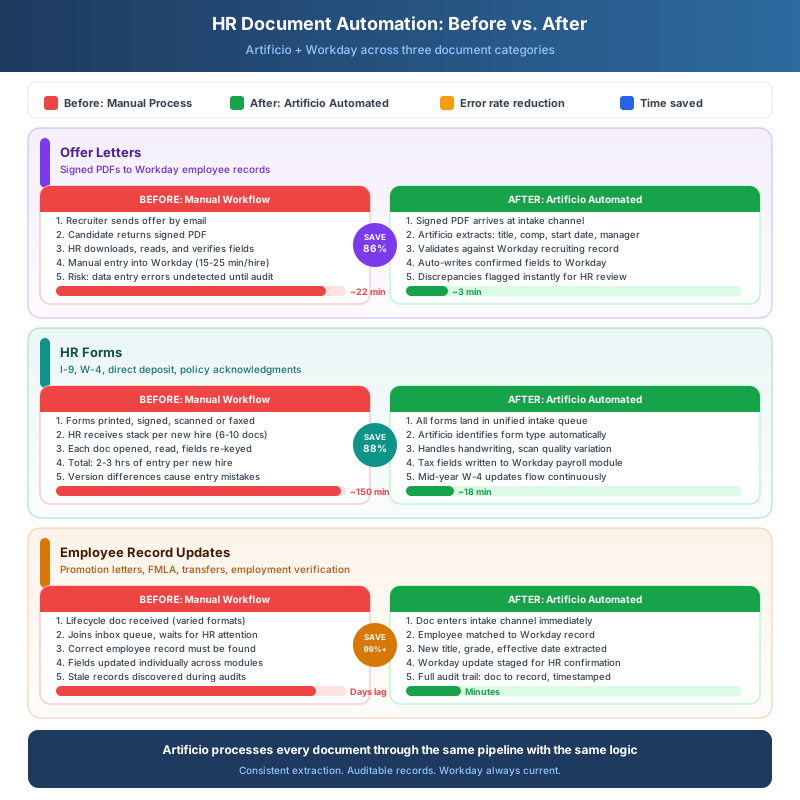
The employee lifecycle document management problem compounds quietly. Most organizations only notice how bad it has gotten during audits, when they discover records that are incomplete, out of date, or inconsistent with source documents. Artificio creates a continuous, auditable chain between incoming documents and Workday records, so the system stays current as a matter of process, not just as a pre-audit scramble.
How the Integration Handles Exceptions
No document processing system handles 100% of documents without exceptions, and the right behavior for exceptions matters as much as accuracy on the easy cases.
Artificio is built around a review-and-confirm model. Documents that the AI processes with high confidence are queued for lightweight human review before writing to Workday. Documents where confidence is lower, or where extracted values conflict with existing Workday data, are flagged for full human review with the extracted data pre-populated and the source document displayed alongside it.
This means HR staff are reviewing exceptions, not doing data entry. The cognitive load is completely different. Checking an AI-extracted value against a source document takes seconds. Re-entering the same information from scratch takes minutes, and introduces its own error rate.
The exception workflow is configurable by document type and by confidence threshold. For high-stakes fields like compensation, organizations can require human confirmation even on high-confidence extractions. For lower-stakes fields like emergency contact phone numbers, they can allow straight-through processing. HR teams own these settings and can adjust them without engineering support.
HR document management sits at the intersection of labor law, tax regulation, and data privacy requirements. Errors have real consequences, and the ability to demonstrate proper document handling during audits is not optional.
The Artificio + Workday integration maintains a full audit trail for every document processed. Each document's intake timestamp, extraction output, human review action, and Workday write event are logged and accessible. When an auditor asks to see the I-9 for a specific employee and verify that the data in Workday matches the source document, that verification takes minutes rather than hours of hunting through file systems.
For organizations subject to EEOC reporting, OFCCP compliance, or state-level HR regulations, the ability to demonstrate process consistency is particularly valuable. Artificio processes every document through the same pipeline with the same logic, creating a defensible record of consistent practice.
Deploying the Integration: What the Setup Process Looks Like
The integration between Artificio and Workday runs through Workday's standard APIs, which means it does not require custom development inside Workday or modifications to existing workflows.
Setup involves three main workstreams. First, the document intake channels are configured: which email addresses, folders, or portals feed documents into Artificio's processing queue. Second, the extraction schemas are defined for each document type: which fields to extract, how to validate them, and where they map in Workday. Third, the review and approval workflows are configured so that extracted data follows the right path before reaching Workday.
Most deployments are operational within four to six weeks for a standard document set. Organizations with complex multi-entity or multi-country document requirements take longer, but the modular nature of Artificio's extraction schemas means new document types can be added incrementally after go-live.
The Workday API connection supports standard Workday authentication and authorization models, so IT security teams are not dealing with anything outside their existing patterns.
The Bigger Picture: What This Integration Is Actually About
When HR teams describe the problem they want to solve with Artificio and Workday, they often frame it as wanting to "reduce manual data entry." That is accurate, but it understates what is actually happening.
The deeper problem is that manual document handling is a liability. It creates inconsistency between source documents and system records. It introduces a time delay between when a decision is made and when the system reflects it. It puts compliance burden on individual employees who are busy with other things. And it scales badly, meaning every new hire, every form update, and every employee change adds incrementally to a workload that never really goes away.
Artificio and Workday together do not just speed up the existing process. They shift the structure of the work. Instead of HR coordinators spending their days moving data from one place to another, they spend them on the things that actually require human judgment: complex situations, exceptions, employee conversations, and the work that documents are really just records of.
That shift is significant. The organizations seeing the clearest results from this integration are not the ones that were most behind before. They are the ones that decided they were done scaling their document handling headcount alongside their workforce, and wanted a different model entirely.
If your Workday deployment is running well but document intake is still a manual process, the gap is probably costing you more than you realize. The integration exists to close it.