

Blog
Automating Student Credential Verification with AI
AI and machine learning are revolutionizing higher education by solving the transfer credit crisis, streamlining verification, and boosting student mobility.

Blog
AI and machine learning are revolutionizing higher education by solving the transfer credit crisis, streamlining verification, and boosting student mobility.
Higher education faces a mounting challenge that affects millions of students, costs institutions thousands of hours in administrative work, and creates barriers to educational mobility that can derail academic dreams. The transfer credit evaluation process, once a manageable administrative task, has become a complex nightmare that can take weeks or even months to complete. Students find themselves in academic limbo, unable to register for courses or plan their degree completion timeline because their previous coursework sits unverified in overwhelmed registrar offices.
The numbers tell a sobering story. According to recent data from the National Student Clearinghouse, over 40% of all college students transfer at least once during their academic career. Each of these transfers requires a comprehensive evaluation of previous coursework, often involving transcripts from multiple institutions, international credentials that require specialized knowledge to interpret, and documentation that arrives in dozens of different formats. Traditional manual verification processes can't keep pace with this volume, creating bottlenecks that hurt both students and institutions.
This crisis extends far beyond simple administrative inconvenience. When students can't get their credits verified quickly, they may take unnecessary courses, extending their time to graduation and increasing their debt burden. Institutions lose revenue from delayed enrollments and face capacity planning challenges when they can't accurately predict course demand. The ripple effects touch financial aid eligibility, graduation timelines, and even career prospects for students whose academic progress stalls during the verification process.
The solution lies in intelligent automation that can transform how institutions handle credential verification. Artificial intelligence and machine learning technologies now offer unprecedented capabilities to process, analyze, and verify academic documents with speed and accuracy that far exceeds human capacity. These systems can read transcripts in multiple languages, understand various grading systems, map courses across institutions, and flag potential issues for human review, all while maintaining the rigorous standards that academic integrity demands.
Understanding the magnitude of the transfer credit crisis requires looking at both the volume of students affected and the complexity of the verification process itself. The modern higher education landscape includes thousands of accredited institutions, each with its own curriculum structures, grading systems, and documentation standards. Community colleges alone enroll nearly 7 million students annually, many of whom plan to transfer to four-year institutions. Add to this the growing number of international students, adult learners returning to education, and military personnel using educational benefits, and the scope of the challenge becomes clear. 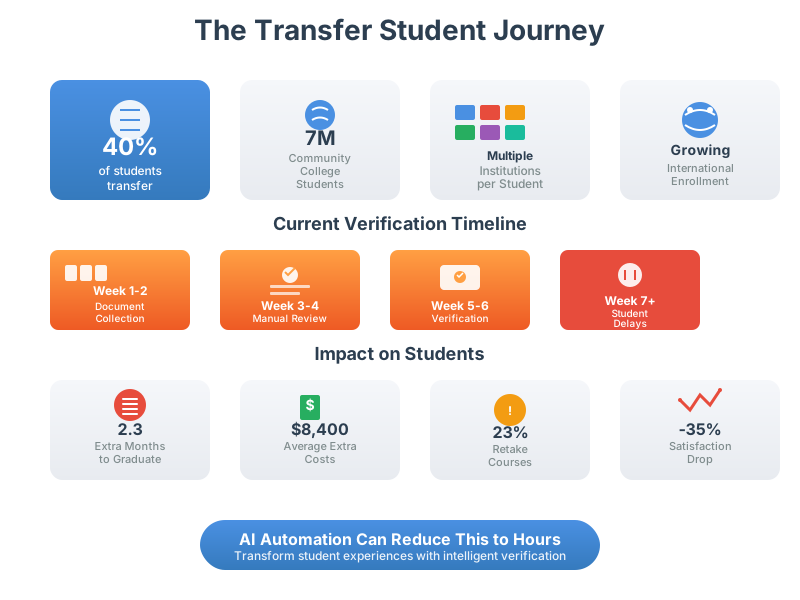
Every transcript tells a story, but deciphering that story requires expertise that most institutions struggle to maintain. A single student might present transcripts from a community college, a four-year university, study abroad programs, and professional certification courses. Each document follows different formatting conventions, uses different terminology for similar concepts, and may include courses that don't have direct equivalents at the receiving institution. Academic evaluators must understand not just what courses were taken, but how they fit into degree requirements, prerequisite structures, and institutional policies.
The international dimension adds another layer of complexity. Students arriving from other countries bring transcripts that may be in different languages, follow unfamiliar educational systems, and represent academic achievements that don't translate directly to American credit systems. The Bologna Process in Europe, the British A-level system, various Asian educational frameworks, and countless other international standards all require specialized knowledge to evaluate accurately. Many institutions rely on external credential evaluation services, adding time, cost, and additional coordination challenges to an already complex process.
Technology has actually made some aspects of the problem worse. While electronic transcripts have eliminated some postal delays, they've also created new challenges around format standardization and system integration. Institutions receive transcripts as PDFs, images, proprietary file formats, and even paper documents that have been scanned with varying degrees of quality. Extracting meaningful data from these diverse formats requires human intervention at every step, creating the bottlenecks that plague current systems.
The financial impact extends beyond administrative costs. Students who can't get credits verified may enroll in courses they don't need, increasing their educational expenses and time to graduation. Institutions lose revenue when students delay enrollment or choose competitors with faster verification processes. The hidden costs include staff overtime, delayed course planning, and the opportunity costs of staff time that could be devoted to more strategic educational initiatives.
The traditional credential verification process reveals why automation has become essential rather than optional. Most institutions still rely on manual review processes that were designed for a different era, when student mobility was lower and transcript formats were more standardized. Understanding these existing processes illuminates both the challenges and the opportunities for intelligent automation.
Academic evaluators typically begin by requesting official transcripts from all institutions a student has attended. This step alone can take days or weeks, depending on the responsiveness of previous institutions and the completeness of student records. Once transcripts arrive, evaluators must manually review each document, course by course, to determine credit equivalencies. This requires deep knowledge of curriculum structures, prerequisite relationships, and institutional policies that may have changed over time.
The evaluation process involves multiple decision points that require both technical knowledge and subjective judgment. Evaluators must determine whether a course from another institution meets specific degree requirements, how many credits to award, and whether prerequisites have been satisfied. They need to understand different grading systems, credit hour calculations, and academic standards to make these determinations accurately. A single transcript might require hours of careful analysis, especially when dealing with international credentials or non-traditional educational experiences.
Documentation requirements add another layer of complexity. Evaluators must maintain detailed records of their decisions, create audit trails for accreditation purposes, and communicate results to multiple stakeholders including students, academic advisors, and financial aid offices. These requirements are essential for institutional accountability but consume significant time and create additional opportunities for errors or inconsistencies.
Quality control presents ongoing challenges in manual systems. Different evaluators may interpret the same transcript differently, leading to inconsistent outcomes for similar situations. Training new staff requires extensive time investment, and experienced evaluators become valuable resources that institutions struggle to retain. The knowledge required for accurate evaluation includes not just current institutional policies but historical information about how requirements and standards have evolved over time.
Communication with students during the evaluation process often lacks transparency. Students may wait weeks without updates, unsure whether their documents have been received, are being processed, or require additional information. This uncertainty affects academic planning, course registration, and financial aid processing. When questions arise, students often struggle to reach knowledgeable staff who can provide specific information about their evaluation status.
The manual process also struggles with peak periods when large numbers of evaluations arrive simultaneously. Transfer admission cycles, semester transitions, and application deadlines create predictable surges in workload that institutions struggle to manage effectively. Temporary staff may lack the expertise for complex evaluations, leading to delays or errors that require additional review cycles.
Technology integration remains limited in most manual systems. Evaluators often work with paper documents or basic PDF viewers, lacking tools for efficient data extraction, comparison, or analysis. Information must be manually entered into student information systems, creating opportunities for transcription errors and requiring additional verification steps. The lack of integrated systems means that evaluation results may not automatically update degree audits, prerequisite tracking, or other academic planning tools.
Artificial intelligence offers transformative solutions that address every major pain point in the credential verification process. Modern AI systems can process documents with accuracy that rivals or exceeds human evaluation while operating at speeds that make real-time verification possible. These systems don't just digitize existing processes but fundamentally reimagine how credential verification can work in the digital age.
Optical Character Recognition (OCR) technology has evolved far beyond simple text extraction. Today's AI-powered OCR systems can read documents in multiple languages, understand complex formatting, and extract structured data from unstructured sources. They can process handwritten notations, handle poor scan quality, and recognize text embedded in tables or other complex layouts. These capabilities mean that transcripts in virtually any format can be automatically processed without manual data entry.
Natural Language Processing (NLP) enables AI systems to understand the meaning behind the text they extract. Course titles, descriptions, and institutional information can be analyzed for semantic meaning rather than just keyword matching. This allows for more sophisticated course mapping that considers not just similar names but similar content and learning objectives. NLP systems can identify equivalent courses even when they have different titles or are offered by different departments.
Machine learning algorithms improve verification accuracy over time by learning from human evaluator decisions. These systems can identify patterns in course equivalencies, understand institutional preferences, and adapt to policy changes. They can flag unusual situations for human review while automatically processing routine evaluations. The learning capability means that AI systems become more effective and efficient as they process more transcripts.
Document classification capabilities allow AI systems to automatically categorize and route different types of academic documents. Official transcripts, course catalogs, degree audits, and other supporting documents can be identified and processed according to their specific requirements. This automation eliminates much of the manual sorting and organization that consumes evaluator time in traditional processes.
Integration capabilities enable AI systems to work seamlessly with existing institutional technology infrastructure. Student information systems, degree audit tools, and academic planning platforms can receive verified credit information automatically, updating student records in real-time. This integration eliminates the delays and errors associated with manual data entry while ensuring that evaluation results are immediately available to students and advisors.
Quality assurance features built into AI systems provide confidence that automated evaluations meet institutional standards. These systems can flag evaluations that fall outside normal parameters, identify potential conflicts or inconsistencies, and maintain detailed audit trails of all decisions. Human oversight remains important, but AI systems can focus human attention on the cases that truly require expert judgment.
The scalability of AI systems addresses the volume challenges that overwhelm manual processes. These systems can process hundreds or thousands of transcripts simultaneously without degrading performance or accuracy. Peak periods that create crisis situations in manual systems become routine processing loads for well-designed AI systems.
Artificio's intelligent document processing platform represents a new generation of AI technology specifically designed for the complex requirements of academic credential verification. While basic OCR systems can extract text from documents, Artificio's approach combines multiple AI technologies to create a comprehensive solution that understands context, maintains accuracy, and integrates seamlessly with institutional workflows.
The foundation of Artificio's system lies in advanced OCR technology that can handle the diverse document formats common in academic environments. International transcripts, multiple languages, varying paper qualities, and complex formatting all present challenges that basic OCR systems struggle to manage. Artificio's OCR engine uses deep learning models trained specifically on academic documents, enabling it to recognize not just individual characters but the structure and meaning of academic records.
Document classification represents a crucial capability that sets Artificio apart from generic document processing solutions. Academic institutions receive hundreds of different document types, from official transcripts and course catalogs to degree audits and certification records. Artificio's AI can automatically identify document types, understand their relationships to each other, and route them through appropriate processing workflows. This classification capability eliminates the manual sorting that consumes significant time in traditional processes.
Named Entity Recognition (NER) technology enables Artificio's system to identify and extract specific types of information from unstructured text. Course numbers, credit hours, grades, institutional names, and other critical data points can be automatically identified and extracted regardless of document formatting. This capability works across multiple languages and educational systems, making it particularly valuable for institutions with diverse student populations.
Data validation features ensure that extracted information meets quality standards before being processed further. Artificio's system can verify that credit hours fall within expected ranges, grades follow institutional standards, and course information includes required components. These validation checks catch errors early in the process, preventing downstream problems and ensuring data integrity. 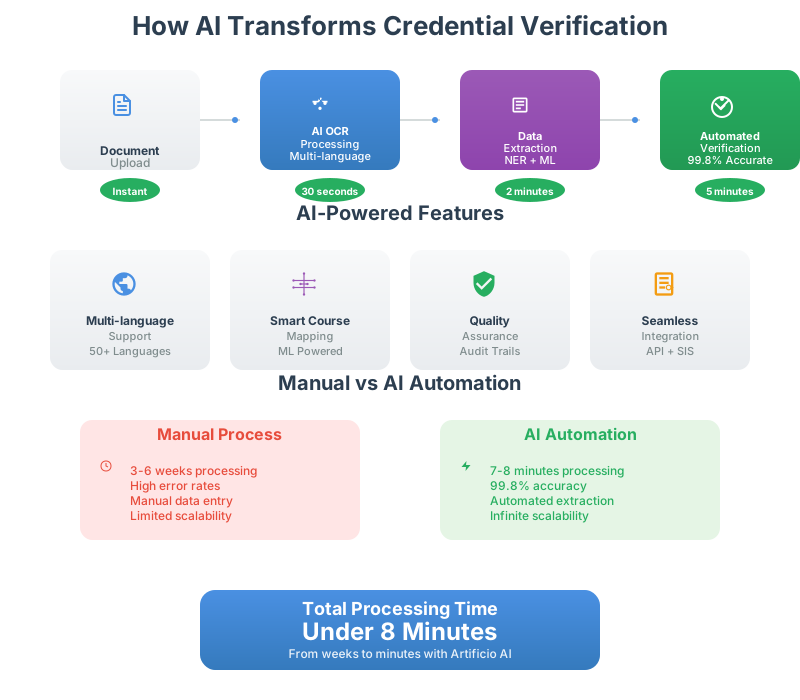
The platform's course mapping capabilities represent perhaps its most sophisticated feature. Using machine learning algorithms trained on millions of course descriptions and institutional catalogs, Artificio can identify equivalent courses across different institutions even when they have different titles or numbering systems. This mapping considers not just course names but learning objectives, content areas, and prerequisite structures. The system learns from human evaluator decisions to improve mapping accuracy over time.
Integration capabilities ensure that Artificio's platform works seamlessly with existing institutional technology infrastructure. APIs and standard data formats enable direct connection to student information systems, learning management platforms, and other academic technology tools. This integration means that verified credits automatically update student records, degree audits, and academic planning tools without manual intervention.
Workflow management features provide institutions with flexibility in how they implement automated verification. Different document types can follow different approval workflows, specific courses can be flagged for human review, and institutional policies can be encoded into the system logic. This flexibility ensures that automation enhances rather than replaces human expertise where it's most valuable.
Quality assurance and audit trail capabilities provide transparency and accountability throughout the verification process. Every decision made by the AI system is logged and documented, creating comprehensive records for accreditation and compliance purposes. Human reviewers can see exactly how decisions were made and can override or modify automated recommendations when necessary.
The system's learning capabilities mean that it becomes more effective over time as it processes more documents and learns from institutional preferences. Machine learning algorithms identify patterns in evaluator decisions, understand policy nuances, and adapt to changing requirements. This continuous improvement ensures that automated verification becomes increasingly accurate and aligned with institutional standards.
The transformation from manual to automated credential verification produces measurable benefits that extend throughout educational institutions. Early adopters of AI-powered verification systems report dramatic improvements in processing times, accuracy rates, and student satisfaction. These improvements translate directly into operational efficiencies and enhanced educational experiences.
Processing time reduction represents the most immediately visible benefit of automated verification. Institutions report reducing average evaluation times from weeks to days or even hours, depending on the complexity of the evaluation. Simple domestic transfers that previously required several days of evaluator time can now be processed automatically in minutes. Even complex international evaluations that might have taken weeks can be completed in days when AI handles the initial processing and data extraction.
Accuracy improvements come from eliminating human errors in data transcription and calculation while maintaining consistency in evaluation decisions. AI systems don't suffer from fatigue, distraction, or subjective interpretation that can affect human evaluators. They apply institutional policies consistently across all evaluations and can flag potential issues for human review. Institutions report significant reductions in evaluation errors and the costly correction processes they require.
Student satisfaction increases dramatically when verification delays are eliminated. Students can register for courses sooner, plan their academic paths more effectively, and reduce uncertainty about their degree completion timeline. The ability to provide real-time status updates throughout the verification process further enhances the student experience. Students no longer need to wait weeks without information about their evaluation progress.
Staff productivity improvements allow institutions to reallocate human resources to higher-value activities. Experienced evaluators can focus on complex cases that require human judgment while AI handles routine evaluations automatically. This shift enables institutions to provide better service without increasing staff costs. Professional development opportunities expand when staff members are freed from repetitive tasks to engage in more strategic work.
Financial benefits accumulate from multiple sources including reduced processing costs, faster student enrollment, and improved resource utilization. Institutions can handle larger volumes of transfer students without proportional increases in evaluation staff. Students complete their degrees faster when they don't lose credits to verification delays, improving institutional completion rates and outcomes metrics.
One notable implementation at a major state university system demonstrated the power of automated verification at scale. Facing a backlog of over 5,000 pending evaluations, the institution implemented Artificio's platform to process routine domestic transfers automatically. Within six months, the backlog was eliminated, average processing times dropped from 3-4 weeks to 2-3 days, and student satisfaction scores improved by over 40%. The same staff that had been overwhelmed by routine evaluations was able to focus on complex international credentials and policy development.
A community college serving a large population of working adults and military personnel found that automated verification particularly benefited non-traditional students. These students often have complex educational backgrounds including military training, professional certifications, and coursework from multiple institutions. Manual evaluation of these diverse credentials was time-consuming and inconsistent. Automated processing not only reduced evaluation times but improved accuracy by ensuring that all relevant experience was properly considered and documented.
International credential evaluation presents particular challenges that AI automation addresses effectively. A private university with significant international enrollment implemented automated processing for routine European transcripts while maintaining human review for complex cases. The system's ability to understand different grading systems and credit structures enabled accurate evaluations without requiring specialized expertise from every evaluator. Processing times for European transcripts dropped from weeks to days while maintaining high accuracy standards.
The cumulative effect of these improvements creates positive feedback loops that benefit entire institutional ecosystems. Faster verification enables better academic planning, which improves student outcomes and institutional metrics. Reduced administrative burdens free resources for student support services and academic program development. Improved data quality enables better institutional research and decision-making.
Successfully implementing AI-powered credential verification requires careful planning, appropriate technical infrastructure, and change management strategies that ensure smooth transitions from manual processes. Institutions considering automation need to understand both the technical requirements and the implementation challenges they'll face during the transition.
Infrastructure requirements for AI-powered verification systems are generally modest compared to other institutional technology initiatives. Cloud-based platforms like Artificio's eliminate the need for significant on-premise hardware investments while providing scalability that matches institutional needs. Standard internet connectivity and modern web browsers are typically sufficient for user access, though integration with existing systems may require additional technical coordination.
Data security and privacy considerations are paramount when implementing automated verification systems. Academic records contain sensitive personal information that must be protected according to FERPA requirements and institutional policies. Artificio's platform includes enterprise-grade security features including encryption, access controls, and audit logging that meet or exceed institutional requirements. Regular security assessments and compliance monitoring ensure ongoing protection of sensitive data.
Integration planning represents a critical success factor for automated verification implementations. Most institutions operate complex technology ecosystems that include student information systems, learning management platforms, degree audit tools, and other specialized applications. Successful automation requires careful coordination to ensure that verified credit information flows seamlessly between systems without disrupting existing workflows. 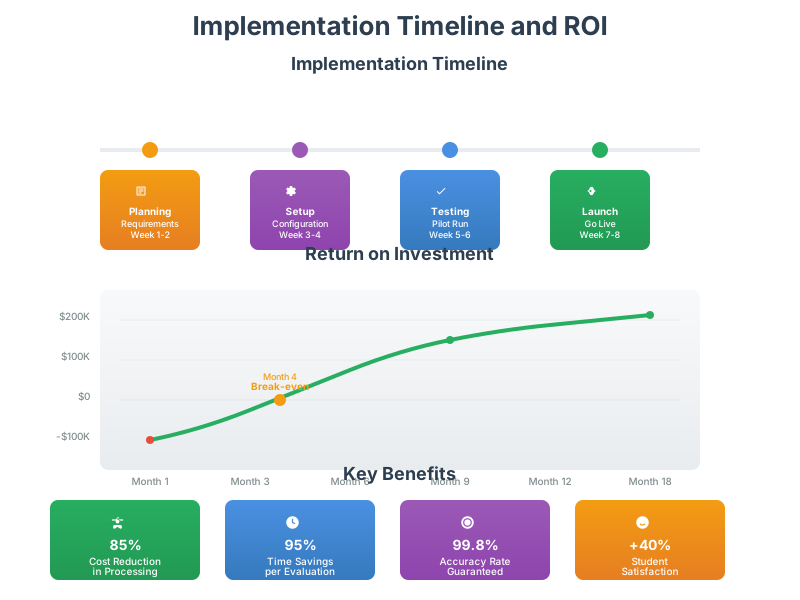
Change management strategies must address both technical and cultural aspects of transitioning from manual to automated processes. Staff members who have performed manual evaluations for years may need training and support to work effectively with AI-powered systems. Clear communication about how automation enhances rather than replaces human expertise helps build buy-in from key stakeholders.
Training requirements vary depending on institutional size and complexity but generally focus on system operation rather than technical implementation. Registrar staff need to understand how to review automated recommendations, override system decisions when necessary, and maintain quality standards. Technical staff require training on system administration, integration management, and troubleshooting procedures.
Pilot implementation strategies allow institutions to test automated verification on a subset of evaluations before full deployment. Starting with routine domestic transfers enables staff to become familiar with the system while processing lower-risk evaluations. Gradual expansion to more complex evaluation types allows for refinement of workflows and identification of edge cases that require special handling.
Performance monitoring during implementation ensures that automated systems meet institutional standards and expectations. Key metrics include processing times, accuracy rates, user satisfaction, and system reliability. Regular review of these metrics enables continuous improvement and early identification of issues that require attention.
Quality assurance procedures must evolve to accommodate automated processing while maintaining institutional standards. Rather than reviewing every evaluation in detail, quality assurance can focus on sampling automated decisions, monitoring system performance metrics, and ensuring that human oversight occurs where it's most valuable. Statistical quality control methods can provide confidence in system performance while reducing review burdens.
Scalability planning ensures that automated systems can handle growth in evaluation volumes without degrading performance. Cloud-based platforms provide natural scalability, but institutions need to plan for peak processing periods and ensure that integration points can handle increased data flows. Capacity planning should consider both current volumes and projected growth over several years.
Ongoing maintenance and support requirements are typically minimal for cloud-based automation platforms but still require institutional planning. Regular system updates, user training, and performance optimization should be built into operational procedures. Vendor support relationships become important for troubleshooting technical issues and implementing new features.
Cost-benefit analysis for automated verification implementations typically shows positive returns within the first year of operation. Reduced staff time, faster processing, and improved student satisfaction combine to create quantifiable benefits that exceed implementation and operating costs. Long-term benefits include improved institutional capacity, better data quality, and enhanced competitive positioning.
The transformation of credential verification through AI automation represents just the beginning of a broader evolution in how academic achievements are documented, verified, and transferred between institutions. Emerging technologies and changing educational models are creating new opportunities and challenges that will shape the future of academic credentialing.
Blockchain technology offers promising solutions for creating tamper-proof academic records that can be verified instantly without relying on institutional intermediaries. Digital credentials stored on blockchain networks could eliminate many of the delays and complexities associated with current transcript systems. Students could maintain complete control over their academic records while providing instant verification to any institution or employer. However, widespread adoption requires coordination across thousands of institutions and significant changes to existing credentialing practices.
Digital badges and micro-credentials are creating new categories of academic achievement that don't fit traditional transcript models. Professional certifications, online course completions, and competency-based assessments generate credentials that need to be verified and evaluated alongside traditional coursework. AI systems must evolve to understand these new credential types and integrate them into comprehensive academic evaluations.
Competency-based education models challenge traditional credit hour systems by focusing on demonstrated mastery rather than time spent in class. These models require more sophisticated evaluation systems that can assess student capabilities across different institutions and learning modalities. AI systems capable of analyzing competency frameworks and mapping achievements across different assessment approaches will become increasingly important.
International education mobility continues to expand, creating demand for verification systems that understand diverse educational systems and standards. AI systems must develop more sophisticated understanding of international qualifications, cultural contexts, and educational frameworks. Machine learning models trained on global educational data will enable more accurate cross-cultural credential evaluation.
Real-time verification capabilities will become standard expectations as technology enables instant processing of most routine evaluations. Students will expect immediate feedback on transfer credit potential, course equivalencies, and degree completion timelines. Institutions that can provide real-time verification will gain competitive advantages in attracting transfer students and improving educational planning.
Predictive analytics will enable institutions to anticipate verification challenges and optimize their systems proactively. AI systems that can analyze incoming student populations, predict evaluation complexities, and recommend process improvements will help institutions maintain high service levels while managing costs effectively. These systems could also help students make more informed transfer decisions by predicting how their credits will transfer to different institutions.
Integration with artificial intelligence tutoring and academic planning systems will create comprehensive educational ecosystems where credential verification is just one component of personalized educational experiences. AI systems that understand student academic histories, career goals, and learning preferences can provide sophisticated guidance that extends far beyond simple credit evaluation.
The convergence of credentialing with employment and professional development will require verification systems that understand workplace learning, professional experience, and career-relevant skills. AI systems must evolve to evaluate not just formal academic credentials but the full spectrum of learning experiences that contribute to professional competency.
The crisis in higher education credential verification demands immediate action, but the solutions now available through AI automation offer hope for transformation rather than just incremental improvement. Institutions that embrace intelligent automation can eliminate the bottlenecks that have plagued transfer students while freeing human expertise to focus on the complex cases and strategic initiatives that truly require professional judgment.
The technology exists today to automate the vast majority of credential verification tasks while maintaining the accuracy and rigor that academic integrity demands. Platforms like Artificio's represent mature solutions that can be implemented quickly and integrated seamlessly with existing institutional technology. The question facing educational leaders is not whether automation is possible, but how quickly they can implement it to serve their students better.
The benefits extend far beyond operational efficiency. Automated verification enables new models of educational mobility where students can move seamlessly between institutions, accumulate credits from diverse sources, and complete their educational goals without artificial barriers. This flexibility becomes increasingly important as education becomes more personalized, competency-focused, and responsive to rapid changes in workforce requirements.
Institutions that act now to implement automated verification will gain competitive advantages that compound over time. Faster processing attracts more transfer students, improves student satisfaction, and enhances institutional reputation. The operational efficiencies create resources that can be invested in student support services, academic program development, and other strategic initiatives that drive institutional success.
The transformation requires commitment from institutional leadership, investment in appropriate technology, and change management strategies that help staff adapt to new workflows. But the examples of successful implementations demonstrate that these challenges are manageable and the benefits are substantial. Early adopters report not just improved efficiency but fundamentally better experiences for students and staff.
The future of higher education depends partly on institutions' ability to adapt to changing student needs and expectations. Transfer students represent a growing segment of the student population, and their success depends significantly on how effectively institutions can evaluate and recognize their previous academic achievements. Automated credential verification provides the foundation for this success by eliminating barriers that have historically impeded educational mobility.
As artificial intelligence continues to evolve, the capabilities of automated verification systems will expand to address even more complex evaluation challenges. Institutions that begin this transformation now will be best positioned to take advantage of these advancing capabilities while building the operational expertise needed to maximize their benefits.
The choice facing higher education leaders is clear. They can continue struggling with manual processes that can't keep pace with student needs, or they can embrace automation technologies that transform credential verification from a bottleneck into a competitive advantage. The students waiting for their credits to be evaluated deserve better than the current system can provide. The technology to deliver that better experience is available now, and institutions that act decisively will lead the transformation of academic credentialing for the digital age.
The transfer credit crisis has reached a tipping point where traditional solutions are no longer adequate. Artificial intelligence offers the tools needed to solve this crisis comprehensively while creating foundations for more responsive, flexible, and student-centered approaches to academic credentialing. Institutions that embrace this transformation will not only solve immediate operational challenges but position themselves as leaders in the evolving landscape of higher education.

Head IT Operations - Co Founder of Artificio
See it in your SAP environment
Bring us a document, a process, or a bottleneck. We'll show how Artificio captures, validates, and posts into SAP — then scale from there.
Security & compliance
ISO 27001:2013 certified, SOC 2 Type 2 compliant, GDPR and HIPAA ready. Every agent action is logged, auditable, and runs in isolated environments.