

Blog
Revolutionizing Education Administration: AI for Education
Discover Artificio's AI-driven tools for education. Automate tasks, improve data, and empower your institution.

Blog
Discover Artificio's AI-driven tools for education. Automate tasks, improve data, and empower your institution.
Educational institutions worldwide face unprecedented challenges in managing the vast quantities of data, documents, and communications essential to their operations. From processing thousands of applications and maintaining student records to generating personalized reports and facilitating timely communication with stakeholders, these administrative tasks consume significant resources while diverting attention from the core mission of education itself. Traditional approaches to these challenges characterized by manual data entry, paper-based processes, and disconnected systems are increasingly proving inadequate in today's digital-first environment.
The education sector's need for digital transformation has become particularly acute in recent years. Research from the Education Technology Association indicates that educational institutions spend, on average, 30% of their administrative budgets on document processing and data management tasks. Moreover, a 2024 survey conducted across 500 educational institutions revealed that administrative staff spend approximately 15 hours per week on manual data entry and document handling activities time that could otherwise be allocated to student engagement and educational innovation.
Artificio, a pioneer in artificial intelligence and machine learning solutions, has developed a comprehensive suite of AI-driven tools specifically designed to address these challenges within the educational context. By leveraging cutting-edge technologies such as natural language processing, computer vision, and predictive analytics, Artificio's platform offers educational institutions an opportunity to fundamentally transform their administrative operations, enhance data accuracy, and improve overall efficiency.
This article explores the extensive capabilities of Artificio's educational tools, examining how these technologies can streamline administrative workflows, enhance communication, and support data-driven decision-making across all levels of educational institutions from primary schools to universities and educational organizations. Through detailed analysis of each key component of the Artificio platform, we aim to provide educational administrators, IT specialists, and decision-makers with a comprehensive understanding of how AI-driven solutions can address the specific challenges facing their institutions.
At the heart of educational administration lies the continuous processing of documents application forms, transcripts, certificates, consent forms, attendance records, and countless other paper-based artifacts that collectively form the administrative backbone of any educational institution. Artificio's Intelligent Document Processing (IDP) system represents a transformative approach to managing this document ecosystem.
While traditional Optical Character Recognition (OCR) technology has been available for decades, Artificio's IDP system goes far beyond simple text extraction. The system employs a sophisticated multi-layered approach that combines computer vision, natural language processing, and machine learning to understand document context, identify relevant data points, and extract information with unprecedented accuracy.
As illustrated in Figure 1, Artificio's IDP system employs a comprehensive workflow that begins with document classification and progresses through increasingly refined stages of analysis and extraction.
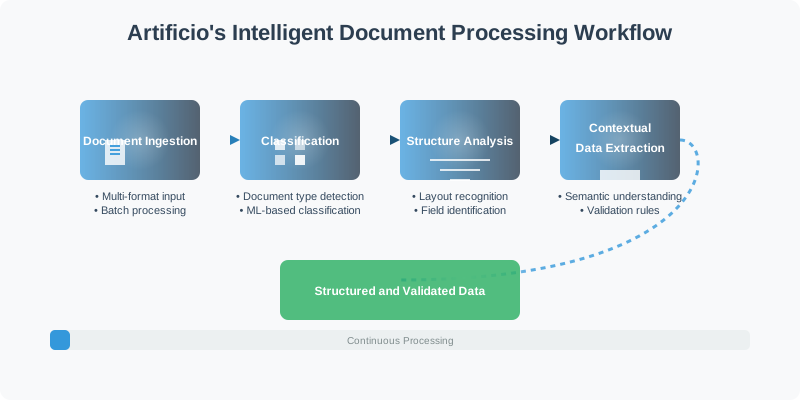
The process begins with initial document classification, where the system automatically identifies document types distinguishing, for example, between application forms, medical records, permission slips, or grade reports. This classification is achieved through a combination of visual layout analysis and content examination, with accuracy rates exceeding 98% for pre-trained document types and 95% for novel documents after minimal training examples.
Following classification, the system proceeds to structural analysis, identifying key elements such as headers, tables, form fields, and signatures. This structural understanding provides the contextual framework necessary for accurate data extraction. Rather than simply recognizing text, Artificio's IDP understands the relationship between text elements and their significance within the document.
The core value of Artificio's IDP system lies in its ability to extract data contextually. For example, when processing a student application form, the system not only identifies a name or date but understands that "John Smith" represents the applicant's name and "09/15/2007" represents their date of birth. This contextual understanding enables the system to map extracted data directly to the appropriate fields in educational databases or management systems.
Moreover, Artificio's IDP employs sophisticated validation mechanisms to ensure data accuracy. The system can:
For educational institutions processing thousands of documents annually, these capabilities translate into substantial time savings and error reduction. Case studies conducted at Westfield Community College demonstrated that implementation of Artificio's IDP system reduced document processing time by 78% while simultaneously decreasing data entry errors by 92%.
Educational institutions deal with numerous complex document types that present unique challenges for automated processing. Artificio's IDP system has been specifically designed to handle these complexities:
Handwritten Documents: Using advanced handwriting recognition algorithms, Artificio can process handwritten forms and notes with accuracy rates approaching 90% significantly higher than industry averages. This capability is particularly valuable for processing examination papers, feedback forms, and other documents that frequently contain handwritten elements.
Multi-language Documents: Educational institutions increasingly serve diverse populations with varying language needs. Artificio's IDP system supports over 25 languages, allowing institutions to process documents in multiple languages without requiring separate workflows or specialized staff.
Complex Tables and Structured Data: Academic transcripts, grade reports, and curriculum documents often contain complex tables and structured data. Artificio's advanced table detection and extraction capabilities ensure that these structured elements are accurately processed and their relationships preserved.
Variable-Format Documents: Unlike industries with highly standardized documentation, educational institutions often deal with documents whose format varies significantly from institution-specific transcripts to individualized education plans. Artificio's adaptable extraction models can adjust to these variations with minimal training.
The combination of these capabilities enables educational institutions to process virtually any document type they encounter, creating a unified digital repository of information that can be easily accessed, analyzed, and integrated with other systems.
While document processing addresses the challenge of handling existing documents, educational institutions must also create, distribute, and manage a wide variety of forms and applications from enrollment forms and scholarship applications to staff evaluations and event registrations. Traditionally, creating these forms required technical expertise or costly custom development, limiting institutions' ability to rapidly adapt to changing needs or implement process improvements.
Artificio's AI-Driven Form and Application Builder fundamentally transforms this aspect of educational administration by democratizing form creation and management, making these capabilities accessible to non-technical staff across the institution.
The Form and Application Builder features an intuitive drag-and-drop interface that allows users to easily create sophisticated forms without coding knowledge. However, unlike conventional form builders, Artificio's solution incorporates AI at every level of the form creation and management process, as depicted in Figure 2.

The system's AI capabilities begin at the design stage, where intelligent templates and design recommendations help users create effective forms. The system analyzes the form's purpose and content to suggest appropriate fields, validation rules, and layouts based on best practices and historical performance data. For example, when creating a student application form, the system might recommend specific field arrangements that have historically resulted in higher completion rates or suggest validation rules that have reduced common errors.
A particularly valuable feature of Artificio's Form Builder is its smart field recognition and data mapping capability. When creating forms, the system automatically recognizes common educational data fields and suggests appropriate validation rules, format requirements, and database mappings. This intelligence extends to understanding the semantic relationships between fields, enabling the system to:
These capabilities not only streamline form creation but also ensure data consistency and reduce the likelihood of validation errors or integration issues.
Perhaps the most innovative aspect of Artificio's Form Builder is its ability to adapt forms dynamically based on user behavior and input patterns. The system continuously analyzes user interactions with forms, identifying points of confusion, abandonment, or frequent errors. Based on this analysis, the system can recommend form modifications or automatically implement adjustments to improve user experience and completion rates.
For instance, if the system detects that many users are abandoning a scholarship application at a particular section, it might suggest simplifying that section or providing additional clarifying instructions. Similarly, if users frequently enter data in an incorrect format despite validation rules, the system might suggest modifying the field label or providing an example input.
This continuous improvement cycle ensures that forms evolve to meet user needs, resulting in higher completion rates and improved data quality. At Eastridge Community College, implementation of Artificio's adaptive form technology increased application completion rates by 37% and reduced the average time to complete applications by 42%.
Artificio's Form Builder seamlessly integrates with broader educational workflows through its robust API connections and pre-built integrations with popular educational management systems. Forms can trigger automated workflows, such as approval processes, follow-up communications, or data synchronization with other systems.
For example, a student enrollment form might automatically initiate the following sequence:
This integration capability ensures that forms are not isolated tools but integral components of efficient administrative workflows.
Educational institutions generate countless documents throughout the academic year transcripts, certificates, personalized learning plans, progress reports, and official communications. Traditionally, creating these documents has been a labor-intensive process involving manual data entry, formatting, and quality control checks. Artificio's Dynamic PDF Generation system transforms this process by automating the creation of sophisticated, personalized documents.
The foundation of Artificio's Dynamic PDF Generation system is its template engine, which allows institutions to create professional document templates that can be automatically populated with personalized data. These templates can include:
The template system supports multiple document types and formats, ensuring that all institutional communications maintain a consistent professional appearance while incorporating necessary personalization.
Creating meaningful educational documents often requires aggregating and contextualizing data from multiple sources. Artificio's system excels at this intelligent data aggregation, pulling relevant information from various databases and systems to create comprehensive documents.
For example, when generating a student progress report, the system might:
This aggregation capability ensures that documents provide comprehensive, accurate information without requiring manual compilation by administrative staff.
Beyond simply populating templates with data, Artificio's system employs natural language generation to create contextual narratives that interpret and explain the data in meaningful ways. This capability is particularly valuable for educational documents, where raw data often requires interpretation to be meaningful to students and parents.
For instance, rather than simply showing that a student achieved a score of 85% on an assessment, the system might generate text explaining: "Sarah has demonstrated strong proficiency in algebraic concepts, scoring 85% on the mid-term assessment. This represents a 7% improvement from the previous assessment and places her in the upper quartile of her peer group."
This narrative generation transforms raw data into meaningful insights, enhancing the value of educational documents and reducing the burden on teachers and administrators to provide this contextual interpretation manually.
Once documents are generated, Artificio's system manages their distribution through multiple channels email, secure portal access, or integration with other communication platforms. The system also provides comprehensive tracking capabilities, allowing institutions to monitor document delivery, access, and engagement.
This tracking functionality is particularly valuable for important administrative documents that require timely review or action. The system can automatically send reminders when documents haven't been accessed or when required actions haven't been completed, ensuring that critical communications achieve their intended purpose.
At Hillcrest Academy, implementation of Artificio's Dynamic PDF Generation system reduced the time required to create and distribute quarterly progress reports from an average of 3.5 days to less than 4 hours, while simultaneously improving report quality and consistency.
Effective communication lies at the heart of successful educational institutions. Faculty, staff, students, parents, alumni, and community partners all require timely, relevant information to engage meaningfully with the institution. However, managing this complex web of communications presents significant challenges for administrators already burdened with numerous responsibilities. Artificio's Automated Communication system addresses these challenges by leveraging AI to deliver personalized, timely, and relevant communications at scale.
Traditional communication approaches in educational settings often relied on generic mass emails or one-size-fits-all announcements that failed to address the specific needs and interests of diverse stakeholders. Artificio's system transforms this paradigm by enabling true personalization at scale.
The system accomplishes this through sophisticated audience segmentation and content personalization engines. Using data extracted from institutional systems and behavioral analytics, the platform can segment audiences based on numerous factors:
Based on these segments, the system generates highly targeted communications that address the specific needs and interests of each recipient. As Figure 3 illustrates, this personalization extends beyond simple name insertion to include truly individualized content, recommendations, and calls to action.
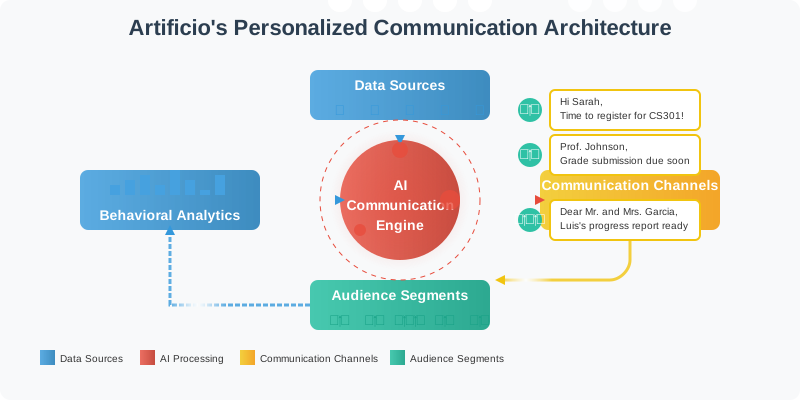
What distinguishes Artificio's communication system is its contextual intelligence its ability to understand not just who should receive a communication, but when, how, and with what specific content. This intelligence is powered by:
Behavioral Analysis: The system analyzes patterns in user engagement with previous communications to identify optimal delivery times, preferred channels, and content formats that generate the highest engagement rates for different audience segments.
Semantic Understanding: Using natural language processing, the system understands the semantic content of communications, enabling it to maintain consistent messaging across multiple touchpoints while avoiding redundancy.
Predictive Modeling: The system employs predictive algorithms to anticipate information needs based on academic calendars, student progression patterns, and historical communication data.
For example, rather than sending a generic reminder about registration deadlines to all students, the system might:
While Artificio's system automates much of the communication process, it maintains appropriate human oversight through a sophisticated approval and monitoring system. The platform allows institutions to establish multi-level approval workflows for different communication types, ensuring that sensitive or high-stakes communications receive appropriate review before distribution.
Additionally, the system's analytics dashboard provides comprehensive insights into communication effectiveness, allowing administrators to monitor:
These analytics enable continuous improvement of communication strategies, with the system automatically incorporating successful approaches into future communications while suggesting modifications to less effective strategies.
Recognizing that effective communication often requires a multi-channel approach, Artificio's system coordinates messaging across email, SMS, mobile app notifications, web portal announcements, and even integration with social media platforms. This coordination ensures consistent messaging across channels while respecting user preferences for how they receive different types of information.
Importantly, the system maintains a comprehensive communication history for each recipient, ensuring that follow-up communications build appropriately on previous interactions. This capability is particularly valuable in complex administrative processes that require multiple touchpoints, such as application processes, financial aid verification, or academic intervention programs.
Educational institutions typically operate numerous specialized systems student information systems, learning management platforms, financial management software, alumni databases, and many others. These siloed systems often create significant challenges for data consistency, process efficiency, and comprehensive analytics. Artificio's Data Integration capabilities directly address these challenges, creating seamless information flow across institutional systems.
While many integration platforms offer basic API connections between systems, Artificio's integration approach goes significantly further. The platform employs a sophisticated semantic data model that understands the meaning and relationships of data across different systems, enabling intelligent mapping and transformation of information as it moves between platforms.
This semantic understanding allows the system to:
For institutions with legacy systems or limited integration capabilities, Artificio also offers advanced screen scraping and robotic process automation tools that can extract data from web interfaces or desktop applications that lack formal APIs.
Artificio's integration platform operates on a real-time, event-driven architecture that ensures timely data updates across systems. Rather than relying solely on scheduled batch processes, the system recognizes significant events in connected systems and triggers appropriate data movements or processes in response.
For example, when a student submits a change of major form through Artificio's form builder, the system might:
This event-driven approach ensures that changes propagate quickly across systems, maintaining data consistency and enabling timely responses to important administrative events.
Recognizing the critical importance of data quality in educational settings, Artificio's integration platform incorporates robust data governance and quality management capabilities. The system:
These governance capabilities are particularly valuable for ensuring compliance with regulatory requirements such as FERPA in the United States or GDPR in Europe, which impose strict standards for the handling of student data.
Perhaps the most powerful aspect of Artificio's integration platform is its ability to enable unified analytics across previously disconnected systems. By maintaining a comprehensive data lake that aggregates information from all connected platforms, the system allows institutions to develop holistic insights that were previously impossible to obtain.
For example, an institution might analyze:
The power of this unified analytics capability extends beyond operational improvements to support strategic institutional goals such as improving student success, optimizing resource allocation, and demonstrating institutional effectiveness to accreditors and stakeholders.
Educational institutions process countless documents requiring signatures—from enrollment agreements and financial aid forms to parental consent documents and faculty contracts. Traditional paper-based signature processes create significant administrative burdens, delay critical processes, and often result in incomplete or improperly executed documents. Artificio's Secure and Verified Electronic Signatures system transforms these processes by providing a comprehensive digital signature solution specifically designed for educational contexts.
Electronic signatures in educational settings must satisfy not only general legal requirements but also specific educational regulations such as FERPA in the United States and similar privacy regulations globally. Artificio's signature system is built from the ground up to meet these specialized requirements, ensuring that all signatures are:
The system supports multiple authentication methods to verify signer identity, including email verification, SMS codes, knowledge-based authentication, and integration with institutional single sign-on systems. These options allow institutions to apply appropriate levels of security based on document sensitivity and regulatory requirements.
Educational signature processes often involve multiple signers in specific sequences—for example, a financial aid form might require signatures from the student, parent, financial aid officer, and department administrator in a particular order. Artificio's signature system includes sophisticated workflow automation capabilities that:
These workflow capabilities significantly reduce the administrative burden of tracking signatures and following up on incomplete documents. At Western Community College, implementing Artificio's signature system reduced the average time to complete multi-party agreements from 12 days to less than 2 days, while increasing completion rates by 34%.
Beyond simply collecting signatures, Artificio's system actively manages compliance throughout the signature process. The system:
This proactive approach to compliance significantly reduces the likelihood of improper or incomplete documentation that could create legal or regulatory issues for the institution.
Artificio's signature system provides administrators with complete visibility into signature processes through comprehensive dashboards and analytics. These tools allow institutions to:
Educational institutions make consequential decisions based on the data in their systems from admissions and financial aid awards to academic interventions and strategic planning. Ensuring the accuracy and integrity of this data is essential but increasingly challenging as data volumes grow and sources multiply. Artificio's Data Verification and Anomaly Detection capabilities provide educational institutions with powerful tools to ensure data quality and identify potential issues before they impact operations.
Artificio's verification system applies sophisticated validation rules across multiple dimensions to identify potential data issues. These validations include:
Syntactic Validation: Ensuring that data conforms to expected formats and patterns (e.g., valid email addresses, proper date formats, correctly formatted student IDs)
Semantic Validation: Verifying that data makes logical sense in context (e.g., ensuring that enrollment dates fall within academic terms, that prerequisites are satisfied for course enrollments)
Relational Validation: Confirming that relationships between data elements are maintained (e.g., ensuring that a student assigned to a course section is enrolled in the appropriate academic program)
Historical Validation: Comparing new data against historical patterns to identify potential anomalies (e.g., flagging unusual changes in enrollment patterns or grade distributions)
Cross-system Validation: Verifying consistency of information across different systems (e.g., ensuring that student contact information is consistent between the student information system and learning management platform)
These multi-layered validations are applied not only when data is initially entered but also continuously as data moves between systems and is updated over time.
While rule-based validations catch many data issues, they cannot identify all potential problems, particularly those that involve subtle patterns or complex relationships. Artificio's system complements traditional validation rules with sophisticated machine learning models that detect anomalies that might otherwise go unnoticed.
These models analyze historical data patterns to establish baselines for normal behavior and then identify deviations that might indicate errors, unusual circumstances, or even potentially fraudulent activity. For example, the system might flag:
When potential anomalies are detected, the system can either automatically correct clear errors (with appropriate logging and notification) or route more complex issues to appropriate personnel for review.
Educational data often contains gaps missing fields in student records, incomplete information in applications, or partial responses to surveys. Rather than simply flagging these gaps, Artificio's system employs sophisticated predictive models to suggest likely values for missing data based on available information and historical patterns.
For example, if a student record is missing a home address zip code but includes city and state information, the system can suggest the most likely zip code based on that partial information. Similarly, if demographic information is incomplete on an application, the system can identify likely values based on other available data, flagging these predictions appropriately as system-generated rather than user-provided.
These predictive capabilities help institutions maintain more complete data for analytical purposes while clearly distinguishing between user-provided information and system-generated predictions.
Artificio's verification and anomaly detection system incorporates sophisticated learning loops that continuously improve its accuracy over time. When data corrections are made either automatically by the system or manually by users these corrections are fed back into the underlying models, enhancing their ability to identify similar issues in the future.
This continuous learning approach ensures that the system becomes increasingly effective at identifying potential data issues specific to each institution's unique context and data patterns. At Eastridge University, implementation of Artificio's verification system initially identified data quality issues in approximately 7% of student records. After six months of operation and continuous learning, the system's accuracy in identifying genuine data issues (vs. false positives) improved from 83% to 96%, significantly reducing the manual review burden on administrative staff.
In today's increasingly competitive and accountable educational environment, institutions must leverage their data assets to inform strategic decisions, improve student outcomes, demonstrate institutional effectiveness, and satisfy regulatory requirements. Artificio's Educational Analytics and Reporting capabilities provide a comprehensive framework for transforming raw educational data into actionable insights that drive institutional improvement.
Educational institutions typically generate vast amounts of data across numerous systems from student information systems and learning management platforms to admissions databases and financial systems. Traditionally, these data sources existed in isolated silos, making comprehensive analysis nearly impossible without extensive manual effort.
Artificio's analytics platform fundamentally transforms this landscape by creating a unified data architecture that brings together information from all institutional systems. This unified approach enables analyses that were previously impossible, revealing insights that emerge only when data from multiple domains is examined together.
For example, instead of analyzing student retention data solely through the lens of academic performance, institutions can now incorporate insights from:
This comprehensive view allows institutions to develop nuanced understandings of complex phenomena like student success, identifying previously hidden factors that influence outcomes and opportunities for targeted interventions.
While comprehensive data integration creates powerful analytical possibilities, it also presents challenges for ensuring appropriate access and usability. Artificio's analytics platform addresses these challenges through a sophisticated role-based approach to data access and presentation.
The system provides customized dashboards and reports tailored to the specific needs and authorization levels of different institutional roles:
Executive Leadership: High-level strategic metrics aligned with institutional goals, including trend analyses, benchmarking against peer institutions, and predictive analytics for strategic planning
Academic Departments: Program-specific analytics on student progression, course performance, curriculum effectiveness, and faculty workload
Student Support Services: Early alert indicators for at-risk students, intervention effectiveness metrics, and service utilization analytics
Individual Faculty: Course-level analytics on student engagement, performance patterns, and learning outcome achievement
Students: Personalized dashboards showing academic progress, degree pathway visualization, and recommender systems for courses and support resources
These role-based analytics ensure that each stakeholder receives actionable insights relevant to their specific responsibilities, presented in formats that facilitate understanding and decision-making.
While descriptive analytics (reporting what has happened) provides valuable context, Artificio's platform extends beyond retrospective analysis to include sophisticated predictive and prescriptive capabilities.
Predictive Analytics: The system employs machine learning models to forecast future outcomes based on historical patterns and current data. These predictive capabilities allow institutions to:
Prescriptive Analytics: Beyond simply predicting outcomes, Artificio's system provides prescriptive recommendations for actions that can improve those outcomes. These recommendations are generated through sophisticated simulation models that evaluate the potential impact of different interventions based on historical effectiveness data.
For example, rather than simply identifying a student as at-risk for non-completion, the system might recommend specific interventions based on the particular risk factors present for that student, prioritized according to their historical effectiveness for similar students.
While traditional analytics platforms often require specialized technical knowledge to generate and interpret reports, Artificio's system includes sophisticated natural language interfaces that make complex analytics accessible to non-technical users.
Using natural language processing and generation technologies, the system allows users to:
This natural language capability democratizes access to institutional data, allowing administrators, faculty, and staff throughout the institution to incorporate data-informed approaches into their decision-making without requiring specialized analytical training.
Artificio's analytics platform is designed not simply as a reporting tool but as an engine for continuous institutional improvement. The system incorporates sophisticated feedback loops that track the outcomes of data-informed decisions and interventions, creating an evidence base for what works in the specific institutional context.
For example, when the system recommends a particular intervention for at-risk students, it subsequently tracks the outcomes for students who received that intervention, using this information to refine future recommendations. Similarly, when course schedule changes are made based on enrollment predictions, the system evaluates the accuracy of those predictions and the impact of the scheduling changes, informing future scheduling decisions.
These feedback loops ensure that the institution's use of analytics evolves and improves over time, building an increasingly effective approach to data-informed decision-making tailored to the institution's unique context and goals.
As we have explored throughout this article, Artificio's comprehensive suite of AI-driven tools offers educational institutions a transformative approach to administrative operations. By addressing critical challenges across document processing, form creation, communication, data integration, signature management, data verification, and analytics, Artificio provides a unified platform that can significantly enhance institutional effectiveness and efficiency.
While each component of Artificio's platform offers substantial benefits individually, the true transformative potential emerges from their integration. When these capabilities work together, they create seamless workflows that eliminate redundancies, reduce errors, and enable entirely new approaches to administrative processes.
For example, consider the comprehensive workflow that might support a student application process:
This integrated workflow not only improves operational efficiency but fundamentally enhances the experience for both students and administrative staff, replacing fragmented processes with a cohesive, intelligent approach to educational administration.
While the comprehensive capabilities of Artificio's platform offer transformative potential, successful implementation typically requires a thoughtful, phased approach tailored to each institution's specific needs and readiness. Based on experiences across numerous educational institutions, successful implementation strategies often follow a common pattern:
This phased approach allows institutions to realize incremental benefits while building toward comprehensive transformation, managing change effectively, and ensuring sustainable adoption of new technologies and processes.
As we look to the future of educational administration, Artificio's vision centers not on replacing human administrators but on fundamentally redefining their roles through effective human-AI collaboration. By automating routine tasks, enhancing decision-making with data-driven insights, and providing intelligent assistance for complex processes, AI technologies free administrative personnel to focus on the aspects of their work that most directly impact educational outcomes building relationships, providing personalized support, and addressing unique challenges that require human judgment and creativity.
This collaborative future of educational administration holds the promise of institutions that are simultaneously more efficient and more human-centered where technology handles routine processes with speed and accuracy while human administrators provide the empathy, judgment, and personal connection that remain essential to educational excellence.
As educational institutions navigate the complex challenges of the 21st century from demographic shifts and funding pressures to evolving student needs and workforce demands those that effectively leverage AI-driven solutions like Artificio's platform will be positioned not just to survive but to thrive, delivering educational experiences that are more responsive, more supportive, and more effective in fulfilling their core mission of student success.

Head IT Operations - Co Founder of Artificio
See it in your SAP environment
Bring us a document, a process, or a bottleneck. We'll show how Artificio captures, validates, and posts into SAP — then scale from there.
Security & compliance
ISO 27001:2013 certified, SOC 2 Type 2 compliant, GDPR and HIPAA ready. Every agent action is logged, auditable, and runs in isolated environments.