

Blog
Transforming Academia with Intelligent Document Processing
Explore how Intelligent Document Processing transforms universities, boosting efficiency and student success.

Blog
Explore how Intelligent Document Processing transforms universities, boosting efficiency and student success.
Maria sighs as she joins the queue stretching from the registrar's office. It's her third visit this week, clutching a folder containing her transcript request forms, financial aid documentation, and departmental approvals each requiring separate signatures from different campus offices. Two hours later, she's informed that her scholarship disbursement has been delayed due to a missing endorsement on page four of her application. She'll need to return tomorrow.
Across town, James logs into his university portal, uploads his scholarship renewal documents, and receives an immediate confirmation that everything is in order. The system automatically verifies his academic standing, cross-references his financial information, and routes the necessary approvals through appropriate channels. Within minutes, he receives notification that his funds will be disbursed on schedule.
This stark contrast illustrates the transformative impact of Intelligent Document Processing (IDP) in higher education. While the technological underpinnings of this revolution are sophisticated combining artificial intelligence, machine learning, optical character recognition, and workflow automation the human experience is refreshingly simple: bureaucratic friction gives way to seamless service delivery.
"What we're witnessing is not merely a technological upgrade but a fundamental reimagining of the student-institution relationship," explains Dr. Eleanor Simmons, Chief Information Officer at Westfield State University. "When we implemented our IDP solution, we expected efficiency gains. What we didn't anticipate was how profoundly it would alter student perceptions of administrative interactions from dreaded obligations to nearly invisible background processes."
The implementation of IDP technology creates a virtuous cycle that extends far beyond operational metrics, penetrating the core experiential aspects of academic life for all stakeholders. This integrated ecosystem demonstrates how technological interventions ripple through the organizational culture, ultimately transforming the lived experience of education itself.
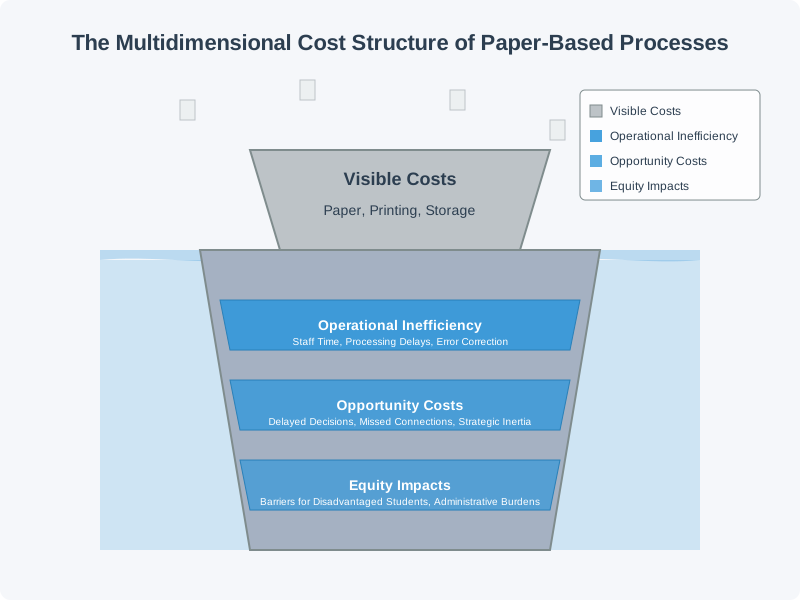
The persistence of paper-based administrative processes in higher education represents more than an operational inefficiency it constitutes what might be termed an "invisible tax" on institutional potential. This tax manifests not only in quantifiable metrics like processing time and storage costs but in the subtle erosion of opportunities for innovation, engagement, and student success.
Consider the cascading consequences of a traditional paper-based admissions process. When admissions officers spend 60-70% of their time on document handling rather than applicant engagement, the institution forfeits invaluable opportunities to attract ideal candidates. When financial aid determinations are delayed by manual processing bottlenecks, students with economic constraints may make attendance decisions based on incomplete information, sometimes choosing against institutions that might have offered competitive packages had the information been processed more expeditiously.
"The true cost of paper isn't captured in operational budgets," notes Dr. Marcus Chen, whose research at the Institute for Educational Technology focuses on administrative friction in higher education. "It's measured in missed connections, delayed decisions, and institutional inertia. When information is trapped in physical documents, it cannot flow to where it's needed most at the moment of maximum impact."
The ramifications extend beyond student recruitment and retention. Research collaborations stall while inter-departmental paperwork navigates physical routing channels. Faculty innovation initiatives wither during protracted approval processes. Community partnerships languish in administrative limbo. In each case, the opportunity cost far exceeds the visible expense of paper-based operations.
This hidden tax is particularly pernicious because it falls disproportionately on institutions and individuals with fewer resources to spare. Elite universities with substantial endowments can afford to hire additional administrative staff to overcome processing backlogs, while mid-tier and regional institutions cannot. Similarly, students from privileged backgrounds possess the social capital and financial flexibility to navigate bureaucratic obstacles, while first-generation and economically disadvantaged students often lack these resources.
The data visualized in Figure 2 reveals the multidimensional impact of this invisible tax across institutional operations. While direct costs like storage and personnel are readily apparent, the secondary and tertiary effects on institutional vitality represent the truly significant burden of paper-dependency.
Intelligent Document Processing offers a pathway to eliminate this hidden tax. By liberating information from physical constraints and enabling its fluid movement throughout institutional systems, IDP creates conditions for responsive, evidence-based decision-making at all levels of university operations. The effect is not merely incremental improvement but transformative change in institutional capacity.
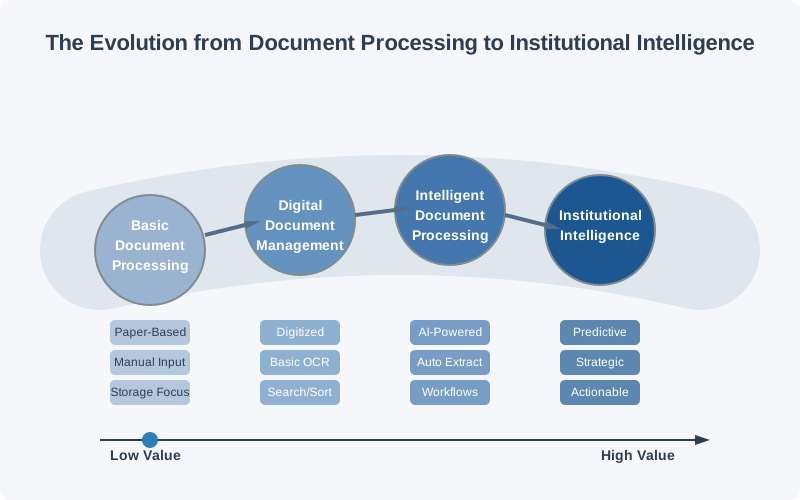
The evolution from traditional document management to intelligent document processing represents a paradigmatic shift in how higher education institutions conceptualize their information ecosystems. This transformation transcends mere operational efficiency, fundamentally reframing institutional data as a strategic asset rather than an administrative burden.
The distinction is profound. Traditional document processing, even when digitized, treats documents primarily as items to be cataloged, stored, and retrieved a logistical challenge to be managed. Intelligent Document Processing, conversely, approaches documents as vessels of valuable data that, when properly extracted, analyzed, and contextualized, yield actionable insights that can drive institutional decision-making across multiple domains.
"We initially implemented our IDP solution to address processing bottlenecks in admissions and financial aid," recounts Dr. Vanessa Rodriguez, President of Eastlake Community College. "Within six months, we recognized that we were sitting on a goldmine of data that could inform everything from curriculum development to facilities planning. The system wasn't just processing forms more efficiently it was generating an entirely new category of strategic intelligence."
This intelligence manifests in multiple dimensions. Longitudinal analysis of course registration patterns reveals emerging student interests before they become apparent through traditional feedback channels. Geographical visualization of applicant data highlights untapped recruitment markets. Temporal mapping of financial aid applications identifies critical intervention points for improving yield rates among admitted students.
The technological underpinnings of this transformation are sophisticated but increasingly accessible. Advanced optical character recognition (OCR) extracts data from structured and unstructured documents with accuracy rates exceeding 98% for most applications. Natural language processing (NLP) algorithms interpret contextual meaning and sentiment, transforming qualitative comments into quantifiable data points. Machine learning systems continuously improve extraction accuracy while identifying correlational patterns that might escape human analysts.
However, the true power of IDP emerges when these technologies are integrated into a cohesive ecosystem that enables cross-functional data utilization. When admissions data flows seamlessly into enrollment management, which feeds into academic planning, which informs financial projections all without manual intervention or data transformation institutions achieve what might be termed "operational intelligence." This state is characterized by data-informed decision-making at all levels of the organization, from strategic planning to day-to-day operations.
Figure 3 illustrates the evolution from document processing to institutional intelligence, highlighting the progressive value creation at each stage of this transformation.
This journey from processing to intelligence requires more than technological implementation; it demands a fundamental reconceptualization of how information flows through academic institutions. Documents cease to be ends in themselves and instead become entry points into an integrated data ecosystem that continuously generates institutional knowledge. In this paradigm, forms, applications, and records are not merely processed they are mined for insights that drive institutional excellence and student success.
The implementation of Intelligent Document Processing in higher education represents more than an administrative upgrade it constitutes a fundamental reimagining of the student journey from initial inquiry to alumni status. This transformation is particularly significant because administrative interactions, while often overlooked in discussions of educational quality, profoundly shape student perceptions of institutional value and commitment to their success.
Consider the traditional student lifecycle in paper-based institutions. Prospective students navigate complex application requirements, often submitting redundant information across multiple forms. Admitted students contend with labyrinthine financial aid processes, frequently discovering documentation issues only after critical deadlines have passed. Enrolled students queue at various administrative offices to register for courses, apply for program changes, or request academic accommodations. Graduating students navigate yet another bureaucratic gauntlet to receive credentials and transition to alumni status.
Each friction point in this journey represents not merely an inconvenience but a moment of potential disengagement a signal to students that their time is not valued and their needs are subordinate to institutional processes. Multiply these moments across thousands of students and years of enrollment, and the cumulative impact on student satisfaction and success becomes substantial.
Intelligent Document Processing fundamentally restructures this experience by placing student needs at the center of administrative design. "The question that drove our implementation wasn't 'How can we process documents more efficiently?' but rather 'How can we make administrative requirements virtually invisible to students?'" explains Dr. Jonathan Winters, Vice President for Student Success at Northern Peninsula University. "We wanted students thinking about their studies, their campus involvement, their career preparation not about form submissions and approval workflows."
This student-centered approach manifests in several transformative capabilities:
Contextual Personalization: Advanced IDP systems recognize returning users and their context, eliminating redundant information requests. When James logs into the financial aid portal to renew his scholarship, the system already understands his academic program, enrollment status, and prior financial arrangements. Rather than requiring comprehensive reapplication, it requests only information that may have changed since his previous submission, such as updated income documentation or changes in dependency status.
Proactive Intervention: By continuously monitoring document status and cross-referencing with institutional timelines, intelligent systems identify potential issues before they impact students. Sophia receives an automated notification that her internship application is missing a departmental endorsement three weeks before the submission deadline not the day after, as might occur in traditional systems.
Multichannel Accessibility: Modern IDP solutions accommodate diverse student needs and preferences through omnichannel document submission and processing. Carlos submits his housing application via smartphone while commuting between his part-time job and evening classes. The system recognizes and processes mobile-captured images with the same accuracy as traditional scanned documents.
Transparent Progression: Students gain unprecedented visibility into administrative processes through intuitive tracking interfaces. Aisha can see precisely where her graduate school application stands in the evaluation process, which components have been reviewed, and when she can expect a decision eliminating uncertainty and anxiety-producing information vacuums.
Integrated Support: When questions or issues arise, contextually aware assistance is immediately available. When Michael encounters confusion about a specific financial aid requirement, the system recognizes his location within the application workflow and connects him with a support specialist who has immediate access to his specific situation, eliminating the need to repeatedly explain his circumstances.
The cumulative effect of these capabilities is a fundamental shift in how students experience the administrative dimension of higher education. The contrast between traditional and IDP-enabled student journeys reveals not merely increased efficiency but qualitative transformation of the student experience across multiple touchpoints.
The implications of this transformation extend far beyond student satisfaction metrics. Research increasingly demonstrates that administrative friction disproportionately impacts retention and completion rates among first-generation, low-income, and non-traditional students precisely the populations many institutions seek to better serve. By removing these barriers, IDP technology becomes a powerful tool for advancing educational equity and institutional mission fulfillment.
While student-facing benefits of Intelligent Document Processing are readily apparent, equally profound transformations occur on the faculty side of the academic equation. The impact on faculty experience and productivity represents one of the most underappreciated dimensions of IDP implementation in higher education.
Professor Andrea Meyers remembers the breaking point that led her university to revolutionize its administrative approach: "I was tracking my time for a semester and discovered I was spending nearly twenty hours monthly on administrative paperwork purchase requests, travel authorizations, research compliance documentation, grade change forms, and endless committee approvals. That's time I wasn't spending mentoring students, advancing research, or improving my courses."
This administrative burden represents a significant opportunity cost for institutions. Faculty members are hired for their disciplinary expertise, teaching abilities, and research potential yet many spend a substantial portion of their professional time navigating complex bureaucratic requirements with low-value administrative tasks. The economic inefficiency is striking: highly compensated knowledge workers performing routine document processing functions that could be automated or streamlined.
More concerning than the economic waste is the impact on core academic functions. Faculty members forced to divide their attention between disciplinary pursuits and administrative requirements inevitably compromise somewhere. Research initiatives advance more slowly. Course innovations remain undeveloped. Student mentoring receives less attention. The cumulative effect is a subtle but persistent degradation of institutional academic quality.
Intelligent Document Processing addresses this challenge through several faculty-oriented innovations:
Administrative Workflow Automation: Routine approval processes that previously required multiple form submissions and physical signatures are transformed into streamlined digital workflows. When Professor Garcia needs to modify his course enrollment cap, a simple digital request automatically routes through appropriate approval channels without requiring tracking or follow-up on his part.
Intelligent Form Completion: Advanced IDP systems recognize context and pre-populate information based on faculty profiles and institutional databases. When preparing a conference travel request, Professor Williams finds that nearly 80% of required fields are already completed based on her department, research account information, and historical travel patterns.
Document Generation and Templating: Rather than creating documents from scratch for routine academic functions, faculty access intelligent templates that incorporate institutional requirements while minimizing input demands. Professor Jones generates comprehensive course syllabi by providing only the unique elements of his course readings, assignment structures, and learning objectives while the system automatically incorporates required institutional policies, academic calendar dates, and accessibility statements.
Centralized Information Access: Faculty no longer need to navigate multiple systems and physical filing locations to access necessary information. Professor Ahmed reviews his advisees' complete academic records through a unified interface that intelligently compiles information from the registrar, financial aid, academic support services, and departmental advising notes.
Analytics and Decision Support: Perhaps most transformatively, faculty receive actionable insights derived from institutional data to inform their academic decision-making. Department Chair Rodriguez reviews automatically generated enrollment trend analyses when planning course offerings, eliminating hours of manual data compilation and analysis.
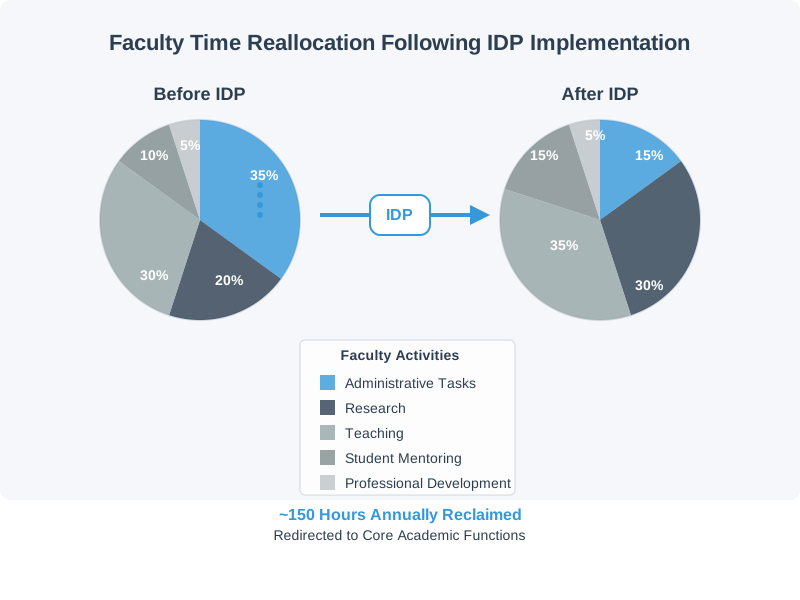
The quantitative impact of these capabilities is substantial. A comprehensive study across twelve institutions implementing advanced IDP solutions found that faculty administrative time decreased by an average of 37%, representing approximately 150 reclaimed hours annually per faculty member. Figure 5 illustrates this redistribution of faculty time and attention across institutions at various stages of IDP implementation.
However, the qualitative dimension of this transformation proves even more significant. Faculty consistently report not merely time savings but a renewed sense of professional focus and purpose. "What I've gained isn't just hours in my week," reflects Professor Thomas after his institution's IDP implementation. "It's the mental space to fully engage with my discipline and my students without the cognitive burden of administrative loose ends constantly pulling at my attention."
This psychological dimension of administrative streamlining warrants greater attention in discussions of academic technology implementation. When faculty members spend less mental energy navigating bureaucratic requirements, they bring greater creativity, engagement, and presence to their core academic functions. The result is a virtuous cycle of enhanced teaching quality, research productivity, and institutional vitality.
Among the most compelling yet underexamined aspects of Intelligent Document Processing in higher education is its potential to advance institutional equity objectives through what might be termed "administrative justice." This framework recognizes that seemingly neutral administrative processes often perpetuate systemic advantages and disadvantages, with profound implications for educational access and success.
Traditional paper-based administrative systems, while ostensibly uniform in their requirements, impose significantly different burdens across student populations. Consider these systemic inequities embedded in conventional processes:
Time Poverty Penalties: Students balancing full-time employment or family care responsibilities face disproportionate challenges when required to visit physical offices during standard business hours. A form submission that represents a minor inconvenience for a traditional student with flexible daytime hours becomes a significant barrier for working adults, single parents, or caregivers.
Navigational Capital Disparities: First-generation college students often lack the institutional knowledge and familial guidance to efficiently navigate complex administrative processes. What appears as straightforward paperwork to continuing-generation students with college-educated parents becomes a bewildering labyrinth for those without this inherited navigational capital.
Documentation Barriers: Requesting official documentation from previous institutions, government agencies, or international entities poses significantly different challenges depending on a student's socioeconomic background, immigration status, or national origin. Some students can easily obtain required records within days; others face months-long processes requiring substantial financial resources.
Language and Accessibility Obstacles: For non-native English speakers or students with certain disabilities, dense administrative language and non-accessible document formats create fundamental barriers to compliance with institutional requirements, irrespective of their academic capabilities or potential.
Financial Friction Points: Even modest processing fees, transcript charges, or document notarization requirements create asymmetric barriers based on students' financial resources. What constitutes a trivial expense for affluent students represents a significant financial calculation for economically vulnerable populations.
These inequities do not typically result from intentional discrimination but rather from administrative systems designed with unstated assumptions about student resources, capabilities, and circumstances. The cumulative effect is that administrative processes inadvertently filter students based on non-academic factors precisely the opposite of meritocratic institutional values.
Intelligent Document Processing addresses these equity concerns through several mechanisms:
Temporal Flexibility: By enabling 24/7 document submission and processing through digital channels, IDP eliminates time-based barriers that disproportionately impact non-traditional students. A parent can complete financial aid verification at midnight after children are asleep; a working student can submit registration documents during a lunch break.
Guided Navigation: Intelligent interfaces provide contextual assistance tailored to user needs, effectively democratizing navigational capital. First-generation students receive the same level of guidance as those with extensive familial experience in higher education settings, leveling the informational playing field.
Documentation Alternatives: Advanced IDP systems incorporate flexible documentation standards and alternative verification methods, recognizing the diverse circumstances from which students arrive. When traditional documentation proves inaccessible, the system suggests acceptable alternatives or connects students with appropriate support resources.
Multilingual and Accessible Design: Modern IDP platforms incorporate universal design principles, offering multilingual interfaces and accessibility features that accommodate diverse user needs. Document requirements become equally navigable regardless of native language or disability status.
Fee Minimization: By reducing processing costs through automation, institutions can eliminate or substantially reduce administrative fees that function as socioeconomic filters, removing financial barriers to administrative compliance.
The equity impact of these capabilities extends beyond specific populations to create what researchers increasingly recognize as "administrative justice" systems designed to ensure that bureaucratic processes do not inadvertently reproduce or amplify existing social inequalities.
The data consistently reveals that while IDP implementation reduces administrative burdens across all student populations, the proportional benefit is greatest for traditionally marginalized groups precisely those most vulnerable to administrative attrition in conventional systems. This pattern suggests that administrative streamlining through intelligent automation represents not merely an operational improvement but a meaningful advance in educational equity.
"We initially approached our IDP implementation as a technical solution to processing inefficiencies," notes Dr. Rebecca Martinez, Chief Diversity Officer at Eastern State University. "What we've discovered is that it functions as an equity intervention, systematically removing barriers that disproportionately impacted our most vulnerable students. The technology itself has become a powerful tool for institutional justice."
This equity dimension provides a compelling moral case for IDP adoption that transcends traditional operational and financial justifications. By recognizing and addressing the differential impact of administrative requirements, institutions can align technological investments with core educational values of access, opportunity, and merit-based advancement.
The environmental implications of transitioning from paper-based to intelligent digital processes represent an increasingly significant consideration for higher education institutions committed to sustainability goals. While operational efficiency and cost reduction often dominate discussions of IDP implementation, the ecological benefits warrant equal attention in an era of heightened environmental consciousness.
The environmental footprint of traditional document processing extends far beyond the visible paper consumption. The complete lifecycle encompasses forest harvesting, pulp processing, paper manufacturing, printing, transportation, storage, and eventual disposal each phase generating substantial carbon emissions, water consumption, and potential pollution. When multiplied across thousands of documents processed annually by typical institutions, the cumulative environmental impact becomes considerable.
"Our sustainability audit revealed that our administrative operations generated approximately 8.5 tons of paper waste annually," reports Dr. Michael Greenfield, Sustainability Director at Western Coastal University. "More concerning than the waste itself were the upstream environmental impacts the estimated 143 trees, 359,000 gallons of water, and 85,000 kilowatt-hours of energy consumed in the production of that paper. The carbon footprint was substantial, particularly when accounting for transportation across the supply chain."
Intelligent Document Processing addresses these environmental concerns through comprehensive digitization of administrative workflows. The direct environmental benefits include:
Resource Conservation: By eliminating paper as the primary medium for information exchange, institutions substantially reduce demand for forest products, water, and energy associated with paper manufacturing. A mid-sized university implementing comprehensive IDP typically reduces paper consumption by 60-80% within the first year of implementation.
Emissions Reduction: Digital workflows eliminate transportation requirements associated with physical document movement, both within institutional mail systems and through external postal services. These transportation emissions, while often overlooked in environmental assessments, constitute a significant component of administrative carbon footprints.
Space Utilization Optimization: The elimination of physical document storage requirements allows institutions to repurpose significant campus real estate previously dedicated to file rooms and document warehousing. Beyond the immediate space benefits, this reduction decreases the energy demands for climate control and maintenance of storage facilities.
Electronic Waste Mitigation: While digital processes do require technological infrastructure with associated environmental impacts, modern cloud-based IDP solutions distribute these impacts across thousands of users, achieving substantial efficiency gains compared to the environmental costs of individual document management systems.
Chemical Reduction: Traditional document processing involves substantial use of inks, toners, and other printing chemicals with potential environmental toxicity. Digital workflows eliminate these chemical inputs and their associated manufacturing and disposal challenges.
The cumulative ecological benefit of these changes extends beyond the campus environment to contribute meaningfully to broader sustainability objectives. For institutions with formal carbon reduction commitments or environmental management systems, IDP implementation represents a relatively straightforward pathway to measurable progress on sustainability metrics.
However, maximizing these environmental benefits requires thoughtful implementation strategies that consider the complete ecological impact of digital transitions. Institutions must account for the embodied energy of technological infrastructure, ensure proper electronic waste management for outdated equipment, and implement energy-efficient data storage practices to avoid simply shifting environmental impacts rather than reducing them.
"The key to environmental optimization is taking a systems approach," advises environmental management consultant Dr. Emma Chen. "Institutions need to consider the complete lifecycle of their information management processes from initial capture through processing, storage, retrieval, and eventual archiving or deletion. An intelligent document system designed with environmental considerations at each stage can deliver substantial ecological benefits while simultaneously improving operational performance."
Several institutions have pioneered comprehensive approaches that integrate IDP implementation with broader sustainability initiatives. Riverdale State University paired its administrative digitization project with a campus-wide renewable energy transition, ensuring that the increased computing load operated on clean energy. Mountain View College implemented an innovative "paper offset" program that directed a portion of documented paper savings toward campus reforestation projects, creating a visible symbol of the environmental benefits of administrative transformation.
These examples illustrate how technological modernization and environmental responsibility can function as complementary rather than competing priorities. By recognizing and intentionally maximizing the ecological benefits of IDP implementation, higher education institutions can simultaneously advance operational excellence and sustainability commitments.
The technical aspects of Intelligent Document Processing implementation system selection, integration, data migration, and security protocols while undeniably complex, often prove less challenging than the human dimensions of organizational change. Successful IDP adoption requires recognition that technological transformation fundamentally disrupts established work patterns, professional identities, and organizational cultures.
"Our greatest implementation challenges weren't technical but psychological," reflects Chief Information Officer Dr. Sarah Brownwell. "We underestimated the depth of attachment to existing processes even inefficient ones and the anxiety that accompanies perceived threats to professional expertise and autonomy. The technology deployed flawlessly; our people struggled to adapt."
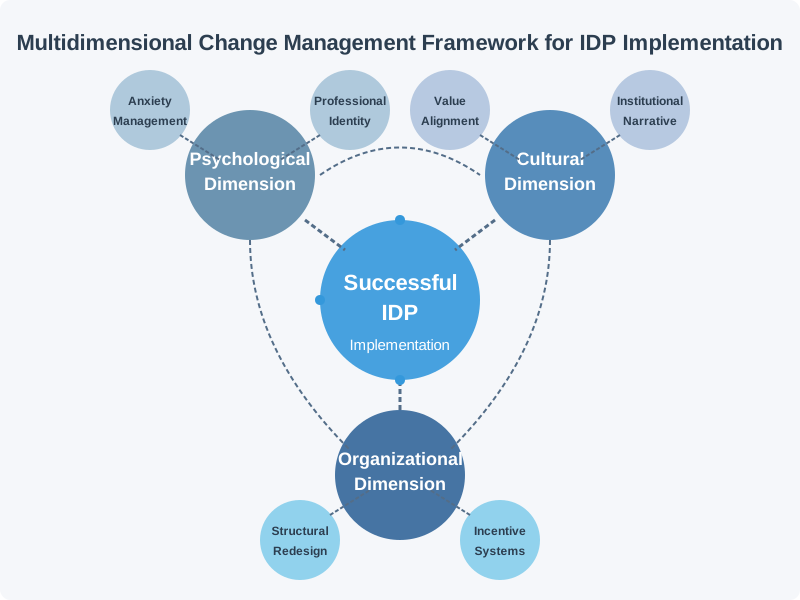
This experience reflects a common pattern across higher education implementations: institutions invest heavily in technological solutions while allocating insufficient resources to the change management processes that ultimately determine adoption success. Effective IDP implementation requires comprehensive change management strategies addressing psychological, cultural, and organizational dimensions of technological transition.
The psychological dimension centers on individual responses to workplace transformation. Administrative staff who have developed expertise in navigating complex paper-based systems may perceive automation as threatening their professional value and job security. Faculty accustomed to high autonomy in managing academic documentation may resist standardized workflows that appear to constrain their discretion. Students familiar with existing processes, despite their inefficiencies, may initially prefer "the devil they know" to untested digital alternatives.
Addressing these psychological barriers requires empathetic engagement with stakeholder concerns and careful attention to adoption incentives. Successful implementations begin with extensive listening sessions that acknowledge anxieties while emphasizing how automation liberates staff for higher-value activities rather than replacing them. Training programs focus not merely on technical functionality but on professional identity transition helping staff envision evolved roles that leverage their institutional knowledge in new contexts. Early adopters receive recognition and opportunities to mentor peers, creating positive social reinforcement for adoption behaviors.
The cultural dimension involves collective values, norms, and practices that influence technology acceptance. Academic institutions often maintain deeply embedded cultural orientations that may conflict with the efficiency-focused paradigms of technological innovation. A departmental culture that values personalized service may perceive automation as depersonalizing student interactions. An institutional tradition of decentralized authority may resist the standardization requirements of enterprise systems.
Cultural transformation requires leadership that bridges technological imperatives with enduring institutional values. Successful implementations frame IDP not as a replacement for human judgment but as an enhancement that allows more meaningful human interactions by eliminating routine processing tasks. Implementation teams include cultural translators respected community members who can articulate how technological changes advance rather than undermine core institutional values. Communication strategies emphasize continuity of mission alongside evolution of methods.
The organizational dimension encompasses structural changes necessary to support new technological capabilities. Legacy organizational structures designed around paper workflows with separate units for document receipt, processing, verification, and storage become inefficient or redundant in integrated digital environments. Reporting relationships, performance metrics, and incentive structures designed for traditional processes may impede rather than support new work patterns.
Addressing these organizational challenges requires courageous leadership willing to reimagine institutional structures around emerging workflows rather than forcing new technologies into outdated organizational frameworks. Successful implementations include organizational analysis that identifies structural barriers to effective technology utilization. Leaders create cross-functional implementation teams with authority to redesign processes that cross traditional departmental boundaries. Performance evaluation systems evolve to recognize contributions to collaborative digital workflows rather than individual document processing metrics.
Figure 7 illustrates the multidimensional change management approach necessary for successful IDP implementation, highlighting the dynamic interplay between psychological, cultural, and organizational factors throughout the adoption lifecycle.
Institutions that excel in this multidimensional approach achieve what might be termed "technological congruence" alignment between technological capabilities, human needs, cultural values, and organizational structures. This congruence enables not merely technical deployment but genuine transformation of administrative operations with sustained stakeholder commitment.
As higher education navigates unprecedented challenges demographic shifts, financial pressures, evolving student expectations, and heightened demands for demonstrable outcomes Intelligent Document Processing emerges not merely as an operational improvement but as a strategic imperative. The institutions that thrive in this environment will be those that recognize administrative excellence as integral to academic mission fulfillment rather than a peripheral support function.
This recognition demands a fundamental reconceptualization of administrative technology investments. Rather than evaluating IDP implementation solely through traditional return-on-investment metrics focused on cost reduction and operational efficiency, forward-thinking institutions adopt a more expansive framework that encompasses:
Experience Enhancement: How does the technology transform the lived experience of students, faculty, and staff in ways that advance institutional distinctiveness and community satisfaction?
Mission Alignment: How does administrative modernization enable more effective fulfillment of core educational, research, and service missions through resource reallocation and enhanced decision-making?
Equity Advancement: How does technological implementation address systemic barriers facing underrepresented populations and create more inclusive administrative environments?
Environmental Responsibility: How does digital transformation contribute to institutional sustainability commitments and model ecological citizenship for students and broader communities?
Organizational Development: How does implementation build institutional capacity for continuous adaptation in an era of accelerating technological and social change?
When evaluated through this comprehensive framework, Intelligent Document Processing reveals its transformative potential. Far from simply digitizing existing processes, IDP enables a fundamental reimagining of academic administration as a strategic asset that actively advances institutional excellence and student success.
The path toward this vision requires intentional leadership that balances technological possibility with human needs, institutional values, and organizational realities. It demands recognition that the most significant barriers to transformation are rarely technical but human the psychological anxieties, cultural attachments, and organizational inertia that maintain suboptimal administrative paradigms despite their evident limitations.
Yet the experiences of pioneering institutions demonstrate that these barriers, while formidable, are not insurmountable. Through thoughtful change management approaches that address the multidimensional nature of technological adoption, higher education leaders can build the stakeholder commitment necessary for sustainable transformation.
The future of higher education administration lies not in incremental improvements to existing processes but in transformative reimagining of how administrative functions contribute to institutional excellence. Intelligent Document Processing provides both technological infrastructure and conceptual framework for this reimagining an opportunity to transcend the artificial separation between administrative efficiency and academic quality that has long constrained institutional potential.
By embracing this holistic vision, institutions position themselves not merely to survive contemporary challenges but to thrive amidst them creating administrative environments that empower rather than impede the teaching, learning, research, and service activities that constitute higher education's essential purpose. In this transformed landscape, the question shifts from whether institutions can afford advanced administrative technologies to whether they can afford to forego the multidimensional benefits these technologies enable.
As we look toward this future, the promise of Intelligent Document Processing extends far beyond operational metrics to the very experience of higher education itself liberating human potential from bureaucratic constraints and creating conditions for genuine administrative excellence in service of academic mission fulfillment.

Head IT Operations - Co Founder of Artificio
See it in your SAP environment
Bring us a document, a process, or a bottleneck. We'll show how Artificio captures, validates, and posts into SAP — then scale from there.
Security & compliance
ISO 27001:2013 certified, SOC 2 Type 2 compliant, GDPR and HIPAA ready. Every agent action is logged, auditable, and runs in isolated environments.