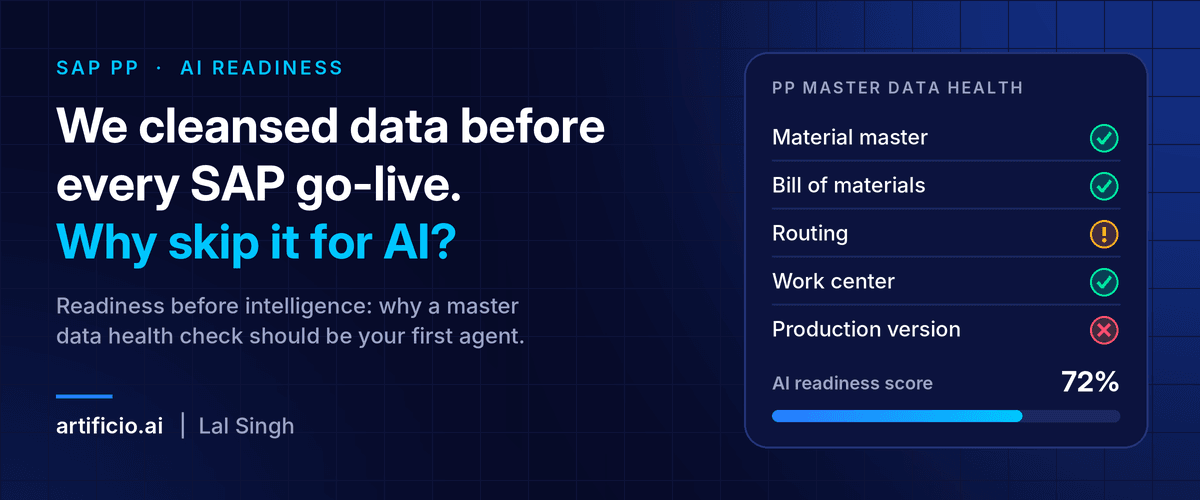
We Cleansed Data Before Every SAP Go-Live. Why Are We Skipping It for AI?
AI agents in SAP are only as good as your master data. An SAP veteran explains why a PP master data readiness check (material, BOM, routing, work center, production version) should be your first AI agent.
Readiness before intelligence: why a PP master data health check agent should be the first agent you deploy?
In short: SAP master data readiness for AI means your material master, BOM, routing, work center and production version data are complete, consistent and close to reality before an AI agent acts on them. In SAP PP, AI agents do not fix bad master data; they amplify it. A master data health check agent should run first, and keep running underneath every decision agent.
In more than 21 years of SAP implementations, I have never seen a serious go-live without an SAP master data cleansing phase. At IBM, Deloitte, Accenture and on my own projects, the plan always had the same line: clean the material masters, validate the BOMs, fix the routings, then load. Nobody argued with it. We all knew what happens when bad data hits a live system.
Today I watch companies rush to put AI agents on top of SAP. Agents that run MRP, expedite purchase orders, reschedule production and talk to suppliers. And almost nobody is asking the old question first: is the data ready?
We would never go live on dirty data. So why are we going live with AI on it?
Why are companies putting AI agents on top of SAP PP?
Every SAP customer I talk to has an AI plan this year. Most of the plans look the same. Pick a painful process, connect an agent to SAP, show a demo, scale it.
In manufacturing, the target is usually planning. MRP exceptions pile up every night. Planners spend their mornings in stock requirement lists and MRP Lists (MD04, MD06 and MD07) deciding what to reschedule, cancel or expedite. An agent that reads exception messages and takes action sounds like the perfect use case.
But here is what the demos do not show. An MRP agent does not think about your plant. It reads your master data. Every decision it makes comes from the material master, the BOM, the routing, the work center and the production version. If those are wrong, the agent will be wrong. Faster, at scale and with confidence.
What happens when an AI agent meets bad SAP master data?
These are not theory. I have seen every one of them on real SAP projects. A human planner usually catches them. An agent will not, unless someone teaches it to look.
Master data issue
What the agent does
Business result
Planned delivery time is 14 days, but the supplier really needs 45
Agent schedules the PO too late and marks it "on time"
Line stops for a shortage the system never predicted
Two production versions valid, one points to an old BOM
Agent picks the wrong version during rescheduling
Wrong components issued, scrap and rework
Routing uses a work center with no capacity or a deleted cost center
Agent dispatches orders to a resource that cannot run them
Capacity plan looks fine on screen, plant is overloaded
Material is set as F with special procurement 30 (subcontracting) but has no BOM
Agent creates subcontract POs with no components to send
Supplier cannot build, order is late
Lot size, safety stock and rounding values copied from a template years ago
Agent "optimizes" against numbers nobody believes
Excess inventory in one plant, shortages in another
Material still in setup status, BOM and routing not finished
Agent treats it as ready and plans production
Orders released for products the plant cannot make yet
The pattern is simple. AI does not fix master data. It amplifies it. A bad value that used to cause one wrong decision a week now causes hundreds a day, with nobody looking.
Why don't traditional master data fixes work for AI?
The SAP world already has answers for master data. I used all of them. They were built for a world where humans made the decisions. That world is ending.
Norm 1: "We cleansed the data at go-live." That was a one-time project. Master data starts to decay the day after go-live. New materials are created in a hurry, suppliers change lead times, engineers change BOMs. A clean snapshot from three years ago tells you nothing about today.
Norm 2: "We have MDG, so our data is governed." Governance controls how data is created. It does not check whether the data still matches reality, or whether objects work together. A material can pass every field rule in MDG and still have no valid production version.
Norm 3: "Planners will catch the problems." This is the hidden one. For 30 years, experienced planners have been the quality check on master data. They know which lead times to ignore and which BOM is wrong. When you put an agent in their place, you remove that safety net. The agent does not know what the planner knows.
Norm 4: "Deploy the agent first, fix data when it breaks." This is how most AI pilots run today. It feels fast. But every failed decision erodes trust, and once a plant manager stops trusting the agent, the project is over.
The new norm is different: data readiness is not a project. It is a continuous check, and it must run before and alongside every agent.
What does AI-ready SAP PP master data mean?
"Clean data" is too vague to act on. For SAP PP, AI-ready means each object is complete, consistent with the others and close to reality. Here is the checklist I use.
Object
AI-ready means
Typical checks
Material master
MRP views reflect how the plant really plans
MRP type, lot size, planned delivery time vs actual PO history, in-house production time vs actual order history, safety stock, procurement type and special procurement, status
BOM
Every produced material has one correct, current structure
Missing BOMs, BOMs on purchased parts, deleted or blocked components, wrong usage or alternative, quantities and scrap that do not match actual consumption
Routing
Operations can actually run as planned
Missing routings, inactive or deleted work centers, standard values far from confirmed times, wrong control keys
Work center
Capacity and cost data are usable
Missing capacity, invalid cost center or activity types, shift data that no longer matches the plant
Production version
The agent can always pick the right BOM and routing
No valid version, overlapping validity dates, versions pointing to old BOM alternatives or missing routings, versions locked for MRP
The most important checks are cross-object. Each record can look perfect alone and still break planning together. A subcontracting material with no BOM. A production version pointing to a routing whose work center was deleted. A new material waiting in setup status that MRP is already planning. Field-level rules will never find these. You need context.
Why should a master data readiness agent be your first AI agent in SAP?
If you are planning to put agents into SAP planning, my advice is simple. Your first agent should not make decisions. It should check whether your data is ready for decisions.
A master data readiness agent works like a permanent go-live cleansing team that never goes home:
Scan material, BOM, routing, work center and production version data, every day, across plants.
Connect each finding to real impact: which MRP exceptions, late orders or excess stock it is causing, and what that costs in dollars.
Learn the rules from your own data. The agent proposes patterns it finds; your experts accept, edit or reject them.
Propose fixes with the evidence behind them, for example a new planned delivery time based on the last 12 months of receipts.
Route each fix to the right owner. Simple fixes can be automated; sensitive ones go to a human for approval.
Post and verify. Approved changes go back to SAP through standard SAP interfaces, every change is logged, and the agent checks that the exception actually went away.
Then it starts again tomorrow. That closed loop is what turns data quality from a one-time cleanup into a living control.
This also changes how you measure AI readiness. Instead of a slide that says "data quality: medium", you get a readiness score per plant and per object. Leadership can see, in numbers, whether a plant is ready for an MRP agent, and what needs to be fixed first.
How do you start? A read-only SAP master data pilot
You do not need a big program to begin. You need one plant and a few weeks.
Start read-only. Connect to SAP with read access only, through OData or simple table extracts. Nothing changes in your system. (How we handle SAP security and data.)
Start from pain, not from fields. Take last month's MRP exceptions and late production orders, and trace each one back to the master data behind it.
Find your top 10. Rank the master data problems by dollar impact. In my experience, a small number of issues cause most of the planning noise.
Fix those first, then measure again. If exceptions drop, you have proof. If they do not, you learned that before you spent money on an agent.
Only then deploy decision agents, and keep the readiness agent running underneath them.
This order protects both your investment and your people's trust in AI.
Frequently asked questions
Why do AI projects in SAP fail?
Most SAP AI projects fail because of the data, not the model. Agents make decisions from master data such as planned delivery times, BOMs, routings and production versions. If that data is wrong, the agent makes wrong decisions at scale, and users stop trusting it.
What SAP PP master data should be checked before deploying AI?
Check five objects: material master (MRP views), bill of materials, routing, work center and production version. Also check how they work together, for example a subcontracting material with no BOM, or a production version pointing to an outdated BOM or routing.
Is SAP MDG enough to make master data AI-ready?
No. SAP Master Data Governance controls how data is created and changed. It does not continuously check whether existing data still matches reality, or whether objects are consistent with each other. A readiness check complements MDG.
How is a master data readiness agent different from a one-time data cleansing project?
A cleansing project fixes a snapshot once. A readiness agent runs continuously: it scans data every day, links issues to MRP exceptions and dollar impact, proposes fixes, routes them for approval, posts approved changes to SAP and verifies the result.
Does a master data health check need changes to SAP?
Not to start. A pilot can run read-only through OData services or table extracts, so nothing in SAP changes until your team approves a fix.
Does this work with SAP ECC and S/4HANA?
Yes. The checks apply to SAP PP master data in both SAP ECC and SAP S/4HANA.
The question every SAP leader should ask
The SAP community learned this lesson the hard way, many times: the system is only as good as its master data. AI does not change that lesson. It makes it urgent.
So before you approve the next agent, ask your team one question: "Is our master data ready for a machine to act on it, without a planner checking every step?" If nobody can answer with numbers, that is your first project.
Readiness before intelligence. Health check before autonomy. That is how we built reliable SAP systems for 20 years, and it is how we will build the autonomous enterprise.
I am building exactly this at Artificio: a master data readiness agent for SAP PP that finds the data behind your MRP problems and closes the loop. If you want to see what your top 10 looks like, request a demo or message me. I would be glad to compare notes.
About the author
Lal Singh is the founder and CEO of Artificio and has more than 21 years of SAP implementation experience at IBM, Deloitte, Accenture, TCS and L&T Infotech. He has led SAP projects for Fortune 500 manufacturers including Ford, Nestlé, Campbell Soup, NVIDIA and Estée Lauder, and is PMP certified. He writes about SAP AI, master data and the autonomous enterprise.