Your AP team is good at their jobs. They know SAP. They know the process. And still, every month-end, the invoice queue swells to a number nobody wants to show the CFO. The backlog did not appear because people stopped working. It appeared because the work keeps arriving faster than any team can manually process it, and MIRO was never designed to handle what finance teams are dealing with today.
This is not a people problem. It is an architecture problem, and AI is the first credible solution to it.
What Actually Happens Inside MIRO
Most articles about SAP invoice processing describe the ideal state: invoice arrives, gets matched to PO and GR, posts to FI, done. Clean. Thirty seconds of work.
That is not what happens in practice.
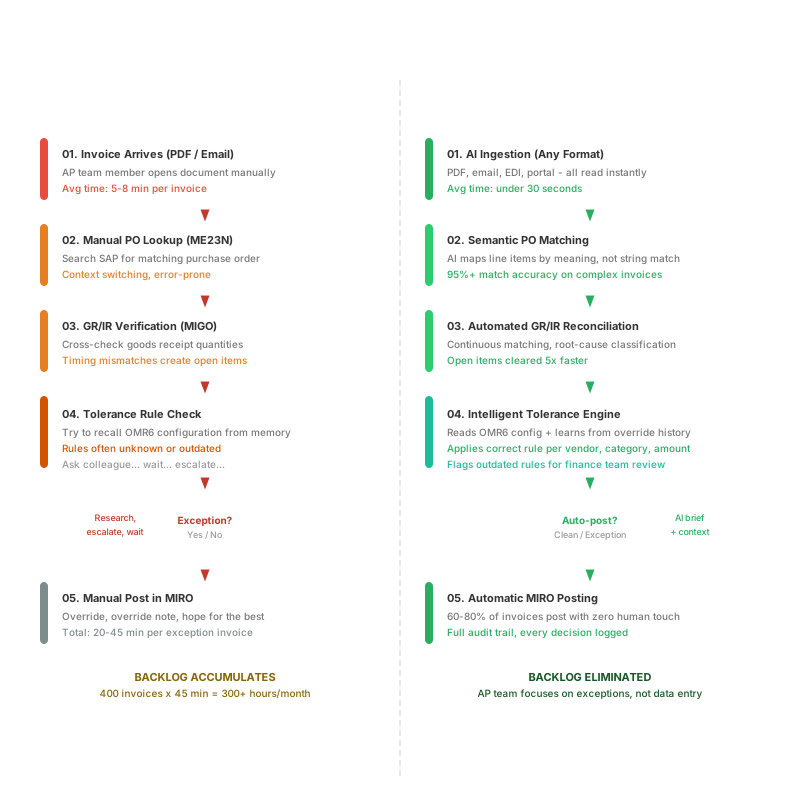
What happens is this: an invoice arrives as a PDF. Someone opens it, reads the vendor name, pulls up the PO in ME23N, checks the quantities against the goods receipt in MIGO, discovers a unit price discrepancy of 0.4%, tries to remember whether that vendor has a tolerance exception, checks the MM60 records, finds nothing useful, asks a colleague, waits, escalates, posts it manually with an override note, and moves to the next one.
Multiply that by four hundred invoices and you have a backlog. Not because anyone was slow. Because the process demands continuous, precise, contextual judgment that manual humans can only provide at a certain throughput.
The MIRO transaction sits at the center of all of this. It is where three-way matching happens, where tolerance rules get applied, and where most invoices either post cleanly or get stuck. When MIRO works, it is invisible. When it breaks down, it is a week of your AP team's time every month.
The GR/IR Problem Nobody Talks About Enough
Before an invoice can post in MIRO, the goods receipt has to exist and match. The GR/IR (Goods Receipt / Invoice Receipt) clearing account is supposed to be temporary, a holding pen where items sit until both sides of the transaction are confirmed.
In reality, it becomes a graveyard.
Partial deliveries, timing mismatches between warehouse scan and system update, vendor invoices that arrive before goods, split POs, blanket orders with rolling call-offs each of these creates a GR/IR reconciliation problem that requires someone to investigate, resolve, and clear manually. The FBL3N report shows the damage. Organizations running SAP for more than a few years often have GR/IR clearing accounts with hundreds of open line items, some of them years old.
The accounting implications are real. Uncleared GR/IR items distort accruals, inflate or understate liabilities, and make the month-end close harder than it needs to be. Auditors notice. Controllers notice. Everyone assumes someone else is cleaning it up.
The root cause is that SAP records transactions but does not interpret them. It knows that GR document 5001234567 exists and that invoice document 5105678901 exists, but it cannot automatically determine that the 2-unit quantity gap between them is because of a partial shipment that the vendor will invoice separately next month. That determination requires context, and context has always required humans.
Until now.
Tolerance Rules: The Rules Your Team Wrote and Forgot
Here is something that happens at almost every organization that has run SAP for more than five years: the tolerance rules in OMR6 were configured during implementation, signed off on, and never revisited.
Those rules reflect the business environment of the time. Price tolerances were set based on typical vendor contracts from years ago. Quantity tolerances were configured for procurement patterns that may have completely changed. Exception lists for specific vendor codes may include companies that no longer exist, and may be missing vendors that now represent 40% of spend.
The rules are still running. They are still blocking or approving invoices every day. But the people who wrote them have moved on, and the institutional knowledge of why any particular tolerance is set the way it is has largely evaporated.
This creates two problems. Invoices that should post automatically get flagged because the tolerances are too tight for current contracts. Invoices that should be reviewed post automatically because an exception was granted years ago and nobody revoked it. Both problems cost money. The first costs time and labor. The second costs actual cash.
When you ask the AP team what the tolerance rules are, most will give you a rough answer. When you look at OMR6, you find something more complicated, with dozens of rules, vendor-specific overrides, and configuration notes that reference projects that finished in 2019.
How AI Fits Into the SAP FI Stack
The good news is that AI does not need to replace SAP. It needs to sit in front of it, handle the interpretation work, and pass clean, validated, matched data to MIRO so that posting happens automatically.
This is where Artificio's approach is different from traditional OCR-based invoice processing tools.
Traditional tools extract data from the invoice document and try to match it against SAP data using exact or fuzzy string matching. They work well when everything is clean and fail badly when anything is ambiguous. A line item described as "freight charges - urgent delivery" on the invoice needs to match against a PO line coded to a specific cost element. String matching cannot do that reliably.
AI-powered document processing reads the invoice with genuine understanding. It identifies the vendor, maps line items to PO structure based on semantic meaning rather than string similarity, and checks the extracted values against both the PO data and the goods receipt in SAP before anything touches MIRO.
The matching layer is only part of it. The more valuable capability is what happens with exceptions.
When an invoice has a discrepancy, the AI does not just flag it and stop. It classifies the discrepancy, checks it against the current tolerance rules, looks at historical patterns for that vendor, and makes a recommendation. "This 1.2% price variance is within the tolerance band for this vendor category. Recommend auto-approval." Or: "This quantity discrepancy follows a pattern seen in the last three invoices from this vendor, all of which required manual GR correction. Flagging for AP review with context."
That is judgment, not just matching. And it is available at the scale of your entire invoice volume, simultaneously, without getting tired or forgetting the context from three invoices ago.
Clearing the GR/IR Backlog With AI Reconciliation
The GR/IR clearing problem has a specific structure that AI handles well.
Each uncleared item represents a state mismatch: either a goods receipt exists without a matching invoice, or an invoice was received without a corresponding goods receipt. The task is to determine why the mismatch exists and what the correct resolution is.
There are a finite number of root causes. Partial delivery. Timing lag. Vendor invoicing error. Quantity dispute. Closed PO with residual liability. Duplicate invoice. Each has a different resolution path, and each leaves traces in SAP data and in the related documents.
AI can analyze the full context of an uncleared GR/IR item: the PO history, the delivery documents, any correspondence that accompanied the goods receipt, the vendor's invoice history, and the aging of the open item. From that context, it can categorize the item and recommend action with a confidence score.
The AP team still makes the final call on disputed items. What changes is that they arrive at that call with a full briefing rather than having to research it from scratch. A reconciliation that used to take 20 minutes of manual investigation takes two minutes of review.
At scale, a team that was clearing 40 GR/IR items per day can handle 200. The backlog shrinks. Month-end gets faster. Accruals get more accurate because the AI can also identify items that represent genuine liabilities and flag them for accrual even when the invoice has not posted.
Re-Learning the Tolerance Rules Automatically
This is the capability that tends to surprise finance teams most.
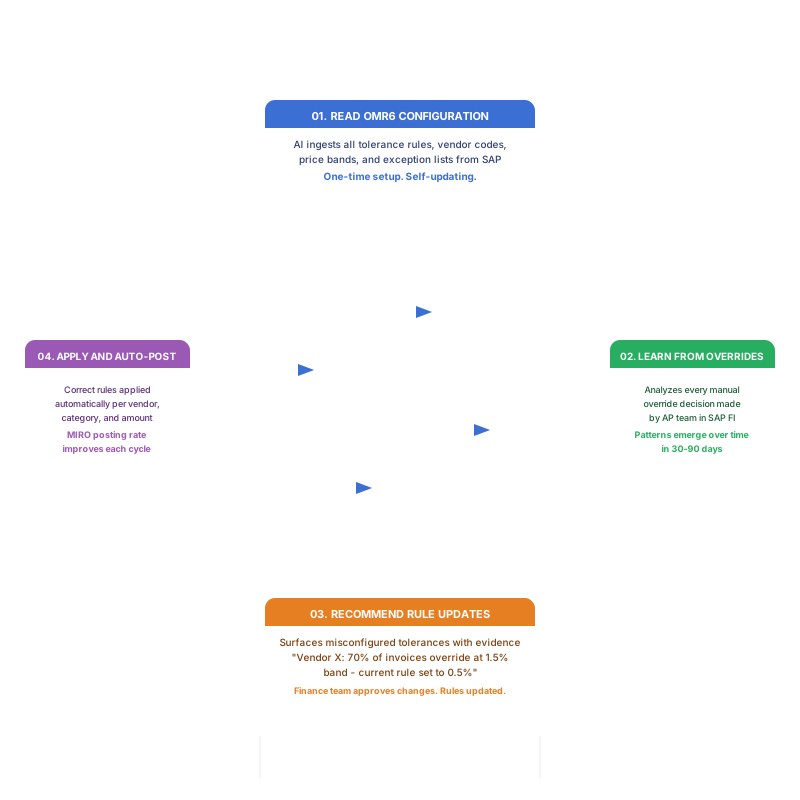
Artificio's AI layer can analyze your historical invoice posting data, the tolerance exceptions your team has manually overridden in the past, and the current OMR6 configuration, and produce a coherent picture of what your tolerance rules actually are in practice versus what they are on paper.
The gap is almost always significant.
More usefully, the AI can identify patterns that suggest your rules need updating. If 70% of invoices from a specific vendor category require manual override within a 1.5% price band, that is a signal that the tolerance for that category is misconfigured. If a specific cost center consistently generates quantity discrepancies that are always approved, the tolerance rule is creating work rather than preventing errors.
This analysis does not require a SAP implementation project. It runs against existing transaction data in FI and MM, produces a report, and gives the finance team a basis for a rational conversation about whether the rules reflect current business reality.
The finance team still owns the rules. What changes is that the rules become visible and maintainable again, rather than a configuration artifact from a project that finished years ago.
What the MIRO Bottleneck Looks Like After AI
The MIRO bottleneck exists because too many invoices require human judgment before they can post. AI does not eliminate human judgment. It reduces the number of cases that require it, and it improves the quality of judgment when it is needed.
After AI integration, the invoice flow typically looks like this:
Invoices arrive through whatever channel they currently use: email, vendor portal, EDI, scan. The AI processes each one immediately on receipt, regardless of volume or time of day. Clean invoices, those that match PO and GR within tolerance and have no anomalies, post automatically to MIRO without any human touch. In most organizations, this accounts for 60 to 80% of invoice volume.
Invoices with resolvable exceptions get routed to the AP team with a full brief: here is what the invoice says, here is what the PO says, here is the discrepancy, here is why it likely occurred, here is the recommended resolution. The AP team clicks approve or escalate. They are not researching from scratch.
Invoices with genuine disputes, vendor errors, or policy violations get flagged clearly, with documentation for the vendor conversation that will need to happen. The AP team knows immediately what the issue is rather than discovering it partway through manual matching.
The result is not that your AP team disappears. It is that they spend their time on decisions rather than research. The backlog does not accumulate because there is no bottleneck waiting for human attention on routine invoices.
Month-end close gets faster because there are fewer open items. GR/IR clears more completely because reconciliation runs continuously rather than in periodic manual batches. Auditors find cleaner transaction records because every AI decision is logged with a rationale.
Integration Without Disruption
A concern that comes up in every conversation about AI and SAP is the integration question. The SAP environment is complex, often highly customized, and changes to it carry risk. Finance teams have seen enough implementations go wrong to be appropriately cautious.
Artificio connects to SAP via standard APIs and does not require modifications to your SAP configuration. The AI layer sits outside the SAP system, reads data through the published interfaces, and writes back to SAP through the same posting mechanisms your team uses today. MIRO still posts the invoice. The difference is that the AI does the pre-posting work that your AP team was doing manually.
This means the rollout risk is low. If the AI layer were to stop working, your AP team would continue processing invoices exactly as they do today. There is no dependency that creates a single point of failure for your AP function.
It also means the integration can be phased. Starting with a specific vendor category, a specific business unit, or a specific invoice type is straightforward. You can run the AI in advisory mode first, where it makes recommendations but humans still post, until the team is comfortable with the accuracy and the organization is ready to move to automated posting.
The Business Case Is Simpler Than It Looks
Finance teams sometimes expect the ROI conversation for AI invoice processing to be complicated. It is not, once you have measured what the current process actually costs.
The cost of manual invoice processing is not just labor time, though that is significant. It includes the cost of late payment penalties when invoices sit in the backlog past due dates, the cost of early payment discounts forfeited because invoices post too slowly to capture the discount window, the cost of duplicate payments that slip through manual processing, and the opportunity cost of finance staff spending time on data entry rather than analysis.
On the other side, the value of AI invoice processing is not just labor savings. It includes the discount capture rate that becomes achievable when invoices post in hours rather than days, the reduction in duplicate payments, the improvement in supplier relationships when payment times become predictable, and the accuracy of month-end accruals when GR/IR reconciliation runs continuously.
Most organizations that measure carefully find that the business case closes on discount capture and late payment avoidance alone, before labor savings are factored in.
Getting Started Is the Hard Part
The thing about AI invoice processing that finance teams do not always hear clearly enough is that the technology is ready. The question is organizational readiness.
That means having a clear picture of your current invoice volume and the breakdown between clean-post and exception invoices. It means understanding what your OMR6 configuration actually says and whether it reflects current business requirements. It means identifying who owns the GR/IR reconciliation process today and what a transition would look like.
Artificio typically starts with a discovery engagement that answers those questions before any technical work begins. The point is to know exactly what the AI will handle, what the team will handle, and what success looks like, before any invoice touches the system.
The MIRO bottleneck is solvable. The GR/IR backlog is clearable. The tolerance rules are recoverable. None of it requires replacing SAP, retraining your team from scratch, or a multi-year implementation project. It requires connecting intelligent automation to the process you already have, in the places where the process currently breaks down.
If your invoice backlog is a recurring problem rather than an occasional one, the architecture is the issue. And architecture problems have architecture solutions.