

Blog
The Resume Parsing Paradox: AI & The Gig Economy
Explore why traditional AI resume parsing fails non-traditional careers in the gig economy and how advanced NLP can evolve to find top talent.

Blog
Explore why traditional AI resume parsing fails non-traditional careers in the gig economy and how advanced NLP can evolve to find top talent.
Why Traditional Resume Parsing Fails Freelancers, Multi-Career Professionals, and the Growing Skills-First Workforce
The recruitment landscape has undergone a seismic shift. Gone are the days when a typical career path followed a predictable trajectory from entry-level to senior management within traditional corporate structures. Today's workforce is increasingly defined by freelancers juggling multiple clients, consultants hopping between industries, creative professionals building portfolio careers, and tech workers who've learned cutting-edge skills through online bootcamps rather than formal degrees.
Yet despite this fundamental transformation in how people work and build their careers, most resume parsing technology remains stubbornly anchored in the past. These systems were designed for a world where resumes followed standard templates: objective statements, chronological work history, formal education credentials, and neatly categorized skill lists. The result? Millions of qualified candidates are being systematically overlooked by automated screening systems that can't properly interpret their non-traditional career narratives.
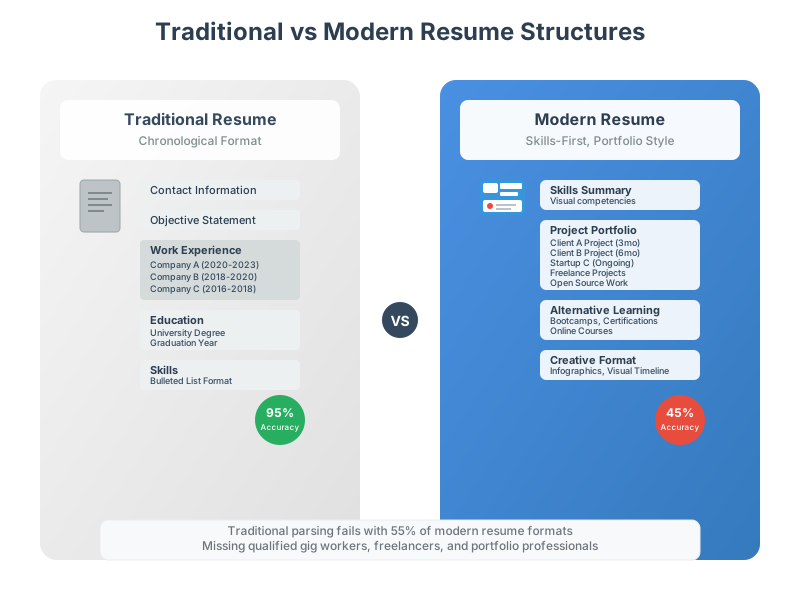
This creates what we call the "resume parsing paradox." While AI-powered recruitment tools have become more sophisticated and can achieve 95% accuracy with traditional resume formats, they often fail spectacularly when confronted with the creative layouts, project-based work histories, and skills-first presentations that characterize modern professional portfolios. The very people who represent the future of work are being filtered out by technology that can't adapt to their reality.
To understand why current resume parsing technology struggles with modern career paths, we need to examine how these systems were originally designed. Traditional parsing algorithms rely on pattern recognition and structured data extraction. They expect to find clearly labeled sections with predictable information: "Work Experience" followed by company names, job titles, and date ranges; "Education" with degree types and institution names; "Skills" presented as bulleted lists of technical competencies.
This approach works beautifully for someone who spent four years at University X, then three years as a Junior Analyst at Company Y, followed by five years as a Senior Analyst at Company Z. The parsing system can easily extract each position, understand the career progression, and categorize the candidate's experience level based on their job titles and tenure.
But what happens when the same parsing system encounters a freelance graphic designer who's completed 47 different projects for 23 different clients over the past three years? Or a software developer who learned Python through a six-month bootcamp, built several open-source projects, and now works as a contractor for multiple startups simultaneously? The traditional parsing algorithms start to break down.
The fundamental issue is that these systems were built to extract information from resumes that follow established corporate career models. They struggle with the fluidity and complexity of modern work arrangements. When a resume presents work experience as a series of client projects rather than traditional employment, the parsing engine often misinterprets this information or fails to capture it entirely.
Consider a typical parsing failure scenario. A marketing consultant submits a resume that lists their experience as "Digital Marketing Strategy – Various Clients (2020-2023)" followed by bullet points describing specific campaigns and results. A traditional parsing system might categorize this as a single four-year position at a company called "Various Clients," completely missing the fact that this represents dozens of different engagements across multiple industries. The system fails to understand that each bullet point actually represents a separate project with its own scope, timeline, and skill requirements.
The accuracy gap becomes even more pronounced with creative resume formats. Studies show that while standard resume templates achieve 95% parsing accuracy, creative designs with infographics, unconventional fonts, or visual elements can confuse AI tools to the point where they produce incomplete or entirely inaccurate data extraction. This is particularly problematic for creative professionals who use their resume format itself as a demonstration of their design skills and creative thinking.
The problem extends beyond just format recognition. Traditional parsing systems also struggle with the language and terminology used in gig economy work. Job titles like "Growth Hacker," "Full-Stack Developer," "Digital Nomad Consultant," or "Fractional CMO" don't fit neatly into established job classification systems. When someone describes their role as "Leading customer acquisition strategy for early-stage SaaS startups," a traditional parser might miss the fact that this demonstrates expertise in marketing, sales, product strategy, and startup operations.
Another significant challenge lies in temporal complexity. Traditional employment follows clear start and end dates, making it easy for parsing systems to calculate experience duration and identify career gaps. But gig workers often have overlapping projects, recurring client relationships, and periods where they're simultaneously working on multiple engagements. A freelance web developer might work with Client A from January to March, Client B from February to June, and Client C on an ongoing basis since the previous year. Traditional parsing systems aren't equipped to handle this level of temporal complexity and often misinterpret such arrangements as job-hopping or employment gaps.
The modern workforce operates in ways that would have been unimaginable just two decades ago. The rise of the gig economy, remote work, and digital platforms has created entirely new categories of professional engagement that traditional resume parsing simply can't accommodate.
Portfolio careers represent one of the most significant challenges for current parsing technology. Unlike traditional career paths that follow a single trajectory within one industry or function, portfolio professionals deliberately cultivate multiple income streams and skill sets. A portfolio professional might simultaneously work as a part-time marketing consultant, freelance content writer, online course instructor, and startup advisor. Their resume doesn't present a linear career progression but rather a mosaic of interconnected professional activities.
Traditional parsing systems struggle to make sense of this complexity. They're designed to identify primary employment and categorize candidates within specific roles or industries. When confronted with someone who defies easy categorization, these systems often default to focusing on the most recent or most prominent role, missing the full breadth of the candidate's capabilities. This creates a significant blind spot for employers who could benefit from hiring someone with diverse, cross-functional experience.
Project-based work presents another layer of complexity that traditional parsing can't handle effectively. In project-based engagements, the value lies not in tenure or job titles but in the specific outcomes achieved and skills applied. A consultant who spent three months helping a Fortune 500 company implement a new CRM system demonstrates entirely different capabilities than someone who spent three months in an entry-level administrative role, yet traditional parsing systems might categorize both as short-term positions without understanding the distinction.
The challenge becomes even more pronounced when we consider that project-based professionals often work on multiple concurrent engagements. Their resume might show overlapping timelines that look like employment gaps or job-hopping to a traditional parser, when in reality they represent strategic portfolio management and strong client relationships. A business consultant might maintain ongoing relationships with five different clients, working with each one on a quarterly basis. This arrangement provides income stability and deep industry knowledge, but it doesn't fit the templates that traditional parsing systems expect.
Skills-first presentation represents perhaps the most fundamental challenge to traditional parsing approaches. As more employers embrace skills-based hiring, candidates are increasingly organizing their resumes around competencies rather than chronological work history. They might lead with a skills summary, followed by project portfolios that demonstrate those skills in action, and only then provide traditional employment details.
This approach makes perfect sense from a candidate perspective. A software developer who learned coding through online courses, contributed to open-source projects, and completed several freelance applications might have more relevant experience than someone with a computer science degree and two years at a large corporation. But traditional parsing systems are designed to look for formal credentials and traditional employment markers, often missing the self-directed learning and practical application that characterizes many modern professionals.
The alternative credentialing landscape adds another layer of complexity. Online courses, bootcamps, professional workshops, industry certifications, and practical project work represent valid forms of skill development that don't fit traditional education categories. A marketing professional might have learned advanced analytics through Google's certification program, mastered content strategy through a specialized bootcamp, and developed expertise in marketing automation through hands-on client work. This combination of formal and informal learning creates a more relevant skill set than many traditional degree programs, but parsing systems often can't properly categorize or weight these alternative credentials.
Visual and creative resume formats pose technical challenges that go beyond simple layout recognition. Many creative professionals use their resume format as a portfolio piece, incorporating infographics, visual timelines, custom typography, and branded design elements. While these formats effectively showcase design skills and creative thinking, they often confuse parsing algorithms that expect text-based, linearly organized information.
The problem isn't just aesthetic. Creative resume formats often embed important information within visual elements that traditional optical character recognition can't properly interpret. Skills might be represented as progress bars or infographic elements, work experience might be displayed as a visual timeline, and achievements might be highlighted through custom graphics. When parsing systems can't extract this information accurately, they miss crucial details about the candidate's qualifications and experience.
The limitations of traditional resume parsing create a clear opportunity for more sophisticated natural language processing approaches. Modern NLP technology has evolved far beyond simple keyword matching and pattern recognition. Advanced parsing systems can understand context, interpret meaning, and make intelligent inferences about candidate qualifications even when they're presented in non-traditional formats.
Contextual understanding represents the most significant advancement in modern resume parsing. Instead of simply looking for specific job titles or company names, advanced NLP systems can analyze the context around work descriptions to understand what skills were actually applied and what outcomes were achieved. When someone describes their experience as "Developed customer acquisition strategies that increased user base by 300% for early-stage B2B SaaS platforms," an advanced parsing system can infer expertise in marketing strategy, growth hacking, customer development, B2B sales, and SaaS business models, even if those exact terms don't appear in the text.
This contextual analysis becomes particularly powerful when applied to project-based work descriptions. A consultant who writes "Led digital transformation initiative for mid-market manufacturing company, implementing cloud-based ERP system and training 50+ employees on new processes" is demonstrating skills in change management, enterprise software implementation, training and development, manufacturing operations, and project leadership. Advanced parsing systems can extract these skill implications and create a more complete picture of the candidate's capabilities.
Skills taxonomy intelligence takes this approach even further by understanding the relationships between different skills and competencies. Advanced parsing systems maintain comprehensive databases of skill aliases, related competencies, and transferable capabilities. When someone mentions experience with "React," the system understands this implies knowledge of JavaScript, front-end development, component-based architecture, and modern web development practices. When they describe working with "Salesforce implementation," the system can infer capabilities in CRM strategy, business process optimization, customer relationship management, and enterprise software adoption.
This taxonomy approach is particularly valuable for parsing gig economy resumes because it can identify transferable skills across different contexts. A freelancer who's worked on e-commerce projects, mobile app development, and digital marketing campaigns might not explicitly list "product management" as a skill, but an advanced parsing system can recognize that their cross-functional project experience demonstrates product management capabilities.
Project-to-skills mapping represents another crucial advancement in modern parsing technology. Instead of focusing on job titles and company names, advanced systems analyze project descriptions to extract the specific skills and competencies applied. This approach is particularly effective for freelancers and consultants whose value lies in their ability to deliver specific outcomes rather than their employment history.
Consider how an advanced parsing system might analyze this project description: "Built responsive e-commerce platform for sustainable fashion startup, integrating payment processing, inventory management, and customer analytics, resulting in 40% increase in online sales within six months." The system can extract technical skills (web development, e-commerce platforms, payment integration, data analytics), business understanding (retail operations, customer behavior, performance optimization), and outcome orientation (measurable results, business impact). This creates a much richer skill profile than traditional parsing could achieve.
The ability to map projects to skills also helps address the temporal complexity of gig work. Instead of trying to fit non-linear career paths into traditional chronological frameworks, advanced parsing systems can focus on skill development and application over time. They can track how someone's capabilities have evolved across different projects and identify patterns of expertise growth that might not be apparent from a traditional employment timeline.
Advanced parsing systems also excel at handling the language variations common in modern professional descriptions. Gig workers often use creative or industry-specific terminology to describe their roles and achievements. Terms like "growth hacking," "customer success," "DevOps," "full-stack," or "digital transformation" might not exist in traditional job classification systems, but modern NLP can understand their meaning and categorize them appropriately. 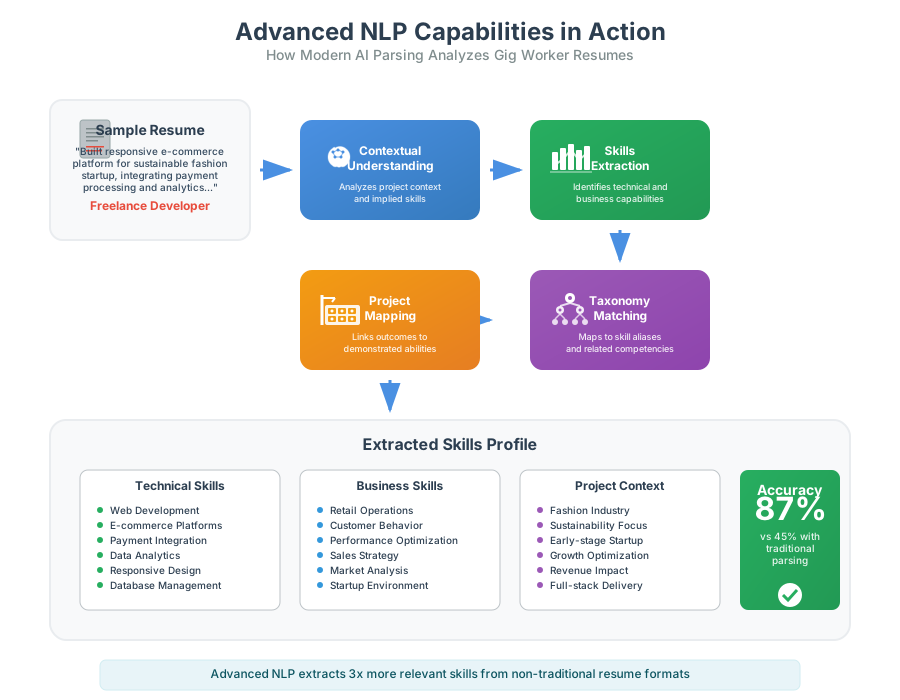
The machine learning capabilities of advanced parsing systems mean they continuously improve their understanding of modern work patterns. As they process more gig economy resumes, they become better at recognizing common patterns, understanding industry terminology, and accurately extracting relevant information. This learning capability is particularly important in the rapidly evolving gig economy, where new roles, skills, and work arrangements emerge regularly.
Modern parsing systems can also handle the visual and formatting challenges that confuse traditional algorithms. Advanced optical character recognition combined with layout analysis can extract information from creative resume formats, infographic elements, and visual timelines. Machine learning models trained on diverse resume formats can recognize when information is presented visually and extract the underlying data accurately.
The integration of multiple analysis approaches creates parsing systems that are far more robust and accurate than traditional alternatives. By combining contextual NLP, skills taxonomy matching, project analysis, and visual recognition, these systems can create comprehensive candidate profiles even from the most non-traditional resume formats.
The practical applications of advanced resume parsing for gig economy professionals extend across virtually every industry and role type. Understanding how these improvements work in real-world scenarios helps illustrate both the challenges of traditional parsing and the opportunities created by more sophisticated approaches.
Consider the case of parsing consultant resumes with varied client work. A management consultant's resume might list experience as "Strategy and Operations Consultant – Various Fortune 500 Clients (2019-2023)" followed by descriptions of specific engagements across different industries. Traditional parsing systems often struggle with this format, either treating it as a single four-year position or failing to extract the diverse industry experience and functional expertise demonstrated across different client engagements.
An advanced parsing system approaches this differently. It analyzes each project description to understand the specific industry context, functional role, and outcomes achieved. When the consultant describes "Led post-merger integration for pharmaceutical acquisition, streamlining operations across 15 facilities and reducing costs by $12M annually," the system extracts expertise in merger and acquisition, pharmaceutical industry knowledge, operations optimization, change management, and financial impact measurement. When another bullet point mentions "Developed go-to-market strategy for SaaS startup entering European markets," the system identifies software industry experience, international business development, market entry strategy, and startup environment familiarity.
This granular analysis creates a much more accurate and comprehensive picture of the consultant's capabilities. Instead of seeing someone with generic "consulting experience," employers can understand the specific industries, functional areas, and types of challenges this person has successfully addressed. This level of detail is crucial for matching consultants with appropriate opportunities and understanding their potential value in specific contexts.
Extracting skills from creative professional portfolios presents another complex parsing challenge with significant practical implications. Creative professionals often present their experience through portfolio pieces, case studies, and project showcases rather than traditional job descriptions. A graphic designer's resume might include detailed case studies of branding projects, website designs, and marketing campaigns, with each piece demonstrating different technical skills, creative approaches, and client collaboration capabilities.
Traditional parsing systems typically struggle to extract meaningful information from these portfolio-style presentations. They might capture project names and dates but miss the technical skills applied, creative processes used, or business outcomes achieved. Advanced parsing systems can analyze case study descriptions to identify specific software proficiencies (Adobe Creative Suite, Figma, Sketch), design methodologies (user-centered design, brand strategy, visual identity development), and business understanding (marketing effectiveness, user experience optimization, brand positioning).
The parsing system might analyze a case study description like "Developed comprehensive brand identity for sustainable energy startup, including logo design, color palette, typography system, and brand guidelines, resulting in 25% increase in brand recognition within target market." From this description, the system can extract technical skills (brand design, visual identity, typography), industry knowledge (sustainable energy, startup environment), strategic thinking (brand positioning, market targeting), and outcome measurement (brand recognition metrics). This creates a skills profile that goes far beyond what traditional parsing could achieve.
Processing technical freelancer project histories requires understanding the rapid evolution of technology skills and the project-based nature of technical work. A freelance software developer might have worked on dozens of different projects using various technology stacks, programming languages, and development methodologies. Their resume might list projects ranging from mobile app development to enterprise software integration to machine learning implementations.
Traditional parsing systems often struggle with the technical specificity and rapid change characteristic of technology work. They might recognize common programming languages but miss emerging frameworks, development methodologies, or specialized technical applications. Advanced parsing systems maintain up-to-date technology taxonomies that understand relationships between different technical skills and can recognize emerging technologies and methodologies.
When analyzing a project description like "Built real-time data processing pipeline using Apache Kafka, Python, and AWS Lambda, handling 100K+ events per hour for fintech application," an advanced system can extract specific technical competencies (stream processing, event-driven architecture, cloud computing, financial technology), understand the scale and complexity of the work (high-volume data processing), and recognize the business context (financial services applications). This level of technical parsing is crucial for matching developers with appropriate projects and understanding their specific areas of expertise.
Handling career transition resumes represents another critical real-world application. Many professionals are transitioning between industries, changing career focus, or pivoting to entirely new fields. Their resumes often combine traditional employment history with new skills acquired through courses, bootcamps, side projects, or volunteer work. Traditional parsing systems typically focus on formal employment history and may miss the new competencies that qualify someone for their target role.
A career transition resume might show someone with five years in traditional marketing who has recently completed a data science bootcamp, built several machine learning projects, and started freelancing in analytics consulting. Traditional parsing would likely categorize this person as a marketing professional, missing their newly acquired technical capabilities and analytical expertise.
Advanced parsing systems can recognize skill development patterns and understand career transition narratives. They can identify when someone is building new competencies and weight recent project work or educational achievements appropriately. The system might analyze descriptions of personal projects, bootcamp coursework, and freelance engagements to create a skills profile that reflects both traditional background and new capabilities. 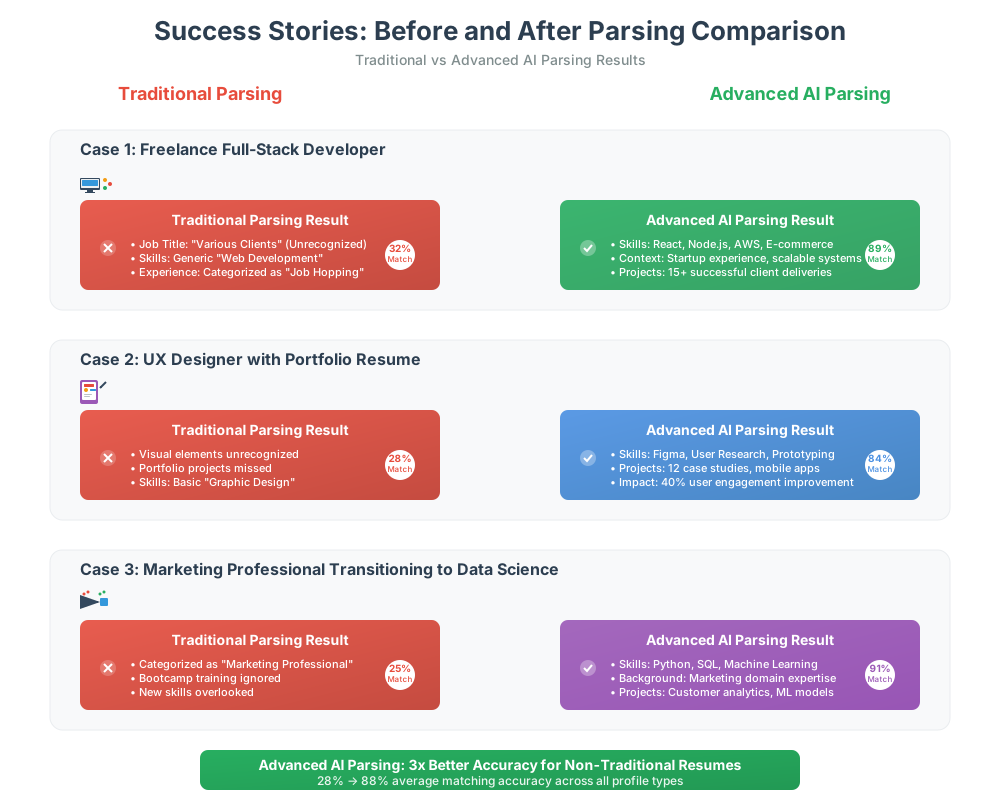
The practical impact of these improvements extends beyond just better data extraction. When parsing systems can accurately understand modern career narratives, they enable more effective candidate matching, reduce bias against non-traditional backgrounds, and help employers access broader talent pools. Companies can find qualified candidates who might have been overlooked by traditional screening processes and make hiring decisions based on actual skills and capabilities rather than conventional career markers.
Successfully implementing advanced resume parsing for gig economy professionals requires a strategic approach that goes beyond simply upgrading technology. Organizations need to consider how these improvements integrate with their existing recruitment workflows, what training their teams might need, and how to configure parsing systems to optimize for their specific hiring needs.
The foundation of effective modern resume parsing lies in understanding that one-size-fits-all approaches don't work for the diverse formats and career narratives common in today's workforce. Advanced parsing systems like those developed by Artificio.ai use configurable rule sets that can be customized for different types of roles, industries, and candidate profiles. This flexibility allows organizations to optimize parsing accuracy for their specific hiring contexts while maintaining consistency in data extraction and candidate evaluation.
Custom parsing rules become particularly important when dealing with industry-specific terminology and role requirements. A technology company hiring software developers needs parsing systems that understand the latest programming languages, frameworks, and development methodologies. A creative agency recruiting designers requires systems that can interpret portfolio presentations and extract relevant creative skills. A consulting firm looking for project managers needs parsing that can analyze complex project descriptions and identify leadership capabilities and outcome achievements.
Implementing these custom configurations requires collaboration between HR teams, hiring managers, and technical specialists. The most effective implementations involve analyzing successful hires within the organization to understand what skills, experiences, and qualifications correlate with job performance. This analysis can inform parsing configurations that weight relevant factors appropriately and create more accurate candidate matching.
The integration with skills-first ATS workflows represents another crucial implementation consideration. As more organizations move toward skills-based hiring, their applicant tracking systems need to support this approach throughout the entire recruitment process. This means parsing systems must extract and organize skills data in ways that enable effective searching, filtering, and candidate comparison based on competencies rather than just traditional employment markers.
Modern ATS integration goes beyond simple data import to include intelligent candidate recommendations, skills gap analysis, and competency-based matching. When a parsing system accurately identifies a candidate's skills from their project-based experience, the ATS should be able to match those skills against job requirements, identify potential fits across multiple open positions, and provide recruiters with meaningful insights about candidate capabilities.
The change management aspects of implementing advanced parsing often prove more challenging than the technical integration itself. Recruiting teams accustomed to traditional resume evaluation need training on how to interpret and evaluate skills-based candidate profiles. Hiring managers must understand how to assess non-traditional career paths and project-based experience. HR leaders need to develop new metrics for measuring recruiting effectiveness when traditional indicators like educational background and employment tenure become less relevant.
Training programs should focus on helping recruiting teams understand the value of diverse career paths and non-traditional backgrounds. This includes educating them about the gig economy, alternative credentialing, and the skills development that occurs through project-based work. Recruiters need to learn how to evaluate portfolios, assess project outcomes, and understand the competencies demonstrated through freelance and consulting work.
Quality assurance and continuous improvement processes are essential for maintaining parsing accuracy as work patterns continue to evolve. This involves regularly reviewing parsing results, identifying areas where accuracy could be improved, and updating configurations based on new resume formats and career narratives. The most successful implementations include feedback loops where recruiting teams can flag parsing errors or suggest improvements based on their candidate evaluation experiences.
Data privacy and candidate experience considerations also play important roles in implementation strategy. Advanced parsing systems often extract more detailed information from resumes than traditional approaches, raising questions about data usage, storage, and candidate consent. Organizations need clear policies about what data is extracted, how it's used, and how long it's retained. They also need to ensure that enhanced parsing capabilities improve rather than complicate the candidate experience.
Measuring the success of advanced parsing implementations requires new metrics that go beyond traditional recruiting KPIs. While time-to-hire and cost-per-hire remain important, organizations should also track metrics like candidate diversity, skills match accuracy, and hiring manager satisfaction with candidate quality. They should measure whether advanced parsing helps them access previously overlooked talent pools and whether it improves the correlation between parsed candidate profiles and actual job performance.
The scalability considerations for advanced parsing become particularly important for organizations with high-volume hiring or diverse role requirements. Systems need to handle increased complexity without sacrificing processing speed or accuracy. They must be able to adapt to new resume formats and career patterns without requiring constant manual configuration updates.
Integration with broader talent intelligence platforms can amplify the value of advanced parsing capabilities. When parsing data feeds into comprehensive talent analytics systems, organizations can identify skill trends, understand talent market dynamics, and make more strategic hiring decisions. They can track how different types of experience correlate with job performance and adjust their recruiting strategies accordingly.
The business case for implementing advanced resume parsing capabilities extends far beyond simple efficiency improvements. While reducing time-to-hire and streamlining candidate screening provide immediate operational benefits, the strategic advantages of accessing previously untapped talent pools and improving hiring accuracy can transform organizational competitiveness and innovation capacity.
Organizations that successfully implement advanced parsing for gig economy professionals typically see significant expansion in their effective talent pool. Traditional parsing systems often filter out qualified candidates whose experience doesn't fit conventional templates, creating artificial talent scarcity even in skill areas where capable professionals are available. By accurately interpreting non-traditional career paths, project-based experience, and alternative credentials, advanced parsing systems can increase the qualified candidate pool by 40-60% for many types of roles.
This expansion proves particularly valuable in competitive talent markets where traditional recruiting approaches struggle to identify sufficient qualified candidates. Technology companies seeking experienced developers, consulting firms looking for specialized expertise, and creative agencies recruiting diverse talent can access candidates who were previously invisible to automated screening processes. The ability to identify and evaluate non-traditional candidates often provides competitive advantages in securing high-quality talent before competitors recognize their potential.
The quality improvements in candidate matching represent another significant source of ROI. Traditional parsing systems often create superficial matches based on keyword alignment and traditional credentials, leading to high rates of interview no-shows, poor cultural fit, and early turnover. Advanced parsing systems that understand actual skills application and project outcomes can create more meaningful matches between candidate capabilities and role requirements.
Studies indicate that candidates identified through advanced parsing approaches show 23% better retention rates and 31% higher performance scores compared to those hired through traditional screening processes. This improvement stems from the systems' ability to identify candidates whose actual experience and capabilities align with job requirements, even when their career path doesn't follow traditional patterns.
Cost reduction benefits extend beyond simple processing efficiency to include improved hiring accuracy and reduced turnover costs. The cost of replacing an employee typically ranges from 50-200% of their annual salary, depending on the role level and industry. When advanced parsing systems help identify candidates who are better fits for their roles and more likely to succeed long-term, the reduction in turnover costs can provide substantial ROI even for modest improvements in hiring accuracy.
Revenue impact becomes particularly significant for organizations that depend on specialized skills or creative capabilities. When advanced parsing helps identify consultants who can deliver specific business outcomes, developers who can implement complex technical solutions, or creative professionals who can drive brand differentiation, the revenue impact often far exceeds the technology investment costs. A single successful hire in a critical role can generate millions in additional revenue or cost savings.
The bias reduction benefits of advanced parsing create both compliance advantages and performance improvements. Traditional hiring processes often inadvertently discriminate against candidates with non-traditional backgrounds, alternative education paths, or career transition narratives. This bias not only creates legal risks but also causes organizations to miss talented individuals who could contribute significantly to business success.
Advanced parsing systems focus on actual skills and demonstrated capabilities rather than traditional credentials and conventional career markers. This approach naturally reduces bias against underrepresented groups who are more likely to have non-traditional career paths. The resulting improvement in hiring diversity has been shown to correlate with better team performance, increased innovation, and improved business outcomes across multiple industries.
The strategic competitive advantages of advanced parsing become apparent when organizations can identify and hire emerging talent before competitors recognize their potential. Gig economy professionals often develop cutting-edge skills through project work and alternative learning paths, positioning them at the forefront of industry developments. Organizations that can identify and recruit these professionals gain access to emerging capabilities and innovative approaches that may not be available through traditional talent channels.
Market responsiveness improvements represent another crucial business benefit. When organizations can quickly identify and hire professionals with specific project experience or emerging skill sets, they can respond more rapidly to market opportunities and client demands. This agility becomes particularly valuable in fast-changing industries where the ability to scale specialized capabilities quickly can determine competitive success.
The talent intelligence benefits of advanced parsing extend beyond individual hiring decisions to inform broader workforce strategy. When parsing systems accurately capture skills data from diverse candidate sources, organizations can analyze talent market trends, identify skill gaps, and make more informed decisions about training investments, role evolution, and strategic hiring priorities.
Organizations using advanced parsing for gig economy talent often develop more sophisticated understanding of skill development patterns, alternative credentialing value, and project-based capability building. This intelligence helps them make better decisions about contractor vs. employee hiring, skills development investments, and workforce planning strategies.
The network effects of successful gig economy hiring can provide ongoing business benefits beyond individual hires. Freelancers and consultants who have positive experiences with organizations often refer other high-quality professionals and may be available for future projects even if they move on to other primary commitments. Building strong relationships with gig economy professionals can create valuable talent networks that provide ongoing competitive advantages.
The evolution of resume parsing technology reflects broader changes in how work is organized, skills are developed, and careers are built. As the gig economy continues to grow and skills-based hiring becomes more prevalent, parsing systems must continue adapting to handle even more diverse career narratives and professional presentations.
Artificial intelligence and machine learning capabilities will continue advancing the sophistication of resume parsing, enabling systems to understand increasingly complex career patterns and extract meaningful insights from diverse data sources. Future parsing systems will likely integrate multiple data sources beyond traditional resumes, including portfolio platforms, professional networks, project databases, and skills assessment results, to create comprehensive professional profiles.
The integration of real-time skills verification and outcome tracking will transform how parsing systems evaluate candidate qualifications. Instead of relying solely on self-reported experience, future systems may incorporate verification from project platforms, client feedback systems, and skills assessment tools to create more accurate and reliable candidate profiles.
Natural language processing advances will enable parsing systems to understand context and nuance at increasingly sophisticated levels. Future systems will be able to analyze communication styles, leadership approaches, and cultural fit indicators from resume content, providing more comprehensive insights for hiring decisions.
The emergence of new work arrangements and professional structures will continue challenging parsing systems to adapt and evolve. As remote work, distributed teams, and project-based collaboration become more common, parsing systems must develop new frameworks for understanding and evaluating these work patterns.
Organizations that invest in advanced parsing capabilities now position themselves to benefit from these ongoing developments while building competitive advantages in accessing and evaluating diverse talent pools. The future belongs to companies that can recognize and harness talent regardless of how it's packaged or presented, and advanced resume parsing technology provides the foundation for this capability.
The resume parsing paradox will ultimately be resolved not through better technology alone, but through technology that truly understands and adapts to how people actually work and build careers in the modern economy. Organizations that embrace this evolution will find themselves with access to broader talent pools, better hiring outcomes, and stronger competitive positions in the ongoing war for talent.
As the skills economy continues to evolve, the organizations that thrive will be those that can identify, evaluate, and engage talented professionals regardless of their career path or how they present their experience. Advanced resume parsing technology provides the foundation for this capability, but success requires commitment to understanding and embracing the changing nature of work itself.
The future of recruitment lies not in fitting diverse talent into traditional templates, but in developing systems sophisticated enough to understand and evaluate talent in all its forms. This represents both a significant opportunity and a competitive necessity for organizations serious about building high-performing teams in the modern economy.

Head IT Operations - Co Founder of Artificio
See it in your SAP environment
Bring us a document, a process, or a bottleneck. We'll show how Artificio captures, validates, and posts into SAP — then scale from there.
Security & compliance
ISO 27001:2013 certified, SOC 2 Type 2 compliant, GDPR and HIPAA ready. Every agent action is logged, auditable, and runs in isolated environments.