

Blog
Impact of Resume Parsing Technology: Transforming Modern Recruitment
Explore resume parsing technology, its benefits for recruitment, implementation challenges, and future trends.

Blog
Explore resume parsing technology, its benefits for recruitment, implementation challenges, and future trends.
In today's competitive talent marketplace, organizations face unprecedented challenges in their recruitment processes. The digital transformation of job applications has enabled candidates to apply for positions with remarkable ease, resulting in an overwhelming influx of resumes for recruiters to process. This phenomenon, often called "resume overload," has become one of the most significant bottlenecks in the hiring pipeline. Human resources departments, regardless of their size or resources, find themselves drowning in documents each formatted differently, emphasizing various aspects of a candidate's background, and containing information presented in myriad ways.
The manual review of these documents not only consumes valuable time but also introduces inconsistencies and potential biases into the recruitment process. In this context, resume parsing technology has emerged as a revolutionary solution that addresses these challenges by transforming unstructured resume data into organized, searchable, and comparable information. This technological advancement represents a paradigm shift in how organizations approach talent acquisition, enabling them to process applications more efficiently, identify qualified candidates more accurately, and ultimately make better hiring decisions.
Resume parsing, at its core, is a sophisticated technological process that converts the unstructured data found in resumes into structured, machine-readable formats. This transformation allows recruitment systems to interpret, categorize, and analyze candidate information systematically. Rather than merely scanning documents for keywords, modern resume parsing employs advanced algorithms and artificial intelligence to comprehend the context, meaning, and relevance of information presented in various formats.
The significance of this technology lies in its ability to bridge the gap between human-created documents designed primarily for human readers and digital systems that require organized data for effective processing. A resume parser serves as an interpreter between these two realms, translating the nuanced language, variable formats, and implicit information in resumes into data fields that can be sorted, filtered, and compared accurately.
Resume parsing can be defined as the automated process of extracting relevant information from resumes or curriculum vitae (CVs) and converting it into structured data formats that can be easily stored, searched, and analyzed within applicant tracking systems (ATS) or other recruitment databases. This process involves not only identifying and extracting information but also categorizing it according to predetermined schema that reflect the organizational structure of human resources data.
The scope of resume parsing extends beyond simple text extraction. Modern parsing systems must contend with multiple document formats (PDF, Word, plain text), various languages, different resume styles, and the inherent ambiguity of human language. Furthermore, they must interpret information contextually, distinguishing between similar terms used in different contexts and recognizing equivalent information presented in different ways.

Figure 1: The resume parsing process transforms unstructured resume documents into structured data that can be easily analyzed and compared.
The development of resume parsing technology parallels the broader evolution of document processing systems and natural language processing (NLP) capabilities. Early resume parsing systems, which emerged in the late 1990s and early 2000s, relied primarily on rule-based approaches and keyword matching. These systems were limited in their abilities, often missing relevant information or misclassifying data when resumes deviated from expected formats.
As computational linguistics and machine learning techniques advanced, resume parsing systems became more sophisticated. The mid-2000s saw the introduction of grammar-based parsers that analyzed sentence structures to extract meaning more accurately. By the 2010s, statistical models and early machine learning approaches were incorporated, enabling systems to learn from large datasets of resumes and improve their accuracy over time.
The current generation of resume parsing technology, emerging in the late 2010s and early 2020s, leverages deep learning, neural networks, and advanced NLP techniques. These systems can understand context, recognize entities, and process information with a level of comprehension that approaches human understanding. This evolution has transformed resume parsing from a rudimentary text extraction tool into a sophisticated AI-driven solution that genuinely "reads" and "understands" resume content.
Modern resume parsing systems are built upon a complex technical foundation that encompasses multiple disciplines, including natural language processing, machine learning, and document analysis. Understanding these technical underpinnings is essential for appreciating the capabilities and limitations of resume parsing technology and for making informed decisions about its implementation in recruitment processes.
The resume parsing process typically unfolds through several distinct stages, each addressing specific challenges in transforming unstructured resume data into structured information:
Throughout these stages, modern resume parsing systems continuously learn and improve from user feedback and additional data, refining their accuracy and expanding their capabilities over time.
The landscape of resume parsing technologies is diverse, with various approaches offering different strengths and limitations. Understanding these different technological paradigms is crucial for organizations seeking to implement the most effective solution for their specific recruitment needs.
Keyword-based parsing represents the earliest and most fundamental approach to resume analysis. These systems operate on a relatively straightforward principle: they scan resume text for predefined keywords and phrases, matching them to established categories such as skills, job titles, educational qualifications, and other relevant attributes. When matches are found, the information is extracted and categorized accordingly.
The primary advantage of keyword-based systems lies in their simplicity and computational efficiency. They process resumes rapidly and perform adequately when handling standardized documents that follow conventional formatting. For organizations with straightforward recruitment needs and candidates who use traditional resume templates, keyword-based parsing may offer a cost-effective solution.
However, this approach suffers from significant limitations. Keyword-based parsers lack contextual understanding, meaning they struggle to interpret information that isn't explicitly stated in expected formats. They frequently misclassify information when words appear in unexpected contexts and fail to recognize equivalent terms or phrases that express the same qualifications differently. For instance, a keyword-based system searching for "project management" might overlook a candidate who describes "leading cross-functional initiatives" without using the exact phrase.
As recruitment has become more competitive and resumes more diverse in their presentation, the limitations of keyword-based parsing have become increasingly apparent. While these systems continue to serve as components within more sophisticated parsing solutions, they rarely function as standalone technologies in modern recruitment environments.
Grammar-based parsing represents a significant advancement over keyword-based approaches, introducing linguistic analysis to the resume parsing process. These systems utilize computational linguistics and natural language processing techniques to analyze sentence structures, grammatical patterns, and syntactic relationships between words. Rather than simply identifying isolated keywords, grammar-based parsers attempt to understand how words function within sentences and extract meaning from their contextual usage.
This approach enables more sophisticated data extraction. A grammar-based parser can recognize that in the sentence "Managed a team of developers implementing Java applications," the term "Java" represents a technical skill rather than a geographical reference, and "managed" implies leadership experience. This contextual understanding allows these systems to extract implied information and categorize it more accurately than keyword-based alternatives.
Grammar-based parsing excels when processing well-structured text with clear grammatical patterns. It performs particularly well with resumes that use conventional phrasing and standard section organizations. However, these systems still struggle with highly unstructured documents, unconventional phrasing, or resumes that deviate significantly from expected formats. Additionally, grammar-based parsers typically rely on predefined rules for different languages, making them less adaptable to multilingual environments without extensive customization.
Statistical parsing represents a paradigm shift in resume analysis, moving from rule-based approaches to probabilistic models trained on large datasets. These systems utilize machine learning algorithms to identify patterns and relationships in resume data, developing statistical models that predict the most likely categorization for different text elements based on observed examples.
Unlike rule-based systems that follow explicit instructions, statistical parsers learn from data, recognizing patterns that might not be obvious to human programmers. They analyze thousands or millions of resume examples to understand how information is typically presented, what features distinguish different data categories, and how contextual factors influence meaning. This learning-based approach enables statistical parsers to handle variations in formatting, phrasing, and organization more effectively than their rule-based counterparts.
The advantages of statistical parsing include greater flexibility, better handling of ambiguity, and the ability to improve over time as they process more examples. These systems perform particularly well when dealing with resumes that deviate from standard formats or use unconventional phrasing. However, they require substantial training data to achieve high accuracy and may perform inconsistently when encountering resume formats or language patterns that differ significantly from their training examples.
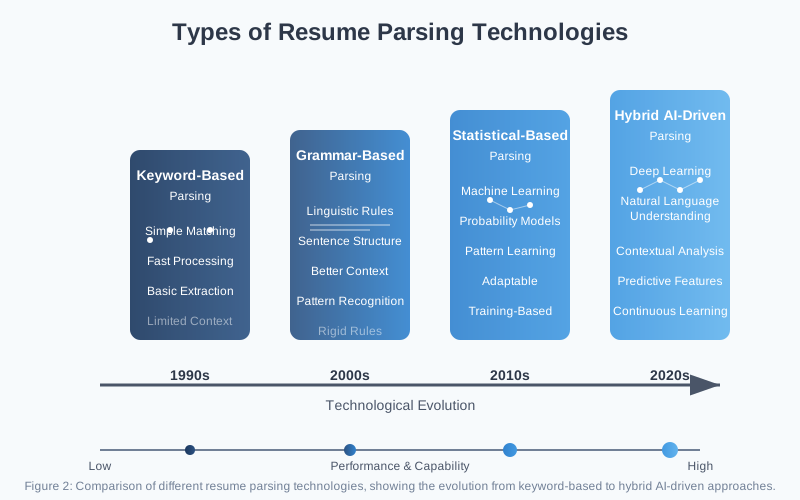
Figure 2: Comparison of different resume parsing technologies, showing the evolution from keyword-based to hybrid AI-driven approaches.
The most advanced resume parsing technologies today combine multiple approaches into hybrid systems powered by sophisticated artificial intelligence. These systems integrate rule-based components, statistical models, deep learning algorithms, and specialized domain knowledge to achieve unprecedented levels of accuracy and comprehension. Rather than relying on a single methodological approach, hybrid systems select and combine techniques based on the specific challenges presented by different resume elements.
Modern hybrid parsers typically incorporate several key technological components:
These integrated systems achieve remarkable levels of comprehension, effectively "reading" resumes with an understanding that approaches human-level analysis. They can recognize equivalent qualifications expressed in different ways, infer implied skills from described responsibilities, and normalize diverse information formats into consistent data structures.
The superiority of hybrid AI-driven parsing is particularly evident when handling complex documents, unusual formats, multiple languages, or specialized industry terminology. Organizations with sophisticated recruitment needs, high application volumes, or diverse candidate pools benefit significantly from these advanced parsing capabilities. However, these systems also represent the most complex and resource-intensive parsing solutions, requiring greater computational resources and often commanding premium pricing.
The implementation of resume parsing technology extends far beyond mere technical efficiency, fundamentally transforming how organizations approach talent acquisition and management. Understanding these broader business applications and impacts is essential for organizations seeking to leverage parsing technology effectively within their recruitment strategies.
At its most fundamental level, resume parsing dramatically improves the efficiency of the recruitment process. By automating the extraction and organization of candidate information, parsing technology eliminates countless hours of manual document review. Recruiters can instantly search for specific qualifications, filter candidates based on multiple criteria, and identify the most promising applicants within minutes rather than days.
This efficiency gain translates directly into business value through several mechanisms:
The cumulative effect of these efficiency improvements can be transformative, particularly for organizations that process large volumes of applications or recruit for positions requiring specific technical qualifications. Companies implementing sophisticated parsing solutions frequently report not only accelerated hiring timelines but also improvements in the quality of their talent acquisitions.
Beyond operational efficiency, resume parsing technology enables a fundamentally more data-driven approach to recruitment. By converting unstructured resume information into structured data, parsing systems create valuable datasets that can inform strategic decision-making throughout the talent acquisition process.
This structured data enables advanced analytics applications such as:
The analytical potential of structured resume data represents one of the most significant strategic advantages of parsing technology. Organizations that effectively leverage this data gain deeper insights into their talent pools, make more informed recruitment decisions, and develop more effective long-term talent acquisition strategies.
One of the most important applications of resume parsing technology is its potential to reduce unconscious bias in the recruitment process. Traditional manual resume screening is vulnerable to various forms of bias, including:
Advanced parsing systems mitigate these biases by focusing objectively on qualifications and relevant experience rather than subjective impressions. By structuring information consistently across all applications, these systems enable more balanced comparisons that emphasize substance over style or personal associations.
Moreover, sophisticated parsing technologies can be specifically designed to support diversity initiatives:
By reducing the influence of unconscious bias and supporting more objective candidate evaluations, resume parsing technology contributes to more diverse and meritocratic hiring practices. Organizations that effectively implement these systems often report more diverse candidate pools and hiring outcomes, representing both an ethical advantage and a competitive edge in securing varied talent and perspectives.
While the benefits of resume parsing technology are substantial, organizations must navigate several challenges to implement these systems effectively. Understanding these challenges and adopting established best practices is essential for maximizing the return on investment in parsing technology.
One of the most persistent challenges in resume parsing implementation is the extraordinary variability in resume formats, structures, and content quality. Resumes are created using countless templates, formatting approaches, and stylistic conventions. Some candidates produce highly structured documents with clear section headings and consistent formatting, while others submit dense narratives with minimal organization. This variability poses significant challenges for parsing systems, particularly when processing:
Even the most sophisticated parsing systems encounter accuracy limitations when processing highly unconventional documents. Organizations must establish realistic expectations regarding parsing accuracy and develop appropriate processes for handling exceptions and edge cases.
Resume parsing technology rarely operates in isolation but must integrate seamlessly with various other systems, including:
Each integration point introduces potential complications, particularly when connecting modern parsing technology with legacy systems that may use different data structures or communication protocols. Organizations often underestimate the complexity of these integrations, leading to implementation delays, functionality limitations, or suboptimal user experiences.
The introduction of parsing technology fundamentally changes how recruiters and hiring managers interact with candidate information. While these changes ultimately improve efficiency, they initially require significant adaptation from users accustomed to traditional document review processes. Common adoption challenges include:
Organizations that neglect the human elements of technology adoption often experience reduced user satisfaction and utilization, limiting the realized benefits of their parsing implementations.
Resume data includes sensitive personal information subject to various privacy regulations, including GDPR in Europe, CCPA in California, and numerous other regional and industry-specific requirements. Organizations implementing parsing technology must ensure that their systems:
The complexity of these requirements increases for multinational organizations processing applications across multiple jurisdictions. Parsing implementations that fail to address these compliance considerations may expose organizations to significant regulatory penalties and reputational damage.
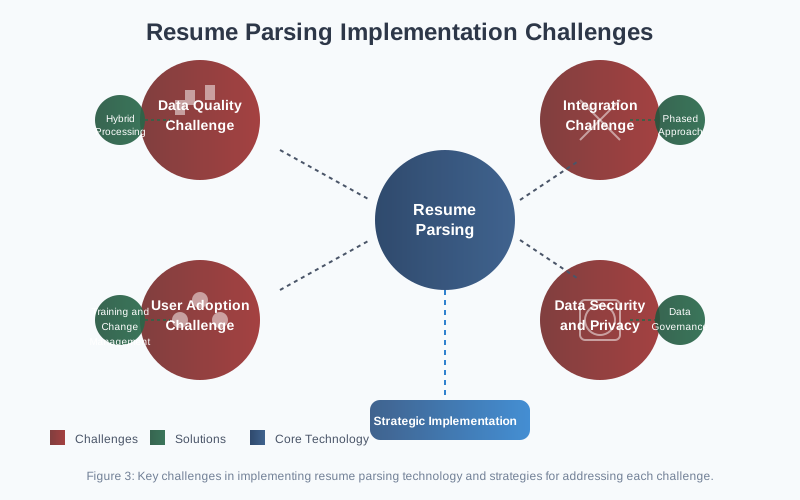
Figure 3: Key challenges in implementing resume parsing technology and strategies for addressing each challenge.
Given the complexity of resume parsing implementations, organizations typically achieve better results with phased approaches rather than immediate enterprise-wide deployments. A recommended phased implementation strategy includes:
This measured approach allows organizations to develop expertise gradually, refine their implementations based on actual usage data, and manage change more effectively than rapid enterprise-wide deployments.
The most successful implementations of resume parsing technology embrace hybrid processing models that combine artificial intelligence with human expertise. These models acknowledge that while parsing systems excel at processing high volumes of standard documents, human judgment remains valuable for handling exceptions, interpreting ambiguous information, and making nuanced evaluations.
Effective hybrid models typically include:
Organizations that implement these hybrid models typically achieve higher satisfaction from both recruiters and candidates while gradually improving their systems' autonomous performance over time.
User adoption represents one of the most frequently overlooked aspects of parsing implementation. Organizations that invest in comprehensive training and change management programs typically achieve faster adoption and higher satisfaction than those focusing exclusively on technical deployment. Effective training programs address:
Beyond formal training, change management programs should include executive sponsorship, clear communication about implementation objectives, and opportunities for users to provide feedback throughout the deployment process.
Resume parsing is not a "set and forget" technology but requires ongoing monitoring and optimization to maintain high performance levels. Organizations should establish systematic processes for:
Organizations that establish these continuous improvement processes typically experience sustained or increasing value from their parsing implementations, while those neglecting ongoing optimization often see declining performance and satisfaction over time.
The evolution of resume parsing technology continues at a rapid pace, driven by advances in artificial intelligence, changing recruitment practices, and emerging business needs. Understanding these trends helps organizations anticipate future capabilities and align their implementation strategies with evolving technological possibilities.
The next generation of resume parsing technology will leverage increasingly sophisticated natural language understanding capabilities, moving beyond current extraction techniques to develop deeper comprehension of resume content. These advancements will enable parsing systems to:
These capabilities will emerge from ongoing research in contextual language models, knowledge graph technologies, and domain-specific AI training techniques. Organizations investing in parsing technologies with strong research and development foundations will benefit from these advances as they mature.
Future parsing systems will increasingly integrate with predictive analytics capabilities, transforming from passive data extraction tools into active talent intelligence platforms. These integrated systems will:
This predictive functionality will be particularly valuable as organizations face increasingly complex talent challenges, including skill shortages, rapid job evolution, and the need to identify candidates with adaptability and growth potential rather than just current qualifications.
While current parsing systems focus primarily on text-based documents, future technologies will develop increasingly sophisticated multimodal capabilities, extracting and interpreting information from diverse formats including:
These multimodal capabilities will be particularly valuable as candidates increasingly supplement or replace traditional resumes with more dynamic and demonstrative application materials. Organizations that anticipate these trends in their parsing strategies will be better positioned to evaluate diverse candidate presentations effectively.
As both regulatory requirements and social expectations around AI ethics increase, future parsing technologies will place greater emphasis on demonstrable fairness, transparency, and bias mitigation. Advanced systems will include:
Organizations that prioritize these ethical considerations in their technology selections will not only address compliance requirements but also strengthen their employer brands through demonstrable commitments to fair and inclusive hiring practices.
The transformative potential of resume parsing technology can only be realized through strategic implementation aligned with broader organizational objectives. Based on observed best practices and emerging trends, the following recommendations can guide organizations seeking to maximize the value of their parsing implementations:
Resume parsing should not be implemented in isolation but integrated within a comprehensive talent strategy that considers:
Organizations that establish these strategic connections typically achieve greater value from their parsing implementations than those pursuing parsing purely as a tactical efficiency measure.
Given the rapid evolution of both parsing technology and recruitment practices, organizations should prioritize adaptable systems with strong learning capabilities over those offering marginally higher current accuracy. Key indicators of adaptability include:
These adaptable systems may require greater initial investment but typically deliver superior long-term value as technology and recruitment practices evolve.
The strategic value of parsed resume data extends far beyond immediate candidate selection, informing broader talent intelligence and workforce planning. Organizations should establish comprehensive data governance practices that:
These governance practices transform parsed resume data from a transactional resource into a strategic asset that informs decisions throughout the talent lifecycle.
While resume parsing technology continues to advance rapidly, human expertise remains essential for effective talent acquisition. Organizations should develop balanced operating models that:
This balanced approach delivers both the efficiency benefits of automation and the quality advantages of human expertise, creating recruitment processes that are simultaneously more scalable and more effective.
Resume parsing technology has evolved from a simple productivity tool into a fundamental component of modern talent acquisition strategies. By transforming unstructured resume data into structured, analyzable information, parsing systems enable organizations to process applications more efficiently, evaluate candidates more objectively, and make hiring decisions more effectively. These capabilities have become increasingly valuable as organizations face growing application volumes, heightened competition for talent, and mounting pressure to demonstrate fair and inclusive hiring practices.
The evolution of parsing technology continues at a rapid pace, driven by advances in artificial intelligence, changing candidate behaviors, and emerging business needs. Organizations that implement these technologies strategically—aligning them with broader talent objectives, adopting hybrid human-AI approaches, and establishing robust data governance practices position themselves for sustainable competitive advantage in talent acquisition.
As we look toward the future, resume parsing will increasingly integrate with broader talent intelligence systems, incorporating predictive analytics, multimodal capabilities, and advanced bias mitigation techniques. These developments will further transform recruitment from a document-centric process into a data-driven discipline that combines algorithmic intelligence with human judgment to identify, engage, and secure the talent organizations need to thrive in an increasingly competitive business environment.
For organizations contemplating resume parsing implementations, the key to success lies not merely in selecting the most advanced technology but in deploying it strategically, managing change effectively, and continuously optimizing performance based on evolving business needs. By approaching parsing implementation as a strategic initiative rather than a tactical automation project, organizations can realize the full transformative potential of this powerful technology.

Head IT Operations - Co Founder of Artificio
See it in your SAP environment
Bring us a document, a process, or a bottleneck. We'll show how Artificio captures, validates, and posts into SAP — then scale from there.
Security & compliance
ISO 27001:2013 certified, SOC 2 Type 2 compliant, GDPR and HIPAA ready. Every agent action is logged, auditable, and runs in isolated environments.