

Blog
AI-Driven Resume Parsing in the Modern Hiring Landscape
Discover how AI resume parsing transforms talent acquisition, enhancing efficiency and candidate matching.

Blog
Discover how AI resume parsing transforms talent acquisition, enhancing efficiency and candidate matching.
The recruitment landscape has undergone a profound transformation in recent years, with artificial intelligence emerging as a pivotal force in reshaping how organizations identify, assess, and secure talent. Among the numerous AI applications in human resources, resume parsing technology stands out as a particularly valuable innovation that addresses the fundamental challenge of efficiently processing large volumes of candidate information. As companies face increasingly competitive talent markets and growing administrative burdens, the ability to rapidly extract, organize, and analyze candidate data has become essential for maintaining competitive advantage in talent acquisition.
Resume parsing, at its core, involves the automated extraction of structured data from unstructured resume documents. While traditional parsing solutions have existed for decades, they were often limited by rigid rules-based approaches that struggled with format variations and contextual understanding. The integration of advanced artificial intelligence, particularly natural language processing (NLP) and deep learning techniques, has revolutionized this technology, enabling systems to understand nuance, context, and implicit connections within candidate documents with unprecedented accuracy.
This comprehensive analysis explores the evolution, technological underpinnings, and strategic implications of AI-driven resume parsing in contemporary recruitment practices. We examine how modern parsing solutions leverage sophisticated machine learning models to transform unstructured resume content into actionable insights, streamlining workflows and enhancing decision-making throughout the talent acquisition process. The article also considers the broader implications for recruitment strategies, candidate experiences, and evolving best practices in an increasingly AI-augmented professional landscape.
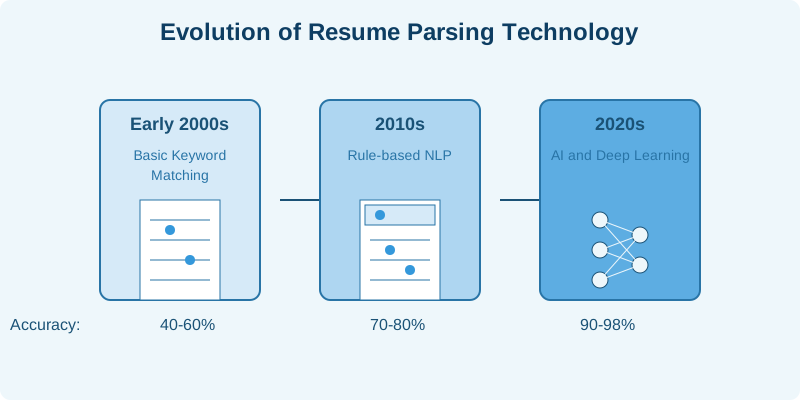
Resume parsing has undergone a remarkable evolution, progressing from simple keyword matching to sophisticated AI-powered analysis. In the early days of digital recruitment, basic parsing tools employed rule-based algorithms that searched for specific terms or patterns within documents. These systems were fundamentally limited, capable of identifying only explicit information in predictable formats and frequently stumbling when confronted with variations in layout, terminology, or document structure.
The first significant leap forward came with the introduction of natural language processing capabilities. Early NLP implementations improved pattern recognition and context sensitivity, allowing systems to better distinguish between different sections of resumes and interpret information more accurately. However, these systems still relied heavily on predefined rules and struggled with semantic understanding.
The contemporary generation of AI-powered resume parsing represents a quantum leap in capabilities. Modern systems employ deep learning architectures trained on vast datasets of resume examples, enabling them to recognize patterns and extract information with human-like comprehension. As illustrated in Figure 1 [ref: resume-parsing-evolution.svg], the progression from rules-based systems to advanced AI has dramatically increased both the accuracy and depth of information extraction from candidate documents.
Today's cutting-edge parsing solutions leverage large language models similar to GPT (Generative Pre-trained Transformer) architectures, which possess sophisticated semantic understanding capabilities. These models can interpret complex relationships between different elements of a resume, recognize specialized terminology across industries, and even infer implicit skills or qualifications not explicitly stated. This technological sophistication has transformed resume parsing from a simple data extraction tool into a comprehensive analysis platform that provides recruiters with multidimensional insights into candidate profiles.
Contemporary AI-driven resume parsing systems are built on a sophisticated technological framework that combines multiple machine learning approaches. At the foundation of these systems lies a multi-stage processing pipeline that transforms unstructured document data into structured, analyzable information.
The parsing process typically begins with document preprocessing, where various file formats (PDF, DOCX, TXT, etc.) are normalized into a consistent text representation. For scanned documents or images, this stage incorporates Optical Character Recognition (OCR) technology to convert visual text information into machine-readable format. Advanced OCR implementations can now handle various font styles, sizes, and even handwritten text with remarkable accuracy, significantly improving the processing of non-digital documents.
Following text extraction, sophisticated segmentation algorithms identify and categorize different sections of the resume. This critical step employs both visual cues (such as headings, spacing, and formatting) and semantic understanding to distinguish between sections like contact information, education history, work experience, skills, and certifications. Modern segmentation approaches utilize deep learning models trained on thousands of diverse resume examples, enabling them to recognize section patterns even in unconventional or creative resume layouts.
The core intelligence of parsing systems resides in their entity recognition and classification capabilities. Named Entity Recognition (NER) models identify specific pieces of information such as names, dates, job titles, company names, educational institutions, and technical skills. Contemporary NER implementations in resume parsing employ bidirectional transformers and attention mechanisms that consider the full context of the document when classifying each entity, dramatically improving accuracy over earlier approaches that analyzed text in isolation or within limited windows.
These technological foundations enable modern parsing systems to handle complex challenges that confounded earlier generations of tools, including:
The technical sophistication of these systems continues to advance rapidly, with ongoing developments in transformer-based architectures, few-shot learning techniques, and multimodal approaches that combine textual and visual understanding for enhanced parsing precision.
Modern AI-driven resume parsing systems offer a sophisticated suite of capabilities that extend far beyond simple data extraction. These advanced features transform the technology from a mere administrative tool into a strategic asset for talent acquisition teams seeking competitive advantage in tight labor markets.
The cornerstone of effective parsing technology lies in its ability to accurately identify and extract a wide range of information from diverse resume formats. Contemporary systems excel at recognizing standard fields such as contact details, work history, and educational background, but their capabilities extend much further. Advanced parsers can identify and classify specialized certifications, technical skills with proficiency levels, project contributions, publications, patents, and even soft skills implied through accomplishment descriptions.
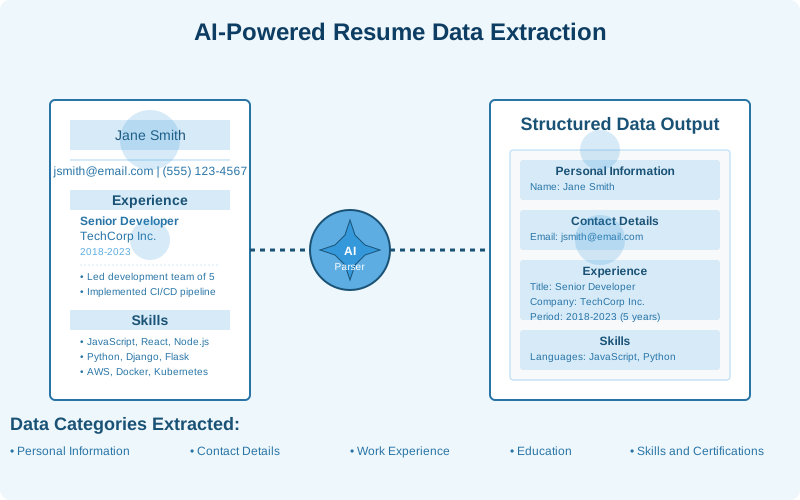
Particularly noteworthy is how these systems handle complex nested information structures. For instance, within a single work experience entry, modern parsers can distinguish between job titles, employment periods, employer details, responsibilities, achievements, and technologies used all while maintaining the hierarchical relationships between these elements. This granular extraction enables much more sophisticated candidate matching and analysis than was previously possible.
As illustrated in Figure 2 [ref: parsing-data-extraction.svg], AI-powered parsing systems typically extract dozens of distinct data points from each resume, creating a multidimensional profile that enables precise candidate-to-job matching. The richness of this extracted data provides recruiters with unprecedented insight into candidate qualifications without manual review of individual documents.
A significant advancement in modern parsing technology is the ability to process virtually any resume format with high accuracy. Contemporary systems handle traditional formats like chronological, functional, and combination resumes alongside more creative or nontraditional presentations. This format-agnostic capability is particularly valuable in creative industries where candidates often use distinctive layouts to showcase their design sensibilities.
This flexibility extends to the technical format of submitted documents as well. Advanced parsing solutions seamlessly process PDFs (both text-based and image-based), Word documents, plain text files, HTML, and even images of printed resumes. The integration of sophisticated OCR technology enables high-quality text extraction from scanned documents, photographs, or unconventional digital formats, ensuring that no candidate is excluded due to document formatting choices.
Multilingual support represents another crucial dimension of format flexibility. Leading parsing solutions now support dozens of languages, recognizing the global nature of talent acquisition in the modern economy. These systems not only extract text in multiple languages but understand the semantic meaning and professional context across linguistic boundaries, enabling truly global talent searches without language barriers.
Perhaps the most significant advancement in modern resume parsing is the shift from syntactic to semantic understanding of content. Earlier generations of parsing technology relied primarily on pattern matching and keyword recognition, which frequently led to misinterpretations when confronted with ambiguous terminology or industry-specific jargon.
Contemporary AI-driven systems employ deep contextual analysis to resolve ambiguities and extract meaning rather than merely identifying words. For example, when encountering the term "Python," these systems can distinguish whether it refers to programming language expertise, experience with scientific computing libraries, or an unrelated reference based on surrounding context. This semantic intelligence dramatically reduces false positives and misclassifications that plagued earlier parsing technologies.
This contextual understanding extends to the interpretation of professional achievements and responsibilities. Modern systems can recognize accomplishment patterns across different industries and roles, enabling them to standardize diverse achievement descriptions into comparable metrics. For instance, parsing systems can identify and normalize various expressions of revenue growth, cost reduction, efficiency improvement, or team leadership, creating standardized achievement profiles that facilitate objective comparison across candidates.
Advanced parsing systems now incorporate sophisticated skill taxonomies and professional ontologies that organize extracted information into structured knowledge representations. These taxonomies enable the system to understand relationships between different skills, technologies, and qualifications, creating a semantic network of professional capabilities.
For example, when a parser identifies experience with "React.js," its ontology might automatically recognize this as a JavaScript framework and establish relationships to broader categories like front-end development, web technologies, and user interface programming. This hierarchical organization allows recruiters to search for candidates with specific technical proficiencies or broader capability categories without needing to specify every related keyword.
The most sophisticated systems continuously update these taxonomies through machine learning, recognizing emerging skills, technologies, and job functions as they appear in candidate resumes. This adaptive approach ensures that parsing systems remain current with rapidly evolving professional landscapes, particularly in technology-intensive fields where new skills emerge frequently.
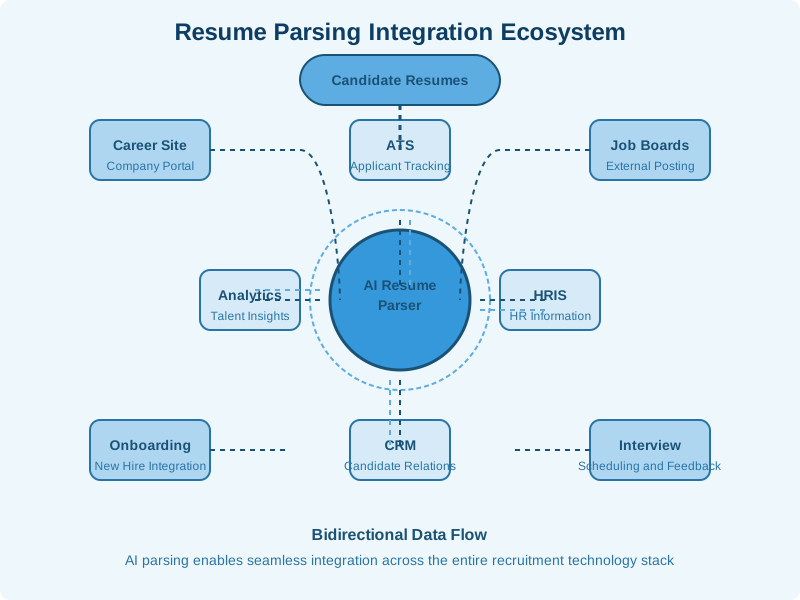
Modern parsing solutions are designed for seamless integration with broader recruitment technology ecosystems. Advanced APIs and pre-built connectors enable parsing systems to communicate bidirectionally with applicant tracking systems (ATS), customer relationship management (CRM) platforms, human resource information systems (HRIS), and other talent acquisition tools.
These integration capabilities support end-to-end automation of recruitment workflows. For example, a candidate submission can trigger automatic parsing, profile creation in the ATS, preliminary qualification assessment, and personalized communication all without manual intervention. This automation dramatically reduces administrative burden while accelerating the recruitment process, allowing talent acquisition professionals to focus on high-value activities like candidate engagement and selection decision-making.
Beyond standard HR systems, leading parsing technologies now offer integration with productivity tools like spreadsheet applications, email platforms, and workflow automation services. These connections enable organizations to build customized talent acquisition pipelines tailored to their specific processes and technology environments, enhancing flexibility and adoption.
As organizations increasingly prioritize diversity, equity, and inclusion in their hiring practices, advanced parsing systems have evolved to address potential sources of algorithmic bias. Contemporary solutions incorporate specialized algorithms and processing approaches designed to minimize the impact of irrelevant personal characteristics on candidate evaluation.
Leading parsing technologies now offer anonymization features that can automatically redact personally identifying information such as names, addresses, graduation dates, and photos elements that may trigger unconscious bias among human reviewers. By focusing analysis strictly on relevant qualifications and experience, these systems help organizations implement more objective candidate evaluation processes.
Ethical implementation extends beyond simple anonymization to encompass the entire model development and training process. Leading vendors now employ diverse training datasets, regular bias auditing, and continuous model refinement to ensure their systems treat all candidates equitably regardless of background. These ethical considerations have become increasingly central to parsing system design as organizations recognize both the moral and business imperative of fair hiring practices.
Successful deployment of AI-driven resume parsing technology requires a thoughtful, strategic approach that extends beyond simple software installation. Organizations that achieve the greatest return on investment typically follow a structured implementation process that encompasses technological integration, workflow redesign, and stakeholder engagement.
The implementation journey begins with a comprehensive needs assessment that identifies specific organizational challenges and objectives for resume parsing technology. This assessment should include an audit of existing recruitment workflows, identification of current bottlenecks, and quantification of time and resources currently devoted to manual resume review. Leading organizations also establish clear key performance indicators (KPIs) during this stage, creating measurable objectives against which implementation success can be evaluated.
Stakeholder engagement represents a critical component of the planning process. Successful implementations typically involve not only talent acquisition leaders but also hiring managers, IT specialists, compliance officers, and frontline recruiters. This cross-functional approach ensures that parsing technology addresses the needs of all participants in the recruitment process while preemptively addressing potential technical or procedural obstacles.
Technology selection should proceed from this foundation of clearly articulated needs and objectives. Organizations must evaluate parsing solutions across multiple dimensions, including accuracy rates, supported languages and formats, integration capabilities, compliance features, and scalability. The most successful implementations often begin with proof-of-concept testing using representative resume samples from the organization's actual candidate pool, ensuring that the selected technology performs as expected with industry-specific terminology and document formats.
Seamless integration with existing recruitment technology represents a critical success factor for parsing implementations. Advanced parsing solutions offer multiple integration pathways, including direct API connections, pre-built connectors for popular ATS platforms, and middleware solutions that facilitate data exchange across disparate systems.
As depicted in Figure 3 [ref: parsing-ecosystem-integration.svg], the parsing technology typically sits at the center of a complex ecosystem of recruitment tools and information systems. Data flows bidirectionally between these systems, with the parser serving as both a data source and a data consumer in the broader technology landscape. Careful mapping of these data flows ensures that parsed information reaches the appropriate destination systems without duplication or information loss.
Integration planning should address both technical and procedural dimensions. Beyond establishing the necessary API connections or data transfer mechanisms, organizations must design workflows that leverage parsed data at appropriate decision points. This may involve creating new fields in the ATS to capture specific parsed data points, configuring automated actions triggered by parser results, or designing customized reports that leverage the enhanced data visibility provided by parsing technology.
Establishing robust data governance practices represents an essential component of successful implementation. Organizations must develop clear policies regarding data retention, candidate privacy, information security, and compliance with relevant regulations such as GDPR, CCPA, or industry-specific data protection frameworks. These policies should address not only the parsed data itself but also the original resume documents, which may contain sensitive personal information.
Quality assurance processes are equally important for maintaining system efficacy over time. Leading implementations incorporate regular auditing procedures to verify parsing accuracy, identify potential issues with specific document formats or content types, and ensure that the system continues to perform as expected despite evolving resume trends or terminology changes. These audits typically involve random sampling of parsed results for manual verification, with findings used to guide system refinements or parser configuration adjustments.
Organizations with sophisticated implementations often establish feedback loops between recruitment teams and parsing technology providers. These mechanisms enable rapid identification and resolution of parsing inaccuracies, while simultaneously providing valuable training data that contributes to ongoing algorithm improvements. This collaborative approach benefits both individual organizations and the broader parsing technology ecosystem.
The human dimension of implementation warrants careful attention, as even the most sophisticated parsing technology delivers value only when effectively utilized by recruitment teams. Comprehensive training programs should address not only the technical operation of parsing tools but also how to interpret and leverage parsed data for improved decision-making. Advanced training approaches often include role-specific modules tailored to the distinct needs of recruiters, hiring managers, and recruitment operations specialists.
Change management represents an equally important consideration, particularly in organizations transitioning from highly manual processes. Effective implementations typically include clear communication regarding the purpose and benefits of parsing technology, transparency about how the technology works, and explicit guidance on the evolving roles of human recruiters in an AI-augmented workflow. This approach helps address potential resistance while fostering a positive perception of the technology as an enabler rather than a replacement for human expertise.
Progressive deployment strategies can facilitate user adoption and system refinement. Many successful implementations begin with a limited-scope pilot focused on specific departments or job categories, allowing for process optimization before organization-wide rollout. This incremental approach provides opportunities to gather user feedback, refine workflows, and demonstrate concrete benefits that can build momentum for broader deployment.
The implementation of advanced AI-driven resume parsing yields multifaceted benefits that extend far beyond simple operational efficiency. Organizations that successfully deploy this technology typically experience transformative impacts across multiple dimensions of their talent acquisition function.
The most immediate and quantifiable benefit involves dramatic reductions in administrative burden and processing time. Traditional manual resume screening represents one of the most time-intensive activities in recruitment, with studies suggesting that recruiters spend an average of 23 hours reviewing resumes for a single hire. Advanced parsing technology can reduce this time investment by 75-80%, automatically extracting relevant information and presenting it in standardized formats that facilitate rapid assessment.
This efficiency gain manifests in measurable improvements in key recruitment metrics. Time-to-fill typically decreases by 20-30% following parsing implementation, while recruiter productivity measured by candidates processed or positions filled per recruiter often increases by 35-40%. These improvements are particularly pronounced in high-volume recruitment scenarios or during periods of organizational growth, where manual processes quickly become unsustainable.
Beyond time savings, parsing technology dramatically improves data consistency and completeness. Manual data entry into ATS systems is notoriously prone to errors and omissions, with studies suggesting error rates between 5-15% depending on process maturity. Automated parsing reduces these errors to negligible levels while ensuring comprehensive capture of relevant information from every resume, creating more complete and reliable candidate databases.
Perhaps the most strategically significant benefit involves improvements in candidate matching precision and, ultimately, quality of hire. Traditional keyword-based matching approaches frequently lead to both false positives (irrelevant candidates who happen to use the right terminology) and false negatives (qualified candidates who express their qualifications using unexpected terminology). Advanced parsing technology with semantic understanding capabilities dramatically reduces these matching errors.
The richness of parsed data enables much more sophisticated matching algorithms that consider not only explicit skills and experiences but also contextual factors, career progression patterns, and accomplishment indicators. Leading organizations leverage this multidimensional matching to identify candidates whose profiles suggest a high probability of success in specific roles, often recognizing potential in candidates who might be overlooked in traditional screening processes.
This improved matching capability translates into quantifiable business outcomes. Organizations with mature implementations typically report 15-25% improvements in quality-of-hire metrics such as hiring manager satisfaction, new hire performance ratings, and first-year retention. The financial impact of these improvements can be substantial, particularly for knowledge-intensive roles where the cost of a poor hire can exceed 150% of annual salary when considering direct recruitment costs, training investments, and productivity implications.
Parsing technology contributes significantly to enhanced candidate experiences throughout the recruitment journey. By enabling faster application processing and more relevant candidate-to-job matching, parsing systems help organizations provide timely responses and appropriate opportunity suggestions to candidates. This responsiveness represents a critical competitive advantage in tight labor markets where top talent may receive multiple competing offers.
The most sophisticated implementations leverage parsing technology to enable hyper-personalized candidate communication. By understanding the specific skills, experiences, and career patterns of each candidate, organizations can provide tailored information about how their background aligns with position requirements, offer personalized insights about potential career paths within the organization, and suggest specific preparation strategies for upcoming interviews. This personalization demonstrates organizational attentiveness and respect for candidate time, substantially enhancing employer brand perception.
Parsing technology also supports improved candidate experiences by reducing repetitive information requests. Once a candidate's resume has been parsed into the structured database, they can be spared the common frustration of manually re-entering the same information across multiple application stages or for different positions within the same organization. This streamlined experience reduces application abandonment rates and improves overall candidate satisfaction with the recruitment process.
Beyond its operational benefits, parsing technology provides organizations with unprecedented visibility into talent market dynamics and internal workforce capabilities. By aggregating and analyzing parsed data from thousands of resumes, organizations gain valuable intelligence regarding skill distribution, experience patterns, and credential prevalence within their candidate pools.
Leading organizations leverage this intelligence for strategic workforce planning initiatives. Systematic analysis of parsing data reveals emerging skill clusters, identifies potential talent gaps compared to future business requirements, and highlights opportunities for internal development versus external recruitment. This data-driven approach to workforce planning represents a significant advancement over traditional methods that relied heavily on anecdotal market observations or generic industry reports.
The most sophisticated implementations extend this analytical capability to proactive talent acquisition strategies. By understanding the specific characteristics and career patterns of high-performing employees, organizations can develop targeted sourcing approaches for candidates with similar profiles. This predictive recruitment capability represents a powerful competitive advantage, particularly for organizations in fast-growing or highly specialized fields where traditional reactive recruitment methods prove insufficient.
When thoughtfully implemented, parsing technology can serve as a powerful tool for advancing diversity, equity, and inclusion objectives. By focusing initial screening on objective qualifications rather than factors that may trigger unconscious bias, parsing systems help organizations build more diverse candidate slates and ultimately more representative workforces.
The anonymization capabilities offered by advanced parsing solutions represent a particularly valuable mechanism for bias reduction. By automatically redacting personally identifying information such as names, addresses, graduation dates, and photos elements that may trigger unconscious bias among human reviewers these systems help ensure that initial candidate evaluations focus strictly on relevant qualifications and experiences. Organizations that implement structured anonymization typically report 20-30% increases in demographic diversity among candidates advancing to interview stages.
Beyond anonymization, the most sophisticated implementations leverage parsing data to identify and address potential bias patterns within existing recruitment processes. Systematic analysis can reveal whether certain language patterns or qualification descriptions disproportionately impact specific candidate groups, enabling evidence-based refinement of job requirements and evaluation criteria. This continuous improvement approach helps organizations progressively eliminate structural barriers to workforce diversity.
Despite the impressive capabilities of modern AI-driven resume parsing, several challenges and limitations merit consideration by organizations implementing these technologies. Understanding these constraints enables more realistic expectations and appropriate risk mitigation strategies.
While contemporary parsing systems handle most standard resume formats with high accuracy, they may still struggle with highly unconventional or creative presentations. Resumes that employ unusual visual layouts, contain significant graphical elements, or deliberately subvert traditional formatting conventions can challenge even the most sophisticated parsing algorithms. This limitation is particularly relevant in creative industries where candidates often use resumes as portfolio pieces to demonstrate design capabilities.
Similarly, parsing systems may encounter difficulties with industry-specific or emerging terminology not represented in their training datasets. Although leading vendors continually update their models, there inevitably exists a lag between the emergence of new terms, technologies, or job functions and their incorporation into parsing models. Organizations in rapidly evolving fields or niche industries should conduct thorough accuracy testing with representative resume samples before deployment.
The handling of ambiguous or context-dependent information represents another persistent challenge. For instance, determining whether a particular skill is merely mentioned or represents a core competency often requires nuanced contextual understanding that remains challenging for even advanced AI systems. Similarly, inferring seniority levels from job titles that may have different meanings across industries or organizations remains difficult for automated systems without industry-specific calibration.
The fundamentally unstructured nature of resume data poses inherent challenges for parsing systems. Unlike information submitted through structured forms, resume content follows no universal standard regarding terminology, section organization, or detail level. This heterogeneity inevitably leads to some degree of information loss or misinterpretation during the parsing process, particularly for nuanced elements like scope of responsibilities or achievement context.
Candidate-provided information quality represents another significant variable affecting parsing accuracy. Resumes often contain inconsistencies, gaps, or deliberately ambiguous phrasing that can challenge interpretation even by human reviewers. While sophisticated parsing systems employ various techniques to handle incomplete or inconsistent information, their performance inevitably degrades when processing resumes with significant quality issues.
International variations in resume conventions add another layer of complexity. Education credentials, professional certifications, and career progression patterns differ substantially across countries and regions. Although leading parsing systems incorporate international awareness, they may still struggle with less common international formats or regional nuances, particularly from emerging markets with less representation in training datasets.
Technical integration complexity represents a significant challenge for many organizations, particularly those with legacy recruitment systems or complex technology ecosystems. While modern parsing solutions offer robust API capabilities, achieving seamless data flow across disparate systems often requires substantial configuration effort and specialized integration expertise. Organizations with limited technical resources may find this integration process challenging without external support.
Data security and compliance considerations add further complexity to implementation. Resume documents contain sensitive personal information subject to various privacy regulations, including GDPR, CCPA, and industry-specific frameworks. Ensuring that parsing processes maintain appropriate data protection throughout the information lifecycle including data transfer, storage, retention, and deletion requires careful system design and governance policies.
Performance at scale constitutes another technical consideration, particularly for organizations processing large resume volumes. While most parsing solutions handle individual documents efficiently, processing thousands of resumes simultaneously during high-volume recruitment campaigns can stress system resources and potentially affect performance. Organizations with periodic high-volume recruiting needs should ensure their selected solution includes appropriate scaling capabilities.
Perhaps the most significant challenges involve ethical dimensions of AI implementation in recruitment. Despite significant advances in bias mitigation, parsing systems inevitably reflect some degree of historical patterns present in their training data. If not carefully designed and monitored, these systems may perpetuate or amplify existing biases in talent evaluation processes.
Certain parsing approaches may systematically advantage candidates from specific backgrounds who are more likely to use expected terminology or presentation formats. For example, candidates educated in prestigious universities or employed by well-known companies often use terminology that closely aligns with conventional parsing expectations, potentially creating subtle advantages over equally qualified candidates who express their qualifications using different language patterns.
Transparency limitations represent another ethical concern. Most commercial parsing solutions employ proprietary algorithms that function as "black boxes," making it difficult for organizations to fully understand how specific parsing decisions are made. This opacity complicates efforts to identify and address potential bias patterns or ensure that parsing systems align with organizational values and compliance requirements.
Organizations can address these challenges through thoughtful implementation strategies and operational safeguards. Regular accuracy auditing represents an essential practice, involving systematic review of parsing results across diverse resume samples to identify and address any systematic errors or biases. These audits should specifically include resumes from underrepresented groups and non-traditional career paths to ensure equitable performance across diverse candidate pools.
Hybrid human-AI workflows offer another effective approach to managing parsing limitations. By designing processes where human recruiters review parsing results for complex or ambiguous cases, organizations can combine technological efficiency with human judgment for optimal outcomes. These hybrid approaches should clearly delineate which decisions rely on automated parsing versus human evaluation, with appropriate governance for each category.
Continuous feedback mechanisms enable progressive improvement of parsing accuracy. By establishing systematic processes for recruiters to flag parsing errors or misinterpretations, organizations create valuable training data that can be used to refine parsing models over time. These feedback loops should be integrated into daily workflows rather than implemented as separate processes to ensure consistent participation and data collection.
The evolution of resume parsing technology continues at a rapid pace, with several emerging trends poised to further transform recruitment practices in the coming years. These developments promise to address current limitations while extending parsing capabilities into new domains of talent assessment and matching.
One of the most promising developments involves multimodal parsing capabilities that extend beyond text analysis to incorporate visual elements, audio content, and interactive media. As candidates increasingly supplement traditional resumes with portfolio websites, video introductions, and digital projects, parsing technology is evolving to extract structured information from these diverse content types.
Advanced computer vision techniques enable the extraction of relevant information from images, diagrams, and visual portfolios, while speech recognition and natural language processing allow for the analysis of video presentations or audio statements. These capabilities are particularly valuable for creative roles where traditional text resumes may inadequately represent candidate capabilities.
The integration of these multimedia elements creates a much more comprehensive candidate profile than possible through text analysis alone. Organizations at the forefront of parsing technology are already implementing solutions that create unified candidate profiles incorporating information from traditional resumes, social media presence, portfolio sites, and video introductions, providing unprecedented visibility into candidate capabilities and potential fit.
The convergence of parsing technology with predictive analytics represents another transformative development in the talent acquisition landscape. By correlating parsed resume attributes with subsequent performance and retention data, organizations can develop increasingly sophisticated models that predict candidate success likelihood in specific roles or organizational contexts.
These predictive capabilities extend far beyond traditional keyword matching or qualification screening. Advanced implementations analyze subtle patterns in career progression, accomplishment descriptions, skill combinations, and even writing style to identify candidates likely to excel in particular organizational environments. This approach enables truly proactive talent acquisition strategies focused on long-term performance potential rather than merely current skill possession.
Leading organizations are beginning to implement "success pattern recognition" approaches that identify common characteristics among high performers in specific roles. These patterns then inform both candidate evaluation criteria and targeted sourcing strategies, creating virtuous cycles of increasingly refined talent identification and development. As these models mature, they promise to substantially increase the predictive validity of recruitment processes while reducing reliance on subjective evaluation methods.
The traditional model of point-in-time resume parsing is evolving toward continuous candidate evaluation approaches that maintain dynamic talent pools with regularly updated information. Rather than parsing a resume once during initial application, advanced systems now continuously refresh candidate profiles by incorporating new information from social profiles, professional activities, skill certifications, and other publicly available sources.
This dynamic approach enables much more sophisticated talent pool management than previously possible. Organizations can maintain continuously refreshed "talent communities" organized by skill clusters, experience levels, and potential organizational fit. When new positions open, these pre-qualified and current talent pools enable dramatically faster matching and outreach than traditional recruitment methods that essentially restart the candidate identification process for each vacancy.
The most advanced implementations incorporate "talent nurturing" automation that maintains ongoing relationships with promising candidates through personalized content delivery, development recommendations, and periodic engagement touchpoints. This approach transforms talent acquisition from a transactional process to a continuous relationship management function, substantially improving both candidate experience and recruitment efficiency.
Emerging approaches to AI development promise to address some of the current limitations in parsing technology through collaborative learning models. Federated learning techniques enable parsing systems to improve through distributed learning across multiple organizations without centralizing sensitive resume data. This approach allows parsing algorithms to benefit from diverse training examples while maintaining strict data privacy and security.
Industry-specific parsing consortiums represent a particularly promising application of this approach. Organizations within specific sectors can collaborate on parser training and refinement for their unique terminology and qualification frameworks without sharing actual candidate data. These collaborative approaches accelerate the development of highly specialized parsing capabilities that would be difficult for individual vendors to achieve independently.
Open skills taxonomies and standardized competency frameworks are emerging as complementary developments that further enhance parser accuracy and interoperability. By establishing common skills definitions and hierarchical relationships between competencies, these frameworks provide crucial reference structures that improve parsing consistency across different systems and organizations. As these frameworks mature and gain industry adoption, they promise to substantially enhance the precision and utility of parsed candidate data.
The evolution of AI-driven resume parsing from simple data extraction to sophisticated candidate analysis represents one of the most significant technological transformations in modern talent acquisition. As organizations navigate increasingly competitive talent markets and growing administrative complexities, the strategic implementation of advanced parsing capabilities has become not merely an operational enhancement but a fundamental competitive necessity.
The most successful organizations recognize that parsing technology delivers value far beyond administrative efficiency. When thoughtfully implemented and integrated with broader talent strategies, these systems enable truly data-driven recruitment approaches that enhance decision quality, improve candidate experiences, and ultimately contribute to superior workforce capabilities. The relationship between parsing accuracy and recruitment outcomes is direct and measurable—organizations with more sophisticated parsing capabilities consistently demonstrate improvements in time-to-fill, quality-of-hire, and diversity metrics compared to those relying on more traditional approaches.
Looking forward, parsing technology will increasingly blur the boundaries between recruitment and broader talent management functions. As parsed candidate data becomes more comprehensive and predictive, it will inform not only initial hiring decisions but also onboarding strategies, development planning, internal mobility programs, and even organizational design initiatives. This evolution positions the parsing function as a critical foundation for the data-driven talent ecosystem that increasingly defines competitive advantage in knowledge-intensive industries.
Organizations seeking to capitalize on these opportunities should approach parsing implementation as a strategic initiative rather than merely a technical deployment. This perspective involves clear alignment with broader talent objectives, thoughtful integration with existing processes, appropriate change management for affected stakeholders, and systematic measurement of business outcomes. With this strategic approach, parsing technology becomes not simply another recruitment tool but a fundamental enabler of talent excellence in an increasingly competitive and dynamic business environment.

Head IT Operations - Co Founder of Artificio
See it in your SAP environment
Bring us a document, a process, or a bottleneck. We'll show how Artificio captures, validates, and posts into SAP — then scale from there.
Security & compliance
ISO 27001:2013 certified, SOC 2 Type 2 compliant, GDPR and HIPAA ready. Every agent action is logged, auditable, and runs in isolated environments.