Every SAP architect eventually hits the same crossroads. The business has approved an intelligent document processing platform. The proof of concept went well. Now someone in the room asks the question that actually matters: "How does it connect to SAP?"
That question is deceptively simple. The answer shapes everything, from how fast the integration goes live, to how well it handles exceptions, to how much maintenance the team carries five years from now. Two answers dominate most conversations: IDocs or APIs. Both work. Neither is universally better. The right choice depends on what your SAP environment looks like, what your document volumes demand, and how much operational complexity your team can absorb.
This guide is written for SAP architects and IT leads who need a clear-eyed comparison, not a vendor pitch. We will walk through how both methods work when connecting a document AI platform like Artificio to SAP, where each one genuinely excels, and what questions to ask before you commit.
Understanding the Two Approaches
Before comparing them, it is worth being precise about what each method actually does.
An IDoc (Intermediate Document) is SAP's native document exchange format. It has been part of the SAP ecosystem since R/3. IDocs define a fixed structure for transmitting business data, whether that is an invoice header, a goods receipt, or a purchase order. When an external system sends an IDoc to SAP, it follows a defined message type (like INVOIC02 or ORDERS05) and arrives through the ALE (Application Link Enabling) framework, the IDoc interface, or more recently through BTP integration scenarios. SAP processes the IDoc according to its own internal logic, posts the resulting business document, and confirms success or failure.
An API integration, by contrast, connects to SAP through exposed service endpoints. In modern SAP landscapes, this typically means RFC function modules, BAPIs (Business Application Programming Interfaces), OData services on SAP Gateway, or REST/SOAP services exposed through the SAP Integration Suite. The external system calls these endpoints directly, passes structured data, and receives a synchronous or asynchronous response.
Both methods move data from outside SAP into SAP. The differences show up in how they move it, when, and what happens when something goes wrong.
Where IDocs Have the Advantage
IDoc integration earns its reputation for a reason. In environments where SAP ECC is the dominant system and the integration team has deep SAP Basis and ABAP knowledge, IDocs offer a level of native reliability that is hard to match.
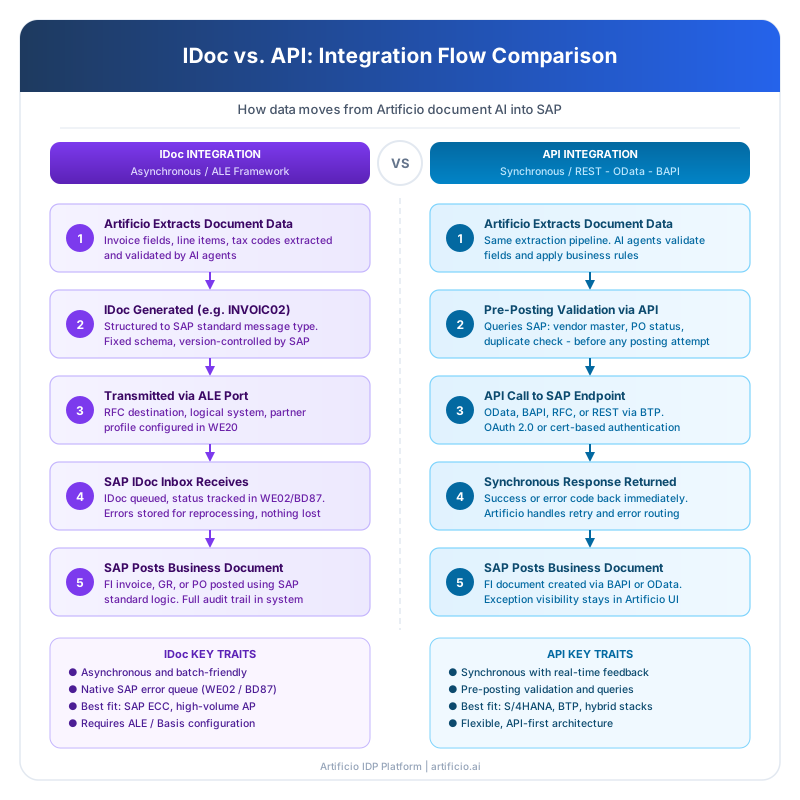
When Artificio processes a vendor invoice and extracts header data, line items, tax amounts, and payment terms, that extracted data needs to land cleanly in SAP as a parked or posted FI document. Through an IDoc path, Artificio generates a well-formed INVOIC02 IDoc, transmits it to SAP's IDoc inbox, and SAP's standard posting logic takes over from there. The process is asynchronous by design. If the IDoc posting fails because a vendor master record is missing or a GL account cannot be determined, SAP flags the IDoc with a specific error status and stores it for reprocessing. Nothing is lost.
This error tolerance is one of the most underappreciated aspects of IDoc-based integration. The IDoc stays in the system. Your team can see it in BD87 or WE02, diagnose the issue, fix the underlying data problem, and reprocess without re-running the entire extraction pipeline. For high-volume AP operations processing thousands of invoices a day, this matters enormously.
IDocs also provide detailed audit trails at no extra development cost. Every IDoc gets a unique number, a status history, and a timestamp. Compliance teams love this. Auditors can trace exactly what arrived, when it was posted, and what triggered any manual intervention.
The trade-off is setup complexity. Configuring the partner profile, the logical system, the port, and the message type in transaction WE20 takes time and requires someone who knows SAP ALE well. For teams working exclusively in SAP ECC with established Basis expertise, this is routine. For teams that have already moved partly to S/4HANA or are working in a hybrid landscape, the picture gets more complicated.
Where APIs Have the Advantage
API integration has become the default approach for most new SAP projects, and the reasons are practical rather than ideological.
The first reason is flexibility. An API call can do things an IDoc cannot, at least not without custom development. It can query SAP before posting, checking whether a vendor exists, whether a purchase order is open, or whether a duplicate invoice already sits in the system. It can retrieve SAP master data to validate extracted fields in real time. It can trigger workflows, update custom fields, and respond to conditions that standard IDoc message types never anticipated.
For Artificio's integration scenarios, this matters in specific ways. Take a three-way match scenario where an invoice needs to be validated against a purchase order and a goods receipt before posting. An API integration lets Artificio query the PO status through an OData call, confirm the GR exists, and only then push the invoice into SAP. An IDoc-based approach would post the invoice and rely on SAP's own matching logic afterward, which works but means the exception handling happens inside SAP rather than before the document arrives.
The second reason is modern stack compatibility. If your SAP environment includes S/4HANA with exposed OData or REST APIs, or if you are routing integrations through SAP BTP Integration Suite (formerly CPI), the API path aligns with how the platform is designed to work. SAP's own roadmap points toward API-first integration. Building new integrations on IDoc in a clean S/4HANA environment means working against the grain of where SAP is heading.
The third reason is speed of iteration. API integrations are typically easier to test, mock, and update than IDoc configurations. When extraction logic changes or a new document type gets added, updating an API payload requires less SAP-side configuration than updating an IDoc message type or partner profile.
The trade-off with APIs is error handling. Synchronous API calls fail immediately and visibly, which is both good and bad. Good, because you know instantly that something went wrong. Bad, because the calling system (Artificio, in this case) needs to manage retries, dead-letter queues, and failure notifications. This is solvable with proper integration architecture, but it requires deliberate design. Asynchronous API patterns through BTP can bridge this gap, but they add architectural layers that pure IDoc setups do not need.
The SAP Landscape Question
The single biggest factor in this decision is the state of your SAP environment, not your preferences about integration style.
If you are running SAP ECC 6.0 with limited customisation of the IDoc framework and a Basis team that manages ALE configurations regularly, IDocs are the path of least resistance. The infrastructure is already there. The expertise is on staff. The monitoring tools are familiar. Adding Artificio to an existing IDoc ecosystem is additive, not transformative.
If you are on S/4HANA, or if you have a significant portion of your integration landscape running through SAP Integration Suite, API integration will be cleaner, faster to implement, and easier to maintain long-term. S/4HANA still supports IDocs for backward compatibility, but the native API surface is far richer and the documentation is better.
If you are in a hybrid landscape, which is where most large enterprises actually sit, the answer is often both. Artificio's architecture supports this. Accounts payable invoices flowing into an ECC backend might use IDocs for the posting step while using an API call to validate vendor master data in the MDG system. Purchase order recognition workflows might trigger via API while confirmation IDocs come back from SAP to update Artificio's processing status.
Hybrid is not a failure to choose. It is often the right engineering answer for complex landscapes.
Document Volume and Processing Speed
Volume considerations affect this decision more than most architects initially expect.
IDoc processing is asynchronous and batch-friendly. SAP processes IDocs in sequence within a given partner and message type, and high IDoc volumes can create queue backlogs if the processing job frequency is not tuned correctly. For most AP operations, this is manageable. For extremely high-velocity scenarios, such as logistics document processing at a distribution centre receiving hundreds of delivery notes per hour, IDoc queue management becomes a specific operational concern.
API integration, particularly synchronous API calls, creates a different kind of load. Each call occupies a work process in SAP for its duration. Under high concurrency, this can affect SAP system performance if connection pooling and throttling are not configured. Asynchronous API patterns or BTP-mediated integration mitigate this, but they add latency.
For most enterprise document AI deployments, neither of these constraints is a hard blocker. They are tuning considerations. The right question is not which method is faster in theory, but which one your team can monitor, tune, and maintain under production load with the tools and skills you actually have. 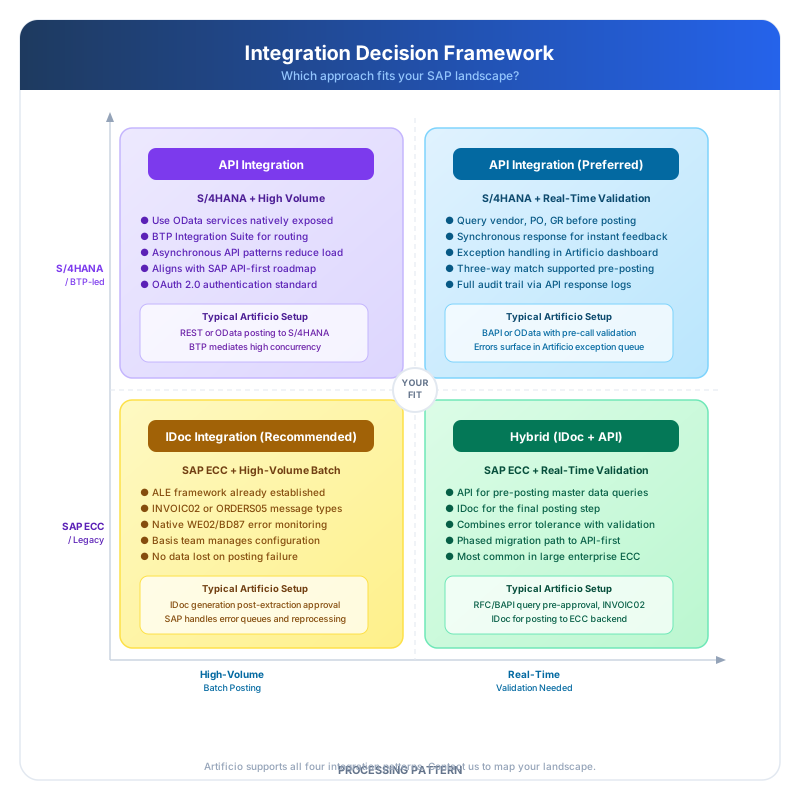
Error Handling and Exception Management
This section deserves more attention than it usually gets in integration discussions.
The practical question is not whether errors will occur. They will. Vendor master records will be missing. GL accounts will be wrong. Tax codes will not match. The question is what happens when they do, and who handles it.
In an IDoc-based integration, SAP owns the error. The IDoc sits in the inbox with a status code. Your SAP team works the exception queue directly in the system they already monitor. The document AI platform does not need to know the reason for the failure, only that the IDoc was not posted. Reprocessing happens in SAP after the underlying issue is resolved.
In an API-based integration, the error response comes back to the calling system immediately. Artificio receives the error code, logs it, and (depending on configuration) either retries automatically, routes to a human exception queue, or escalates via notification. This keeps exception visibility in the document AI platform's own interface, which operators find useful because they are already working there to manage extraction quality and approval workflows.
Neither model is strictly better. The IDoc model is better if your exception handling processes are SAP-centric and your AP team is comfortable working in SAP transaction screens. The API model is better if you want exception handling to be visible in Artificio's dashboard alongside extraction confidence scores and approval status.
Artificio supports both patterns. The decision about which one to implement should match where your operations team actually works and what your support model looks like.
Both integration methods have mature security models in SAP, but they differ in how that security is configured and who manages it.
IDoc connections rely on RFC destinations and trust relationships between logical systems. Access is controlled at the SAP Basis level. Adding a new partner system requires Basis involvement to configure the port and partner profile. This is a feature as much as a constraint. It means every integration goes through a controlled onboarding process, which suits organisations with strict change management requirements.
API connections can use various authentication mechanisms: Basic Auth for legacy setups, OAuth 2.0 for modern gateway configurations, certificates for machine-to-machine trust, or API keys managed through SAP Integration Suite. The flexibility is useful. The governance requirement is that your SAP team defines and enforces which mechanisms are acceptable, and that credentials are managed through proper secrets management (not hardcoded in middleware).
For enterprise deployments of Artificio, both approaches are compatible with SOX compliance, GDPR requirements for processing records, and standard audit trail expectations. The implementation specifics depend on your organisation's broader security policies.
Making the Decision: A Practical Framework
After this analysis, the choice usually becomes clearer when you work through a short set of questions.
What is your primary SAP system? ECC with active IDoc usage points toward IDoc for posting steps. S/4HANA with OData services points toward API. Hybrid landscape points toward assessing each integration scenario separately.
What does your team know? A Basis team fluent in ALE and IDoc configuration can implement and maintain IDoc integration with confidence. A team more comfortable with REST APIs and modern integration tooling will be faster and more effective with API-based approaches.
Do you need real-time validation before posting? If Artificio needs to check SAP master data during the extraction or approval workflow (not just at posting time), API integration is the cleaner path. IDocs are a push mechanism. They are not designed for interactive query patterns.
What does your exception handling process look like? If your AP team lives in SAP, IDoc error queues fit naturally. If they work primarily in Artificio's interface to manage approvals and exceptions, API-driven error routing keeps everything in one place.
How important is long-term maintainability in your architecture? For organisations building on S/4HANA as the long-term platform, API-first integration aligns with SAP's own direction and will be easier to maintain as the landscape evolves.
How Artificio Handles Both
Artificio is built to work with real enterprise SAP environments, which means it does not force a single integration model. The platform supports IDoc-based posting for ECC environments where that model is already established, and API-based integration for S/4HANA and BTP-centric landscapes.
In practice, most enterprise deployments use a combination. Artificio extracts and validates data, runs business rule checks, and manages the approval workflow. The posting step, whether it goes via IDoc or API, is configurable per document type and per target system. Goods receipts might post differently from vendor invoices. HR documents might route differently from finance documents.
The integration layer is not the differentiator in document AI projects. Extraction accuracy, exception handling, and the speed at which exceptions get resolved are what drive ROI. But the integration layer needs to be right, or the rest does not matter. Getting this decision right at the start saves significant rework later.
If you are evaluating Artificio for an SAP environment and want to work through the integration architecture for your specific landscape, that is a conversation worth having before the proof of concept stage. The integration questions are almost always answerable. But they are much easier to answer before the project scope is locked.