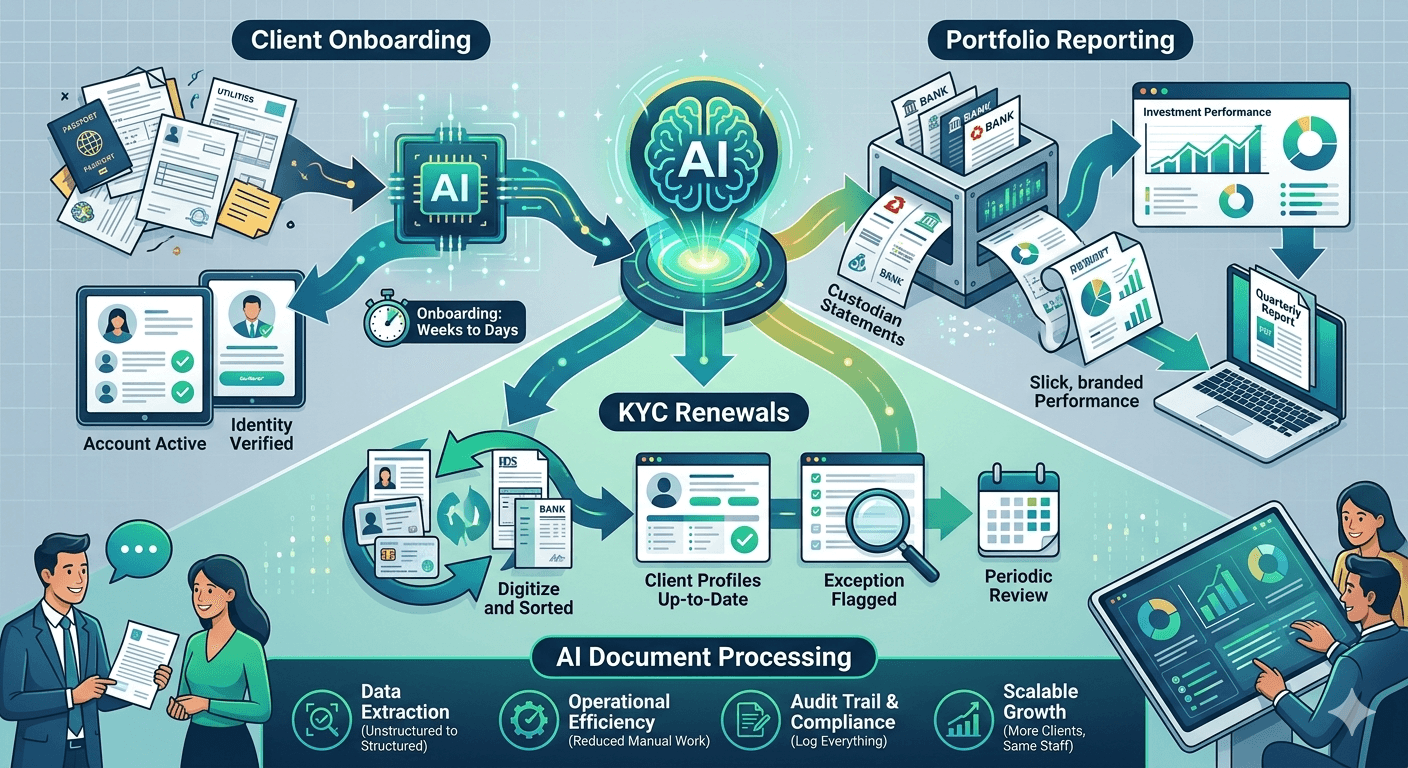
A new client signs their advisory agreement on a Tuesday. Three weeks later, they're still waiting for their account to be active. Somewhere in that gap, a compliance officer is chasing a missing passport copy. An ops team member is re-keying address details from a utility bill into a CRM. Someone else is manually cross-checking fund statements against a spreadsheet to build a quarterly report.
This is the daily reality at thousands of wealth management firms. And it isn't a people problem. The advisors are skilled. The ops teams are diligent. The problem is the documents.
Wealth management is one of the most document-intensive industries on earth. Client onboarding alone can involve dozens of forms, identity documents, financial statements, risk questionnaires, and regulatory disclosures. KYC renewals add another layer of recurring compliance burden. Portfolio reporting means pulling data from multiple custodians, formatting it consistently, and delivering it on tight schedules. Do all of this manually, and you're handing off hours every week to tasks that don't require human judgment at all.
AI-powered document processing changes the equation. Not by replacing advisors, but by removing the friction that surrounds them.
The Three Workflows Where Time Goes to Die
Before looking at the solution, it's worth understanding exactly where the bottlenecks sit. They fall into three distinct buckets.
Client onboarding packets are the most visible. A typical onboarding pack includes a new account application, anti-money laundering documentation, source of wealth declarations, proof of identity, proof of address, investment objectives questionnaires, and sometimes custody agreements that run to twenty pages. Each document needs to be reviewed, validated, and reconciled against what the client put into your CRM. If a field doesn't match, someone picks up the phone. If a document is expired, the whole process stalls.
The average time to onboard a high-net-worth client at a traditional advisory firm runs between two and four weeks. That's not a complaint about the process designers. It's the natural consequence of routing paper through multiple people.
KYC renewals are less visible but arguably more painful. Regulators require firms to periodically re-verify client information, usually every one to three years depending on the client's risk profile. For a firm with a few hundred clients, that creates a constant rolling workload of renewal requests, document collection, comparison against historical records, and sign-off workflows. The documents clients send back are never in a standard format. A utility bill comes as a photo taken in poor lighting. A bank statement arrives as a ten-page PDF with a lot of information that isn't relevant to the compliance check. Someone has to sift through it, extract what matters, and update the record.
Most firms manage this with spreadsheets and email reminders. It works until it doesn't.
Portfolio reporting documents represent the third major pressure point. Quarterly and annual reports pull data from multiple custodians, sometimes using different data standards and formats. Building a coherent, branded report that accurately reflects a client's holdings, performance, and fee structure means either a lot of manual reconciliation or an expensive reporting platform that still requires significant configuration. When markets move quickly, clients expect faster turnarounds. The reporting process doesn't always accommodate that.
These three workflows share a common trait. They're all document-heavy, data-extraction-dependent, and sensitive to errors. They're exactly where AI document processing delivers the clearest return.
What AI Document Processing Actually Does Here
The phrase "AI document processing" covers a lot of ground, so it's worth being specific about what it means in this context.
Traditional document management tools, including older OCR software, work well when documents arrive in a predictable format. A W-9 that's always the same template, a form that's always digitally native. Wealth management documents are rarely that cooperative. Clients send scanned copies of documents printed years ago. International clients send identity documents in formats your compliance team has never seen. Custodian statements vary by provider, by jurisdiction, and sometimes by month.
Modern AI document processing, the kind built on large language models and trained on diverse document types, handles that variability. It reads a document the way a knowledgeable human would: understanding context, identifying relevant fields, and extracting structured data even when the layout is unfamiliar. The difference is it does this in seconds, not minutes, and without fatigue.
For wealth management specifically, this matters across all three workflow categories.
Transforming Client Onboarding
When a new client submits their onboarding packet, whether through a portal, email, or even a physical drop-off that gets scanned, the documents go into the AI processing pipeline. The system identifies each document type automatically. It extracts the relevant data fields, name, address, date of birth, nationality, document expiry dates, and maps them against your expected data schema.
If anything is missing or doesn't match, the system flags it immediately. Not after three days of waiting for a compliance officer to review the folder. Immediately. The client gets a precise, specific notification about what's needed, rather than a vague request to "re-submit your documents."
For firms using Artificio, this means the human review step focuses entirely on exceptions. A compliance officer doesn't scroll through fifty pages of documentation to confirm that a passport number matches the application. They look at the flagged items, apply their judgment, and move on. The volume of work that requires human attention drops dramatically.
The downstream effect is meaningful for client experience too. Onboarding timelines that used to stretch across weeks compress into days. Advisors can tell clients with confidence that their account will be active by Thursday. That's a different conversation than "we'll let you know once compliance has finished their review."
Multi-jurisdictional onboarding, something that wealth managers with international clientele deal with regularly, benefits especially. When a client is based in Singapore but investing through a UK-domiciled fund, the documentation requirements on both ends are complex. An AI system trained on international document types handles that complexity without needing specialist staff for each jurisdiction.
Streamlining KYC Renewals at Scale
KYC renewal is where most firms feel the sustained pressure most keenly. Onboarding is a one-time event per client. KYC renewal happens again and again, across your entire client base, on different schedules.
The AI approach shifts the workload significantly. When a client's renewal is due, the system can automatically generate a pre-filled renewal request using the data already on file, asking the client only to confirm or update what's changed and upload fresh verification documents. The documents they submit get processed automatically. The system compares the extracted data against the existing record, highlights discrepancies, and routes cases that need human review to the appropriate team.
For the majority of clients whose circumstances haven't changed materially, the renewal can move through almost entirely without manual intervention. For clients flagged as higher risk, or where the system detects significant changes in the submitted documents, a compliance officer gives it a closer look.
This tiered approach, where automation handles the straightforward cases and humans focus on the complex ones, is what makes scale manageable. A firm that struggled to keep up with renewals for 200 clients can run the same process across 2,000 without proportional headcount growth.
The audit trail is another underappreciated benefit. Every document processed, every field extracted, every comparison made, and every human decision recorded. When regulators ask for evidence that your renewal process was conducted properly, you can pull a complete, timestamped record rather than reconstructing it from email threads.
Automating Portfolio Reporting Documents
Portfolio reporting sits slightly apart from the compliance-driven workflows above. The pressure here is less about regulatory risk and more about operational cost and client satisfaction.
A quarterly portfolio report for a high-net-worth client might draw data from three custodians, cover a dozen different asset classes, include performance attribution analysis, and need to arrive within a week of quarter-end. Doing this manually means someone spending significant time pulling statements, normalizing data formats, calculating returns, and populating a report template. Multiply that by your entire client book and it becomes a significant resource commitment every quarter.
AI document processing handles the extraction layer. Custodian statements, regardless of format, get processed automatically. The relevant data, positions, values, transactions, fees, gets pulled into a structured format that feeds directly into your reporting output. What used to be a manual aggregation task becomes a verification task. Your team checks the numbers rather than assembling them.
The quality improvement is as significant as the time saving. Manual re-keying introduces errors. Automated extraction doesn't. When a client spots a discrepancy in their quarterly report, it's far less likely to be a data entry mistake and far more likely to be something meaningful about their portfolio.
For firms that produce bespoke narrative commentary alongside performance data, the AI layer can also generate draft commentary based on the structured data, covering performance versus benchmark, notable portfolio changes, and market context. Advisors review and personalize the commentary rather than starting from a blank page.
None of this requires ripping out your existing technology stack. Wealth management firms typically run a combination of CRM systems (Salesforce is common), portfolio management platforms, and compliance workflow tools. AI document processing plugs in alongside these rather than replacing them.
When a document is processed, the extracted data flows into the CRM automatically. KYC renewal records update in your compliance platform. Portfolio data feeds into your reporting tool. The AI layer sits between document receipt and data destination, handling the translation from unstructured document content to structured system data.
Artificio connects to the systems wealth managers already use. SAP, Salesforce, NetSuite, and custom-built platforms can all receive structured output from the document processing pipeline via API. The integration work is considerably lighter than most firms expect.
The Compliance Confidence Argument
There's a conversation that comes up often when wealth management firms evaluate AI document processing. It goes roughly like this: "We're in a highly regulated industry. How do we know the AI is getting it right?"
It's the right question to ask. The answer has two parts.
First, AI document processing doesn't make compliance decisions. It extracts data, flags exceptions, and routes documents for human review. The judgment calls stay with your compliance team. The AI handles the mechanical work, not the regulatory interpretation.
Second, the transparency of AI processing actually improves compliance confidence compared to manual processes. Every extraction is logged, every field match is recorded, and every exception is documented with the reason it was flagged. You have a complete, auditable record of how every document was handled. Many firms find that this level of documentation is substantially better than what their manual process produced.
Regulators increasingly expect firms to demonstrate process consistency and auditability. Automated processing, done well, makes that easier to demonstrate, not harder.
What This Looks Like in Practice
Picture a mid-size wealth management firm with around 800 clients across retail and high-net-worth segments. They were running onboarding at an average of 18 days per client, with a team of four operations staff spending most of their time on document handling. KYC renewals were managed through a shared spreadsheet and were persistently behind schedule. Portfolio reports took four to five days to produce after quarter-end.
After implementing AI document processing across all three workflows, onboarding dropped to an average of four days. The ops team's time on document handling fell by around 65%, freeing them to focus on client-facing support. KYC renewals became a workflow that ran continuously in the background rather than a periodic scramble. Quarterly reports were delivered within 48 hours of quarter-end.
The ROI shows up in multiple places. Staff time redirected to higher-value work. Faster onboarding that improves the early client experience. Reduced compliance risk from a more consistent, documented process. And the ability to grow the client book without proportional headcount increases.
Getting Started
The question for most firms isn't whether AI document processing is right for them. It's where to start.
Onboarding tends to be the highest-value entry point because the pain is most visible and the ROI is easiest to measure. A faster, cleaner onboarding process delivers immediate client experience improvement and quantifiable time savings.
KYC renewal automation is often the next step, particularly for firms facing upcoming regulatory reviews or struggling with renewal backlogs.
Portfolio reporting automation tends to follow once firms have seen how the document processing layer performs and have built confidence in the output quality.
The firms that move fastest are the ones that start with a defined workflow, measure the baseline carefully, and run a structured pilot before scaling. That approach creates internal confidence in the technology and gives you the data to justify broader rollout.
Wealth management has always been a relationship business. The advisors who thrive are the ones who spend their time on strategy, insight, and client conversation, not on document logistics. AI document processing doesn't change what makes a great advisor. It removes the operational friction that gets in the way of letting them do that work.